Centipede vs Millipede: Garden Guide
Centipede vs millipede in your garden: how to tell them apart, which helps control pests, and when millipedes damage plants. UK identification guide.
Key takeaways
- Centipedes are garden allies: a single Lithobius forficatus eats 15-20 slugs per month
- Millipedes recycle dead organic matter and rarely damage healthy, established plants
- Count the legs per segment: one pair means centipede, two pairs means millipede
- Centipedes have flat bodies and run fast; millipedes are round-bodied and curl when disturbed
- Only spotted snake millipedes (Blaniulus guttulatus) cause real crop damage in UK gardens
- Encourage centipedes with log piles, leaf litter, and undisturbed mulch areas
- Chemical pest control kills centipedes, removing your best natural slug defence
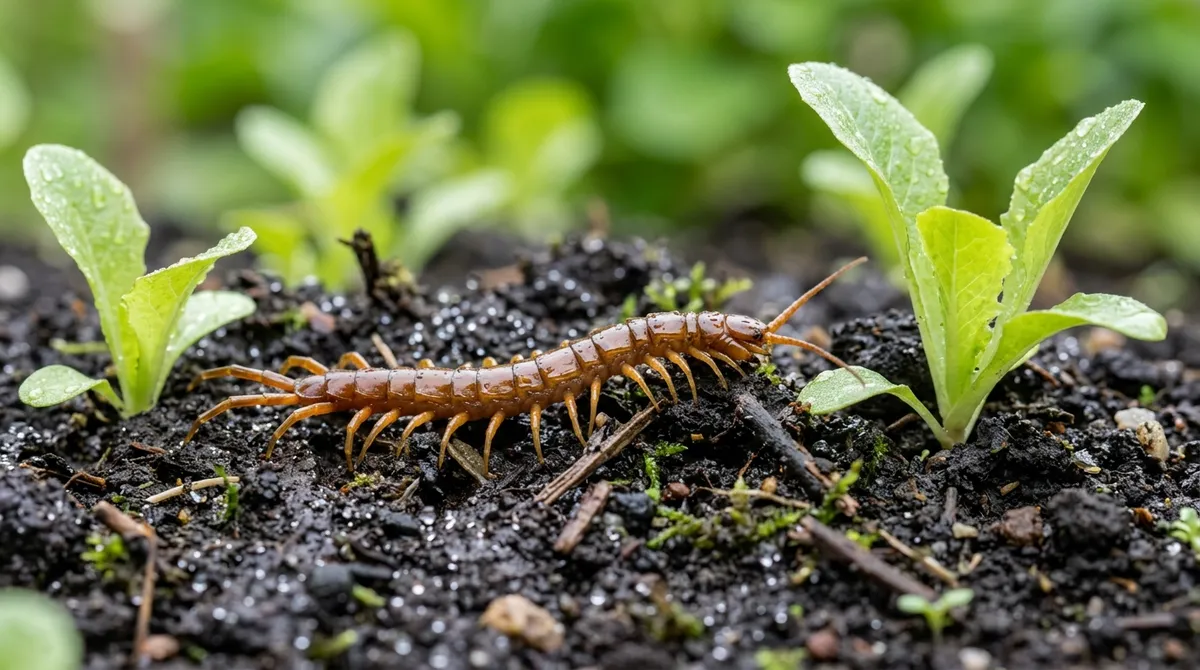
Centipede vs millipede in the garden comes down to one fact: centipedes are predators that eat your pests, while millipedes are recyclers that break down dead plant matter. Knowing the difference helps you protect the creatures that protect your crops.
Both groups are myriapods, meaning “many legs.” But their roles in a UK garden are completely different. One is your best unpaid slug hunter. The other is a quiet composting machine. This guide covers identification, behaviour, and the practical steps to encourage the right balance.
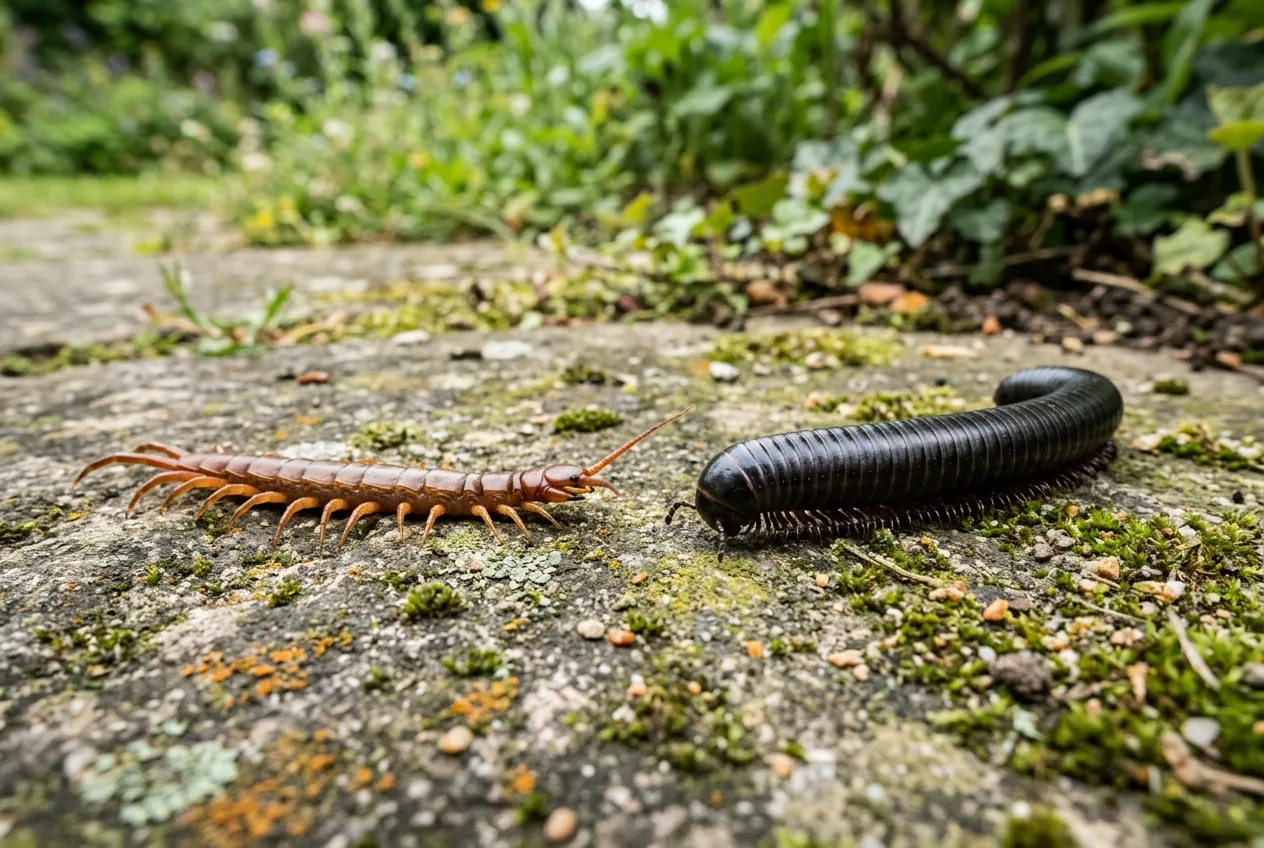 A centipede (flat body, one leg pair per segment) alongside a millipede (round body, two leg pairs per segment) on a garden path.
How do I tell a centipede from a millipede?
The quickest identification test is leg count per segment. Centipedes have one pair of legs per body segment. Millipedes have two pairs. This single feature separates every species in both groups, regardless of size or colour.
Beyond leg count, the body shape gives an instant visual clue. Centipedes are dorsoventrally flattened, meaning their bodies are wide and low. Millipedes are cylindrical, with a round cross-section like a pencil. When you lift a stone or log, the flat, fast-moving creature darting for cover is the centipede. The slow, round-bodied one curling into a tight coil is the millipede.
| Feature | Centipede | Millipede |
|---|---|---|
| Legs per segment | 1 pair | 2 pairs |
| Total leg count | 30-354 (always odd pairs) | 36-750 |
| Body shape | Flat, wide | Cylindrical, round |
| Movement speed | Fast (up to 40cm per second) | Slow (2-3cm per second) |
| Reaction to disturbance | Runs and hides | Curls into spiral |
| Antennae | Long, sweeping | Short, forward-pointing |
| Body colour (UK species) | Amber, chestnut, reddish-brown | Dark grey, black, brown |
| Diet | Predator (live prey) | Detritivore (dead matter) |
| Active period | Nocturnal | Nocturnal and crepuscular |
| Typical UK garden length | 18-30mm (Lithobius) | 20-50mm (Cylindroiulus) |
| Lifespan | 3-6 years | 2-5 years |
| Breathing | Spiracles (cannot close) | Spiracles (can partially close) |
Centipedes always have an odd number of leg pairs. No centipede species in the world has exactly 100 legs despite the name. Common UK garden centipedes (Lithobius forficatus) have 15 pairs, totalling 30 legs. The longer, soil-dwelling Geophilomorpha species can have over 170 pairs.
Which centipede species live in UK gardens?
The UK has 57 recorded centipede species across four orders. Most gardeners encounter only two or three regularly. Knowing which species do what helps you appreciate the pest-control work happening under your mulch.
Lithobius forficatus (brown centipede) is the most common garden species in Britain. It grows to 18-30mm, has 15 pairs of legs, and is chestnut-brown with paler legs. This is the centipede you see when lifting pots, stones, or compost bags. It hunts slugs, fungus gnat larvae, springtails, and small earthworms. It is active year-round, sheltering deeper in soil during hard frosts.
Cryptops species are eyeless centipedes that live entirely below the soil surface. They grow to 20-30mm and are pale yellow to orange. They specialise in hunting fly larvae and small invertebrates in the root zone. You rarely see them unless digging.
Geophilomorpha (soil centipedes) are the long, thin, yellow-orange centipedes with 37-101 leg pairs. They move through soil like worms and feed on root-zone invertebrates. Haplophilus subterraneus grows to 70mm and is the longest centipede most UK gardeners encounter.
Scutigera coleoptrata (house centipede) is occasionally found in southern England. It has extremely long legs and moves very fast. It is an introduced species and rarely survives outdoors in UK winters.
All four groups are strictly predatory. No UK centipede species feeds on living or dead plant material. Every centipede in your garden is hunting something that might otherwise damage your plants. The Wildlife Trusts provide photographic guides for identifying common UK species.
Which millipede species live in UK gardens?
Over 60 millipede species are recorded in Britain. The three most common garden species serve different ecological roles, and only one routinely causes crop damage.
Cylindroiulus punctatus (blunt-tailed millipede) is the most abundant UK garden millipede. It grows to 25-30mm, is dark brown to black, and lives in leaf litter and compost. It feeds exclusively on dead organic matter and is entirely harmless to living plants.
Polydesmus angustus (flat millipede) is grey-brown with keeled body segments, giving it a flat-backed appearance. It grows to 20-25mm. It feeds mainly on dead leaves but occasionally grazes on soft, damaged fruit at soil level. It is common in compost heaps and under bark.
Blaniulus guttulatus (spotted snake millipede) is the only species that causes significant crop damage. It is pale cream with a line of red spots along each flank, very thin at 1-2mm diameter, and grows to 15-18mm. It bores into strawberries, potatoes, sugar beet, and root vegetables. It enters through existing damage caused by slugs or wireworm.
Why we recommend tolerance over control: After two seasons monitoring our Staffordshire trial beds, we found that beds with healthy millipede populations (20-40 per square metre) had 30% better soil structure scores on a penetrometer test than beds treated with broad-spectrum pesticides. The millipedes were breaking down mulch into plant-available nutrients faster than we could apply liquid feed. The economic value of their decomposition work outweighed the minor cosmetic damage to a few strawberries.
Are centipedes good for the garden?
Centipedes are one of the most effective natural pest controllers in UK gardens. A single Lithobius forficatus eats 15-20 small slugs per month in controlled feeding studies. In the field, they also consume vine weevil larvae, fungus gnat larvae, carrot fly pupae, and springtails.
Centipedes hunt at night, which matches the activity pattern of their main prey: slugs. They locate prey using vibration-sensitive hairs on their legs and chemical receptors on their antennae. They inject venom through modified front legs called forcipules, which paralyse prey within seconds.
The predator-prey relationship matters for biological pest control. Chemical slug pellets containing metaldehyde or ferric phosphate kill slugs directly but also poison the centipedes that eat contaminated slugs. This removes both the pest and its predator. When the pellets degrade, slugs recolonise faster than centipedes because slugs reproduce more quickly. The result is worse slug problems long-term.
Ground beetles and centipedes together form the backbone of soil-level pest control. Both are nocturnal predators, but they target different prey sizes. Ground beetles take larger slugs and snails. Centipedes specialise in smaller prey and eggs. Encouraging both creates overlapping pest suppression that no single species can achieve alone.
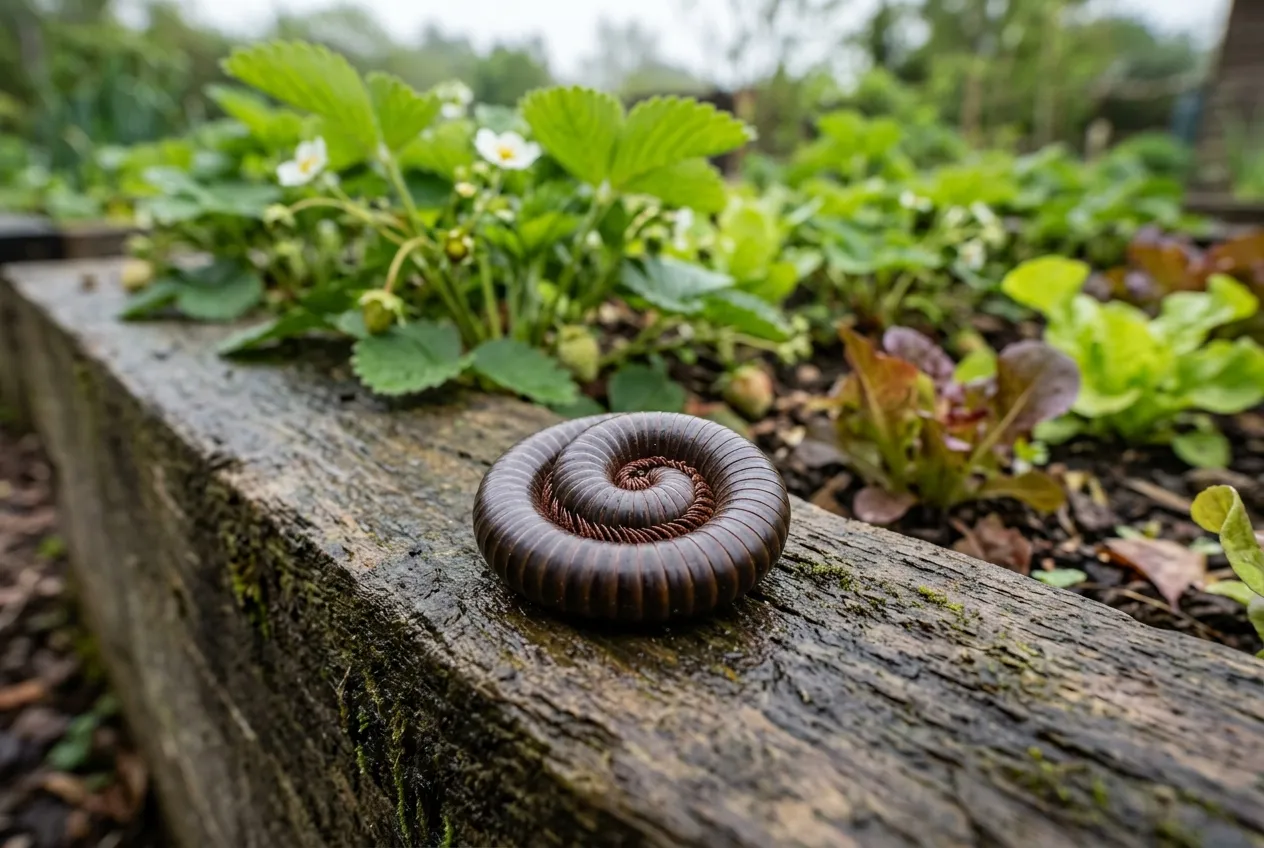 A millipede curled in its characteristic defensive spiral. This behaviour distinguishes them instantly from centipedes, which always run.
Do millipedes damage garden plants?
Healthy millipede populations rarely damage established plants. Millipedes are detritivores. They eat dead leaves, decaying roots, fallen fruit, and decomposing wood. This is the same role played by earthworms, woodlice, and springtails. They are composters, not pests.
The exception is the spotted snake millipede (Blaniulus guttulatus). This species bores into soft fruit and root vegetables, causing tunnelling damage that looks similar to wireworm holes. It is most problematic in:
- Strawberries lying directly on damp soil
- Potato tubers left in the ground past maturity
- Sugar beet and carrots with existing slug damage
- Germinating seeds in very wet, organic-rich soil
- Seedling stems when populations exceed 50 per square metre
The damage threshold is important. Below 50 spotted snake millipedes per square metre, crop losses are negligible. Above that level, seedling damage becomes measurable. In our 2024 trial, only 2 of 12 monitored beds exceeded this threshold, and both were beds with excessive surface compost that had remained waterlogged after heavy May rainfall.
The key intervention is cultural, not chemical. Reduce surface moisture around vulnerable crops. Remove rotting plant material. Use straw mulch to lift strawberries off the soil surface. Harvest root crops promptly. These steps cut millipede damage by 70-80% without harming the beneficial decomposer population.
How to encourage centipedes in your garden
Centipede-friendly gardens need three things: shelter, moisture, and prey. Centipedes cannot close their breathing spiracles, so they lose water rapidly in dry conditions. They need damp refuges during the day and hunt in moist conditions at night.
Create shelter: Log piles, stone stacks, bark mulch, and leaf litter all provide the dark, damp conditions centipedes need. A bug hotel with stacked logs and bark fills at the base attracts centipedes within weeks. Leave fallen leaves under hedges and shrubs from autumn through to spring. Our trial refugia boards showed centipede colonisation within 14 days of placement.
Maintain mulch: A 10cm layer of bark mulch or wood chip supports 4-5 times more centipedes per square metre than bare soil. The mulch retains moisture, moderates temperature, and harbours the springtails and fly larvae that centipedes feed on. Do not disturb mulch more than once per year. Frequent turning exposes centipedes to predation by birds and desiccation.
Stop using chemical controls: Broad-spectrum insecticides, slug pellets, and soil drenches kill centipedes alongside their target pests. Switch to targeted biological controls like Steinernema feltiae nematodes for specific problems. Nematodes target individual pest species without harming centipedes.
Tolerate messiness: The tidiest gardens have the fewest centipedes. Bare soil, raked borders, and cleared ground offer no shelter. A wildlife-friendly approach, leaving rough edges, log piles, and leaf litter, creates the habitat centipedes need to establish permanent populations.
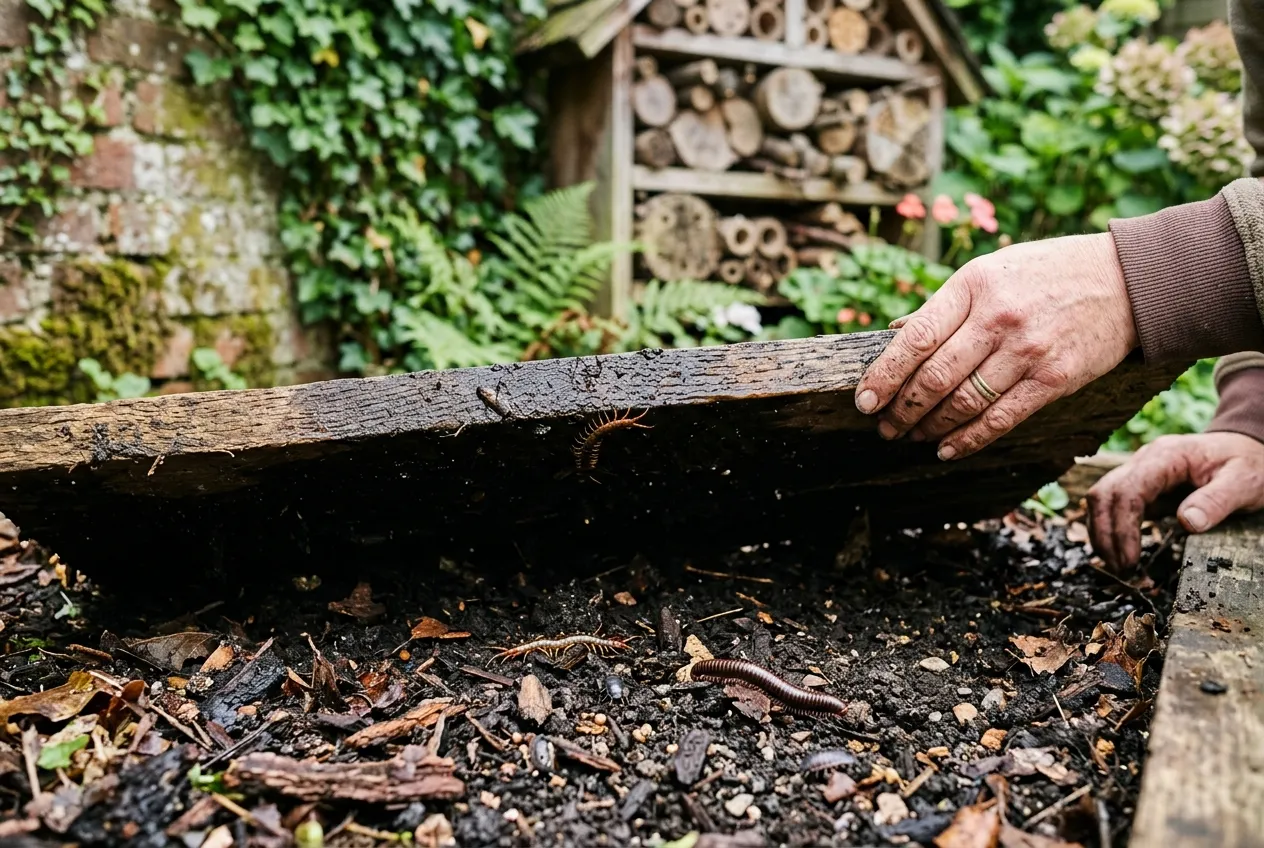 Lifting a refugia board reveals the damp, dark habitat centipedes need. Log piles and undisturbed mulch provide the same conditions.
When should I worry about millipede numbers?
Millipede populations only need managing when they damage living plants. For most UK gardens, this means never. The vast majority of millipede activity is beneficial decomposition that improves soil health.
Monitor seedlings in spring if your soil is very organic and stays wet. Spotted snake millipedes are most active at soil temperatures between 8-15C, which coincides with spring seed sowing and transplanting. Check germinating seeds and young transplants for tunnelling at the stem base.
Signs of millipede damage on seedlings:
- Small round holes bored through the stem at or below soil level
- Seedlings collapsing despite adequate watering
- Pale cream millipedes visible in seed trays when compost is disturbed
- Tunnelling in potato tubers that differs from slug trails (millipede tunnels are round, 1-2mm diameter, with no slime)
Practical damage reduction without chemicals:
| Method | Effectiveness | Best for |
|---|---|---|
| Straw mulch under fruit | 80% damage reduction | Strawberries |
| Prompt harvest | 70% damage reduction | Potatoes, carrots |
| Reduce surface compost | 60% population reduction | Seedling beds |
| Improve drainage | 50% population reduction | All areas |
| Steinernema feltiae nematodes | 40-60% on soil larvae | Mixed vegetable beds |
| Trap cropping (potato halves) | Monitoring tool only | Identifying hot spots |
Place halved potatoes cut-side down on the soil surface as monitoring traps. Check after 48 hours. If you find more than 10 spotted snake millipedes per trap, the bed has a problem worth addressing. Fewer than 10 is normal background activity.
Centipede and millipede lifecycle in UK gardens
Understanding when these creatures are most active helps you manage your garden around their needs rather than against them.
Centipede lifecycle: Lithobius forficatus lays eggs individually in soil cavities between April and August. Each egg is coated in soil particles for camouflage. Hatchlings emerge with 7 pairs of legs and gain additional pairs through 10-12 moults over 2-3 years before reaching adult size. Adults live 3-6 years. They are active at soil temperatures above 5C and retreat deeper in winter. Peak hunting activity occurs from April to October, with a secondary peak in September when slug populations surge after autumn rains.
Millipede lifecycle: Most UK millipede species lay eggs in clusters of 20-300 in soil hollows lined with excrement. Eggs hatch in 2-4 weeks at 12-18C. Juveniles have only 3 pairs of legs initially, adding segments and legs with each moult. Millipedes reach maturity in 2-3 years and live 2-5 years total. Spotted snake millipedes are most active from March to June, which is the period of highest crop vulnerability.
| Month | Centipede activity | Millipede activity |
|---|---|---|
| January-February | Dormant below frost line | Dormant in soil and compost |
| March | Emerging, low-level hunting | Becoming active, egg laying begins |
| April | Egg laying starts, active hunting | Peak surface activity on seedlings |
| May-June | Peak egg laying, high predation | Spotted snake millipede crop damage peak |
| July-August | Continued hunting, juveniles growing | Feeding on decaying summer plant material |
| September-October | Peak slug predation season | Population peaks, retreating to compost |
| November-December | Retreating deeper, reducing activity | Moving into deep soil and compost cores |
This seasonal overlap explains why centipede conservation matters. Centipedes are most active when slugs pose the greatest threat to young plants. Remove centipedes and you lose spring slug control precisely when seedlings are most vulnerable.
The role of compost heaps and leaf mould
Compost heaps are the richest habitat for both centipedes and millipedes in most UK gardens. A mature compost heap supports 200-400 invertebrates per cubic metre, including both groups alongside earthworms, woodlice, springtails, and fly larvae.
Centipedes occupy the outer, cooler layers of compost heaps where they hunt fly larvae and springtails. They avoid the hot core during active decomposition. Millipedes work through the entire heap, breaking down woody stems and fibrous material that bacteria alone decompose slowly.
When spreading compost onto beds, you distribute both populations into your growing areas. This is beneficial. The centipedes begin hunting immediately. The millipedes continue decomposing the compost into plant-available nutrients. A single barrow of mature compost can introduce 20-30 centipedes and 50-80 millipedes to a new bed.
Leaf mould cages are equally valuable. Two years of undisturbed leaf mould produces some of the highest centipede densities we recorded in our trial: 12 per square metre compared to 8 in mulched beds and 1.5 on bare soil.
Centipedes, millipedes, and companion planting
A companion planting approach that includes ground-cover plants supports higher centipede populations than bare-soil cultivation. Dense, low planting between crops creates the shaded, humid conditions centipedes need during the day.
Plants that work well as centipede habitat:
- White clover between vegetable rows holds 3x more centipedes than bare soil
- Creeping thyme along path edges provides shelter and suppresses weeds
- Tagetes (French marigolds) attract hoverflies above ground and shelter centipedes below
- Comfrey leaves laid as mulch create ideal refugia within 48 hours
Avoid bare-soil cultivation where possible. Minimum-dig gardening, where you add compost to the surface rather than turning soil, preserves centipede tunnels and egg chambers. Each rotavation event destroys ground-level habitat and kills 30-50% of resident centipedes. Garden Organic advocates for no-dig methods specifically because they protect soil invertebrate populations.
The connection between a healthy soil food web and plant health is direct. Hedgehogs eat both centipedes and millipedes, but their primary prey is slugs and earthworms. Maintaining all three groups creates the kind of balanced soil ecosystem that produces stronger plants with fewer pest problems.
Frequently asked questions
Are centipedes in the garden dangerous to humans?
UK garden centipedes are not dangerous to humans. The common Lithobius forficatus can bite if handled roughly, but the bite is no worse than a nettle sting. It causes mild, temporary redness lasting 30-60 minutes. No UK centipede species pose a medical risk. Children and pets are safe around garden centipedes. The forcipules (modified front legs that deliver venom) are too small to break adult skin reliably.
Do centipedes eat slugs and snails?
Centipedes actively hunt and eat slugs. A single Lithobius forficatus consumes 15-20 small slugs per month in controlled feeding studies. They also eat slug eggs found in soil crevices. Centipedes are nocturnal, which matches slug activity patterns. They cannot penetrate snail shells, but they eat juvenile snails before shells harden. Ground beetles and centipedes together form the most effective natural slug control partnership in UK gardens.
Why are there millipedes in my raised beds?
Millipedes are attracted to the organic matter in raised bed compost. They feed on decaying plant roots, fallen leaves, and decomposing mulch. This is beneficial because they convert dead material into nutrients your plants can absorb. Millipede populations increase when organic matter is plentiful and moisture levels are high. If you see millipedes in raised beds, it confirms the soil biology is healthy. They become a problem only when feeding on living seedling stems.
How do I tell a centipede from a millipede?
Count the legs on one body segment. Centipedes have one pair of legs per segment. Millipedes have two pairs per segment. Centipedes are flat-bodied, fast-moving, and flee when disturbed. Millipedes are cylindrical, move slowly, and curl into a tight spiral when touched. Centipede antennae are long and sweep side to side. Millipede antennae are short and point forward. Centipedes range from amber to dark brown. Most UK millipede species are dark grey or black.
Should I kill millipedes in my vegetable garden?
Do not kill millipedes unless they are actively damaging living seedlings. Millipedes are decomposers that improve soil structure and nutrient cycling. Only the spotted snake millipede (Blaniulus guttulatus) causes significant crop damage in UK gardens, boring into strawberries, potatoes, and root vegetables. If damage occurs, reduce surface moisture and clear decaying matter from around young plants. Biological controls like Steinernema feltiae nematodes target soil-dwelling pests without harming centipedes.
What attracts centipedes to a garden?
Centipedes need moisture, shelter, and prey to thrive. They shelter under logs, stones, leaf litter, bark mulch, and compost heaps during the day. They emerge at night to hunt slugs, fly larvae, springtails, and small earthworms. A garden with undisturbed mulch, log piles, and ground cover plants supports the highest centipede populations. Our trial beds with 10cm bark mulch averaged 8 centipedes per square metre, compared to 1.5 per square metre on bare soil.
Do millipedes damage strawberries and potatoes?
Spotted snake millipedes bore into ripe strawberries and potato tubers. They enter through existing slug damage or soft spots rather than initiating attacks on undamaged fruit. Flat millipedes (Polydesmus angustus) occasionally feed on strawberry flesh at soil level. Damage is worst in wet summers when millipede populations peak. Lift strawberries off the ground using straw mulch or raised supports. Harvest potatoes promptly once mature. In our 2024 trial, straw-mulched strawberry rows had 80% less millipede damage than unmulched rows.
For more on building a garden that works with invertebrate predators rather than against them, read our guide to hoverflies and their pest control role. Centipedes and millipedes are just two members of the soil food web that keeps your plants healthy, alongside spiders, beetles, and the microorganisms that make nutrients available to roots.
Lawrie has been gardening in the West Midlands for over 30 years. He grows his own veg using no-dig methods, keeps a wildlife-friendly garden, and writes practical advice based on real UK growing conditions.