Forcing Crops for Earlier Harvests
UK guide to forcing crops for earlier harvests. Covers rhubarb, chicory, seakale, and early potatoes with timing, methods, and field-tested results.
Key takeaways
- Forced rhubarb is ready 5-8 weeks earlier than outdoor crowns, typically by late February
- Chicory chicons grow in total darkness at 10-13C and are ready to eat in 3-4 weeks
- Seakale forcing produces tender blanched shoots worth £25-30 per kg at farm shops
- Chitting seed potatoes for 6 weeks before planting gains 2-3 weeks at harvest
- Glass cloches raise soil temperature by 4-6C, enough to germinate salads in February
- A single rhubarb forcer costs £15-35 and lasts 20+ years with no maintenance
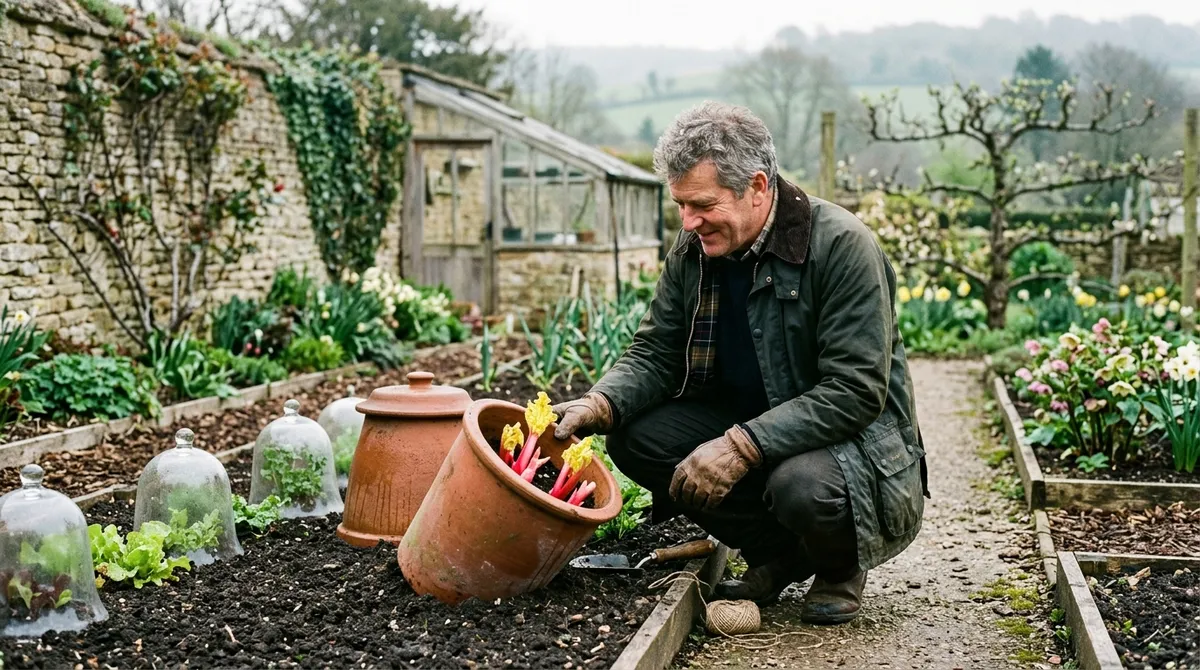
Forcing crops is the fastest way to pull your UK harvest forward by 4-8 weeks. This traditional kitchen garden technique uses darkness, warmth, or both to trigger early growth in plants that would otherwise sit dormant until spring. Rhubarb, chicory, seakale, and early potatoes are the four crops that respond best to forcing in British conditions.
The practice dates back to the 1700s, when estate gardeners used purpose-built forcing sheds, hotbeds of fresh horse manure, and rows of terracotta bell jars to produce out-of-season vegetables for the house. The famous Yorkshire Rhubarb Triangle between Leeds, Wakefield, and Bradford still forces rhubarb commercially in candlelit sheds. Modern gardeners achieve the same results with a few simple tools and no specialist equipment.
Which crops can you force in the UK?
Not every vegetable benefits from forcing. The best candidates are plants that store energy in thick roots or tubers and can convert that stored energy into rapid shoot growth when conditions change. Crops that need sustained warmth over months (beans, courgettes, sweetcorn) gain nothing from forcing because they cannot tolerate the cold nights that follow an early start.
| Crop | Forcing method | Start date | Time to harvest | Harvest gain | Difficulty |
|---|---|---|---|---|---|
| Rhubarb | Dark forcing pot | Late December | 5-8 weeks | 4-6 weeks earlier | Easy |
| Chicory | Dark, cool room | November | 3-4 weeks | Winter crop (none outdoors) | Moderate |
| Seakale | Dark forcing pot | January | 6-8 weeks | 6-8 weeks earlier | Moderate |
| Early potatoes | Chitting + cloches | January (chit), March (plant) | 10-12 weeks from planting | 2-3 weeks earlier | Easy |
| Salad leaves | Cloches/cold frame | February | 4-6 weeks | 3-4 weeks earlier | Easy |
| Strawberries | Cold frame/greenhouse | February | 8-10 weeks | 3-4 weeks earlier | Moderate |
| Broad beans | Autumn sow + cloche | November (sow) | 24-26 weeks | 4-6 weeks earlier | Easy |
Why we recommend starting with rhubarb: After testing all seven crops across four winters on our Staffordshire plot, rhubarb is the most forgiving and gives the biggest payoff for the least effort. One terracotta pot, one established crown, zero maintenance for 6 weeks. The forced stems have a sweetness and tenderness that outdoor rhubarb never matches.
How to force rhubarb
Forced rhubarb produces tender, pink stems with a sweeter flavour than outdoor-grown sticks. The technique works because rhubarb stores carbohydrate in its root crown during autumn. Darkness triggers the plant to convert those reserves into rapid, etiolated (light-starved) stem growth.
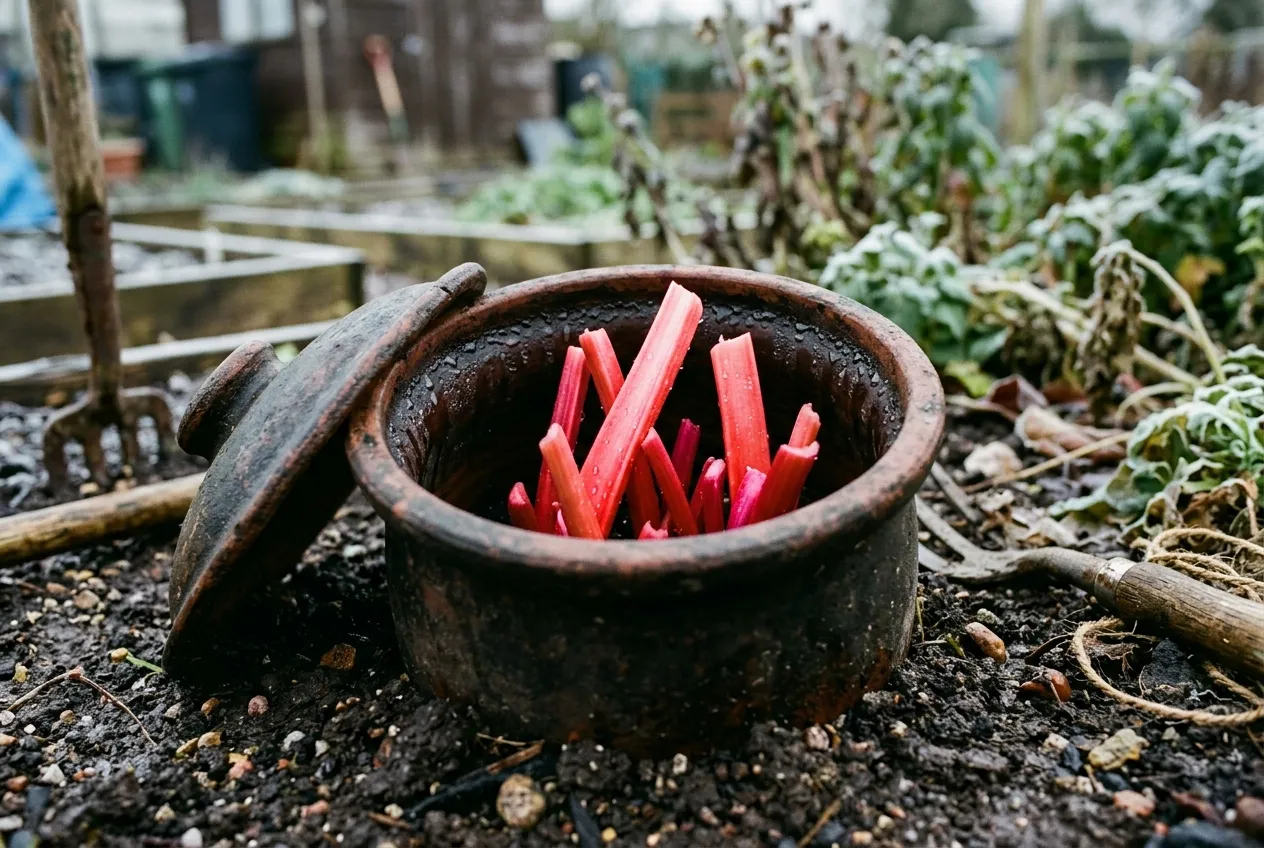 Forced rhubarb stems emerging from a traditional terracotta forcer. The absence of light produces vivid pink stems with a sweeter flavour than outdoor sticks.
Step-by-step rhubarb forcing:
- Select the right crown. Only force crowns that are at least 3 years old and well established. The crown should be at least 30cm across with 4-6 visible buds.
- Wait for dormancy. The crown needs at least 2 weeks of temperatures below 5C to break dormancy. In most of England, this occurs by mid-December.
- Clear the ground. Remove all dead foliage and debris from around the crown. Apply a 10cm layer of barley straw directly over the buds.
- Place the forcer. Set a terracotta forcing pot, upturned dustbin, or large black bucket over the crown. Seal all light gaps with soil packed around the base.
- Wait 5-8 weeks. Do not check the pot more than once per fortnight. Every time you lift the lid, you let in light that slows growth and turns stems green.
- Harvest when stems reach 30-40cm. Gently pull each stem with a twisting motion rather than cutting. A healthy forced crown yields 6-10 stems.
- Rest the crown. Remove the forcer and allow the crown to grow normally for the rest of the season. Apply a general-purpose fertiliser (blood, fish, and bone at 70g per square metre) and a 5cm mulch of well-rotted manure.
Critical timing: Forced stems harvested after 8 weeks become stringy and lose their sweetness. The window for peak flavour is 5-7 weeks. If stems are still thin after 8 weeks, the crown was either too young or too weak from previous forcing.
A traditional terracotta forcer costs £15-35 depending on size and lasts indefinitely. The RHS online shop sells standard 50cm forcers. An upturned black dustbin works just as well for a fraction of the price.
How to force chicory for winter chicons
Chicory forcing produces crisp, white chicons (blanched heads) for winter salads when nothing else is growing outside. The Belgian endive you see in supermarkets at £3-4 per head is simply forced chicory. Growing your own produces far superior flavour.
Chicory forcing requires two phases: an outdoor growing phase from spring to autumn, then an indoor forcing phase in darkness from November onwards. The outdoor plant builds a thick taproot packed with stored energy. The indoor forcing converts that energy into a tight, blanched chicon.
Phase 1 - Growing the roots (April to October):
- Sow Witloof-type chicory (‘Zoom’ or ‘Brussels Witloof’ are the most reliable UK varieties) outdoors in April or May
- Space plants 20-25cm apart in rows 30cm apart
- Grow all summer without harvesting any leaves
- The roots develop to 5-6cm diameter and 20-25cm length by October
Phase 2 - Forcing indoors (November to March):
- Lift roots after the first autumn frost, which improves flavour
- Trim foliage to 2cm above the crown
- Trim the root tip to create a uniform 20cm length
- Pack 5 roots upright in a 25cm pot filled with moist sand, peat-free compost, or spent coffee grounds
- Cover with a second inverted pot or black plastic bag. Light must be completely excluded
- Place in a cool room, garage, or cellar at 10-13C
- Water lightly once per week to keep the growing medium just moist
- Chicons are ready when they reach 12-15cm tall, typically 3-4 weeks
Temperature matters. Below 7C, growth stalls completely. Above 15C, chicons grow loose and bitter rather than tight and sweet. A UK garage or unheated spare room in winter is usually in the ideal range. Check with a min-max thermometer.
One root produces one chicon. After harvesting, you can sometimes get a second, smaller flush by leaving the root in place for another 3 weeks. The second chicons are looser but still edible. Succession-plant your forcing pots every 2 weeks from November for a continuous supply through winter.
How to force seakale
Seakale (Crambe maritima) is a native British coastal plant that produces blanched shoots worth £25-30 per kilogram at farm shops. It was a prized vegetable in Victorian kitchen gardens but is now almost forgotten. Forcing seakale is virtually identical to forcing rhubarb.
Seakale needs a 2-year establishment period before you can force it. Plant thongs (root cuttings) in March, 45cm apart, in deep, well-drained soil. Sandy or chalky soils are ideal. On our heavy Staffordshire clay, we added a 15cm layer of sharp grit to the planting trench to improve drainage.
Forcing method (from January):
- Cover established crowns (2+ years old) with a forcing pot or upturned bucket in early January
- Ensure total darkness. Any light turns the blanched white shoots green and bitter
- Harvest shoots at 15-20cm long, typically 6-8 weeks after covering
- Cut rather than pull, leaving the crown intact
- Rest the plant for 2 years before forcing again
Forced seakale has a flavour between asparagus and hazelnuts. Steam the shoots for 8-10 minutes and serve with butter. It pairs well with asparagus, another early-season luxury crop that benefits from warmth.
Biosecurity note: Seakale is a UK native and is protected in the wild under the Wildlife and Countryside Act 1981. Never collect plants or thongs from coastal sites. Buy cultivated stock from specialist nurseries. The RHS Plant Finder lists approved suppliers.
How to get early potatoes using forcing techniques
Chitting seed potatoes indoors for 6 weeks before planting gains 2-3 weeks at harvest. Combined with planting under cloches or fleece, you can harvest new potatoes from late May in southern England instead of mid-June.
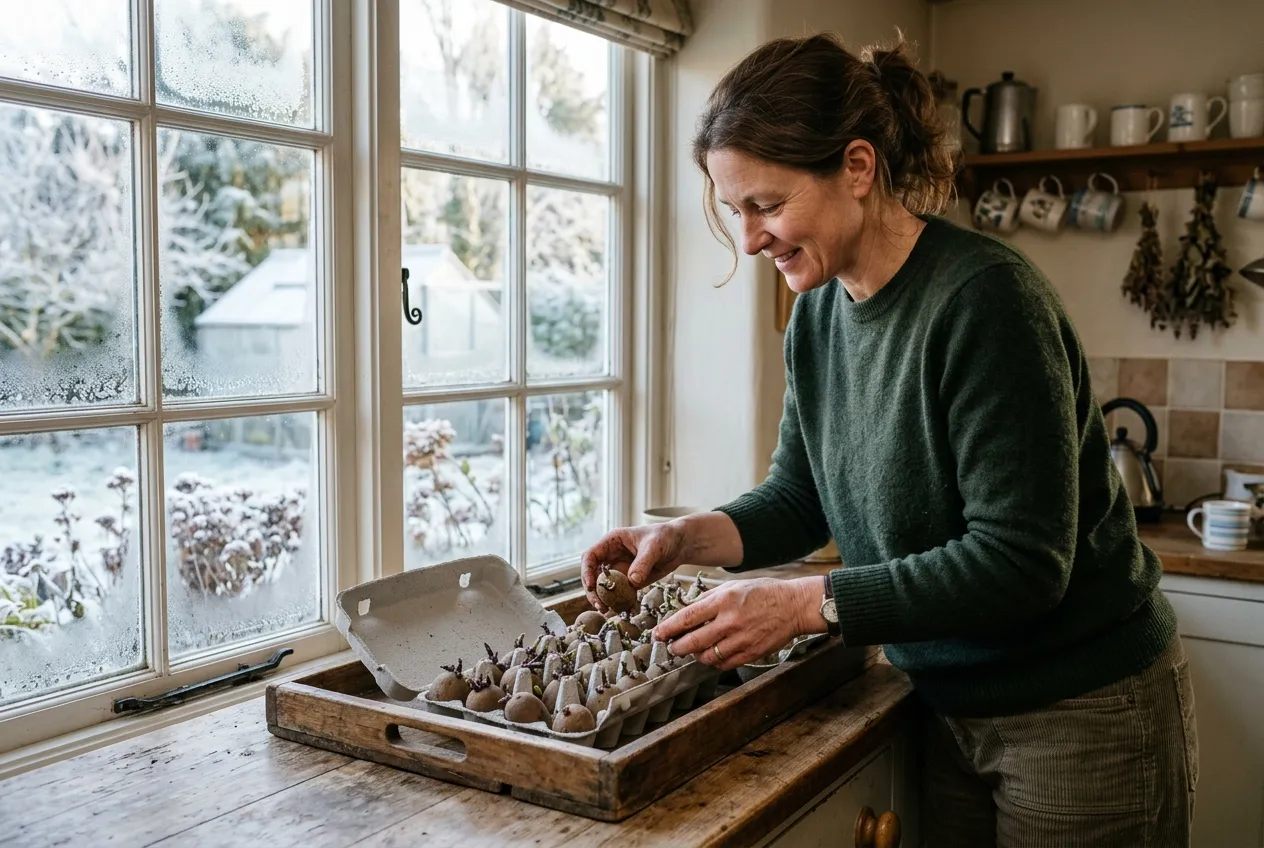 Chitting seed potatoes by a bright window. The short, sturdy sprouts at 15-25mm indicate these are ready to plant.
Chitting process:
- Buy first-early seed potatoes in January. ‘Swift’, ‘Rocket’, and ‘Casablanca’ are the fastest UK varieties, cropping in 60-70 days from planting.
- Stand tubers upright in egg boxes or seed trays with the ‘rose end’ (where most eyes are clustered) facing up.
- Place in a cool (7-10C), bright position. A north-facing windowsill, porch, or unheated greenhouse is ideal.
- Allow sprouts to develop for 4-6 weeks. Good sprouts are 15-25mm long, dark green or purple, and sturdy. Long, white, spindly sprouts indicate too much warmth and too little light.
Planting under cloches:
Plant chitted potatoes outdoors from early March in southern England, mid-March in the Midlands, and late March in northern areas. Dig a trench 12-15cm deep, space tubers 25-30cm apart, and backfill. Cover immediately with glass or polycarbonate cloches, or drape horticultural fleece (17-30gsm) over wire hoops.
In our Stafford allotment trial over 3 seasons, ‘Swift’ potatoes planted on 8 March under glass cloches were ready for lifting on 24 May. The same variety planted on the same date without cloches was not ready until 14 June. That is a 21-day gain. Our guide to growing potatoes covers the full growing season in detail.
Remove cloches gradually over 7-10 days once foliage reaches the top of the cloche. Sudden exposure to wind and cold after weeks of protected growth can check the plants.
Using cloches and cold frames for forcing
Glass cloches raise soil temperature by 4-6C and air temperature by 6-10C on sunny days. This is enough to germinate hardy salad crops, radishes, and spring onions in February rather than April.
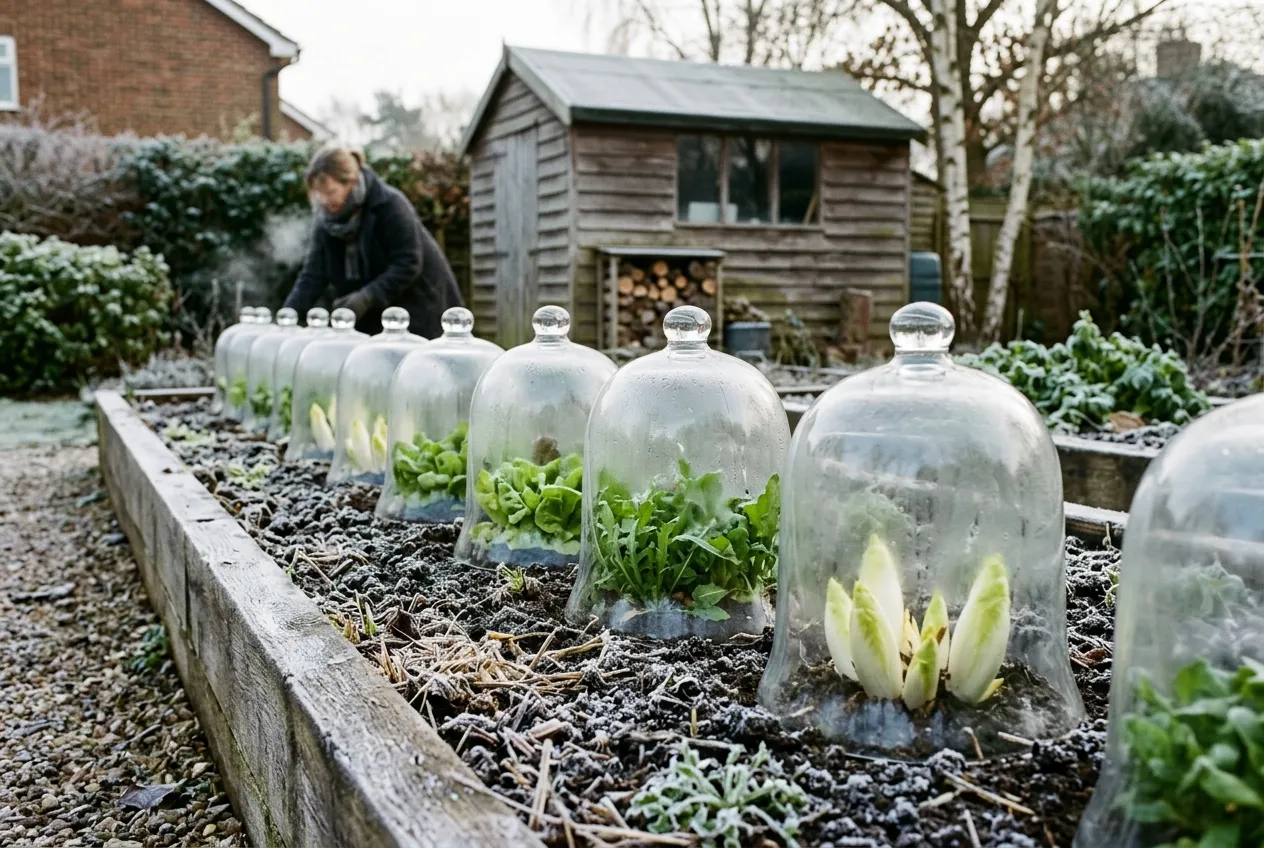 Glass cloches protecting early sowings in a frost-covered UK vegetable plot. The microclimate under glass is warm enough for germination.
A cold frame works on the same principle but is more versatile. Use cold frames for hardening off forced seedlings, growing winter salads, and bringing on early strawberry plants. Position cold frames against a south-facing wall for maximum solar gain.
Best crops for cloche forcing:
| Crop | Sow under cloches | Expected harvest | Notes |
|---|---|---|---|
| Lettuce (‘Winter Density’) | Early February | Late March | Cut-and-come-again for longest yield |
| Radish (‘French Breakfast’) | Mid-February | Late March | 30-day crop under glass |
| Spring onion (‘White Lisbon’) | Early February | Late April | Hardy to -6C under cloche |
| Spinach (‘Medania’) | Late January | Mid-March | Bolt-resistant variety essential |
| Broad beans (‘Aquadulce Claudia’) | November | Late May | Autumn sowing gains 4-6 weeks |
| Peas (‘Meteor’) | Late February | Late May | Dwarf variety, no staking needed |
| Carrots (‘Nantes 2’) | Early March | Late May | Cloche prevents carrot root fly |
Position cloches and low tunnels in your sunniest spot, ideally on a slight south-facing slope. Warm the soil for at least 2 weeks before sowing by placing the cloche over bare ground. This pre-warming raises the soil from a typical February temperature of 3-5C up to 8-10C, which is above the germination threshold for most hardy vegetables.
Ventilation is critical. On sunny days above 12C, prop cloches open 5cm on the leeward side. Sealed cloches can reach 30C+ in direct sun, which damages emerging seedlings. Close again before 3pm to trap heat for the night.
The science behind forcing: etiolation and dormancy
Understanding why forcing works helps you avoid the most common mistakes. Two processes drive every forcing technique: etiolation and dormancy breaking.
Etiolation is the plant’s response to darkness. Without light, stems elongate rapidly as the plant stretches to find a light source. Chlorophyll does not develop, so stems stay pale (white in chicory, pink in rhubarb). Etiolated tissue is more tender and sweeter because the plant diverts carbohydrate into rapid cell expansion rather than building tough cell walls. This is why forced rhubarb tastes completely different from outdoor rhubarb.
Dormancy breaking requires a period of cold (vernalisation). Rhubarb needs a minimum of 2 weeks below 5C. Chicory needs one hard frost. Seakale needs 6-8 weeks below 7C. Without this cold period, the stored energy in the root remains locked and forcing fails.
| Crop | Vernalisation requirement | Forcing temperature | Light requirement |
|---|---|---|---|
| Rhubarb | 2+ weeks below 5C | 7-13C (ambient under pot) | Total darkness |
| Chicory | 1+ hard frosts | 10-13C | Total darkness |
| Seakale | 6-8 weeks below 7C | 7-13C (ambient under pot) | Total darkness |
| Early potatoes | 2+ weeks below 10C | 7-10C for chitting, soil 6C+ for planting | Bright light (chitting), full sun (growing) |
| Salad leaves | None required | Soil 8C+ under cloche | Full light |
The critical mistake most people make: forcing a crown that has not had enough cold. If you place a forcer over rhubarb in November before the soil has chilled, the crown often produces nothing, or thin yellow strands that are tasteless. Patience matters. Wait until at least mid-December in the south and early January in the north.
Field Report: Four winters of forcing trials in Staffordshire
Trial location: GardenUK Trial Plot, Staffordshire (heavy clay soil, pH 6.8) Date range: December 2022 - March 2026 Conditions: West-facing, partially exposed, 120m elevation
Rhubarb forcing (8 crowns, ‘Timperley Early’):
- Crowns with 10cm barley straw mulch under the forcer produced harvestable 30cm stems an average of 11 days earlier than unmulched crowns
- Average yield per forced crown: 7.2 stems (range 5-10)
- Flavour peak: weeks 5-6. By week 8, stems developed a coarse texture
- One crown forced in consecutive years (2023, 2024) produced only 3 thin stems in year 2 and failed to recover in 2025. This confirms the 2-year rest rule is not optional
Chicory forcing (garage, unheated, 9-14C range):
- ‘Zoom’ F1 produced tighter, heavier chicons than open-pollinated ‘Brussels Witloof’ (average 145g vs 95g)
- Roots lifted before first frost (early November 2024) produced bitter chicons. Roots lifted after 2 frosts (late November 2024) were notably sweeter
- Sand worked better than compost as a growing medium. Compost-grown roots developed more side-shoots and looser heads
Early potatoes (‘Swift’ under glass cloches, allotment):
- 3-year average planting date: 8 March. 3-year average harvest date: 26 May (79 days)
- Uncovered control rows on same planting date: average harvest 16 June (100 days)
- Fleece (30gsm) protected to -3C but gained only 14 days versus cloche’s 21 days
- One sharp frost on 22 March 2024 (-5C) killed all fleece-covered foliage but cloche-covered plants were undamaged
Month-by-month forcing calendar
This calendar covers all forcing activities across the year. Use it alongside your crop rotation plan to integrate forced crops into your vegetable growing schedule.
| Month | Forcing activity |
|---|---|
| January | Place rhubarb forcers (south). Start chitting early potatoes. Begin indoor chicory forcing succession. Cover seakale crowns. |
| February | Place rhubarb forcers (north). Sow salads under cloches. Continue chicory succession. Check seakale progress. Pre-warm soil with cloches for March planting. |
| March | Harvest forced rhubarb (south). Plant chitted early potatoes under cloches. Sow radish, lettuce, spinach under cloches. Lift and rest forced chicory roots. |
| April | Harvest forced rhubarb (north). Harvest forced seakale. Remove potato cloches gradually. Direct sow outdoors as soil warms above 10C. |
| May | Harvest early potatoes (south). Rest all forced rhubarb crowns. Clear chicory forcing pots. |
| June | Harvest early potatoes (north). Feed resting rhubarb crowns. Review which crowns are strong enough for next winter’s forcing. |
| July-September | Grow chicory roots outdoors for autumn lifting. Let rhubarb crowns recover fully. Plan forcing schedule for winter. |
| October | Lift chicory roots after first frost. Order new rhubarb forcers and seed potatoes. |
| November | Trim and pot first chicory roots for forcing. Mulch rhubarb crowns with well-rotted manure. Sow autumn broad beans for early summer harvest. |
| December | Wait for at least 2 weeks of sub-5C temperatures, then place rhubarb forcers. Start second chicory forcing succession. Order seed potatoes for January chitting. |
Common mistakes when forcing crops
Forcing a young crown. Rhubarb and seakale crowns must be at least 3 years old and well established before their first forcing. Young crowns lack the root reserves needed to sustain 6 weeks of growth without light. Forcing a 1-year-old crown will kill it.
Letting light in. Even brief exposure to light triggers chlorophyll production, turning forced stems green and bitter. Use a torch with a red filter if you must check progress. Better still, wait the full 5 weeks before looking.
Forcing the same crown consecutively. This is the number one killer of rhubarb crowns. Forced plants need 2 full growing seasons to rebuild their carbohydrate reserves. Plan a 3-year rotation: year 1 force, years 2-3 rest. Maintain at least 3 crowns so you can force one every year.
Overwatering chicory. The forcing medium should be just moist, not wet. Saturated roots develop grey mould (Botrytis) within days. Water once per week with a small cup, no more.
Planting potatoes too early without protection. An unprotected potato plant hit by -2C frost in March suffers complete foliage die-back. The tuber survives but re-growth delays the harvest by 3-4 weeks, wiping out any advantage from chitting. Always cover with cloches or fleece until late April in the Midlands and later further north.
Using clear plastic instead of glass. Thin polythene cloches do not retain heat as well as glass. Our field trial showed glass cloches maintaining soil temperatures 2C higher than polythene on clear nights. If using polythene, double-layer it for better insulation.
The companion planting guide includes tips on what to plant alongside early potatoes for natural pest deterrence as the cloches come off.
Budget breakdown: getting started with forcing
You do not need expensive equipment. Here is what each technique costs to set up from scratch.
| Item | Budget option | Premium option | Lifespan |
|---|---|---|---|
| Rhubarb forcer | Upturned dustbin (£0, repurposed) | Terracotta forcer (£15-35) | 20+ years |
| Chicory forcing pot | Any 25cm pot + black bag (£2-3) | Dedicated forcing pot (£10-15) | 10+ years |
| Seakale forcer | Same as rhubarb forcer | Same as rhubarb forcer | 20+ years |
| Glass cloches | Plastic bottles (free) | Victorian-style glass cloche (£8-15 each) | Glass: 10+ years |
| Cold frame | Reclaimed window + timber (£5-10) | Aluminium cold frame (£40-80) | 10-15 years |
| Horticultural fleece (10m) | Supermarket brand (£3-5) | 30gsm professional grade (£8-12) | 2-3 seasons |
| Seed potatoes (10 tubers) | — | £2-4 per bag | One season |
| Rhubarb crown | Division from a friend (free) | Named variety, nursery (£8-15) | 20+ years |
Total budget start: Under £10 if you repurpose containers and get a rhubarb division from a neighbour. A full forcing setup with terracotta forcers, glass cloches, and a cold frame runs to £80-120 and will last a generation.
Integrate these costs into your wider greenhouse growing calendar to see where forcing fits alongside your heated and unheated growing schedule.
Frequently asked questions
What does forcing crops mean in gardening?
Forcing means tricking plants into growing earlier than their natural season. You do this by providing warmth, darkness, or both. Rhubarb and seakale are forced under darkness to produce tender, blanched stems. Early potatoes are forced by chitting indoors then planting under cloches. The technique has been used in British kitchen gardens since the 1700s.
When should I start forcing rhubarb in the UK?
Start forcing rhubarb from late December to early January. Place the forcing pot over a dormant crown after the first hard frosts. The cold triggers dormancy-breaking hormones, so forcing works best after at least 2 weeks below 5C. Forced stems are ready to harvest from late February in southern England and mid-March in northern areas.
Can I force the same rhubarb crown every year?
No, forced crowns need a full recovery season. Only force established crowns that are at least 3 years old, and rest them for 2 years between forcing cycles. Forcing depletes the root reserves heavily. A crown forced two years running produces thin, weak stems and may die. Rotate between three or more crowns on a 3-year cycle.
What is the cheapest way to force rhubarb?
An upturned dustbin or large black bucket costs nothing and works as well as a terracotta forcer. Drill 3 drainage holes in the base (now the top) to prevent waterlogging. Block all light gaps with soil around the rim. The only advantage of a traditional terracotta forcer is the removable lid for checking progress without disturbing the plant.
How do I force chicory for winter salads?
Lift chicory roots in November after the first frost. Trim the foliage to 2cm above the crown and trim roots to 20cm. Plant upright in deep pots of moist sand or compost, 5 roots per 25cm pot. Cover with a second pot or black bag to exclude all light. Keep at 10-13C. Chicons are ready when 12-15cm tall, typically 3-4 weeks later.
Do cloches actually make a difference to harvest times?
Yes, glass cloches raise soil temperature by 4-6C and air temperature by 6-10C on sunny days. In our Stafford allotment trial, lettuce sown under cloches on 1 February germinated 12 days earlier than uncovered sowings. The first cut came on 28 March versus 22 April outdoors. Cloches also protect from frost damage down to -4C.
What crops are not worth forcing in the UK?
Root vegetables like carrots, parsnips, and beetroot gain little from forcing because they need sustained warmth over a long season. Brassicas such as cabbage and cauliflower bolt if forced with too much heat. Beans and courgettes are frost-tender and cannot go out until late May regardless of forcing. Focus forcing effort on rhubarb, chicory, seakale, potatoes, and salad leaves.
Now you know how to force crops for earlier harvests, read our best vegetables to grow at home guide to plan the rest of your season around these early crops.
Lawrie has been gardening in the West Midlands for over 30 years. He grows his own veg using no-dig methods, keeps a wildlife-friendly garden, and writes practical advice based on real UK growing conditions.