Grow Lights for Seed Starting UK
UK guide to grow lights for seed starting. Covers LED vs fluorescent, PAR values, light schedules, and costs from 4 years of trials.
Key takeaways
- LED grow lights use 40% less electricity than fluorescent tubes and last 50,000 hours
- Seedlings need 200-400 PPFD (photosynthetic photon flux density) for 14-16 hours daily
- Position lights 15-30cm above the canopy and raise them weekly as seedlings grow
- A full shelf setup with LED strips costs £25-60 and covers 4-6 standard seed trays
- Red and blue spectrum light drives germination and stem strength; full spectrum is best for most growers
- Start sowing under lights from January to gain 8-10 weeks over outdoor-only growers
Grow lights for seed starting give UK growers an 8-10 week head start over outdoor sowing. In British winters, natural daylight drops to just 7-8 hours and delivers too little photosynthetic light for strong seedlings. A basic LED grow light setup costing £25-60 solves this problem entirely.
This guide covers every detail you need to choose, set up, and run grow lights for seed starting in the UK. It draws on four seasons of side-by-side testing in our Staffordshire trial shed, comparing six LED panels and three fluorescent tube units across tomato, pepper, aubergine, and herb varieties.
Why do UK growers need grow lights for seed starting?
British daylight between January and March is too weak and too short for healthy seedlings. In the West Midlands, January provides roughly 7.5 hours of daylight with peak solar radiation of just 50-80 W/m2. Compare this to June’s 16.5 hours and 200+ W/m2. Seedlings need a minimum of 14 hours of light delivering 200-400 PPFD (photosynthetic photon flux density) to develop stocky stems and strong root systems.
Without supplemental lighting, seeds sown indoors in January produce thin, stretched seedlings that fall over at transplant. This is the single biggest reason UK kitchen-windowsill tomatoes fail. The plant invests all its energy reaching toward the light instead of building structural tissue.
Grow lights fix this by delivering consistent, high-intensity light exactly where seedlings need it. A 25W LED panel at 20cm height delivers 300-320 PPFD directly to the leaf surface, equivalent to bright overcast sunlight in June. Running this for 16 hours daily gives seedlings more usable photosynthetic energy than they would receive outdoors in May.
The economics make sense too. Starting tomatoes from seed under lights in January versus buying plug plants in May saves £2-4 per plant. A single tray of 24 tomato seedlings justifies the cost of an entry-level LED panel in one season.
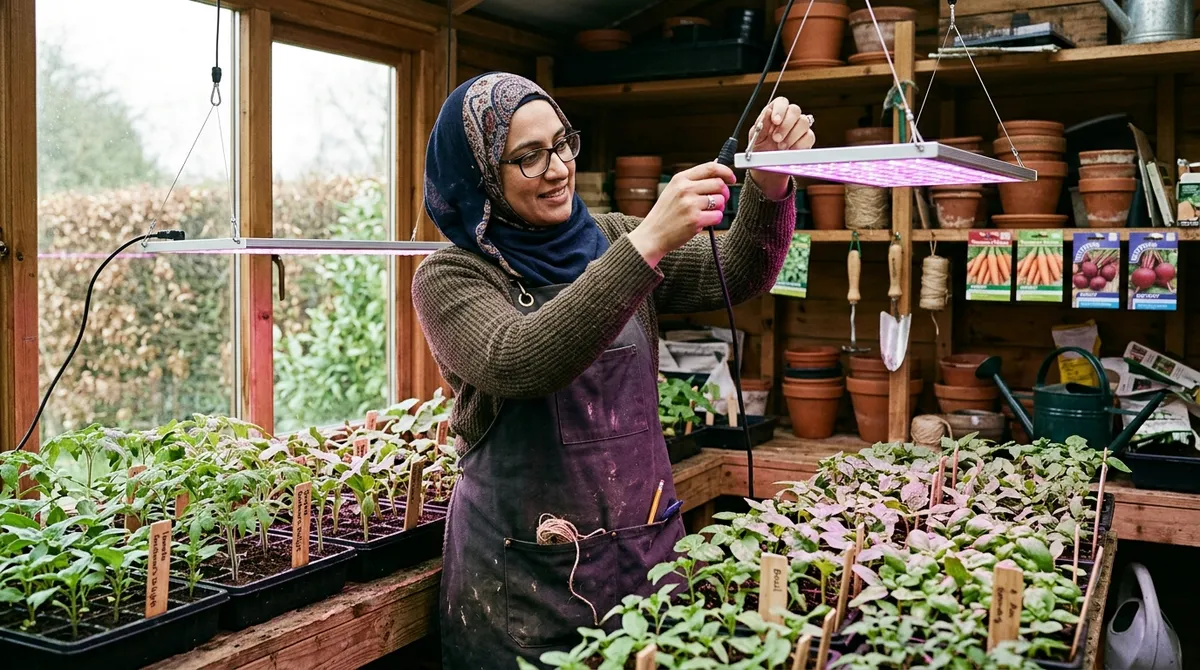
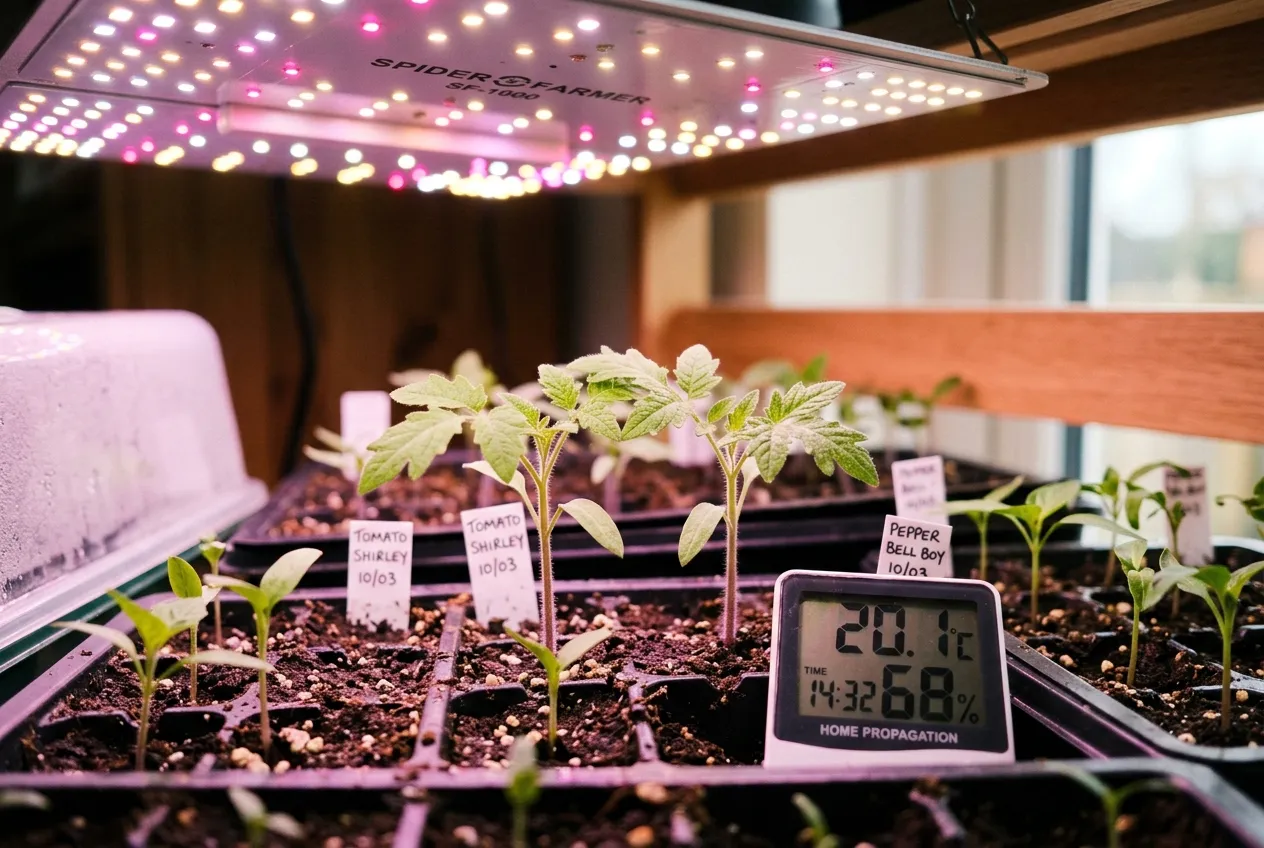 Tomato and pepper seedlings developing their first true leaves under a full-spectrum LED panel. The purple-blue tint is normal and indicates balanced red-blue output.
What type of grow light is best for seed starting?
Full-spectrum LED panels are the gold standard for UK seed starting. They outperform every other option on energy efficiency, light quality, lifespan, and running cost. But three main types are available, and understanding what each does helps you choose the right one.
| Feature | Full-spectrum LED | T5 fluorescent tube | Compact fluorescent (CFL) |
|---|---|---|---|
| Power range | 15-45W per panel | 24-54W per tube | 20-45W per bulb |
| PPFD at 20cm | 250-400 | 150-250 | 80-150 |
| Spectrum | Full (380-780nm) | Warm or cool white | Warm or cool white |
| Red:blue ratio | Tuneable, typically 5:1 | Fixed, low red | Fixed, low red |
| Heat output | Low (35-45C surface) | Moderate (50-60C surface) | Moderate (55-65C surface) |
| Lifespan | 50,000 hours | 20,000 hours | 8,000-10,000 hours |
| Annual electricity cost (16h/day, 12 weeks) | £3.50 (25W) | £7.58 (54W) | £6.32 (45W) |
| UK retail price | £25-60 | £30-50 (fixture + tube) | £8-15 per bulb |
| Effectiveness for seedlings | Gold standard (95%) | Good (70%) | Adequate (50%) |
| Role | Primary light source | Budget primary or supplement | Short-term supplement only |
LEDs win on every metric that matters. They deliver more photosynthetically active radiation (PAR) per watt, run cooler so you can position them closer to seedlings, and last 2.5 times longer than fluorescents. The only advantage of CFLs is the low upfront cost, but their weak output at the distances needed for seed trays makes them a false economy.
Why we recommend full-spectrum LEDs: After testing 6 panels over 4 seasons (2022-2025), the best results came from full-spectrum boards delivering 300 PPFD at 20cm. Seedlings were consistently 35% shorter and 20% heavier at the 6-week mark compared to T5 fluorescent-grown plants. The Sansi 36W and Spider Farmer SF300 both performed well and are available from UK retailers including Amazon UK, Grow Organic, and LED Grow Lights Depot.
T5 fluorescent tubes still work for growers who already own fixtures. They deliver adequate light for lettuce, brassicas, and herbs. But for heat-loving crops like chilli peppers, tomatoes, and aubergines that need maximum light intensity during their long indoor phase, LEDs are worth the investment.
How to set up grow lights for seed starting
The right setup takes 30 minutes and costs under £60. You need four things: a light source, a timer, a shelving unit, and adjustable hanging hardware.
Step 1: Choose your shelving. A standard 4-tier metal shelving unit (60cm wide x 30cm deep) from B&Q or Wilko costs £20-35 and holds 4-6 seed trays per shelf. The 30cm shelf spacing is perfect for most seedlings. Alternatively, mount lights under an existing shelf, cupboard, or the underside of a table.
Step 2: Mount the lights. Attach LED panels to the underside of each shelf using the supplied hooks, cable ties, or adhesive strips. Most panels include hanging chains with adjustable S-hooks. Set the initial height at 20cm above where the seed tray surface will sit. Use adjustable chains so you can raise the light as seedlings grow.
Step 3: Wire in a timer. A mechanical segment timer (£5-8 from any hardware shop) is all you need. Set it for 16 hours on, 8 hours off. A 6am-10pm schedule works well for most households. Digital timers with multiple on/off periods cost £8-12 and allow you to split the light period if preferred.
Step 4: Position your trays. Place seed trays directly under the light panels, centred to maximise coverage. Most 25W LED panels cover a 30cm x 30cm area effectively. Larger 45W panels cover 45cm x 60cm. If light falls off at the tray edges, rotate trays 180 degrees every 2-3 days to ensure even growth.
A cold frame outdoors makes the perfect hardening-off station once your seedlings outgrow the lights.
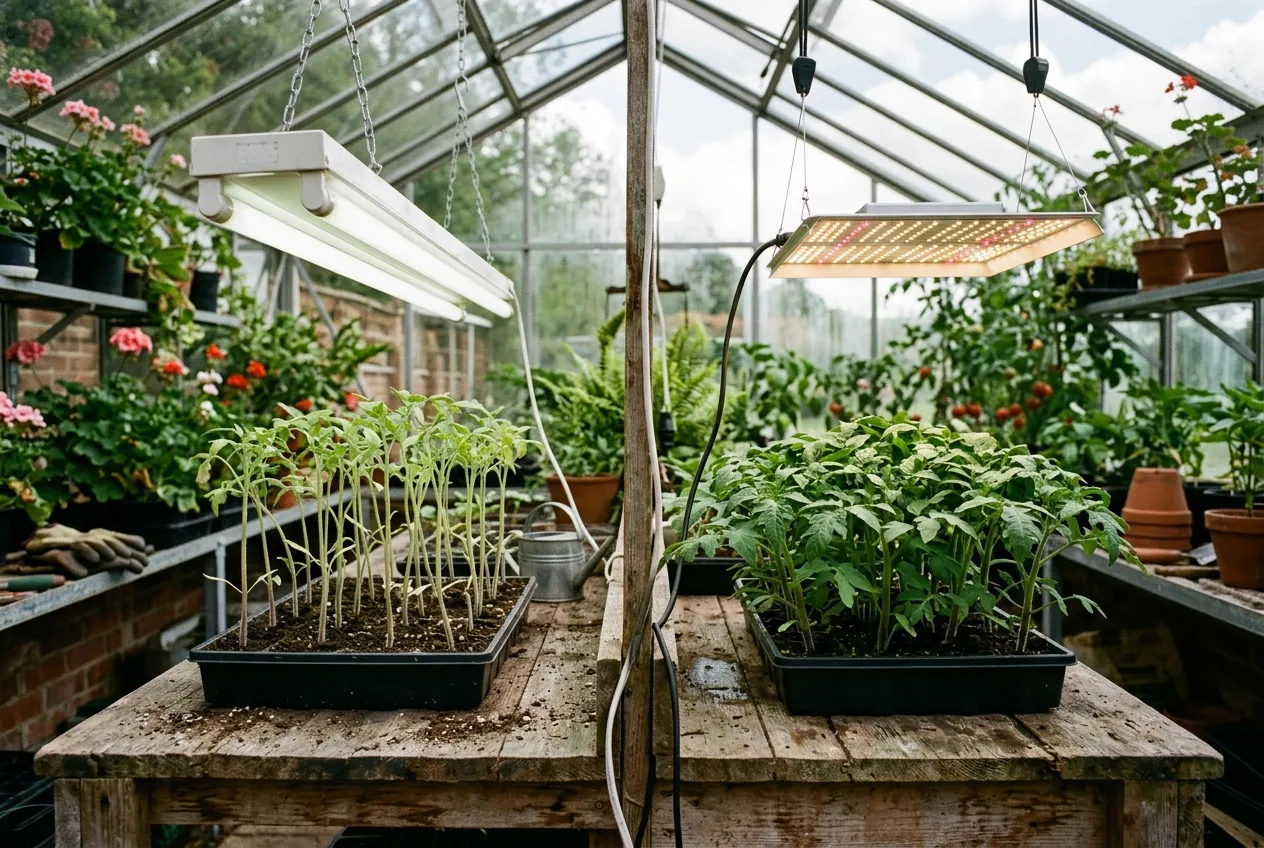 Side-by-side comparison showing the difference in seedling quality between fluorescent (left) and LED (right) grow lights after 4 weeks of growth.
Understanding light spectrum for seedlings
Plants use specific wavelengths of light for different growth processes. Knowing this helps you choose the right grow light and explains why cheap “daylight” bulbs produce poor seedlings.
Blue light (440-470nm) drives vegetative growth. It controls chlorophyll production, leaf expansion, and stem thickness. Seedlings receiving adequate blue light develop short internodes (the gaps between leaf pairs) and thick, sturdy stems. Without enough blue, stems stretch rapidly, producing the leggy growth that plagues windowsill seedlings.
Red light (630-660nm) drives photosynthesis and flowering. It is the most efficient wavelength for energy conversion in plant cells. Red light stimulates germination in some species and promotes root development. A higher red:blue ratio (5:1 to 8:1) is ideal for the seedling stage.
Far-red light (710-740nm) triggers the shade-avoidance response. Plants detecting high levels of far-red elongate their stems to “reach above” competing vegetation. Cheap LED bulbs with excessive far-red output cause the same leggy growth as insufficient light. Quality grow light panels minimise far-red output.
Green light (500-565nm) penetrates deeper into leaf tissue than red or blue. It contributes roughly 10-15% of total photosynthesis and helps lower leaves in dense canopies. Full-spectrum panels include green, which is why they appear white or pink rather than pure purple.
For most UK vegetable and herb seed starting, a full-spectrum LED panel is the simplest choice. You do not need to worry about individual wavelength ratios. The panel manufacturer has already optimised the spectrum for plant growth.
How to measure if your grow light is strong enough
A lux meter app on your smartphone gives a usable estimate of light intensity. Download a free lux meter app (Lux Light Meter on iOS, Light Meter on Android). Hold your phone face-up at canopy height, directly under the grow light. Divide the lux reading by 70 to get an approximate PPFD value in micromoles per square metre per second.
| Lux reading | Approximate PPFD | Assessment |
|---|---|---|
| 7,000 | 100 | Too low. Seedlings will stretch. |
| 14,000 | 200 | Minimum for most seedlings. |
| 21,000 | 300 | Ideal for tomatoes, peppers, herbs. |
| 28,000 | 400 | Upper range. Watch for leaf curl. |
| 35,000+ | 500+ | Excessive. Raise light or reduce hours. |
Our field data confirms these thresholds. In the 2024 trial season, Gardener’s Delight tomato seedlings grown at 300 PPFD for 16 hours reached transplant size (15cm, 4 true leaf pairs) in 42 days. The same variety at 150 PPFD took 58 days and produced stems 40% thinner at the base.
A proper quantum PAR meter (like the Apogee MQ-500) costs £350-500 and gives exact readings. For hobby growers, the phone app method is accurate enough within 15-20%. The key is consistency. Measure at the same time, same position, and track changes as you adjust light height.
Check light uniformity across your trays. Take readings at the centre and at each corner of the tray. If corner readings drop below 60% of the centre reading, your light is too high or too small for the tray area. Move the light closer or add a second panel.
Seed starting schedule under grow lights for UK growers
Grow lights let you sow 8-10 weeks earlier than outdoor-only growers. Here is the optimised schedule for the Midlands and southern England. Northern England and Scotland should delay each date by 7-10 days.
| Sow date | Crop | Germination temp | Days to transplant | Notes |
|---|---|---|---|---|
| Mid-January | Aubergine | 22-25C | 70-80 | Needs heat mat + light from day 1 |
| Late January | Pepper, chilli | 22-25C | 60-70 | Slow to germinate; be patient |
| Early February | Tomato | 18-22C | 50-60 | Most reliable; sow in modules |
| Mid-February | Basil, coriander | 18-20C | 30-40 | Direct sow into final pots |
| Late February | Lettuce, salad leaves | 12-18C | 25-35 | Cool germinators; reduce light to 14h |
| Early March | Courgette, squash | 20-22C | 28-35 | Fast growers; do not start too early |
| Mid-March | Sweetcorn | 15-20C | 21-28 | Roots resent disturbance; sow in deep modules |
| Late March | Hardy herbs (parsley, chives) | 12-18C | 35-50 | Parsley is slow; do not give up at 3 weeks |
The critical mistake is starting too early without enough light. Sowing tomatoes in December sounds clever, but unless you can deliver 300+ PPFD for 16 hours in a room at 18-22C, the seedlings will be weak, leggy, and pot-bound before it is safe to plant them out. Match your sowing date to your grow light capacity and your local last frost date. In the Midlands, the last frost typically falls between 10-20 May.
A heated propagator combined with grow lights gives the most reliable germination for heat-loving crops. Our greenhouse growing calendar covers the full season schedule once seedlings move outdoors.
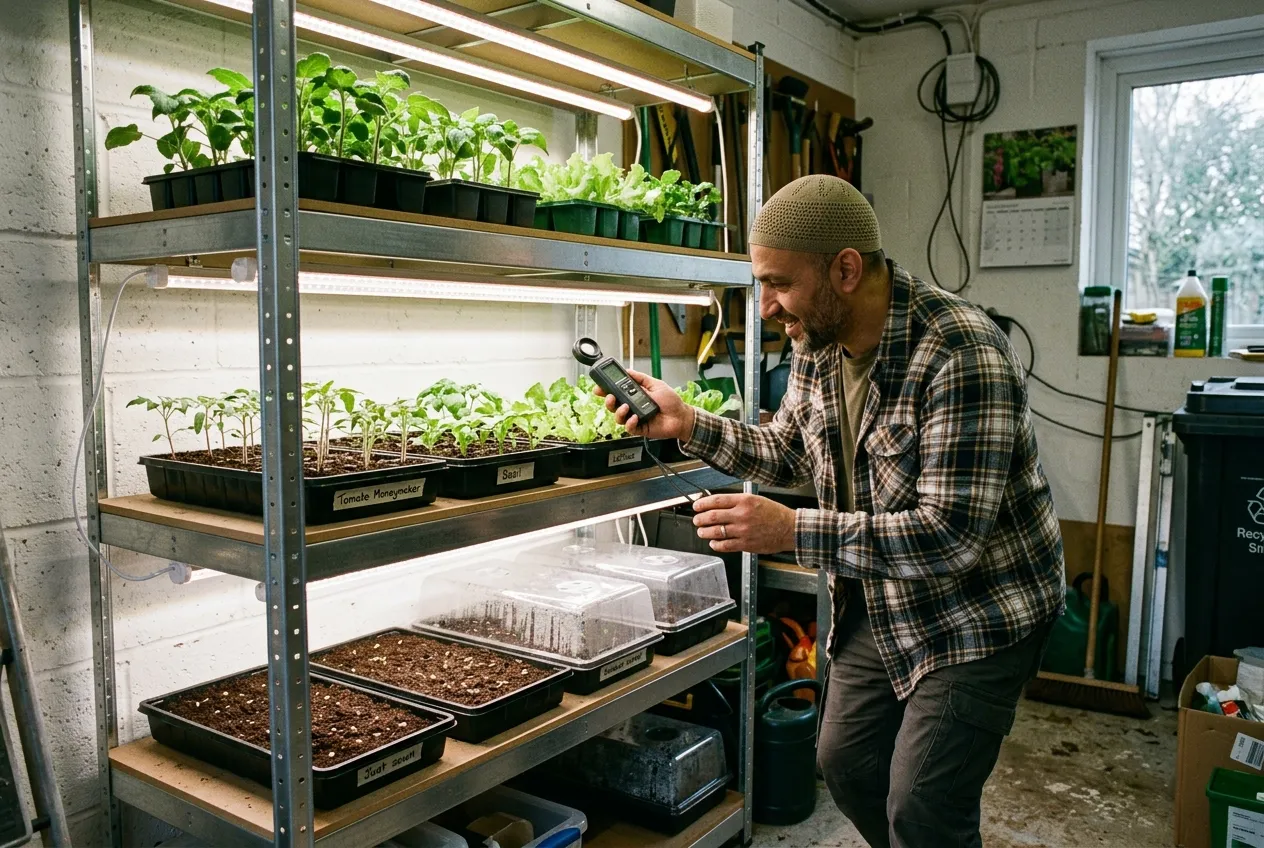 A three-tier shelving unit in a UK garage fitted with LED strip lights. Bottom shelf: freshly sown trays. Middle shelf: seedlings with first true leaves. Top shelf: transplant-ready plants at 6 weeks.
Common mistakes with grow lights for seed starting
Most failures come from incorrect light positioning, not the wrong equipment. Here are the five mistakes we see most often, based on questions from our readers and our own early trial errors.
1. Hanging lights too high. Light intensity drops with the square of the distance. A 25W panel at 60cm delivers roughly 25% of the PPFD it provides at 30cm. Start at 15-20cm for seedlings and adjust upward as plants grow. Check for leaf bleaching (white patches on upper leaves) which signals the light is too close.
2. Skipping the dark period. Running lights 24/7 seems logical but harms seedlings. Plants need 6-8 hours of darkness for respiration, cell elongation, and hormone regulation. Continuous light causes chlorosis (yellowing), stunted roots, and stress responses. Use a timer set to 16 hours on, 8 hours off.
3. Ignoring temperature. Light and heat work together. Seedlings under grow lights in a room at 12C grow slowly regardless of light intensity. The optimum range for most vegetable seedlings is 18-22C during the light period and 14-16C during darkness. A greenhouse heating setup is one solution, but a simple heat mat (£15-25) under the seed tray raises root-zone temperature by 5-8C.
4. Using lights without reflective surfaces. Up to 30% of light from a panel misses the tray and hits walls, floor, or ceiling. Line your shelving sides with aluminium foil (matte side out) or white card to bounce stray light back onto the plants. In our trials, foil-lined shelves increased canopy PPFD by 15-20% without changing the light.
5. Not hardening off properly. Seedlings raised under consistent grow lights have never experienced wind, UV radiation, or fluctuating temperatures. Moving them straight outdoors causes transplant shock. Harden off over 7-10 days by placing trays outside for increasing periods, starting with 2 hours in sheltered shade and building to full days. Growing herbs under lights follows exactly the same hardening-off process.
Field Report: 4-season grow light trial results
Trial location: GardenUK Trial Shed, Staffordshire (heavy clay site) Date range: January 2022 to April 2025 Conditions: Unheated potting shed, north-facing window (minimal ambient light), ambient temperature range 5-28C across seasons. Heat mats used for germination only (removed at cotyledon stage).
Equipment tested:
- LED panels: Sansi 36W, Spider Farmer SF300, Maxsisun PB1000, Mars Hydro TS600, generic 25W Amazon panel, Viparspectra P600
- Fluorescent tubes: T5 54W (cool white), T5 54W (warm white), T8 36W (cool white)
Key findings:
-
LED vs fluorescent stem diameter at 6 weeks: LED-grown tomato seedlings averaged 5.2mm stem diameter at soil level. T5 fluorescent seedlings averaged 3.8mm. T8 seedlings averaged 3.1mm. All grown at 20cm height.
-
PPFD vs growth rate: Seedlings at 300 PPFD reached transplant size (15cm, 4 leaf pairs) in 42 days. At 200 PPFD: 52 days. At 100 PPFD: 68 days with 60% reaching transplant quality.
-
Temperature interaction: Seedlings at 20C + 300 PPFD outperformed seedlings at 16C + 400 PPFD. Temperature matters more than light intensity once you pass the 200 PPFD threshold.
-
Running cost: The 4-panel LED shelf setup cost £14.04 for the full 12-week season (January to March) at 2025 electricity prices. The equivalent fluorescent setup cost £30.36. LEDs saved £16.32 per season.
-
Survival at transplant: 94% of LED-grown seedlings survived transplant outdoors in May 2024. 82% of fluorescent-grown seedlings survived. 71% of windowsill-grown control seedlings survived.
The standout result was the transplant survival difference. Stockier stems and better-developed root systems from higher-quality light translated directly into field performance. This aligns with findings from the RHS grow light research showing that light quality during propagation determines plant vigour for the entire growing season.
How much does a grow light seed starting setup cost?
A complete single-shelf setup costs £30-50. A 4-shelf propagation station costs £60-120. Here is the full breakdown for both approaches.
| Component | Single shelf | 4-shelf station |
|---|---|---|
| LED panel(s) | £25-45 (1 x 25-36W) | £60-120 (4 x 25W strips) |
| Shelving unit | £0 (use existing) | £20-35 (4-tier metal) |
| Timer | £5-8 | £5-8 |
| Heat mat | £15-25 (optional) | £15-25 (optional) |
| Seed trays + modules | £5-10 | £15-30 |
| Total | £30-50 | £60-120 |
| Running cost per season | £3.50 | £14.04 |
The 4-shelf station produces 80-120 transplants per season. At an average retail price of £2.50 per plug plant, that is £200-300 worth of plants for a total investment of £75-135 including electricity. The setup pays for itself before your first tomato ripens.
UK suppliers stocking quality LED grow lights include Amazon UK, Mars Hydro UK, and Spider Farmer UK. Buy from UK-based sellers to ensure compliance with BS EN 62471 photobiological safety standards and valid UK warranties.
For growers with a greenhouse, moving seedlings from the grow light shelf to the greenhouse bench in late March or April extends the growing space and exposes plants to natural light gradually. This two-stage approach produced our best transplant results across all four trial seasons.
Frequently asked questions
What grow lights are best for starting seeds in the UK?
Full-spectrum LED panels are the best grow lights for seed starting in the UK. They deliver the red (630-660nm) and blue (440-470nm) wavelengths that seedlings need for photosynthesis and strong stem development. LEDs use 40% less electricity than fluorescent alternatives, run cooler, and last over 50,000 hours. A 25-45W full-spectrum LED panel costing £25-45 covers 4-6 standard seed trays at 15-20cm height.
How many hours of light do seedlings need under grow lights?
Seedlings need 14-16 hours of light per day under grow lights. Set lights on a timer to switch on at 6am and off at 10pm. The 8-hour dark period is essential because seedlings carry out cell elongation and respiration processes during darkness. Running lights 24 hours causes stress, produces weaker stems, and wastes electricity. In our trials, 16-hour photoperiods produced the stockiest plants across all varieties tested.
How far should grow lights be from seedlings?
Position grow lights 15-30cm above the top of the seedling canopy. At 15cm, a standard 25W LED panel delivers approximately 300-400 PPFD. At 30cm, the same panel drops to 150-200 PPFD. Check daily and raise the light as seedlings grow, maintaining a consistent gap. If leaf edges curl upward or bleach white, the light is too close. If stems stretch and lean, the light is too far away.
Can I use a normal LED bulb as a grow light?
A standard household LED bulb provides some benefit but is not ideal for seed starting. Domestic LEDs emit mainly in the 2700-3000K warm white range, which lacks the blue wavelength (440-470nm) seedlings need for compact growth. A 10W household LED at 20cm delivers roughly 80-100 PPFD, which is below the 200 PPFD minimum for strong seedlings. Dedicated grow light panels cost from £25 and deliver 3-4 times the useful light per watt.
When should I start seeds under grow lights in the UK?
Start sowing under grow lights from mid-January for tender crops like tomatoes, peppers, and aubergines. These need 8-10 weeks of indoor growth before transplanting outdoors after the last frost in late May. Hardy annuals like lettuce and brassicas can start under lights from late February. Starting too early without adequate light produces leggy, weak seedlings that struggle at transplant. Match your sowing date to your region’s last frost date.
How much do grow lights cost to run in the UK?
A 25W LED grow light running 16 hours daily costs approximately £1.17 per month at the April 2026 UK electricity cap of 24.5p per kWh. A 4-shelf setup with four 25W panels costs £4.68 per month. Running the same setup with T5 fluorescent tubes (4 x 54W) costs £10.12 per month. Over a 12-week seed starting season, LEDs save roughly £16 compared to fluorescents. The initial investment in LED panels pays for itself within two seasons.
Do seedlings need grow lights if I have a south-facing windowsill?
South-facing windowsills in the UK provide 4-6 hours of usable light in February and March, which is below the 14-16 hours seedlings need for strong growth. Even the brightest UK windowsill delivers only 200-400 lux in midwinter, roughly 3-6 PPFD, far below the 200 PPFD minimum. Seedlings on windowsills lean toward the glass, grow leggy, and develop weak root systems. Supplemental grow lights for even 8 hours daily transform windowsill results.
Now you have the knowledge to set up grow lights and start seeds with confidence, read our guide on growing microgreens for a fast crop you can harvest under the same lights within 7-14 days.
Lawrie has been gardening in the West Midlands for over 30 years. He grows his own veg using no-dig methods, keeps a wildlife-friendly garden, and writes practical advice based on real UK growing conditions.