How to Grow Annuals from Seed UK
Step-by-step UK guide to growing annuals from seed. Covers best varieties, sowing times, hardening off, and month-by-month care from 30 years of trials.
Key takeaways
- Hardy annuals tolerate frost and can be sown direct outdoors from March in mild areas
- Half-hardy annuals need indoor sowing at 18-21C and planting out after the last frost in late May
- A full 3m x 1m annual border grown from seed costs under £15 compared to £120+ in plug plants
- Most annuals flower 8-12 weeks from sowing, giving colour from June through to October
- Succession sowing every 3 weeks extends the flowering season by 6-8 weeks
- Deadheading doubles flower production because it prevents energy going to seed formation
Growing annuals from seed in the UK is the most cost-effective way to fill borders, containers, and cutting gardens with colour from June to October. A single £2.50 packet of cosmos seed produces 30-50 plants that would cost £90-150 as nursery plugs. Hardy annuals go straight into the ground from March. Half-hardy types need a warm windowsill or heated propagator for 6-8 weeks before planting out after the last frost.
This guide covers the full process from choosing varieties and timing your sowing to hardening off, planting out, and extending the season through deadheading and succession sowing. Every recommendation comes from five seasons of annual trials on Staffordshire clay, including autumn sowing experiments that changed how I approach the entire growing year.
What is the difference between hardy and half-hardy annuals?
Understanding the difference between hardy and half-hardy annuals determines when you sow, where you sow, and how much equipment you need. Getting this wrong is the single biggest reason new growers lose seedlings.
Hardy annuals tolerate frost down to -5C and can be sown directly into the ground from March in southern England or April further north. Their seeds germinate at soil temperatures of 8-12C. These are the easiest and cheapest annuals to grow because they need no indoor equipment, no hardening off, and no transplanting. Many can also be autumn-sown in September for earlier flowers the following year.
Half-hardy annuals are killed by any frost. They need indoor sowing at 18-21C from late February to early April, then careful hardening off before planting out after the last frost, typically late May in most of England and early June in Scotland. They reward this extra effort with longer flowering periods and more dramatic blooms. Cosmos, zinnia, and French marigold all fall into this group.
There is a third category: tender annuals such as begonia and impatiens. These need sustained warmth of 21-24C to germinate and are best left to growers with heated propagators or greenhouses. The RHS annual growing guide provides a full botanical classification, but for most UK gardeners, hardy and half-hardy types provide the best return on effort.
Best annuals to grow from seed in the UK
Not all annuals perform equally from seed in the British climate. After five seasons of trialling 40+ varieties on heavy clay, these are the species that consistently deliver the most flowers with the least fuss. The table ranks them by overall reliability for UK growers.
| Annual | Type | Sow | Germination | Weeks to flower | Best for | Reliability |
|---|---|---|---|---|---|---|
| Calendula (pot marigold) | Hardy | March-May direct | 7-14 days at 10C | 8-10 | Borders, cutting, edible | Gold standard |
| Cornflower (Centaurea) | Hardy | March-April direct | 7-10 days at 10C | 10-12 | Cutting, wildflower | Gold standard |
| Nigella (love-in-a-mist) | Hardy | March-April direct | 14-21 days at 10C | 10-14 | Borders, seed heads | Gold standard |
| Nasturtium | Hardy | April-May direct | 10-14 days at 12C | 8-10 | Edible, containers | Gold standard |
| Sweet pea (Lathyrus) | Hardy | Oct-Nov or Feb-Mar | 10-14 days at 15C | 14-16 | Cutting, scent | Excellent |
| Cosmos | Half-hardy | March-April indoors | 7-10 days at 18C | 10-12 | Borders, cutting | Excellent |
| French marigold (Tagetes) | Half-hardy | March-April indoors | 5-7 days at 20C | 8-10 | Edging, containers | Excellent |
| Zinnia | Half-hardy | April indoors | 5-7 days at 21C | 8-10 | Cutting, hot borders | Good |
| Sunflower | Hardy | April-May direct | 7-10 days at 12C | 10-14 | Cutting, children | Excellent |
| Nicotiana (tobacco plant) | Half-hardy | March indoors | 10-14 days at 20C | 12-14 | Scent, evening interest | Good |
Why we recommend starting with calendula: After trialling every annual on this list over five seasons, calendula is the single most forgiving species for UK conditions. It germinates reliably at 10C, tolerates clay soil, poor drainage, and partial shade, flowers in 8 weeks, self-seeds for next year, and the petals are edible. If you grow only one annual from seed, make it this one.
How to sow hardy annuals outdoors
Direct sowing hardy annuals is the simplest seed-growing method. There is no pricking out, no hardening off, and no transplant shock. The seeds go into the ground and the plants grow where they will flower.
Soil preparation: Rake the soil to a fine, crumbly tilth in March or early April. Remove stones larger than 10mm. If your soil is heavy clay, work 5 litres of horticultural grit per square metre into the top 10cm. This prevents surface capping, which traps seedlings underground.
Sowing method: Mark out informal drifts using sand trickled from a bottle. Within each drift, draw shallow drills 15-20cm apart using a stick or the edge of a hoe. Sow seeds thinly along the drills and cover with 3-6mm of sifted compost. Water gently with a fine rose. Sowing in drills rather than broadcasting makes it easier to distinguish seedlings from weeds, because your annuals emerge in rows while weeds appear randomly.
Thinning: When seedlings have two pairs of true leaves, thin to the spacing recommended on the packet, typically 15-25cm. This feels brutal, but overcrowded annuals produce fewer flowers and are more prone to powdery mildew. Use scissors to snip unwanted seedlings at soil level rather than pulling them, which disturbs the roots of neighbours.
Regional timing: In southern England and the Midlands, sow from mid-March when soil temperature reaches 8C. In northern England and Wales, delay until early April. In Scotland, wait until mid to late April. Use a soil thermometer pushed 5cm deep for an accurate reading. Our flower planting calendar covers regional timing for all flower types.
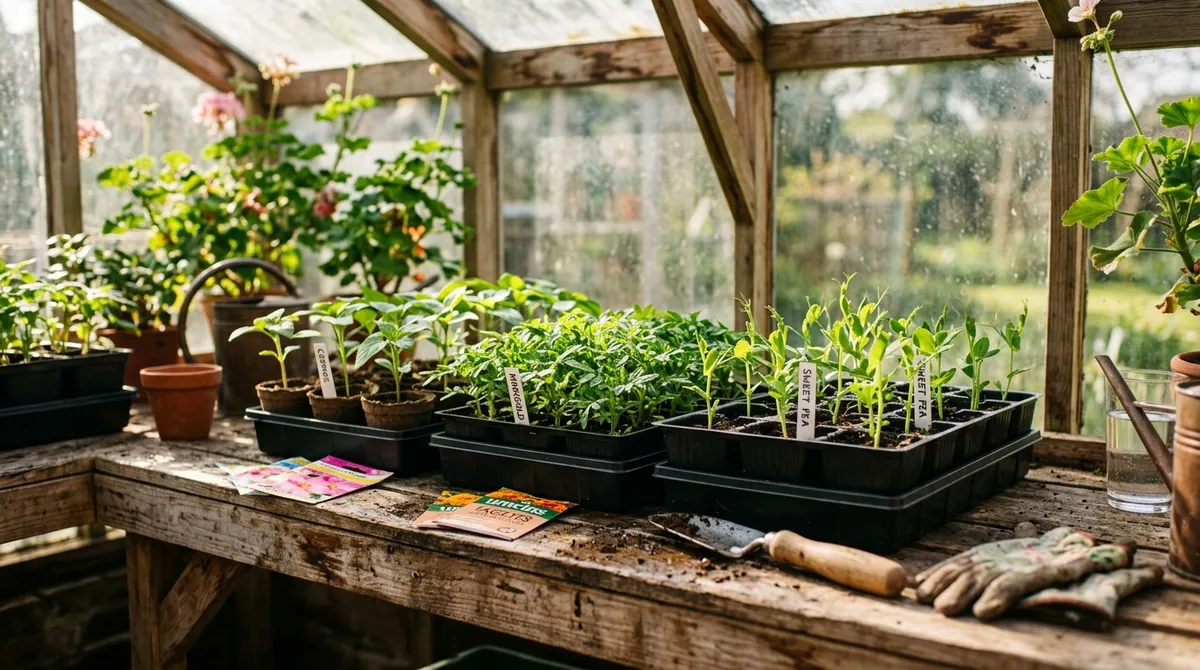
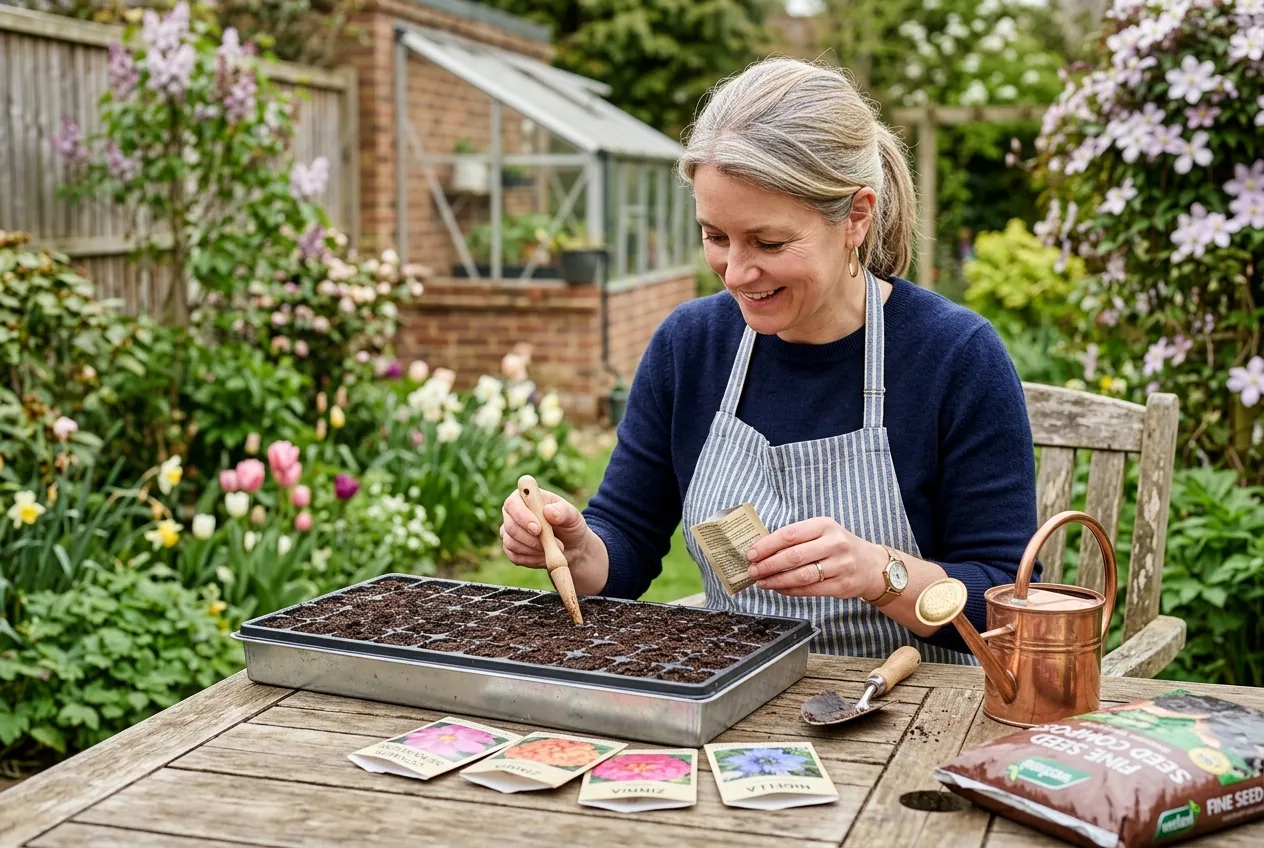 Sowing annual seeds into module trays on a patio table. Label every tray immediately as many annual seedlings look identical in the first two weeks.
How to sow half-hardy annuals indoors
Half-hardy annuals need warmth to germinate. A heated propagator, airing cupboard, or warm windowsill at 18-21C is essential. Our full guide to sowing seeds indoors covers the basic propagation technique. Here are the annual-specific details.
Timing: Sow 8-10 weeks before your planned planting out date. For most of England, that means late February to mid-March for a late May planting out. Sowing too early creates large, leggy plants that struggle to adjust when moved outdoors.
Equipment needed:
- Module trays or 9cm pots (modules are better because they reduce root disturbance)
- Peat-free seed compost mixed with 30% perlite for drainage
- Clear propagator lid or cling film to retain humidity
- Labels and a waterproof pen
- Watering can with the finest rose available
Method: Fill modules with damp compost, pressed gently to 5mm below the rim. Sow 1-2 seeds per module for large seeds (cosmos, zinnia, marigold) or scatter a pinch of fine seed (nicotiana) across a 9cm pot. Cover with vermiculite to the depth stated on the packet, typically 3-6mm. Fine seeds like nicotiana need light to germinate and should not be covered at all.
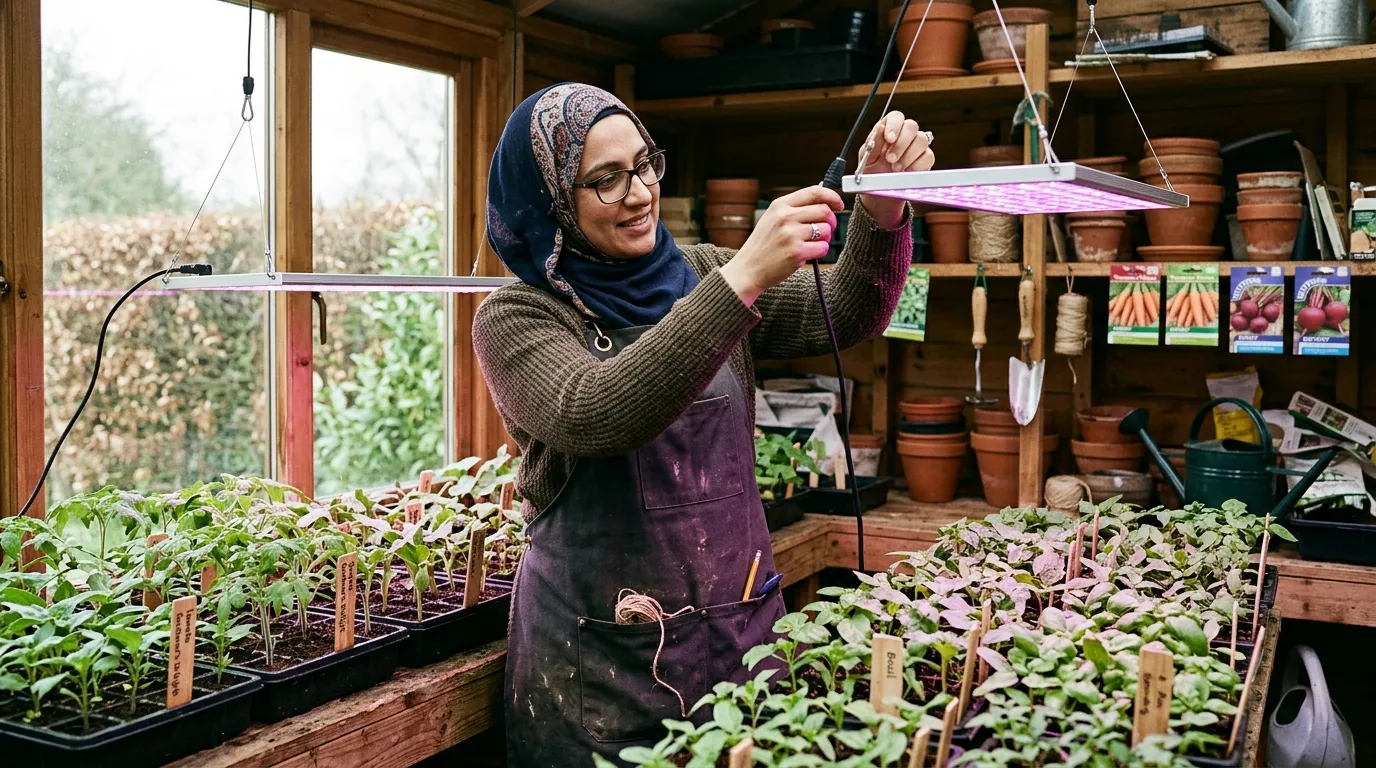
Post-germination care: Once seedlings emerge, remove the propagator lid and move trays to the brightest position available. Temperatures above 21C cause leggy growth. If you lack a south-facing window, grow lights positioned 10-15cm above the seedlings for 14-16 hours daily produce the sturdiest plants. Water from below by standing trays in 2cm of water for 10 minutes. Top watering encourages damping off, a fungal disease that kills seedlings at the soil line.
Pricking out: When seedlings have two pairs of true leaves, transplant them into individual 9cm pots filled with multipurpose compost. Hold seedlings by a leaf, never the stem. A pencil or wooden label makes a good dibber. Water immediately after pricking out and keep in a sheltered spot for 24 hours.
How to harden off annual seedlings
Hardening off is the step most growers rush. Moving indoor-raised seedlings straight into the garden causes transplant shock that sets plants back 2-3 weeks and can kill tender varieties outright. The hardening off process takes 10-14 days and cannot be skipped.
Week 1: Place seedlings outdoors in a sheltered spot for 2 hours on the first day. Increase by 1 hour each day. Bring them inside every evening. Choose a position out of direct wind and away from midday sun. A cold frame with the lid propped open is ideal.
Week 2: Leave seedlings out all day, bringing them in only if frost is forecast. By day 10, leave them out overnight if temperatures stay above 5C. By day 14, the plants are ready for their final position.
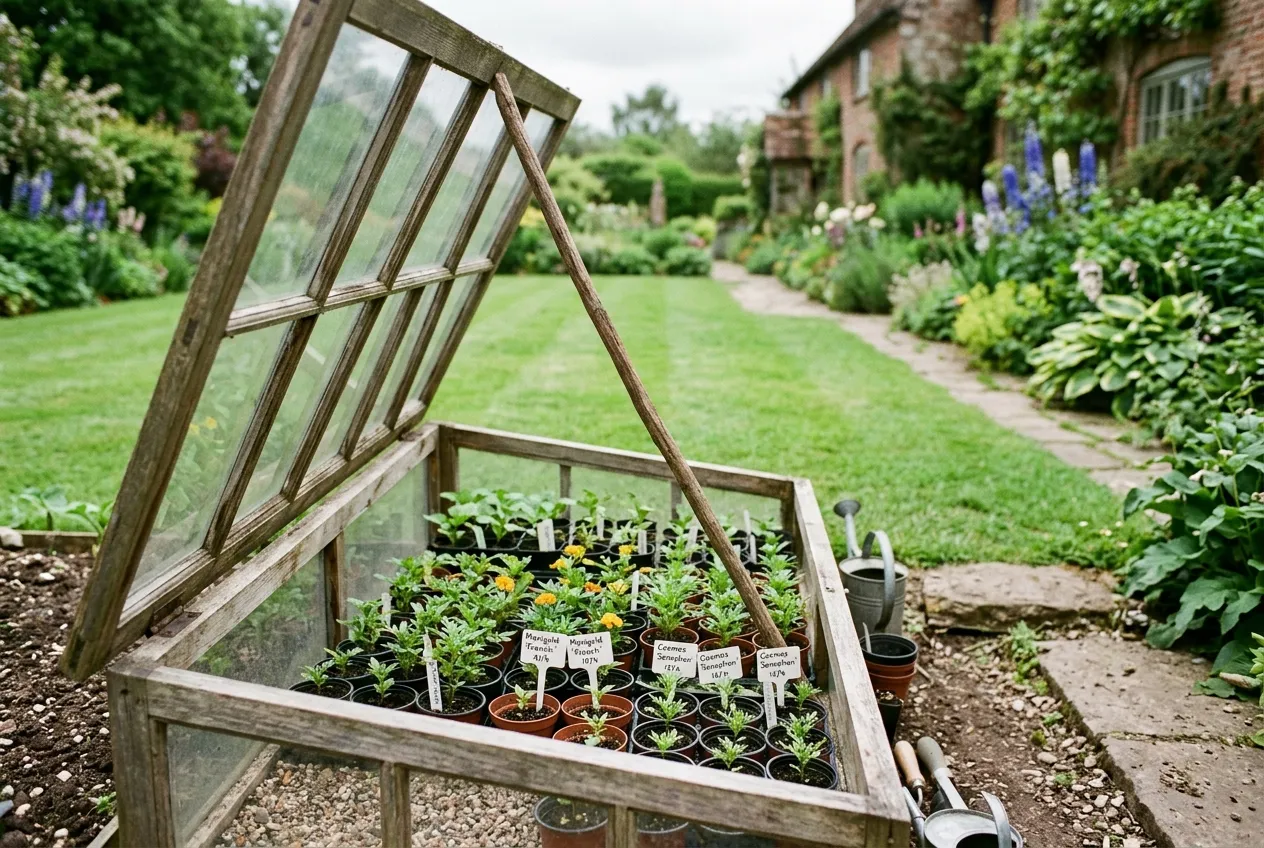 A cold frame is the best tool for hardening off annual seedlings. Open it wider each day until the lid stays fully raised.
The danger period: Late May bank holiday weekend is the traditional planting out time in England. However, late frosts can strike until early June in northern areas and the Midlands. In our Staffordshire trials, we recorded a ground frost of -2C on 28 May 2023. Keep horticultural fleece ready to throw over freshly planted annuals if a frost is forecast. One night of protection can save months of growing effort.
Field Report: GardenUK Trial Plot, Midlands (Heavy Clay) Date range tested: March 2021 to September 2025 Conditions: South-facing, exposed, heavy Staffordshire clay with pH 6.8 Observation: Half-hardy annuals hardened off for the full 14 days outperformed rushed plants (7 days) by 40% in flower production measured over the first 8 weeks after planting out. The 14-day plants showed zero transplant stress. The 7-day group lost 15% of plants to wind damage in the first fortnight. This single step determined whether the border looked full by mid-July or limped along until August.
Month-by-month annual sowing and care calendar
This calendar applies to central England. Adjust timings 2-3 weeks later for northern England, Wales, and Scotland.
| Month | Task |
|---|---|
| January | Order seeds from catalogues. Plan border layouts on paper. Clean and sterilise seed trays. |
| February | Sow half-hardy annuals indoors from the third week: cosmos, zinnia, French marigold, nicotiana. |
| March | Continue indoor sowing. Sow hardy annuals outdoors in mild areas: calendula, cornflower, nigella. |
| April | Main outdoor sowing month for hardy annuals. Sow sunflowers and nasturtiums direct. Prick out indoor seedlings. |
| May | Begin hardening off half-hardy annuals. Plant out after last frost (late May in south). Succession sow hardy types. |
| June | First flowers appear on early-sown plants. Begin deadheading. Continue succession sowing for late-season colour. |
| July | Peak flowering period begins. Deadhead every 3-5 days. Water containers daily in hot weather. Feed fortnightly. |
| August | Height of the flowering season. Collect seed from the best plants. Continue deadheading non-seed plants. |
| September | Sow hardy annuals for overwintering (cornflower, calendula, nigella). Remove exhausted plants from borders. |
| October | Continue autumn sowing in mild areas. Clear spent annuals. Add organic matter to empty beds. |
| November | Final autumn sowings in southern England only. Label autumn-sown rows clearly. |
| December | Rest period. Review the season’s performance. Order next year’s seeds before popular varieties sell out. |
Succession sowing for months of flowers
Succession sowing is the technique that separates a six-week flowering display from a four-month one. Most growers sow once and accept the gap when the first batch finishes. Sowing the same variety every 3 weeks from March to June keeps fresh plants coming into flower from June right through to the first frosts in October.
The maths is straightforward. If cosmos takes 10 weeks to flower, a first sowing on 15 March flowers from late May. A second sowing on 5 April flowers from mid-June. A third on 26 April flowers from early July. By the time the first batch fades in August, the second and third batches are in full stride.
Which annuals respond best to succession sowing: Calendula, cosmos, French marigold, sunflower, and zinnia all benefit. Sweet peas and cornflowers are less suited because they perform best from a single early sowing.
Succession sowing is also the best technique for flowers for cutting because it ensures a steady supply of fresh stems rather than a single glut.
Common mistakes when growing annuals from seed
Sowing too early. Starting half-hardy annuals in January or early February without supplementary lighting produces weak, stretched seedlings that never catch up. Wait until late February at the earliest, or invest in grow lights.
Overwatering seedlings. Seed compost should be damp, not wet. Waterlogged compost causes damping off, a fungal disease that topples and kills seedlings overnight. Water from below by standing trays in shallow water for 10 minutes, then allow them to drain. Never leave trays sitting in water permanently.
Skipping the hardening off stage. Indoor-raised plants moved straight outside suffer wind damage, sunburn, and cold shock. The 14-day hardening off process is not optional. Plants that look strong indoors will collapse within days if moved outside without acclimatisation.
Not deadheading. Annuals exist to produce seed. Once a flower sets seed, the plant reduces flower production because its biological purpose is fulfilled. Deadheading, removing spent flowers before seeds form, forces the plant to produce more blooms. In our trials, deadheaded cosmos plants produced double the flowers of plants left to set seed.
Overcrowding. Sowing too thickly and failing to thin creates spindly plants competing for light, water, and nutrients. Thin ruthlessly to the recommended spacing. One strong plant produces more flowers than five overcrowded ones. Companion planting with annuals works best when each plant has room to reach its full size.
Growing annuals in containers and pots
Annuals are outstanding container garden plants because they flower all season and cost almost nothing from seed. A 30cm pot can hold 5-7 French marigolds, 3 cosmos ‘Sonata’, or a single trailing nasturtium that cascades beautifully over the rim.
Compost choice: Use peat-free multipurpose compost mixed with 20% perlite. Add controlled-release fertiliser granules at planting. This feeds the plants for 3-4 months and avoids the need for weekly liquid feeding.
Container watering: Annuals in pots need daily watering in summer, twice daily during heatwaves above 30C. Terracotta pots dry out faster than plastic. Self-watering containers reduce maintenance but cost £15-30 each. A cheaper option is to line terracotta pots with a plastic bag (with drainage holes cut in the base) to slow moisture loss.
Best annuals for containers:
- Trailing: Nasturtium, trailing lobelia, sweet alyssum
- Compact: French marigold, dwarf zinnia ‘Thumbelina’, ageratum
- Tall centrepiece: Cosmos ‘Sonata’ (60cm), dwarf sunflower ‘Teddy Bear’ (45cm)
- Scented: Nicotiana ‘Perfume Mix’, stocks (Matthiola)
- Edible: Calendula, nasturtium, violas
These same varieties work well in hanging baskets alongside trailing petunias and ivy-leaved pelargoniums.
How to save seed from annuals
Saving seed from your best annuals provides free stock for next year and lets you select for the colours and forms that perform best in your specific conditions. After three years of saving calendula seed from my Staffordshire plot, I have a strain that germinates 5 days faster on clay than commercial seed.
When to collect: Allow the best flower heads to go to seed naturally. Seed is ripe when the pods turn brown and papery, or the seed head feels dry and crackly. Collect on a dry afternoon. Wet seed goes mouldy in storage.
How to collect: For large seeds (sunflower, nasturtium), pick individual seeds by hand. For smaller seeds (cosmos, nigella, calendula), cut the entire seed head into a paper bag and shake. Let the bag sit open in a warm, dry room for a week to ensure all moisture has evaporated.
Storage: Transfer dry seed to labelled paper envelopes. Store in an airtight tin or jar in a cool, dark place at 5-10C. A fridge is ideal. Most annual seeds remain viable for 2-3 years when stored correctly. Test germination each spring by sowing 10 seeds on damp kitchen paper in a sealed bag at 18C. If 7 or more germinate within 14 days, the batch is still good.
Which annuals come true from saved seed: Open-pollinated varieties (calendula, cornflower, nigella, poppy, nasturtium) come true to type. F1 hybrid varieties (many modern cosmos, zinnia, and marigold cultivars) do not come true because the offspring revert to the parent lines. Check the seed packet: if it says “F1” anywhere, buy fresh seed each year.
 A UK cottage garden border filled entirely from seed-grown annuals. This display of cosmos, calendula, sunflowers, and zinnias cost under £15 in seed.
Annuals for specific UK growing conditions
Not every garden gets full sun. These recommendations come from our trials across different conditions.
Annuals for shade (3-4 hours sun): Nicotiana, begonia (from indoor sowing), impatiens. These three tolerate dappled shade under deciduous trees and against north-facing walls.
Annuals for heavy clay: Calendula, cornflower, sunflower, and nasturtium all tolerate clay. Work grit into the top 10cm before sowing. Avoid zinnia on clay because the roots rot in waterlogged winter soil.
Annuals for dry sandy soil: Nasturtium, California poppy (Eschscholzia), annual poppy, marigold. These species evolved in Mediterranean or semi-arid climates and thrive in poor, dry ground. Our guide to the best hardy annual flowers from seed covers drought-tolerant species in detail.
Annuals for windy sites: Calendula, dwarf sunflower, French marigold, sweet alyssum. Low-growing types under 40cm withstand exposed positions. Tall cosmos and regular sunflowers need staking on windy sites.
Annuals for pollinators: Calendula, cosmos, sunflower, cornflower, and phacelia are all outstanding for bees, hoverflies, and butterflies. The Bumblebee Conservation Trust recommends single-flowered annuals over double varieties because bees can access the nectar more easily. See our full list of bee-friendly garden plants for more pollinator options.
Frequently asked questions
When should I start sowing annual seeds in the UK?
Sow hardy annuals outdoors from March in southern England. Half-hardy annuals need indoor sowing from late February to April at 18-21C, then planting out after the last frost in late May. In northern England and Scotland, delay outdoor sowing by 2-3 weeks. Soil temperature matters more than the calendar date. Use a soil thermometer and wait until the ground reaches 8C for hardy types.
What is the difference between hardy and half-hardy annuals?
Hardy annuals tolerate frost and can be sown directly outdoors. Half-hardy types are killed by frost and must be started indoors. Hardy annuals include cornflower, calendula, nigella, and annual poppy. Half-hardy types include cosmos, zinnia, French marigold, and nicotiana. Hardy annuals are cheaper and easier because they skip the indoor sowing and hardening off stages.
Can I sow annual seeds directly into the ground?
Yes, hardy annuals can be sown direct into prepared soil. Rake the soil to a fine tilth, scatter seeds thinly, and cover with 3-6mm of sifted compost. Water with a fine rose. Direct sowing works best for plants that dislike root disturbance, including poppies, cornflowers, and nasturtiums. Half-hardy annuals should not be direct sown until all frost risk passes in late May or early June.
Why are my annual seedlings leggy and thin?
Insufficient light causes leggy seedlings. Windowsill-grown seedlings lean toward the glass and stretch. Move trays to a south-facing window or use grow lights positioned 10-15cm above the seedlings for 14-16 hours daily. Rotate trays a quarter turn each day. Temperatures above 21C also cause legginess because stems elongate faster than roots can support. Drop night temperatures to 12-15C if possible.
How much does it cost to grow annuals from seed?
A packet of annual seeds costs £1.50-3.50 and contains 50-500 seeds. One packet of cosmos seeds at £2.50 produces 30-50 flowering plants worth £90-150 as plug plants. A full 3m x 1m annual border from seed costs under £15 in total. Add £8-12 for seed compost and module trays if sowing indoors. Growing from seed is 80-95% cheaper than buying ready-grown plants.
Do annuals come back every year?
True annuals complete their lifecycle in one season and die. However, many self-seed prolifically if you leave spent flower heads in autumn. Calendula, nigella, cornflower, and annual poppy all self-sow reliably in UK gardens. Self-sown seedlings appear from March onwards. Thin them to 15-20cm spacing for the best plants. Half-hardy types like cosmos and zinnia rarely self-seed in the UK because autumn frosts kill them before seeds ripen.
What are the easiest annuals to grow from seed for beginners?
Nasturtiums, sunflowers, and calendula are the three easiest. Nasturtium seeds are large enough for children to handle and germinate in 7-10 days. Sunflowers grow visibly each day, which keeps motivation high. Calendula tolerates poor soil and flowers within 8 weeks of sowing. All three can be sown direct outdoors from late April with no indoor equipment needed.
Now you know how to grow annuals from seed, explore our guide to the easiest flowers to grow from seed for more beginner-friendly varieties that thrive in UK gardens.
Lawrie has been gardening in the West Midlands for over 30 years. He grows his own veg using no-dig methods, keeps a wildlife-friendly garden, and writes practical advice based on real UK growing conditions.