Allotment Rules UK: What You Can Do
UK allotment rules explained. What you can and cannot do, council tenancy rules, structures allowed and keeping animals. From an allotment holder.
Key takeaways
- Allotment rules vary by council — always read your specific tenancy agreement before building anything
- Standard UK allotment plot is 10 rods (253 square metres or roughly 25m x 10m)
- Most councils allow sheds (6x4ft max), greenhouses and polytunnels with written permission
- You cannot sleep overnight, run a commercial business, or keep most livestock without permission
- Non-cultivation (leaving more than 25% of the plot unworked) is the most common reason for eviction
Allotments are one of the best deals in UK gardening. A 250-square-metre plot of growing land for 25-120 pounds a year is extraordinary value. But the plot comes with rules, and not knowing them is the fastest route to a warning letter or losing your tenancy.
The rules come from two places: the Allotments Acts (1908, 1922 and 1950) set the legal framework, and your council’s individual tenancy agreement adds the specific details. Every council writes its own rules, so what is allowed in one borough may be banned in the next.
After 11 years on a council allotment in Staffordshire, I have navigated the rules, made mistakes, received a warning letter, and learned where the boundaries are. This guide covers what you can and cannot do on a UK allotment based on the legal framework and common council tenancy terms.
Getting an allotment
The legal right to request
Under the Allotments Act 1908, if six or more registered electors in a parish petition the council for allotment land, the council has a duty to provide it. In practice, most councils already maintain allotment sites, but the legal obligation means they cannot simply sell the land for development. Allotment land that was purchased or appropriated under the Allotment Acts requires Secretary of State consent for disposal.
How to apply
Contact your local council directly. Most have an online application form or a phone number for the allotments office. You will be placed on a waiting list for your preferred site (or any site in the area, depending on the council’s system).
Waiting times vary dramatically. Rural councils may have plots available immediately. Urban councils in London, Bristol and Manchester report waiting lists of 3-5 years. The national average is roughly 18 months according to the National Allotment Society.
Costs
Rent ranges from 25 pounds per year in some rural councils to 120 pounds per year in London boroughs. Most areas charge 40-70 pounds per year for a full 10-rod plot. Half plots (5 rods) are available from many councils at half the rent. Concessions for pensioners and people on benefits reduce the cost by 25-50% in most areas.
There is no deposit, but some councils charge a small one-off fee (10-20 pounds) for a key to the site gate.
| Cost item | Typical range | Notes |
|---|---|---|
| Annual rent (full plot) | 25-120 pounds | Varies by council area |
| Annual rent (half plot) | 12-60 pounds | Available at most sites |
| Concession discount | 25-50% | Pensioners, benefits recipients |
| Gate key deposit | 10-20 pounds | One-off, refundable |
| Water charge | 0-20 pounds | Some councils charge separately |
What you can do on your allotment
Growing food
This is the primary purpose and the one activity every council supports without restriction. Vegetables, fruit, and herbs are all permitted. Intensive growing methods including raised beds, no-dig, polytunnels and cloches are standard practice on allotments.
Growing flowers
Most councils allow flowers alongside food crops. Cut flowers, pollinator-friendly plantings and companion flowers are generally accepted. The key restriction: the majority of the plot (typically 75% or more) must be food production. A dedicated cutting garden bed is usually fine as long as the rest of the plot is productive.
Structures (with permission)
Most councils allow:
- Sheds up to 6x4ft (1.8x1.2m) for tool storage. Some allow larger. Must be for storage only, not living.
- Greenhouses typically 6x4ft to 8x6ft. Some councils allow larger with specific permission.
- Polytunnels with written permission. Size limits vary widely.
- Cold frames and cloches are generally unrestricted.
- Water butts and rainwater collection are encouraged.
- Raised beds are unrestricted at most sites.
The universal rule: get written permission before building anything. “I didn’t know” is not a defence when the site committee sends a removal notice.
Fruit trees and soft fruit
Fruit trees are allowed on most allotments. Some councils specify that trees must be on dwarfing rootstock (keeping height manageable) and must not shade neighbouring plots. Soft fruit (strawberries, raspberries, blackcurrants, blueberries) is unrestricted.
Composting
Every allotment should have a compost system. Most councils actively encourage composting as the preferred method of dealing with green waste. Two or three compost bays made from pallets is standard allotment practice.
Beekeeping
Many councils allow beekeeping with written permission and sometimes a separate licence. Requirements typically include: completing a beekeeping course, membership of the local beekeepers’ association, liability insurance, and positioning hives to minimise disruption to neighbouring plot holders. Not all sites are suitable — the site committee assesses each application.
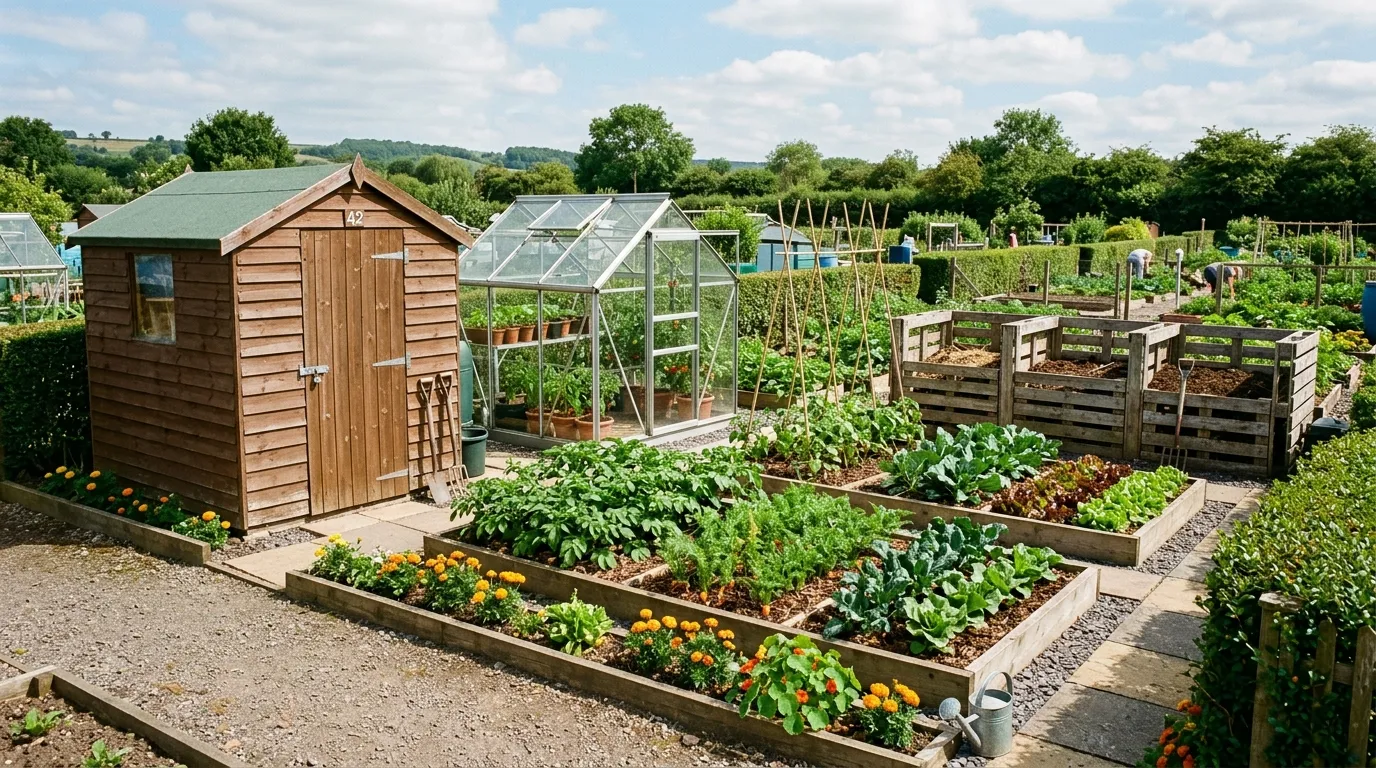
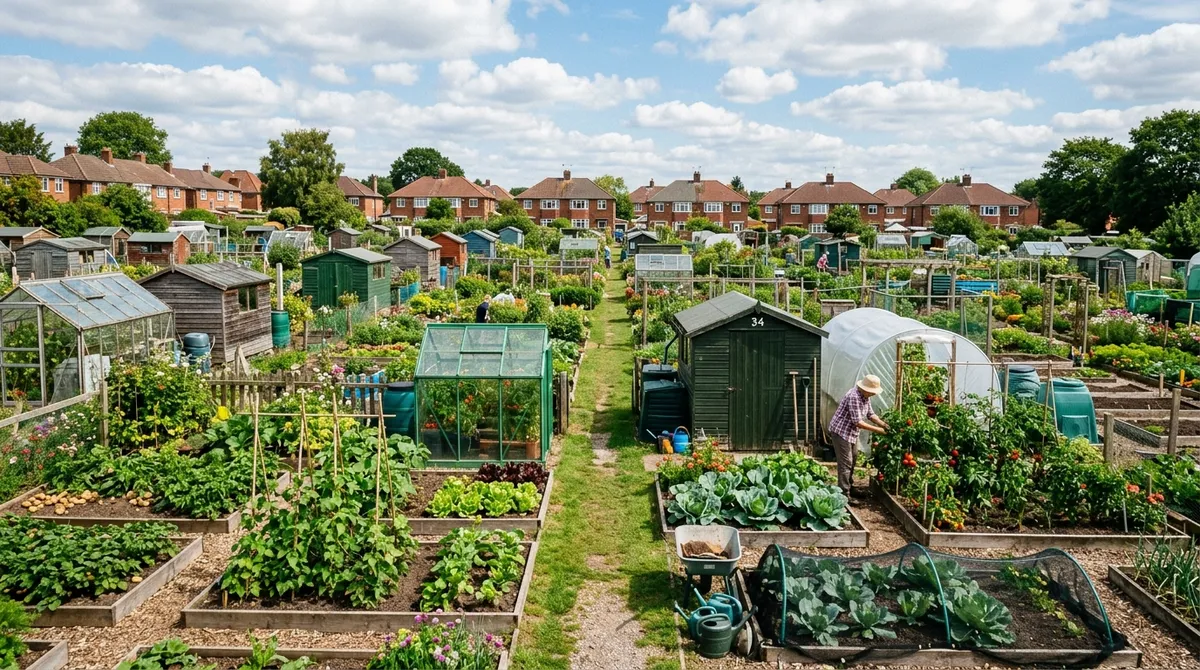
A well-maintained allotment with permitted structures: a 6x4ft shed, a small greenhouse, raised beds and compost bays. All structures had written permission from the council.
What you cannot do
Sleep overnight
The Allotments Act 1950 Section 12 prohibits using an allotment as a dwelling. This means no overnight sleeping — in the shed, in a tent, or anywhere on the plot. Some councils allow staying on site during daylight hours, but the overnight prohibition is universal and strictly enforced.
Run a commercial business
Allotments are for personal and family consumption. Selling surplus produce at the allotment gate or at local markets is a grey area — some councils allow it informally, others explicitly prohibit it. Running a commercial growing operation (selling to shops, restaurants or via an online business) violates most tenancy agreements.
The legal position: the Allotments Act 1922 defines an allotment as land “wholly or mainly cultivated by the occupier for the production of vegetable or fruit crops for consumption by himself or his family.” Commercial production falls outside this definition.
Keep most livestock
Without specific written permission, you cannot keep any animals on an allotment. Even where chickens are allowed (typically 4-6 hens, no cockerels), other livestock is restricted:
- Rabbits: Some councils allow a small number for meat production
- Pigs: Rarely allowed. Requires planning permission and waste disposal compliance
- Goats/sheep: Almost never permitted on council allotments
- Dogs: Must be on a lead at all times on most sites. Some sites ban dogs entirely
Have bonfires (at most sites)
Bonfires are the most contentious allotment issue. Many councils have banned them entirely because smoke drifts into neighbouring properties. Where still allowed, restrictions typically include: green waste only (no plastics, treated timber or household waste), specific days or hours, and stopping immediately if smoke becomes a nuisance.
The practical alternative is composting. Everything that would go on a bonfire can be composted, chipped, or taken to the council green waste facility.
Neglect the plot
Non-cultivation is the most common reason for receiving a warning or losing a tenancy. Most councils require at least 75% of the plot to be under active cultivation. Annual inspections (usually June or July when plots should be at peak production) assess this.
The cultivation standard varies by council, but generally means: soil prepared for or supporting crops, paths maintained, weeds controlled, and structures in good repair. A plot that is mostly weeds, unplanted, or clearly abandoned will trigger a warning letter followed by a notice to quit (typically 28 days to remedy the situation, or 12 months’ notice to vacate).
| Prohibited activity | Legal basis | Notes |
|---|---|---|
| Overnight sleeping | Allotments Act 1950 s.12 | Universal, no exceptions |
| Commercial growing | Allotments Act 1922 definition | Personal/family use only |
| Livestock (unpermitted) | Tenancy agreement | Written permission needed for hens |
| Bonfires | Many councils: full ban | Check your specific rules |
| Non-cultivation (>25% unworked) | Tenancy agreement | Annual inspection in June/July |
| Permanent buildings | Tenancy agreement | Structures must be removable |
| Herbicide misuse | Tenancy agreement | Some sites are organic-only |
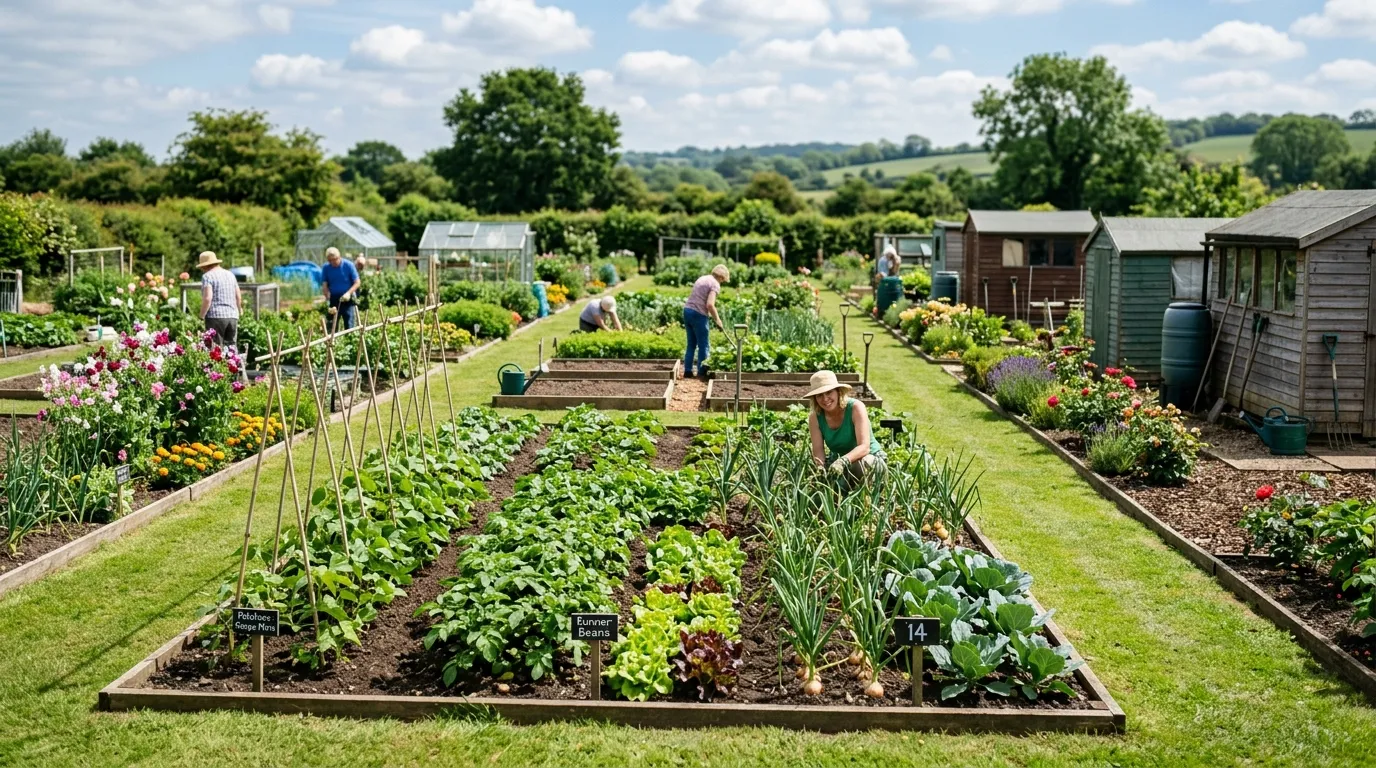
Allotment plots at inspection standard in June. At least 75% of each plot is under active cultivation with maintained paths and controlled weeds.
The tenancy agreement
Your tenancy agreement is the document that governs your specific allotment. Read it completely before signing. It covers:
Rent and payment: When rent is due (usually annually in advance), the amount, and what happens if you do not pay. Non-payment triggers a 40-day notice to vacate under the Allotments Act.
Cultivation requirements: The minimum percentage of the plot that must be under cultivation, the definition of “cultivation” used by your council, and inspection dates.
Structures and alterations: What you can build, maximum sizes, the permission process, and whether structures must be removed when you vacate.
Restrictions: Specific prohibitions on bonfires, chemicals, livestock, overnight stays, subletting, and nuisance behaviour.
Termination: How much notice you must give to leave (usually 12 months or until the next rent date), and how the council can terminate your tenancy (non-cultivation, non-payment, breach of rules).
Tips for new allotment holders
Start small. A full 10-rod plot is a lot of ground. If a half plot is available, take it. You can always request a full plot later once you know the workload. Many experienced holders say a half plot (125 square metres) produces more than enough food for a family.
Talk to neighbours. The people on the plots around you know the soil, the microclimates, the site committee, and the unwritten rules. A five-minute conversation saves hours of trial and error.
Prioritise paths and access. Create clear paths between beds from day one. This prevents soil compaction on growing areas and makes the plot look maintained, which matters at inspection time.
Join the site committee. Most allotment sites are self-managed by a committee of plot holders. Joining gives you a say in site decisions and a better understanding of how the rules are applied in practice.
Record everything. Keep a note of what you grow, when you sow, and what works. An allotment diary or planting calendar is invaluable for improving results year on year.
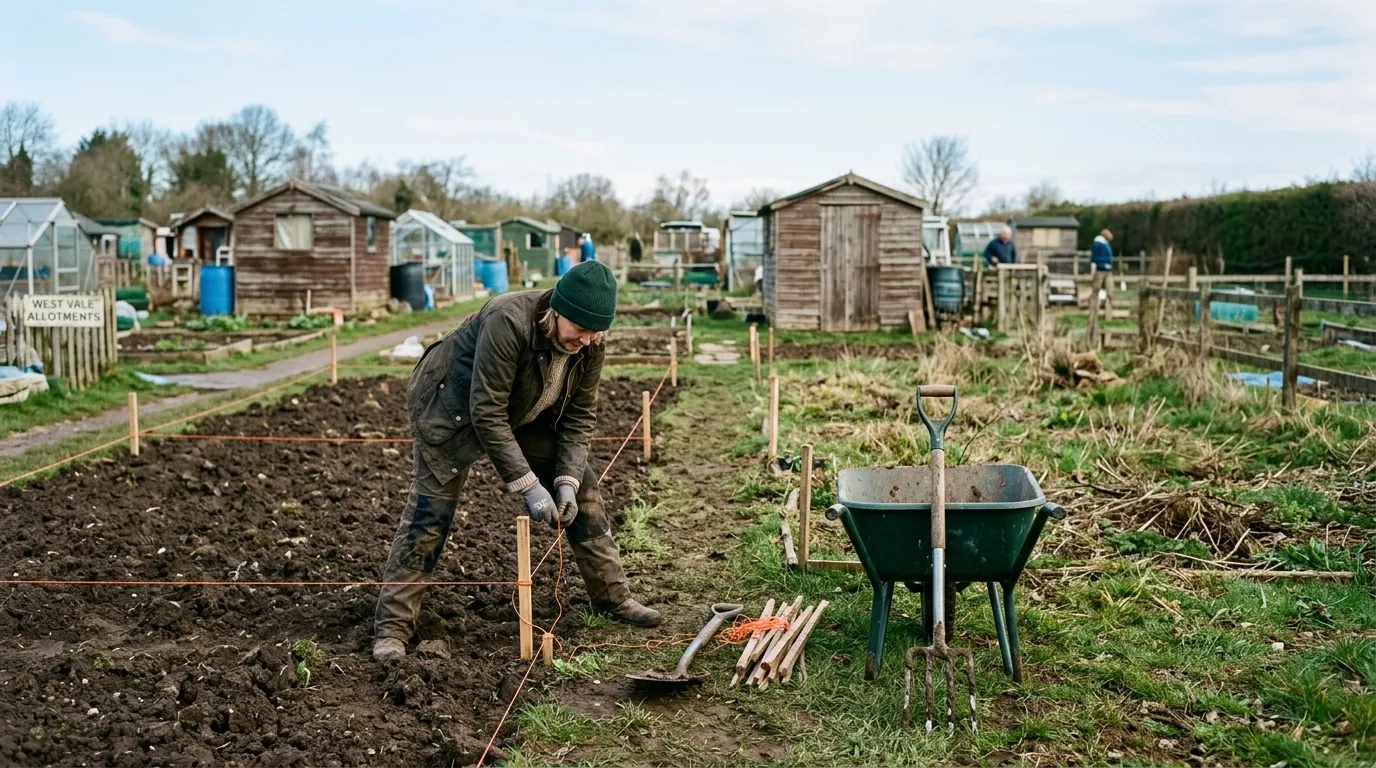
A newly taken-on allotment plot in March. The holder has marked out beds and paths first, then cleared each bed section by section rather than trying to tackle the whole plot at once.
Allotment law: the basics
Three acts of Parliament govern UK allotments:
Allotments Act 1908: Placed a duty on councils to provide allotments where there is demand (6+ electors petitioning). This is the foundation of the legal right to an allotment.
Allotments Act 1922: Defined allotments as land for personal food production. Gave councils powers to manage allotment sites and set tenancy conditions.
Allotments Act 1950: Prohibited using allotments as dwellings. Added provisions for compensation when allotment land is appropriated for other uses.
These acts give allotments stronger legal protection than most people realise. Statutory allotment land (acquired under the Acts) cannot be sold or repurposed without the Secretary of State’s consent, a public inquiry, and proof that the land is surplus to allotment requirements.
Related reading
Lawrie has been gardening in the West Midlands for over 30 years. He grows his own veg using no-dig methods, keeps a wildlife-friendly garden, and writes practical advice based on real UK growing conditions.