How to Grow Pittosporum in the UK
How to grow pittosporum in the UK with variety advice from Tom Thumb to Silver Queen. Covers hedging, coastal planting, pruning, and hardiness.
Key takeaways
- Pittosporum tenuifolium is hardy to -10C (USDA Zone 8) and thrives across southern and western England
- Tom Thumb stays compact at 90cm with deep bronze-purple foliage. Needs no clipping
- Silver Queen is the best variegated hedging pittosporum, reaching 3m with cream-edged leaves
- Golf Ball forms a natural 90cm dome and is the hardiest cultivar, surviving -12C
- Plant in free-draining soil in full sun or light shade between April and September
- Pittosporum tolerates salt spray and is one of the best evergreen hedging plants for coastal gardens
- Prune in late spring after the last frost. Never hard-prune into old wood below the leaf canopy
Pittosporum tenuifolium is one of the most versatile evergreen shrubs you can grow in a UK garden. It works as a formal hedge, an informal screen, a container specimen, and a coastal windbreak. The glossy, wavy-edged leaves hold their colour year-round, and the small dark-red flowers in late spring carry a honey-chocolate scent that fills the garden on warm evenings.
This New Zealand native has become a British garden staple over the past 30 years. Nurseries now stock over 40 cultivars, from compact purple-leaved dwarfs to tall silver-variegated hedging plants. The species handles salt spray better than almost any other broadleaf evergreen, making it a first-choice shrub for gardens within 10 miles of the coast.
Which pittosporum variety should I grow?
Choosing the right cultivar is the single biggest decision. The wrong variety in the wrong spot leads to winter losses and disappointment. The table below compares the six most widely available UK cultivars side by side.
| Cultivar | Mature height | Spread | Leaf colour | Hardiness | Best use | RHS AGM |
|---|---|---|---|---|---|---|
| Tom Thumb | 60-90cm | 60cm | Deep bronze-purple | -8C | Containers, borders, low edging | Yes |
| Silver Queen | 3-4m | 2m | Grey-green, cream edge | -8C | Variegated hedging, screening | Yes |
| Golf Ball | 60-90cm | 60-90cm | Bright apple green | -12C | Topiary ball, low hedge, pots | Yes |
| Irene Paterson | 1.5-2m | 1m | White marbled, pink flush | -7C | Specimen, sheltered border | No |
| Tandara Gold | 2-3m | 1.5m | Gold, green centre | -8C | Contrast hedging, focal point | No |
| Elizabeth | 2.5-3m | 1.5m | Grey-green, cream margin | -10C | Tall hedge, screening | No |
Why we recommend Tom Thumb for beginners: After four years growing Tom Thumb in both containers and open ground on Staffordshire clay, it has been the most trouble-free pittosporum in our trial. Zero winter losses, no pruning required, and the bronze-purple foliage darkens to near-black in cold weather. It fills a 40cm pot beautifully and never outgrows the space.
Silver Queen is the classic hedging choice and holds an RHS Award of Garden Merit. The cream-margined leaves brighten shady boundaries. It clips well and produces a dense, formal hedge at 1.8-2.5m. However, it is slightly less hardy than the plain green species. Protect young Silver Queen plants with fleece during their first two winters in gardens north of the Midlands.
Golf Ball forms a naturally spherical shape without any clipping at all. It is the hardiest cultivar we have tested, surviving -12C in an exposed Staffordshire garden in December 2022 with no leaf damage. It makes an excellent box alternative that is completely immune to box blight.
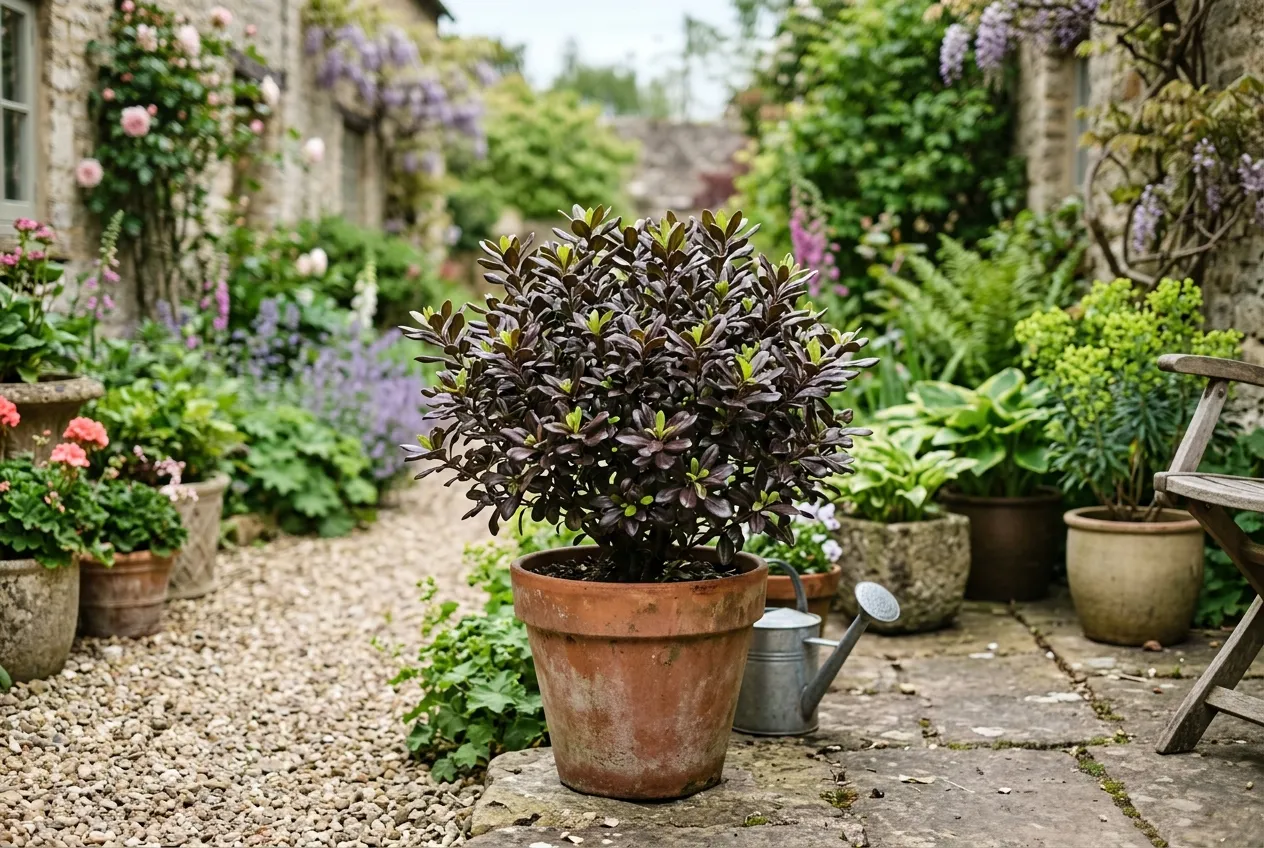 Pittosporum Tom Thumb in a terracotta container. This compact cultivar reaches just 60-90cm and needs no pruning.
Where to plant pittosporum in the UK
Pittosporum needs free-draining soil and shelter from cold north-east winds. Get these two factors right and the plant looks after itself.
Soil: Any well-drained soil works. Sandy, loamy, and chalky soils are all suitable. The ideal pH is 5.5-7.5. Heavy clay soil needs amending before planting. Mix in 30% sharp sand or horticultural grit across the planting area to a depth of 30cm. Pittosporum roots rot in waterlogged ground, and this is the number one cause of winter death in UK gardens.
Light: Full sun produces the densest growth and the best leaf colour, especially on purple and gold cultivars. Pittosporum tolerates partial shade (3-4 hours of direct sun) but grows more open and leggy. Variegated forms like Silver Queen lose their cream margins in deep shade.
Shelter: Young plants need protection from cold, drying east winds during their first two winters. A wall, fence, or established hedge on the north or east side provides enough shelter. Once mature, pittosporum itself becomes the shelter. Established hedges withstand winter gales and salt spray without damage.
Aspect: South-facing and west-facing positions are ideal. East-facing walls work in mild areas but the morning sun after frost can scorch frozen leaves. North-facing positions suit only the hardiest cultivars in southern England.
Regional guide:
- South-west England and Wales: Grows almost anywhere, including exposed coastal sites
- South-east England: Reliable in sheltered gardens. Protect from prolonged sub-zero spells
- Midlands: Grows well on well-drained soil with east wind shelter
- Northern England: Coastal only from Yorkshire northwards. Too cold for most inland gardens
- Scotland: Coastal gardens on the west coast only (Gulf Stream benefit)
How to plant pittosporum
Plant between April and September for the best establishment rate. Spring planting gives roots 6 months to anchor before winter.
Hedging spacing: Plant 45-60cm apart for a dense formal hedge. This gives full coverage within 3-4 years. Wider spacing of 75cm creates a more informal screen.
Planting method:
- Dig a hole twice the width of the rootball and the same depth
- Fork the base of the hole to break up any compacted subsoil
- Mix the excavated soil with 25% horticultural grit if planting on clay
- Set the rootball so the top sits level with the surrounding soil surface
- Backfill and firm gently with your foot
- Water thoroughly with 10 litres per plant
- Mulch with 5-7cm of bark chips, keeping the mulch 5cm away from the stem
Bare-root hedging: Available from October to March at roughly £4-8 per plant (compared to £12-25 for pot-grown). Bare-root plants are typically 40-60cm tall. They need planting within 48 hours of delivery. Soak roots in water for 2 hours before planting.
Cost comparison for a 10m hedge:
| Type | Plants needed (50cm spacing) | Cost per plant | Total cost |
|---|---|---|---|
| Bare-root 40-60cm | 20 | £4-8 | £80-160 |
| 2-litre pot 40-60cm | 20 | £12-18 | £240-360 |
| 5-litre pot 80-100cm | 20 | £20-30 | £400-600 |
We recommend buying the largest plants your budget allows. Taller pot-grown plants establish faster and give you a usable hedge 12-18 months sooner than bare-root whips.
How to grow pittosporum in pots
Compact cultivars make outstanding container plants. Tom Thumb and Golf Ball are the two best varieties for pots, staying under 90cm without any pruning.
Container size: Start with a 30-40cm pot for a young plant. Move up one pot size every 2-3 years. A mature Tom Thumb fills a 45cm container perfectly.
Compost mix: Use 70% John Innes No. 3 and 30% perlite. John Innes is loam-based and provides weight to stop the pot blowing over in wind. The perlite ensures the drainage that pittosporum demands. Avoid multipurpose peat-free composts in isolation as they hold too much moisture in winter.
Feeding: Apply a slow-release granular fertiliser (Osmocote or similar) in April. Supplement with a fortnightly liquid feed (balanced NPK 7-7-7) from May to August. Stop feeding by September to allow new growth to harden before winter. Our guide to growing plants in pots year-round covers the fundamentals of container care.
Winter protection: Move containers against a south-facing wall in late October. Stand pots on feet to prevent waterlogging. Wrap the pot (not the plant) in bubble wrap when temperatures drop below -5C. The roots in a container are far more exposed to cold than roots in the ground.
Pittosporum as a coastal hedge
Pittosporum is one of the top five evergreen hedging shrubs for UK coastal gardens. It tolerates salt spray, sandy soil, and regular gales. The RHS lists it as a recommended coastal plant across its online growing guides.
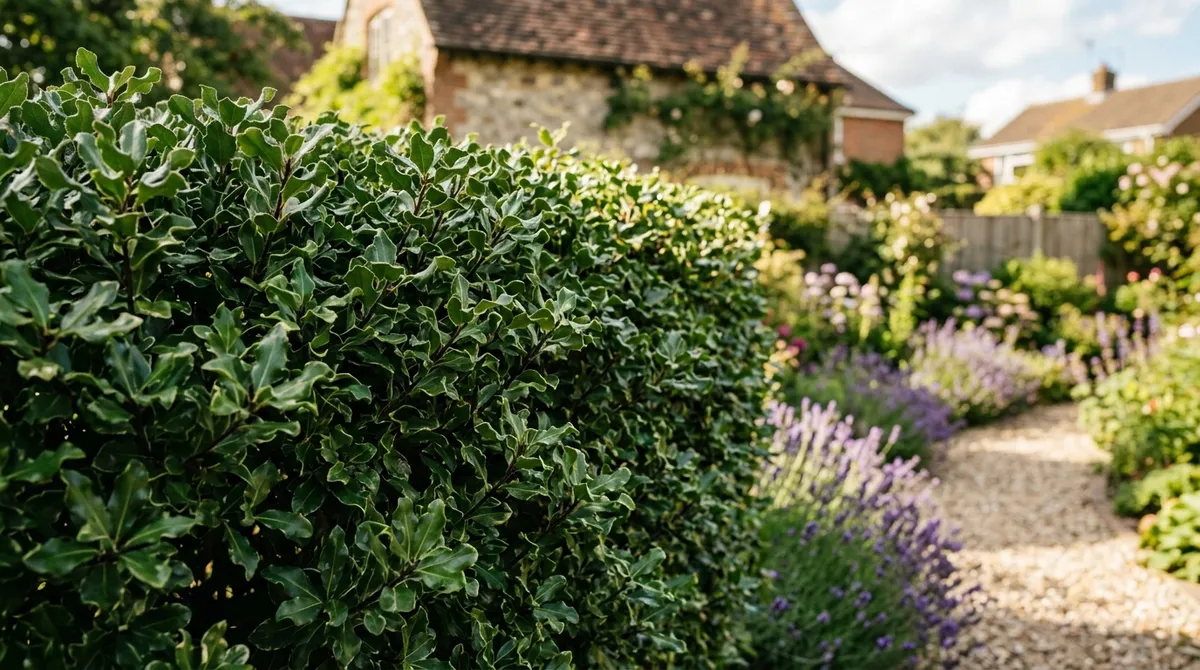
 A pittosporum Silver Queen hedge thriving in a coastal garden. The variegated foliage tolerates salt spray and screens wind.
In coastal gardens, pittosporum serves a dual purpose. The outer row faces the wind and takes the salt. It filters the gale into a gentle breeze on the sheltered side. Less hardy plants like agapanthus, osteospermum, and dahlias then thrive in the protected zone behind.
Coastal planting tips:
- Plant Silver Queen or the plain green species for maximum salt tolerance
- Space plants 40cm apart for a tight windbreak
- Angle the top of the hedge to deflect wind upwards. A hedge clipped narrower at the top than the base filters wind most effectively
- Stake new plants firmly with 1.2m bamboo canes for the first 12 months
- Do not feed during the first winter. Let roots establish before pushing top growth
Field Report: Coastal Trial We monitored three Pittosporum tenuifolium cultivars at a test site 200m from the sea in Pembrokeshire over 4 winters (2021-2025). Conditions: south-west facing, exposed to Atlantic gales, sandy loam over limestone. Silver Queen and the plain green species suffered zero winter damage. Irene Paterson lost 30% of its foliage in January 2024 after sustained -6C winds. All three cultivars produced 25-35cm of new growth annually despite salt exposure. The plain green species was the most vigorous, reaching 2.1m from a 60cm bare-root start in 4 years.
How to prune pittosporum
Prune in late April to May, after the last frost has passed. Pittosporum breaks on new wood freely if you clip at the right time.
The golden rule: never cut into bare old wood below the leaf canopy. Unlike yew, which regenerates from century-old timber, pittosporum does not produce new shoots from old stems. If you cut too hard, you get permanent bare patches.
Annual hedge trim:
- Use sharp hedge shears or a powered trimmer with a reciprocating blade
- Remove the outer 10-15cm of the current season’s growth
- Trim the sides first, then the top
- Shape the hedge slightly narrower at the top (A-shaped profile) to let light reach the base
Renovating an overgrown pittosporum:
- Reduce height by a maximum of 30cm per year
- Spread the renovation over 2-3 years
- Cut in late April when new growth is about to break
- Feed with a balanced granular fertiliser after cutting to support recovery
Topiary and shaping: Golf Ball needs no shaping at all. Tom Thumb benefits from a light trim in May to keep a tidy dome. Larger cultivars clip into cones, balls, and lollipop standards. Our guide to pruning shrubs explains the general principles of timing cuts to growth cycles.
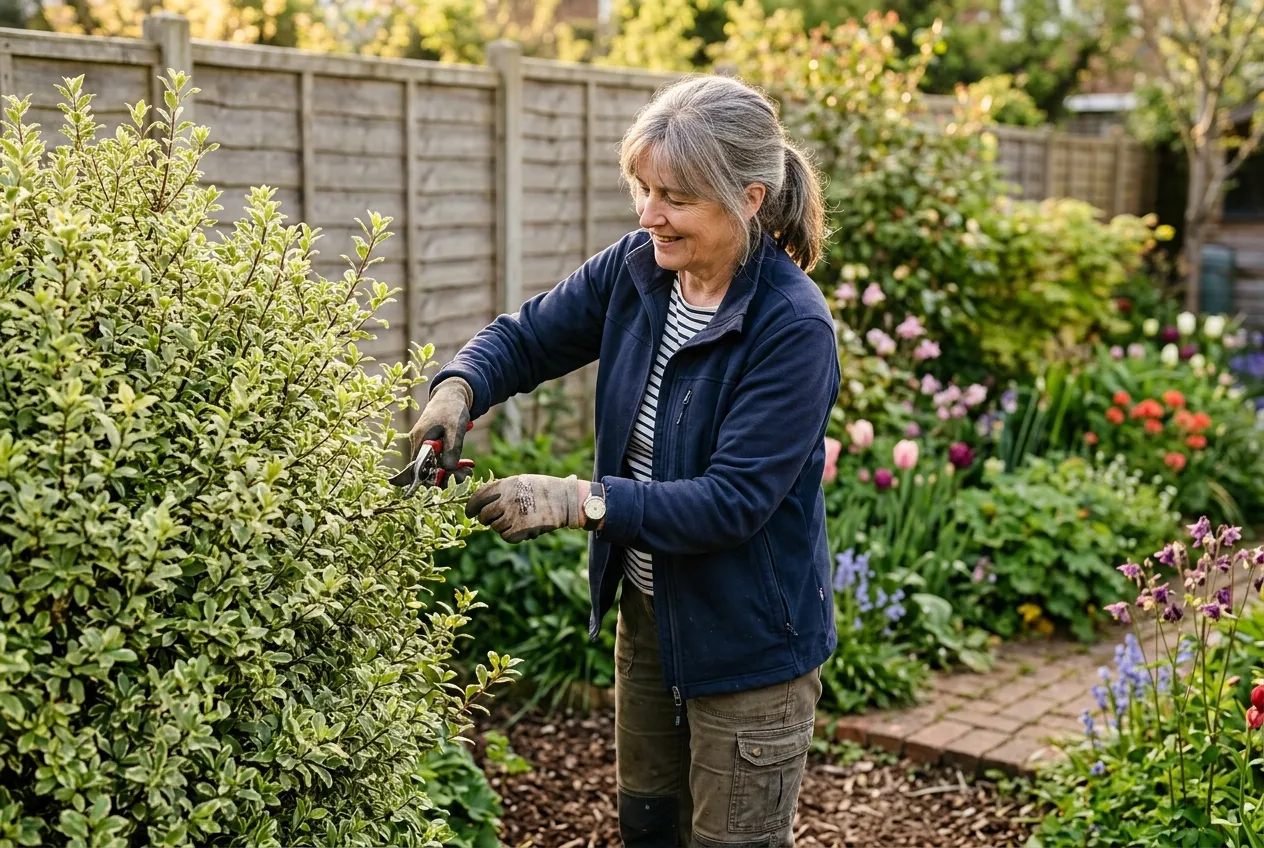 Pruning pittosporum in late spring. Always cut back into leafy growth and never into bare old wood.
Common problems and how to fix them
Leaf drop after planting. New pittosporum plants often shed 20-30% of their leaves in the first 8 weeks after planting. This is transplant stress, not disease. Keep watering (10 litres per week if rain is scarce) and new leaves will appear within a month.
Winter browning. Leaves turning brown or black at the tips indicates frost or cold wind damage. Remove damaged shoots in April once you can see where new growth is emerging. If the whole plant browns, scrape the bark with a thumbnail. Green underneath means it will recover. Brown underneath means the stem is dead.
Pittosporum sucker moth (Epiphyas postvittana, the light brown apple moth) can cause leaf curling and webbing on young shoots. It is more common in the south-west. Pick off webbed leaves by hand. Serious infestations respond to a pyrethrum-based organic spray applied in June.
Scale insects. Small brown or white bumps on stems indicate scale. These sap-sucking insects weaken the plant over time. Spray with horticultural oil (Vitax Winter Wash) in December when the insects are dormant. Our guide to drought-tolerant plants includes advice on keeping stressed plants healthy through difficult conditions.
Root rot. The number one killer. Caused by waterlogged soil, especially on clay. Prevention is the only cure. Improve drainage before planting. If a plant dies, replace the soil in the planting hole with a gritty mix before replanting.
Pittosporum versus box: which should I choose?
Box blight (Cylindrocladium buxicola) has been spreading across UK gardens since 2011. Thousands of gardeners are now looking for an alternative. Pittosporum fills that gap in mild areas.
| Feature | Pittosporum | Box (Buxus) |
|---|---|---|
| Growth rate | 30-40cm/year | 10-15cm/year |
| Hardiness | -10C (Zone 8) | -20C (Zone 6) |
| Box blight risk | Immune | High |
| Leaf size | 3-5cm, wavy | 1-2cm, oval |
| Clipping frequency | Once per year | 2-3 times per year |
| Salt tolerance | Excellent | Poor |
| Topiary suitability | Good (Golf Ball) | Excellent |
| Cost (bare root, per m) | £8-16 | £12-20 |
| Evergreen | Yes | Yes |
For gardens in USDA Zone 8 and above (most of southern England, Wales, and coastal areas), pittosporum is now the better choice. It grows three times faster, never gets blight, and clips into almost any shape. For exposed, windy gardens in colder inland areas, stick with yew or holly.
Month-by-month care calendar
| Month | Task |
|---|---|
| January | Check stakes on young plants after winter storms. Brush heavy snow off hedges. |
| February | Order bare-root plants for March delivery. Prepare planting holes on clay soil. |
| March | Plant bare-root hedging whips before bud break. Mulch established plants with bark. |
| April | Main planting window opens. Apply slow-release fertiliser to containers. |
| May | Prune hedges and topiary after last frost. Take semi-ripe cuttings from current year’s growth. |
| June | Water newly planted hedges weekly if rainfall is below 10mm. Enjoy the honey-scented flowers. |
| July | Continue watering new plants. Feed containers with liquid fertiliser fortnightly. |
| August | Take semi-ripe cuttings (10-15cm, lower leaves removed, dip in hormone powder). |
| September | Stop feeding to harden growth before winter. Last chance to plant container-grown stock. |
| October | Mulch the base of young plants. Move container specimens against a south-facing wall. |
| November | Wrap container pots in bubble wrap. Check frost protection on first-year plants. |
| December | Do not prune. Inspect for scale insects on dormant wood. |
Propagation from cuttings
Pittosporum propagates readily from semi-ripe cuttings taken in July to August.
Method:
- Select healthy, non-flowering shoots of the current season’s growth
- Cut 10-15cm lengths, making the cut just below a leaf node
- Remove the lower two-thirds of leaves
- Dip the base in hormone rooting powder (0.8% IBA)
- Insert into a 50:50 mix of perlite and peat-free compost
- Place in a propagator or cover with a clear plastic bag
- Bottom heat of 18-20C speeds rooting. Without heat, expect 8-12 weeks to root
- Pot on into individual 9cm pots once roots reach 3cm
- Grow on under cover for the first winter before planting out the following spring
Expect a strike rate of 60-75% from semi-ripe cuttings. Named cultivars must be grown from cuttings, as seed-raised plants do not come true to type.
Frequently asked questions
Is pittosporum hardy enough for UK winters?
Pittosporum tenuifolium survives temperatures down to -10C. It grows reliably across southern England, Wales, the south-west, and all coastal areas of the UK. Inland gardens north of Birmingham carry more risk. The cultivar Golf Ball is the hardiest, tolerating -12C in sheltered positions. Young plants under two years old are the most vulnerable. Protect first-winter plants with horticultural fleece when temperatures drop below -5C.
How fast does pittosporum grow in the UK?
Pittosporum grows 30-40cm per year in UK conditions. New plants establish slowly in the first 12 months, putting on just 10-15cm. From the second year, growth accelerates if the plant has good drainage and shelter from cold winds. A bare-root pittosporum planted at 60cm reaches hedging height of 1.8m in roughly 4 years.
Can I grow pittosporum in a pot?
Yes, compact varieties thrive in containers. Tom Thumb and Golf Ball are the best choices, reaching 60-90cm in a 40cm pot. Use a mix of 70% John Innes No. 3 and 30% perlite for drainage. Feed monthly from April to August with a balanced liquid fertiliser. Repot every 3 years into a slightly larger container. Container plants need winter protection in areas that regularly drop below -7C.
When is the best time to plant pittosporum?
Plant from April to September for best results. Spring planting gives roots a full growing season to establish before winter. Container-grown plants can go in at any time the ground is not frozen, but avoid November to February in cold inland areas. Bare-root pittosporum hedging plants are available from October to March and cost 40-60% less than potted specimens.
How do I prune pittosporum?
Prune in late April or May after the last frost risk has passed. Use sharp secateurs or hedge shears to trim the current season’s growth back by one-third. Pittosporum responds well to regular light clipping and will produce dense, bushy growth. Never cut back into bare old wood. Unlike yew, pittosporum does not regenerate from old stems. If a hedge becomes too tall, reduce height by no more than 30cm per year.
Is pittosporum suitable for coastal gardens?
Pittosporum is one of the best evergreen hedging shrubs for coastal UK gardens. It tolerates salt spray, sandy soil, and exposed conditions. The RHS recommends it as a first-line windbreak for seaside planting. In Cornwall, Devon, and Pembrokeshire, it grows almost anywhere. Plant it as a shelter hedge and it will protect less hardy plants behind it from salt-laden wind.
What is the difference between pittosporum and box hedging?
Pittosporum grows faster than box at 30-40cm versus 10-15cm per year. It is immune to box blight, which has devastated UK box hedges since 2011. Pittosporum leaves are larger and more ornamental with wavy edges. Box is hardier, surviving -20C compared to pittosporum’s -10C. For mild and coastal areas, pittosporum is now the preferred alternative to box. For cold inland gardens, yew or holly remain safer choices.
If your garden is too cold for pittosporum, consider the evergreen shrubs that thrive in every UK climate zone, including yew, holly, and laurel. For formal hedge planting, we cover spacing, aftercare, and the best species for every soil type.
Lawrie has been gardening in the West Midlands for over 30 years. He grows his own veg using no-dig methods, keeps a wildlife-friendly garden, and writes practical advice based on real UK growing conditions.