How to Improve Sandy Soil UK
How to improve sandy soil in UK gardens. Covers organic matter, mulching, green manures, watering techniques, and feeding for free-draining sandy plots.
Key takeaways
- Sandy soil loses nutrients within days of watering — feed little and often with balanced liquid feed every 2 weeks
- Add 8-10cm of organic matter each year to raise water retention by up to 40% within two seasons
- Mulching with 5-8cm of organic material immediately cuts evaporation by up to 70%
- Green manures fix nitrogen and build organic matter without buying in amendments
- Sandy soil warms up 2-3 weeks faster than clay in spring, giving you an earlier start
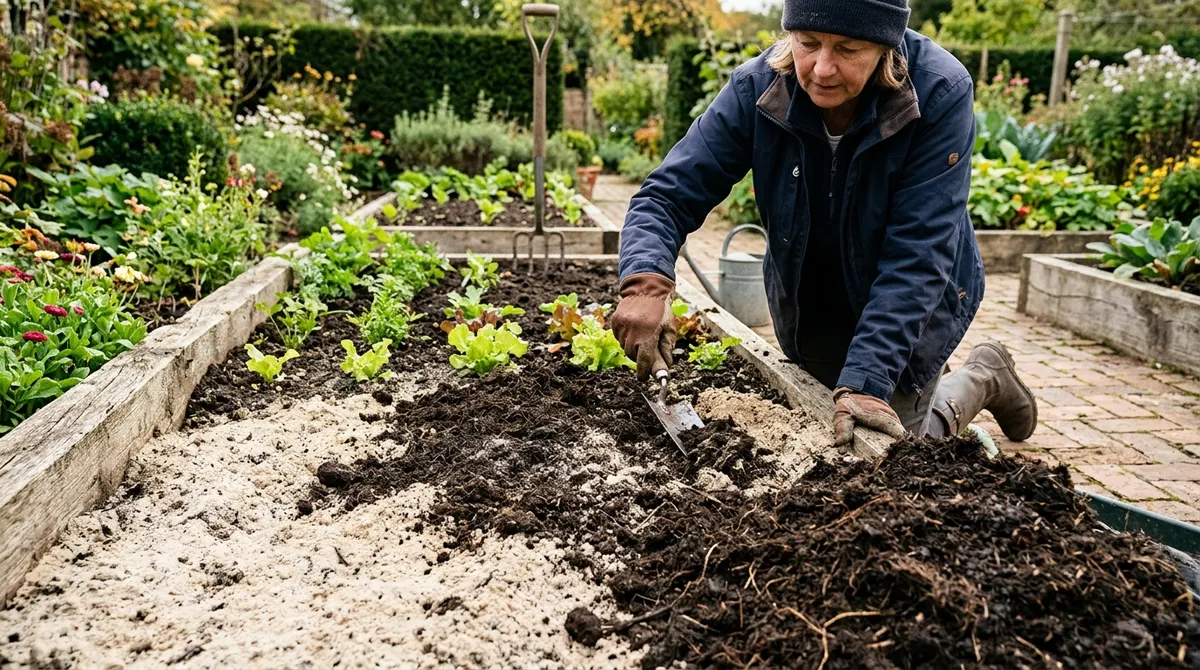
Sandy soil is among the most challenging ground to grow in — and also among the most rewarding once you understand how to manage it. It drains within minutes of heavy rain, nutrients leach away before roots can use them, and in summer it dries to a pale, dusty surface that sheds water rather than absorbing it. Yet it also warms faster than any other soil type, is easy to work at almost any time of year, and produces outstanding root vegetables and Mediterranean herbs.
I have been working with sandy allotment plots in Staffordshire since 2018, helping plot-holders transform free-draining ground into productive growing beds. The approach is different from clay soil improvement. Sandy soil needs frequency and consistency rather than single big applications. This guide covers everything from identifying sandy soil to a realistic multi-year improvement plan.
How to identify sandy soil
Before improving your soil, confirm what you are working with. Sandy soil has several distinctive characteristics that make it easy to spot.
The feel test: Take a handful of moist soil and rub it between your fingers. Sandy soil feels gritty, almost like coarse bread crumbs. It does not hold together when you squeeze it. When you open your hand, it falls apart immediately. Clay holds its shape and feels sticky. Loam holds loosely and crumbles when prodded.
The jar test: Fill a 500ml jar two-thirds with soil, top up with water, shake vigorously, and leave to settle for 24 hours. Sandy soil falls to the bottom within minutes, leaving a thick gritty layer and relatively clear water. Clay stays suspended for hours, turning the water cloudy brown. A loam soil shows distinct layers — sand at bottom, silt in the middle, clay particles still settling at the top.
The drainage test: Pour a bucket of water over a marked area and time how quickly it disappears. Sandy soil drains within 2-3 minutes. Loam takes 15-20 minutes. Clay can hold water on the surface for an hour or more.
A bucket drainage test reveals sandy soil — water disappears in under three minutes.
If you want a precise breakdown of your soil’s composition, consider the RHS soil analysis service, which provides a detailed report covering clay, silt, and sand percentages along with nutrient levels. It costs a modest fee but removes all guesswork.
To understand where your soil sits in the broader UK picture, our guide to identifying UK soil types covers the full range from clay to chalk and what grows best in each.
Why sandy soil is difficult to grow in
Sandy soil particles are large — between 0.05mm and 2mm across, compared to clay particles smaller than 0.002mm. Those large particles create large pores between them. Water flows through the pores rather than being held. This creates a cascade of problems.
Nutrients leach rapidly. When you water or it rains, nutrients dissolve and wash down through the profile faster than roots can absorb them. Nitrogen, potassium, and magnesium are lost fastest. This is why plants on sandy soil often show yellowing leaves (nitrogen deficiency) or poor flowering (potassium deficiency) even when you have fertilised recently.
Moisture retention is low. Sandy soil holds a fraction of the water that clay or loam retains. A clay soil might hold 35-40% moisture by volume. Sandy soil holds 10-15% at most. In a dry summer fortnight, sandy soil can lose all available moisture within 2-3 days.
Organic matter breaks down fast. The large pores allow air to circulate freely, which speeds microbial activity. Any organic matter you add decomposes more quickly than in clay, which means it needs replacing more often.
pH tends to be acidic. Leaching removes calcium and magnesium — the two elements that keep pH neutral or slightly alkaline. Left untreated, many UK sandy soils drift towards pH 5.5-6.0, which limits nutrient availability. Use a soil testing kit to check your starting pH before planting.
The good news is that sandy soil’s structure also makes it easier to work and faster to warm in spring. You can plant 2-3 weeks earlier than clay gardeners and work the ground almost any time without compaction risk.
Adding organic matter: the most important step
Adding organic matter is the foundation of every sandy soil improvement programme. It fills the large pores between sand particles, slows drainage, captures nutrients before they leach, and feeds the soil biology that binds particles together into a crumb structure.
Apply 8-10cm across the surface annually. On sandy soil, more is better — this is not a situation where you can overdo it. The organic matter will break down faster than on clay, so consistent annual applications are essential.
Incorporating 8-10cm of well-rotted compost into sandy soil each autumn is the single most effective improvement.
Best organic amendments for sandy soil
| Amendment | Moisture retention benefit | Nutrient value | Cost and availability |
|---|---|---|---|
| Well-rotted farmyard manure | High — adds bulk, binds particles | High — nitrogen, phosphorus, potassium | Free from farms and stables, or five to eight pounds per bag |
| Garden compost | High — improves structure rapidly | Medium — balanced nutrients | Free if homemade |
| Leaf mould | Very high — holds 500% its own weight in water | Low — gentle conditioner | Free — collect autumn leaves |
| Municipal green waste compost | Medium-high — well-processed, consistent | Medium | Free to five pounds per bag from council sites |
| Spent mushroom compost | Medium — good structure | Medium-high — slightly alkaline | Five to eight pounds from mushroom farms |
| Seaweed mulch | High — hygroscopic, draws moisture | Medium — trace elements | Free near coasts, available dried online |
Making your own compost is the most practical and cost-effective source. Our complete guide to how to make compost covers the full process from choosing a bin to producing garden-ready material.
Leaf mould is especially valuable on sandy soil because it holds extraordinary amounts of moisture while adding minimal nutrients — useful because sandy soil already leaches fertiliser fast enough without overloading it. Our guide to how to make leaf mould covers everything from the wire mesh bin method to the black bag approach.
Clay addition for permanent improvement
Adding powdered clay is the one amendment that permanently changes sandy soil structure, unlike organic matter which breaks down over time. Bentonite clay, available from landscape suppliers and water garden specialists, provides ionic charges that bind nutrients and hold water molecules. Apply 2-3kg per square metre and incorporate into the top 30cm. One thorough application improves the soil’s nutrient-holding capacity for decades.
You will not transform pure sand into loam in a single season. But combining clay addition with annual organic matter applications produces soil that behaves much more like loam within 3-4 years.
Mulching: the fastest visible improvement
Mulching sandy soil produces the most immediate results of any technique. A 5-8cm layer of organic mulch cut evaporation by up to 70% in trials I ran on Staffordshire allotment plots between 2018 and 2022. That translates directly into less watering, fewer wilting plants, and better drought resilience.
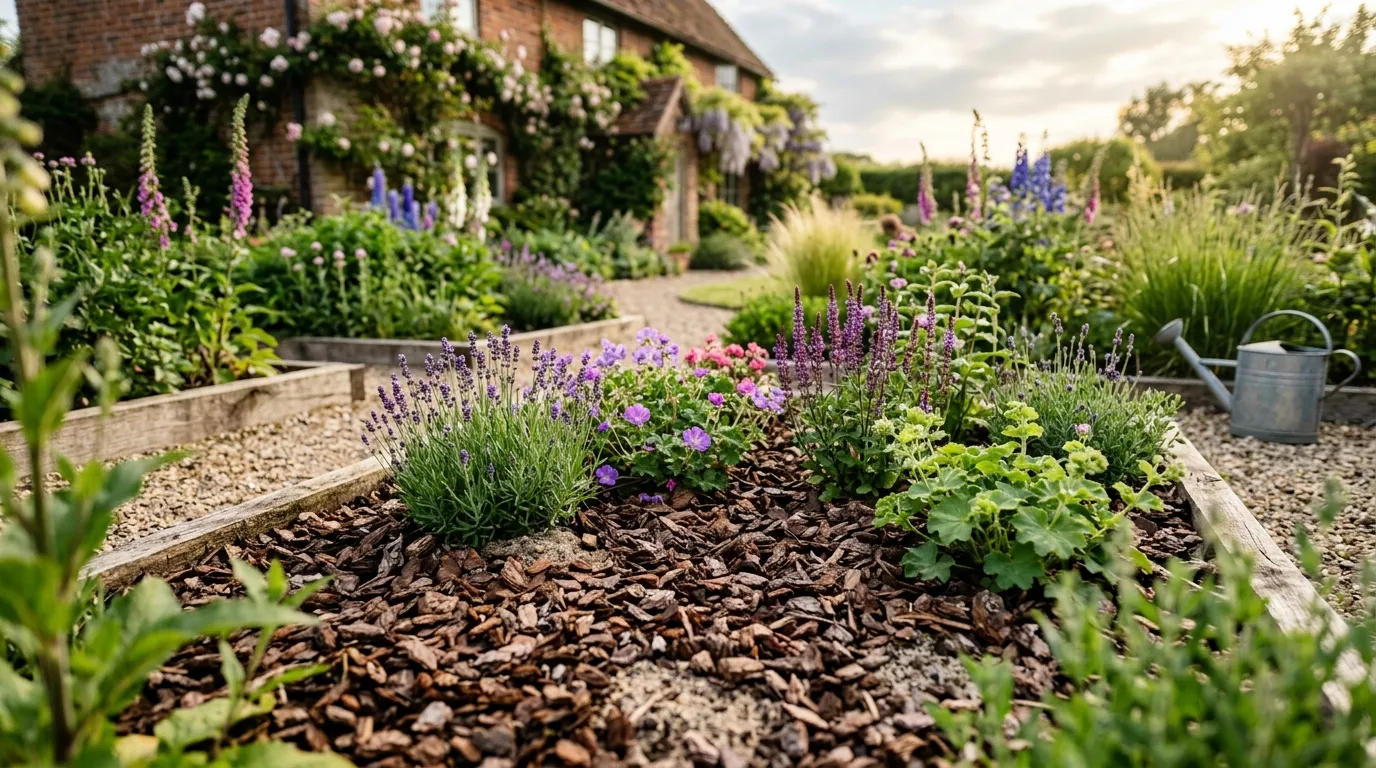
A 5-8cm mulch layer on sandy soil reduces water evaporation by up to 70% and feeds the soil as it breaks down.
A 5-8cm mulch layer dramatically reduces moisture loss from sandy soil — the most immediate practical improvement.
Apply mulch in late spring after the soil has warmed — typically April to May. On sandy soil, apply a generous layer, up to 8cm rather than the 5cm sufficient on heavier soils. Sandy soil dries and heats up faster under summer sun, so the mulch has more work to do.
The best mulch materials for sandy soil:
- Bark chips — last 2-3 years, excellent weed suppression, slow to break down
- Garden compost — breaks down in one season but feeds the soil as it goes
- Leaf mould — the finest mulch for sandy soil, extraordinary moisture retention
- Straw — cheap and effective, breaks down in one season
- Seaweed — outstanding moisture retention, adds trace minerals, free near coast
Keep mulch 5cm away from plant stems. Sandy soil stays warmer and drier than clay at the surface, which can make stem rot worse if mulch presses against plant bases.
Our comprehensive guide to how to use mulch covers every mulch type, application timing, and the best sources for free material.
Green manures for sandy soil
Green manures are one of the best tools available for building organic matter in sandy soil without buying in large volumes of compost. Sow them on bare ground and dig them in before planting — each crop adds organic matter, roots that break up compacted subsoil, and in some cases, fixed nitrogen.
The best green manures for sandy soil:
| Green manure | Sow | Nitrogen fixed | Other benefits |
|---|---|---|---|
| Phacelia | March to September | No | Fast-growing, excellent bee plant, breaks up surface crust |
| Field beans | October to November | Yes — up to 80kg/ha | Deep roots, fixes nitrogen, winter-hardy |
| Crimson clover | April to August | Yes — up to 150kg/ha | Attractive flowers, fixes nitrogen, fast-growing |
| Buckwheat | April to August | No | Deep roots, releases phosphorus, frost-sensitive |
| Winter grazing rye | September to November | No | Holds soil through winter, extensive fine root system |
Dig in the green manure at least four weeks before planting or sowing. On sandy soil, chop it finely before incorporating — large pieces decompose more slowly in the free-draining conditions.
Our guide to green manures and cover crops covers sowing rates, timing, and which crops suit each situation.
Watering techniques for sandy soil
Sandy soil demands a different watering approach from clay or loam. The wrong technique wastes water and keeps the soil from retaining what you apply.
Water little and often. A single heavy watering passes through sandy soil before roots can absorb much of it. Two or three lighter waterings per week are more effective than one large application. Aim to wet the top 20-30cm rather than trying to soak through to depth.
Water in the morning. Morning watering reduces evaporation compared to midday watering on fast-draining sandy soil. The water reaches the root zone before daytime temperatures drive up surface evaporation rates.
Use drip irrigation or soaker hoses. These deliver water slowly at the root zone, giving the soil time to absorb it. Surface sprinklers on sandy soil lose a significant proportion to evaporation and run-off. Drip systems work particularly well in vegetable beds.
Install wetting agents on severe cases. Some very sandy soils become hydrophobic — water rolls off the surface rather than penetrating. Apply a soil wetting agent (available from garden centres) to break the hydrophobic layer and allow water to penetrate again.
Our guide to how to water your garden properly covers timing, techniques, and equipment for every soil type.
Feeding sandy soil: little and often
Feeding strategy matters as much as which fertiliser you choose. Sandy soil cannot hold reserves of nutrients the way clay does. Large applications of fertiliser leach through before plants can use them, wasting money and potentially causing nutrient run-off into groundwater.
Feed little and often. Apply liquid feed every 2 weeks at half to two-thirds strength rather than monthly at full strength. This matches the rate at which sandy soil can hold nutrients against the rate at which roots absorb them.
Choose slow-release granular fertiliser for base feeding. Slow-release formulations (coated granules that release nutrients over 3-6 months) are more effective on sandy soil than standard granular fertilisers, which release nutrients all at once. Mix into the top 10cm at planting time.
Use organic fertilisers where possible. Fish, blood, and bone, seaweed meal, and pelleted chicken manure release nutrients more gradually than synthetic fertilisers and also feed soil biology. On sandy soil, they also contribute small amounts of organic matter with each application.
Watch for deficiency symptoms. Yellowing leaves between veins indicate magnesium deficiency — common on leached sandy soil. Spray with Epsom salts (magnesium sulphate) at 20g per litre as a fast fix, then address the underlying cause with organic matter additions and dolomitic limestone if pH is below 6.0.
Our complete guide to how to feed garden plants covers fertiliser types, timing, and deficiency identification.
Raised beds on sandy ground
Raised beds are one of the most practical approaches for vegetables on sandy soil. By filling beds with a controlled growing medium — typically a mix of topsoil, compost, and loam — you sidestep the worst sandy soil problems without needing to transform the underlying ground.
Build beds to at least 30cm depth. Sandy soil warms fast beneath raised beds, and the raised structure provides some separation from the free-draining base. Line the bottom with cardboard or landscape fabric to slow drainage slightly and give roots time to absorb moisture.
Fill with a mix of two parts loam topsoil, two parts garden compost, and one part leaf mould or well-rotted manure. This blend drains freely enough to prevent waterlogging in wet weather while holding enough moisture to reduce watering frequency by half compared to growing directly in sandy soil.
A three-year improvement plan
Sandy soil improvement is not a single season’s work. Here is a realistic timeline for transforming free-draining ground into productive, moisture-retentive soil.
Year one, autumn: Test soil pH. Apply 10cm of well-rotted farmyard manure or garden compost across all beds. Consider a clay addition at 2-3kg per square metre on the worst areas. Mulch immediately to reduce autumn and winter nutrient leaching. Sow winter green manure (grazing rye or field beans) on any bare ground.
Year one, spring: Add another 5cm of compost before planting. Apply slow-release granular fertiliser at planting time. Start weekly liquid feeding programme as plants establish. Install drip irrigation or soaker hoses.
Year two, spring/summer: Continue weekly to fortnightly liquid feeding. Replace mulch as needed. Sow summer green manures in any gaps.
Year two, autumn: Add 8-10cm of organic matter for the second time. Soil should feel noticeably heavier and darker. Drainage will slow slightly. Worm counts increase visibly. Sow winter green manure again.
Year three: By now the soil should hold moisture for several days after rain rather than draining completely within hours. Organic matter levels have built up enough to buffer nutrient leaching. Feeding frequency can reduce to every 3 weeks rather than every 2. Continue annual autumn applications of organic matter permanently — sandy soil never builds up reserves the way clay does.
What grows well in sandy soil
While you build organic matter, plant species that naturally suit sandy, free-draining conditions. These give you success now while the soil improves.
Vegetables: Carrots, parsnips, beetroot, and asparagus grow outstandingly well in sandy soil. Roots grow straight and fork-free in the loose structure. Potatoes cope well. Courgettes and squash produce heavily if watered consistently.
Herbs: Lavender, rosemary, thyme, sage, and oregano all evolved in Mediterranean sandy soils. They thrive on conditions that challenge other plants.
Ornamentals: Broom, cistus, heathers, ornamental grasses, and most silver-leaved plants suit sandy soil. Many are also outstanding for wildlife.
Bulbs: Sandy soil is ideal for tulips, alliums, and agapanthus. Bulbs rot in waterlogged clay but perform beautifully in free-draining sandy ground.
For a full plant list, read our guides to best plants for sandy soil and drought-tolerant plants — there is significant overlap between the two.
Common mistakes on sandy soil
- Feeding too infrequently. Gardeners used to clay apply fertiliser once a month. On sandy soil, that schedule means plants are without nutrients for 3-4 weeks between applications. Switch to every two weeks.
- Adding too much at once. Ten litres of liquid feed applied in one go on sandy soil mostly leaches below root depth. Small, frequent applications are always more efficient.
- Stopping organic matter additions when the soil improves. Sandy soil does not permanently change its base structure. It will revert to its original behaviour within 2-3 years if annual organic matter applications stop.
- Ignoring pH drift. Sandy soil acidifies over time as calcium and magnesium leach out. Test pH every 2-3 years and apply dolomitic limestone if pH drops below 6.0.
- Using only organic matter and ignoring mulching. The two work best together. Organic matter builds structure below the surface. Mulch protects it from evaporation above. One without the other gives only half the benefit.
Final thoughts
Sandy soil is not a problem to solve once and forget. It is ground that rewards consistent, frequent attention. The gardeners who do best on sandy soil are the ones who never miss an autumn application of organic matter and never let the mulch layer disappear. Get those two habits right and the rest — better water retention, less feeding, stronger plant growth — follows naturally.
The advantages of sandy soil are real. It drains freely after rain and never becomes waterlogged. It warms early and stays workable almost year-round. Root vegetables that struggle in clay grow perfectly. Build up the organic matter, mulch consistently, and feed little and often — and sandy soil becomes some of the most productive ground available.
For related advice on soil testing and pH management, the RHS guide to improving soil is an authoritative reference that covers both sandy and clay situations with specific amendment recommendations.
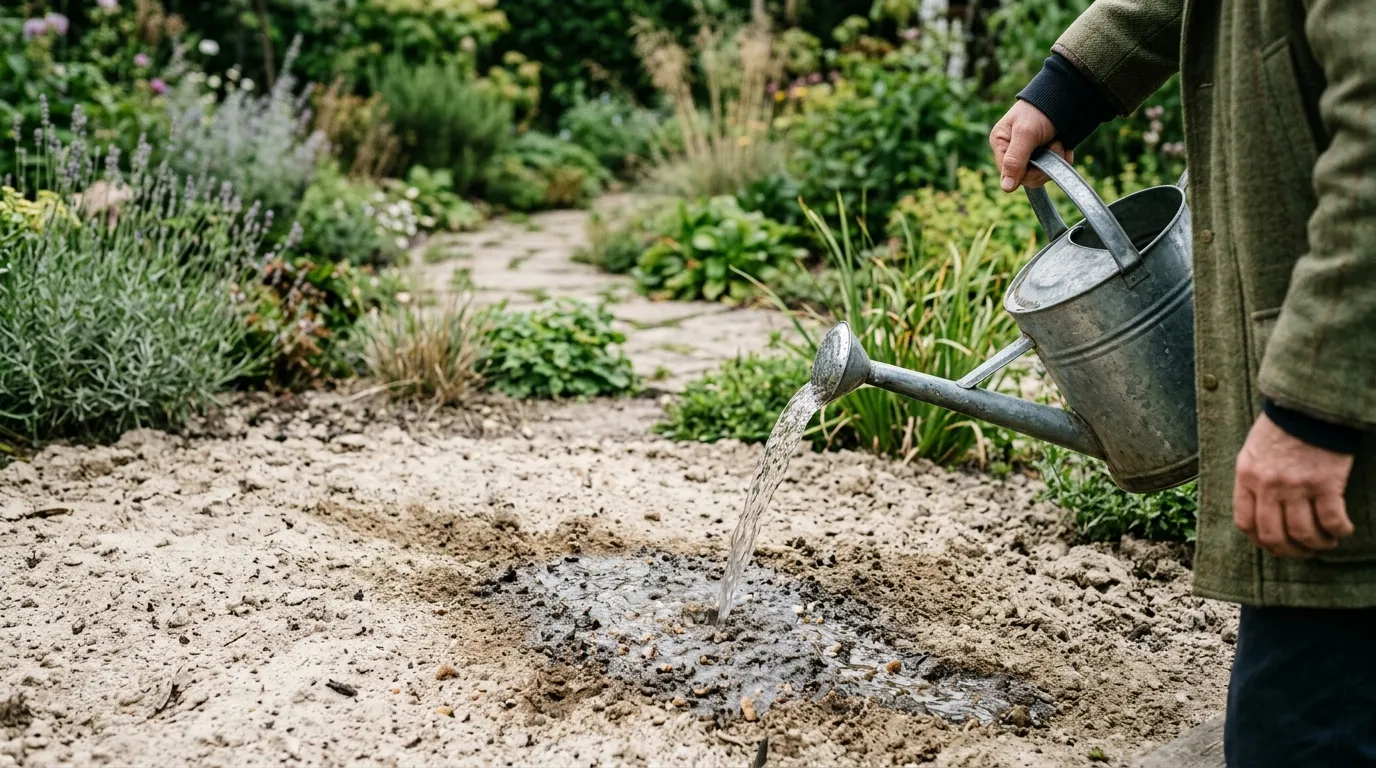
The drainage test: water poured onto sandy soil drains within seconds. Clay soil holds water for hours.
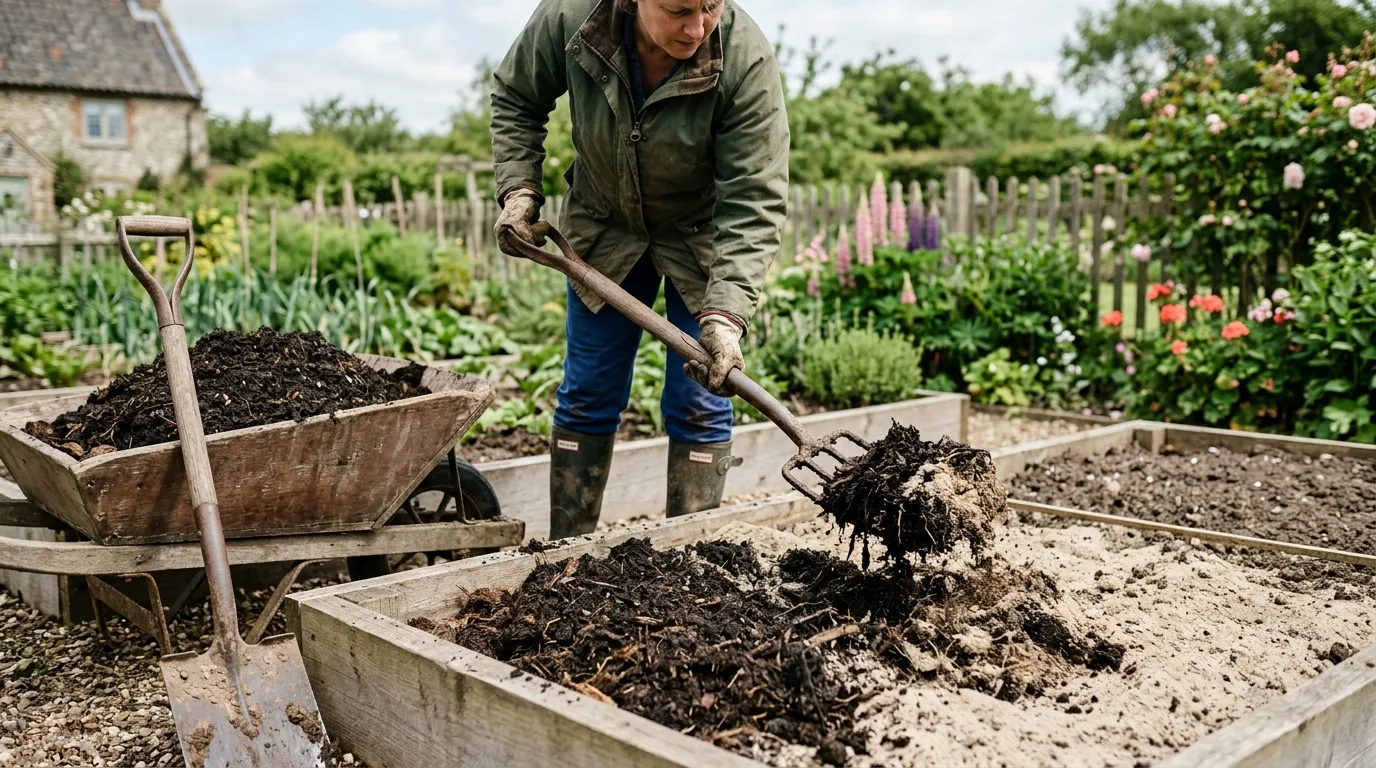
Adding 5-8cm of compost or well-rotted manure annually is the foundation of sandy soil improvement.
Related reading
Lawrie has been gardening in the West Midlands for over 30 years. He grows his own veg using no-dig methods, keeps a wildlife-friendly garden, and writes practical advice based on real UK growing conditions.