Key takeaways
- Four yucca species are fully hardy outdoors in the UK, tolerating -12C to -20C
- Do not confuse hardy yuccas with the houseplant Yucca elephantipes, which dies below 5C
- Full sun and sharp drainage are essential — yuccas rot in waterlogged clay soil
- Established plants are drought-tolerant and need virtually no watering or feeding
- Dramatic 1.5-2m white flower spikes appear after 5-7 years, usually in July-August
- Y. filamentosa is the hardiest species at -20C and the best choice for cold northern gardens
Hardy yucca plants bring bold, architectural drama to UK gardens with virtually zero maintenance. These evergreen rosettes of sword-shaped leaves thrive in full sun, tolerate drought, and survive UK winters down to -20C depending on species. They are not the soft, tropical houseplant sold in supermarkets, outdoor yuccas are tough, spiny, and built to endure.
Four species grow reliably outdoors across the British Isles. Once established in free-draining soil, they ask for nothing: no watering, no feeding, no spraying. The reward, after 5-7 years of patience, is a dramatic flower spike reaching 1.5-2m, studded with hundreds of white bell-shaped blooms. This guide covers the right species for UK conditions, planting on difficult soils, and the one factor that kills more yuccas than cold ever does: waterlogging.
Which yucca species are hardy in the UK?
Four species have proven track records outdoors in British gardens. The common houseplant Yucca elephantipes (spineless yucca) is NOT hardy and dies below 5C. Do not confuse it with the species listed here.
| Species | Hardiness | Mature height | Spread | Leaf type | Flower spike |
|---|---|---|---|---|---|
| Y. gloriosa | -15C | 150-200cm | 150cm | Stiff, dark green, sharp tips | 150-200cm, white tinged purple |
| Y. filamentosa | -20C | 75-100cm | 100cm | Soft, green, curly white threads | 150-200cm, creamy white |
| Y. recurvifolia | -12C | 150-200cm | 120cm | Flexible, blue-green, drooping | 100-150cm, white |
| Y. rostrata | -12C | 200-300cm | 100cm | Narrow, blue-grey, stiff | 100-150cm, white |
Yucca gloriosa (Spanish dagger) is the most commonly grown outdoor yucca in the UK. It forms a stout trunk over time and produces stiff, dark green leaves with dangerously sharp points. Mature specimens develop multiple heads. It thrives in coastal and urban gardens and is naturalised on sand dunes in southern England.
Yucca filamentosa (Adam’s needle) is the hardiest species at -20C and the best choice for northern England and Scotland. It stays compact as a stemless rosette and is the most likely to flower. The common name refers to the distinctive curly white fibres along the leaf edges. ‘Bright Edge’ and ‘Color Guard’ are popular variegated cultivars.
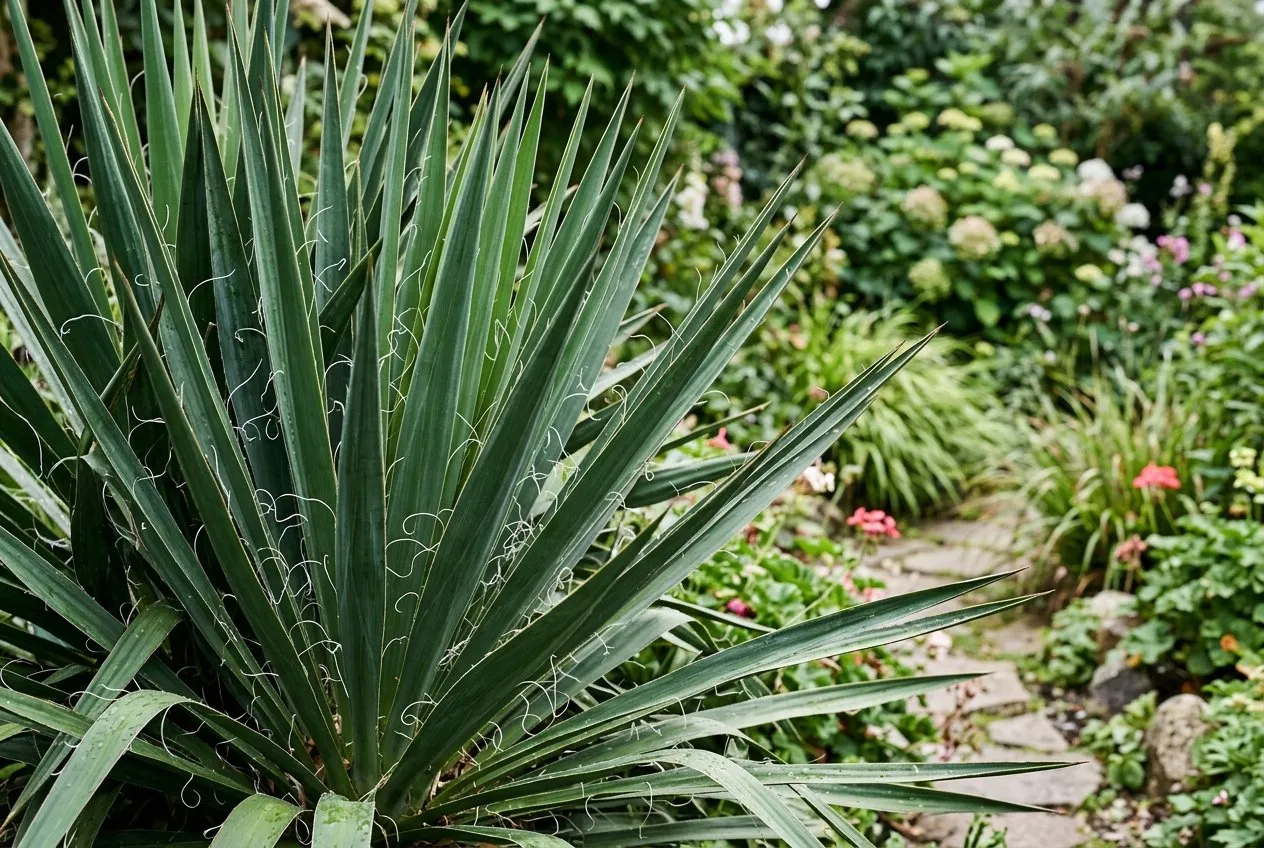 Yucca filamentosa is the hardiest species at -20C and the most reliable flowerer in UK conditions.
Yucca recurvifolia has softer, arching leaves that are less hazardous than Y. gloriosa. The blue-green foliage droops gracefully and the plant forms a short trunk with age. It is slightly less hardy at -12C but survives in most of England and sheltered Welsh and Scottish gardens.
Yucca rostrata (beaked yucca) is the most architectural species, forming a 2-3m trunk topped with a perfect sphere of narrow, blue-grey leaves. It is the hardiest trunk-forming yucca and makes a striking centre piece. Specimens at RHS Wisley and the Beth Chatto Gardens have survived decades outdoors.
Where to plant yucca in a UK garden
Two factors determine success: full sun and sharp drainage. Yuccas evolved in semi-arid regions of North and Central America. They photosynthesise most efficiently in direct sunlight and store water in their roots and trunk base. Shade weakens growth and prevents flowering.
Drainage is the critical factor in UK conditions. Most yucca deaths in British gardens are caused by root rot from winter waterlogging, not cold. Heavy clay soil holds water around the root crown for weeks during autumn and winter, creating conditions that rot the fleshy roots. Even species hardy to -20C will die in a waterlogged clay bed.
The solution is soil modification. Dig out a planting area 60cm wide and 40cm deep. Fill the lower half with 50:50 sharp grit and topsoil. Plant the yucca so the crown sits 10-15cm above the surrounding soil level. Top-dress with 5cm of gravel or decorative stone. This raised, free-draining mound mimics the rocky, well-drained slopes where yuccas grow naturally.
South-facing walls, gravel gardens, and raised beds are ideal locations. Avoid north-facing positions, low-lying frost pockets, and any area where puddles form after rain.
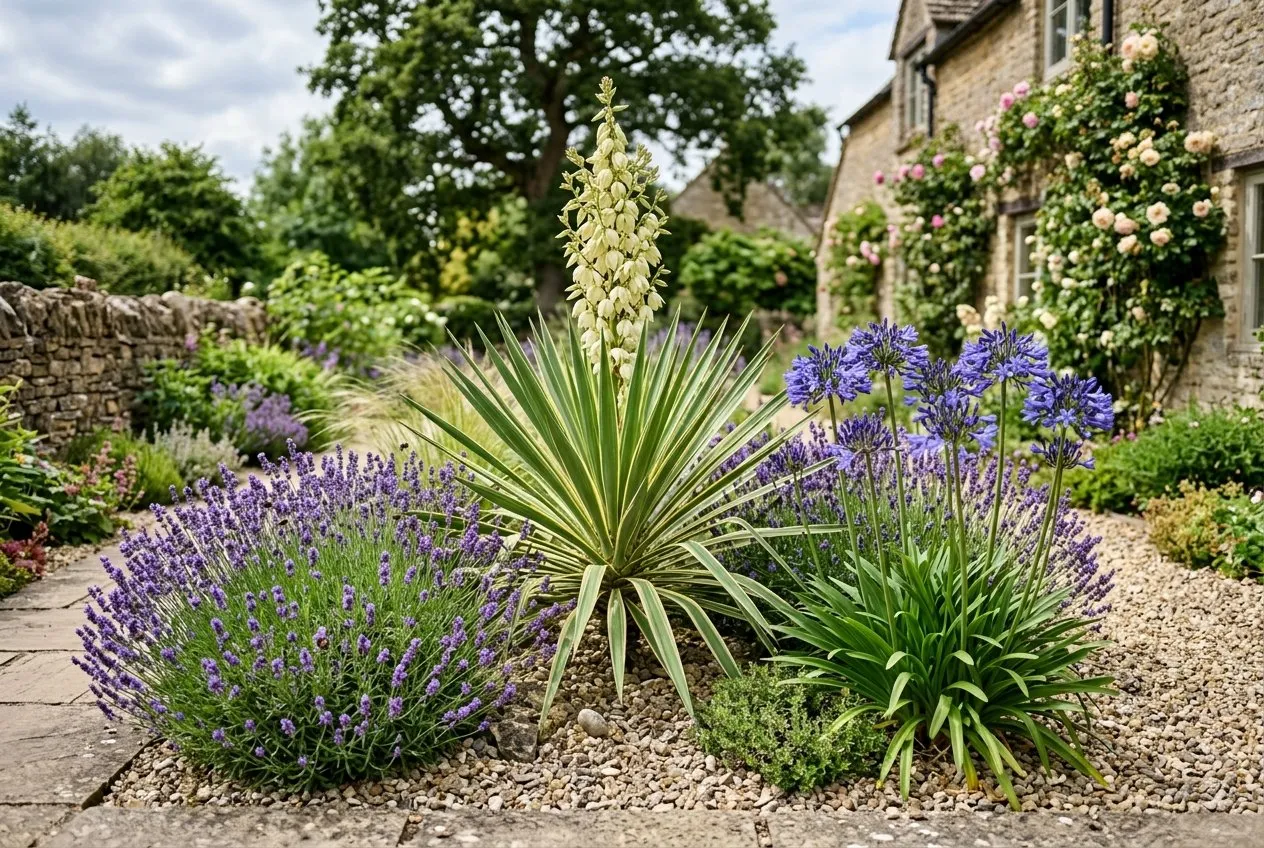 A raised gravel bed against a south-facing wall provides the perfect drainage and warmth for yuccas.
How to plant a yucca outdoors
Plant yuccas in spring (April-May) or early autumn (September). Spring planting gives the longest establishment period before winter. Container-grown plants from garden centres transplant with minimal root disturbance.
Dig the modified planting hole as described above. Remove the yucca from its pot and check the root ball. If roots are circling, tease them out gently. Position the plant so the crown sits at the same level as it was in the pot, or slightly higher. Backfill with the grit and topsoil mix. Water once to settle the soil, then do not water again unless there is a prolonged dry spell in the first summer.
Wear thick leather gloves when handling yuccas. The leaf tips of Y. gloriosa and Y. rostrata are genuinely dangerous, sharp enough to puncture skin and even eye-safe glasses. Tape a wine cork onto the tip of each leaf when working close to the plant. This is not an exaggeration; A&E departments in areas with large yucca populations report regular eye injuries from garden plants.
For container planting, use a pot of at least 40 litres with wide drainage holes. Fill with 50% John Innes No. 3 and 50% horticultural grit. Top-dress with gravel. Stand the pot on feet throughout winter to ensure water drains freely.
How to care for yucca plants in the UK
Established yuccas need almost nothing. This is one of their greatest virtues for low-maintenance gardens.
Watering: Do not water established yuccas in the ground. Ever. UK rainfall provides more than enough moisture. Overwatering is the fastest way to kill a yucca. Container yuccas need water once a fortnight in summer and none at all from October to March.
Feeding: Yuccas prefer poor soil. Rich, fertile conditions produce floppy growth that is vulnerable to rot. If you want to feed, apply a light dressing of controlled-release fertiliser in April. But most gardeners find their yuccas grow perfectly well without any feeding at all.
Removing dead leaves: The lower leaves turn brown and papery as the plant grows. Some gardeners prefer the natural skirt of dead leaves hanging down the trunk. Others remove them for a cleaner look. Cut close to the trunk with sharp secateurs in spring. Do not pull dead leaves off, as this can tear the bark.
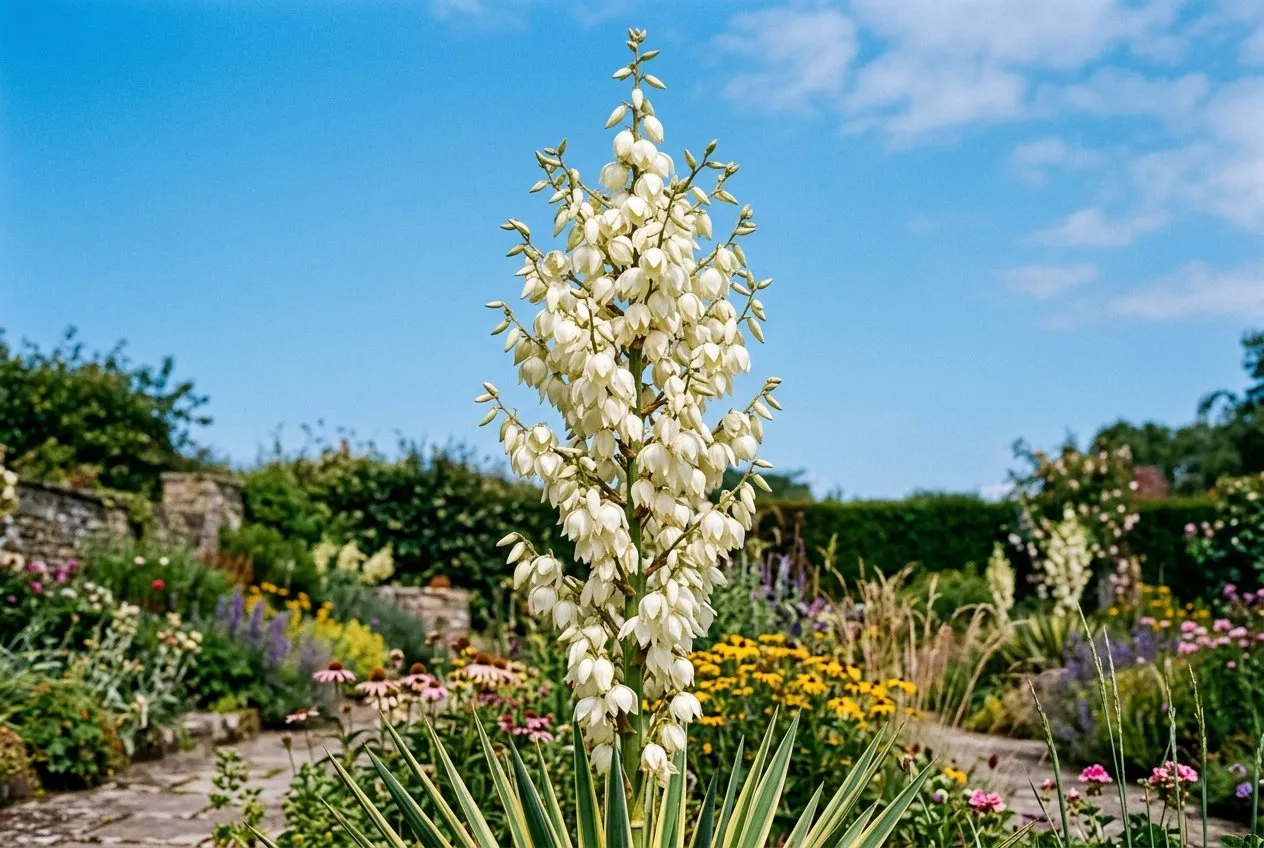 A Yucca gloriosa flower spike reaches 1.8m with over 200 individual bell-shaped white blooms.
When and how do yuccas flower in the UK?
Yucca flower spikes are among the most dramatic displays any garden plant can produce. A spike emerges from the centre of the leaf rosette in early July and grows rapidly over 2-3 weeks, reaching 1.5-2m. It carries 100-200 individual bell-shaped flowers in white or cream, sometimes tinged with purple.
Flowering depends on the previous summer’s heat. Hot summers build up the energy reserves that trigger flower spike development the following year. After the cool summers of 2023 and 2024, flowering was sparse in many UK gardens. The warm summer of 2022 produced widespread yucca flowering across southern England.
Y. filamentosa is the most reliable flowerer in UK conditions, often producing spikes annually once mature. Y. gloriosa flowers every 2-3 years on average. Y. rostrata may take 10-15 years to flower from planting, but the wait is worth it.
In the wild, yuccas are pollinated by yucca moths (Tegeticula spp.) in a famous example of obligate mutualism. These moths do not exist in the UK, so yuccas never set seed outdoors here. The flower spike can be cut off after flowering or left to dry and removed in autumn.
How to propagate yucca plants
Yuccas produce offsets (pups) from the base that can be separated and replanted. Wait until offsets are at least 15-20cm tall with their own root system before removing. Use a sharp spade to sever the pup from the parent plant in spring, cutting through the connecting root cleanly. Pot into gritty compost and keep in a sheltered spot for the first winter.
Stem sections of Y. gloriosa and Y. recurvifolia can also root successfully. Cut a 30cm section of trunk, allow the cut to dry for a week, then insert the base into gritty compost. Roots and shoots emerge over 6-12 weeks. This is how nurseries propagate large quantities.
Root cuttings work for Y. filamentosa. Dig up a thick root in spring, cut into 10cm sections, and lay horizontally in a tray of gritty compost. New shoots emerge in 4-8 weeks.
Common problems with yucca in the UK
Root rot
The number one killer. Caused by waterlogged soil, especially heavy clay in winter. Symptoms include soft, brown tissue at the base, collapsed leaves, and a foul smell. Once the crown rots, the plant cannot be saved. Prevention is everything: plant in modified, free-draining soil and raise the crown above ground level.
Leaf spot
Brown or grey spots on leaves, usually caused by fungal pathogens in humid conditions. Remove affected leaves. Improve air circulation. Leaf spot rarely threatens the overall health of the plant.
Scale insects
Brown, dome-shaped insects on leaf surfaces, particularly in sheltered positions. Wipe off with a damp cloth or spray with an organic pest control product. Heavy infestations are unusual outdoors.
Physical damage from wind
Y. rostrata’s long, narrow leaves can snap in strong gales. Plant in a position sheltered from prevailing westerly winds. Y. gloriosa and Y. filamentosa have stiffer leaves and handle wind better.
Designing with yuccas in UK gardens
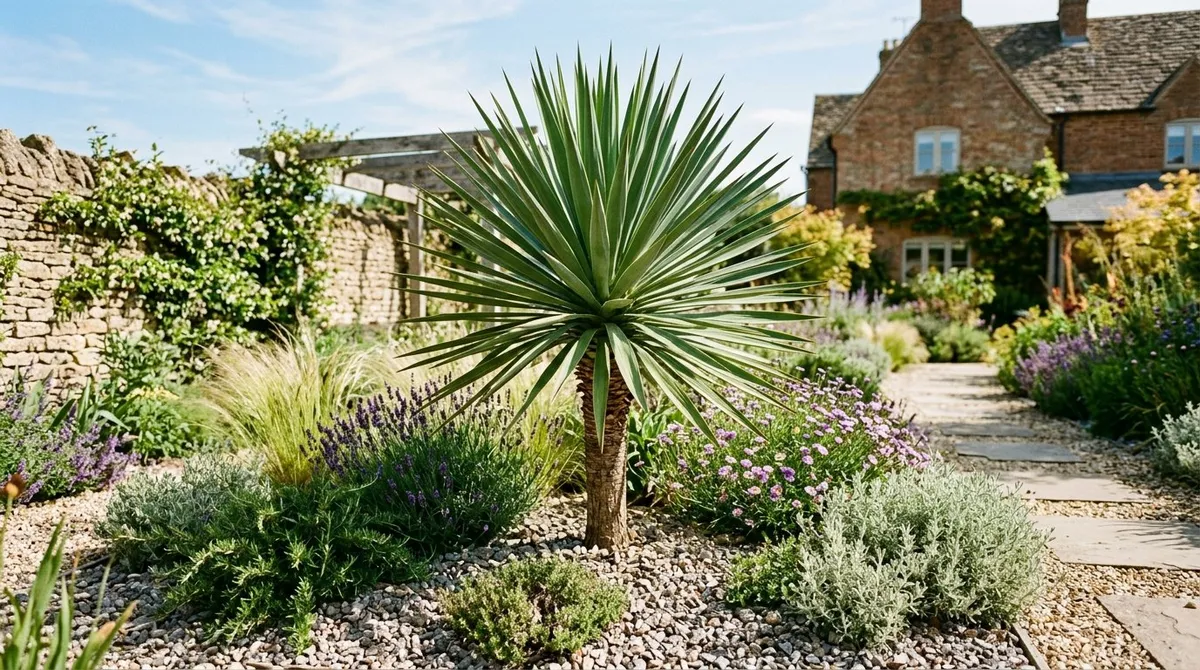
Yuccas work as centre pieces in drought-tolerant planting schemes. Pair them with Mediterranean plants such as lavender, rosemary, santolina, and ornamental grasses. The stiff, architectural form of yucca contrasts with the soft, billowing texture of grasses like Stipa tenuissima and Miscanthus.
In gravel gardens, group yuccas with agave (in pots, brought in for winter), Phormium tenax, and Cordyline australis for an exotic, subtropical look. Against a warm south-facing wall, underplant with Erigeron karvinskianus and Verbena bonariensis for a relaxed, Mediterranean atmosphere.
Yuccas also work in large containers on terraces, balconies, and courtyards. Their evergreen presence gives year-round structure when deciduous plants are bare.
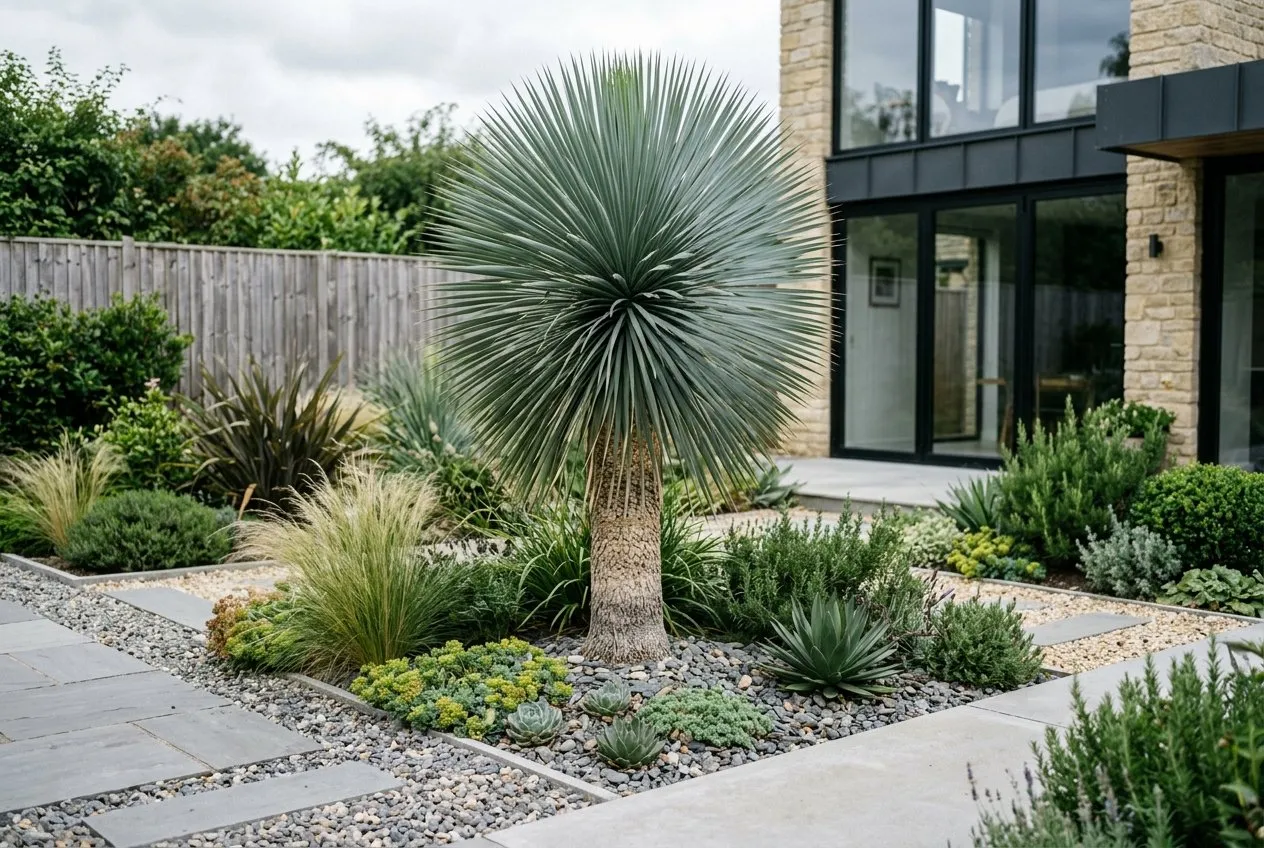 Yucca rostrata’s perfect blue sphere of narrow leaves creates an outstanding centre piece in gravel gardens.
Frequently asked questions
Can yucca grow outside in the UK?
Yes, four yucca species grow reliably outdoors year-round. Y. gloriosa (to -15C), Y. filamentosa (to -20C), Y. recurvifolia (to -12C), and Y. rostrata (to -12C) are all fully hardy. They need full sun and free-draining soil. The common houseplant Y. elephantipes is not hardy and dies below 5C, it must stay indoors.
How long does it take a yucca to flower in the UK?
Most hardy yuccas take 5-7 years to produce their first flower spike. Y. filamentosa often flowers earliest, sometimes within 3-4 years of planting. Y. gloriosa typically takes 5-7 years. The flower spike grows rapidly over 2-3 weeks in July, reaching 1.5-2m with hundreds of white bell-shaped blooms. Not every plant flowers every year.
Why is my outdoor yucca dying?
The most common cause is root rot from waterlogged soil. Yuccas cannot tolerate standing water around their roots during winter. Improve drainage by adding 30% sharp grit to the planting hole and raising the plant 10-15cm above the surrounding soil level. Crown rot (soft, brown centre) is usually fatal. Leaf browning in winter is normal for Y. gloriosa.
Do I need to protect yucca in winter in the UK?
Y. filamentosa and Y. gloriosa need no winter protection anywhere in the UK. Y. rostrata benefits from rain protection (a small overhead cover) in areas with heavy winter rainfall, as it dislikes prolonged wet conditions more than cold. Wrapping leaves with fleece is unnecessary for hardy species and can trap moisture, worsening rot risk.
How do you remove dead leaves from a yucca?
Cut dead lower leaves close to the trunk with sharp secateurs in spring. Wear thick gloves because yucca leaf tips are extremely sharp. Leave 5-10cm of the leaf base attached, as pulling leaves off can tear the trunk bark. Some gardeners remove the dry skirt of dead leaves for a clean trunk look. Others leave it for insect habitat.
Can I grow yucca in a pot outdoors?
Yes, all four hardy species suit large containers of 40 litres or more. Use a mix of 50% John Innes No. 3 and 50% horticultural grit. Ensure drainage holes are open and raise the pot on feet for winter drainage. Container yuccas stay smaller and flower less often than ground-planted specimens. Water sparingly, once a fortnight in summer, not at all in winter.
Our team produces practical UK gardening guidance from source research, contributor records and established horticultural practice. Editorial standards are overseen by Matt W.