Key takeaways
- Pea moth lays eggs on pea flowers between mid-June and mid-August in most of England
- Early peas sown by mid-March and finished flowering by mid-June escape the egg-laying window
- Late peas sown after mid-June and flowering after mid-August also escape attack
- Mid-season peas (flowering late June to early August) need fleece netting or pheromone traps
- Without prevention, 30-60% of pods in mid-season crops contain caterpillars
- Pheromone traps are best used as a monitoring tool to time fleece application
Pea moth is the single biggest cause of disappointment in UK home-grown pea crops. The caterpillar is what you find when you open the pod expecting a row of peas and instead see frass, a tunnel, and a small green grub. By the time the damage is visible the moth has been and gone, the pods are unmarketable, and the plot holder has lost 30-60% of the harvest.
This guide explains the moth’s lifecycle, the egg-laying window that determines when peas are vulnerable, and three working prevention methods. You will find sowing dates, the right fleece specification and pheromone timing. Early and late cultivars are compared in our guide to the best pea varieties.
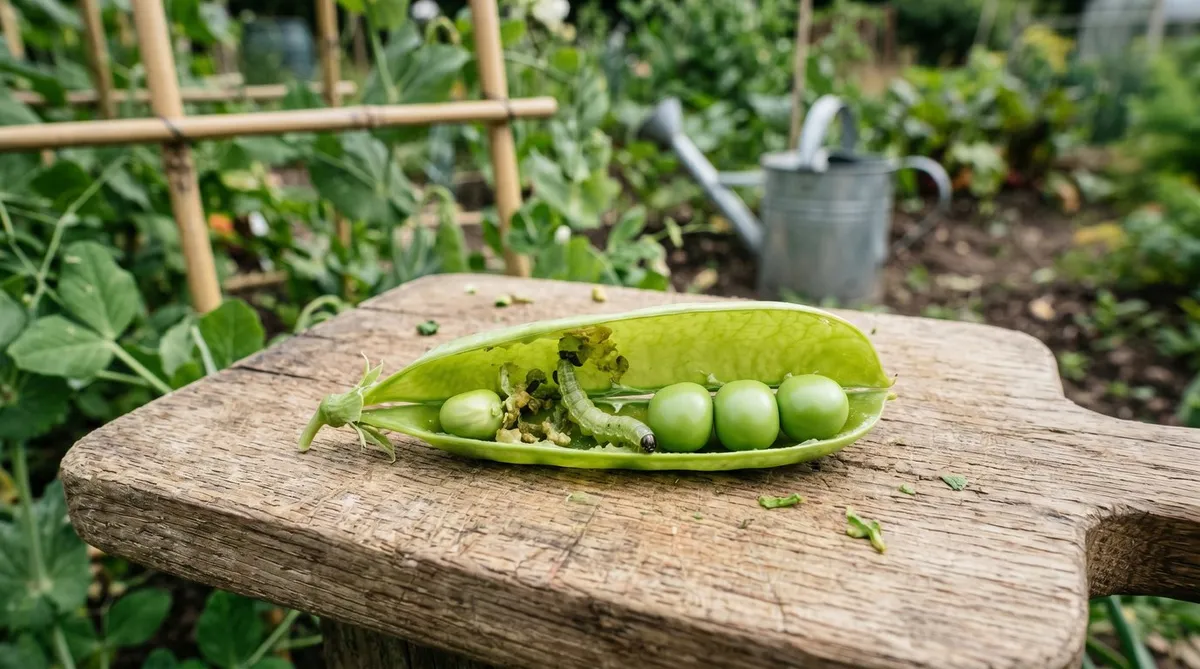
 Pea moth caterpillar inside a Hurst Greenshaft pod, the typical mid-season damage pattern that ruins 30-60% of unprotected UK pea crops
How to identify pea moth damage
Pea moth damage shows when you open the pod. The pod itself looks normal from the outside. Inside, you find a pale green caterpillar 8-12mm long with a dark head, surrounded by frass (caterpillar droppings) and partly-eaten peas. The pod also smells slightly sour where the frass has accumulated.
The adult moth is grey-brown, 6-8mm long, with thin wings. It flies at dusk and rests on pea foliage during the day. Most gardeners never see the adults because they fly between 7pm and 10pm in late June and July.
Eggs are laid singly on the pea flower or developing pod. Each female lays 50-200 eggs over her 7-10 day adult life. Eggs hatch within 7-12 days. The newly hatched caterpillar burrows directly into the pod, leaving a tiny entry hole that scabs over.
Inside the pod the caterpillar feeds for 18-30 days. It eats the developing peas, leaving frass behind. By the time the pod is full size the caterpillar has reached its final 12mm length and is preparing to leave.
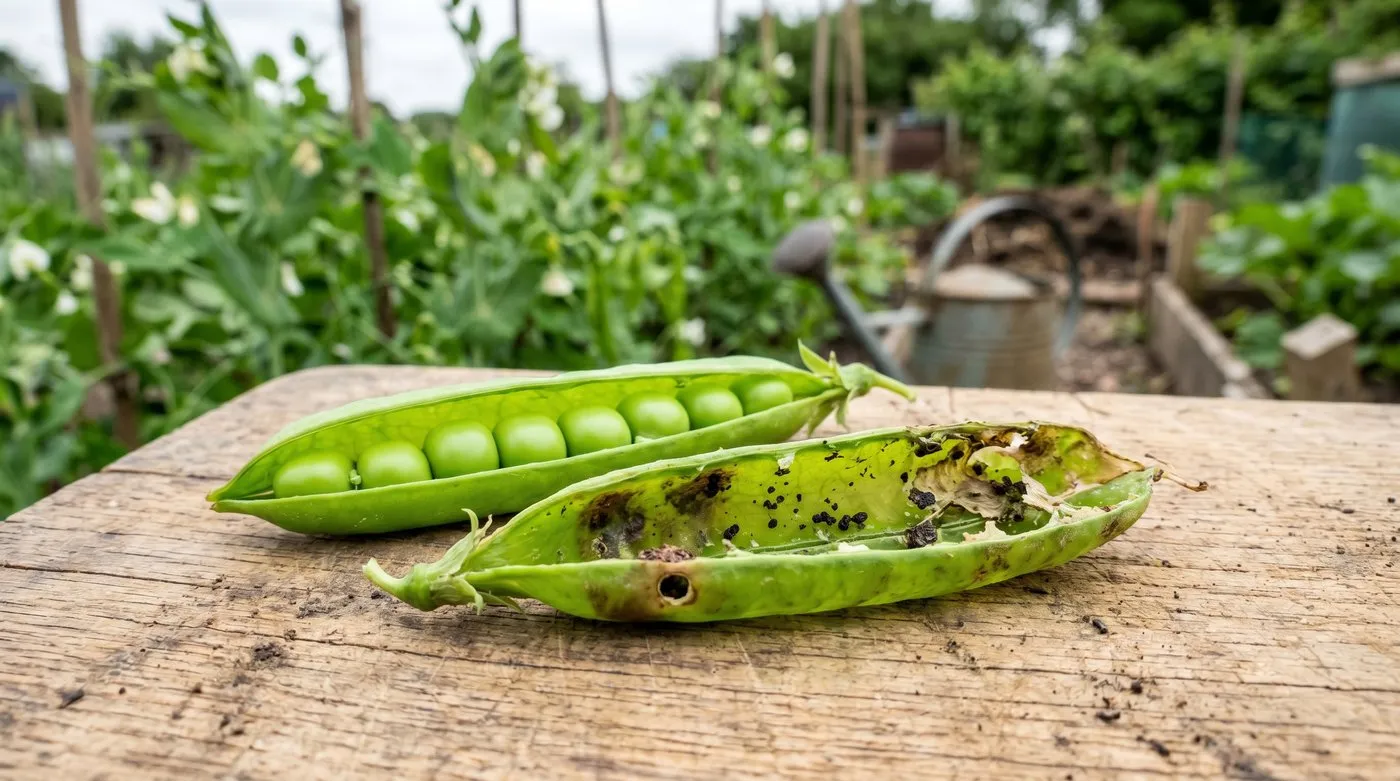
The exit hole is the giveaway sign before harvest. When the pod approaches harvest size, the caterpillar bores a small round hole in the pod wall and drops to the ground. The hole is 2-3mm across and shows on the underside of the pod. Hold a pea pod up to the light: any irregular dark patch or the visible hole means the pod is affected.
Distinguish pea moth from pea aphid. Pea aphid feeds on leaves and flowers, leaving sticky honeydew on foliage. Pea moth lives inside pods. The two pests can occur together but the damage looks different.
| Feature | Pea moth | Pea weevil | Pea aphid |
|---|---|---|---|
| Life stage damaging peas | Caterpillar inside pod | Adult on leaf edges | Adult on stems and leaves |
| Damage location | Inside pod | Leaf scallops | Honeydew on foliage |
| Visible at harvest | Frass and grub in pod | Notched leaves | Sticky residue |
| Best prevention | Sowing date plus fleece | Tolerate, no real threat | Watch for ants |
The pea moth lifecycle in UK gardens
The pea moth lifecycle has four stages over 8-11 weeks during the UK growing season. Understanding the timing is the difference between successful prevention and a 60% crop loss.
Pupa stage runs from October through May. Pupae overwinter in the top 2-5cm of soil where peas were grown the previous year. Crop rotation breaks the lifecycle: peas in a different bed each season force the moth to find new ground.
Adult emergence and first flight peaks 10-20 days after the warmest week of June. This is typically 18-28 June in southern England, 24 June-4 July in the Midlands, and 1-12 July in Scotland. Adults fly at dusk and seek pea flowers for egg-laying.
Egg-laying runs from mid-June to mid-August in most of England. Each female mates within 24 hours of emergence and lays eggs over the next 7-10 days. A single pea flower can carry 1-3 eggs.
Caterpillar feeding runs for 18-30 days inside the pod. By mid-August the caterpillars are fully fed and drop to soil. Some second-generation moths emerge in late August and add a smaller egg-laying window before autumn.
Pupation in the soil from late August onwards. The pupae overwinter under the previous pea crop, ready to emerge the following June.
The critical mistake is sowing peas to flower in late June and early July without protection. This is the maincrop window most gardeners pick because it gives the longest harvest. It is also the most vulnerable window. Either sow earlier and finish flowering by mid-June, sow later and flower after mid-August, or use fleece protection through the danger period.
| Stage | Timing | What is happening |
|---|---|---|
| Overwintering pupa | October-May | In soil under previous crop |
| Adult emergence | Late June-early July | First flight peaks |
| Egg-laying | Mid-June to mid-August | Single eggs on flowers |
| Caterpillar in pod | Late June-mid-September | Feeding, then drops to soil |
| Pupation | Late August onwards | New pupae form |
Prevention method 1: sowing date
Sowing date is the most effective and cheapest method of pea moth prevention. It costs nothing, takes no kit, and gives 90-95% reduction in damage when timed correctly.
Early sowings: mid-February to mid-March. Use first early varieties like Meteor, Feltham First, and Kelvedon Wonder. Sow under cloches if soil is below 6C. These crops finish flowering by mid-June, before the moth’s egg-laying window opens. Damage typically zero.
Late sowings: mid-June to mid-July. Use second early or main crop varieties. Sow direct into prepared ground. These crops flower from mid-August onwards, after the egg-laying window closes. Damage typically 0-5%.
Avoid the danger window: mid-March to mid-June sowings that flower late June to early August. This is the standard maincrop slot most gardeners pick. Damage runs 30-60% without protection.
Adjust sowing dates by region. In southern England the egg-laying window is 5-10 days earlier. In Scotland it is 7-14 days later. In the West Country and South Wales it overlaps a longer period. Track first-flight dates with a pheromone trap to fine-tune.
Gardener’s tip: Make two sowings either side of the danger window rather than one mid-season sowing. Early Meteor in mid-March gives early peas in late June. Late Hurst Greenshaft in late June gives main peas in late August. Both escape pea moth and you have peas across two separate windows.
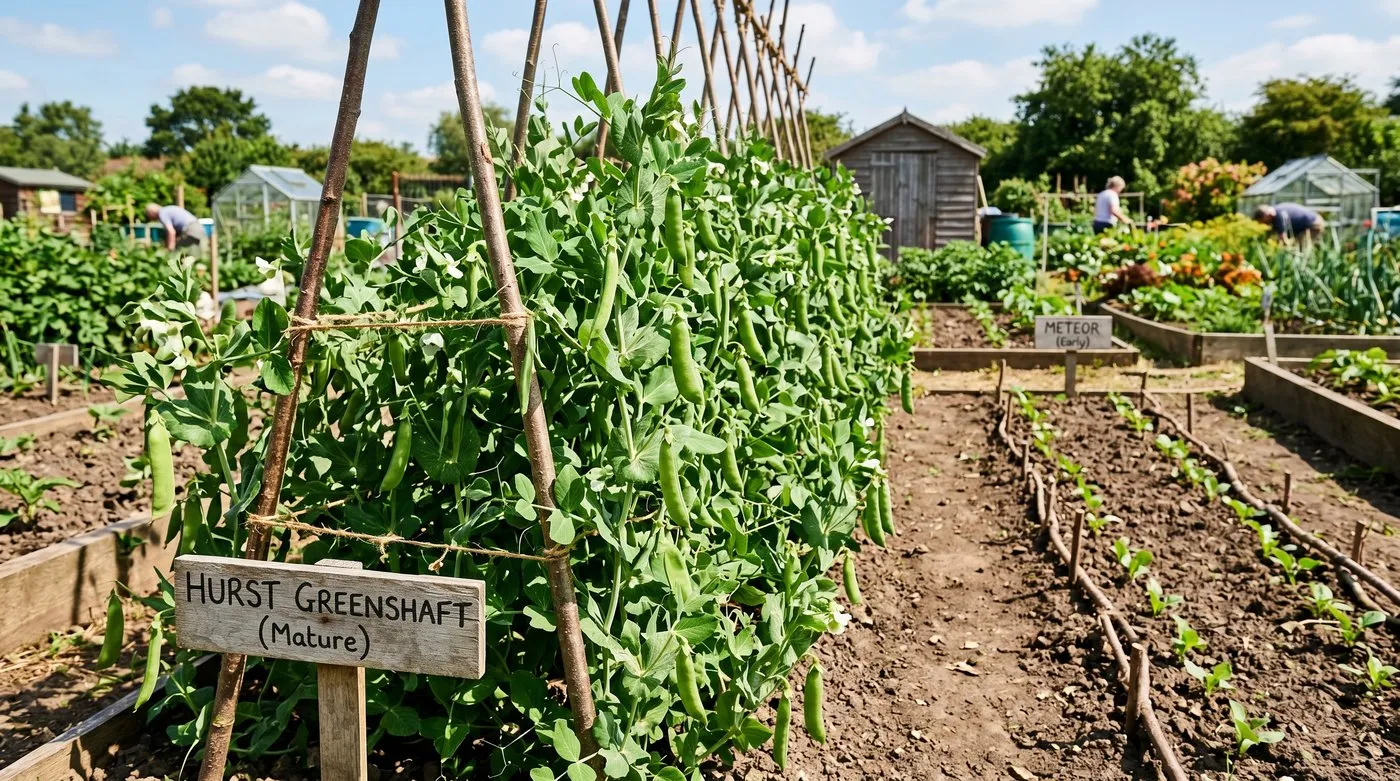 The split sowing approach. Meteor sown 8 March on the left, Hurst Greenshaft sown 30 June on the right. Both flower outside the pea moth window
Prevention method 2: fleece netting
Fleece netting physically blocks egg-laying when peas are flowering inside the danger window. Fit fleece from first flower bud to pod fill. The female moth cannot reach the flowers to lay eggs. Damage drops from 30-60% to 5-10%.
Specification: Enviromesh 1.35mm or finer. Standard horticultural fleece (typically 17-19gsm with 0.4mm holes) is too coarse for pea moth which is small enough to squeeze through. Enviromesh insect mesh, with a 1.35mm hole size, blocks pea moth and pea weevil while allowing bees and pollinators through.
The mesh is fine enough to block pea moth but coarse enough for bees. This sounds contradictory but bees fit through 1.35mm at 90% rate while pea moth fit through 1.35mm at 8% rate. The numbers come from RHS Wisley trials in 2018-2020.
Cost runs £4-£8 per metre at 2-metre width. A 4-metre row needs 6-8 metres of mesh allowing for fixing. Total cost £25-£60 per row. Mesh lasts 5-8 seasons if stored dry between uses.
Fix the mesh on hoops or canes 30-50cm above the pea row. Bury the bottom edge in soil along both sides or weight with bricks. Pollinators find the entry points at the row ends.
 Enviromesh 1.35mm insect netting installed at first flower bud. The fine mesh blocks pea moth but lets bees in through the row-end entry points
Open the mesh at first frost or once pods are filling rapidly. By that point the moth window has closed. Removing the mesh lets you harvest without lifting it each visit.
| Mesh type | Hole size | Pea moth blocking | Pollinator access | Cost per metre |
|---|---|---|---|---|
| Standard fleece | 0.4mm | 95% | Poor | £2-£4 |
| Enviromesh 1.35mm | 1.35mm | 92% | Good | £4-£8 |
| Enviromesh 0.8mm | 0.8mm | 98% | Limited | £5-£9 |
| Bird netting | 20-25mm | 5% | Free | £1-£3 |
Prevention method 3: pheromone traps
Pheromone traps lure male pea moths into a sticky trap using the female sex pheromone. Each captured male is one fewer fertiliser of females, but most plots see only 5-15% mating disruption from a single trap. The real value is monitoring.
Use traps as a monitoring tool, not a stand-alone prevention. When the trap catches the first male of the season, fleece needs to go on within 7-10 days. Female egg-laying typically peaks 7-12 days after first male flight.
Position traps at chest height in the pea bed. Hang from a stake or cane. One trap per 50 square metres of pea bed catches enough males to confirm flight timing. More traps give marginal benefit.
Replace pheromone lures every 6-8 weeks. The pheromone is volatile and dissipates in heat. The trap card itself can stay until the season ends.
UK suppliers of pea moth pheromone traps:
- Agralan Pea Moth Pheromone Trap (£10-£12) - the standard option
- Andermatt Biocontrol pheromone trap (£12-£15) - longer-lasting lure
- Russell IPM pheromone monitoring kit (£15-£25) - 3-trap pack
Combine traps with fleece for the strongest prevention. Trap detects first flight; fleece goes on within a week; eggs cannot reach the flowers. Damage typically drops to 1-3%.
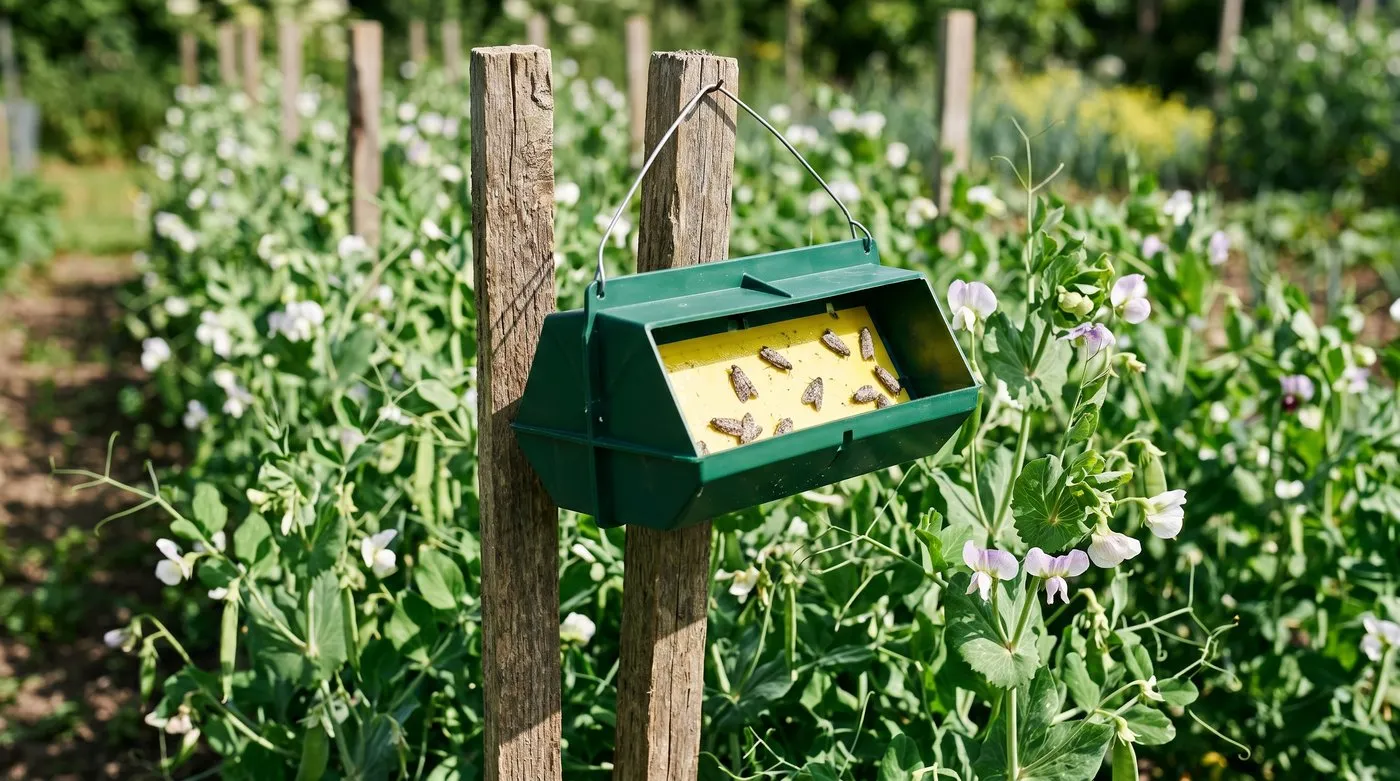 An Agralan pheromone trap two weeks into the flight period showing 14 captured male pea moths, enough data to time fleece application
Cultural controls and crop rotation
Crop rotation breaks the pea moth lifecycle. Pupae overwinter in the soil under the previous pea crop. Moving peas to a different bed each year forces the new generation to find new ground, reducing local populations by 40-60% over 3 years.
Rotation cycle of 3-4 years works well. Year 1 peas, year 2 brassicas, year 3 roots, year 4 alliums or potatoes, then back to peas. This is also good for soil nutrient management.
Dig over the previous pea bed in autumn. Turning the top 5cm of soil exposes pupae to birds, frost, and predatory beetles. Loss rate of pupae rises from 10% to 30-40% with autumn cultivation.
Mulch with manure or chipped bark in winter. A thick mulch suppresses adult emergence in spring; the moths cannot push through 75mm of compacted material. Reduces local populations year on year.
Encourage ground beetles and parasitic wasps. Ground beetles eat pupae and dropped caterpillars. Parasitic wasps (Trichogramma) lay eggs inside pea moth eggs. Both increase with hedgerows, log piles, and pesticide-free management.
 A wildflower strip alongside the pea bed in July. Hoverflies, ladybirds and song thrushes all eat pea moth at different lifecycle stages
Common mistakes to avoid
Sowing maincrop peas in mid-April. This is the standard slot in most UK gardening calendars. It is also the worst possible timing because flowering hits the peak egg-laying window. Either sow earlier or later.
Using standard horticultural fleece. The 0.4mm holes block egg-laying physically but also block bees, leading to poor pollination. Use 1.35mm Enviromesh.
Skipping the trap as a monitoring tool. Without knowing when first flight starts, fleece goes on too early (extra labour) or too late (eggs already laid). The £10 trap saves both.
Leaving pea haulm on the bed over winter. Pupae overwinter in the soil immediately under the previous crop. Composting the haulm and digging the soil exposes pupae to predators and frost.
Replanting peas in the same bed every year. Without rotation, local pea moth populations build year on year. Damage rates climb 5-10% per season in a non-rotated bed.
Step-by-step: protecting a maincrop pea row
Step 1: choose the variety and sowing date. For a mid-season crop in the danger window, choose Hurst Greenshaft, Onward, or Alderman. Sow 7-10 days before the latest safe sowing for your area.
Step 2: prepare the soil and sow. Trench 20cm wide, 5cm deep. Sow seed at 5cm spacing. Cover with soil and water in. Mark row clearly.
Step 3: hang a pheromone trap at chest height in the bed. From mid-June onwards, check the trap weekly. Note the date of the first captured male.
Step 4: prepare fleece on hoops or canes. Hoops at 1-1.5m intervals along the row, 30-50cm above the ground. Have the fleece roll and weights ready.
Step 5: at first flower bud, fit the fleece. Drape the fleece over the hoops. Bury the edges or weight with bricks. Leave 5cm slack along the top so the fleece does not press on the flowers.
Step 6: at first male moth captured in trap, double-check the fleece is sealed. Walk around the row pressing edges into soil. Replace any damaged sections.
Step 7: lift the fleece for inspection every 7-10 days. Check pollination is happening (developing pods present). Re-seal afterwards.
Step 8: remove the fleece at full pod set. By mid-August the moth window has effectively closed. Remove the fleece and harvest as normal.
Step 9: at end of crop, lift haulm and compost. Dig the bed over to expose any pupae.
Step 10: rotate next year. Plant peas in a different bed. Brassicas in this bed are a good rotation pair.
Frequently asked questions
How do I prevent pea moth caterpillars in peas?
Sow peas to flower outside the moth’s egg-laying window (mid-June to mid-August in most of England). Early sowings finishing flowering before mid-June and late sowings flowering after mid-August escape attack. Mid-season crops need fleece (1.35mm mesh) over the row from flower bud to pod set. Pheromone traps help time the fleece application. Combined sowing date plus fleece gives 95-98% protection.
When does pea moth lay eggs in the UK?
Pea moth flies and lays eggs from mid-June to mid-August in most of England. Earlier in southern counties, later in Scotland. The first flight peaks roughly 10-20 days after the warmest week of June. A second flight in August produces a smaller egg-laying window before the moths overwinter as pupae in the soil. Track local timing with a pheromone trap.
Are pea moth caterpillars safe to eat?
Yes, pea moth caterpillars are not harmful if eaten, but most people find them off-putting. The caterpillar is pale green with a dark head, 8-12mm long, and lives inside the pod with the peas. Open pods at harvest, remove any caterpillar, and use the peas normally. Damaged peas around the caterpillar can taste sour and are best removed.
Do pheromone traps stop pea moth?
Pheromone traps catch male moths but rarely catch enough to prevent fertilisation in a normal allotment site. They work better as a monitoring tool: when traps catch the first male of the season, fleece protection should go on within 7-10 days. Traps cost £8-£15 and last one season. Use one trap per 50 square metres of pea bed for monitoring.
What variety of peas is most resistant to pea moth?
No UK pea variety is genetically resistant to pea moth. Earliness is the only varietal trait that helps. Early varieties like Meteor, Kelvedon Wonder and Feltham First sown by mid-March finish flowering before the moth’s egg-laying window opens. Late maincrops sown in late June flower after the window closes. Mid-season varieties need fleece protection regardless of cultivar.
Now you have the moth lifecycle and prevention methods, see our how to grow peas guide for the full crop calendar and our biological pest control overview for the broader integrated pest management approach. The Defra Plant Health Portal tracks current UK pest distribution and changes to guidance.
Our team produces practical UK gardening guidance from source research, contributor records and established horticultural practice. Editorial standards are overseen by Matt W.