Key takeaways
- Rosemary leaf beetle is metallic green with purple stripes, 6-8mm long, easy to spot on grey foliage
- Adult beetles are active April to October; larvae feed September to April
- Both adults and larvae feed on rosemary, lavender, sage, thyme and oregano
- Hand-picking on cool mornings catches 70-80% of adults before they fly
- Neem oil at 0.5% applied weekly during active feeding cuts populations by 60-70%
- Untreated colonies defoliate plants by 60-80% within two growing seasons
Rosemary leaf beetle is the iridescent green-and-purple jewel that has been chewing UK Mediterranean herb beds since 1994. It looks beautiful, photographs well, and quietly defoliates rosemary, lavender, sage and thyme to the point that whole plants give up by year three. Most home growers spot the damage long before they spot the beetle, by which point the population has bred for several generations.
This guide explains how to identify the beetle and its larvae, the lifecycle that gives away the best control timing, and the four-method ranking that gives you 70-80% control without insecticides. You will find the cool-morning hand-picking technique, the neem oil concentration that actually works, and the host plant list that decides which plants need protection. Pair this with our how to grow rosemary guide and organic pest control overview.
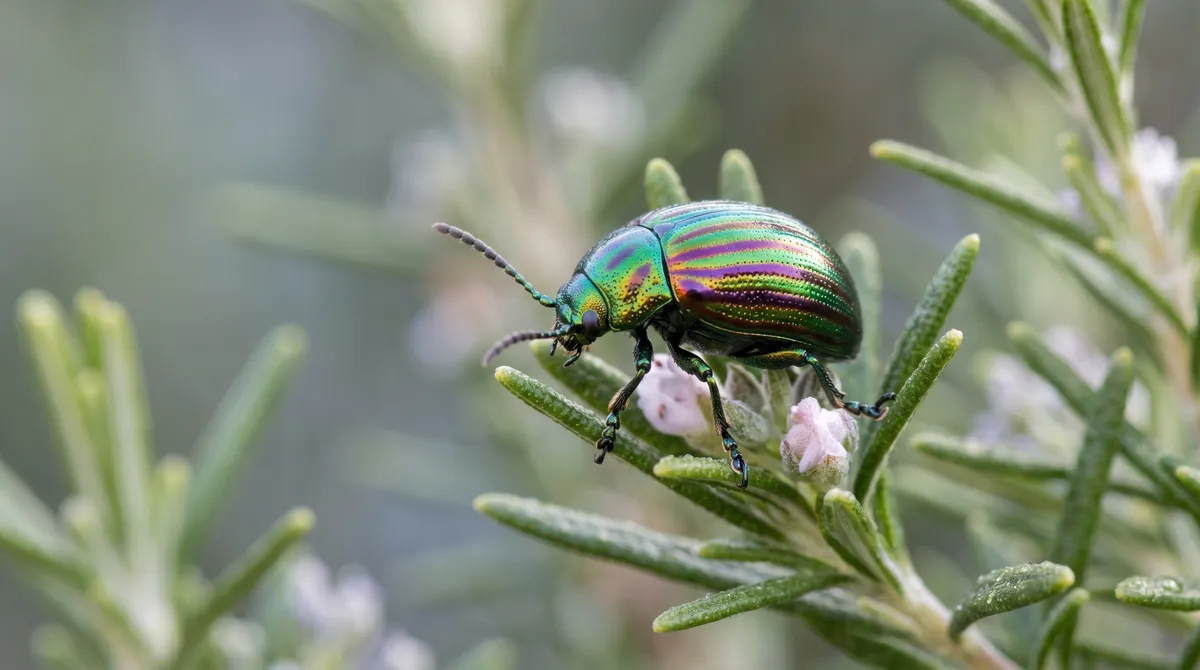
 An adult rosemary leaf beetle on rosemary in early June, the metallic green and purple stripes are diagnostic and unmistakable on UK herbs
How to identify rosemary leaf beetle
The adult rosemary leaf beetle is unmistakable on grey herb foliage. It is 6-8mm long, oval, metallic green with five vertical purple stripes running along the wing cases. The legs are dark, the antennae thin. In bright sunlight the beetle catches the light like a tiny jewel.
The beetle does not fly readily. Most movement is by walking from leaf to leaf and stem to stem. It only flies in warm sunshine when disturbed. This is the single feature that makes hand-picking effective; the beetle cannot escape upwards quickly.
Larvae are easier to miss than adults. They are 6-10mm long, pale grey-brown with darker heads, and live on the underside of leaves where they feed. Larvae move slowly and are hard to see against the silver-grey of rosemary or lavender. Turn leaves over to find them.
Eggs are pale yellow, laid in small batches on stems. Each female lays 50-200 eggs over her 4-6 week life. Eggs hatch within 7-10 days into first-instar larvae.
Damage is the main giveaway. Adults eat oval notches in leaf edges. Larvae skeletonise leaves from the underside, leaving a transparent network of veins. Heavily fed leaves dry out and drop. Severely affected plants show 30-60% leaf loss within 6-8 weeks of an unmanaged infestation.
Distinguish rosemary leaf beetle from native UK leaf beetles. Native beetles like the green tortoise beetle and the dock leaf beetle are smaller and rounder. The shimmering green-and-purple pattern is unique to Chrysolina americana in UK herb beds.
| Stage | Appearance | Feeding location | Best control window |
|---|---|---|---|
| Adult | 6-8mm green plus purple stripes | Top and edges of leaves | Cool morning hand-pick |
| Larva | 6-10mm grey-brown | Leaf undersides | Brush off with hand |
| Egg | Yellow batches on stems | Stems, lower foliage | Squash by hand |
| Pupa | Soil 5-15cm under plant | Underground | Inspect in summer |
The rosemary leaf beetle lifecycle
Rosemary leaf beetle has two generations per year in most of the UK. Understanding the timing decides when control work pays off and when it does not.
Pupal stage runs in soil from May to July and again January to March. Pupae sit 5-15cm down in dry soil under the host plant. Soil cultivation in late summer can expose them to predators and frost.
Adult emergence and first-generation feeding runs April to early July. Adults emerging from overwintered pupae feed and mate during May. Each female lays 50-200 eggs in early to mid-June.
First-generation larvae feed on leaf undersides June to early September. By August these larvae drop to the soil and pupate.
Second-generation adults emerge late August to October. They feed lightly on autumn herbs and mate before overwintering as adults in plant debris. Some second-generation adults overwinter; others die.
Second-generation larvae are the heaviest feeders. They develop September to April, feeding on leaves through autumn, winter and early spring. Mild UK winters mean larvae feed steadily on rosemary and lavender even in January.
The critical mistake is treating only in summer. Most home gardeners notice adults in May-July and spray then, but the bigger feeding load is the autumn-winter larval generation. Without October-March larval control, populations rebuild every year regardless of summer treatment.
| Month | Stage active | Control action |
|---|---|---|
| January-March | Larvae feeding | Daily brush-off, neem on warm days |
| April-May | New adults emerging | Hand-pick on cool mornings |
| June-July | Adults plus eggs | Hand-pick, squash eggs |
| August-September | Larvae feeding | Brush larvae off undersides |
| October-December | Larvae plus some adults | Brush larvae, watch for adults |
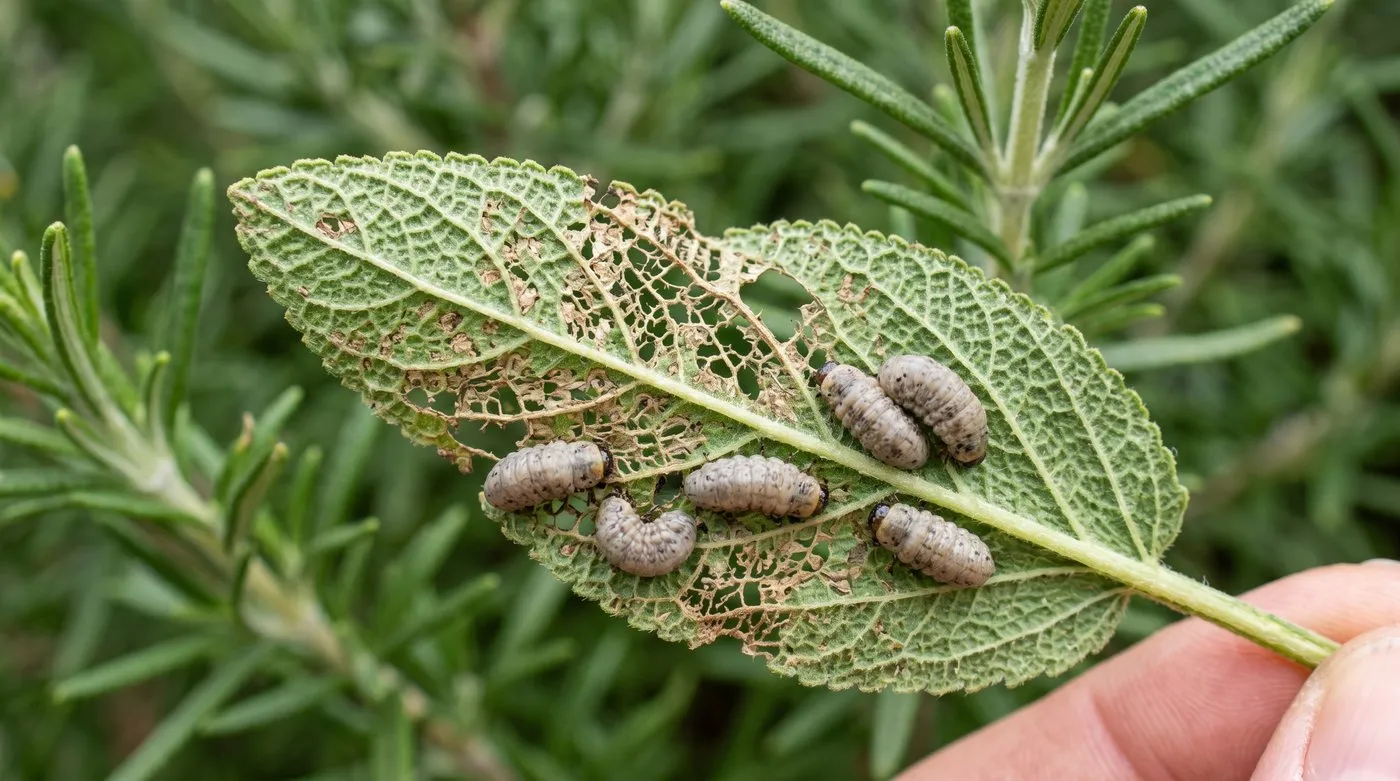 Second-generation larvae feeding on the underside of a sage leaf in November, the autumn-winter generation that most home gardeners miss
Control method 1: cool-morning hand-picking
Hand-picking before 9am catches 70-80% of adult beetles before they warm up. This is the most effective single intervention for adults and costs nothing.
Why timing matters. Beetles are sluggish below 14C. They cannot fly, drop slowly, and stay visible on top of foliage. Above 18C they fly readily and disappear into the bed.
Method: carry a bucket of soapy water (5ml washing-up liquid in 2 litres). Walk slowly along the herb bed at first light. Hold the bucket under each plant and brush beetles off with your free hand. They drop straight in.
Inspection frequency: twice a week May to August, weekly September to April. Each session takes 10-15 minutes for a 14-plant bed.
Combine with squashing eggs. Adult inspection finds yellow egg batches on stems. Squash these between thumb and finger; one minute per plant.
Hand-picking declining results when populations are extreme. If you find more than 10 beetles per plant per inspection, you are losing ground. Add neem oil sprays as a second method.
Gardener’s tip: Take photographs of each inspection. After 4-6 weeks of consistent hand-picking the population visibly drops. Photographs show this objectively to confirm the method is working. If populations are not falling, switch to neem in addition.
 Cool-morning hand-picking on a herb bed at 7am, the single most effective intervention for adult populations of rosemary leaf beetle
Control method 2: neem oil spray
Neem oil is the most effective organic spray against rosemary leaf beetle. The active compound azadirachtin disrupts feeding and moulting in larvae and reduces egg viability in adults.
Mix at 0.5% with a wetting agent. Dilute 5ml of cold-pressed neem oil per litre of warm water with 1ml of liquid soap or horticultural surfactant. Shake well. Spray covers leaf undersides where larvae feed.
Apply weekly during active feeding. Spray late evening when bees are not foraging and direct sun is not on the plants. Neem breaks down in UV light within 8-24 hours, so applications need repeating.
Effectiveness varies by stage. Adults: 40-50% kill from a single spray, 70-75% from 4 weekly sprays. Larvae: 60-70% kill from a single spray due to thinner cuticle. Eggs: limited effect, mostly through reducing female feeding.
Cold-pressed neem only. Solvent-extracted neem has lower azadirachtin content and is less effective. UK suppliers selling cold-pressed neem at 1500ppm or higher: Neem Tree Farms, Fyfanwy Naturals, and Organic Garden Catalogue.
Cost runs roughly £15-£25 for a 100ml bottle of cold-pressed neem. This treats 14 herb plants for a full season at weekly intervals.
| Method | Adult control | Larval control | Cost per season | Best timing |
|---|---|---|---|---|
| Cool-morning hand-pick | 70-80% | Limited | £0 | All seasons |
| Neem oil 0.5% | 40-75% | 60-70% | £15-£25 | Active feeding |
| Combined hand-pick plus neem | 80-90% | 60-70% | £15-£25 | Year-round |
| Pyrethrum (organic synthetic) | 70-85% | 70-80% | £10-£15 | Avoid bee hours |
| Pheromone trap | None established | None | £0 | No effective lure |
Control method 3: physical larva removal
Larvae feeding through autumn and winter are the highest-impact stage to control. A larva eats 5-10 times its body weight in foliage before pupating. Removing larvae directly cuts feeding load.
Inspect leaf undersides weekly October to April. Larvae are easier to find on dry days when foliage is not glistening with rain. Use a hand lens for the smaller first-instar larvae.
Brush larvae off with a soft paintbrush into a soapy water bucket. A paint brush is gentler than fingers and dislodges larvae without bruising the foliage.
Heavy infestations need branch shaking. Hold a tray under each plant section, shake the branch firmly. Larvae fall onto the tray. Empty into bucket.
Combine with squashing pupae in soil. When you turn the soil under the plant in summer (May-July) you find brown round pupae 5-15cm down. Squash with a trowel.
Larval removal is the winter equivalent of summer hand-picking. Together they manage both feeding generations.
 Late-evening neem oil spray on lavender. The 0.5% mix targets larvae on leaf undersides where the spray reaches feeding insects directly
Control method 4: pyrethrum as a last resort
Pyrethrum is a contact insecticide derived from chrysanthemum flowers. It is the strongest organic control for very heavy infestations.
Use only when populations exceed 20 beetles per plant per inspection. At lower levels, hand-pick plus neem is enough. At very high populations, pyrethrum knocks numbers back fast.
Spray late evening, never during bee foraging hours. Pyrethrum kills bees on contact. Application at 8-9pm on a still evening is safest. Avoid spraying open flowers.
Effectiveness: 70-85% kill of adults from a single spray, 70-80% kill of larvae. Effects last 24-48 hours, after which beetles re-invade.
Apply maximum 2 sprays per season. More than this disrupts beneficial insect populations and rarely improves long-term control.
UK products: Pyrol Bug and Larvae Killer, Doff Pyrethrum Spray, Mr Fothergill’s Pyrethrum 5EW. All available at garden centres and online for £10-£15 per bottle.
Cultural controls and host plant management
Rosemary leaf beetle attacks all Mediterranean herbs in the Lamiaceae family. The main hosts are rosemary, lavender, sage, thyme, oregano, hyssop, savory and marjoram. Less commonly: perovskia, nepeta, agastache.
Mixed plantings dilute the beetle’s impact. A herb bed of just rosemary and lavender concentrates the population. Adding non-host plants (mint, basil, parsley, chives) breaks up the buffet.
Container herbs are easier to inspect and treat. Lift each pot to check undersides; turn over and brush off larvae. Reduces both adults and larvae compared to ground-planted herbs.
Companion plants that attract predators:
- Yarrow (Achillea) attracts ladybirds and lacewings
- Fennel attracts parasitic wasps that parasitise larvae
- Marigolds attract ladybirds and hoverflies
Soil cultivation in summer. Lightly fork the top 5-10cm of soil under herbs in May-July to expose pupae. Birds and ground beetles take exposed pupae quickly.
Replace severely affected plants every 4-5 years. Rosemary and lavender become woody with age and have less new growth to support feeding. A replanting cycle keeps growth vigorous and reduces defoliation impact.
 Mixed Mediterranean herb bed with companion plants. Yarrow and fennel attract ladybirds, lacewings, and parasitic wasps that prey on rosemary leaf beetle
Common mistakes to avoid
Spraying only in summer. The autumn-winter larval generation is the heavier feeding stage. Without October-March control, populations rebuild every year regardless of summer treatment.
Hand-picking in warm afternoons. Beetles fly readily above 18C and disappear before you can collect them. Always hand-pick before 9am.
Using diluted soap solutions instead of neem. Soap kills only adults on contact at the moment of spraying. Neem affects feeding and moulting for days. Soap is for emergencies only.
Pulling out affected plants instead of treating. Removing the rosemary forces beetles onto neighbouring lavender or thyme. Treat the existing plants and rotate plantings on a 4-5 year cycle.
Ignoring pupae in the soil. A bed left undisturbed lets pupae complete their cycle in spring. Light fork the surface in summer to expose them.
Using systemic insecticides on edible herbs. Many systemic products are unsafe for herbs you intend to eat. Stick to neem and pyrethrum, both with short pre-harvest intervals.
Step-by-step: managing rosemary leaf beetle on a UK herb bed
Step 1: take a baseline count. On a cool morning in April, walk the bed and count adult beetles on each plant. Note total. This is your starting figure.
Step 2: equip yourself. Bucket, washing-up liquid, soft paintbrush. Cold-pressed neem oil and a 1-litre spray bottle. Hand lens optional.
Step 3: hand-pick twice a week May to August. Before 9am. Drop adults into soapy water. Squash eggs on stems.
Step 4: spray neem oil weekly during active adult feeding. Late evening. Cover leaf undersides. Repeat after rain.
Step 5: brush larvae off undersides weekly September to April. Use the paintbrush. Drop larvae into the soapy water bucket.
Step 6: monitor population at end of each month. Same plant inspection sequence each time. Compare counts to baseline.
Step 7: if populations exceed 20 beetles per plant per inspection, add pyrethrum. One application, late evening, on a still day.
Step 8: lightly fork soil under plants in May-July. Expose pupae to predators.
Step 9: in autumn, plan companion planting changes. Add yarrow, fennel, or marigolds for spring planting.
Step 10: at season end, photograph and log results. Compare year on year. Reduction of 60-80% is realistic over 2-3 seasons of consistent management.
Frequently asked questions
What does rosemary leaf beetle look like?
Rosemary leaf beetle is a metallic shiny beetle 6-8mm long, with vertical green and purple stripes along the back. The wing cases are oval and the legs are dark. The larvae are pale grey-brown with a darker head, 6-10mm long, and feed on the underside of leaves. Both stages are easy to spot on the grey foliage of rosemary and lavender. The pattern is unmistakable in UK herb beds.
How do I get rid of rosemary leaf beetle?
Hand-pick adult beetles on cool mornings (before 9am) when they are sluggish. Drop them into soapy water. Brush larvae off leaf undersides through autumn and winter. Spray neem oil (0.5%) weekly during active feeding. Combined hand-pick and neem reduces populations by 70-80% over 2 seasons. Use pyrethrum only as an emergency for very heavy infestations.
What plants does rosemary leaf beetle attack?
Rosemary leaf beetle attacks all Mediterranean herbs in the Lamiaceae family. The main hosts are rosemary, lavender, sage, thyme, oregano, hyssop and savory. It also feeds on perovskia and nepeta. Plants with grey foliage and aromatic oils are the preferred targets. Mint and basil are usually unaffected, making them useful companion plants in a mixed herb bed.
Is the rosemary leaf beetle a UK native?
No, rosemary leaf beetle is native to southern Europe and arrived in UK gardens in 1994 from imported plants. It first established in southern England and has spread to every English county by 2020. Climate warming has accelerated the spread; the beetle now overwinters successfully as far north as Scotland. Wales and Northern Ireland have also confirmed populations.
When are rosemary leaf beetles most active?
Adult beetles are active April to October. Larvae feed September through April, on the underside of leaves. Two generations per year mean adults can be present at any time from spring to autumn. Peak feeding for larvae is October-November and again February-March; adult feeding peaks May-July. Mild UK winters allow larvae to keep feeding through January.
Now you have the lifecycle and control methods, see our how to grow rosemary guide for full propagation and planting information, and our organic pest control overview for the broader integrated pest management approach. The Buglife conservation profile of Chrysolina americana tracks UK distribution and reporting.
Our team produces practical UK gardening guidance from source research, contributor records and established horticultural practice. Editorial standards are overseen by Matt W.