Key takeaways
- Orange, raised pustules on the leaf underside from May mean rust, not black spot
- The fungus spreads fastest at 18-21C in still, humid air, doubling within 10-14 days
- Pustules turn black by September and overwinter on fallen leaves and stem lesions
- A summer sulphate of potash feed hardens leaf tissue and lowers susceptibility
- Badly rusted stems must be pruned out in spring before the orange spores release
If your rose leaves are dropping in July with tiny bright orange dots on the undersides, that is rose rust, not black spot and not a feeding problem. Rose rust is caused by fungi in the genus Phragmidium, and it shows as raised orange pustules under the leaves from May, spreading fastest in still, humid air at 18-21C. Left alone it strips a bush of leaves by late summer, weakens next year’s growth and cuts flowering. The good news is that it is one of the more predictable rose diseases, because it overwinters in one place you can do something about.
This guide covers how to identify rose rust, how to tell it apart from the black spot it is constantly confused with, the lifecycle that decides when to act, and the control programme that actually breaks the cycle on a UK rose bed. Most of it costs nothing but a rake and some timing.
What rose rust looks like on the leaf
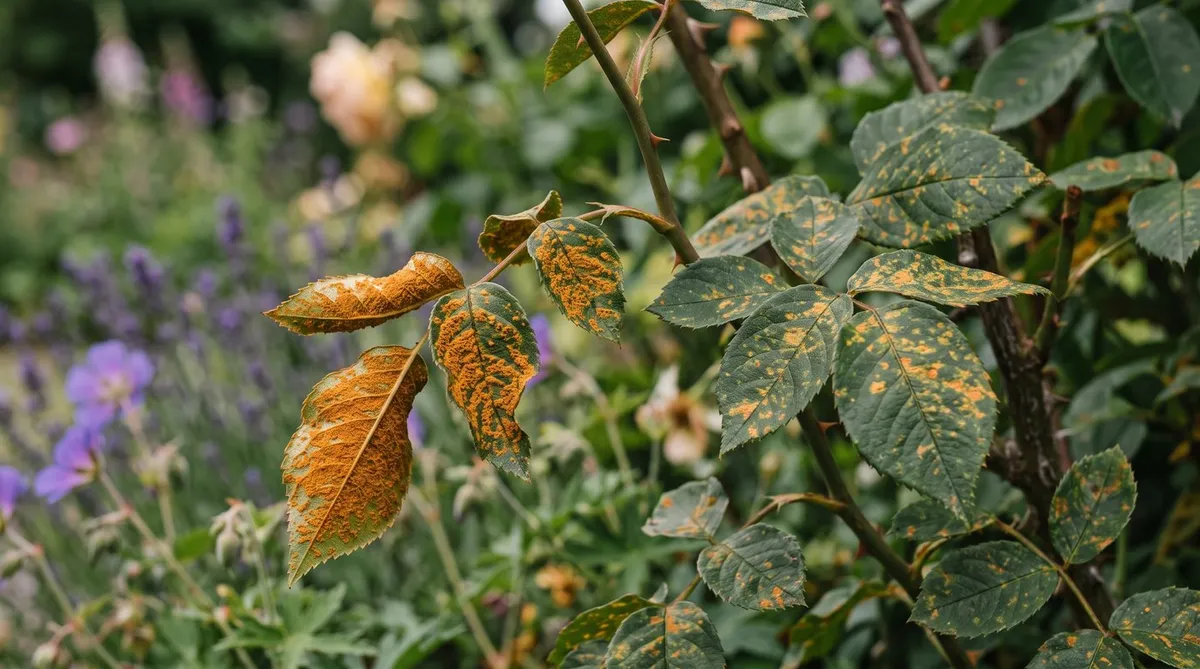
Rose rust announces itself on the underside of the leaf. The first summer sign is scattered bright orange pustules, each 1-2mm across, dusty to the touch, on the lower surface. Look at the top of the same leaf and you see matching yellow or pale flecks where the tissue above each pustule has lost its green. Rub a pustule with a fingertip and it leaves an orange smear, which is thousands of spores coming away.
The pattern always starts low and works up. The bottom leaves on the bush, closest to last year’s overwintered spores in the soil and the old wood, go first. From there it climbs. On a susceptible variety in a wet July the whole bush can be spotted within three weeks.
There is a second, earlier stage most people miss. In April and May, before any pustules, you sometimes find swollen, bright orange patches on the previous season’s stems, and small orange spots on the very first undersides. This is the spring stage releasing the spores that start the year’s cycle. Catching it here, by pruning those stems out, is worth more than any summer spray.
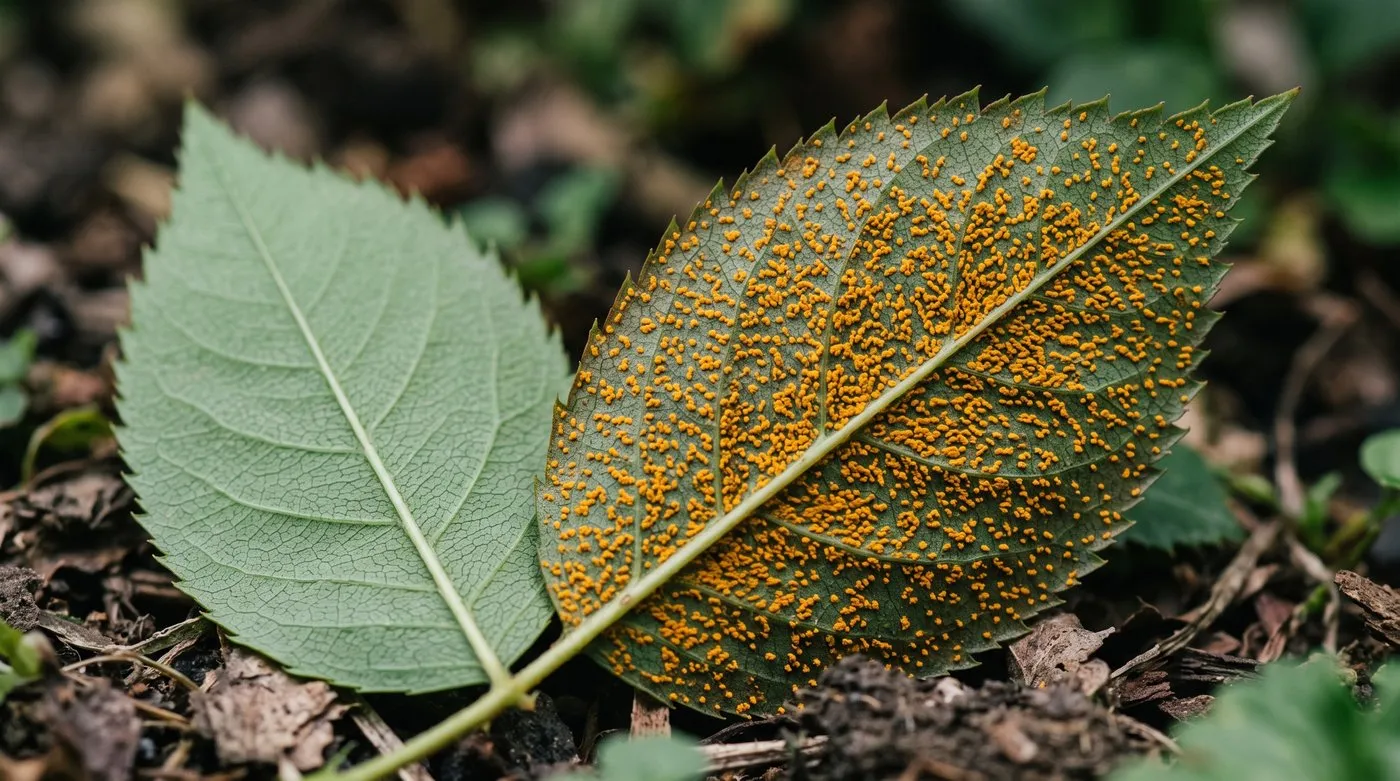 Bright orange pustules on the underside, 1-2mm across and dusty. The yellow flecks on the upper surface sit directly above them.
Rose rust or black spot: the two-second test
These two diseases share bushes, share weather and get mixed up constantly, yet they need slightly different handling. The test takes two seconds. Turn the leaf over.
Rose rust is orange and raised. The spore masses sit on the underside, they are powdery, and they smear orange. The damage on the upper surface is a pale yellow mottle above each pustule.
Black spot (Diplocarpon rosae) is flat and black. It makes dark brown to black blotches with feathery, diffuse edges on the upper surface, often ringed by a yellow halo, and the leaf yellows and drops. There is no orange powder anywhere. Our full guide to black spot on roses covers its separate cycle, but the identification split is simple: orange powder underneath is rust, black blotches on top are black spot.
A third confusion is powdery mildew, which makes a white, talc-like coating on young leaves and buds, not orange dots. If you are unsure which fungal problem you have, the powdery mildew treatment guide sets out its white bloom in detail. All three can appear on one neglected bush, which is usually a sign the plant is stressed, crowded and short of air.
| Feature | Rose rust | Black spot | Powdery mildew |
|---|---|---|---|
| Colour | Bright orange | Dark brown to black | Chalky white |
| Where | Leaf underside | Leaf upper surface | Young leaves, buds, shoots |
| Texture | Raised, powdery | Flat blotch | Felty coating |
| Edge | Discrete round pustule | Feathery, spreading | Diffuse patch |
| Smear test | Leaves orange smear | No smear | White wipes off |
| Peak | July to August | June to September | Dry days, humid nights |
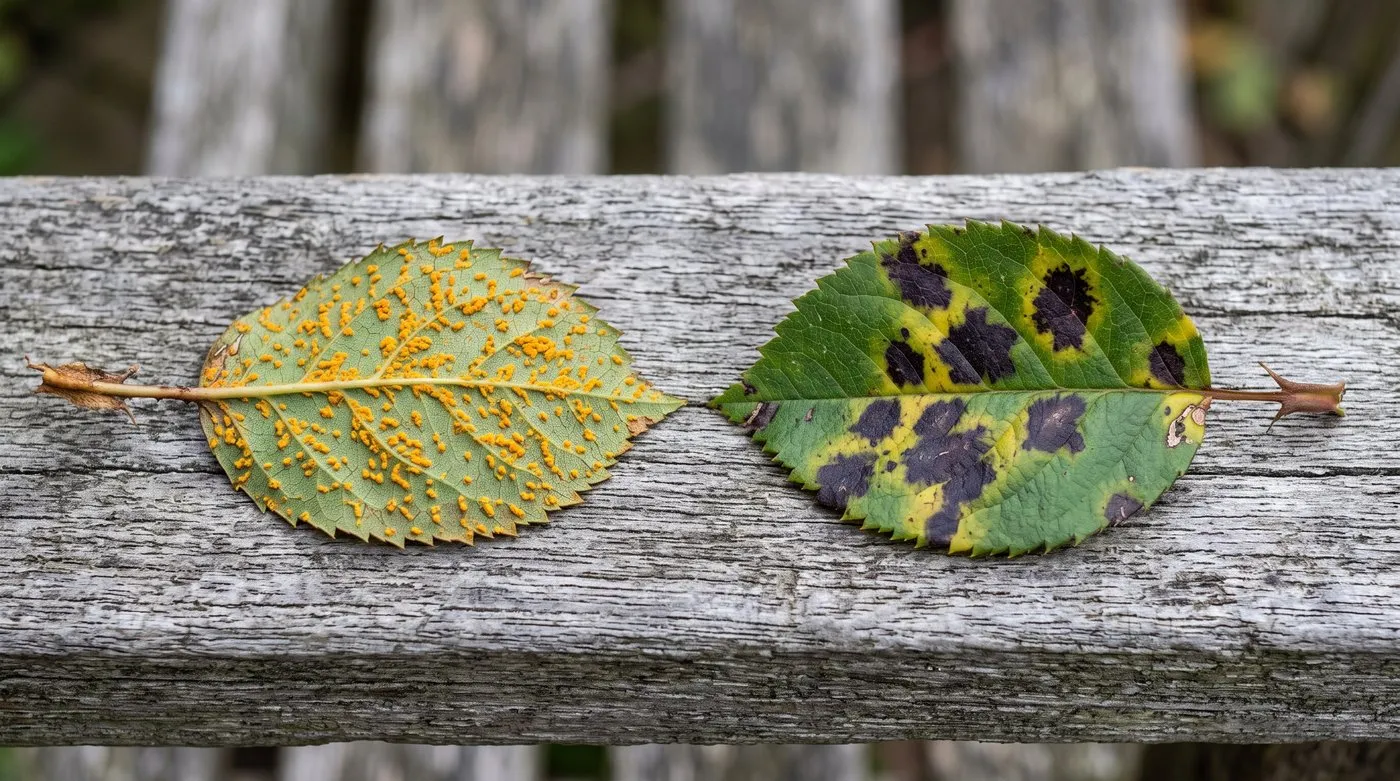 The two-second test side by side. Orange powder underneath on the left is rust. Flat black blotches on top on the right are black spot.
The rust lifecycle and why timing beats spraying
Understanding the sequence is what separates people who spray all summer and still lose the leaves from people who rake once and barely spray at all. Rose rust runs a five-stage annual cycle, and each stage looks different.
- Spring, stems and first leaves (April-May). Overwintered spores germinate. Swollen orange patches (aecia) form on last year’s stems and small orange spots appear on the earliest leaf undersides. Temperatures around 10-15C and spring damp trigger it.
- Summer, the orange pustules (June-August). The stage everyone recognises. Orange pustules (uredinia) erupt on leaf undersides and release wind-blown spores that reinfect the same bush and its neighbours. This is the repeating, explosive phase.
- The doubling. In warm, humid weather at 18-21C, a new generation of summer spores matures roughly every 10-14 days. One spotted leaf in early July becomes a spotted bush by month end. This is why early action is cheap and late action is not.
- Late summer, the colour change (September). The pustules darken from orange to black. These black spores (teliospores) are the tough overwintering stage. Once you see black pustules the year’s damage is done, but the plant is now loading next year’s inoculum.
- Winter, survival. The black teliospores sit out the cold on fallen leaves on the soil and in stem lesions. In spring they germinate and the cycle restarts at stage one.
Here is the critical mistake, and nearly everyone makes it. They fight the orange summer stage and ignore the black overwintering stage. Spraying in July slows the current attack but does nothing about the spores dropping to the soil in September, which is where next year’s outbreak is decided. The gardener who sprays four times in summer and leaves the fallen leaves in place is treating the symptom every year while carefully preserving the cause. Break stage five and the whole thing collapses.
Autumn leaf clearance: the one job that matters most
If you do nothing else, do this. Clear every fallen rose leaf off the soil in autumn and bin or burn it.
The black overwintering spores travel on those leaves. Leave them lying under the bush and you have laid a spore carpet directly beneath the plant, ready to splash up onto the lowest leaves in spring. Rake them off and you remove the bulk of the inoculum before it can act.
Do it thoroughly. A few leaves tucked under the crown are enough to seed a new year, so clear right up to the stems. Never add rusted leaves to a cool compost heap, because the spores survive the process and you simply spread them around the garden with the finished compost. A hot heap running above 60C will destroy them, but the safe route is the council green bin or a bonfire.
Gardener’s tip: Do the leaf clearance in two passes, one in early November as the bulk falls and a tidy-up in December once the last leaves are down. The stragglers carry as many spores as the first flush, and it is the tidy-up pass that people skip.
Feeding, air flow and the conditions rust hates
Rust is a disease of stressed, crowded, soft-grown roses. Three cultural changes make a bush far less hospitable, and none of them involves a sprayer.
Potassium. A rose short of potassium grows soft, thin-walled leaf tissue that rust penetrates easily. Feed with sulphate of potash in July, at roughly 30g per square metre worked into the soil surface and watered in. Potash firms the leaf cuticle and improves disease resistance across the board. Avoid heavy, late nitrogen feeds, which do the opposite by pushing soft, sappy growth that rust loves.
Air flow. Spores need the leaf wet for several hours to germinate. A bush crammed against a fence or its neighbours stays damp for hours after rain and holds a still, humid microclimate. Prune for an open, goblet-shaped centre, thin out crossing stems, and give roses room. Good spacing is the cheapest fungicide there is.
Watering. Water at the base, never over the foliage, and water in the morning so any splashed leaves dry by evening. Overhead watering in the evening leaves foliage wet all night, which is exactly the germination window the fungus needs. If you grow roses in pots, the same rules apply, and our guide to growing roses in containers covers watering and feeding for potted bushes where the compost dries faster.
Warning: Do not reach for a high-nitrogen lawn or general feed to green a rusty bush back up. The flush of soft growth it produces is more susceptible to rust, not less. If the bush looks pale and hungry, use a balanced rose feed with a good potash content, and save the nitrogen for spring.
Pruning out infected stems in spring
The spring stem stage is the quiet one that decides your summer. Those swollen orange patches on last year’s wood are spore factories about to fire. Prune them out in late winter or early spring, before the orange releases.
Go over the bush at pruning time and cut back to clean, healthy wood any stem showing an orange lesion or a distorted, swollen patch. Cut to just above an outward-facing bud, and take the prunings off the plot rather than leaving them on the border. Disinfect the secateurs between bushes if rust was bad the previous year, a quick wipe with methylated spirit, so you are not carrying spores from bush to bush.
This is also the moment to open the centre of the plant for the air flow described above. Spring pruning does double duty: it removes overwintered inoculum and it builds the ventilated shape that stops the disease establishing. For the wider picture on rust across other plants, from leeks to pears, the general rust disease guide shows how the same host-specific pattern repeats, and the pear rust guide covers a rust with a very different two-host lifecycle.
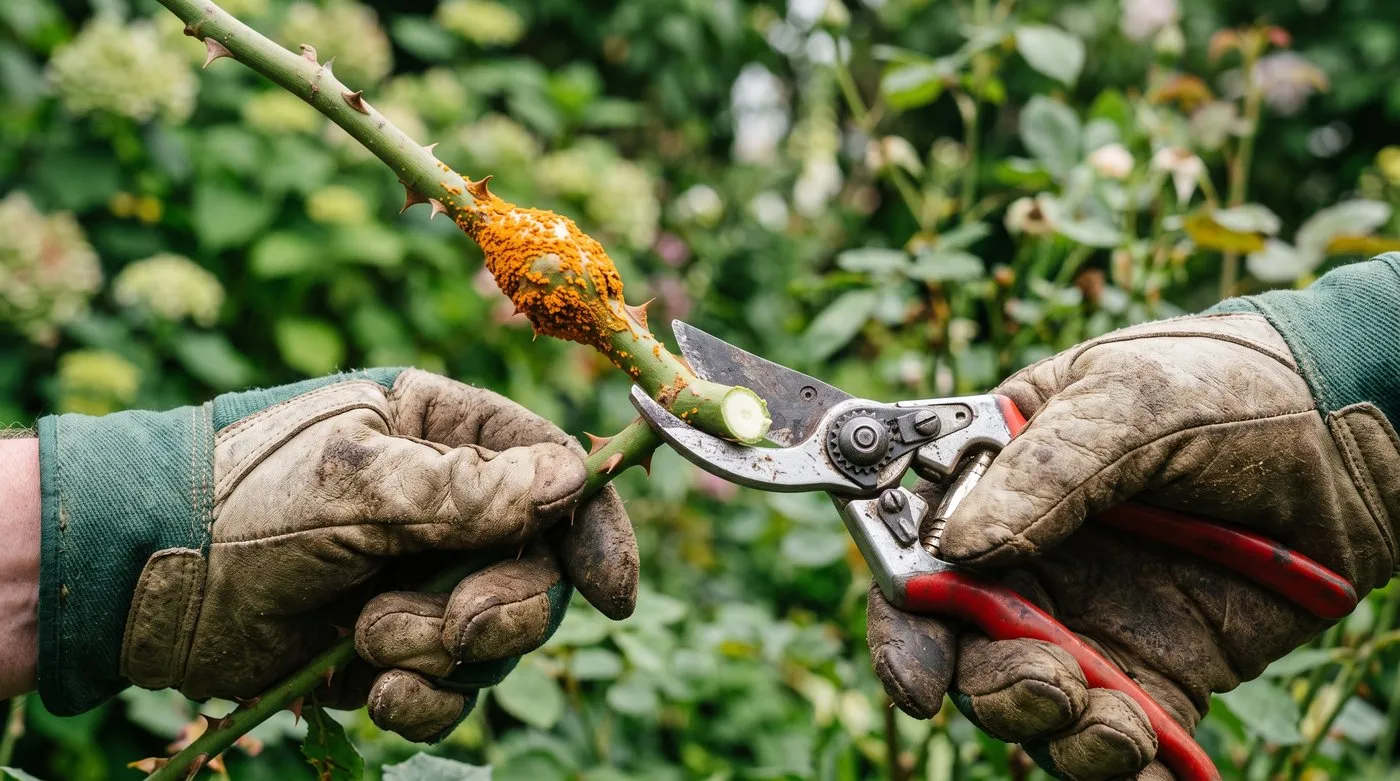 A swollen orange lesion on last year’s stem is the spring spore stage. Cut it out before it releases, back to clean wood.
Fungicides: what works and what they cannot do
Sprays have a place, but a narrow one. They protect healthy leaves and slow an active attack. They do not cure a badly rusted leaf and they do nothing about the overwintering spores, so a spray-only programme fails on a susceptible variety.
The amateur options in the UK are triazole fungicides, chiefly tebuconazole, often sold combined with triticonazole in rose-specific products. Note that myclobutanil was withdrawn from the amateur UK market, so older advice naming it is out of date. Apply at the very first orange pustules, coat the leaf undersides where the spores are, and repeat at the label interval. Rotate between different active ingredients across the season to reduce the risk of the fungus building resistance.
Resistant and susceptible roses
Variety choice front-loads the whole problem. Some roses shrug rust off, others catch it every year whatever you do. If a bush rusts badly three years running despite good hygiene, replace it rather than nursing it.
Rugosa roses and many modern shrub roses bred for disease resistance carry good rust tolerance. Older hybrid teas and some ramblers are notably prone. When buying, look for varieties described as rust resistant or awarded for health, and check they suit your position, because a healthy variety in a dark, airless corner still struggles. Our guides to the best climbing roses for UK gardens and to companion planting for roses both flag disease resistance where it matters, and good companions that improve air movement around the base help too.
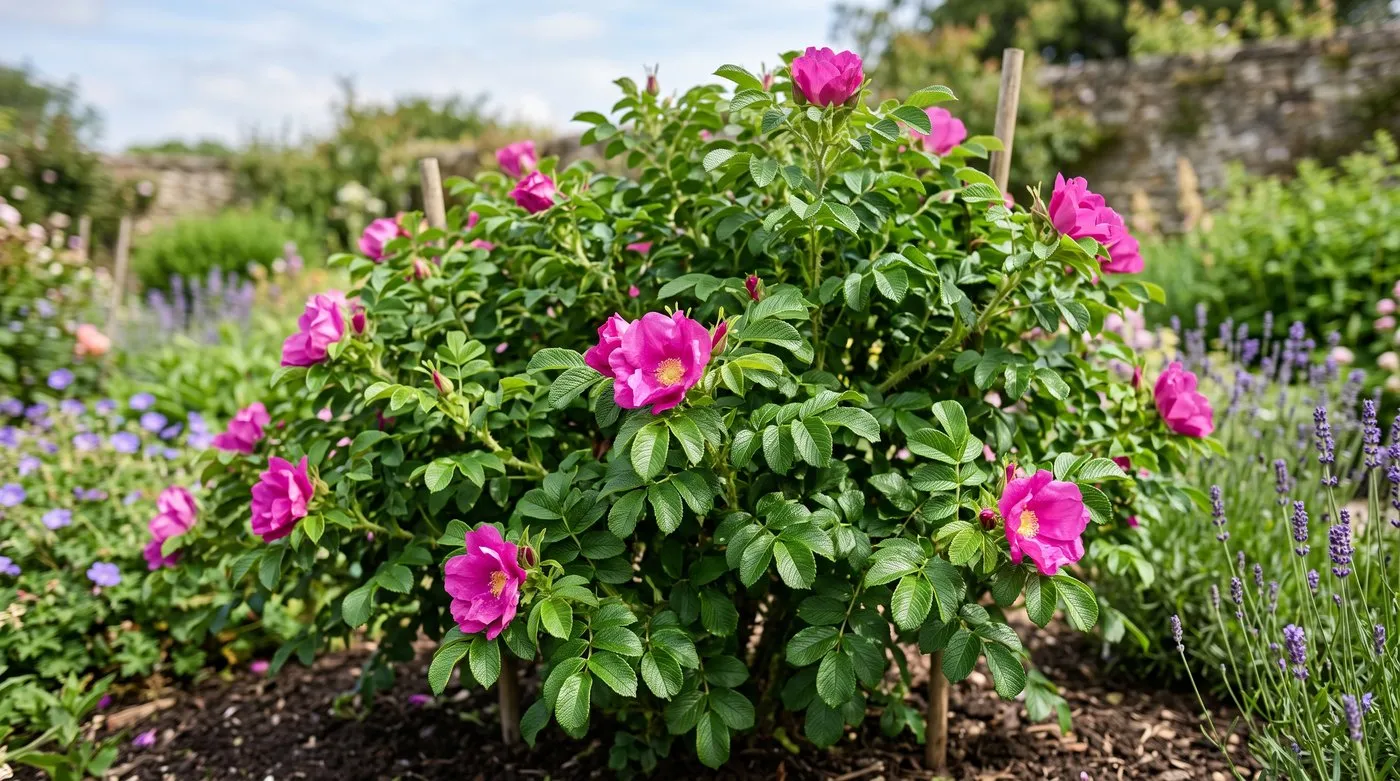 Rugosa roses carry good rust tolerance. Clean, leathery foliage like this in an open, airy position is the low-effort route to a rust-free bush.
The gold standard is the first two rows working together: clear the leaves in autumn and prune the stems in spring, so both overwintering sites are dealt with. Everything below supports that. A spray on top of good hygiene is worth having on a prized susceptible bush. A spray instead of hygiene is a yearly tax that never fixes anything.
Month-by-month rose rust calendar
| Month | What to do |
|---|---|
| January-February | Prune out stems with swollen orange lesions. Open the centre for air flow. Bin prunings. |
| March | Mulch after clearing the soil surface. Do not bury old leaves, remove them. |
| April-May | Watch stems and lowest leaves for the first orange spring spots. Remove any you find. |
| June | First summer pustules possible. Check leaf undersides weekly. Water at the base only. |
| July | Peak spread in warm humid spells. Apply sulphate of potash. Remove worst leaves. Spray if needed. |
| August | Continue monitoring. Keep foliage dry. Pick off heavily rusted leaves and bin them. |
| September | Pustules turn black. Damage is done for the year. Begin picking up early fallen leaves. |
| October | Leaves fall in quantity. Rake and bin, do not compost cool. |
| November | Main leaf clearance. Clear right up to the stems in two passes. |
| December | Tidy-up clearance of the last fallen leaves. This pass is the one people skip. |
Common mistakes with rose rust
- Mistaking it for black spot and treating the wrong thing. They look different once you turn the leaf over. Orange powder underneath is rust. Black blotches on top are black spot. Get the diagnosis right before you act.
- Spraying in summer and leaving the leaves in autumn. This treats the symptom every year and preserves the cause. The overwintering spores on fallen leaves are what restart it. Clear them.
- Composting rusted leaves in a cool heap. The spores survive and you spread them with the finished compost. Bin, burn, or use only a hot heap above 60C.
- Feeding soft with nitrogen to green it up. Lush, sappy growth is more susceptible, not less. Feed potash, not nitrogen, to a rusty bush.
- Crowding roses against fences and each other. Still, humid air keeps the leaves wet long enough to germinate spores. Space and prune for air flow.
The short version on rose rust
Rose rust is orange, it lives on the underside of the leaf, and it survives the winter on fallen leaves and old stems where you can reach it. That last fact is the whole game. The disease you see erupting in July was posted to you last autumn, on the leaves you left under the bush. Rake them up, prune the orange lesions out in spring, feed potash not nitrogen, and give the plant air, and you starve the cycle at both ends.
Spray if you like, on a prized bush and only as backup, but never instead of the raking. And if a variety rusts every year despite all of it, that is the variety telling you to replace it. For the wider run of rose troubles, black spot, mildew and the rest, work through the garden problems section and match the sign to the cause before you reach for anything in a bottle. The RHS guidance on rose rust is a sound second reference on the pathogen itself.
Frequently asked questions
How do I tell rose rust from black spot?
Rust is orange and raised, black spot is flat and black. Turn a spotted leaf over: rose rust makes bright orange, powdery pustules on the underside, with matching yellow flecks on top. Black spot makes dark brown or black blotches with feathery edges on the upper surface and no orange powder anywhere. The two often share a bush, but the colour and the raised texture tell them apart in seconds.
What causes rose rust?
Fungi in the genus Phragmidium, most often Phragmidium tuberculatum in the UK. The spores spread on wind and rain splash and germinate on wet leaves at 18-21C. Crowded, poorly ventilated plantings, overhead watering and potassium-short soils all raise the risk. The disease overwinters as black teliospores on fallen leaves and on lesions in the stems.
Can a rose recover from rust?
Yes, most roses survive rust and releaf the next spring. Rust rarely kills an established bush, but a heavy attack strips leaves early, weakens the plant and cuts flowering. Repeated bad years on a susceptible variety are a reason to replace it. Clear the leaves, feed with potash and improve air flow, and a healthy rose bounces back.
Should I remove leaves with rose rust?
Yes, pick off badly rusted leaves and bin or burn them. Removing the worst leaves through summer slows the spore load, and clearing every fallen leaf in autumn is the single most effective step. Never compost rusted leaves in a cool heap, because the spores survive and return. A hot heap over 60C destroys them, but binning is safer.
Does rose rust spread to other plants?
No, rose rust only infects roses. Each rust fungus is host-specific, so Phragmidium on your roses cannot jump to beans, leeks or hollyhocks. Those carry their own separate rusts. You can grow roses next to other crops without cross-infection, though the general conditions that suit one rust, damp and still air, suit them all.
When does rose rust appear in the UK?
From May, with the worst attacks in warm, humid July and August weather. The first sign in spring is small orange spots on the undersides of the lowest leaves and swollen orange patches on last year’s stems. Summer brings the classic orange pustules. By September the pustules darken to black as the fungus forms its overwintering spores.
What is the best spray for rose rust?
A triazole fungicide such as tebuconazole, applied at the first orange pustules. UK products combining tebuconazole with triticonazole are sold for roses and work on light infections. Spray the leaf undersides, repeat per the label, and rotate products to avoid resistance. Spraying alone fails without leaf clearance and better air flow, so treat it as a support, not a cure.
Our team produces practical UK gardening guidance from source research, contributor records and established horticultural practice. Editorial standards are overseen by Matt W.