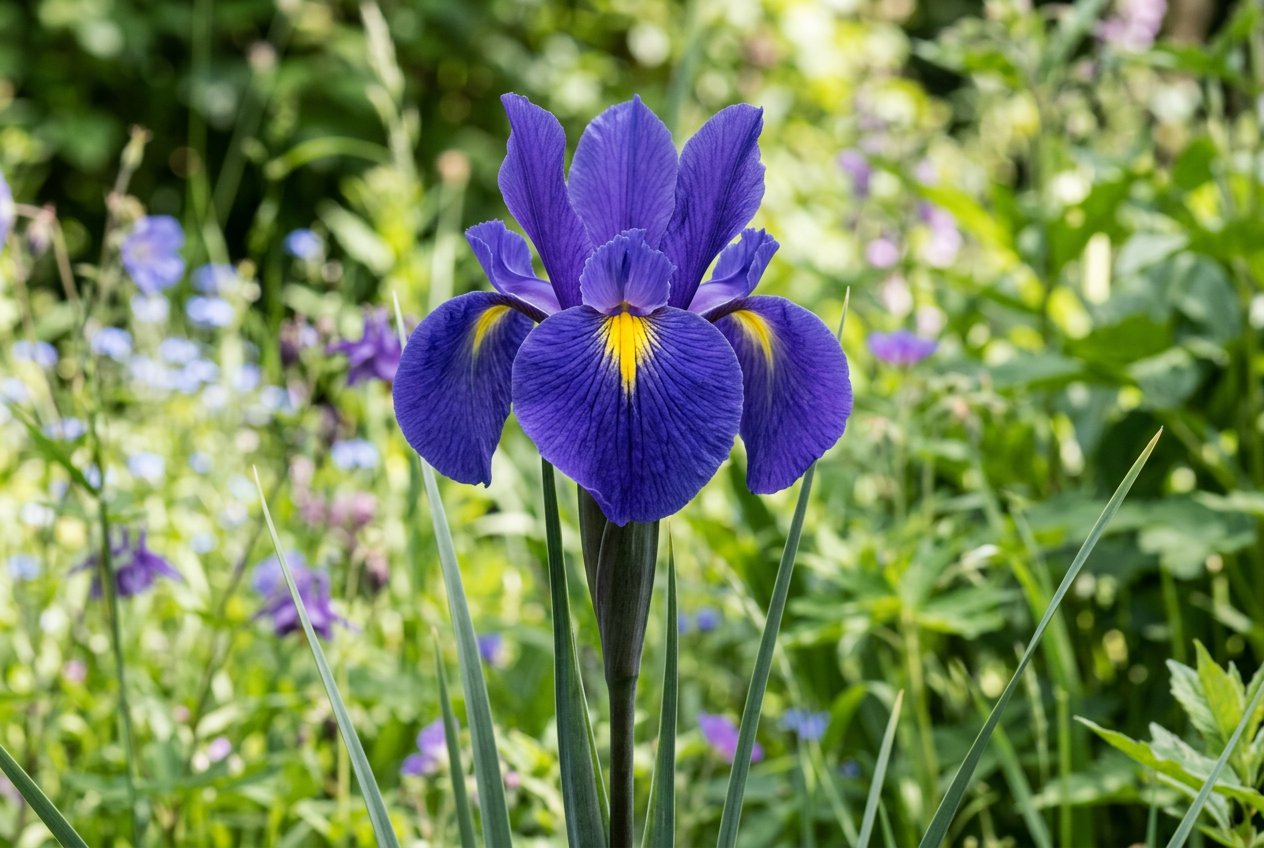
Iris latifolia
Iris latifolia
English iris produces large elegant flowers in shades of blue, purple, and white in June and July, later than Dutch irises. Despite its name, it originates from the Pyrenees but was first traded through English ports. Prefers slightly damper conditions than Dutch irises. A beautiful choice for cottage garden borders.
Where to plant
Best aspect
Border position
When to plant and expect flowers
Plant
Flowers
How to grow iris latifolia
Plant 10-12cm deep in autumn. Unlike Dutch irises, prefers slightly moist soil and tolerates partial shade. Later flowering, extending the iris season into July. Excellent cut flower. Good for cottage garden borders.
Soil requirements
Soil type
loam, clay
Moisture
moist
pH
neutral, acid
Aftercare
Allow foliage to die back naturally after flowering. Remove spent flower heads to prevent self-seeding.
Propagation
- Offsets in autumn
- Seed
Wildlife value
Toxicity
Mildly toxic. Contains irisin compounds causing gastrointestinal upset if ingested.
Common problems
- Ink disease
- Slugs
- Can be short-lived in dry conditions
Similar bulbs to grow
Allium sphaerocephalon
Allium sphaerocephalon
Lilium regale
Lilium regale
Gladiolus communis subsp. byzantinus
Gladiolus communis subsp. byzantinus
Camassia leichtlinii
Camassia leichtlinii
Narcissus poeticus var. recurvus
Narcissus poeticus var. recurvus
Related guides
The 70-30 Rule for Better Garden Borders
The 70-30 planting rule explained: 70% structure and foliage, 30% seasonal flowers, measured by area, so your UK border looks full in every month.
Air-Purifying Houseplants: What They Really Do
Do air-purifying houseplants work? The honest answer, the ten easiest plants to grow anyway, which are pet-safe, and what actually freshens indoor air.
Allotment Planner: Month-by-Month
A friendly month-by-month allotment planner for the UK: what to sow, plant, pick and tidy each month, plus a handy sowing and harvest chart.