Key takeaways
- A 2019 review found you need 10-1000 plants per square metre to beat home ventilation
- The 1989 NASA study tested plants in sealed chambers, not real ventilated rooms
- Real wins are humidity, focus, and wellbeing, plus tiny VOC and CO2 uptake at high density
- Spider plant, snake plant, pothos, and peace lily are the easiest UK performers
- Snake plant releases oxygen at night, so it suits bedrooms
- Peace lily, pothos, English ivy, and dracaena are toxic to cats and dogs
Air-purifying houseplants are one of the most oversold ideas in gardening, and the honest answer is more interesting than the marketing. The phrase comes from a famous 1989 NASA study that tested whether certain indoor plants could strip pollutants from spacecraft air. They could, inside sealed chambers. In your living room, with a window and a door and central heating, the effect is tiny. This guide explains what the science actually shows, which plants genuinely earn their place, and how to really improve the air you breathe at home. The good news is that houseplants still pay you back in humidity, focus, and mood.
You do not need to choose between honesty and a green home. The same plants the studies tested are easy, cheap, and forgiving. They just work through comfort and wellbeing rather than filtration.
What the NASA study really found, and what it missed
The 1989 NASA Clean Air Study sat plants in sealed acrylic chambers and pumped in known pollutants. Researchers measured how fast levels of formaldehyde, benzene, trichloroethylene, xylene, and toluene fell. Several plants performed well in that closed box. The headline that “houseplants clean your air” was born from this single, artificial setup.
The problem is scale. A sealed 0.15 cubic metre chamber is nothing like a 30 cubic metre room that swaps its air every hour through gaps, vents, and open doors. A 2019 review in the Journal of Exposure Science and Environmental Epidemiology, by Cummings and Waring, pulled together a dozen of these chamber studies. They converted the results into a real-world figure called clean air delivery rate.
Their conclusion was blunt. You would need somewhere between 10 and 1000 plants per square metre of floor to match the pollutant removal of simply ventilating the room. For a typical 12 square metre UK bedroom, that is hundreds to thousands of plants. The natural air exchange in any normal home overwhelms what a few pots can do.
Gardener’s tip: Do not buy a plant to filter your air. Buy it because you enjoy it. The wellbeing and humidity benefits are real and proven, while the filtration claim falls apart at household scale.
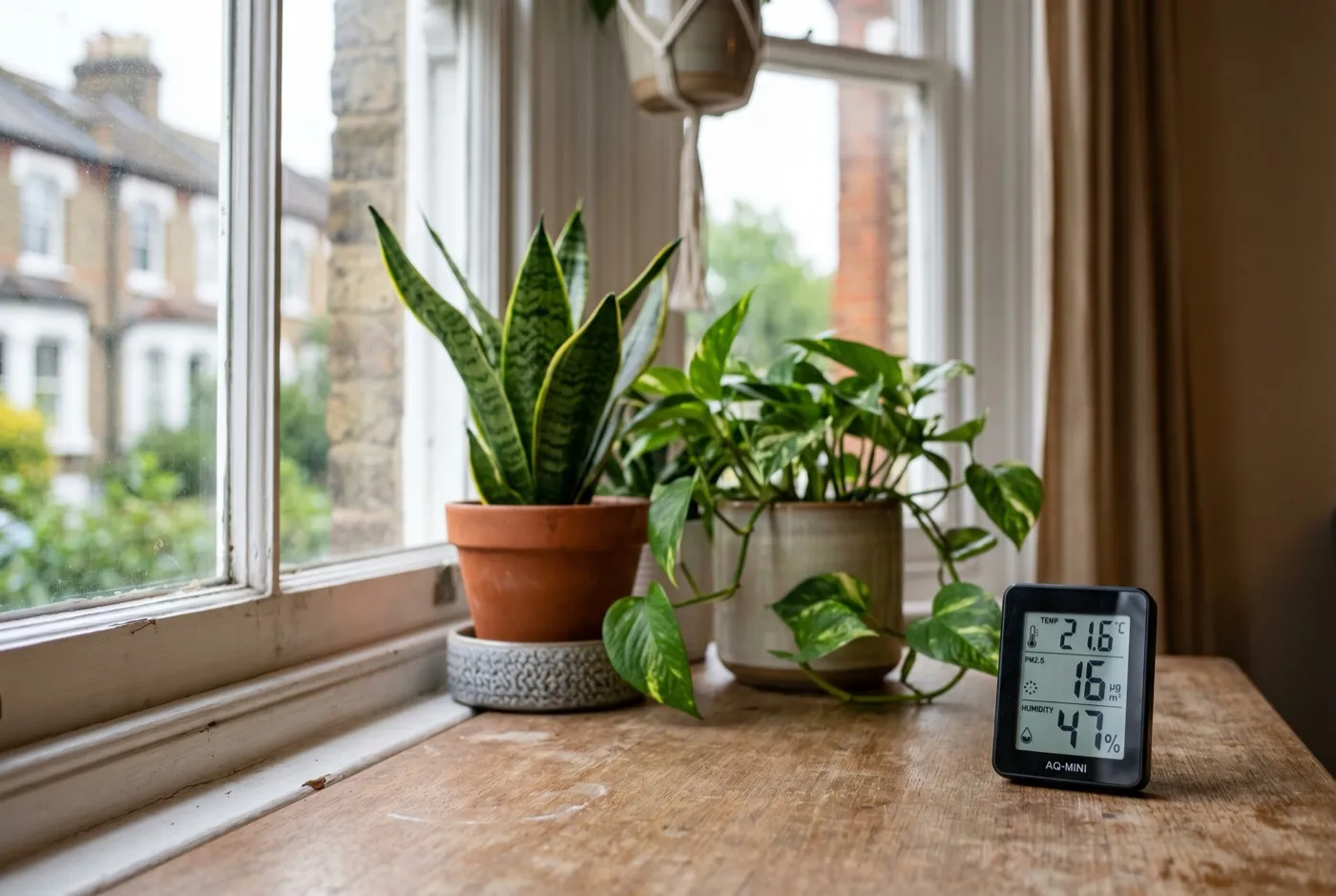 A budget air monitor barely registers a change from a few plants. Humidity, shown on the right dial, is where plants actually shift the numbers.
The benefits houseplants genuinely deliver
If filtration is mostly a myth, the real benefits are not. Four of them stand up to scrutiny and matter in dry, centrally heated UK homes.
Humidity is the strongest. Plants release water vapour through their leaves in a process called transpiration. A grouped collection raises local relative humidity by several points, easing dry skin, sore throats, and static. Ferns and palms transpire the most.
Wellbeing and biophilia come next. Multiple controlled studies link indoor plants to lower stress and better mood. The 1984 hospital window study by Roger Ulrich first showed nature views speed recovery, and pot plants tap the same instinct.
Focus is the third. A 2014 University of Exeter study found office plants lifted productivity by around 15% versus bare desks. Our guide to the best office houseplants picks species that cope with desks and aircon. The fourth benefit is modest CO2 and VOC uptake, which only becomes meaningful at high plant density, such as a packed conservatory or a green wall.
Ten air-purifying houseplants worth growing in UK homes
These are the species the lab studies tested, ranked here by how easy they are to keep alive in a real UK home. A thriving plant always beats a dead specialist, so ease matters more than any filtration claim.
| Plant | Light need | Watering | Pet-safe? | VOC tested | Difficulty | Role |
|---|---|---|---|---|---|---|
| Snake plant (Dracaena trifasciata) | Low to bright | Every 3-4 weeks | No (mildly toxic) | Benzene, formaldehyde | Very easy | Bedroom, night oxygen |
| Spider plant (Chlorophytum comosum) | Bright indirect | Weekly | Yes | Formaldehyde, xylene | Very easy | Beginner all-rounder |
| Pothos (Epipremnum aureum) | Low to bright | Every 1-2 weeks | No (toxic) | Benzene, formaldehyde | Very easy | Shelf trailing plant |
| Peace lily (Spathiphyllum) | Low to medium | When leaves droop | No (toxic) | Benzene, trichloroethylene | Easy | Low-light corner |
| Aloe vera | Bright direct | Every 2-3 weeks | No (mildly toxic) | Formaldehyde, benzene | Easy | Sunny windowsill |
| Dracaena (Dracaena marginata) | Bright indirect | Every 1-2 weeks | No (toxic) | Trichloroethylene, xylene | Easy | Floor-standing accent |
| Chinese evergreen (Aglaonema) | Low to medium | Every 1-2 weeks | No (toxic) | Benzene, formaldehyde | Easy | Shady living room |
| Rubber plant (Ficus elastica) | Bright indirect | Every 1-2 weeks | No (mildly toxic) | Formaldehyde | Moderate | Statement floor plant |
| Areca palm (Dypsis lutescens) | Bright indirect | Twice weekly | Yes | Formaldehyde, xylene | Moderate | Humidity, pet homes |
| Boston fern (Nephrolepis exaltata) | Bright indirect | Keep moist | Yes | Formaldehyde, xylene | Hard | Bathroom humidity |
The snake plant tops the list because it survives neglect, low light, and a missed month of watering. It also uses CAM photosynthesis, so it releases oxygen at night, which makes it the classic bedroom pick. The spider plant and pothos are the next safest bets for beginners. The Boston fern sits last because it sulks the moment the air dries out, though it is the best humidifier of the lot. Anthurium missed the original lab lists but earns a place on the same shelf, tolerating similar conditions to peace lily while flowering for far longer.
If a north-facing room is your only spot, our guide to the best low-light houseplants for UK homes covers the species that cope with the least light.
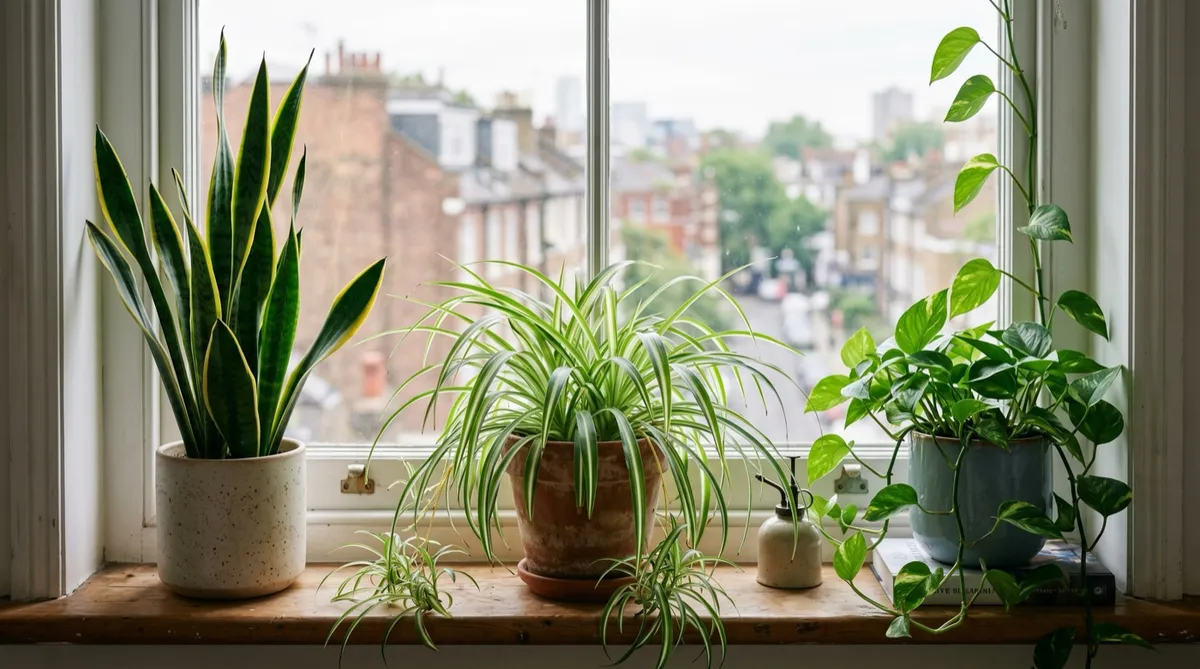
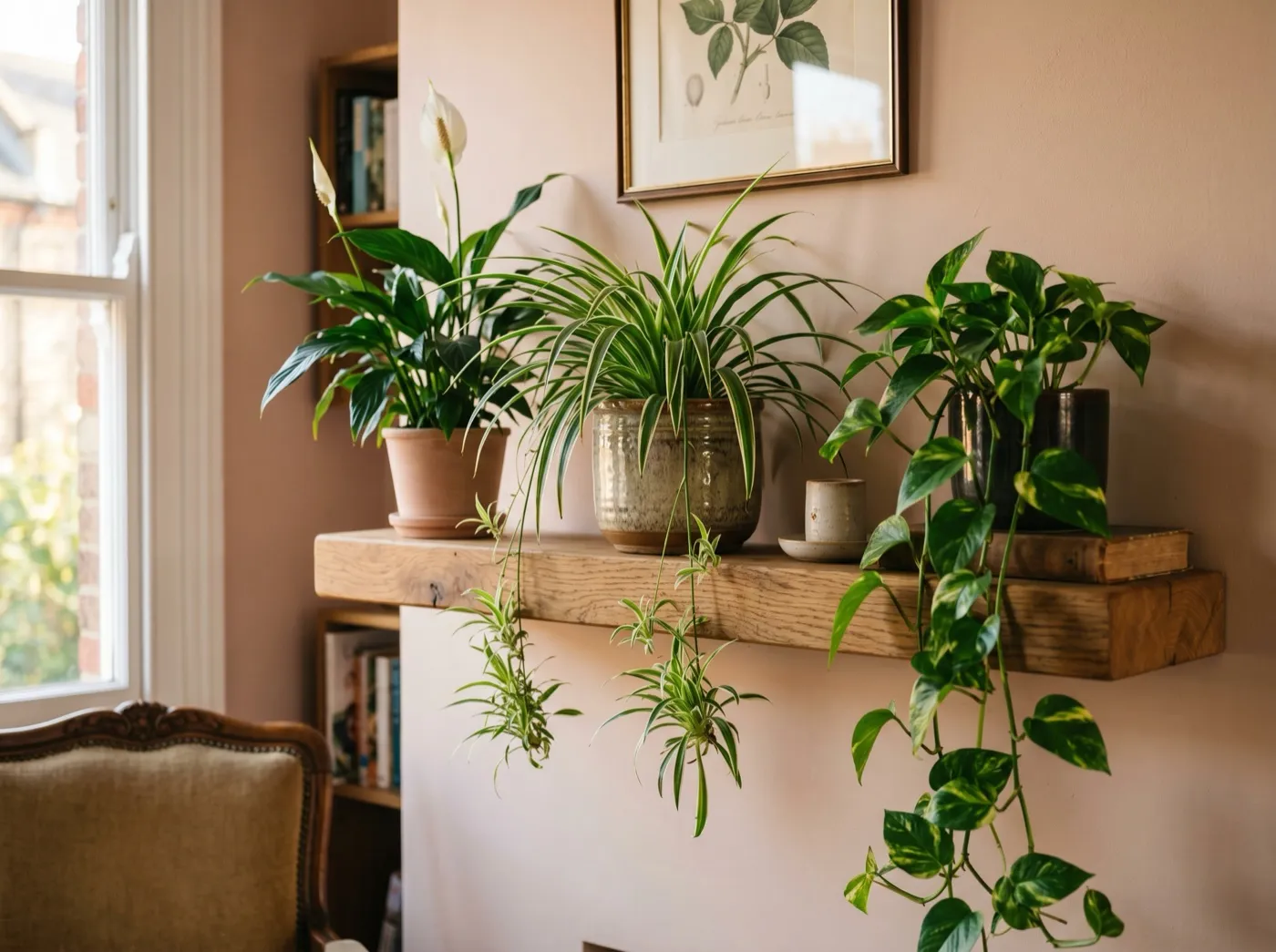 A grouped shelf of spider plant, peace lily, and pothos. Clustering plants creates a small humid microclimate and looks fuller than scattered single pots.
Pet-safe versus toxic houseplants
This is the question that catches out the most buyers, and getting it wrong can mean an emergency vet bill. Several of the best-known air plants are toxic to cats and dogs if chewed.
The toxic group includes peace lily, pothos, English ivy (Hedera helix), dracaena, Chinese evergreen, and aloe vera. Peace lily and the true lilies are the most serious for cats, causing mouth irritation and, with lilies proper, kidney damage. English ivy causes drooling and stomach upset.
The pet-safe group is led by spider plant, areca palm, and Boston fern. The spider plant is the standout, since it is non-toxic, easy, and a tested formaldehyde remover. Cats often chew its dangling plantlets, which is harmless but messy.
Warning: Keep peace lily, pothos, and English ivy well out of reach of cats and dogs. If a pet eats any part, ring your vet or the Animal PoisonLine. Do not wait for symptoms.
If you want trailing greenery in a home with pets, our guide to the best hanging houseplants for UK homes flags the non-toxic options for high shelves.
How to actually improve your indoor air
Since plants will not filter a real room, here is what does, ranked by how much difference it makes per pound and per minute of effort. Treat this as the order to work through.
| Action | How it works | Effectiveness | Role |
|---|---|---|---|
| Ventilate | Open windows 5-10 minutes, twice a day | Very high | Primary fix, free |
| Source control | Remove the pollutant source itself | Very high | Primary, root-cause fix |
| Extractor fans | Vent cooking and bathroom moisture out | High | Targeted, kitchen and bath |
| HEPA air purifier | Mechanical filter pulls particles from air | High | For allergies and pollution |
| Houseplants | Trace VOC uptake, added humidity | Very low for air | Wellbeing and humidity only |
Ventilation is the gold standard and it is free. Opening a window for five minutes swaps a room’s worth of stale air, which no realistic plant collection can match. Source control comes next: choosing low-VOC paint, airing new furniture, and not burning scented candles tackles the pollution at its origin. A HEPA air purifier is the genuine technical fix if you have asthma or live by a busy road. Plants sit at the bottom for air, but at the top for humidity and mood.
What plants cannot do is remove particulate matter, carbon monoxide, or nitrogen dioxide from traffic. For those you need ventilation or a purifier. Knowing the limits stops you trusting a pot of ivy to do a filter’s job.
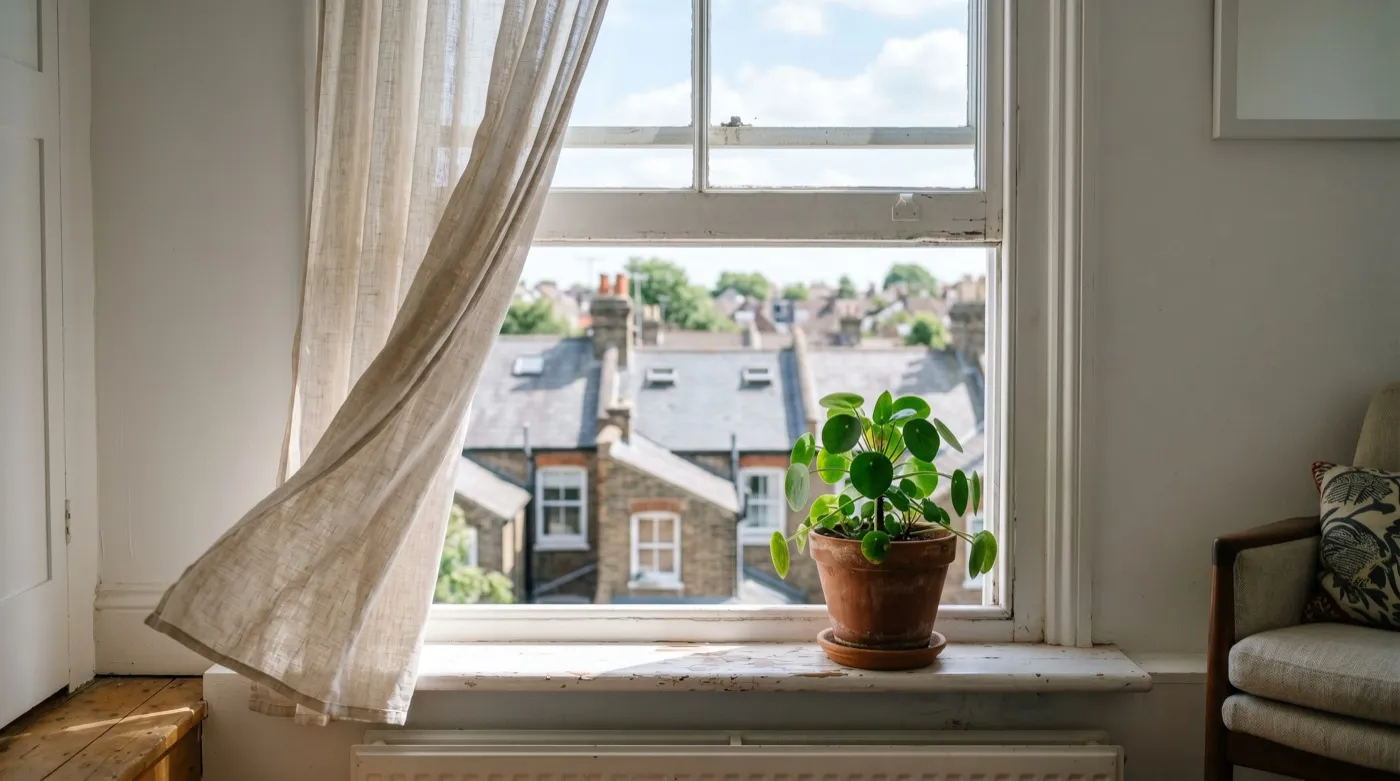 Five minutes of open-window ventilation clears more pollutants than any houseplant collection. Plants and fresh air work best together, not as rivals.
Caring for air-purifying plants through the UK seasons
Most air plants are tropical, so the UK challenge is short, dark winters and dry central heating. Match your care to the season and these plants are hard to kill.
In winter, growth stalls and water use drops sharply. This is when most houseplants die, not from cold but from overwatering. Let the top 3-5cm of compost dry before watering. Move plants away from cold single-glazed windows at night, where temperatures can fall below 10C. In spring and summer, growth resumes, so water more often and feed monthly.
| Season | Light | Watering | Key task |
|---|---|---|---|
| Spring | Increasing, move from darkest corners | Weekly as growth resumes | Repot and start feeding |
| Summer | Shade from harsh south-window sun | Most frequent, check twice weekly | Feed monthly, mist ferns |
| Autumn | Move toward brighter spots | Reduce as growth slows | Last feed, clean leaf dust |
| Winter | Maximise, north windows still fine for snake plant | Sparingly, let compost dry | Stop feeding, watch for root rot |
For watering and feeding detail, see our guides on how to feed houseplants in the UK and getting plants into the right pots with how to repot houseplants.
Gardener’s tip: Wipe dust off broad leaves like rubber plant and peace lily every few weeks. A clean leaf photosynthesises better, and dust is the silent reason many houseplants slowly fade indoors.
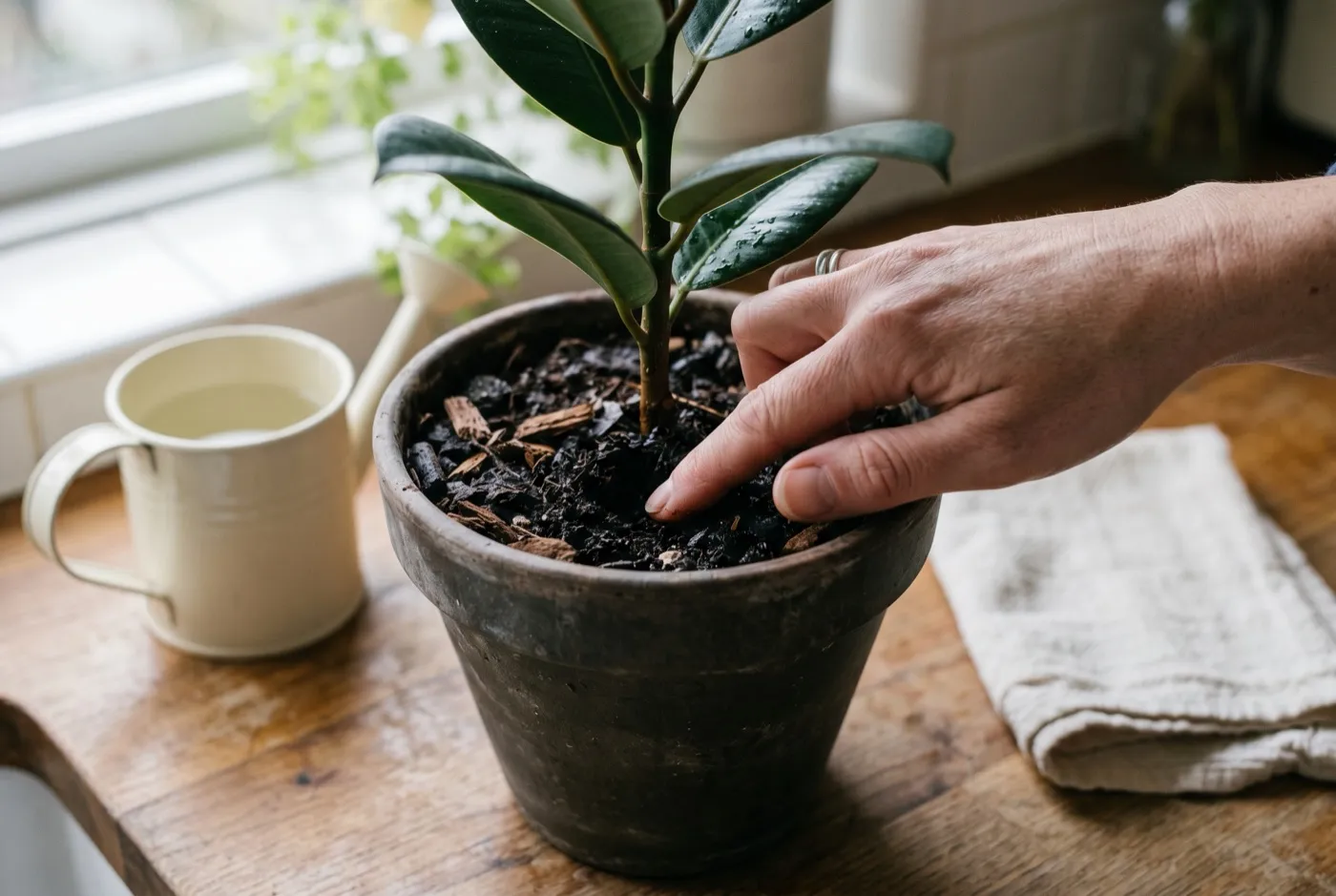 Wipe dust off the leaves and ease back on watering through winter. Clean leaves and the right light matter far more than plant count.
Common mistakes that kill air-purifying houseplants
Most houseplant failures come down to a handful of repeated errors. Avoid these and your plants last for years.
- Overwatering in winter. This is the number one killer. Soggy compost suffocates roots and triggers root rot, a black, mushy decline that is usually fatal. Always let the surface dry first, and never leave a pot standing in water.
- Buying for filtration, not for the spot. People buy a Boston fern for a dry, dark hallway because it is “air-purifying”, then it dies in weeks. Match the plant to the light and humidity you actually have.
- Ignoring pet toxicity. A peace lily on a low table near a cat is an avoidable risk. Check the toxicity before you buy, not after.
- Misting to raise humidity. A quick mist evaporates in minutes and does little. Grouping plants or using a pebble tray works far better for lasting humidity.
- Tolerating fungus gnats. Those little black flies around the compost signal it is too wet. They breed in soggy soil, so the fix is drier watering, not more spray. Our guide to fungus gnats on houseplants covers the full treatment.
The snake plant is also slow to outgrow its pot, so it rarely needs repotting. When it finally fills out, you can split the rhizome to make new plants. Our guide on how to propagate houseplants walks through dividing it. For a glossy-leaved talking point with the same easy nature, try our coffee plant guide. For a splash of deep purple that folds up at night, Oxalis triangularis is another easy houseplant.
For the wider picture on choosing and placing indoor greenery, explore more of our houseplant content across the site. The Royal Horticultural Society’s houseplant advice is a sound, non-commercial reference for individual species care.
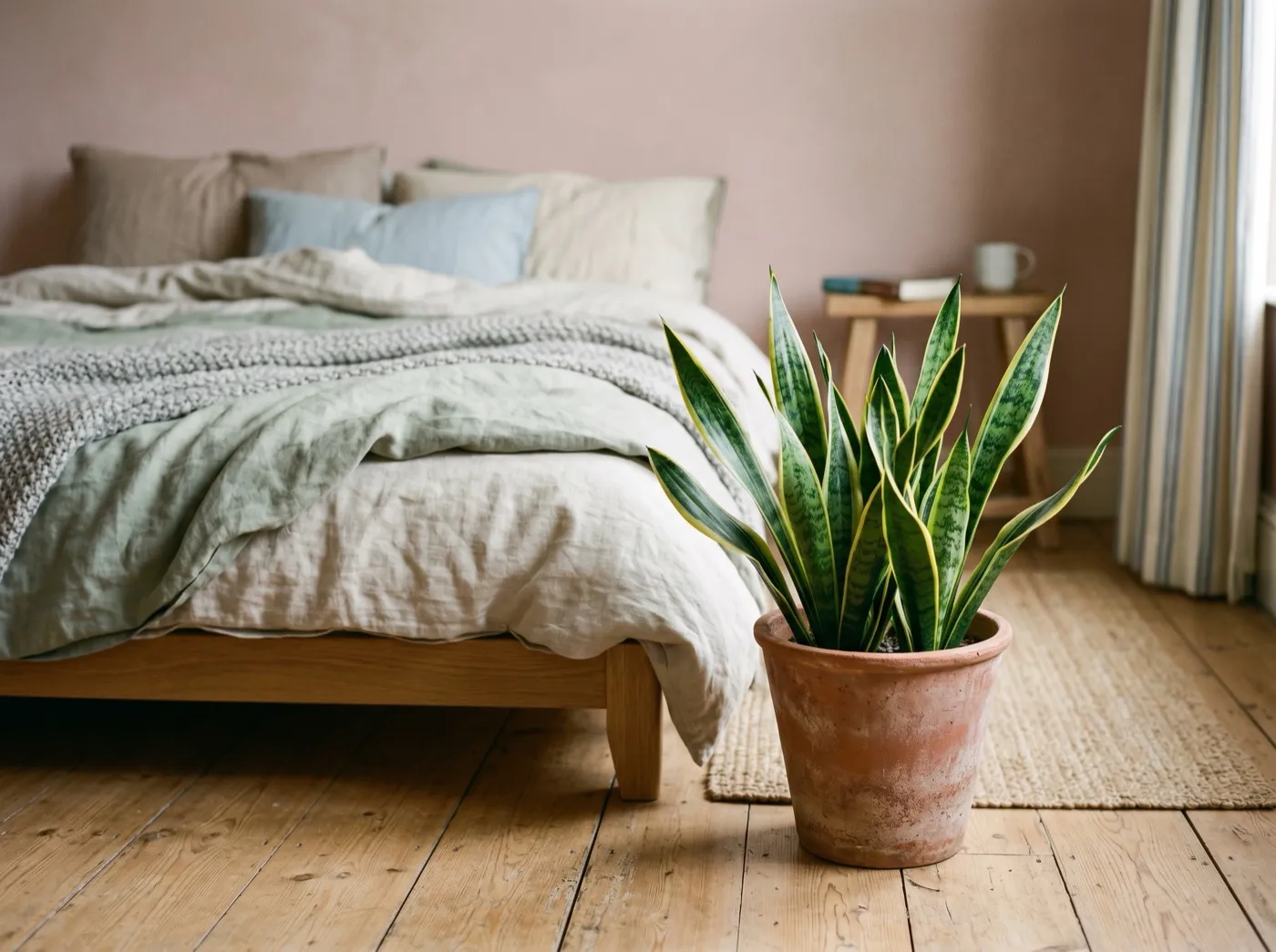 The snake plant releases oxygen at night and survives weeks of neglect. It is the most forgiving choice for a low-light UK bedroom.
Frequently asked questions
Do air-purifying houseplants actually clean the air?
Barely, in a normal ventilated room. The 1989 NASA study used sealed chambers, not real homes. A 2019 review found you would need 10 to 1000 plants per square metre to match a single air change from an open window. Plants do add humidity and lift wellbeing, which are the genuine benefits.
Which houseplant cleans the air the most?
No single plant cleans a real room meaningfully. In lab tests, spider plant, peace lily, and snake plant removed formaldehyde and benzene effectively. At normal household density the effect is tiny. Choose the easiest plant to keep alive instead, since a thriving plant beats a dead specialist.
What is the best air-purifying plant for a bedroom?
Snake plant suits bedrooms because it releases oxygen at night. Most plants take in oxygen after dark, but snake plant uses CAM photosynthesis and gives oxygen out. It also tolerates low light and infrequent watering, making it nearly impossible to kill in a UK bedroom.
Are air-purifying houseplants safe for cats and dogs?
Many are not, so check before buying. Peace lily, pothos, English ivy, and dracaena are toxic to cats and dogs. Spider plant, areca palm, and Boston fern are pet-safe. Keep toxic species on high shelves away from curious pets, or pick a non-toxic alternative.
How many plants do I need to purify a room?
Far more than is practical, around 10 to 1000 per square metre. That figure comes from the 2019 Journal of Exposure Science review by Cummings and Waring. For a 12 square metre room that means hundreds of plants. Opening a window for five minutes does far more than any realistic plant collection.
Do houseplants increase humidity in UK homes?
Now you know what air-purifying plants can and cannot do, browse our full houseplants guides to choose the right greenery for every room in your home.
Our team produces practical UK gardening guidance from source research, contributor records and established horticultural practice. Editorial standards are overseen by Matt W.