Key takeaways
- Running bamboo (Phyllostachys) spreads 6-10m via underground rhizomes and repair bills often hit £3,000-£8,000
- Clumping bamboos (Fargesia) spread under 15cm per year and need no root barrier
- Italian alder hits 60-80cm/year and tolerates wind, clay, and waterlogged soil better than any conifer
- Pleached hornbeam gives 1.8-2.4m of head-height privacy on a clear 1.8m stem, ideal for narrow gardens
- Magnolia grandiflora gives evergreen screening and 25cm scented summer flowers in milder UK regions
- All 10 alternatives stay clear of the RHS invasive plants list and Wildlife and Countryside Act 1981
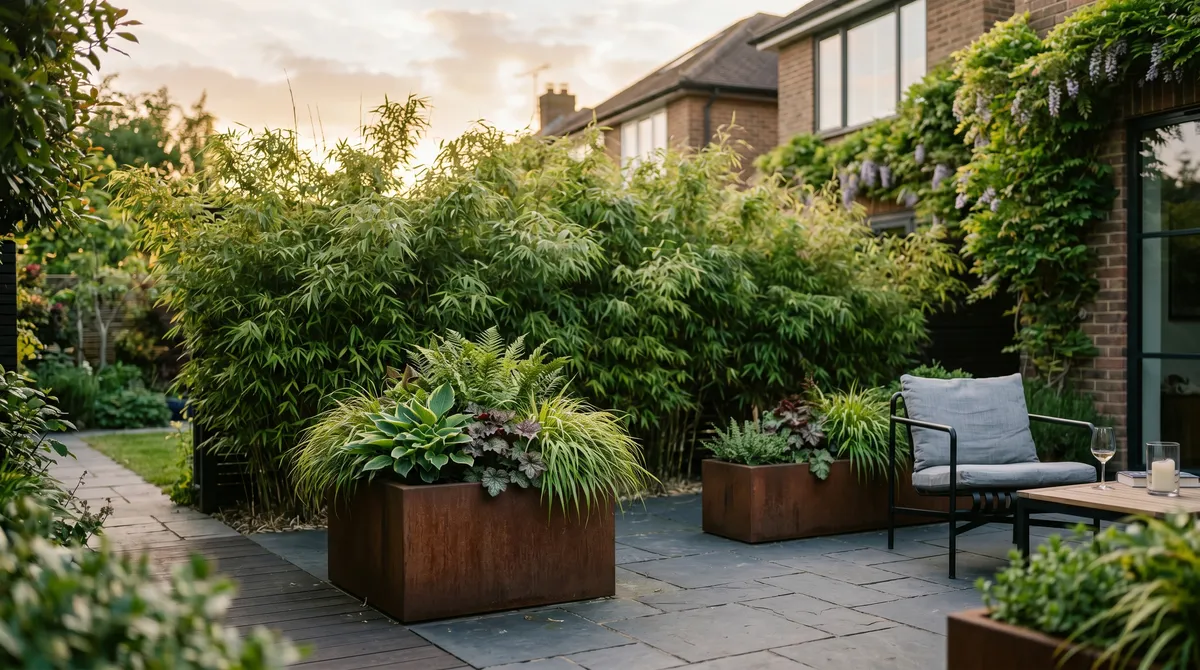
Bamboo gives a contemporary screening look that almost nothing else matches. The problem is that the cheap running species sold at most UK garden centres become invasive within two seasons. Phyllostachys aurea shoots tear up paving, lift fence posts, and emerge through neighbouring lawns by year three. Removal often costs £3,000 to £8,000 with a mini-digger and a fortnight of labour.
Why Running Bamboo Is the Wrong Choice
Running bamboo spreads through underground stems called rhizomes. Phyllostachys aurea, the most common species in UK garden centres at £25-£40 per 3L pot, sends rhizomes 6-10m horizontally before sending up new shoots. The shoots emerge anywhere, through gravel drives, paving slabs, lawns, and into neighbours’ beds.
The Royal Horticultural Society maintains guidance on invasive bamboo and lists Phyllostachys, Sasa, Sasaella, Pleioblastus, and Pseudosasa as potentially invasive. While bamboo is not listed under Schedule 9 of the Wildlife and Countryside Act 1981 (unlike Japanese knotweed), planting bamboo that crosses a boundary can trigger a private nuisance claim under common law. A 2022 case in Croydon County Court awarded £15,000 against a homeowner whose Phyllostachys nigra crossed into the next-door garden.
Clumping bamboo, almost entirely the Fargesia genus in temperate UK conditions, spreads in a tight crown that expands by 5-15cm per year. There are no rhizomes. The clump can be lifted, split, or removed with a spade.
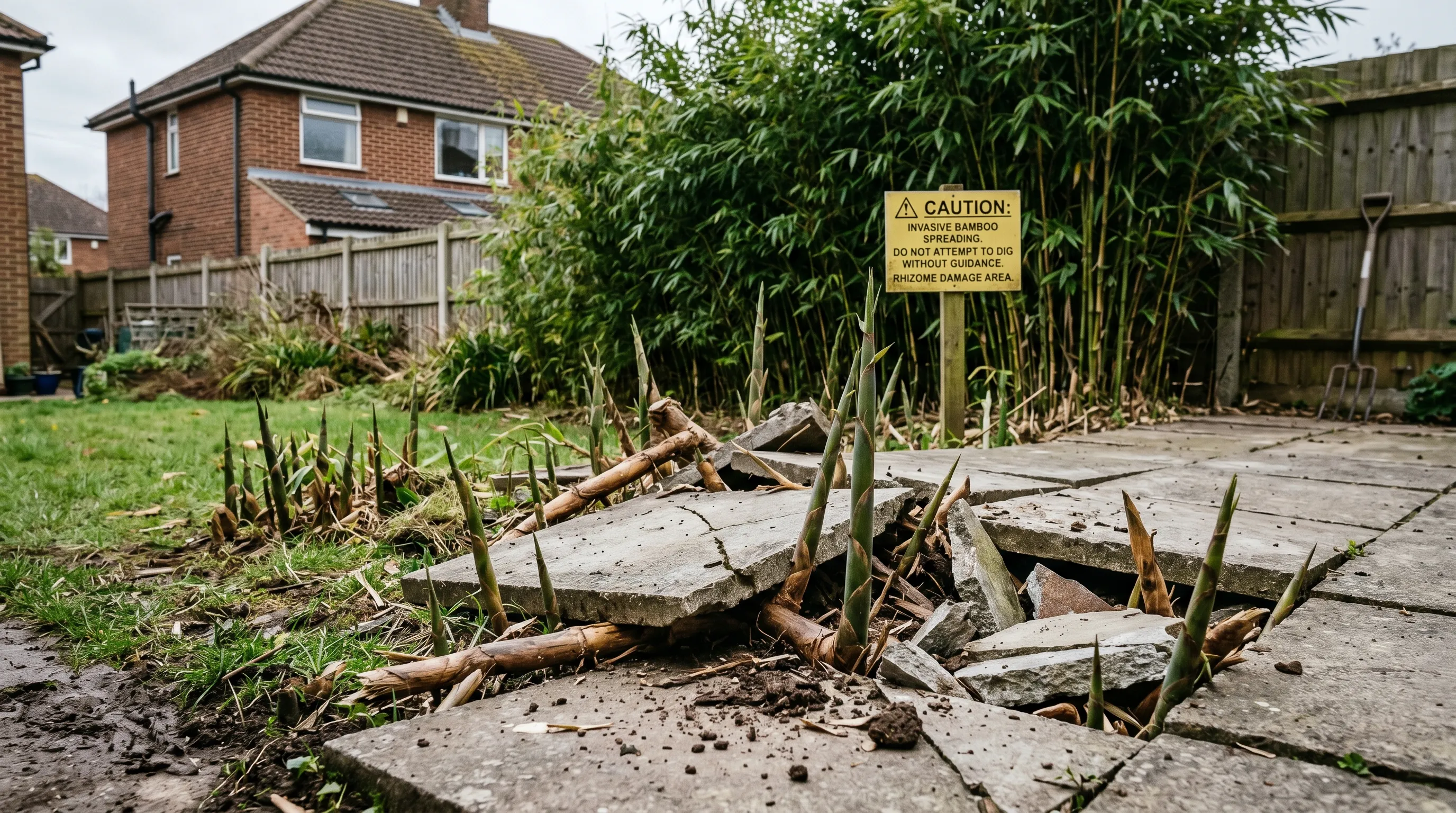 This is what runaway Phyllostachys aurea does to a gravel drive in 14 months. The original 3L plant was 4.2m from the nearest visible shoot.
The 10 Best Non-Invasive Alternatives Ranked
The table below ranks the 10 best alternatives by suitability for UK private gardens. We weight growth speed, hardiness, maintenance level, and the contemporary look that draws people to bamboo in the first place.
| Rank | Species | Type | Growth rate | Mature height | RHS hardiness | Cost/m |
|---|---|---|---|---|---|---|
| 1 | Fargesia rufa | Clumping bamboo | 30-40cm/yr | 2.5m | H5 (-15C) | £25-£40 |
| 2 | Italian alder (Alnus cordata) | Fast deciduous tree | 60-80cm/yr | 15m | H6 (-15C) | £35-£60 |
| 3 | Pleached hornbeam | Trained hedge on stems | 25-35cm/yr | 3-4m | H7 (-20C) | £150-£280 |
| 4 | Quercus ilex (evergreen oak) | Mediterranean evergreen | 30-45cm/yr | 10-20m | H5 (-15C) | £40-£80 |
| 5 | Fargesia murielae | Tall clumping bamboo | 40-50cm/yr | 4m | H6 (-15C) | £35-£55 |
| 6 | Griselinia littoralis | Coastal evergreen | 30-45cm/yr | 4m | H4 (-10C) | £20-£35 |
| 7 | Ilex crenata (Japanese holly) | Box-substitute evergreen | 15-25cm/yr | 2-3m | H6 (-15C) | £40-£65 |
| 8 | Magnolia grandiflora | Evergreen flowering tree | 25-40cm/yr | 8-15m | H4 (-10C) | £60-£120 |
| 9 | Willow living screen | Native deciduous fedge | 150-200cm/yr | 3m | H7 (-20C) | £8-£15 |
| 10 | Native mixed hedge | Wildlife hedge | 30-40cm/yr | 3-4m | H7 (-20C) | £4-£8 |
Costs assume 60-90cm bare-root or 5-10L container plants from a specialist nursery. Pleached trees and large standards push the upper end of the range.
Fargesia Rufa: The Direct Bamboo Replacement
If you want bamboo and only bamboo will do, Fargesia rufa is the species to plant. Native to the mountains of central China at 2,500-3,000m altitude, it tolerates UK winters down to RHS H5 (-15C). The canes are slender at 1-2cm thick, the leaves are narrow and finely textured, and the clump stays in a tight base that expands by no more than 15cm per year.
Growth rate 30-40cm/year. Mature height 2.5m. Width 1-1.5m. Plant 3L containers at £25-£40 each, one per metre for a continuous screen. The first two summers need heavy mulching and weekly watering. After year three, Fargesia rufa is bulletproof.
For a taller bamboo, Fargesia murielae reaches 4m at 40-50cm/year. Wider canes (2-3cm), broader leaves, and RHS H6 hardiness (-15C). Plant where you need 3m+ of screen and have at least 2m of width to give the clump room to mature.
Italian Alder: The Fast Tree Screen
Italian alder fixes its own nitrogen via root nodules. It tolerates wet clay, dry chalk, salt wind, and urban pollution. It is the standard street tree on motorway service stations because nothing else copes with the conditions. For privacy, plant standards at 2-3m apart in a single row.
A 1.8-2.4m feathered standard costs £35-£60. Plant November to March, stake for the first three years, and mulch generously each spring. By year five, you have a 5-7m screen with feathered foliage to ground level.
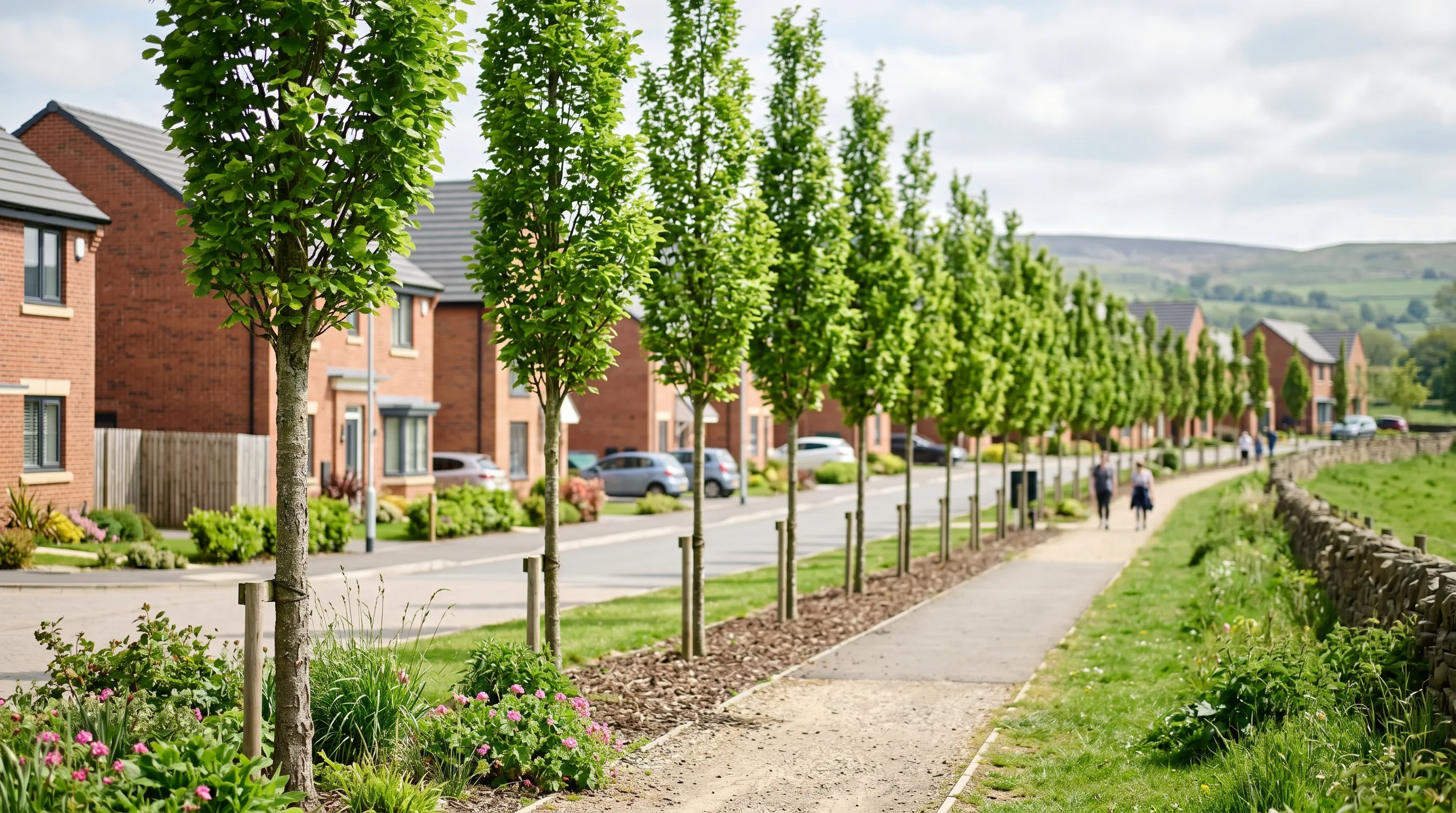 Italian alder makes the fastest tree screen for UK new-build gardens. The narrow profile means you do not lose 4m of border width.
Pleached Hornbeam: First-Floor Privacy
A standard pleached hornbeam comes pre-trained on a 1.5-1.8m clear stem with a 1.2m x 1.2m square frame of woven branches at the top. After 3-5 years of summer trimming, the canopy meshes into a continuous box-shaped hedge in the sky. Plant at 1.5-2m spacing. A single tree costs £150-£280.
For a narrow new-build garden overlooked by neighbouring upstairs windows, pleached hornbeam is the fastest way to block sightlines without losing all the ground-level border space. Stand under the canopy and you still have full use of the bed below.
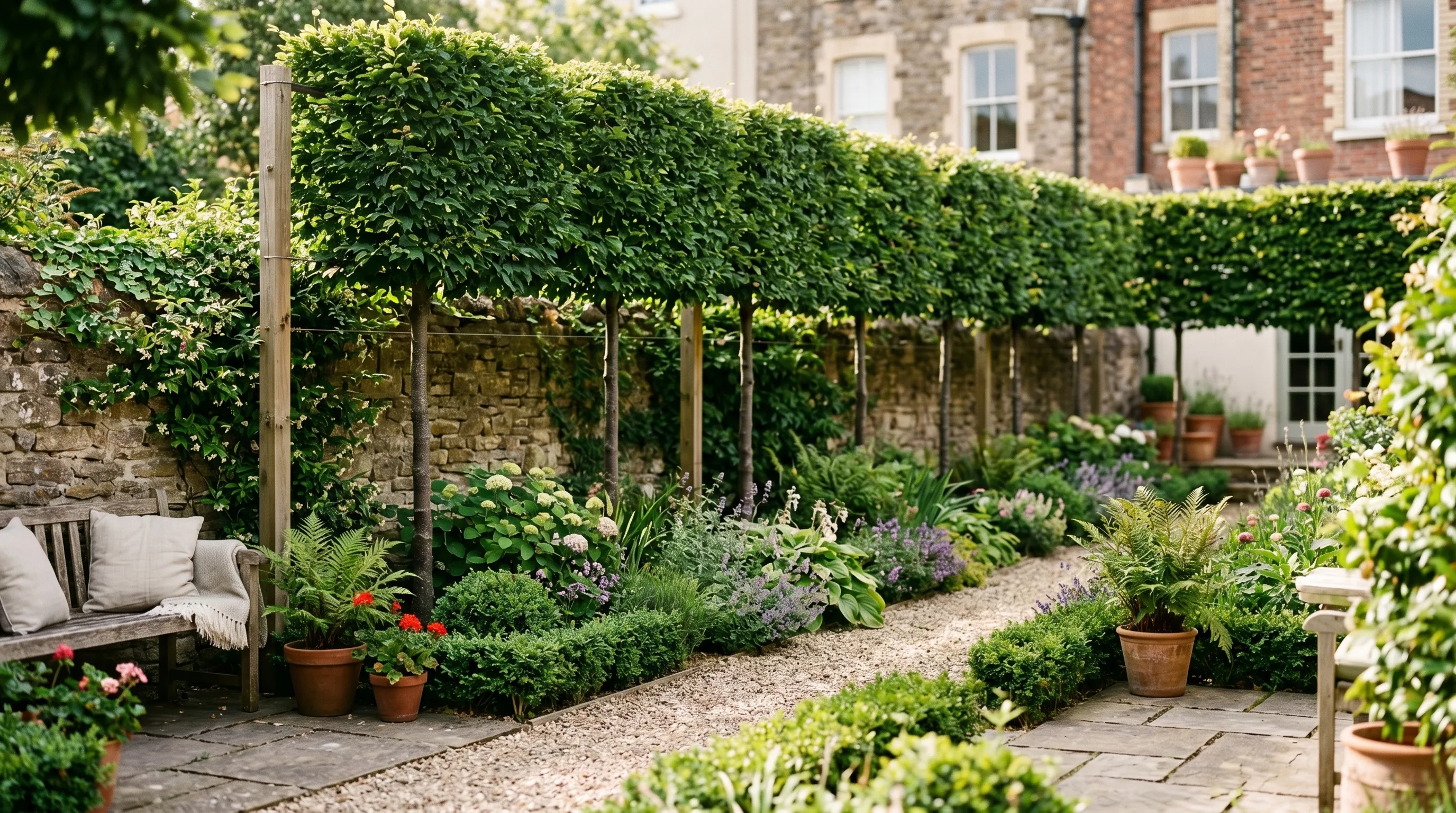 Pleached hornbeam in our Bristol client’s courtyard. 1.8m of clear stem leaves the planting bed below intact.
Quercus Ilex: The Evergreen Oak Screen
Holm oak or evergreen oak (Quercus ilex) is the dense Mediterranean evergreen most British gardens overlook. Growth rate 30-45cm/year, mature height 10-20m unclipped, RHS H5 hardy to -15C. The leaves are leathery, dark green above, grey-felted below.
Quercus ilex clips well into a tall hedge at 3-5m. It tolerates salt wind, dry chalk, and urban pollution. In coastal Cornwall, Devon, and Pembrokeshire it forms dense windbreak hedges along clifftop gardens. Plant 80-120cm whips at £40-£80 each in a single row at 1-1.5m spacing.
The slow first three years are the only downside. Plants establish by sending down a deep tap root before pushing top growth, so year one and two show little above-ground change. From year three onwards, growth accelerates to a steady 35-45cm per year.
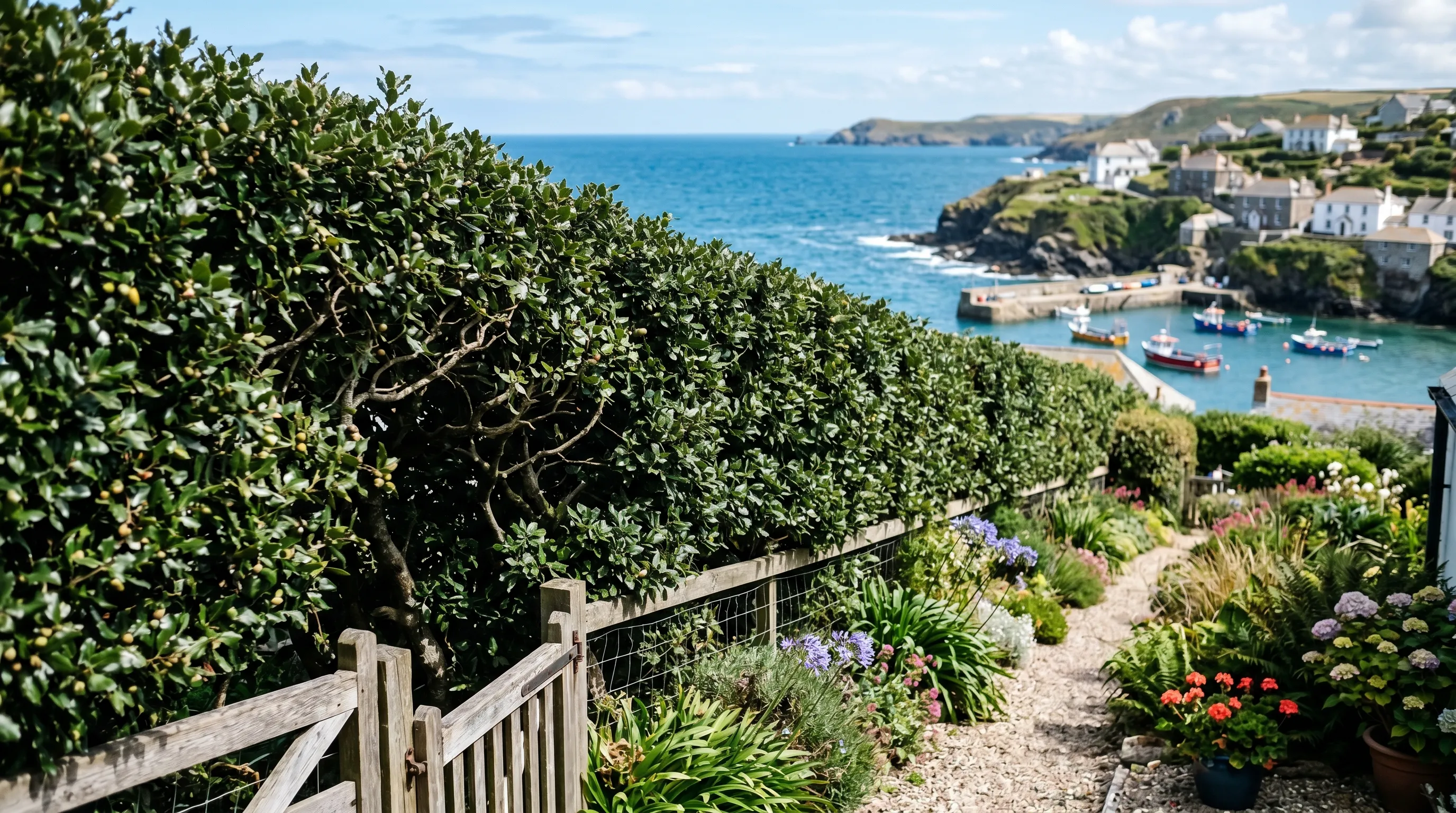 Quercus ilex shaped into a tall coastal screen in a Cornish fishing village garden. Salt wind, granite soil, and full exposure are no problem.
Griselinia and Ilex Crenata: The Lower Screens
Griselinia littoralis is the bright apple-green evergreen that thrives in seaside gardens. Growth rate 30-45cm/year, mature height 4m, RHS H4 hardy to -10C. Plant 60cm bare-root or container at £20-£35 per plant, 2 per metre. Best in mild southern and western counties. Avoid exposed eastern Scotland.
Japanese holly (Ilex crenata) replicates the look of clipped box without the box tree caterpillar risk. Growth rate 15-25cm/year, mature height 2-3m. Best for low formal screens, cloud-pruned topiary, or modern Japanese-style gardens. £40-£65 per metre planted at 3-4 plants per metre.
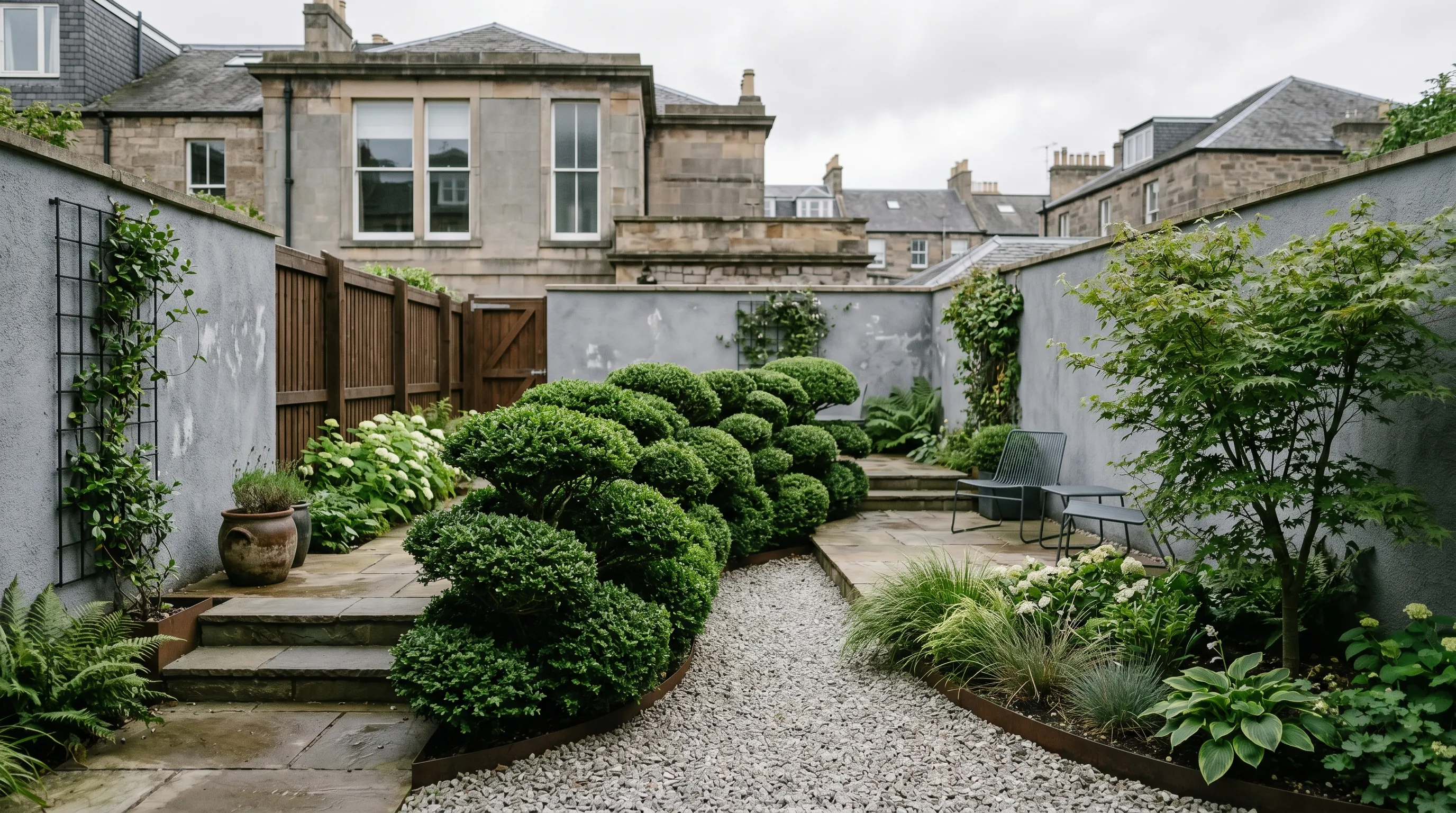 Ilex crenata cloud-pruned for a contemporary Japanese-influenced look. The closest visual match to clipped box with none of the caterpillar risk.
Magnolia Grandiflora and Other Flowering Options
Magnolia grandiflora is the evergreen flowering option for warmer south-coast gardens. Growth rate 25-40cm/year, mature height 8-15m, RHS H4 hardy to -10C. Large 20-25cm white scented flowers from June to September. Pollinated by beetles, useful for pollinator gardens.
Plant container specimens at £60-£120 each. The cultivar ‘Exmouth’ is the hardiest and most reliable in UK conditions. ‘Little Gem’ stays smaller at 4-6m and suits courtyard gardens.
Two further alternatives worth knowing:
Willow Screens and Native Hedges: The Budget Routes
Living willow (Salix viminalis, Salix alba var. vitellina) gives the fastest cheap screen in this list. Cut stems pushed into prepared ground at 20cm spacing in February-March root and grow 1.5-2m in a single season. Cost £8-£15 per metre. Annual pruning by laying stems horizontally creates a woven living fedge.
Willow needs annual maintenance and tolerates only damp soil. Not suitable for dry south-facing borders. Best for boundary screening at the back of large gardens, allotments, and informal cottage-garden borders. For a wildlife-rich permanent boundary, mixed native hedging at £4-£8 per metre is the cheapest option and supports more nesting birds than any other screen in this list.
Warning: Never plant any Phyllostachys species in a UK garden without a 60-80cm deep HDPE root barrier installed before planting. Standard pond liner at 0.5mm thickness fails within five years. Even with a barrier, expect to monitor for escaped shoots annually. The simpler choice is to plant a clumping bamboo or one of the alternatives in this guide.
Comparing Bamboo vs Tree vs Hedge Privacy
The three categories of bamboo alternative differ in cost, speed, and look. Use the table below to match the right option to your space.
| Approach | Best for | Initial cost | Years to full screen | Annual maintenance |
|---|---|---|---|---|
| Clumping bamboo (Fargesia) | Contemporary look, narrow gardens | £25-£40/m | 4-5 years | Minimal |
| Fast tree screen (Italian alder) | Tall screens on new-build estates | £35-£60/m | 4-6 years | One trim/year |
| Pleached hornbeam | First-floor privacy in narrow gardens | £150-£280 per tree | 3-5 years to mesh | Annual summer trim |
| Evergreen hedge (Quercus ilex, griselinia) | Permanent boundary, mid-height | £20-£80/m | 5-7 years | One trim/year |
| Living willow fedge | Cheap fast informal screen | £8-£15/m | 1-2 seasons | Twice yearly |
| Native mixed hedge | Wildlife-rich permanent boundary | £4-£8/m | 4-5 years | One trim/year |
Common Mistakes When Choosing a Bamboo Alternative
1. Buying running bamboo by mistake. The labels on garden centre bamboo rarely highlight running vs clumping clearly. Look for Fargesia in the genus name. Anything starting with Phyllostachys, Pleioblastus, Sasa, or Pseudosasa is running and needs a root barrier or rejection at the till.
2. Planting Magnolia grandiflora in exposed northern gardens. It is rated H4 (-10C) and will defoliate or die in any winter that drops below -12C. The cultivar ‘Exmouth’ is the hardiest at H5, but choose Quercus ilex or pleached hornbeam for any garden north of Birmingham.
3. Skipping the root barrier and “monitoring” a Phyllostachys. Running bamboo sends rhizomes 50-100cm below the surface. By the time you spot the first escaped shoot, the rhizome network is 4-6m across. Eradication then costs the same whether you started monitoring on day one or year three.
4. Underestimating the spread of mature Fargesia. Even clumping bamboo expands at the base. Plan for 1.5m of width per mature plant by year ten. A 5m run needs 4 Fargesia rufa, not 5, to avoid overlap.
5. Planting a single row of Italian alder too close to a fence. Plant at least 1.5m from a fence line. Italian alder roots are vigorous and extensive, and a planting hole 50cm from a fence post creates fence-lift problems by year four. For more on boundary planting and fence interactions, see our guide on fast-growing climbers for fences and walls.
Month-by-Month Establishment Calendar
| Month | Task |
|---|---|
| November | Plant bare-root Italian alder, hornbeam standards, and pleached trees |
| December | Mulch newly planted clumping bamboo with 10cm bark; firm in frosted plants |
| January | Hand-weed at base; check stakes after gales |
| February | Last chance to plant living willow stems |
| March | Final bare-root planting window; apply slow-release fertiliser to bamboo |
| April | Water bamboo and pleached trees weekly if dry; new growth emerging |
| May | Watch for nesting birds and avoid trimming in established hedges |
| June | First summer trim for pleached hornbeam (light) |
| July | Water Fargesia clumps weekly during dry spells |
| August | Main pleaching trim for hornbeam; tip-prune Quercus ilex |
| September | Last summer trim for griselinia and Ilex crenata |
| October | Plan winter planting; order bare-root for November delivery |
Buying Safe Bamboo and Tree Screens in the UK
- Big Plant Nursery (West Sussex) for the largest Fargesia and Italian alder standards
- Walter’s Bamboo (Surrey) for the UK’s leading clumping bamboo specialism
- Hedges Direct (Lancashire) for the best bare-root pricing on native hedging and hornbeam
- Practicality Brown (Buckinghamshire) for pleached trees and large evergreen specimens
For Fargesia rufa specifically, buy 3L or 5L plants rather than 2L. The larger size establishes faster and gives a usable screen 12-18 months earlier. Expect to pay £30-£40 per 3L plant. Bargain plants at £15-£20 are usually root-bound and take an extra year to recover.
Reject any bamboo where you can see thick white rhizomes circling the pot. These indicate the plant has been sat in stock too long. Healthy Fargesia shows fine pale roots and tight canes.
Now You’ve Picked a Safe Screen
Now you have chosen a non-invasive alternative, the next step is getting the planting layout right. Read our hedge planting guide for the UK for the full step-by-step method, or explore the best trees for privacy in UK gardens for a wider look at single-specimen and grouped tree screening.
Our team produces practical UK gardening guidance from source research, contributor records and established horticultural practice. Editorial standards are overseen by Matt W.