Key takeaways
- The 2 metre high hedge trigger needs two or more evergreen trees forming a barrier
- Council high hedge complaint fees typically run £400 to £1,050 and are rarely refunded
- You may cut branches back to the boundary line only, never one centimetre beyond
- There is no rule that you own the left-hand fence, only the T-marks on the title plan
- Fences are 2m under permitted development, dropping to 1m beside a highway
- A contested boundary reaching court commonly costs £15,000 to £50,000 per side
Garden neighbour disputes almost always start with the same handful of features: a hedge that got away, branches over the fence, a boundary nobody can prove, and now a camera on the wall. UK boundary law is less dramatic than most people assume. There is no general right to a view, no automatic right to light across open ground, and no rule about which fence is yours. What does exist is a specific set of statutes and common law rights that decide who can do what.
This guide sets out the law feature by feature, with the real costs attached. It covers England, Wales, Scotland and Northern Ireland where they differ.
Important: This article is general information, not legal advice. Boundary law turns on the wording of your deeds and the facts of your plot. Before you spend money or cut anything you cannot put back, take advice from a solicitor who does property disputes.
Which garden features actually cause neighbour disputes
Four features generate most of the complaints that reach UK councils and solicitors. Hedges come first by a wide margin, and leylandii dominates that category. Trees come second, split between overhanging branches, falling leaves and root damage. Boundary structures come third: fences, walls and the endless argument about who repairs them.
The fourth group is newer. Cameras and privacy, driven by doorbell units and cheap wireless CCTV, now produce complaints that barely existed fifteen years ago. Bonfires, decking overlooking a bedroom, and outbuildings built to the fence line fill out the rest.
The pattern behind all of them is the same. A feature grows, changes or gets installed, one household’s enjoyment drops, and nobody talks about it for eighteen months. By the time anyone speaks, the conversation is already an argument. Knowing which of these features carries a statutory remedy, and which only has a common law one, decides how you should approach it.
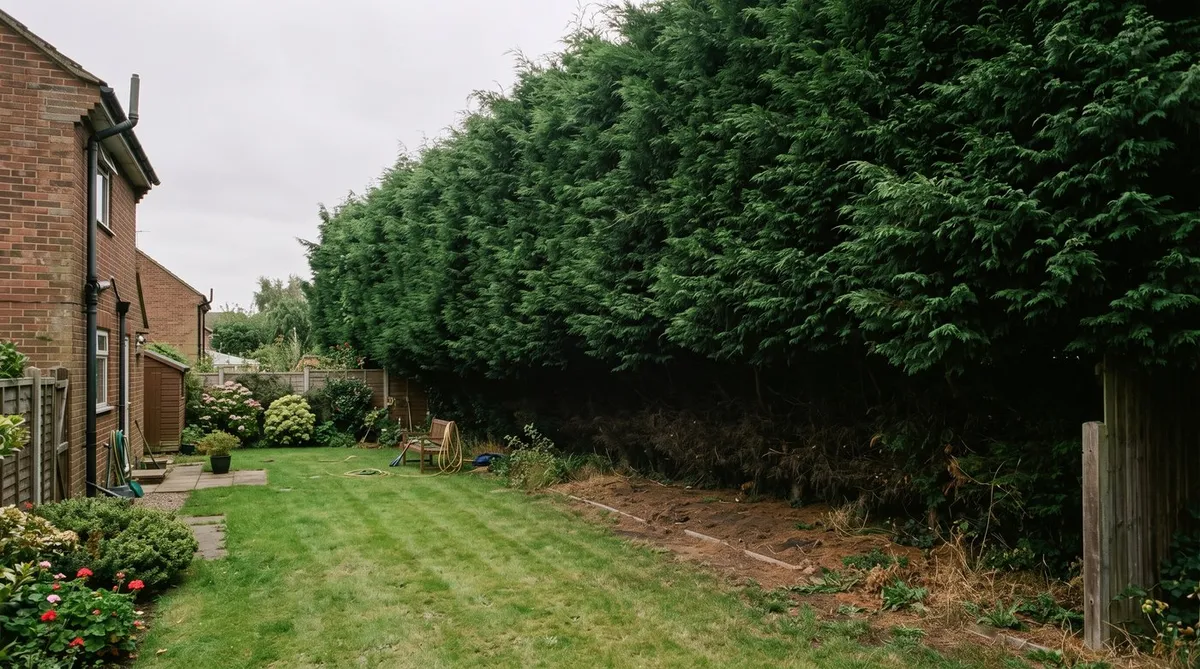
 A leylandii run on an Essex semi boundary. The bare strip along the base shows how little light reaches the ground once the hedge passes about 4 metres.
The 2 metre high hedge rule and what actually triggers it
Part 8 of the Anti-social Behaviour Act 2003 created the high hedge complaint system in England and Wales. It came into force in 2005. Three conditions must all be met before a council can act.
- The hedge is formed wholly or predominantly by a line of two or more trees or shrubs. A single specimen tree, however large, is outside the scheme.
- The trees are evergreen or semi-evergreen. Deciduous beech and hornbeam hedges are usually excluded, even at 6 metres.
- The hedge rises more than 2 metres above ground level and acts as a barrier to light or access, adversely affecting the reasonable enjoyment of a home or garden.
Two metres is not a legal maximum height. This is the single most misunderstood point in UK hedge law. Your neighbour is entitled to grow a 4 metre hedge. The 2 metre figure only opens the door to a complaint, and the council then judges whether the hedge is genuinely unreasonable in that setting.
Measurement is taken from ground level at the base of the hedge, on the hedge owner’s side where the ground is uneven. Trellis, fence panels and mounded soil beneath the hedge are excluded from the height. Councils apply a formal light-loss calculation, so a north-facing hedge 15 metres from a window may fail where a south-facing one 4 metres away succeeds. The full statutory framework sits on GOV.UK’s neighbour dispute guidance.
How a high hedge complaint works and what your council charges
A high hedge complaint is a last resort by design. The council will refuse to open the file unless you show you have tried and failed to settle it directly. In practice that means dated letters, not a doorstep conversation you cannot evidence.
The fee is set by each authority and is not standardised. Across English district and unitary councils the typical charge sits between £400 and £1,050. A large minority charge £700 to £1,050, and some offer a reduced rate of around £100 for households on qualifying benefits. Once the council decides your complaint on its merits the fee is non-refundable, win or lose. Most councils do refund it where they reject the complaint as invalid at the outset.
If the complaint succeeds the council issues a remedial notice. This states the height the hedge must be cut to, the deadline for the initial cut, and the ongoing maintenance required to keep it there. Notices commonly specify 2 to 2.5 metres. The notice is registered as a local land charge, so it binds future owners of that property too.
Either party may appeal to the Planning Inspectorate in England, or the Welsh Ministers in Wales, within 28 days. Failing to comply with a remedial notice is a criminal offence carrying a fine of up to £1,000, plus the council’s costs of doing the work itself. Timescales are slow: expect 3 to 9 months from complaint to notice.
High hedge law in Scotland and Northern Ireland
The rest of the UK has parallel systems with different statutes and details. Do not quote the 2003 Act to a Scottish council.
Scotland runs the High Hedges (Scotland) Act 2013, in force from 1 April 2014. The trigger is the same: two or more evergreen or semi-evergreen trees forming a barrier over 2 metres that impairs reasonable enjoyment. You apply to the local authority for a high hedge notice. Fees vary by council and are generally lower than English ones, commonly £275 to £450. Appeals go to Scottish Ministers.
Northern Ireland uses the High Hedges Act (Northern Ireland) 2011, operating since 2012 through the eleven district councils. The definition again matches: two or more evergreens, over 2 metres, harming reasonable enjoyment. Fees are generally lower, often around £350. Appeals go to the Planning Appeals Commission.
All three systems share the same weakness. Deciduous hedges fall outside them, single trees fall outside them, and a hedge that blocks a view rather than light will usually fail. If your problem is a beech hedge or one oak, the statutory route is closed and you are back to negotiation or common law nuisance.
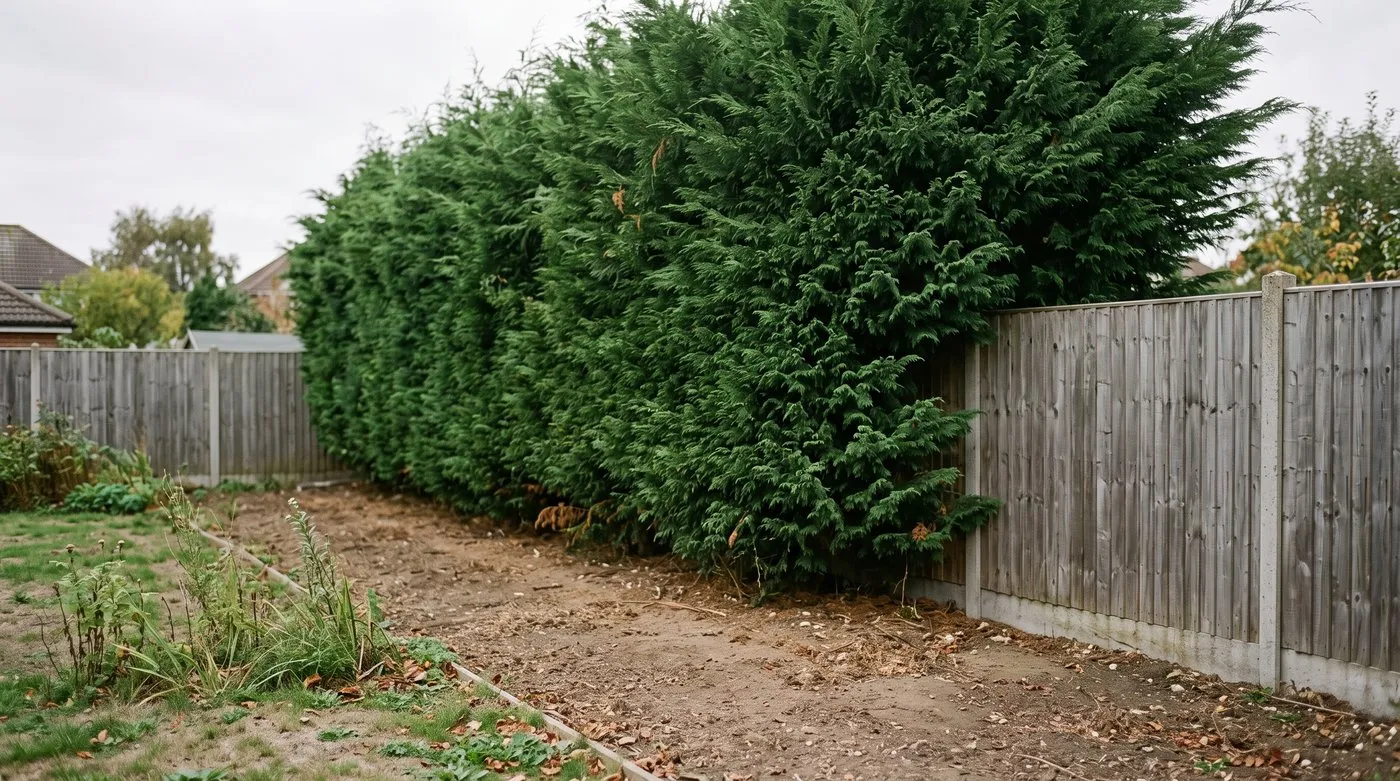
 Bringing a boundary hedge down to an agreed 2.4 metres. Agreeing a height and a cutting month in writing prevents the same argument returning every August.
Cutting back overhanging branches without breaking the law
You have a common law right of abatement. Where a neighbour’s branches cross the boundary they are technically trespassing, and you may cut them back. Four limits apply, and people break all four regularly.
First, you may only cut to the boundary line, not beyond it. Cutting into their side is criminal damage under the Criminal Damage Act 1971. Second, you may not enter their land or lean over the fence to make the cut. That is trespass. Third, the branches and any fruit on them remain your neighbour’s property. You must offer them back. Throwing them over the fence uninvited is fly-tipping and has produced fixed penalty notices.
Fourth, and the one that catches people out, is protection. If the tree carries a Tree Preservation Order or stands in a conservation area, cutting without consent is an offence. TPO breaches carry an unlimited fine in the magistrates’ court, and an unlimited fine on indictment where a tree is destroyed. Conservation area trees over 75mm in diameter at 1.5 metres need six weeks’ written notice to the council before any work.
There is one more trap. If your cut destabilises the tree and it later fails onto their property, you can be liable. Take a tree surgeon’s advice on anything above about 4 metres, and keep the quote. Our guide on pruning trees for privacy and light covers the practical cutting technique once the legal position is clear.
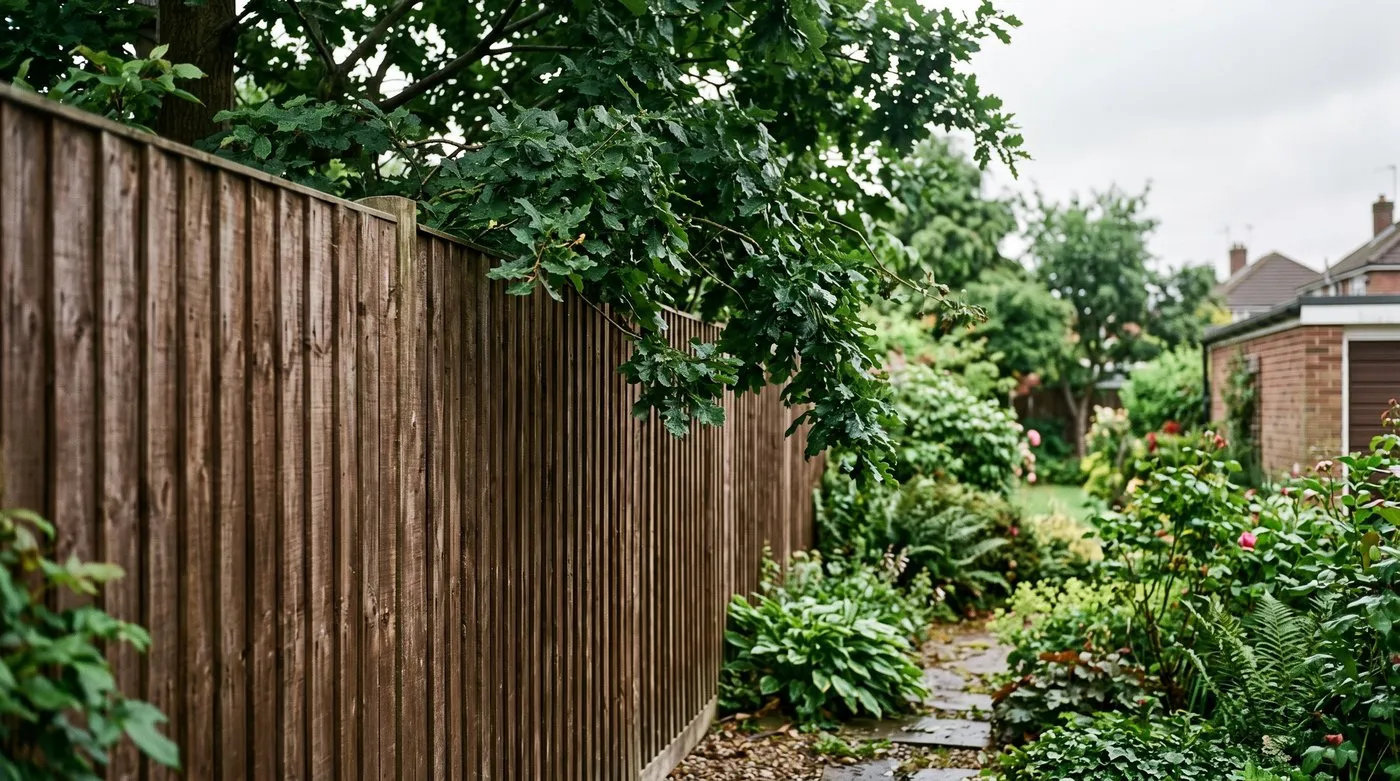 Overhanging growth crossing a close-board fence. The vertical face of the fence marks the line you may cut to, and no further.
Tree roots, drains and where liability actually sits
Roots follow the same abatement rule as branches. You may cut encroaching roots back to the boundary line, subject to the same TPO and conservation area consents. In practice root cutting is far riskier than branch cutting, because severing structural roots on one side can bring a mature tree down.
Root damage claims fall under private nuisance. To succeed you must show the roots caused the damage, that it was reasonably foreseeable, and that you gave the owner notice. Clay soils make this common: shrinkable clay dries out around a thirsty tree and the ground moves, causing subsidence. Insurers deal with hundreds of these claims each year, and poplar, willow, oak and elm are the usual culprits.
Drains are the other flashpoint. Roots do not break sound modern plastic pipe. They exploit joints that have already failed, usually in Victorian clay drainage. A CCTV drain survey costs £180 to £350 and is the only way to prove which is true. Get the survey before you accuse anyone, because a survey showing a failed joint puts the repair back on the drain owner.
Who owns the fence, and why the left-hand rule is a myth
There is no rule that you own the left-hand fence. There is no rule that you own the right-hand one either. The belief is one of the most persistent myths in British property, and it has no legal foundation at all.
Ownership is shown on the title plan held at HM Land Registry. Boundary responsibility is marked with a T-mark. The T sits with its stem on the boundary line and its bar inside the plot of the owner responsible for that stretch. Two T-marks joined back to back form an H, which indicates a party fence with shared responsibility.
Download a title plan and register entry for £7 each through the HM Land Registry portal, or £11 each by post. Read the transfer deed too, because many T-marks are recorded only in a covenant in the original conveyance. Where nothing is recorded, the boundary is undetermined and the general boundaries rule applies: the plan shows the approximate line, not the exact one.
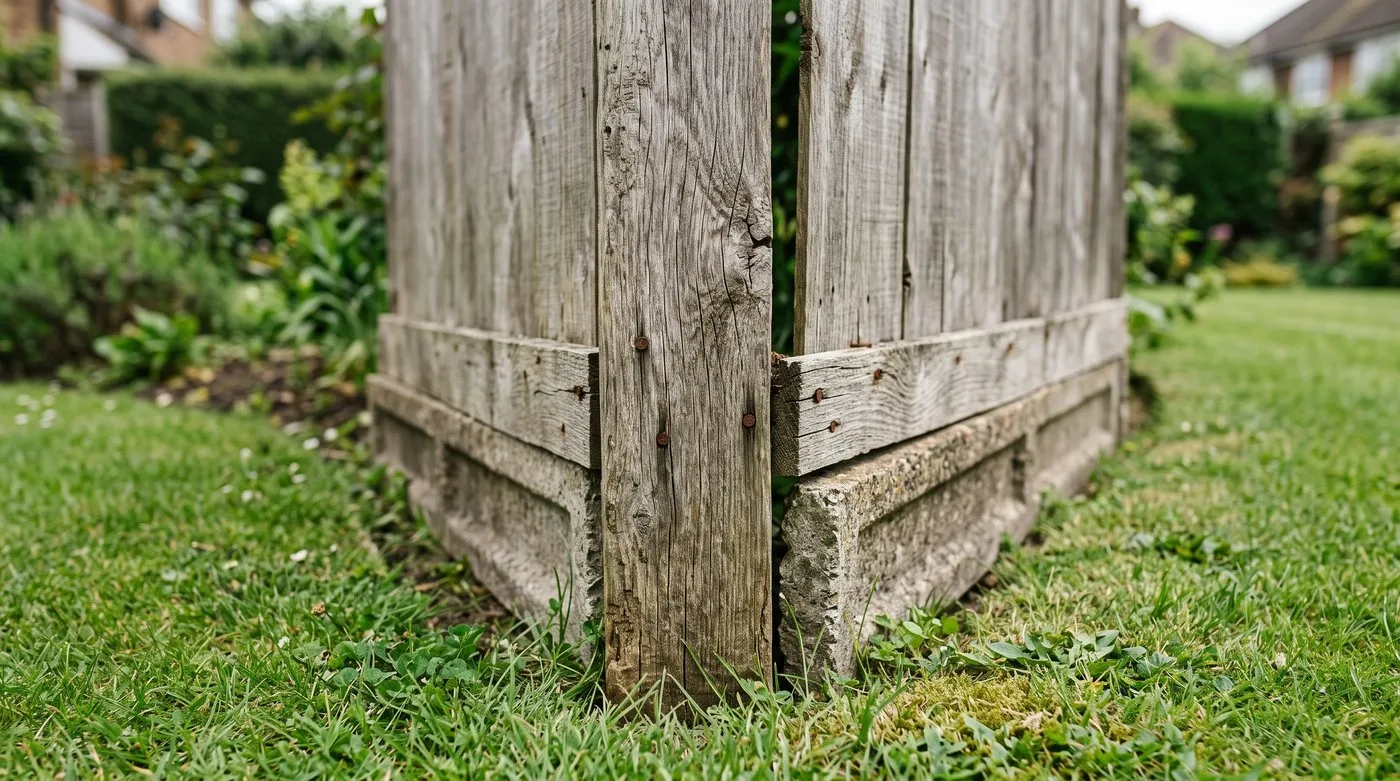 The physical fence line rarely matches the title plan exactly. A determined boundary application to HM Land Registry costs £90 and fixes it permanently.
Fence, wall and outbuilding heights you can build without planning
Read the first two rows together. Within 2 metres of a boundary the whole building, ridge included, must stay under 2.5 metres. You cannot put a 4 metre dual-pitched shed on the fence line. The 4 metre and 3 metre overall limits, and the separate 2.5 metre eaves limit, only apply once the building sits more than 2 metres from the boundary. The 50 per cent footprint test measures the land around the original house, meaning the house as it stood on 1 July 1948 or as first built, not your present-day curtilage.
Permitted development rights are removed on listed buildings, in some conservation areas, and on many post-2005 estates through an Article 4 direction or an estate covenant. Check your title register for restrictive covenants before assuming the national limits apply to you.
Decking above 300mm is the most common accidental breach. It is also the most common privacy complaint, because raised decking at 600mm gives a clear view over a 1.8 metre fence into the neighbouring garden. If overlooking is your problem rather than the deck itself, dense screen planting on your own side solves it faster than a planning complaint.
Japanese knotweed encroachment and what it costs you
Japanese knotweed crossing a boundary is a private nuisance, settled by the Court of Appeal in Williams v Network Rail in 2018. The court held that encroaching knotweed interferes with the neighbour’s quiet enjoyment and amenity even without physical damage to a building. The Supreme Court narrowed what you can recover in Davies v Bridgend County Borough Council [2024] UKSC 15, decided on 8 May 2024. It held unanimously that any fall in value occurring before the defendant’s breach is not recoverable. Ordinary but for causation applies to private nuisance, so damages cover only the loss the breach itself caused.
This makes knotweed the most financially serious item on the list. Professional treatment runs from £2,500 for a herbicide programme over three growing seasons to £10,000 to £15,000 for excavation and licensed disposal on a larger stand. Lenders no longer work to the old 7 metre rule, which RICS abolished in 2022. Valuers now apply management categories A to D, judged on the actual impact on the property rather than the distance to a building. A stand on the boundary still hits both properties’ value, but the category drives the lending decision.
Act early and act formally. Photograph the stand with a scale in frame, date it, and write to the owner. Get a professional management plan from a contractor with Property Care Association membership, because that document is what lenders and courts accept. Identification matters first, because bindweed, Russian vine and dogwood all get misreported. Our Japanese knotweed identification guide shows the shovel-shaped leaves and zig-zag stem pattern that confirm it.
Light, overshadowing and the right you probably do not have
Most people believe they have a right to light in the garden. In nearly all cases they do not. A right to light under the Prescription Act 1832 attaches to a defined aperture, meaning a window or a rooflight, and it is acquired after 20 years of uninterrupted enjoyment. It does not attach to open ground.
So a hedge or building that shades your lawn, your greenhouse or your vegetable bed gives you no right to light claim at all. Your remedies are the high hedge scheme if the evergreen conditions are met, or a nuisance claim if the interference is genuinely unreasonable, which is a high bar.
Where a window is affected the test is not total darkness. It is whether enough light remains for the ordinary use of the room. Surveyors apply the 50 per cent rule: the room should keep adequate light over half its area at working plane height. A right to light surveyor’s report costs £900 to £2,500.
The practical answer is usually horticultural rather than legal. Reducing a hedge to 2.4 metres, thinning a crown by 20 per cent, or replacing leylandii with something manageable delivers more light for less money than any claim. A western red cedar hedge gives the same evergreen screen at half the annual growth rate of leylandii.
CCTV, doorbell cameras and UK GDPR over the fence
Domestic CCTV is exempt from data protection law only while it captures your own property alone. The moment a camera records your neighbour’s garden, their drive or the public pavement, the household exemption falls away. That was the effect of Fairhurst v Woodard in 2021, where a claimant succeeded in harassment under the Protection from Harassment Act 1997 and in data protection under UK GDPR and the Data Protection Act 2018. Her nuisance and privacy claim failed. The court held itself bound by Fearn v Tate Gallery [2020] EWCA Civ 104, which decided that overlooking is not actionable in nuisance. It is a county court decision, so it is not binding precedent.
Once the exemption is lost, the camera owner becomes a data controller under UK GDPR and the Data Protection Act 2018. Their duties are real: justify the coverage, minimise it, put up a visible notice that recording is taking place, keep footage no longer than necessary, and respond to a subject access request within one month.
Audio is treated more seriously than video. A doorbell recording conversations across a 6 metre driveway is very hard to justify, and courts have singled this out. Most disputes settle once the owner angles the camera down, applies a privacy mask in the app, and switches audio off.
If a request is ignored, complain to the Information Commissioner’s Office. The ICO rarely fines a household, but its correspondence usually resolves the behaviour. Citizens Advice sets out the practical steps clearly in its guide to problems with neighbours.
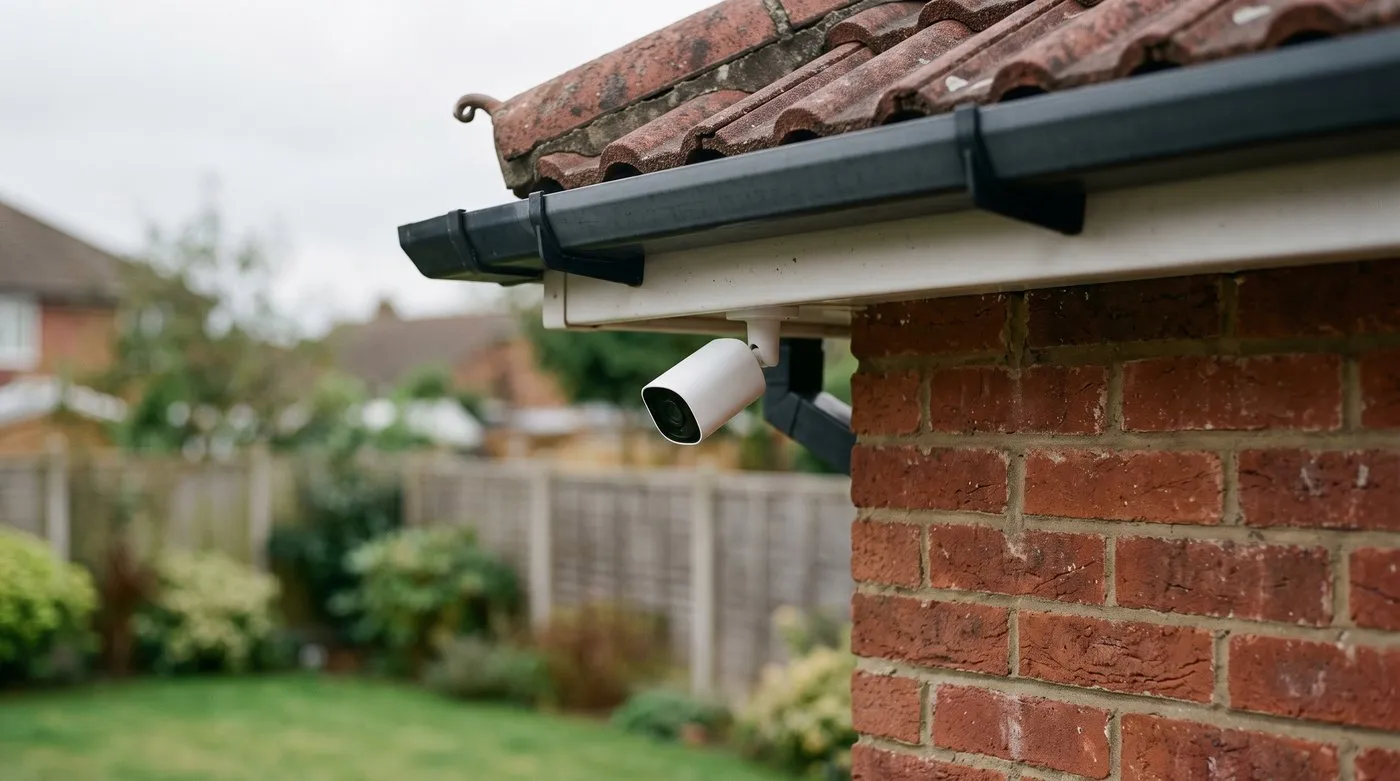 A domestic camera under the eaves. Angling it down so it covers only your own boundary usually keeps you inside the household exemption.
Bonfires, smoke and when it becomes a statutory nuisance
There is no law against a garden bonfire in the UK, and no legal restriction on the time of day. What exists is the statutory nuisance regime under section 79 of the Environmental Protection Act 1990.
Smoke, fumes or gases from a domestic property become a statutory nuisance where they unreasonably interfere with the use or enjoyment of another property. Councils assess frequency, duration, timing and the material burnt. One bonfire a year is not a nuisance. A weekly fire of wet garden waste and treated timber usually is.
Where a council serves an abatement notice and it is ignored, the fine for a domestic property is unlimited, plus a further daily fine while the breach continues. Burning household waste, plastics, tyres or treated timber can also breach waste regulations separately. Under section 161A of the Highways Act 1980, letting smoke drift across a road is an offence carrying an unlimited fine.
Allotments follow their own tenancy rules on top of this, and many sites now ban burning outright. Bonfire rules on UK allotments covers what site agreements typically say. In a private garden, the practical fix is to burn dry material only, on a still day, well away from the boundary, and never within an hour of your neighbour hanging washing out.
Dispute types ranked by the remedy available
| Dispute | Statutory remedy | Typical resolution time | Cost to you | Role |
|---|---|---|---|---|
| Evergreen hedge over 2m | High hedge complaint to council | 3 to 9 months | GBP 400 to 1,050 fee | Primary route, strongest remedy |
| Overhanging branches | None, common law abatement | Same day | GBP 0 to 400 tree surgeon | Self-help, no permission needed |
| Japanese knotweed | Private nuisance claim | 6 months to 3 years | GBP 2,500 to 15,000 treatment | Highest financial stakes, act first |
| Bonfire smoke | Statutory nuisance, EPA 1990 | 4 to 12 weeks | Free to complain | Council-led, needs a diary of dates |
| CCTV over the boundary | UK GDPR, ICO complaint | 6 to 16 weeks | Free to complain | Usually settles without formal action |
| Fence ownership | None, deeds govern it | 2 to 8 weeks | GBP 7 to 90 Land Registry | Evidence-led, rarely needs a lawyer |
| Boundary line itself | Determined boundary application | 3 to 18 months | GBP 90 plus surveyor fees | Last resort, expensive if contested |
The council high hedge complaint is the gold standard remedy where it applies, because it produces an enforceable notice that binds future owners and cannot be argued away. Its weakness is scope: deciduous hedges, single trees and view-blocking all fall outside it. Every other item on this list depends on either your own self-help or on persuading a third party to act.
The de-escalation ladder: five stages and when to move up
Almost every dispute that ends in court could have stopped at stage one. Work through these in order and do not skip a rung.
- Talk, then confirm in writing. Have the conversation face to face, then send a short friendly note recording what you agreed. Cost: nothing. Roughly 6 in 10 disputes end here.
- Formal letter with evidence. Dated photographs, measurements, and a specific request with a reasonable deadline of 28 days. Keep a copy. Cost: nothing.
- Mediation. A community mediation service or a Civil Mediation Council member. Typical cost £100 to £500 per party, with some local authority schemes free. Sessions run 2 to 4 hours and settle a high proportion of boundary matters.
- Statutory route. The council high hedge complaint, an environmental health complaint or an ICO complaint, depending on the feature. Cost: £0 to £1,050.
- Solicitor and, last, court. Only when a real property right or real money is at stake.
Move to stage five when the dispute involves the boundary line itself, a restrictive covenant, an adverse possession claim, knotweed, or subsidence damage. Those turn on documents and expert evidence, and self-representation goes badly. Everything else is usually cheaper to solve with a hedge trimmer and a conversation.
 Stage one settles most disputes. A conversation before the growing season, followed by a short written note, prevents almost every escalation on this list.
The root cause behind most boundary disputes
The underlying cause is almost never the hedge, the fence or the camera. It is an information gap that both households filled with assumptions. One believes the left-hand fence rule. One believes hedges have a 2 metre legal limit. Neither has read the title plan. Both are certain they are right.
That gap is missed because the features involved change slowly. A leylandii adds 50 to 90cm a year. Nobody notices in month three. By year four the light has gone and the relationship has soured, so the first conversation happens under pressure instead of in good faith.
The permanent fix is a boundary agreement in writing, made while everyone is still on speaking terms. It runs to one page. Name the features, agree a maximum hedge height and a cutting month, record who maintains which fence, note who pays for shared work, and both sign and date it. Attach a copy of the title plan with the T-marks marked up.
That document is not a deed and does not bind a future buyer automatically. It does, however, resolve almost every dispute on this page before it starts, and it is powerful evidence if one ever escalates. Choosing the right plant at the boundary in the first place removes the problem entirely: compare annual growth rates before you buy, and pick a screen you can realistically keep on top of with one cut a year.
Common mistakes in UK garden neighbour disputes
- Cutting beyond the boundary line. People trim the whole shrub because a half-cut plant looks odd. Cutting into your neighbour’s side is criminal damage, and it hands them the moral high ground and a claim. Cut to the vertical plane of the boundary and stop.
- Throwing cuttings over the fence. The material is legally theirs, so returning it feels logical. Doing it without asking is fly-tipping, and councils have issued fixed penalty notices for exactly this. Offer the cuttings back, and dispose of them yourself if refused.
- Paying a council fee too early. A 400 to 1,050 pound high hedge fee is non-refundable once decided, and councils reject complaints where you cannot show reasonable prior attempts to settle. Spend three months building an evidence folder first.
- Assuming a T-mark forces a rebuild. A T-mark usually shows responsibility to maintain, not an obligation to replace. If a neighbour refuses to renew a rotten fence, your realistic option is a new fence built wholly inside your own land.
- Failing to disclose the dispute when selling. Form TA6 requires you to declare disputes and complaints about the property. Concealing one can amount to misrepresentation, and buyers have successfully sued after completion. Disclose it and price it in.
Gardener’s tip: Book boundary hedge work for late September. Nesting bird protection under the Wildlife and Countryside Act 1981 makes cutting between March and August risky, and September growth stays tidy through winter. Our guide to when to cut hedges in the UK sets out the legal dates in full.
What a garden dispute actually costs in the UK
| Item | Typical UK cost | Notes |
|---|---|---|
| Title plan and register download | GBP 7 each online | HM Land Registry portal, GBP 11 by post |
| Determined boundary application | GBP 90 plus surveyor | Surveyor adds GBP 600 to 2,000 |
| High hedge complaint fee | GBP 400 to 1,050 | Non-refundable once decided on merits |
| Community mediation | GBP 0 to 500 per party | Some council schemes are free |
| Hedge reduction by contractor | GBP 200 to 800 | A 20m leylandii run at 5m height |
| CCTV drain survey | GBP 180 to 350 | Settles most root and drain arguments |
| Knotweed herbicide programme | GBP 2,500 to 6,000 | Three growing seasons, with guarantee |
| Knotweed excavation | GBP 10,000 to 15,000 | Licensed disposal, larger stands |
| Solicitor’s letter before action | GBP 250 to 600 | Often the point a dispute settles |
| Contested boundary in court | GBP 15,000 to 50,000 per side | Frequently exceeds the land’s value |
The hidden costs matter more than the headline figures. An undisclosed dispute can knock 5 to 10 per cent off a sale price, or lose the buyer entirely. A remedial notice on your own property is a registered land charge that every future conveyancer will see. And a soured relationship costs you the shared access, the parcel taken in, and the fence repaired without argument.
 A settled boundary is worth more than winning the argument. Gaps under fences, roaming pets and shared access all run smoother once the line is agreed in writing.
Frequently asked questions
How tall can my neighbour’s hedge be in the UK?
There is no fixed legal height limit for a hedge in the UK. The 2 metre figure only sets the point at which a council can consider a formal high hedge complaint. That complaint route needs an evergreen or semi-evergreen barrier of two or more trees that harms your reasonable enjoyment of your home.
Can I cut my neighbour’s overhanging branches?
Yes, you may cut overhanging branches back to the boundary line. You must not lean over or step onto their land to do it. Cutting beyond the boundary can amount to criminal damage, and a protected or conservation area tree needs council consent first.
Do I have to give the cuttings back to my neighbour?
Yes, the branches and any fruit remain your neighbour’s property in law. You should offer them back rather than keep them. Throwing them over the fence without asking counts as fly-tipping, so ask first and dispose of them yourself if they decline.
Is it true you always own the left-hand fence?
No, the left-hand fence rule is a myth with no basis in law. Ownership is shown by T-marks on the title plan filed at HM Land Registry. The T sits inside the boundary of the responsible owner, and a joined H mark means a shared party fence.
How high can I build a garden fence without planning permission?
Two metres in most rear gardens, or one metre next to a highway. Those are permitted development limits and they include any trellis or gravel boards. Listed buildings, conservation areas and properties with removed permitted development rights need a planning application.
What does a high hedge complaint to the council cost?
Most English councils charge between £400 and £1,050 for a high hedge complaint. A large minority charge £700 to £1,050. The fee is non-refundable once the council decides your complaint on its merits, so gather dated photographs and measurements first.
Can my neighbour point a CCTV camera at my garden?
Only if they can justify it, because filming beyond their boundary engages UK GDPR. A domestic camera covering only their own property is exempt. Once it captures your garden or the pavement, they become a data controller with duties to signpost the camera and respond to requests.
Our team produces practical UK gardening guidance from source research, contributor records and established horticultural practice. Editorial standards are overseen by Matt W.