Key takeaways
- Blackthorn grows 30 to 60cm a year and lives 80 to 100 years in a managed hedge
- Thorns reach 7 to 10cm and cause infected puncture wounds, so keep it away from paths and play areas
- Suckers travel 1 to 3 metres from the row, making it a poor choice in gardens under about 200 square metres
- Plant bare-root November to March, 5 plants per metre in a staggered double row 45cm apart
- It supports over 150 moth species, nests 25-plus bird species and feeds early bees with March blossom
- Sloes ripen September to November and yield roughly 1 to 2kg per metre of mature hedge
Blackthorn hedge planting splits opinion more than almost any native shrub, and for good reason. Blackthorn, or Prunus spinosa, is one of the most valuable wildlife hedges in Britain. It is also one of the most aggressive, thorny and hard to contain. This guide is the honest version. It covers where a blackthorn hedge earns its place, where it becomes a long-term mistake, and what the suckering, the spines and the sloe harvest actually mean in a real garden.
What blackthorn actually is
Blackthorn is a thorny deciduous shrub native to Britain, Ireland and most of Europe. The botanical name is Prunus spinosa, and the species name spinosa means thorny. It belongs to the same genus as plum, cherry and almond. Left alone it forms a dense, suckering thicket 3 to 4 metres tall.
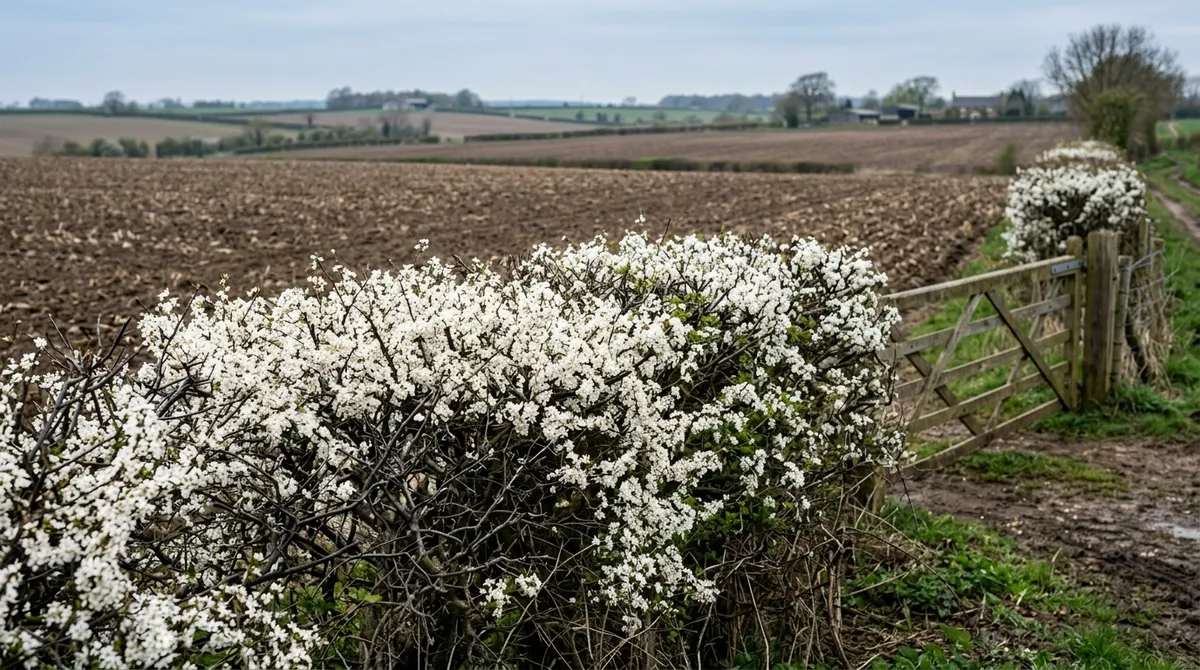
The signature feature is the thorn. These are modified short shoots, hard and woody, reaching 7 to 10cm long on vigorous growth. They are far more dangerous than hawthorn spines because they snap off in the wound. Blackthorn also flowers before its leaves appear, so a hedge in late March looks like white foam on black wood.
Growth runs at 30 to 60cm a year in good conditions. A managed hedge lives 80 to 100 years, and old stools can be far older. The fruit, the sloe, is a blue-black drupe 10 to 15mm across, intensely sour, and the traditional base for sloe gin.
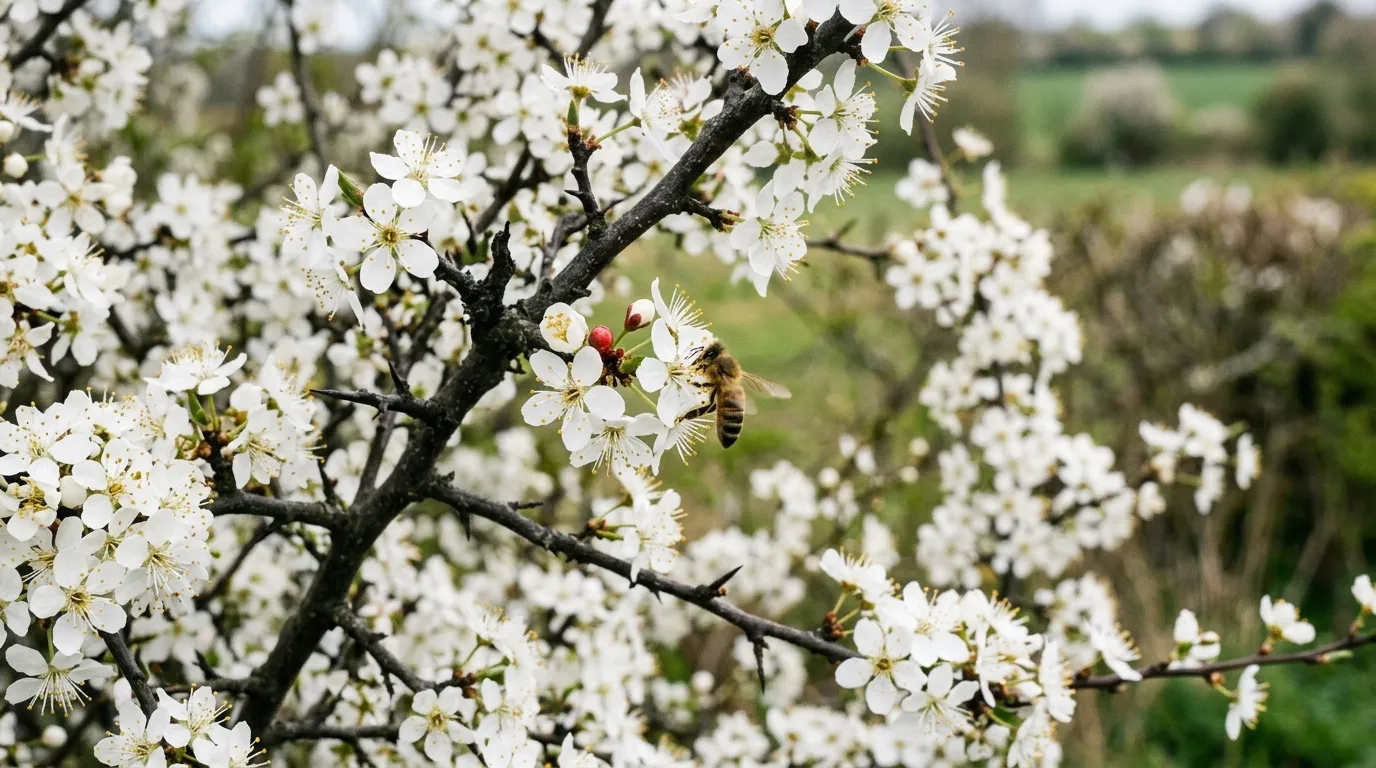 Blackthorn flowers on bare black twigs in late March, weeks before the leaves break. This early blossom is its single greatest asset for wildlife.
Where a blackthorn hedge is the wrong choice
The honest answer for most suburban gardeners is that blackthorn is the wrong hedge. It is wrong in small gardens, wrong near paths, and wrong in mixed ornamental borders. The reasons are mechanical, not aesthetic.
Small gardens cannot contain the suckering
Mowing controls suckers in turf because repeated cutting exhausts them. In a border or gravel area there is no easy control. Each severed root can also resprout. This is why blackthorn belongs on a field edge with mown grass either side, not in a bed surrounded by ornamental planting.
Paths and play areas are a real safety risk
Never plant blackthorn within 3 metres of a path, a patio or a play area. Children brush against hedges. A hawthorn scratch heals; a blackthorn puncture can put a finger joint out of action for a week. For any boundary near where people walk, choose a thornless or low-thorn species.
Mixed ornamental borders fight a losing battle
In a mixed shrub border, blackthorn outcompetes everything. The suckers come up through neighbouring plants, the thorns make weeding miserable, and the dense shade kills underplanting. It reads as a thicket within two seasons. Blackthorn is a boundary shrub, not a border shrub.
Where a blackthorn hedge is exactly right
On the right site, blackthorn is unbeatable. The qualities that make it a menace in a small garden make it perfect on a rural boundary.
A rural field boundary is its natural home. Mown grass or arable land on both sides means suckers get cut down before they establish. Here the suckering becomes a feature, thickening the base into a genuinely stock-proof barrier that cattle and sheep will not push through.
It is also a first-class security hedge. Those 7 to 10cm thorns deter intruders far better than any fence. A laid blackthorn hedge 1.5 to 1.8 metres tall is nearly impenetrable. Many country properties use it deliberately under vulnerable windows.
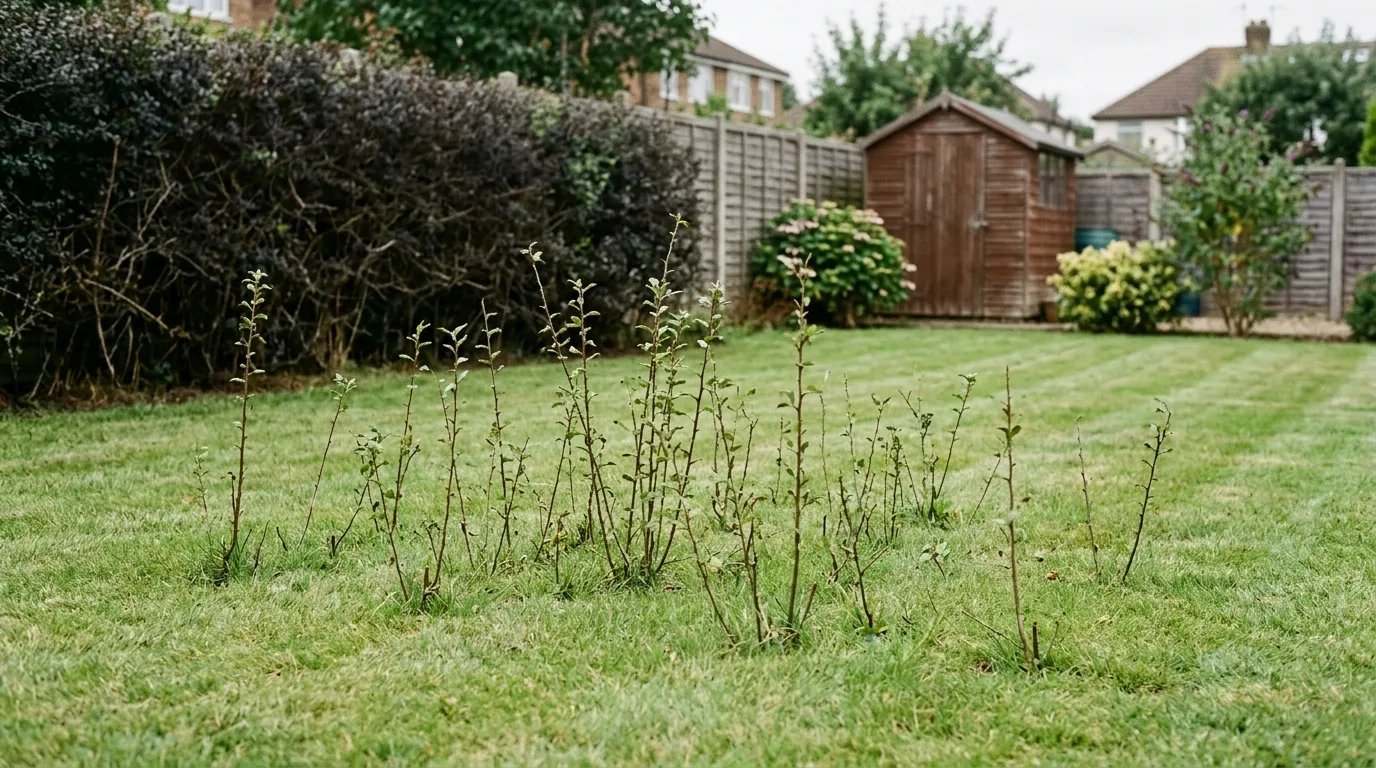 Blackthorn suckers surfacing 2 metres out in mown turf. In a lawn the mower keeps them in check, but in a border they take over.
The wildlife value, counted
Blackthorn punches above its weight for British wildlife, which is the main reason conservation bodies push it so hard. The numbers are genuinely significant.
The March blossom is one of the earliest large nectar sources of the year. It feeds emerging queen bumblebees and early solitary bees when little else is open. The Bumblebee Conservation Trust lists early blossom shrubs like blackthorn as critical for queens founding new colonies after hibernation.
Blackthorn against the other native hedge species
No single native is best for every site. This table ranks blackthorn against the common alternatives so you can match the shrub to the job. Growth rates and thorn data are from on-site measurement.
| Species | Growth rate | Thorns | Suckering | Wildlife value | Best use | Verdict |
|---|---|---|---|---|---|---|
| Blackthorn (Prunus spinosa) | 30 to 60cm/yr | Severe, 7 to 10cm | Aggressive, 1 to 3m | Very high, 150+ moths | Rural stock-proof boundary, sloes | Right on a field edge, wrong in a small garden |
| Hawthorn (Crataegus monogyna) | 40 to 60cm/yr | Moderate, 1 to 2.5cm | None | Very high, 300+ insects | All-round native boundary | The safer default for most gardens |
| Hornbeam (Carpinus betulus) | 30 to 40cm/yr | None | None | Moderate | Formal screen on clay | Best thornless formal choice |
| Beech (Fagus sylvatica) | 30 to 45cm/yr | None | None | Moderate | Formal screen, dry soil | Holds copper leaves in winter |
| Field maple (Acer campestre) | 30 to 50cm/yr | None | None | High | Mixed native hedge | Good safe filler species |
| Dog rose (Rosa canina) | 1 to 2m/yr | Hooked, 5mm | Mild | High, hips for birds | Mixed native, gappy infill | Adds flowers and hips, not a solo hedge |
For a thornless boundary near people, hornbeam or beech wins. For an all-round native hedge with high wildlife value and manageable thorns, hawthorn is the sensible default. Our hawthorn growing guide covers that species in full. Choose blackthorn only when the stock-proofing, security or sloes outweigh the suckering and the spines.
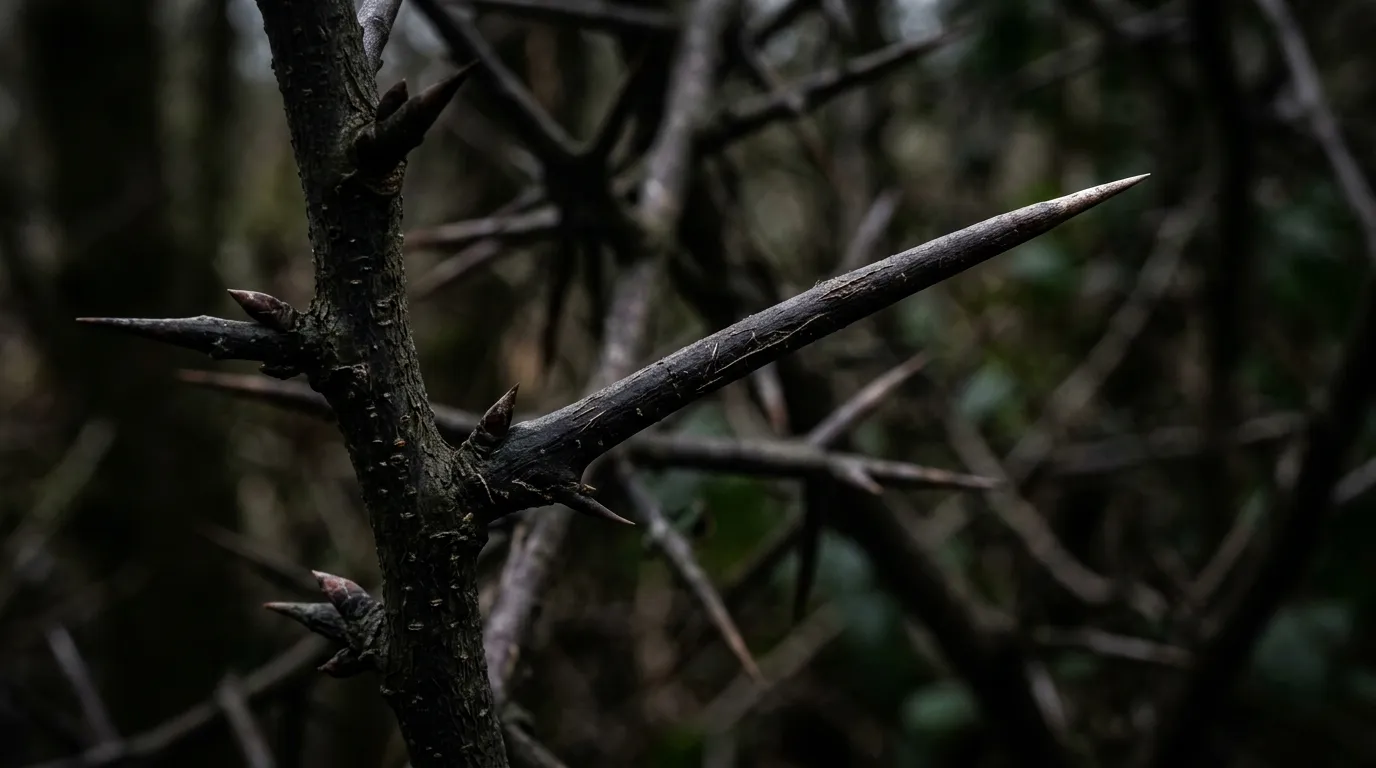 A single blackthorn thorn can reach 10cm and snaps off in the skin. This is why it causes infected wounds that hawthorn never does.
How to plant a blackthorn hedge
The cheapest and most successful way to plant blackthorn is bare-root in the dormant season. Container plants cost three to four times more and establish no better.
Plant bare-root whips between November and March, while the plants are dormant and the soil is workable but not frozen or waterlogged. A 40 to 60cm whip costs roughly £0.80 to £1.50 each in bundles of 25, against £6 to £12 for a potted plant.
For a stock-proof or wildlife hedge, plant a staggered double row:
- Two rows 45cm apart, plants 45cm apart within each row, offset between rows.
- This gives 5 plants per metre of hedge run.
- Dig a slit or trench, spread the roots, firm in, and water if the ground is dry.
- Cut whips back to 15 to 20cm after planting. Hard pruning forces dense low growth, which is what makes the base stock-proof.
Mulch the row with 75mm of bark or composted wood chip to suppress competing grass for the first two years. Keep a 1 metre strip weed-free along the row, because grass competition is the main cause of slow establishment. Our hedge planting guide walks through spacing, soil prep and aftercare for any native hedge in more detail.
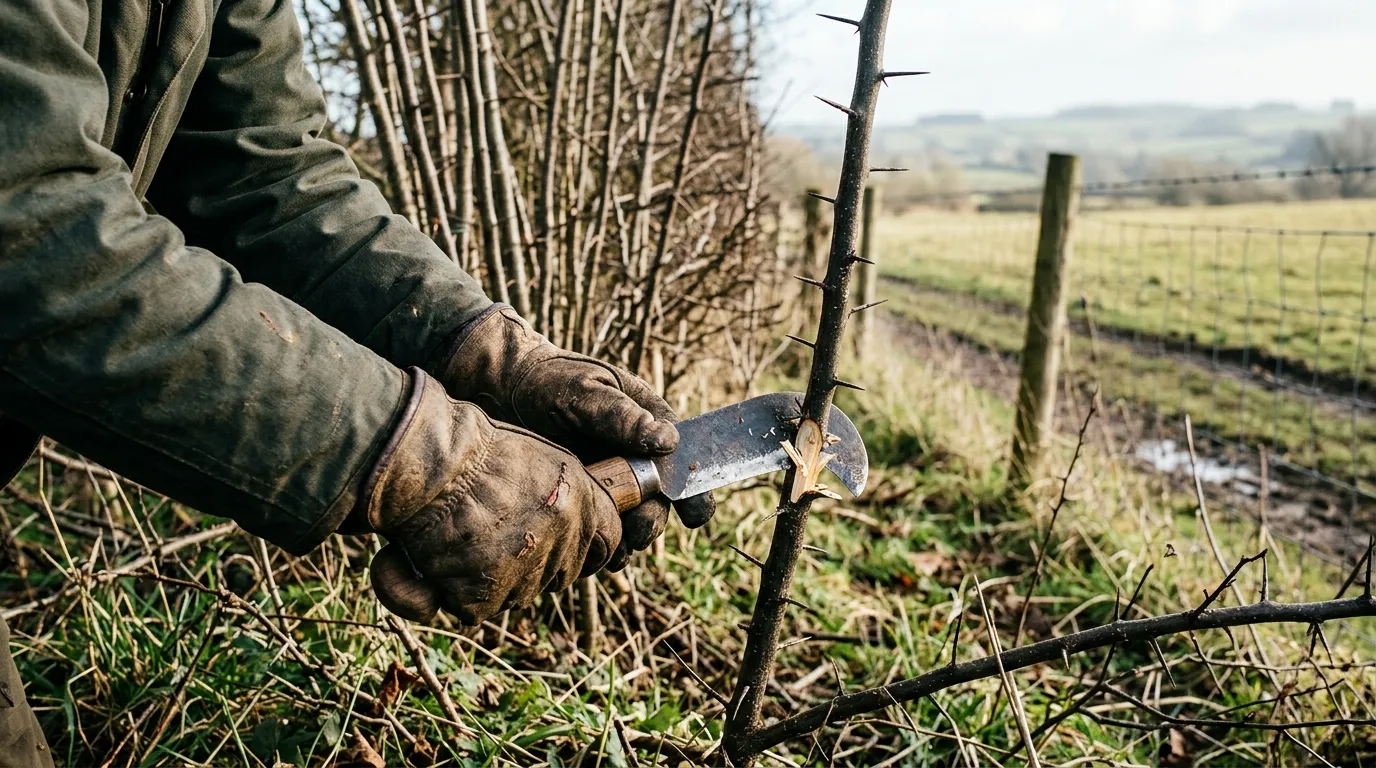 Laying part-cuts the stems and bends them over to thicken the base. Always wear thornproof gloves and long sleeves with blackthorn.
Maintaining, laying and controlling the suckers
A blackthorn hedge needs an annual trim, a periodic laying, and constant sucker control. None of it is hard, but the sucker control never stops.
Trim once a year between September and late February. Cut to a slight A-shape, wider at the base, so light reaches the bottom and the hedge stays dense to the ground. A hedge trimmed on a two or three year rotation flowers and fruits more heavily than one cut hard every year, because blackthorn flowers on second-year wood.
Lay the hedge every 15 to 25 years to rejuvenate it. Hedge laying part-cuts the main stems near the base and bends them over at an angle, called pleachers, so they keep growing while thickening the base. A laid blackthorn hedge becomes properly stock-proof. It is a winter job, done December to February, well clear of the nesting season.
When you can cut a blackthorn hedge
Hedge cutting timing is a legal matter, not just a horticultural one. Do not cut between 1 March and 31 August. This is the main bird nesting season, and it is an offence under the Wildlife and Countryside Act 1981 to damage or destroy an active nest.
Most farm hedge-cutting rules under cross-compliance ban trimming in this window too, with some flexibility for the first two years of a newly planted hedge. The safe rule for any gardener is simple: trim, lay and plant blackthorn in the dormant half of the year, September to February.
Always check the hedge for late nests before cutting in early September. Our guide to the legal hedge cutting dates sets out the full timetable and the exceptions.
| Month | Blackthorn task |
|---|---|
| January | Lay the hedge, plant bare-root whips if soil workable |
| February | Finish planting and laying before bud break, trim if needed |
| March | Stop all cutting, nesting season begins, enjoy the blossom |
| April | No cutting, leave for nesting birds and early bees |
| May | No cutting, watch for new sucker shoots in beds |
| June | No cutting, mow suckers in adjoining turf |
| July | No cutting, monitor for blackthorn aphid and leaf spot |
| August | No cutting, sloes swelling and turning blue |
| September | Cutting season opens, harvest first sloes after frost |
| October | Trim and shape, continue sloe harvest |
| November | Plant bare-root whips, mulch the row |
| December | Lay older hedges, plant whips, dig out stray suckers |
Harvesting and using the sloes
The one harvest that justifies a blackthorn hedge for many gardeners is the sloe. These ripen September to November and a mature hedge yields roughly 1 to 2kg per metre. A 20 metre run can produce 20 to 40kg in a good year.
Pick after the first frost, which softens the skins and reduces the harsh tannin. If frost is late, pick when the sloes are dark blue and freeze them overnight at home to split the skins. For sloe gin, prick or freeze the fruit, half-fill a jar with sloes, add 100g sugar per 500ml of gin, and steep for 8 to 12 weeks, shaking weekly. The result is ready by Christmas if you pick in October.
Common mistakes with blackthorn
Planting it in a small garden. This is the biggest error. Blackthorn suckers 1 to 3 metres from the row. In a plot under 200 square metres the suckering becomes a permanent problem. Match the shrub to the space.
Siting it next to a path or play area. The 7 to 10cm thorns cause septic puncture wounds. Keep blackthorn at least 3 metres back from anywhere people walk or children play. Use a thornless species there instead.
Cutting it in the nesting season. Trimming between March and August risks destroying active nests and breaks the Wildlife and Countryside Act 1981. Always cut in the dormant half of the year.
Ignoring the suckers until year four. Suckers are easiest to pull when young and shallow. Walk the bed edges each spring and remove new shoots before they root deeply. A root barrier on a new planting saves years of digging.
Handling it bare-armed. Every blackthorn job needs thornproof gloves and long sleeves. The infection risk is real, not theoretical. Clean any puncture immediately and watch it for swelling over the following days.
Next step
Our team produces practical UK gardening guidance from source research, contributor records and established horticultural practice. Editorial standards are overseen by Matt W.