Key takeaways
- At 16 plugs per m2 and £1.15 to £1.50 a plug, a creeping thyme lawn costs £20 to £30 per m2 in materials against £4 to £7 per m2 for turf
- On unimproved heavy clay our thyme reached only 20% cover in two years and was dug out; the gritty raised bed beside it hit 95%
- Thyme is a subshrub, not a grass: it lignifies from year three and we replanted 30% of a 6m2 mat in year four
- No selective weedkiller works on a broadleaf lawn, so every weed comes out by hand: about 90 minutes a month from April to September
What a creeping thyme lawn actually costs per m2
Nobody publishes this number, which is telling. Here it is.
The variable is plug spacing. Every supplier quotes a range, and the range decides everything: cost, time to cover, and how much weeding you do while you wait. A plug at 25cm centres works out at 16 plants per square metre. Trade plugs from a UK grower run £1.15 to £1.50 each in trays of 40 or more. Retail 9cm pots are £3.50 to £4.50 each, which is a different conversation entirely.
| Spacing | Plants per m2 | Plug cost at £1.30 | Time to full cover | Weed pressure while waiting |
|---|---|---|---|---|
| 20cm centres | 25 | £32.50 | 12 months | Low |
| 25cm centres | 16 | £20.80 | 18 months | Moderate |
| 30cm centres | 11 | £14.30 | 24 months | High |
| 40cm centres | 6 | £7.80 | 36 months or never | Severe, usually fails |
Add the ground work. A real 20m2 project on ordinary UK soil needs roughly 320 plugs at £416, two bulk bags of 6mm grit at about £75 each, and a day of levelling. That is £566 in materials, or £28 per square metre. The same 20m2 in turf costs £80 to £140 laid. Grass seed costs about £12.
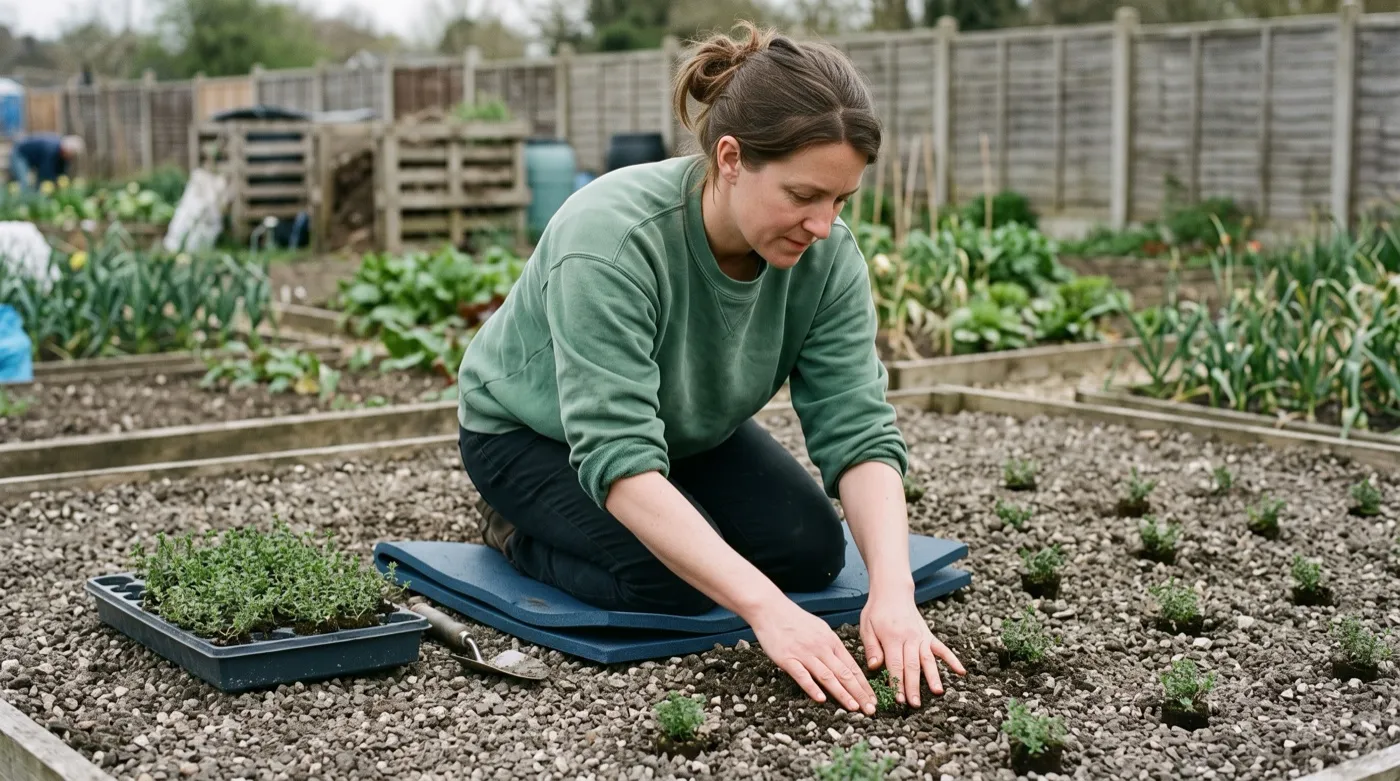 Sixteen plugs per square metre at 25cm centres is the honest density. Wider spacing saves money and then loses it to two years of hand weeding.
Thymus serpyllum, ‘Coccineus’ and ‘Elfin’ compared
The trend photographs are not all the same plant, and the differences matter more than the flower colour.
| Variety | Height | Flower and window | Time to knit | Traffic | Best use |
|---|---|---|---|---|---|
| Thymus serpyllum | 50-80mm | Pink-purple, June to August | 18 months | Light | The default for a mat. Quickest cover |
| T. serpyllum ‘Pink Chintz’ | 40-50mm | Salmon-pink, June to July | 18 months | Light | Woolly grey foliage, best all-round mat |
| T. praecox ‘Coccineus’ | 30-50mm | Magenta-red, June to July | 24 months | Very light | The “red creeping thyme” of the trend. Slower |
| T. ‘Elfin’ | 20-30mm | Pale pink, sparse | 36 months plus | None | Bun-forming alpine. Not a lawn plant at all |
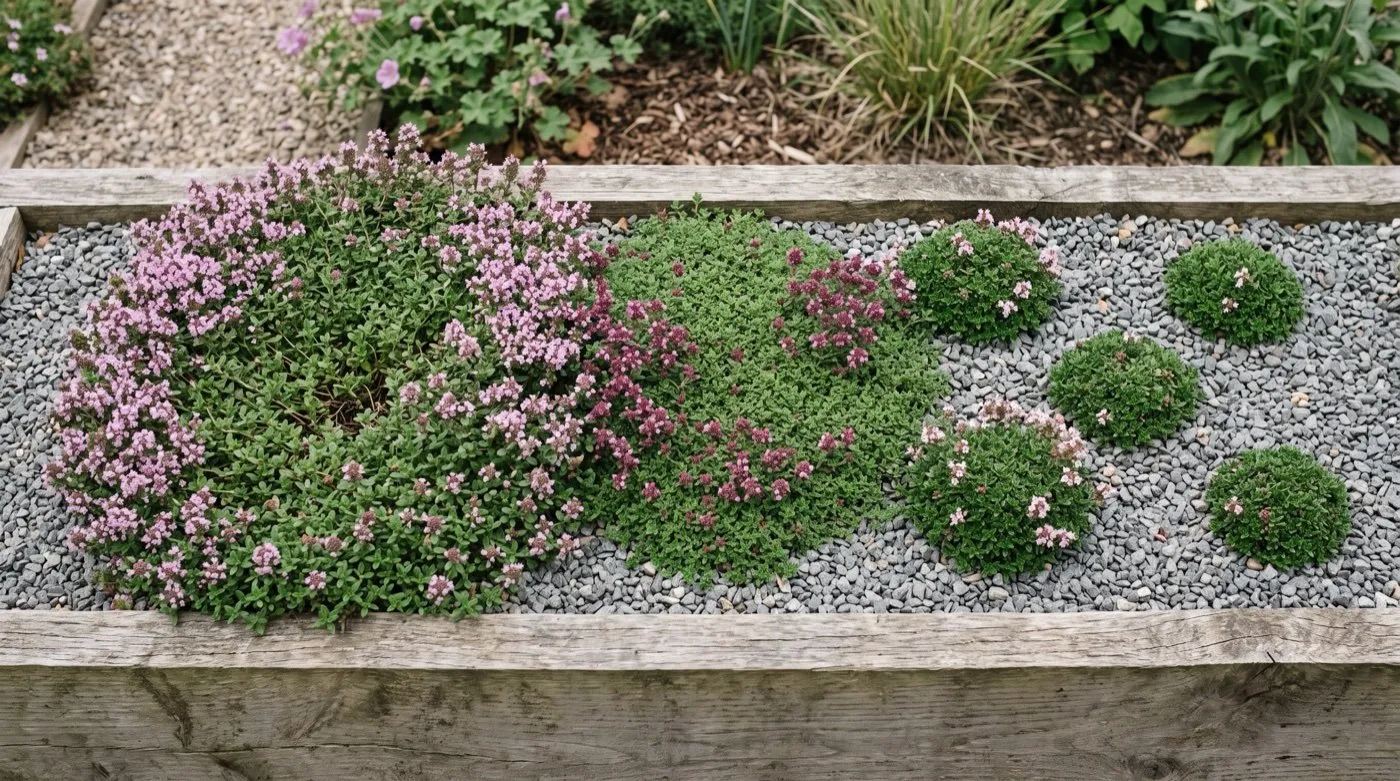 Left to right: Thymus serpyllum, T. praecox ‘Coccineus’ and T. ‘Elfin’. Only the first two behave like a mat. ‘Elfin’ stays as separate buns.
The four conditions thyme will not forgive
Thyme comes from dry stony hillsides around the Mediterranean and southern Europe. Four things kill it, and three of them describe most British gardens.
Shade is next. Thyme needs a genuine 6 hours of direct summer sun. At 4 hours it stretches, flowers thinly and opens gaps. Under a north wall or a tree canopy it simply thins away over two seasons.
Compaction is third. Thyme roots run in the top 100mm to 150mm and need air throughout that depth. A soil you cannot push a finger into is a soil thyme will not colonise.
Competition is fourth and the one people underestimate. Thyme is low, slow and mild-mannered. Meadow grass, willowherb and creeping buttercup are none of those things. Anywhere thyme has not yet covered, something else will, within one growing season.
Warning: Do not dig a gritty hole in solid clay and plant thyme in it. You have built a sump. Water runs through the free-draining pocket, hits the clay pan and sits there, so the plant drowns faster than it would have in plain clay. Build up at least 150mm above the surrounding grade instead, so water has somewhere to leave.
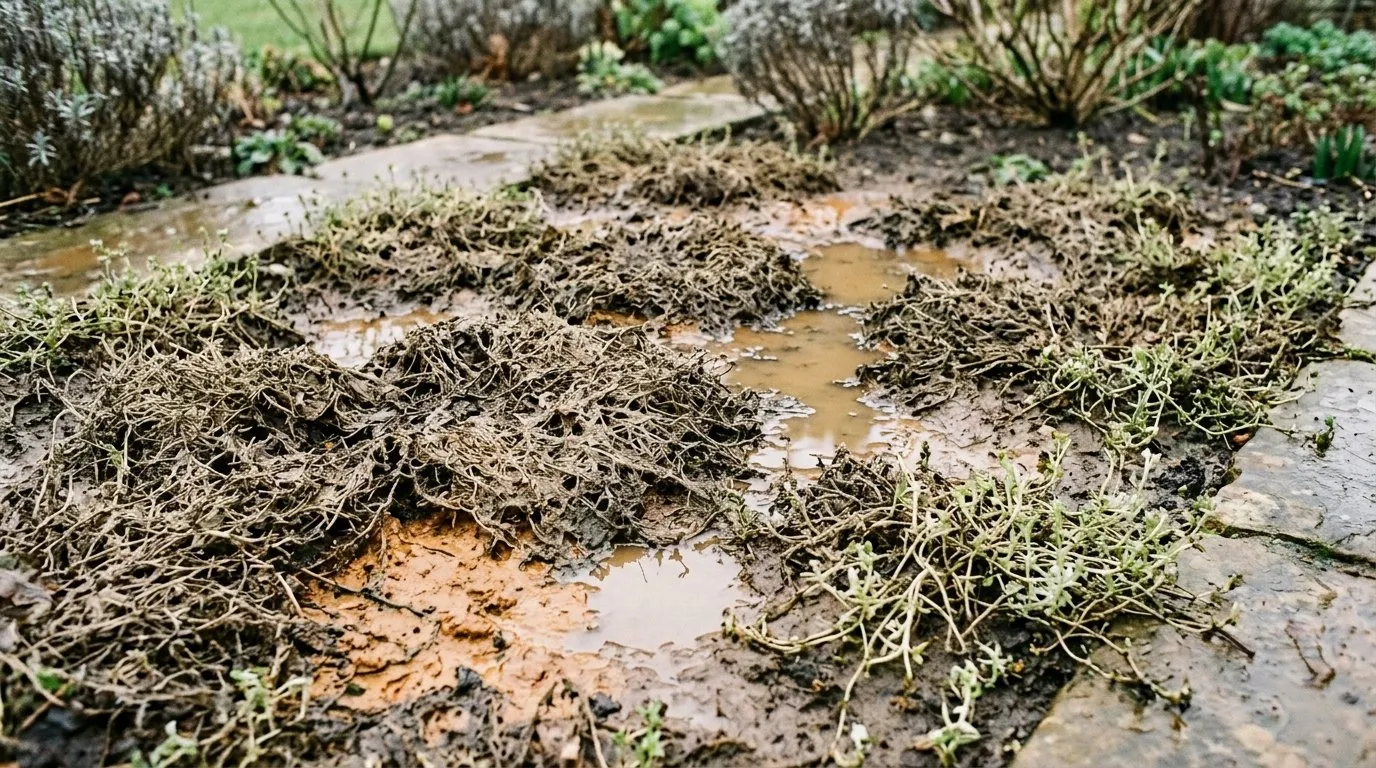 The clay half of the trial in February 2020. No hard frost that winter, just five months at field capacity. This is what kills thyme in Britain.
Traffic: the claim that breaks first
Every trend piece says a thyme lawn is walkable. That word is doing enormous work.
Grass survives being trodden on because its growing point, the crown, sits at or below soil level where a boot cannot reach it. Cut a grass blade and it regrows from the base within days. Thyme has no equivalent. Its growth comes from the shoot tips, which are exactly what your foot lands on, and a crushed woody stem carries no dormant buds, so it does not come back.
What thyme does tolerate is genuine occasional contact: a few footfalls a week, brushing past, the odd kneel. What it will not take is a route to a shed, a washing line, a bin store, or a child. If people cross it, put stepping stones in at 600mm centres and let the thyme be the thing between them.
How a thyme mat ages, year by year
This is the part the trend content never reaches, because most of it was written from a photograph taken in year two. Thyme runs a five-stage arc.
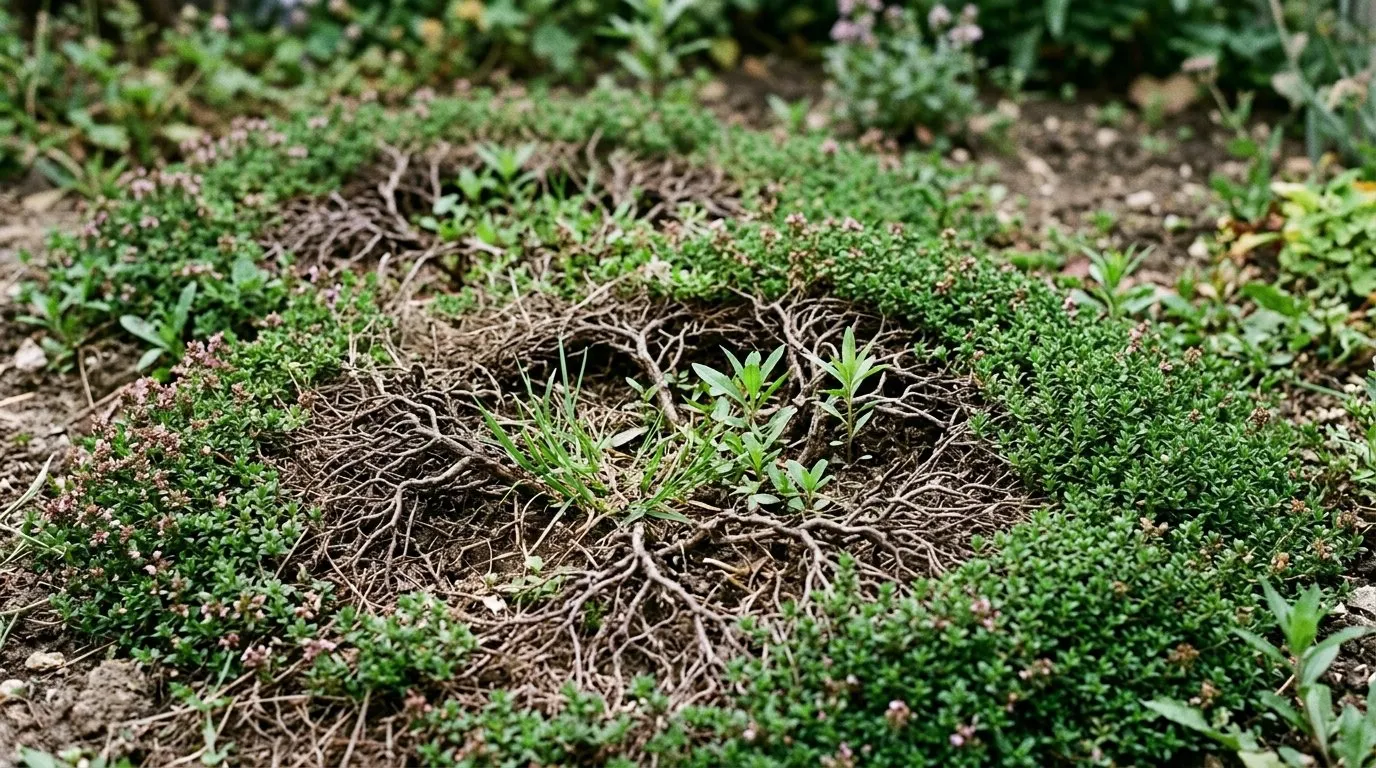 Year four in the raised bed. The mat has hollowed into rings of woody stem and meadow grass has taken the middles. No photograph of this exists in any trend article.
Weeding a lawn you cannot spray
Here is the practical trap that decides whether you keep a thyme lawn or dig it out.
Selective lawn weedkillers work on a simple split: the active ingredients disrupt growth in broadleaved plants and leave narrow-leaved grasses alone. That is the entire principle of a weed-and-feed. Thyme is broadleaved. Anything that would remove a dandelion, a buttercup or a plantain from your thyme lawn removes the thyme too. There is no product, and there will not be one.
It also gets worse over time rather than better, because the woody gaps from year three are perfect weed seedbeds. A thyme lawn is at its lowest maintenance in years two and three and its highest in years one and five.
Gardener’s tip: Do the weeding in the fortnight after a decent rain, when the ground gives. Willowherb and meadow grass lift with the root intact from damp gritty soil and snap off at the crown from dry soil, which means they regrow. Ten minutes a week in a damp April beats two hours in a dry July.
Thyme lawn versus chamomile, clover and No Mow May
Chamomile ‘Treneague’ is the closest genuine rival because it is the non-flowering clonal form, so it stays low without shearing. It scored worse than thyme for me: it browns badly in a dry July and rots as readily in a wet January. Our guide to growing chamomile in the UK covers it properly.
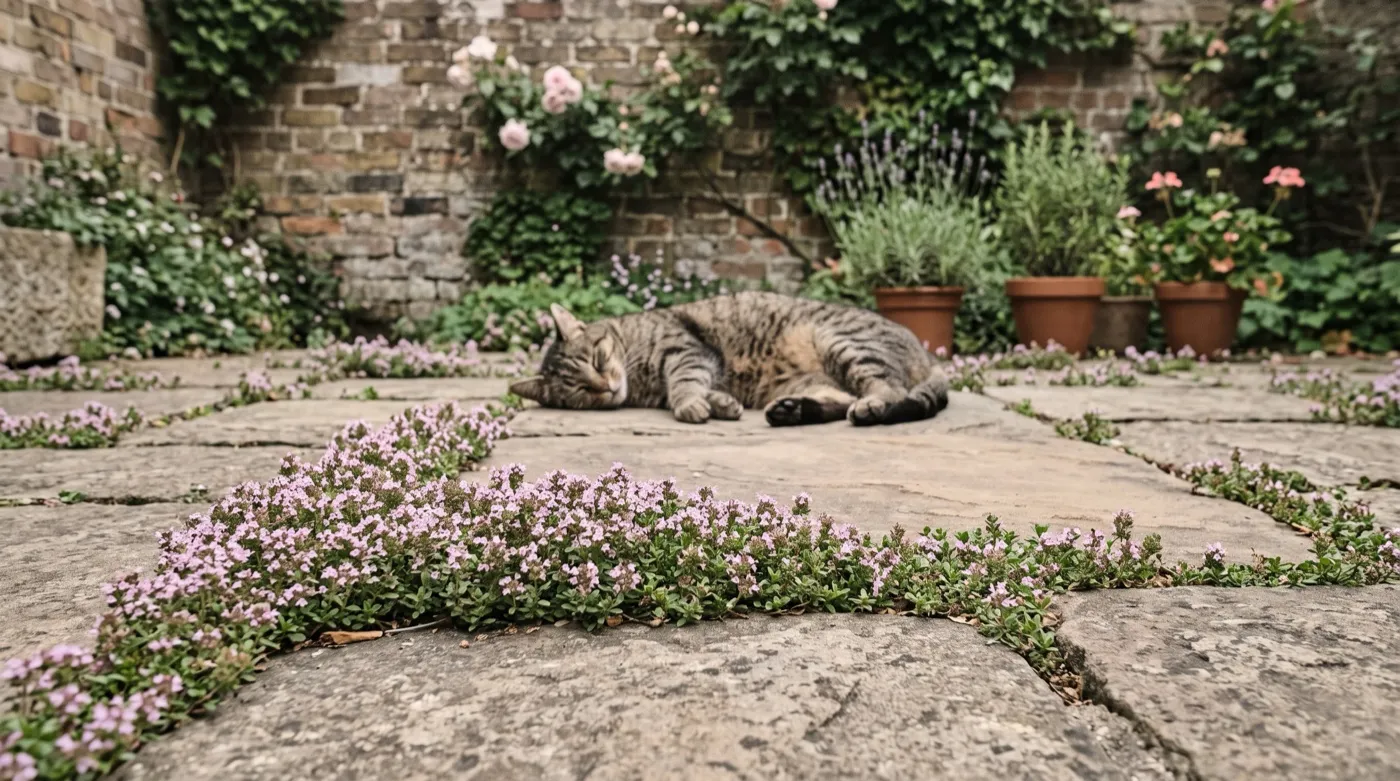 This is where thyme earns its place: between pavers, in reflected heat, with sharp drainage and nowhere for a foot to land squarely. The cat is about the only traffic it will take.
Where a creeping thyme lawn genuinely works
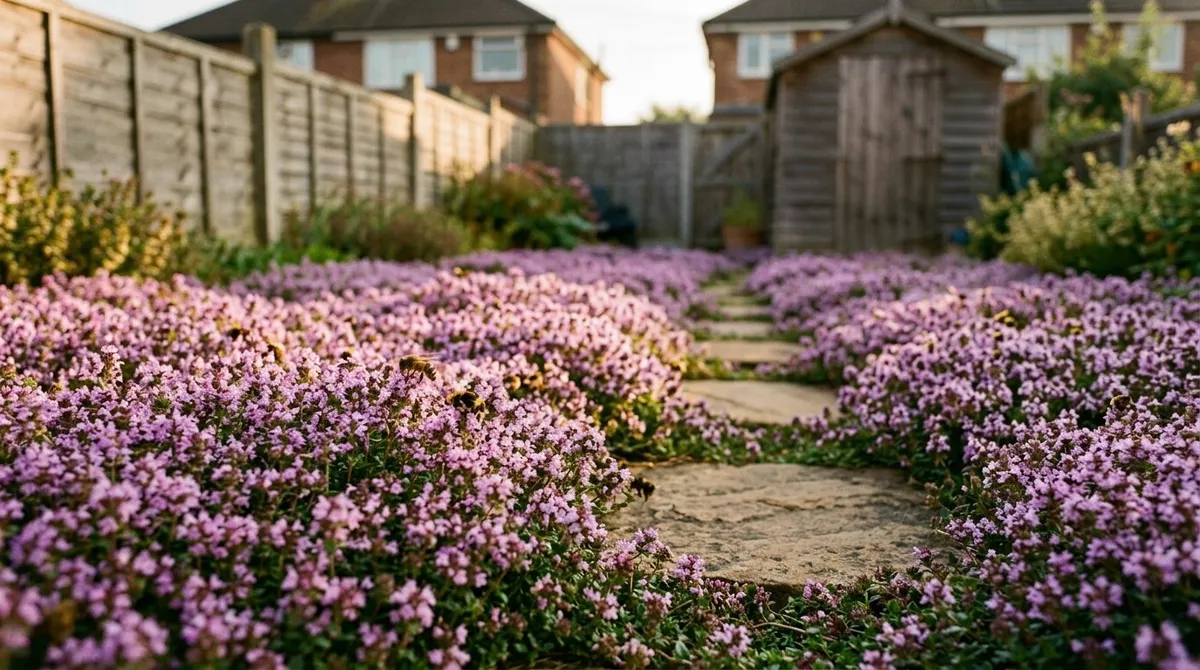
Between pavers and setts. The slabs carry the feet, the thyme fills the joints, and the stone throws heat and keeps the crowns dry. This is the single best use and it needs no lawn at all.
Small sunny areas under 10m2. At that size the cost is £200 to £300, the weeding is 20 minutes a month, and you can genuinely keep on top of it. Scale is the enemy here, not the plant.
Hot dry banks. A south-facing slope that is miserable to mow and dries to dust in July is exactly the site thyme evolved for. Drainage is free on a slope and nobody walks on it.
Gravel gardens and seaside plots. Sharp drainage, reflected heat, low fertility, salt tolerance and wind: thyme handles all five. If this is your ground, see how to create a gravel garden, because a gravel garden with thyme through it is a better project than a thyme lawn.
Where it fails, predictably and every time: shade, clay, north-facing ground, anywhere over 20m2 that you also have to weed, and any surface a child or a dog uses.
The bee count on 4m2 of flowering thyme
The pollinator claim is the one part of the trend that survives contact with reality, so let us be precise about it rather than vague.
The honest qualifier is the window. Thyme flowers June to early August, so call it 8 weeks. A mown grass lawn offers nothing at all, so thyme wins easily there. An unmown lawn with clover, selfheal, bird’s-foot trefoil and dandelion feeds insects from April to September, roughly 24 weeks, and costs nothing. Thyme is denser for a shorter time.
 Counting foragers at 13:00 in July: a mean of 47 on 4m2, peaking at 61. The bee value is real. The eight-week flowering window is the part to plan around.
A month-by-month thyme lawn calendar
| Month | Job |
|---|---|
| January | Do nothing. Keep off it entirely: frozen thyme stems snap and do not regrow |
| February | Check for crown rot and heave. Firm back any plugs lifted by frost |
| March | Weed while the ground is damp and roots lift whole. Order plugs now for April |
| April | Plant. Soil is warming, roots have six months before winter. Never plant in autumn |
| May | Water new plugs every 3 to 4 days. Established mats need nothing |
| June | Flowering starts. Stop all weeding while bees are working it |
| July | Shear the mat by one third the week flowering finishes. Never cut into brown wood |
| August | Take cuttings from green shoot tips as free replacements for year four |
| September | Last chance to weed before growth stops. Soil below 10C ends all spread |
| October | Brush leaves off. A wet leaf mat over thyme rots it in six weeks |
| November | Lift pots onto feet. Check that raised beds still drain freely |
| December | Nothing. Assess bare patches now for an April replant |
Two entries carry most of the weight. Plant in April, never October, because a plug going into winter with three weeks of root has no chance on any British soil. And shear in July, because that single cut is what postpones the woody collapse.
Why the trend content is wrong about clay
The root cause of almost every failed thyme lawn in Britain is that the advice was written somewhere else. Most of the creeping thyme content ranking in the UK originates in the United States, where the plant is grown in continental climates with dry frozen winters and hot summers. Under a Colorado winter the soil freezes solid in November and stays dry and frozen until March, so the plant is dormant, sealed and safe.
Our winter does the opposite. UK soil sits at field capacity from October to March, wet and unfrozen, at 3C to 7C. That is not dormancy. That is five months of a warm bath with no oxygen in it, which is the exact condition Phytophthora and Pythium need to swim their zoospores into damaged roots. The plant is not cold enough to shut down and not dry enough to stay clean.
The permanent prevention is not a plant choice, it is an earthwork. Build the bed 150mm to 200mm above the surrounding grade, cut 6mm horticultural grit through the top 300mm at roughly one 25kg bag per square metre, and give the water somewhere to go sideways. Do that once and it works for every future planting. Skip it and you will buy plugs again in 2028.
Common mistakes
The honest verdict
A creeping thyme lawn is not a lawn. It is a low ornamental planting that happens to be flat, and judged as that it is lovely: fragrant, drought-proof, alive with bees for two months, and completely mow-free. Judged as a lawn replacement it fails on cost, traffic, longevity and weeding, and on clay it fails outright.
Now you know what a thyme lawn really costs, read our guide to growing thyme in the UK to get the soil and the shearing right before you spend a penny on plugs.
Frequently asked questions
How much does a creeping thyme lawn cost per square metre?
Budget £20 to £30 per square metre in materials alone. That assumes 16 plugs per m2 at 25cm centres and £1.15 to £1.50 a plug from a trade plug grower, plus grit. Retail 9cm pots at £3.99 each push the same square metre past £60. Turf costs £4 to £7 per m2 by comparison.
Can you walk on a creeping thyme lawn?
Will creeping thyme grow on clay soil?
No, not on unimproved clay. It rots in winter waterlogging. Our clay half held 20% cover after two years while the gritty raised bed beside it hit 95%. If you have clay you must build up at least 150mm above grade with a free-draining mix, not dig a gritty hole that fills like a sump.
Why has my creeping thyme gone woody and bare in the middle?
Thyme is a subshrub and lignifies with age, usually from year three. Old brown wood carries no dormant buds, so it never reshoots. Shearing the mat by a third straight after flowering in late July keeps green growth coming and delays it by a year or two. Once the centre is bare, replant it.
Can you use weedkiller on a thyme lawn?
No. Selective lawn weedkillers kill broadleaved plants, and thyme is broadleaved. Anything that removes buttercup or dandelion removes your lawn with it. Every weed comes out by hand or with a narrow hoe. Budget about 90 minutes a month from April to September for a 12m2 area.
Is creeping thyme better for bees than a normal lawn?
What is the difference between red creeping thyme and Thymus serpyllum?
Red creeping thyme is usually Thymus praecox ‘Coccineus’, a slower, flatter, magenta-flowered form. Thymus serpyllum is the wild thyme of the trend photographs, taller at 50 to 80mm and quicker to knit. ‘Coccineus’ takes about 24 months to cover ground that serpyllum covers in 18.
Our team produces practical UK gardening guidance from source research, contributor records and established horticultural practice. Editorial standards are overseen by Matt W.