Key takeaways
- A solid, gapless barrier cuts measured traffic noise by 8 to 12 decibels, halving the perceived loudness
- A leafy hedge alone reduces measured sound by just 1 to 3 decibels, but helps perception
- Mass and height matter, not foliage. Sound is energy that pours through every gap
- An earth bund or berm is the most effective domestic barrier, blocking and absorbing sound
- A water feature masks residual traffic noise with broadband sound the brain tunes out
- Fences over 2 metres or any boundary next to a highway usually need planning permission
Reducing traffic noise in the garden comes down to one principle most guides get wrong. Garden noise reduction is about mass and height, not leaves. Sound is energy. It pours through every gap in a hedge or a slatted screen the way water finds a crack in a dam. A solid, heavy, gapless barrier is the only thing that lowers the actual decibel reading. Everything else changes how the noise feels, which still matters, but it will not move a sound meter.
The science of garden sound and the mass law
Sound is mechanical energy travelling as pressure waves through air. To stop it, you must block, absorb or reflect that energy. You cannot filter it like light through a curtain. This is why a leafy hedge disappoints. The waves slip between every leaf, twig and stem. Foliage is mostly air, and air carries sound freely.
The principle that governs barriers is the mass law. The heavier a barrier is per square metre, the more sound it stops. Roughly, every doubling of mass cuts transmitted noise by about 6 decibels. A lightweight overlap fence panel weighs little, so it leaks. A close-board fence, an acoustic panel filled with mineral aggregate, or a brick wall weighs far more per square metre and blocks far more.
Height matters as much as mass. Sound travels in straight lines and bends over the top of a barrier. A low fence lets traffic noise sail straight over into your ears. A 2 metre barrier creates an acoustic shadow behind it. The taller it is, and the closer it sits to either the road or your seating area, the deeper that shadow becomes.
One more rule decides everything. A barrier is only as good as its biggest gap. A single 50mm gap under a fence, or a missing knot in a panel, leaks enough energy to wreck the whole structure. Sound floods through the weak point. Seal the base, the joints and the posts, or the mass law cannot do its job.
Measured decibels versus how loud it feels
The decibel scale is logarithmic, not linear, and this changes how you read every number in this guide. A 10 decibel reduction does not mean the noise is 10 percent quieter. It means the sound energy has dropped to a tenth, and the human ear perceives it as roughly half as loud. A 3 decibel cut halves the sound energy but is only just noticeable. A 6 decibel cut is clearly noticeable. A 10 decibel cut is the holy grail for a domestic barrier.
This is why honesty about methods matters. A hedge that cuts 2 decibels has barely changed the energy reaching you. The meter confirms it. Yet the same hedge can make the garden feel much calmer, because perception and measurement are two different things.
Two psychological factors do most of the perceived work. The first is sight. If you cannot see the road, your brain downgrades the threat and the volume with it. The second is masking, which the next section covers. A clever garden uses real mass to cut the measured figure, then layers planting and water on top to win the perception battle as well.
Garden noise reduction methods ranked by real decibel cut
Not all methods are equal, and treating them as if they are wastes money. The table below ranks every common option by the realistic measured reduction it delivers in a UK domestic garden. Be clear-eyed about it. Hedges and plants sit near the bottom for measured decibels, even though they are the first thing most people reach for.
| Method | How it works | Realistic dB cut | Cost (per metre) | Role |
|---|---|---|---|---|
| Earth bund or berm | Solid mass plus ground absorption | 10 to 15 dB | 50 to 150 pounds | Barrier and absorption |
| Masonry or brick wall | Maximum mass, fully gapless | 10 to 15 dB | 250 to 500 pounds | Barrier |
| Acoustic mass-loaded fence | Heavy panels, sealed joints | 8 to 12 dB | 150 to 300 pounds | Barrier |
| Close-board timber fence (2m) | Solid, heavy, gapless | 8 to 12 dB | 80 to 120 pounds | Barrier |
| Green wall on solid panel | Mass of panel plus surface absorption | 8 to 12 dB | 200 to 400 pounds | Barrier and absorption |
| Water feature | Broadband sound masking | 0 dB measured | 100 to 600 pounds | Psychological masking |
| Dense evergreen hedge | Visual screen, slight absorption | 1 to 3 dB | 30 to 80 pounds | Psychological and small effect |
| Lightweight panel fence | Too little mass, leaks energy | 2 to 4 dB | 40 to 70 pounds | Weak barrier |
The pattern is plain. Solid mass at the top, perception at the bottom. The best gardens combine the two. Build a heavy gapless barrier for the measured cut, then dress it with planting and water for the feel. A bund or wall plus a fountain beats a thick hedge on its own every time.
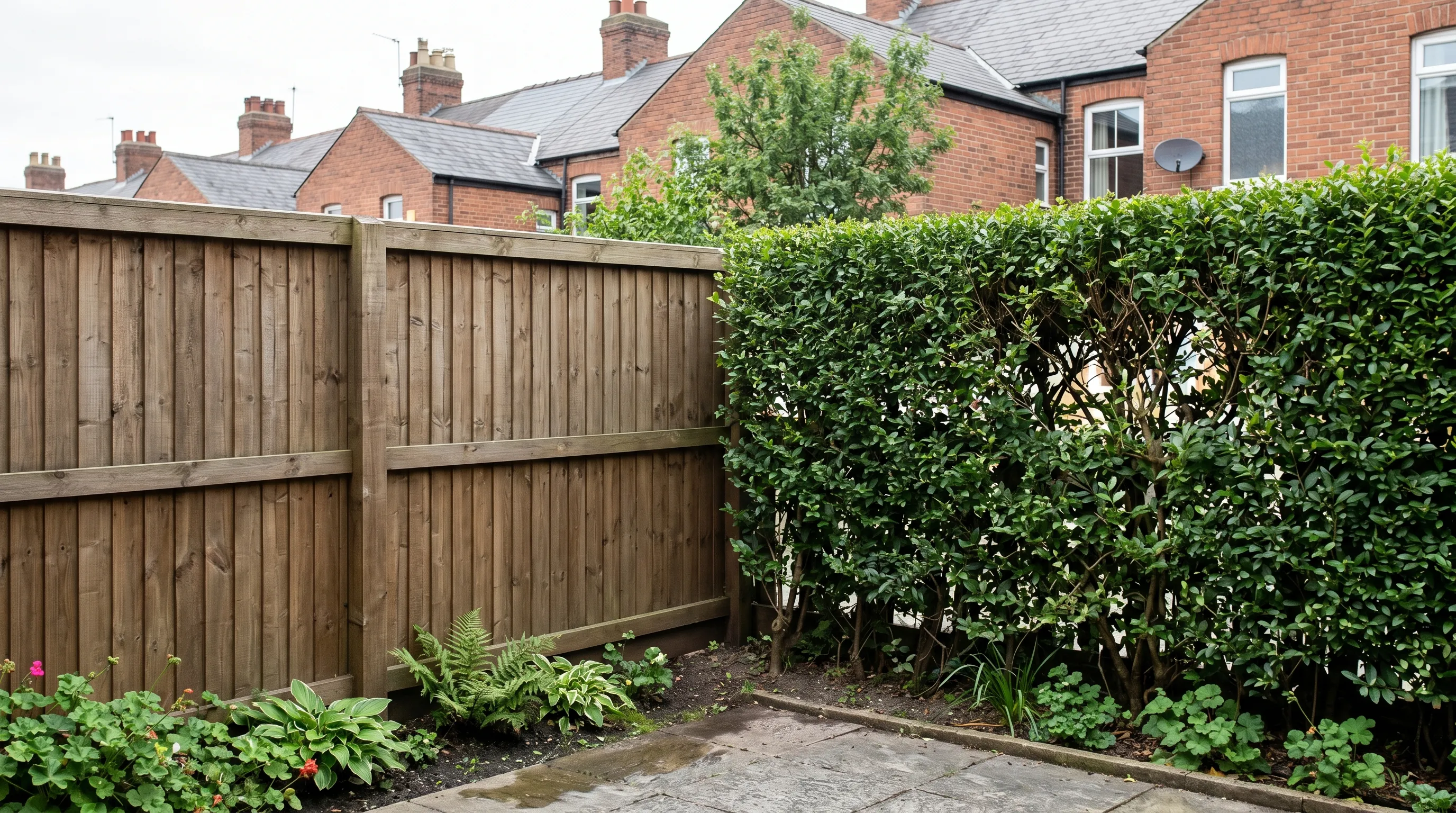 The solid panel on the left blocks sound. The leafy hedge on the right lets it through the gaps. Mass beats foliage for measured decibels.
Solid acoustic fencing, the practical first choice
A solid acoustic fence is the most realistic option for most UK gardens. It needs little ground, installs in a day or two, and delivers a genuine 8 to 12 decibel cut when built properly. The key word is solid. Overlap and slatted fences leak. You need close-board, tongue-and-groove, or purpose-made acoustic panels.
The best performers are mass-loaded acoustic fences. These use timber faces wrapped around a dense mineral or composite core, sometimes weighing 30 to 40 kilograms per square metre. That mass is what stops the energy. Brands such as Jacksons Fencing and AcoustiFence sell tested systems with published noise figures, often quoting 24 to 28 decibels of laboratory reduction, which translates to a real-world 8 to 12 in a garden once gaps and flanking are accounted for.
Sealing the base is non-negotiable. Fit concrete gravel boards along the bottom so no gap exists between the fence and the soil. Bolt panels tight to posts with no light showing through joints. The closer the fence sits to the road, the better, because it intercepts the noise before it spreads.
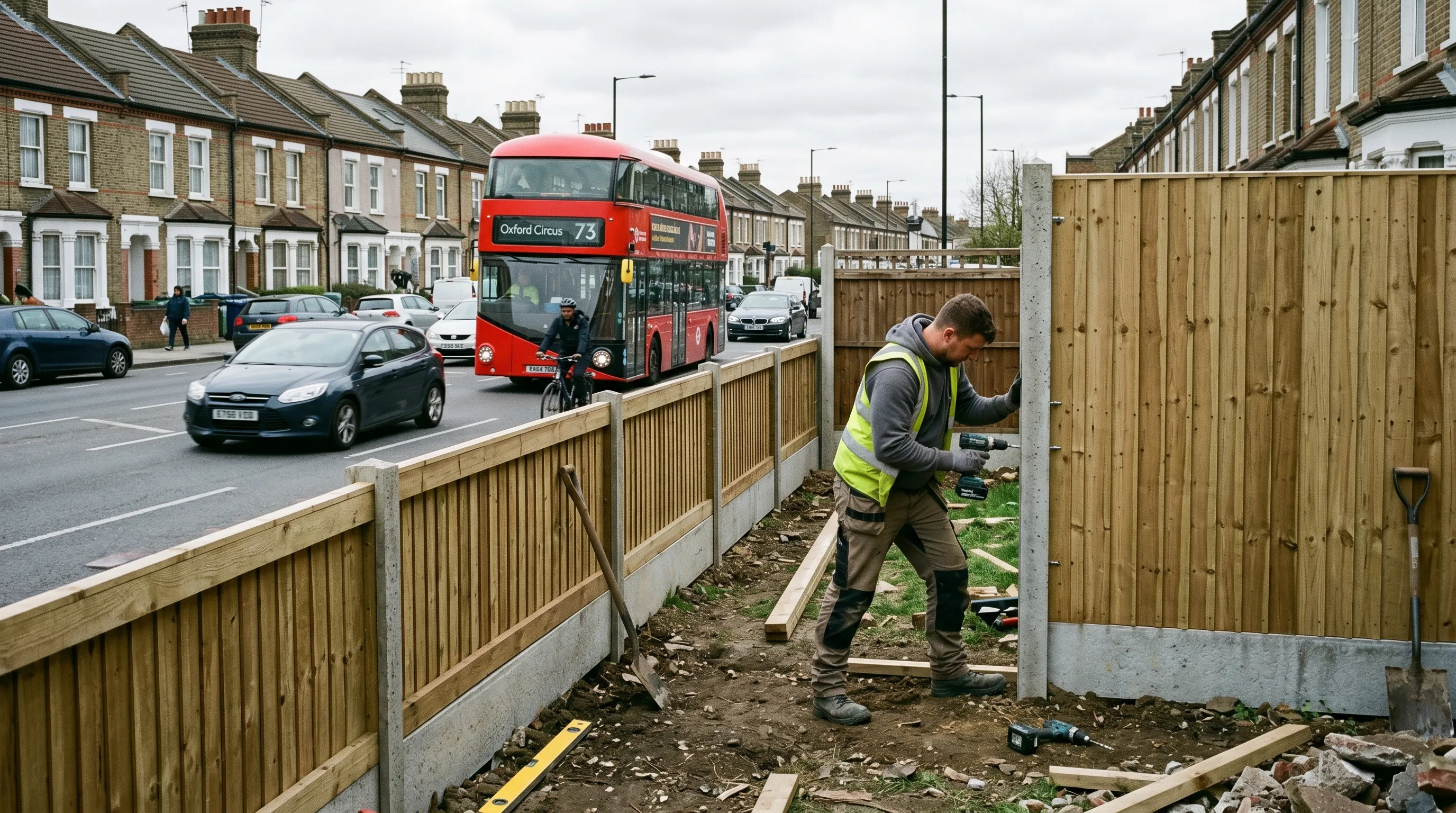 Concrete gravel boards seal the gap to the ground. A single open gap at the base undoes the whole barrier.
Earth bunds, berms and masonry walls for the biggest cut
An earth bund is the most effective barrier a domestic garden can have. A bund, or berm, is a raised mound of compacted soil, usually 1.5 to 3 metres high, planted on top. It works twice over. The solid mass of soil blocks sound like a wall, and the soft, planted surface absorbs energy rather than reflecting it back into the street. Bunds routinely cut 10 to 15 decibels.
The catch is space. A 2 metre bund needs a base several metres wide, because soil only holds a stable slope of around 30 degrees. You also need machinery and a supply of subsoil, though spoil from a building project is often free. For gardens with room, a bund topped with a fence gives the deepest cut of all, combining height from the fence with mass and absorption from the mound.
A brick or masonry wall matches the bund for measured reduction without the footprint. Its density makes it gapless and heavy, cutting 10 to 15 decibels at 2 metres. It is the most expensive option at 250 to 500 pounds per metre, and any wall over 2 metres or beside a highway needs planning permission and proper foundations. For a small urban plot, though, a rendered blockwork wall is often the only barrier that fits.
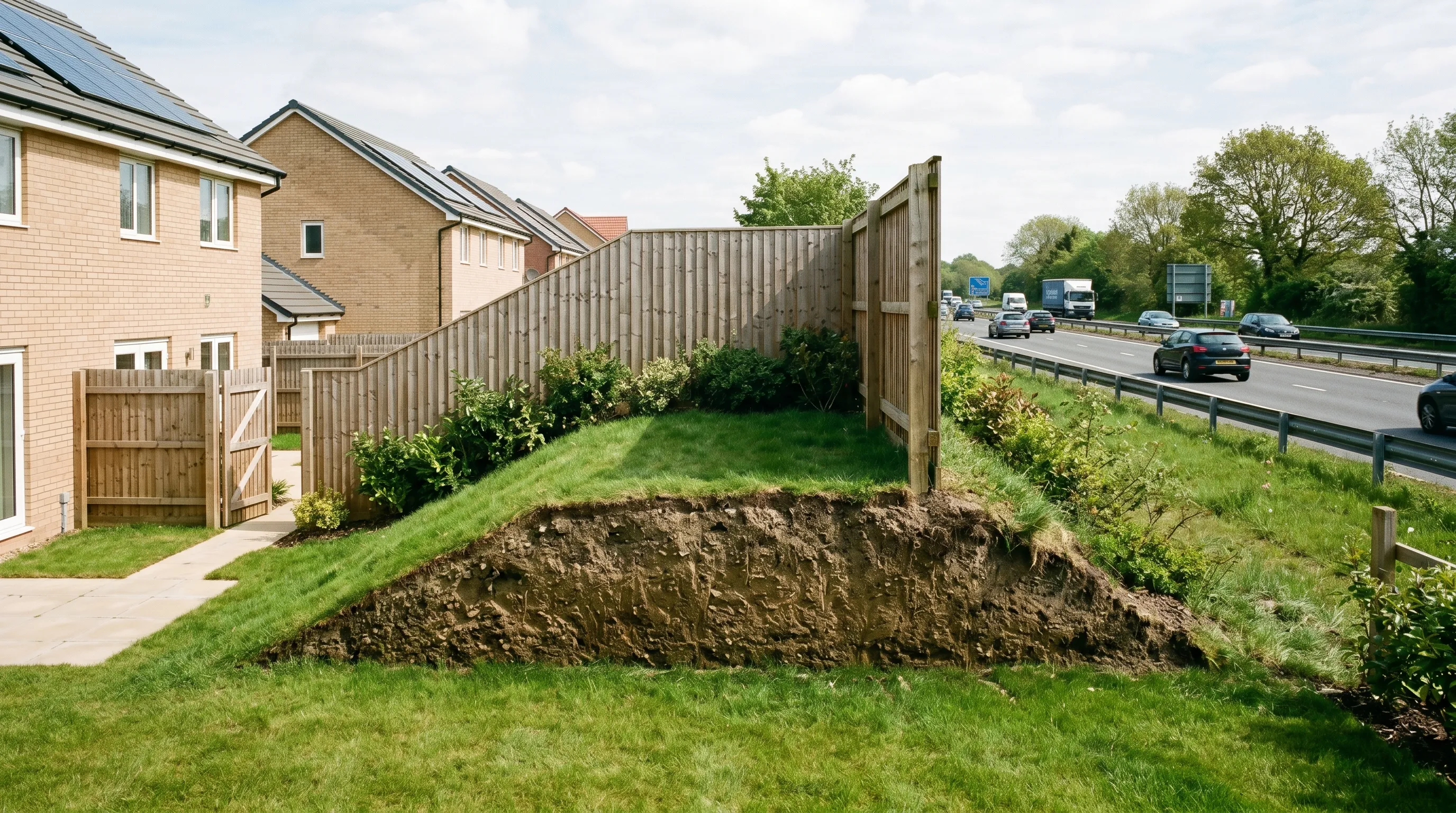 An earth bund blocks and absorbs sound. A fence on the crest adds height for the deepest domestic noise cut.
Green walls and hedges, honest about what they do
Living green walls and dense hedges do far less for measured noise than people expect, but they are not pointless. A pure hedge of yew, laurel or privet cuts only 1 to 3 decibels, because foliage is porous and sound slips through it. As a standalone noise barrier, a hedge fails.
Its strengths are perception and surface absorption. A 2 metre evergreen hedge hides the road completely, and out of sight genuinely lowers perceived volume. A thick hedge also adds a soft, sound-scattering surface that reduces hard echoes off walls and patios. For the real cut, plant the hedge in front of a solid fence or wall, never instead of one.
A green wall on a solid backing is the best of both. Climbers such as ivy, star jasmine or evergreen clematis grown over an acoustic panel give you the mass of the panel for blocking, plus a soft planted surface for absorption. The combination cuts 8 to 12 decibels and looks alive rather than like a stockade. Dense evergreen hedging species like Taxus baccata, Prunus laurocerasus and Ligustrum ovalifolium grow 20 to 40 centimetres a year and reach screening height in three to five years.
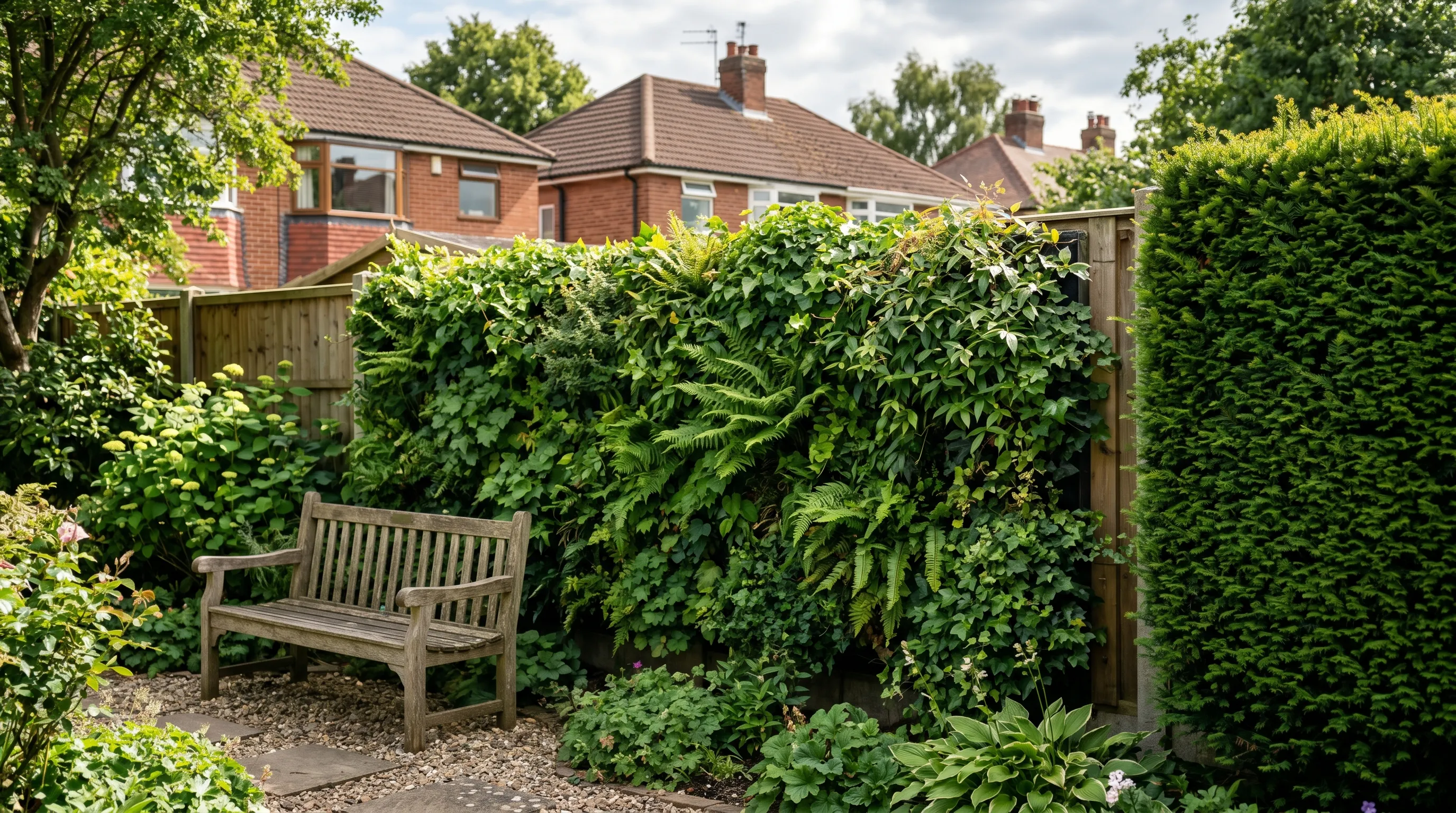 A green wall over a solid panel blocks and absorbs. The yew hedge beside it hides the road and softens echoes.
Sound masking with water and wind
Masking does not reduce noise. It buries it. A water feature produces broadband sound spread across many frequencies, much like traffic itself. When two similar sounds overlap, the brain struggles to separate them and stops registering the steady background. The road is still there on the meter, but your ear pays it no attention. This is the single cheapest way to make a road-side garden feel peaceful.
Placement is everything. Site the water feature close to your seating area, not against the boundary. You want the pleasant water sound to be louder at your ear than the traffic. A gentle trickle will not cover a busy road. A cascade, a wall-mounted blade, or a bubbling urn with a strong flow rate works far better. Match the volume of water to the volume of road.
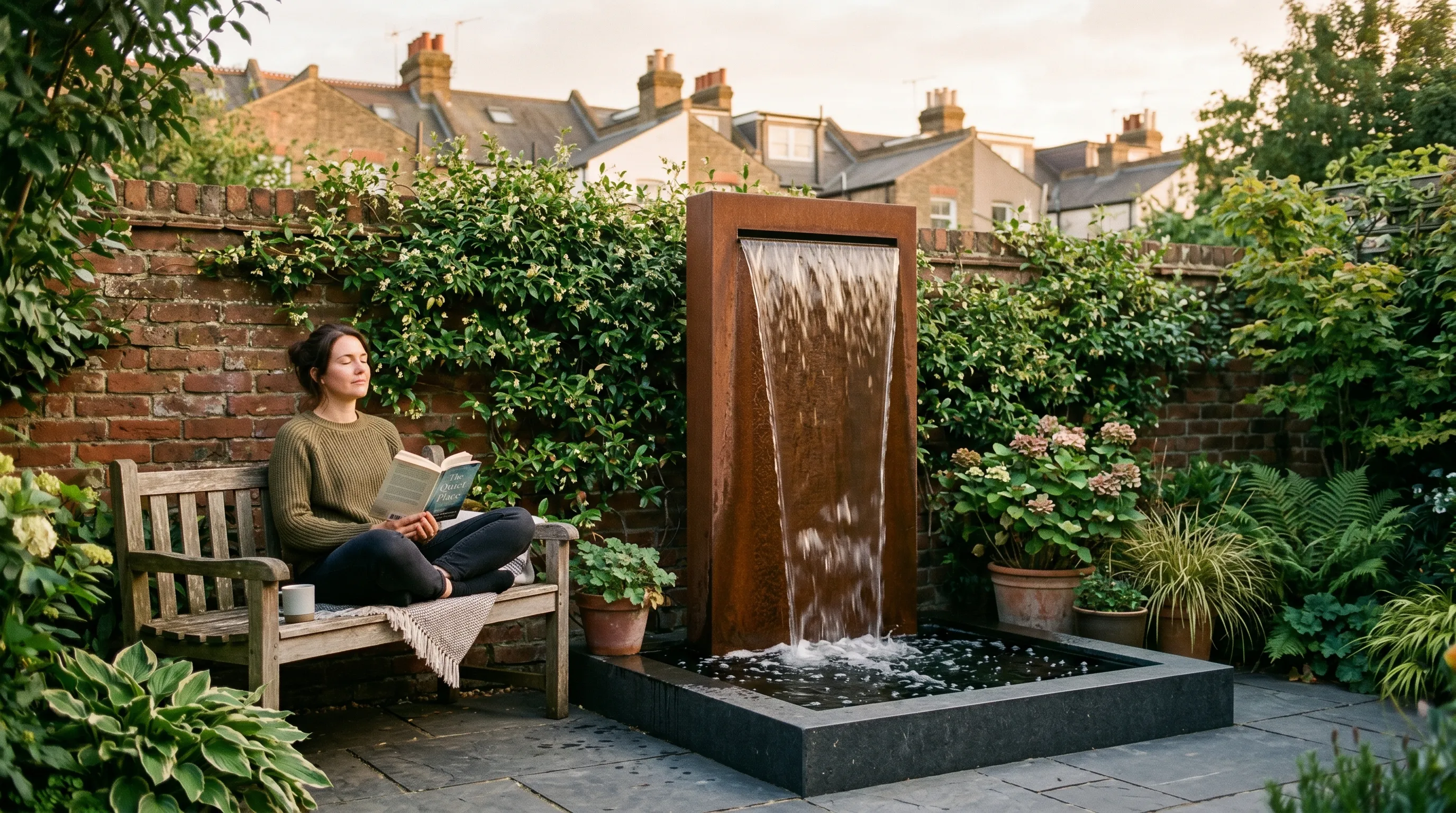 A strong water flow near the seating area masks residual traffic noise the barrier cannot remove.
Placing seating, windows and screens for best effect
Where you sit decides how much noise you hear, often more than the barrier itself. A barrier casts an acoustic shadow directly behind it. Sit deep inside that shadow, close to the fence or wall, not out in the open middle of the lawn where noise bends over the top and lands again.
For the house itself, the road-facing windows take the brunt. Keep bedroom and living room windows on the quieter side where the layout allows. A solid boundary fence or hedge in the front garden intercepts some road noise before it reaches the glass. In a tight city garden, every hard surface reflects sound, so soft absorptive materials like planting and timber help more than render and paving.
Common mistakes that ruin a noise barrier
A few predictable errors undo all the effort and money. Avoid these and a barrier performs as it should.
Relying on a leafy hedge alone. This is the number one mistake. A hedge looks like a wall but behaves like a net for sound. It cuts 1 to 3 decibels at best. Plant the hedge in front of a solid barrier, never instead of one, if you want a real reduction.
Leaving a gap under the fence. Sound floods through the smallest opening. A 50mm gap at the base, or daylight between panels and posts, leaks enough energy to cancel the mass above. Fit concrete gravel boards and seal every joint. The barrier is only as good as its biggest hole.
Buying lightweight panels. A thin overlap or larch-lap panel weighs too little to obey the mass law. It rattles and leaks. Pay for close-board or acoustic panels with real density. Mass is the entire point.
Building too low. A 1.2 metre fence lets traffic noise pass straight over. You need 2 metres of height to create a useful acoustic shadow. Going below that wastes the spend.
Forgetting masking. Even a perfect barrier leaves some residual noise. Without a water feature or rustling planting near the seating area, the ear locks onto what remains. Pair mass with masking for the calmest result.
What it costs to quieten a UK garden
Budget honestly, including the hidden items. A noise barrier is groundwork as much as fencing, and the base prep often costs as much as the panels.
| Element | Budget option | Better option | Cost |
|---|---|---|---|
| Solid barrier | Close-board fence on gravel boards | Mass-loaded acoustic fence | 80 to 300 pounds per metre |
| Earth bund | Free spoil, self-dug | Imported subsoil plus machinery | 50 to 150 pounds per metre |
| Masonry wall | Rendered blockwork | Facing brick on foundations | 250 to 500 pounds per metre |
| Posts and base | Concrete-set timber posts | Steel posts, deep footings | 30 to 60 pounds per post |
| Water feature | Solar bubbling urn | Mains cascade or wall blade | 100 to 600 pounds |
| Planting | Bare-root hedging whips | Mature pleached screens | 30 to 200 pounds per metre |
Warning: Fences and walls over 2 metres high need planning permission almost everywhere in the UK, and any boundary next to a highway used by vehicles is capped at 1 metre under permitted development. Earth bunds usually need approval too. Always check with your local planning authority and the Planning Portal before building. The Royal Horticultural Society also has guidance on screening planting that suits exposed and road-side sites.
Frequently asked questions
Do plants and hedges actually block traffic noise?
Plants and hedges block very little measured noise, just 1 to 3 decibels. Foliage is porous, so sound energy passes straight through the gaps between leaves and stems. The real value of a hedge is psychological. Hiding the road from view and adding gentle rustle makes the garden feel quieter even when a meter barely moves. For a measurable drop you need a solid, heavy, gapless barrier behind the planting.
What is the best fence for reducing road noise?
The best fence is a solid, gapless one at least 2 metres tall. Close-board timber, tongue-and-groove or mass-loaded acoustic panels all perform well, provided there are no gaps anywhere. Concrete gravel boards must seal the base to the ground. The heavier and taller the barrier, the more it cuts. A well-built 2 metre acoustic fence removes 8 to 12 decibels of road noise, halving the perceived loudness at your seat.
How much does a garden noise barrier cost in the UK?
Expect 80 to 200 pounds per metre installed for most barriers. A standard close-board fence runs about 80 to 120 pounds per linear metre. Dedicated acoustic fencing with mass-loaded panels costs 150 to 300 pounds per metre. An earth bund is cheaper in materials but needs space and machinery to build. A masonry wall is the most expensive at 250 to 500 pounds per metre, though it lasts for decades.
Will a water feature cover up traffic noise?
A water feature covers traffic noise by masking it, not by blocking it. Moving water produces broadband sound across many frequencies, similar to traffic. The brain stops registering steady background sound, so a cascade or blade near your seating area makes road noise far less noticeable. It does not lower the meter reading at all. It changes which sound your ear chooses to focus on, which is often what matters most in a garden.
Do I need planning permission for a noise barrier fence?
You usually need permission if the barrier exceeds 2 metres. Permitted development allows fences and walls up to 2 metres high in most rear gardens. Any boundary next to a highway used by vehicles is capped at 1 metre without permission. Earth bunds and taller acoustic fences almost always need approval. Always check with your local planning authority before building anything near a road.
Our team produces practical UK gardening guidance from source research, contributor records and established horticultural practice. Editorial standards are overseen by Matt W.