Key takeaways
- Pondless designs hide water under stones or grates, eliminating algae and leaf litter problems
- A recirculating bowl needs 30 minutes annual maintenance versus 8-12 hours for an open pond
- UK costs run £200 for a self-build millstone to £1,800 for a custom rill
- Pumps need replacing every 4-7 years; budget £40-£120 per replacement
- Reservoirs of 80-300 litres are standard; bigger reservoirs need topping up less often
- Sealed designs avoid the legal duty of care owed to children that open ponds carry
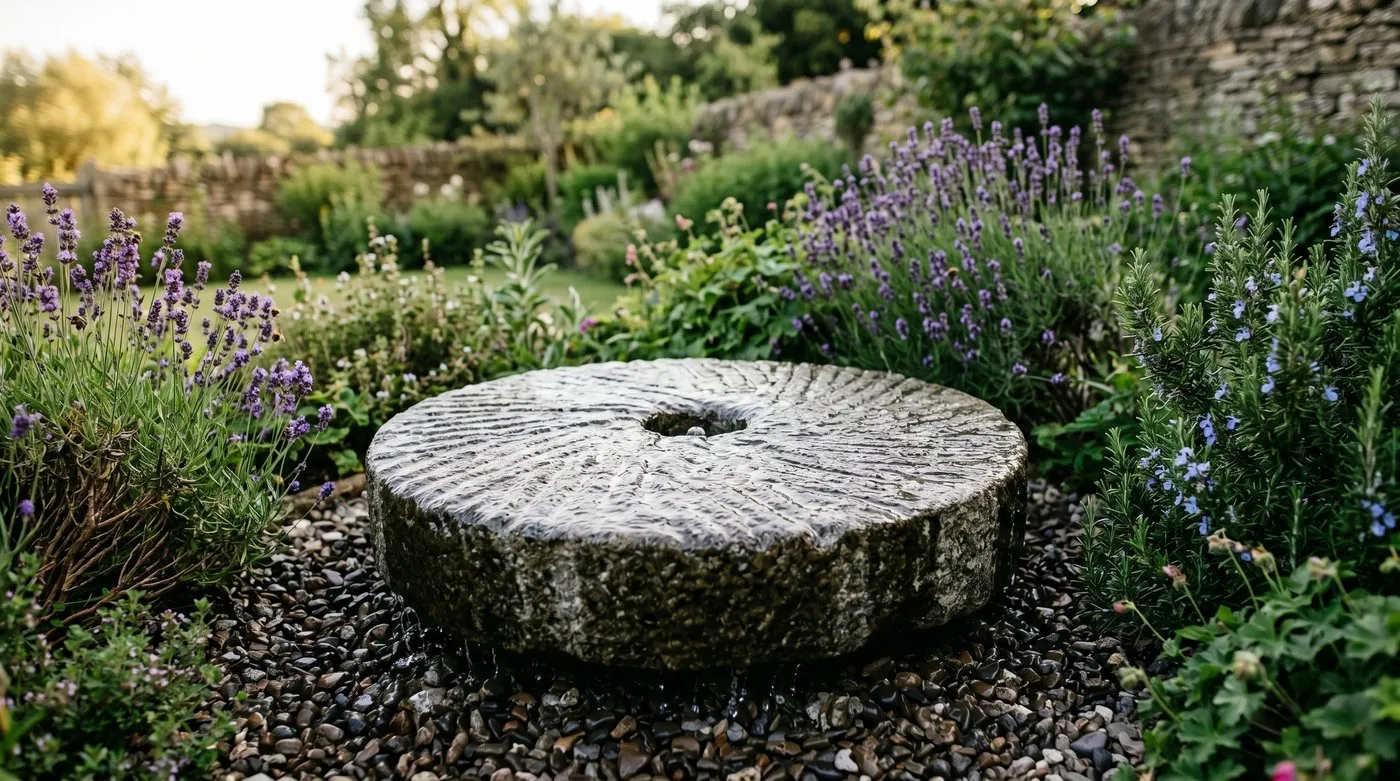 A 600mm granite millstone over a 200-litre hidden reservoir, the most commonly chosen low-maintenance UK design
What makes a water feature low-maintenance
A low-maintenance water feature has no open standing water. The water sits in a hidden reservoir below ground level, recirculates through a pump, and emerges from a stone, bowl, or grate. There is nowhere for algae to bloom, nowhere for leaves to settle, and no pond ecosystem to manage.
The four main maintenance jobs of a traditional pond disappear. Algae blooms (4-6 hours every spring) become a one-off filter rinse. Leaf clearance (2-3 hours every autumn) becomes a 5-minute pre-filter check. Plant management (3-4 hours per year) is eliminated. Pump maintenance shrinks from quarterly to annual.
The pump is the only moving part. Pump life decides total cost over time. A £50 budget pump dying every 18 months is more expensive over a decade than a £120 quality pump lasting 7 years. Brands matter; we cover this further down.
Water loss happens through evaporation, not seepage. A sealed reservoir with a butyl liner loses water only when the surface is exposed to sun and wind. Reservoirs deeper than 30cm with most of the surface area covered evaporate slowly. A 200-litre reservoir loses 5-10 litres a week in July sun.
Children and pets are safer. A pondless feature carries no drowning risk for toddlers or dogs. The Occupiers Liability Act 1957 places a duty of care on garden owners for open water. Hidden-reservoir designs avoid this concern entirely.
| Maintenance task | Open pond | Pondless feature |
|---|---|---|
| Algae control | 4-6 hours per year | 0 hours |
| Leaf clearance | 2-3 hours per year | 5 minutes per year |
| Plant management | 3-4 hours per year | 0 hours |
| Pump cleaning | 4 hours per year | 1 hour per year |
| Total annual time | 13-17 hours | 1-1.5 hours |
Design 1: pondless cascade
A pondless cascade is a stream of water flowing over stones into a hidden gravel-filled reservoir. Water pumps from the reservoir up to the head of the cascade, then flows back down. The feature gives the visual impact of a stream without any open water.
Build cost in 2026 sits at £600-£1,500 for a 2-3 metre run. Materials: butyl liner (£80-£200), pump (£80-£150), stones (£150-£400), gravel (£60-£120), reservoir grid (£40-£80), labour or DIY time. Bigger cascades scale up linearly.
Reservoir size determines top-up frequency. A 200-litre buried reservoir runs a 2-metre cascade for 2-4 weeks between top-ups in summer. A 300-litre reservoir extends this to 4-6 weeks. Reservoirs under 100 litres need weekly attention.
Drop height drives the sound profile. A 30cm drop produces a soft burble. A 60cm drop gives a steady running-water sound. Drops over 90cm produce splash that throws water beyond the catchment, increasing evaporation by 40-60%.
Best position is partial shade with morning sun. Full sun raises evaporation. Deep shade slows the small amount of natural cleaning the moving water provides. East-facing partial shade is optimal.
Gardener’s tip: Add a UV clarifier in line with the pump (£40-£80) to keep water crystal clear. The UV light kills the suspended algae cells that occasionally develop even in pondless features. Fit it inside the reservoir, not the cascade head, so it stays dark and safe.
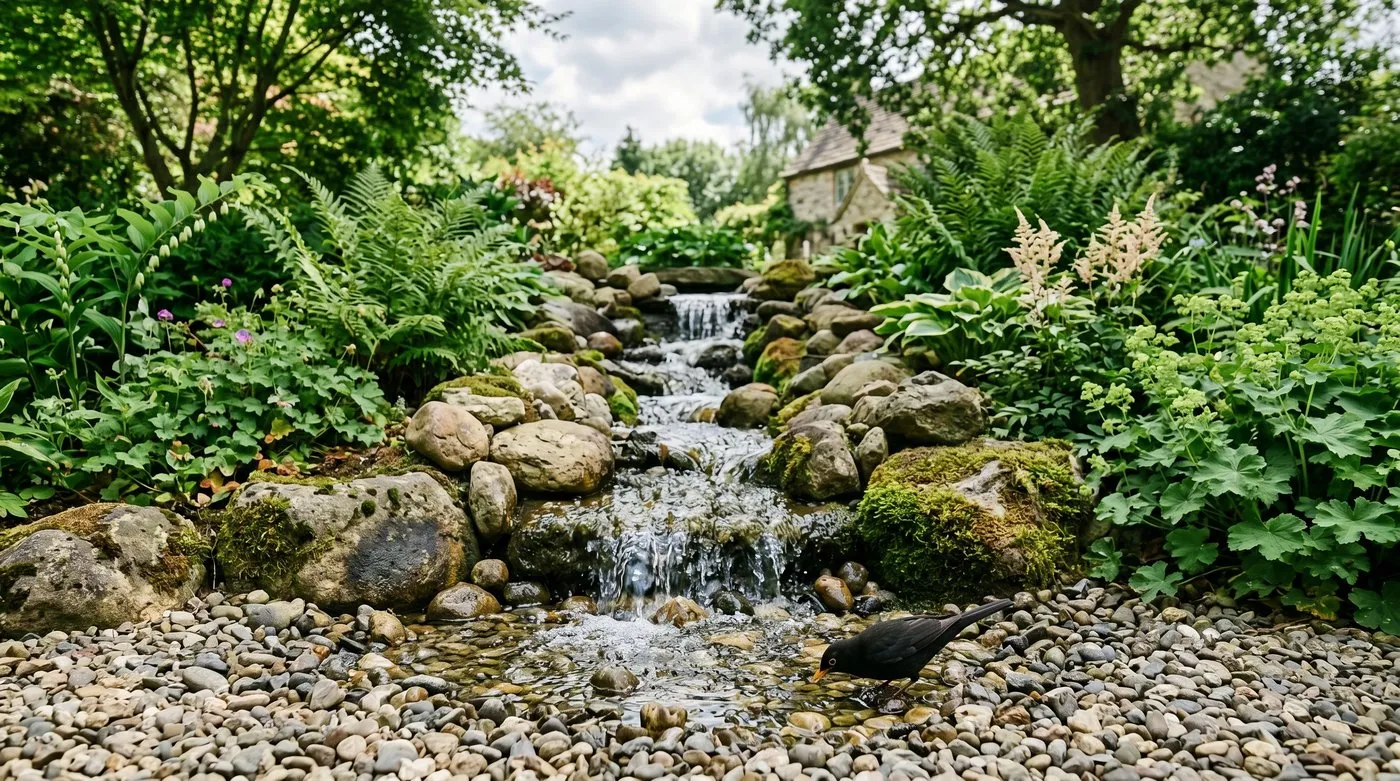 A 3-metre pondless cascade with a 250-litre buried reservoir, the highest-impact design within the £1,000 budget bracket
Design 2: recirculating bowl
A recirculating bowl is a stone, ceramic, or copper basin that overflows water around its rim into a hidden reservoir below. It is the simplest pondless design, takes minimal space, and works on patios, courtyards, and small gardens.
Build cost is £200-£500 for self-build. A 50cm stone bowl (£80-£200), small submersible pump (£40-£70), 80-100 litre reservoir (£40-£80), grate or pebbles to hide the reservoir (£40-£100). Off-the-shelf complete kits cost £400-£800.
Reservoir size of 80-100 litres is sufficient for a 50cm bowl. Top up every 10-14 days in summer, every 4-6 weeks in winter. Bigger bowls need bigger reservoirs.
Pump flow rate determines the overflow style. A 600 litre per hour pump produces a slow, even film over the bowl rim. A 1500 lph pump throws water 5-10cm out. Match the pump to the visual effect you want; an oversized pump empties the reservoir faster.
Materials matter for longevity. Granite, basalt, and slate basins last 30+ years outdoors. Ceramic glaze can crack in UK winters when water freezes inside. Copper bowls develop a green patina over 2-3 years that some gardeners love and others repaint.
Design 3: rill and runnel
A rill is a narrow formal channel of water running through a garden, often along a path or terrace edge. A runnel is the same idea on a smaller scale. Both can be sealed and recirculating, hiding the reservoir at one or both ends.
Build cost is £400-£1,800 depending on length and finish. A 3-metre rill in concrete with a butyl liner runs £400-£700. The same rill in cut natural stone runs £1,200-£1,800. Custom-fabricated stainless steel rills sit at the top of the price band.
Sealed rills avoid the maintenance problem of open pond rills. Traditional rills filled with ornamental fish need quarterly cleaning. A sealed recirculating rill draws water from a reservoir at one end, runs it along the channel, and returns through a filter to the same reservoir.
Channel depth of 5-10cm is standard. Anything deeper looks like a trench. Anything shallower evaporates too fast. Width 15-25cm gives the visual impact and lets the water move at a steady pace.
Best for formal garden styles. Rills suit Mediterranean, Japanese, and modernist designs. They look out of place in cottage and naturalistic gardens. For those, choose a cascade or bowl.
| Design | Build cost | Annual maintenance | Best for |
|---|---|---|---|
| Pondless cascade | £600-£1,500 | 1-1.5 hours | Naturalistic, sloped sites |
| Recirculating bowl | £200-£500 | 30-45 minutes | Patios, small gardens |
| Sealed rill | £400-£1,800 | 1-2 hours | Formal, modernist, terrace |
| Millstone feature | £300-£800 | 30 minutes | Mixed styles, mid-budget |
| Reservoir bubbler | £150-£400 | 30 minutes | Tiny gardens, balcony |
Design 4: millstone feature
A millstone feature is a flat circular stone over a hidden reservoir, with water bubbling up through the centre and flowing across the surface. It is the most popular pondless design in UK gardens because it suits almost any style and sits well at any garden scale.
Build cost is £300-£800 self-build, £600-£1,200 supplied and fitted. Materials: 60-90cm stone (£100-£300), submersible pump (£60-£120), 200-300 litre reservoir (£80-£150), reservoir grid (£40-£80), pebbles or gravel for surround (£50-£120).
Stone choice affects appearance and durability. Genuine granite millstones with grinding grooves cost £200-£400 and last centuries. Reconstituted stone millstones cost £80-£150 and last 15-20 years. Sandstone weathers attractively but flakes after 8-10 years in heavy frosts.
Reservoir size of 200-300 litres sets the top-up cycle. A 250-litre reservoir runs a 70cm millstone for 2-4 weeks between summer top-ups. Smaller reservoirs need weekly attention.
Pump position is under the central hole of the stone. A 4-wire flexible hose lifts water from the pump up through the stone. Use stainless steel or reinforced flexible hose; cheap clear plastic hose hardens and cracks within 3-5 seasons.
The sound profile is gentle. A millstone produces a quiet ripple sound rather than a babbling cascade. Best for gardens where you want soft background water, not a dominant feature.
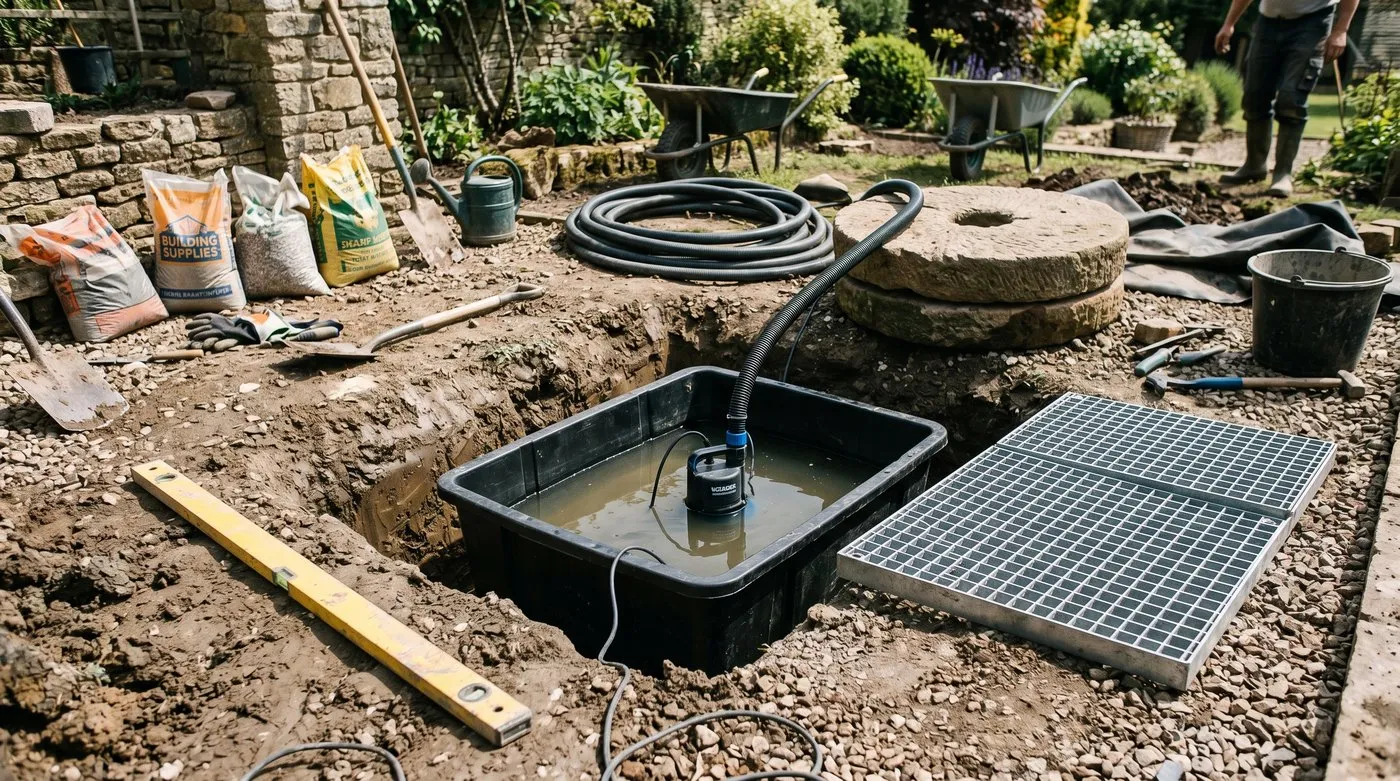 The hidden side of a millstone feature, the 250-litre reservoir, the pump, and the grate that holds the stone level over the water
Design 5: reservoir bubbler
A reservoir bubbler is the smallest pondless format, a single point of bubbling water over hidden gravel. It works in containers, on balconies, and in tiny courtyard gardens. Build cost runs £150-£400.
Build is the simplest of the five. Materials: a half barrel or large planter (£40-£100), a small submersible pump (£40-£60), a piece of grating to hide the reservoir (£20-£40), pebbles for surround (£20-£60). Total components fit in a single car boot.
Reservoir size of 40-80 litres limits the visual scale. Suitable for a single bubble, not a cascade or fountain. Top-up every 5-7 days in summer.
Pump flow rate of 200-500 litres per hour is enough. Anything more is wasted in a small reservoir; the pump just throws water out of the catchment.
Best for compact spaces and rented properties. A reservoir bubbler can be lifted and moved without major dig-up. Useful for tenants who cannot install permanent features.
Pump specifications and lifespan
Pump quality is the single biggest factor in maintenance load. A cheap pump dying every 18 months adds replacement labour, water loss when the feature dries out, and the cost of new units. A quality pump lasts 4-7 years.
Choose a pump rated for continuous duty. Look for an IP68 rating (fully submersible) and a duty cycle of 24/7. Pumps marketed for fountains often have 12-hour duty cycles and burn out under continuous use.
Match the flow rate to the design. Rule of thumb: lift height in metres x feature volume per hour. A 50cm bowl needs roughly 600 lph. A 2-metre cascade needs 1500-2500 lph. A 3-metre rill needs 2000-3000 lph.
The leading UK pumps in 2026:
- Oase Aquarius Universal 600 (£75-£90) for bowls and bubblers, 5-7 year life
- Oase Aquarius Universal 1500 (£140-£170) for cascades and rills, 5-7 year life
- Aquascape Ultra 800 (£90-£120) for millstones, 6-8 year life
- Hozelock Cyprio Cascade 1500 (£100-£130) for budget cascades, 4-5 year life
- Pondxpert SolidPond 2500 (£75-£100) for medium cascades, 3-4 year life
Pre-filter sponges add 1-2 years to pump life. A sponge fitted to the pump intake catches debris before it reaches the impeller. Rinse the sponge twice a year. The £5 sponge saves the £80 pump.
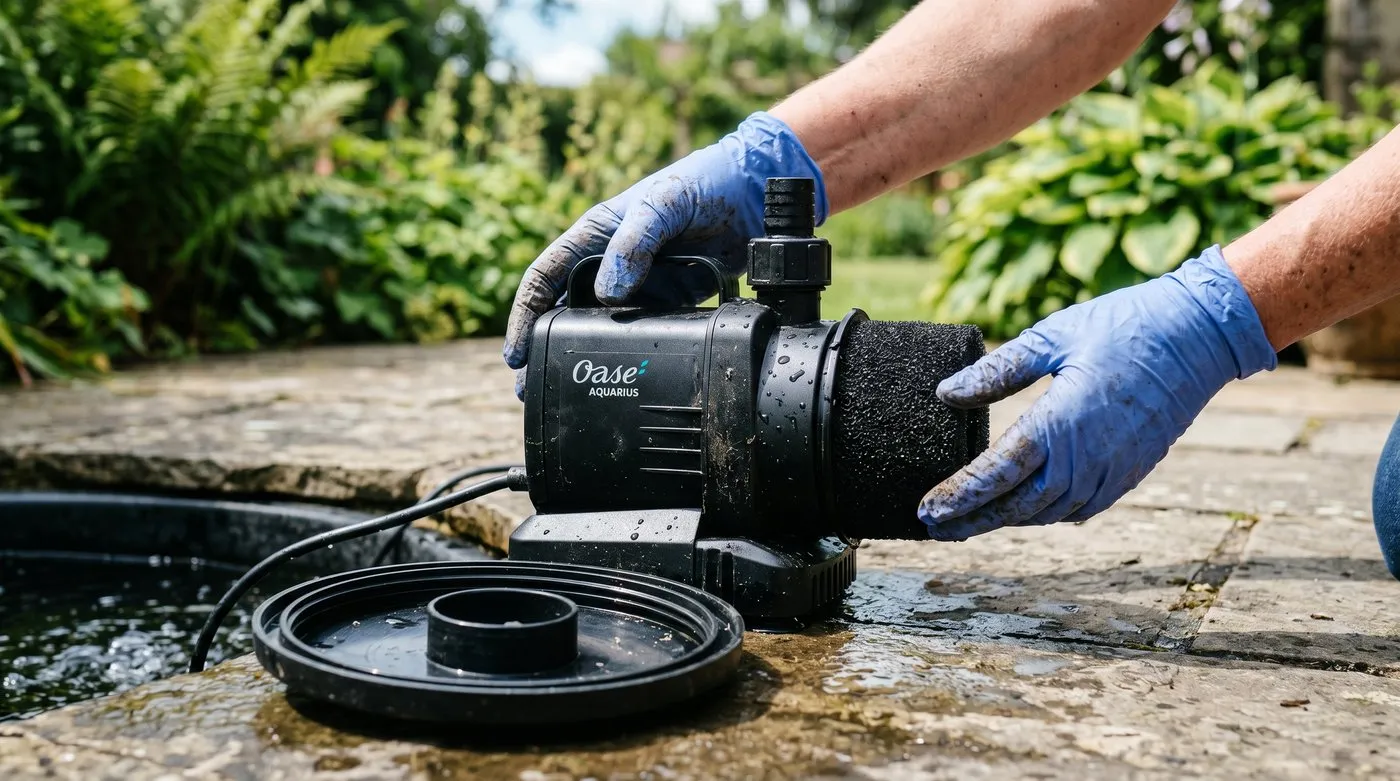 An Oase Aquarius pump with pre-filter sponge during the spring rinse. The 5-minute annual service that takes pump life from 3 years to 7
Annual maintenance schedule
A well-built low-maintenance feature needs four short maintenance jobs per year. Total time 30-90 minutes annually.
Spring (March-April): pre-filter rinse and reservoir top-up. Remove the pump pre-filter sponge, rinse under cold water until the water runs clear (no soap or detergent). Top up the reservoir to the design level.
Summer (June-July): mid-season top-up. Check the reservoir water level. Top up using rainwater where possible. Trim back any overhanging plants that are dropping leaves into the feature.
Autumn (October-November): leaf removal. Lift the grate or pebbles, remove any leaves that have fallen into the reservoir. Rinse the pre-filter again. Check the pump runs cleanly.
Winter (December-February): frost protection if needed. In hard frosts, drain the visible water and switch off the pump for the duration. Most low-maintenance features run through normal UK winters because the reservoir is below ground level and protected by the grate.
Pump replacement every 4-7 years. When the pump fails, replace with the same model or equivalent flow rate. The hose and reservoir stay in place.
| Month | Job | Time |
|---|---|---|
| March | Pre-filter rinse, reservoir check | 15 minutes |
| July | Reservoir top-up, plant trim | 10 minutes |
| October | Leaf removal, pre-filter rinse | 15 minutes |
| December | Optional frost shutdown | 5 minutes |
Common mistakes to avoid
Undersizing the reservoir. A 50-litre reservoir under a 70cm millstone needs topping up weekly. Use the 200-300 litre size and forget about it for a month.
Cheap pumps. A £20 budget pump fails within 18 months. The £60 difference to a quality pump pays back in saved replacement labour and avoided downtime.
Wrong location. Full sun raises evaporation by 40-60%. Deep shade slows natural cleaning. East-facing partial shade is best.
No pre-filter. The pump impeller is destroyed by debris in 12-24 months without one. The £5 sponge saves the £80 pump.
Hard plumbing. Rigid pipework cracks at fittings within 5 years. Use reinforced flexible hose and stainless steel jubilee clips.
Skipping the autumn leaf check. A single drift of leaves can clog a pump within 48 hours, drain the reservoir, and burn out the motor. Five minutes in October prevents an £80-£150 replacement.
Step-by-step: building a self-build millstone feature
Step 1: choose location. East-facing partial shade is best. Solid ground for the reservoir, near a power point for the pump.
Step 2: dig the reservoir hole. 80cm wide, 50-60cm deep for a 200-litre reservoir. Spirit level the base.
Step 3: install the reservoir. Drop the prefab reservoir into the hole. Backfill with sand or fine gravel to support the sides. Run the power cable through the cable gland or duct.
Step 4: install the pump. Place the pump on a flat surface in the centre of the reservoir. Fit pre-filter sponge. Attach reinforced 25mm flex hose to the outlet.
Step 5: install the grate. A galvanised steel mesh grate or reservoir lid sits over the hole. The grate must support the weight of the stone (50-150kg).
Step 6: position the stone. Lower the stone onto the grate so the central hole sits over the hose end. Thread the hose up through the hole and trim flush with the top.
Step 7: fill the reservoir. Use rainwater or tap water (allow 24 hours for chlorine to dissipate before running the pump). Fill to within 5cm of the grate underside.
Step 8: surround with pebbles or gravel. Spread 50-75mm of decorative pebbles around the stone, hiding the grate edges.
Step 9: connect power and test. Plug in the pump. Adjust flow with the inline tap (if fitted) until water runs evenly across the stone surface.
Step 10: run for 24 hours and recheck water level. Pebbles and reservoir absorb some water in the first day. Top up to design level.
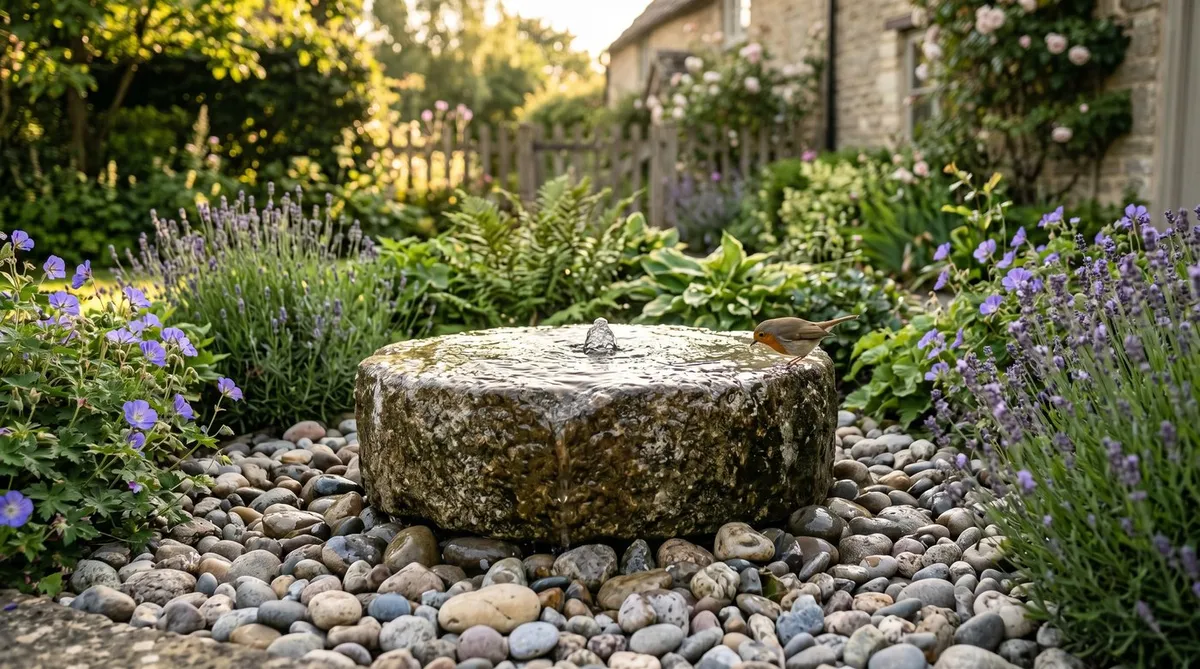
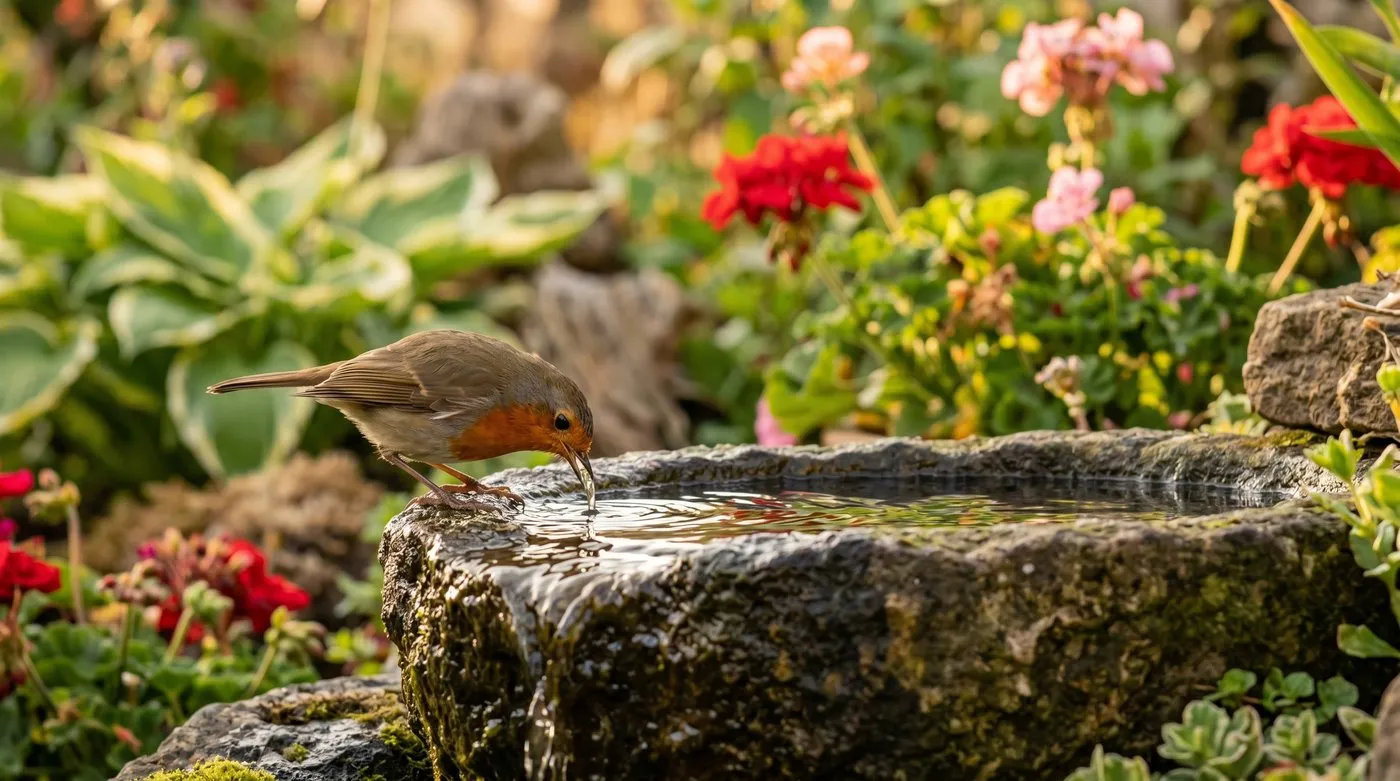 A robin drinking at the rim of a recirculating bowl. Hidden-reservoir features still attract birds and the gentle moving water is a year-round draw
Related reading: a recirculating water rill is one of the lowest-upkeep moving-water features to build.
Frequently asked questions
What is a low-maintenance water feature?
A water feature with no open pond, no fish, and no exposed water surface. The water recirculates under stones, grates, or a hidden reservoir, so there is no algae, no leaf debris, and no pond cleaning. Annual maintenance is roughly 30 minutes versus 8-12 hours for a traditional pond. The five reliable UK designs are pondless cascades, recirculating bowls, sealed rills, millstone features, and reservoir bubblers.
What is the cheapest low-maintenance water feature?
A self-built recirculating bowl using a 50-litre pond liner, a £40-£60 submersible pump, a stone bowl, and pebbles to hide the reservoir. Total cost £180-£250. Build time 4-6 hours. Maintenance under 30 minutes per year. The next step up is a self-build millstone feature at £300-£500 which gives a more substantial visual impact.
How often does a recirculating water feature need topping up?
Top up every 7-14 days in summer, every 30-60 days in winter. Evaporation rate depends on water surface area and weather. A 200-litre reservoir loses 5-10 litres a week in July sun, 1-2 litres a week in February. Use rainwater where possible to avoid limescale buildup on the visible stone surface.
Are pondless water features safe around children and pets?
Yes, pondless designs are the safest water features for gardens with young children or pets. The water sits under stones or a grate with no open pool. There is no drowning risk and no Occupiers Liability Act 1957 duty of care concern about open water. This makes them the standard recommendation for family gardens, nurseries, and care home grounds.
How long does a water feature pump last?
Quality submersible pumps last 4-7 years in continuous use. Cheaper pumps fail within 18-24 months. Brands like Oase, Aquascape and Pondxpert give the longest life. Pumps fail when leaves clog the impeller or when the unit runs dry. Use a pre-filter sponge and check the reservoir level monthly. Pre-filters add 1-2 years to pump life and cost £5-£10.
Our team produces practical UK gardening guidance from source research, contributor records and established horticultural practice. Editorial standards are overseen by Matt W.