Key takeaways
- Wind on a 15m-high roof runs 20-40% faster than at ground level, so windbreaks come before plants
- A typical flat roof carries about 0.75-1.5 kN/m2 imposed load, roughly 75-150kg per square metre
- A 50-litre pot of saturated compost weighs around 60kg, so heavy items sit over load-bearing walls
- Lightweight peat-free compost cut with 25-30% perlite saves about 30% of pot weight versus topsoil mixes
- Slatted windbreak screens with 50% gaps cut wind force far better than a solid panel that creates turbulence
- Wind-tough plants like Stipa, lavender, pittosporum and sedum survive exposure that kills soft-leaved plants
A rooftop sits 10 to 30 metres up, where wind blows 20 to 40 per cent faster than at ground level and a single 50-litre pot of wet compost can weigh 60kg. Those two facts, wind and weight, shape every decision you make up there. Get them right and a bare roof becomes the best space on the building.
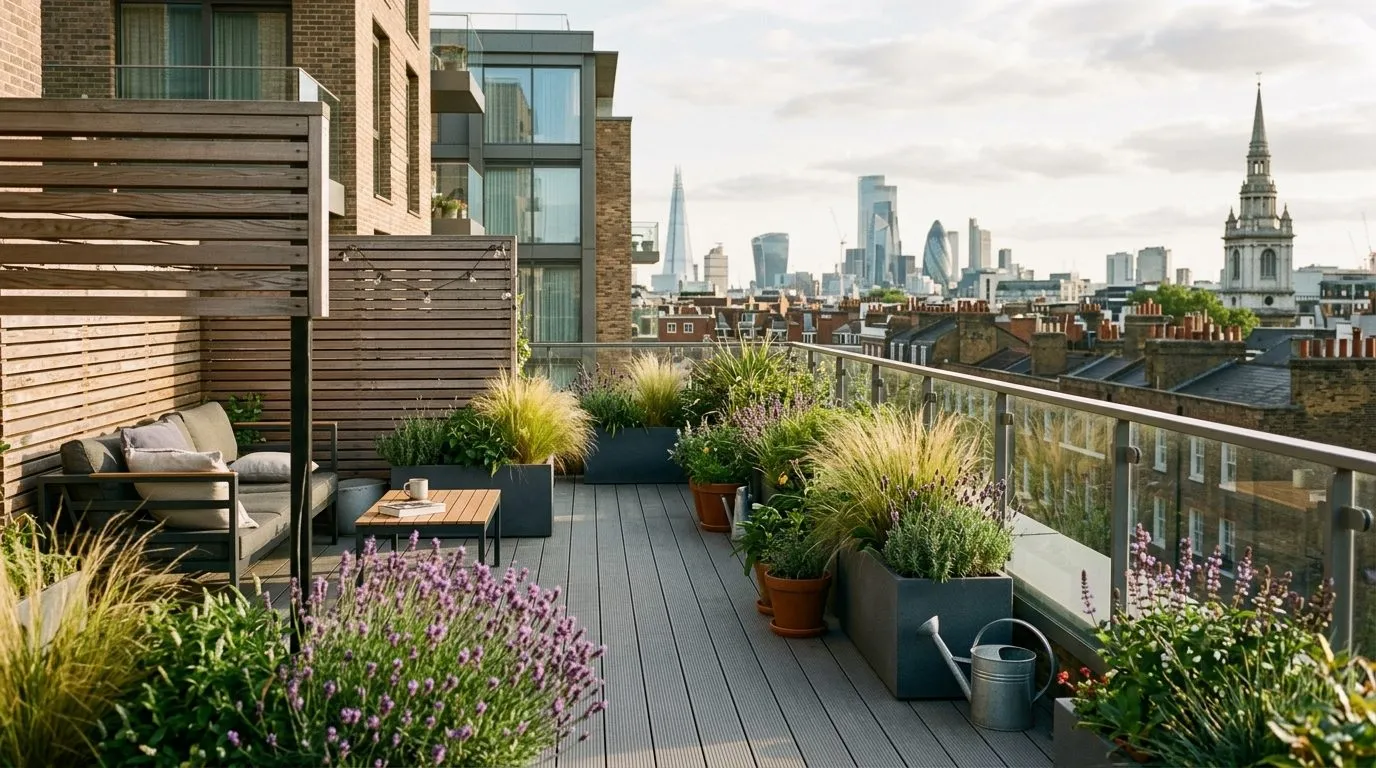
This guide works through the three things that make rooftops different from a normal garden: exposure to wind, the structural weight a roof can safely carry, and growing everything in containers. The horticulture is similar to ground-level pots, but the constraints are stricter. The Royal Horticultural Society’s advice on gardening in exposed sites is a useful companion to read alongside this.
Why rooftops are harder than normal gardens
Three forces work against you on a roof: wind, weight limits, and fast-drying containers. A ground-level garden has soil, shelter, and a fence to lean things against. A roof has none of that. The surface was usually designed to keep rain out, not to hold a garden up.
Wind is the first enemy. Buildings funnel and accelerate air, so a sheltered street can sit under a roof that gets battered. Weight is the second. Every pot, slab, and litre of water adds load the structure must carry. The third is exposure drying: sun and wind pull moisture from pots two to three times faster than at ground level. Plan for all three from the start, not as an afterthought.
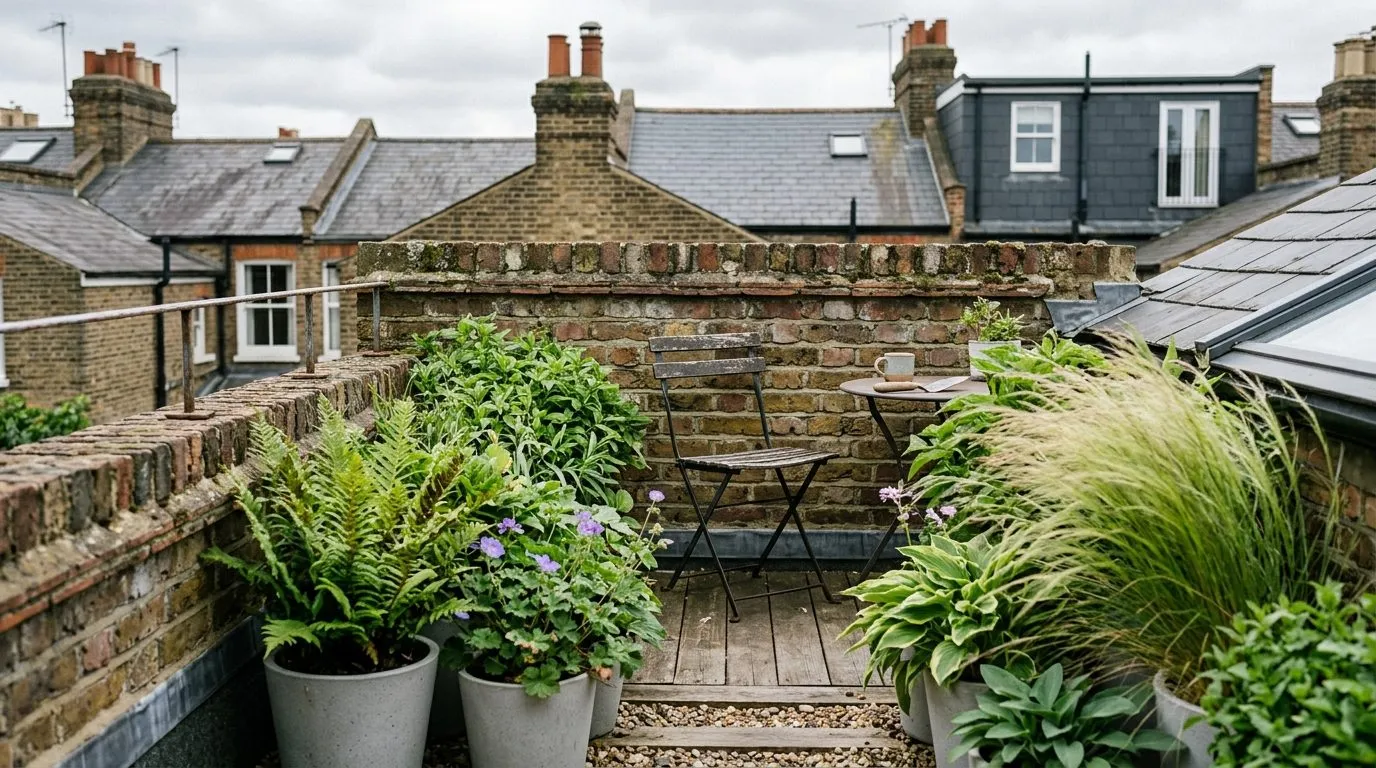
The good news is that rooftop growing shares a lot with container gardening at ground level. The pots, composts, and feeding rules carry across. You just apply them inside tighter limits.
How much wind does a rooftop garden get?
Wind speed rises with height, so a roof at 15 metres can see gusts 20 to 40 per cent stronger than the street below. Tall buildings nearby make it worse by squeezing and channelling air into corners and along parapets. Some rooftop corners get vicious eddies even on a calm-feeling day.
Wind does three things to a roof garden. It topples tall pots. It shreds soft leaves and snaps stems. And it dries compost out within hours. Soft-leaved plants like hostas, bananas, and large-flowered dahlias tear within a season. The fix is to slow the wind before it reaches the plants.
Windbreaks beat solid walls
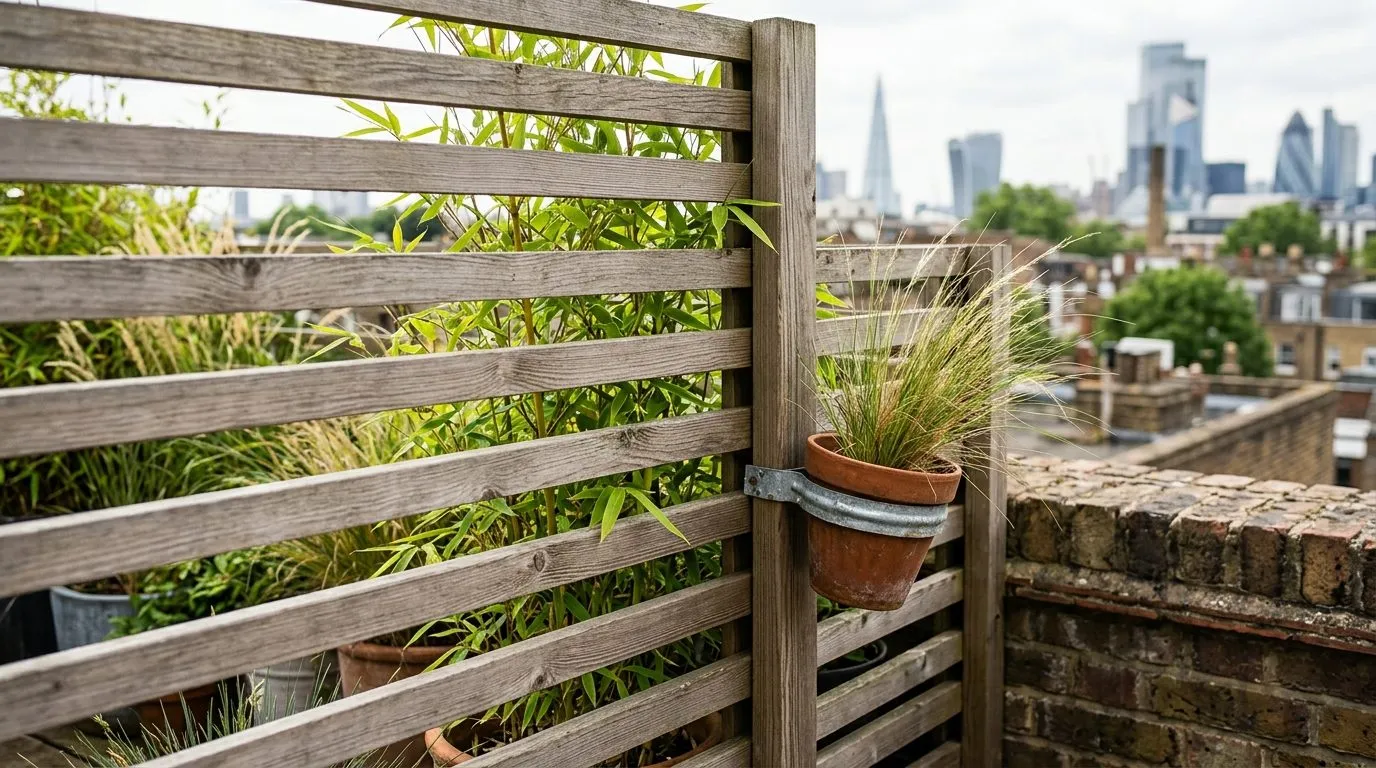
A solid panel feels protective but creates a problem. Wind hits it, lifts over the top, then crashes down behind it as turbulence. A permeable screen works better. Slatted timber, woven willow, or steel mesh with 40 to 50 per cent gaps lets some air through and breaks the force without the downdraught.
A 1.8m screen shelters a strip roughly 8 to 10 metres deep behind it. Site your most tender plants in that zone. The same logic that protects an exposed, windy garden at ground level applies on a roof, just with lighter, fixed screens bolted to the structure rather than fence posts in soil.
Stop pots blowing over
Understanding roof weight loading
A typical UK flat roof carries an imposed load of about 0.75 to 1.5 kilonewtons per square metre, which is roughly 75 to 150kg per square metre. Imposed load is everything you add on top: pots, paving, water, furniture, and people. Older roofs, balconies, and garage roofs can be far lower. Never assume.
The danger is that water is heavy and invisible until it is too late. Wet compost weighs far more than dry. A pot that felt fine in the garden centre can double in weight after rain. This is the single most overlooked risk in rooftop gardening.
What things weigh on a roof
Use this table to estimate load before you buy anything. Saturated weights matter more than dry, because rain and watering happen.
| Item | Approximate weight | Notes |
|---|---|---|
| 10L pot, saturated compost | 11-13kg | Multiply up for bigger pots |
| 35L planter, saturated | 40-45kg | Common medium shrub pot |
| 50L planter, saturated | 55-65kg | Needs a load-bearing wall below |
| Paving slab, 600x600x40mm | 30-35kg | Heavy; use timber decking instead |
| Composite decking, per m2 | 20-30kg | Spreads load evenly |
| Water in a 30L pot | 30kg | Water alone, before compost |
| Adult person | 70-90kg | Count people in your load sums |
A few pots add up fast. Ten 35-litre planters at 45kg each is 450kg before you add yourself and a chair. Spread that across the floor and keep the heavy items at the edges.
Where to put the heavy things
Place your heaviest pots directly over load-bearing walls, never in the centre of an unsupported span. Walls carry far more than the middle of a roof deck. Run a line of large planters along the parapet that sits over the outside wall. Keep the centre of the roof for lightweight pots, decking, and seating.
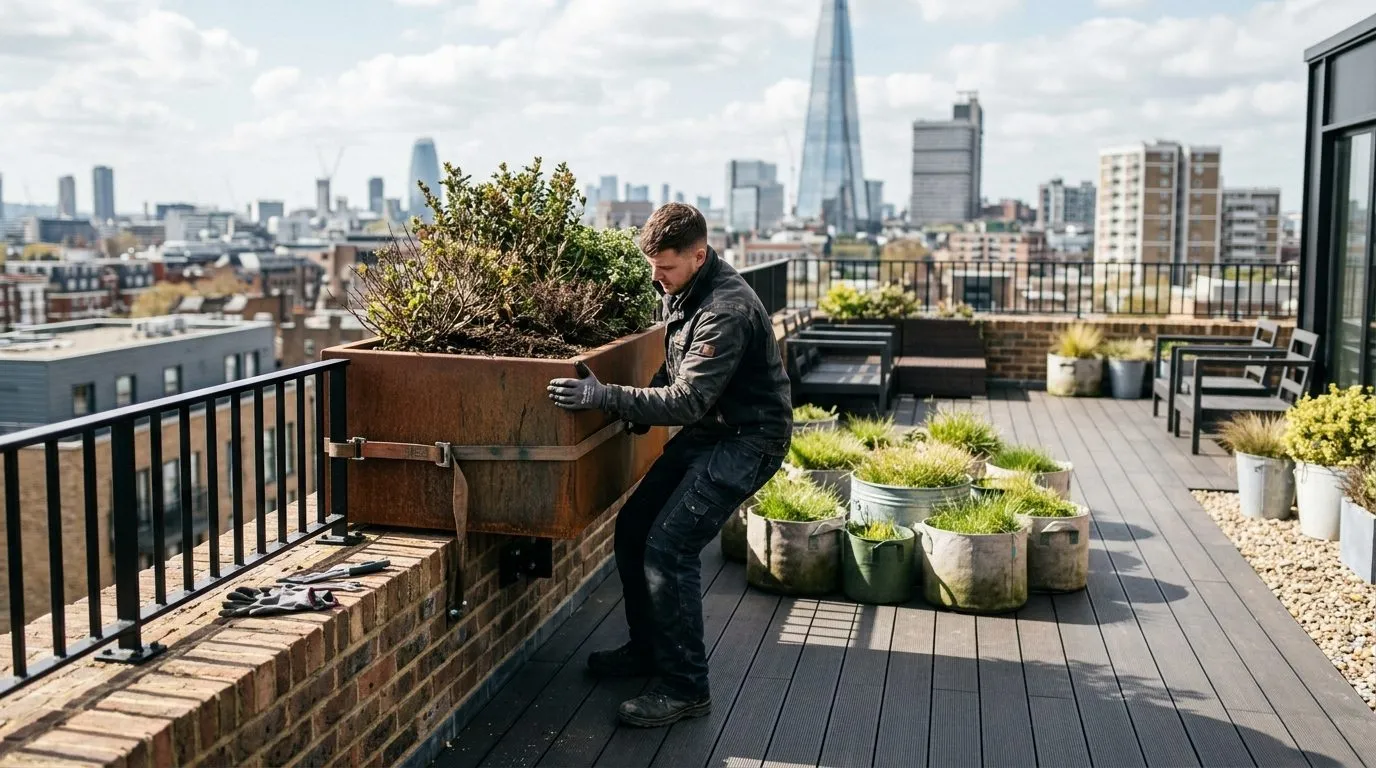
If you cannot see where the walls run, the floor below tells you. The walls holding up the rooms beneath are the same walls supporting your roof edges. A structural engineer marks these out properly.
When to call a structural engineer
Call one before you load anything heavier than a few small pots. A structural engineer checks the deck construction, the span, the waterproofing, and the safe imposed load. The survey costs around £400 to £800 in 2026 and often pays for itself by telling you exactly what the roof can take. For leasehold flats, you usually need the freeholder’s consent and proof of a survey before any roof loading. This is not a corner to cut.
Choosing containers and compost for weight
Lightweight planters and perlite-cut compost can halve the load of a traditional pot. Material choice matters as much as size. Terracotta and concrete look the part but are dead weight. Swap them for fibreglass, rotomoulded plastic, or fibre-clay, which give the same look at a fraction of the weight.
Lightweight container materials
- Fibreglass - strong, frost-proof, looks like stone or metal, very light
- Rotomoulded plastic - tough, UV-stable, cheap, the lightest option
- Fibre-clay (poly-terracotta) - terracotta look, about half the weight
- Galvanised steel troughs - light, modern, good over a parapet line
- Timber raised planters - line with plastic, lighter than masonry beds
Avoid solid concrete, stone, and unglazed terracotta unless they sit directly on a load-bearing wall.
Lightweight compost mixes
Standard topsoil and John Innes composts are heavy because of the loam content. For a roof, use a peat-free multipurpose mix and cut it with 25 to 30 per cent perlite. Perlite is volcanic glass that weighs almost nothing and improves drainage. That blend saves roughly a third of the weight against a loam-based mix while still holding moisture.
Add water-retaining granules if you cannot irrigate daily. Top every pot with 3 to 5cm of bark or gravel to slow evaporation in the wind. The same lightweight approach suits balcony gardens, where load limits are just as tight.
Drainage and irrigation on a roof
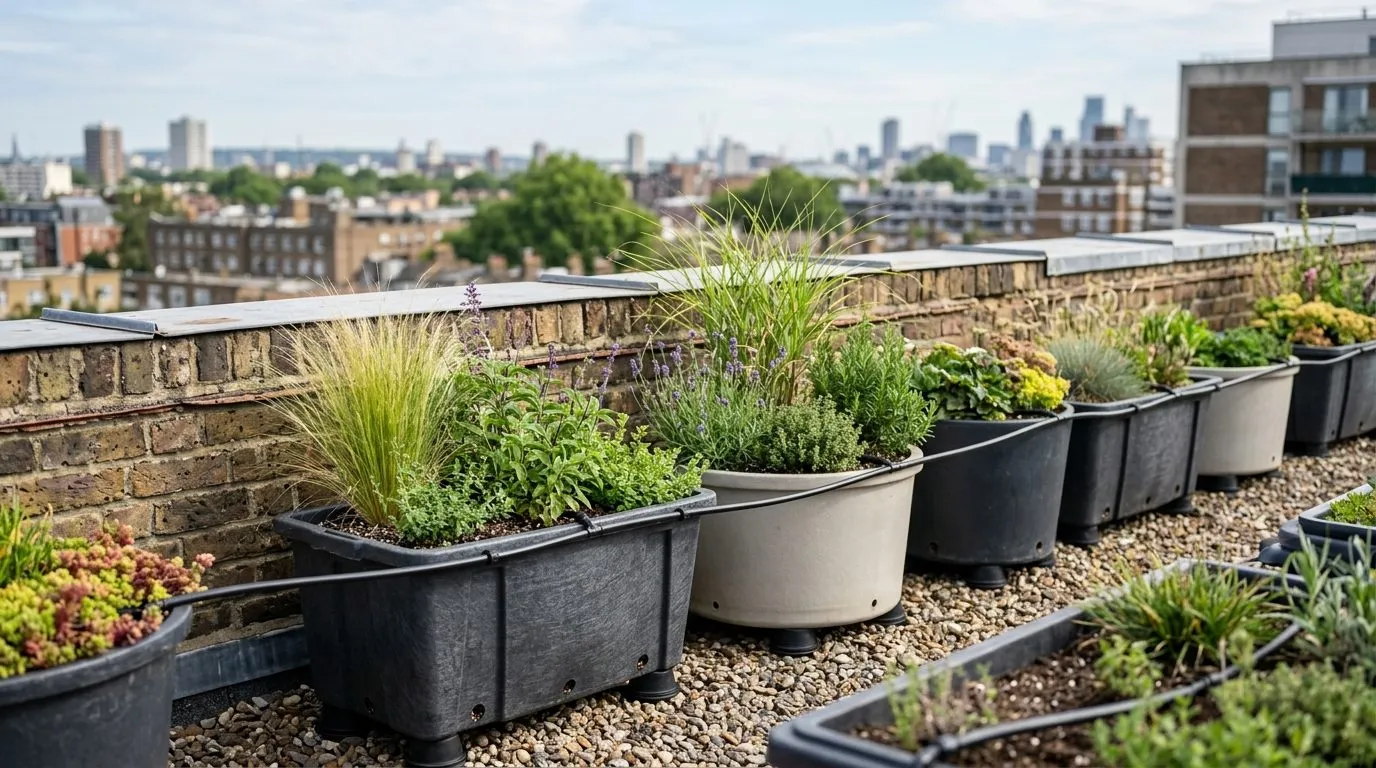
Every container needs free drainage, and most roofs need an automatic watering system to cope with fast drying. Blocked drainage is a double risk on a roof: it drowns roots and adds standing-water weight the structure must carry.
Raise every pot on pot feet so water escapes and air reaches the roof membrane beneath. This stops the waterproofing rotting under permanently wet pots. Never let pots sit in trays of standing water up there.
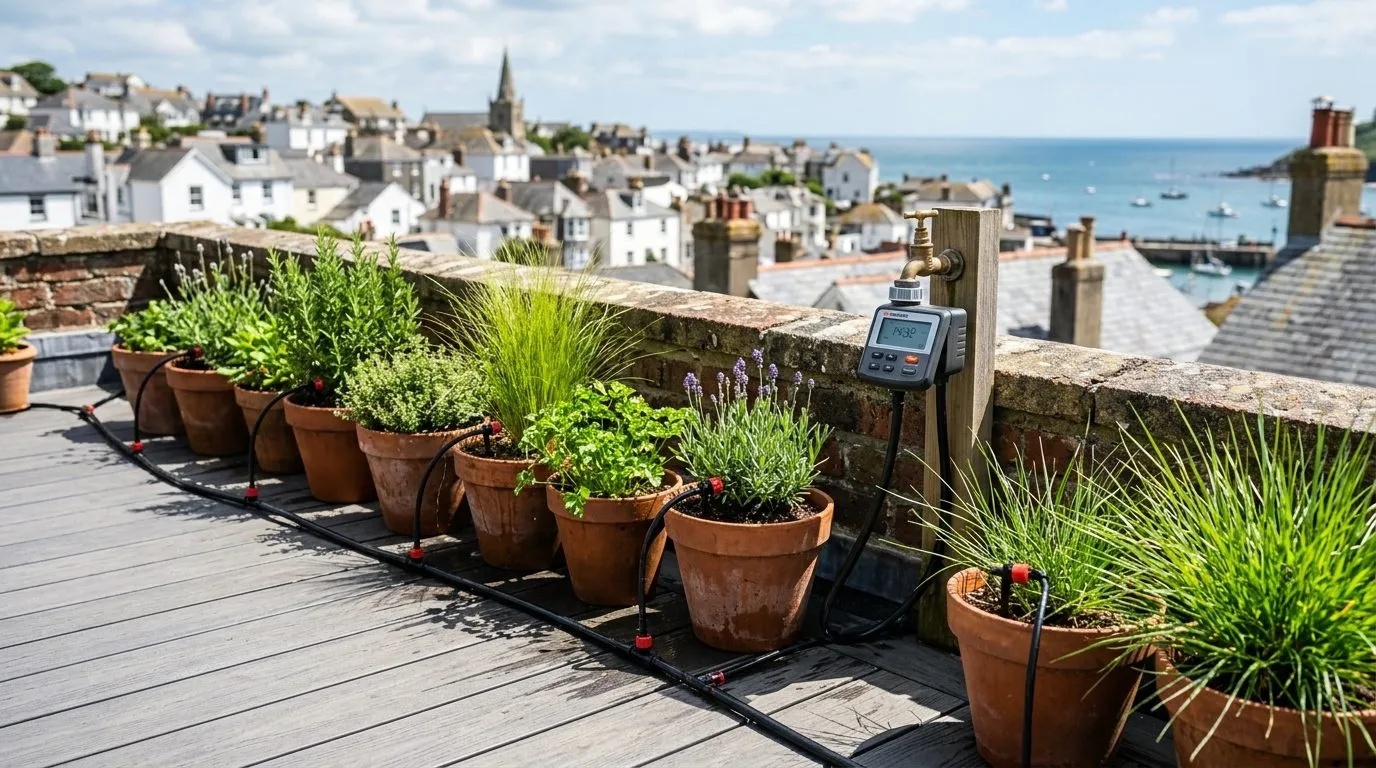
Wind and sun dry rooftop pots two to three times faster than ground-level ones. In a hot July week you may need to water twice a day by hand. A drip system on a battery-powered timer solves this. Run thin supply tubing along the pots, fit an adjustable dripper to each, and set the timer for early morning. Self-watering planters with a built-in reservoir are a good no-plumbing alternative for smaller setups.
Best wind-tough plants for UK rooftops
Small-leaved, flexible, drought-tolerant plants survive rooftop wind that destroys soft, leafy ones. Think coastal and Mediterranean: plants built for exposure, poor soil, and dry spells. Grasses are the backbone because they bend instead of snapping.
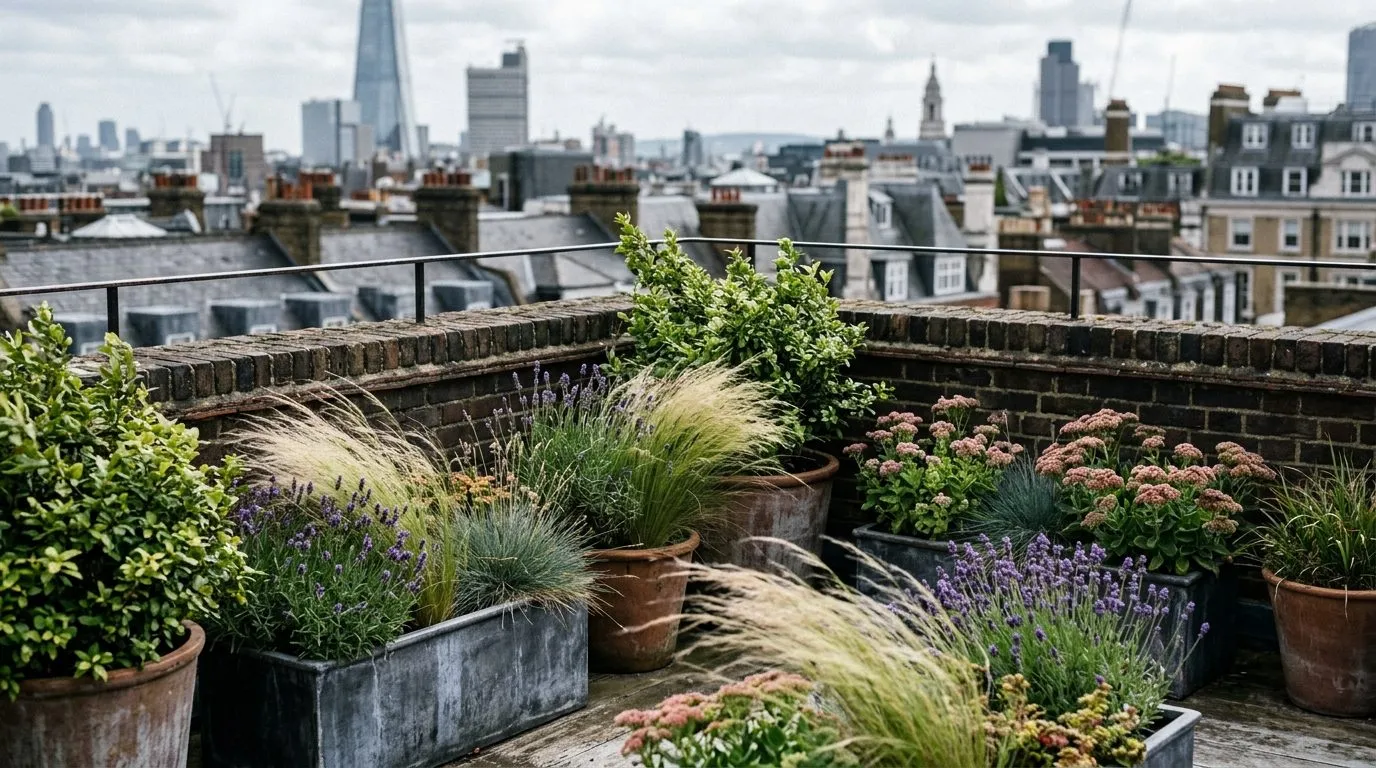
Wind-tough plant table
| Plant | Type | Height | Why it copes |
|---|---|---|---|
| Stipa tenuissima | Grass | 40-60cm | Bends flat in gusts, recovers instantly |
| Lavender (Hidcote) | Shrub | 40-60cm | Tough, aromatic, loves dry exposed sites |
| Pittosporum tenuifolium | Shrub | 1-2m | Small leathery leaves shrug off wind |
| Sedum (Hylotelephium) | Perennial | 30-50cm | Fleshy, drought-proof, never needs shelter |
| Festuca glauca | Grass | 20-30cm | Compact blue tufts, wind and drought tough |
| Rosemary | Herb/shrub | 50-100cm | Woody, coastal-hardy, evergreen |
| Pine (mugo) | Conifer | 50-150cm | Dense, evergreen, takes full exposure |
| Erigeron karvinskianus | Perennial | 20-30cm | Self-seeds, flowers May to November |
Many of these are also reliable drought-tolerant plants because rooftop wind and ground-level drought ask the same toughness of a plant. For low planters along a parapet, the same picks that work as window box plants suit shallow rooftop troughs.
Plants to avoid
Skip anything with large soft leaves or tall brittle stems. Hostas shred. Banana plants tear to ribbons. Tall dahlias and delphiniums snap. Bamboo whips around and dries out unless very sheltered. Acers scorch in wind within weeks. If a plant struggles in a coastal garden, it will struggle on a roof.
Designing the layout
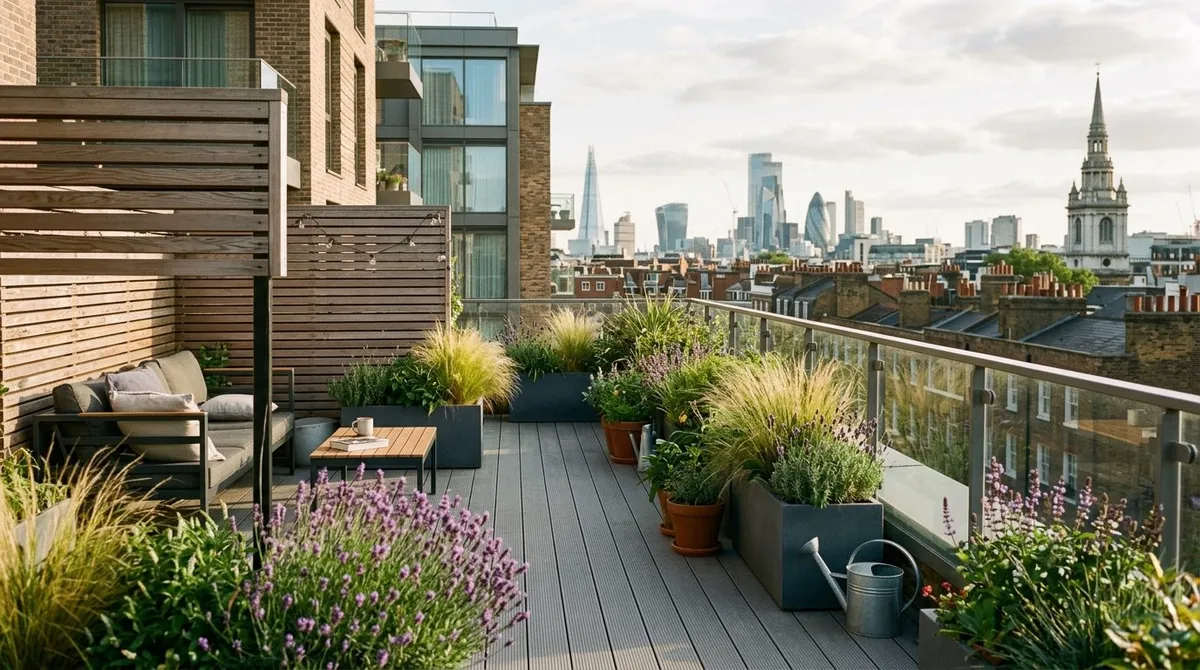
Group the garden into a sheltered core and a tough outer edge, with heavy planters over the walls. Put seating and your most tender plants in the lee of the windbreak. Use the exposed parapet line for grasses, lavender, and sedum that do not mind a battering, doubling as ballast over the load-bearing wall.
Composite decking spreads weight and gives a level, splinter-free floor without the load of paving. Keep colours and materials simple so the city view does the work. The principles that make a small garden design feel bigger, clear sightlines, a single focal point, and repeated planting, work just as well up high.
For greenery without container weight, a sedum mat or living green roof on a shed or garden building below offers a model for low-load planting. A small container pond can work too, but water is heavy at 1kg per litre, so a 40-litre pond adds 40kg and must sit over a wall.
Common mistakes on rooftop gardens
Loading the roof before checking it can take it
The biggest and most dangerous error. People buy pots, fill them, and only later wonder if the roof is strong enough. Get the structural survey first. A roof failure is catastrophic and almost always uninsured if you skipped the checks.
Using heavy pots and compost
Terracotta and concrete pots filled with topsoil double your load for no benefit. Lightweight fibreglass and rotomoulded planters with perlite-cut compost carry the same plants at half the weight. Choose light from the start.
Ignoring the wind until plants die
A roof bought in still summer weather feels calm. The first autumn gale shows the truth. Fit windbreaks and choose wind-tough plants before the weather turns, not after you have lost a season of growth.
Forgetting drainage and the membrane
Pots sitting flat in puddles rot the waterproofing beneath them. Always raise pots on feet and keep water moving. A damaged roof membrane is far more expensive than a few pot feet.
Under-watering in summer
Rooftop pots dry out fast. Relying on hand-watering means dead plants the first time you go away in July. Fit a drip timer or use self-watering planters from day one.
Frequently asked questions
Do I need permission for a rooftop garden UK?
Often yes, especially for flats and leasehold buildings. Check your lease for roof access rights and any clause covering roof loading. Listed buildings and conservation areas may need planning consent. A structural engineer’s sign-off protects you if anything goes wrong later.
How much weight can a flat roof hold?
A typical UK flat roof carries about 0.75-1.5 kN per square metre. That is roughly 75-150kg per square metre of imposed load. Older roofs and balconies can be far lower. Always get a structural engineer to confirm before placing pots, water or paving.
What plants survive on a windy rooftop?
Tough, small-leaved and flexible plants survive best. Ornamental grasses, lavender, rosemary, pittosporum, sedum and pine all cope with wind. Avoid large soft leaves like hostas and bananas, which shred. Coastal and Mediterranean plants are reliable rooftop choices.
How do I stop pots blowing over on a roof?
Weight the base and group pots together for shelter. Use wide, low planters rather than tall narrow ones. Add gravel or paving slabs in the base for ballast. Tie tall plants to a screen or rail and site them behind a windbreak.
What compost should I use in rooftop containers?
Use a lightweight peat-free mix cut with perlite. Add 25-30% perlite to reduce weight by about a third versus topsoil-based composts. A loam-light multipurpose blend holds moisture without the dead weight of John Innes. Top with bark to slow drying.
Do rooftop gardens need irrigation?
Most do, because wind and sun dry containers fast. A drip system on a battery timer keeps pots watered while you are away. Self-watering planters with a reservoir also work well. Expect to water daily in summer without an automatic system.
Can any flat roof become a garden?
No, only roofs with proven structural capacity and safe access. Many flat roofs were never designed for foot traffic or loading. A structural engineer must confirm the deck, waterproofing and edge protection first. Never assume a roof is strong enough.
Our team produces practical UK gardening guidance from source research, contributor records and established horticultural practice. Editorial standards are overseen by Matt W.