Key takeaways
- Vita Sackville-West designed Sissinghurst's White Garden 1949-1962
- Six design principles: monochrome palette, foliage tones, structure, scent, paths, focal point
- Best plants: Rosa Mulliganii, white delphiniums, Lysimachia clethroides, silver Stachys
- Box parterre frames the planting and gives year-round structure
- Garden looks best at twilight when whites glow and scent intensifies
- National Trust property open mid-March to early November
The White Garden at Sissinghurst Castle in Kent is the most influential garden of the 20th century. Designed by Vita Sackville-West and her husband Harold Nicolson between 1949 and 1962, it pioneered the single-colour theme that has inspired thousands of UK gardens since. The remarkable thing about Sissinghurst is its scale: the famous White Garden is just 12 metres by 15 metres - smaller than many suburban back gardens. The lessons it teaches are applicable to any UK plot.
The history - how Sissinghurst was made
Vita Sackville-West (1892-1962) was a poet, novelist and gardening journalist for The Observer. With her husband Harold Nicolson (a diplomat and writer), she bought Sissinghurst Castle in 1930 - a derelict Elizabethan ruin in Kent. Over 30 years they transformed the surrounding land into a series of “garden rooms” defined by walls, hedges and architectural structure.
The White Garden was the last and most refined of these rooms. Vita conceived the all-white idea in 1949, writing in The Observer:
“There is a great new garden… where there will be a great many white flowers, grey foliage, silver foliage. Some Box hedges in a chequer pattern. The Italian way.”
The original 1949 planting was experimental. The mature White Garden as visitors now see it was largely the work of 1955-1962. Vita continued writing about and refining it until her death in June 1962.
After Vita’s death, head gardeners Pamela Schwerdt and Sibylle Kreutzberger maintained and developed the garden under the supervision of the National Trust (which acquired Sissinghurst in 1967). Current head gardener Troy Scott Smith continues the work.
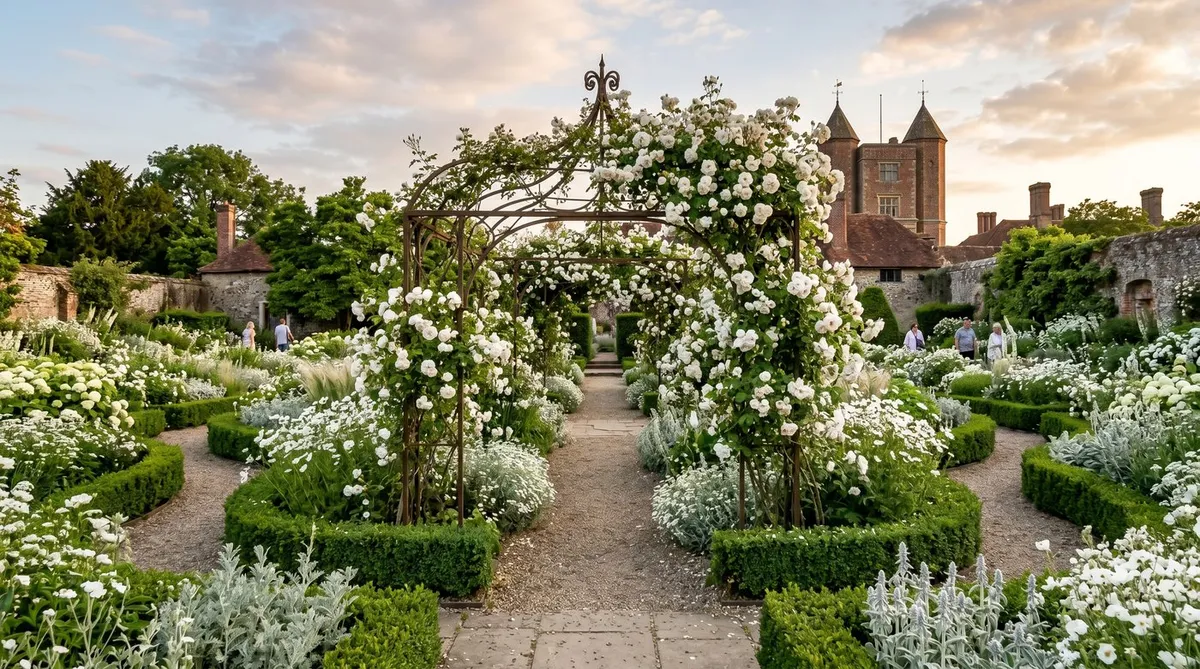
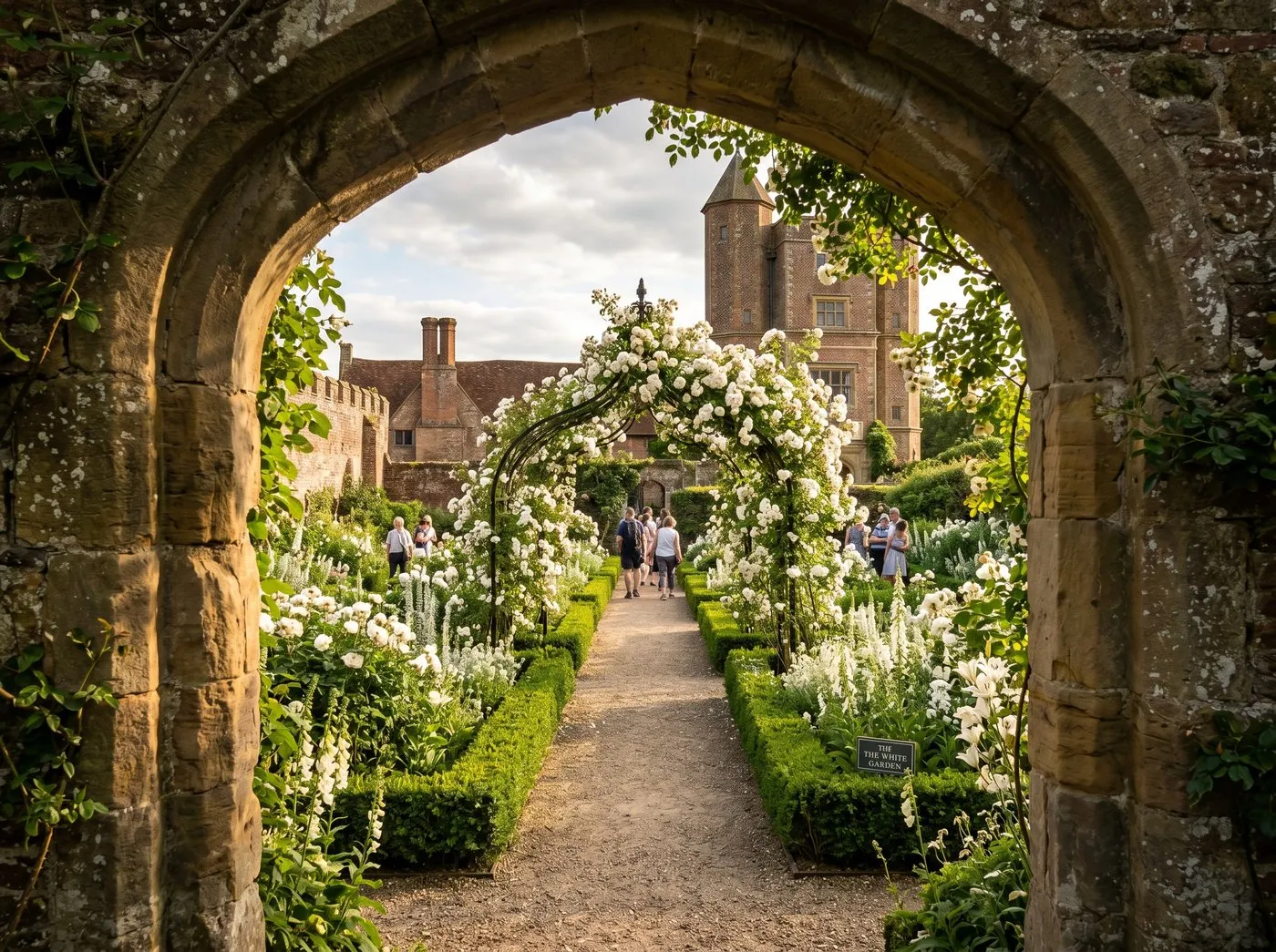 The classic approach to the White Garden - through the stone archway, the central rose arbour framed by box hedging. The same view Vita Sackville-West designed.
The 6 design principles
Sissinghurst’s White Garden teaches six lessons that work in any UK plot. Each one can be applied to a small garden bed without copying the specific plants.
Principle 1: Single colour palette
The white garden is white. No accidental pinks. No “subtle” pastels. The discipline is absolute. Even the small splashes of green and silver are deliberate foliage choices, not flower compromises.
Why it works: a single-colour palette eliminates competing visual elements and forces attention onto form, foliage, structure and seasonal change. Mixed-colour beds compete for attention; single-colour beds resolve into a unified image.
For UK home gardens: pick one colour and commit. Common UK choices: white (most light-reflective, best for shaded gardens), blue (cooling, recedes visually), yellow (warming, advances visually), red (dramatic, needs deep green foliage for balance).
Principle 2: Layered foliage tones
White flowers alone would be monotonous. Sissinghurst layers in:
- Silver foliage (Stachys byzantina, Cynara, Eryngium giganteum, Artemisia)
- Grey-green foliage (Sedum, Olearia, Helichrysum)
- Variegated foliage (white-edged hostas, variegated Brunnera)
- Pure green foliage (box, yew, dark backgrounds)
- Glaucous foliage (Crambe maritima, Centaurea cineraria)
These tones create depth and interest even when no flowers are in bloom. October’s bare-bones state is still visually rich.
For UK home gardens: add 3-5 silver and grey foliage plants for every 10 white flowering ones. The non-flowering periods become more interesting than the flowering ones.
Principle 3: Year-round structure
The box parterre (low Buxus hedges in geometric patterns) gives Sissinghurst its bones. Every winter when the flowers are gone, the box pattern remains - a green geometric drawing on the garden floor.
The central iron rose arbour adds vertical structure. Tall yew columns frame the views into and out of the garden.
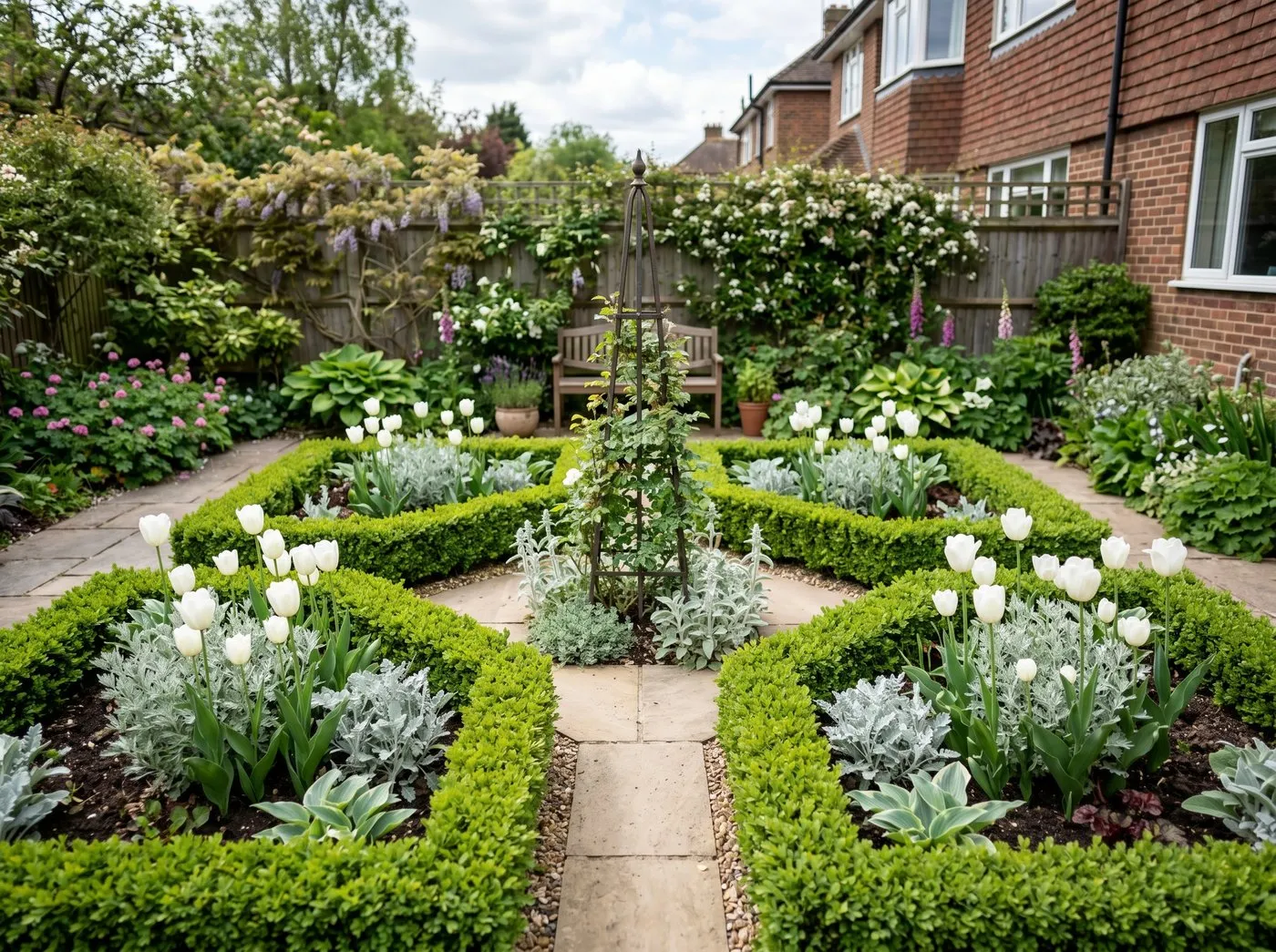
For UK home gardens: box, yew, holly, beech hedging or pleached trees give the same effect at any scale. A 60cm-high box edging around a 2m × 3m bed transforms a flat planting into a structured composition. Add one vertical feature - obelisk, archway, tall topiary, mature tree.
Principle 4: Scented evening plants
White flowers reflect moonlight; many white flowers also produce strong evening scent to attract moths. Sissinghurst exploits this. Plants chosen for evening fragrance include:
- Nicotiana sylvestris (woodland tobacco - intense night scent)
- Lonicera japonica (white-flowered honeysuckle)
- Trachelospermum jasminoides (star jasmine)
- Lilium regale (regal lily)
- Hesperis matronalis alba (white sweet rocket)
- Phlox paniculata white forms
The combined effect at twilight is a glowing scented room. Visitors who only see the garden at noon miss half of it.
For UK home gardens: include 2-3 evening-scented plants near any seating area or path. A small UK garden with 6 white-flowering plants is transformed by adding one good Nicotiana sylvestris near the back door.
Principle 5: Gravel paths
The White Garden’s paths are pale gravel, not paving. Gravel does three things:
- Reflects light - works with the white planting to brighten the garden
- Defines edges softly - less harsh than paving slabs
- Allows self-seeding - white-flowered plants drop seed into gravel and the next year’s surprise plants emerge
The gravel is loose, with the paths feeling soft underfoot. The contrast with the dense formal box hedging is part of the design.
For UK home gardens: even a small bed benefits from a pale gravel edge or surround. Cotswold buff stone, pale slate chippings, or limestone gravel all work. £40-£60 per square metre installed.
Principle 6: Central focal point
The White Garden has a single dramatic focal point: a wrought-iron arbour at the centre, draped in Rosa Mulliganii (a vigorous white climbing rose). Everything in the surrounding planting leads the eye toward it.
The arbour is functional (a place to sit) and structural (a vertical accent). It’s strong enough to anchor the whole garden but not so dominant that it overwhelms.
For UK home gardens: a small bed needs a focal point too. Options: a single tall plant (rose obelisk, standard rose, mature shrub), a small piece of garden sculpture, a strikingly-shaped pot, a sundial, a bench. The focal point doesn’t need to be expensive - it needs to be deliberate.
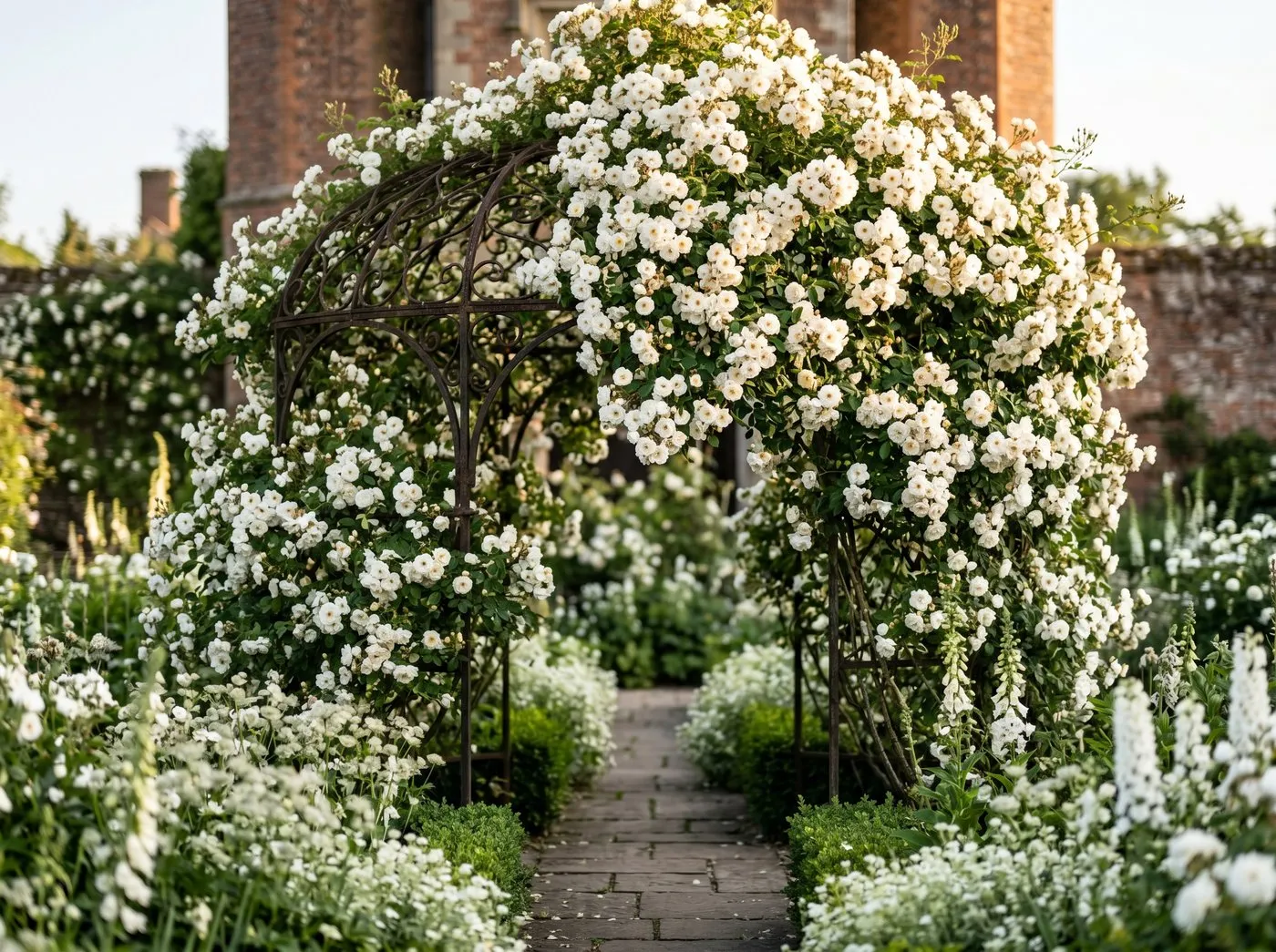 The central iron arbour with Rosa Mulliganii - the focal point that anchors the entire garden. A small UK garden equivalent could be a single obelisk with a white climbing rose like Madame Alfred Carrière.
The Sissinghurst plant list (by season)
The full National Trust planting list runs to over 100 species. The following is a working subset that achieves the Sissinghurst look at UK home-garden scale:
Spring (April-May)
- Tulipa ‘White Triumphator’ - elegant white lily-flowered tulip
- Narcissus ‘Thalia’ - white triandrus daffodil, 2-3 flowers per stem
- Anemone blanda alba - white spring anemone, naturalises
- Hesperis matronalis alba - white sweet rocket, evening scent
- Allium ‘Mount Everest’ - large white drumstick allium
- Crambe maritima - silvery foliage, white flowers
Early summer (June-July)
- Rosa Mulliganii - vigorous white rambling rose (the central plant at Sissinghurst)
- Rosa ‘Madame Hardy’ - white old-rose, intense fragrance
- Delphinium ‘Galahad’ - tall white delphinium
- Iris ‘White Knight’ - bearded white iris
- Lupinus ‘Noble Maiden’ - white lupin
- Aquilegia ‘White Barlow’ - double-flowered white columbine
- Foxglove (Digitalis purpurea f. albiflora) - white foxglove
High summer (July-August)
- Lysimachia clethroides - white gooseneck loosestrife
- Lilium regale - regal lily, white with yellow throat
- Phlox paniculata ‘David’ - mildew-resistant white phlox
- Nicotiana sylvestris - woodland tobacco
- Cosmos ‘Purity’ - tall white cosmos
- Anemone × hybrida ‘Honorine Jobert’ - white Japanese anemone
Late summer-autumn (August-October)
- Aster ‘White Climax’ - white New England aster
- Echinacea purpurea ‘Alba’ - white coneflower
- Dahlia ‘Karma Snowflake’ - white pompon dahlia
- Crambe cordifolia - giant white-flowered ornamental kale
- Hydrangea paniculata ‘Limelight’ - white-green panicle hydrangea
Foliage plants (year-round)
- Stachys byzantina - silver lambs ears
- Artemisia ‘Powis Castle’ - silver artemisia
- Eryngium giganteum ‘Miss Willmott’s Ghost’ - silver thistle
- Helichrysum italicum - curry plant, silver foliage
- Hosta ‘Patriot’ - white-edged hosta
- Buxus sempervirens - box hedging for structure
Adapting Sissinghurst to a small UK garden bed
The single biggest lesson from a Sissinghurst visit: scale. The garden is much smaller than the famous photos suggest. The design works because of structure, not size.
A practical small-UK-garden Sissinghurst-inspired bed (2m × 3m):
Structure:
- 60cm-high Buxus sempervirens edging around the perimeter (about £80 of plants)
- Single small iron obelisk in the centre (£40-£80)
- White rambling rose climbing the obelisk (Rosa ‘Madame Alfred Carrière’, £25)
Spring planting:
- 30 ‘White Triumphator’ tulip bulbs (£15)
- 12 ‘Thalia’ narcissi (£8)
- White Anemone blanda underplanting (£10)
Early summer:
- 3 white foxgloves (£12, self-seed thereafter)
- 1 Iris ‘White Knight’ (£8)
- 2 white aquilegia (£10)
High summer:
- 1 Nicotiana sylvestris (annual, £4 per year)
- 1 Phlox ‘David’ (£8)
- 3 regal lily bulbs (£12)
Late summer:
- 1 ‘Honorine Jobert’ Japanese anemone (£10)
- 1 white Echinacea (£8)
Foliage:
- 3 Stachys byzantina (£18)
- 1 Artemisia ‘Powis Castle’ (£12)
- 1 white-edged Hosta (£10)
Total initial cost: about £290 for a Sissinghurst-style bed.
Annual top-up cost: £30-£50 for replacement annuals and any plant losses.
The bed transforms a 6m² patch into a controlled, structured, scented, year-round-interesting feature. Far more impact per pound than a mixed-colour bed of the same area.
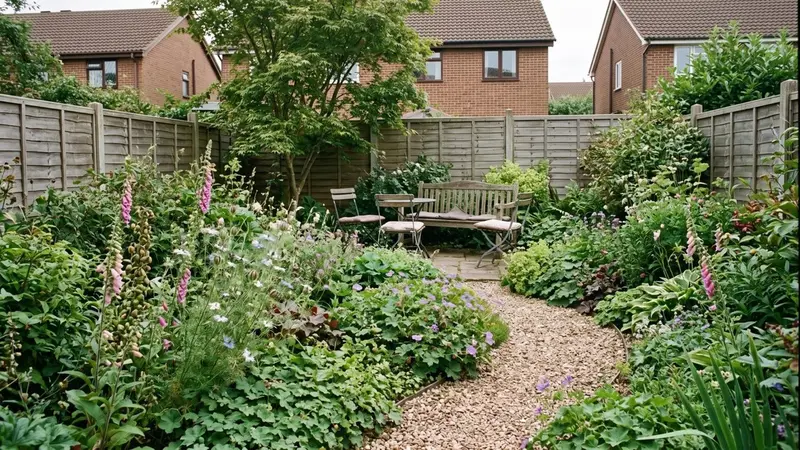
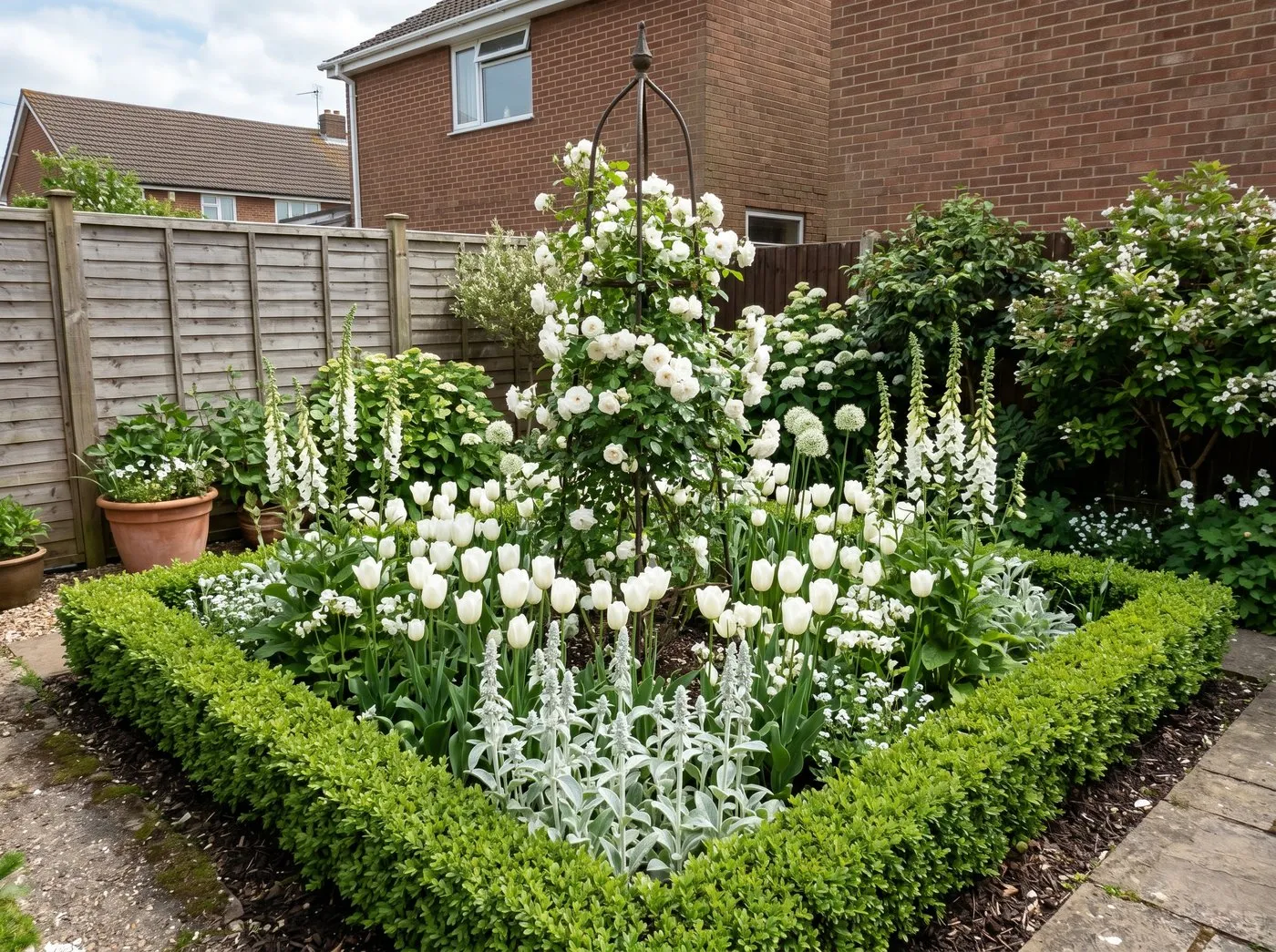 A Sissinghurst-inspired bed in a UK back garden - 2m × 3m, box-edged, central obelisk with white climbing rose. About £290 to establish, lasts 10+ years with annual top-ups.
Visiting Sissinghurst - practical UK gardener’s notes
Location
Sissinghurst Castle Garden is in Kent, between Cranbrook and Biddenden. Postcode: TN17 2AB.
Opening
Mid-March to early November. Specific dates vary year by year - check the National Trust website. Closed in winter when the garden is being prepared.
Cost
National Trust members: free. Non-members 2026: approximately £14-£18 adult, depending on season.
Booking
Pre-booking online is recommended for peak summer weekends (June-August). Walk-up entry is usually possible Tuesday-Thursday.
Best time to visit
For the white garden specifically:
- Late June-mid July at evening - peak season, white roses in full flower, evening scent strongest
- Early May at midday - spring whites, tulips, daffodils, fewer crowds
- September at any time - late whites (asters, dahlias, anemones), quieter atmosphere
Avoid:
- August Sundays - peak crowds
- Noon in midsummer - hot, busy, harsh light
What else to see at Sissinghurst
The White Garden is the most famous but the wider site includes:
- The Rose Garden - mixed-colour old roses, equally beautiful
- The Cottage Garden - hot colours, yellow/orange/red
- The Herb Garden - culinary and medicinal herbs in formal layout
- The Lime Walk - spring bulb garden, peak April-May
- The Tower - climb for the iconic view down on the White Garden
- The Library - Vita’s writing room, preserved
Allow 3-4 hours for a thorough visit.
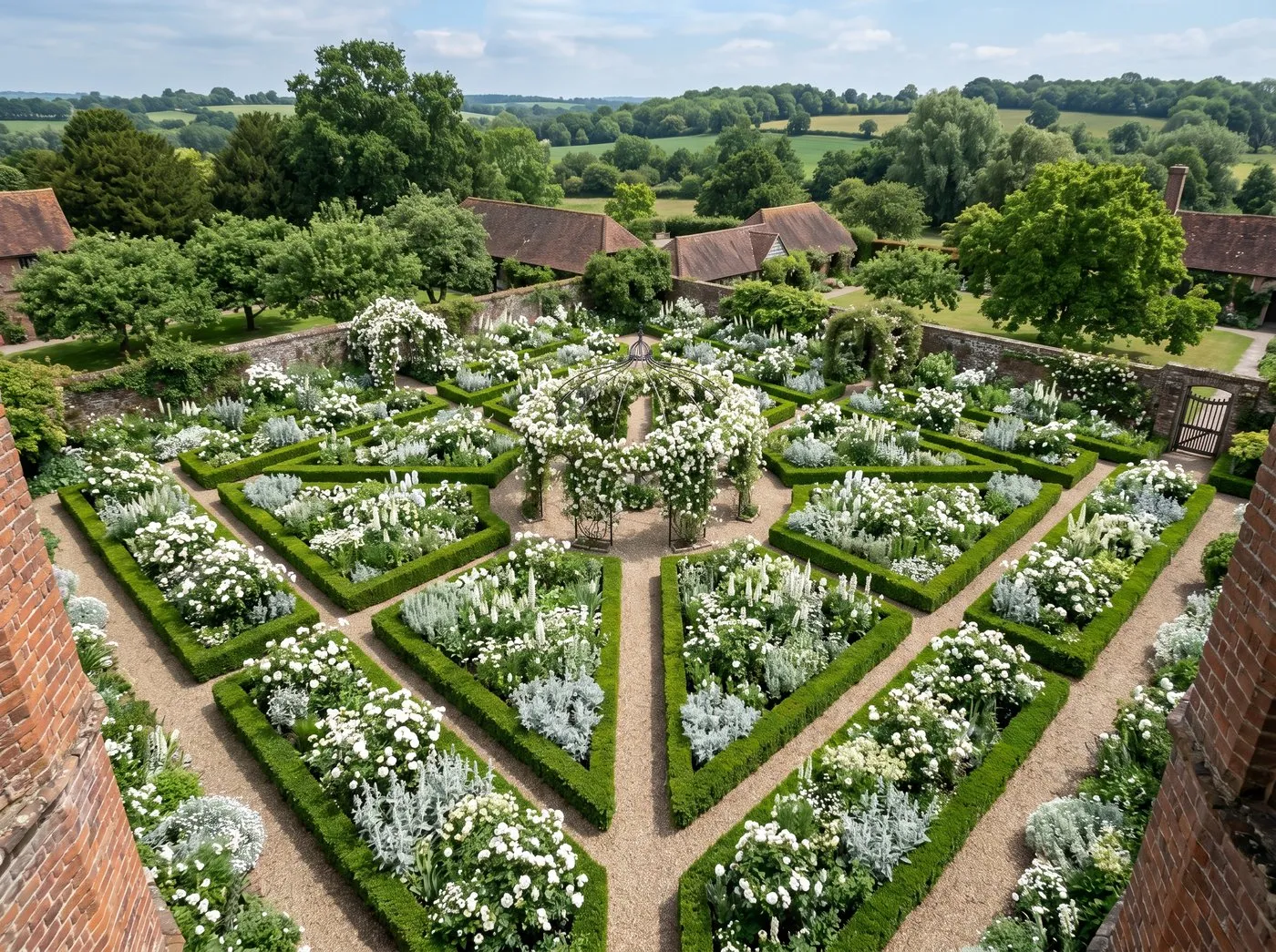 The tower view - the iconic angle, only accessible by climbing the Elizabethan tower. The geometric pattern of the box parterre becomes visible from above.
The wider Vita Sackville-West legacy
Vita’s gardening influence extends beyond Sissinghurst:
- Her column in The Observer (1947-1961) shaped UK gardening writing for a generation
- Her advocacy for old-fashioned roses helped save many heritage varieties
- Her belief in “garden rooms” popularised the concept now used in countless UK garden designs
- Her published books (Some Flowers, A Joy of Gardening, In Your Garden) remain in print
For UK gardeners interested in the philosophy behind Sissinghurst, Vita’s own writing is the best place to start. Her 1953 book “In Your Garden Again” is particularly approachable - short Observer columns republished as essays.
Why white gardens work especially well in UK light
The UK climate suits the white garden idea better than warmer European countries:
Long northern dusks. UK midsummer evenings stretch from 9pm to 10:30pm with usable light. White flowers reflect this fading light far longer than any other colour.
Soft cool light. UK daylight is less harsh than Mediterranean summer light. White flowers don’t bleach to glare; they hold their visible structure.
Cloud cover. UK summer days often have softening cloud. White flowers glow against grey skies rather than disappearing into them.
Cool nights. Evening scent disperses more slowly in cool air, intensifying the experience near scented plants.
The combination of UK long dusks, soft light, frequent cloud and cool evenings means a white garden in the UK has 6-8 hours of beautiful effect per day in midsummer. The same garden in southern France would have 2-3 hours.
Field note: The National Trust Sissinghurst page gives current opening times, ticket prices and visit-planning information. The Sissinghurst archive holds Vita’s planting plans and correspondence.
Lessons summary
Sissinghurst’s deepest lesson is restraint. Saying no to plants that don’t fit the palette. Saying no to focal points that compete. Saying no to “just one” out-of-palette splash of colour. The discipline produces composition; the lack of discipline produces clutter.
Now you’ve got the heritage framework
Our team produces practical UK gardening guidance from source research, contributor records and established horticultural practice. Editorial standards are overseen by Matt W.