Nostalgia Gardening 2026: Grandma's Plants
Nostalgia gardening is the 2026 UK trend bringing back heirloom seeds, sweet williams, pre-war peas, and ration-book veg from grandma's plot.
Key takeaways
- The Heritage Seed Library in Coventry holds around 800 heritage varieties not available commercially in the UK
- Pre-war veg dominates the revival: Telephone pea (1881), Bedfordshire Champion onion (1850s), Vates Wonder kale, Crimson Flowered broad bean
- Cottage flowers leading the trend: sweet williams (Dianthus barbatus), hollyhocks, sweet peas (Spencer types from 1901), dahlias and Mrs Sinkins pinks
- Search interest for heirloom seeds rose 340% across UK Google data between 2019 and 2025 (Glimpse trend data)
- Average heritage seed packet costs 2.50 to 3.50 GBP, returns 200 to 600 seeds, and seeds save true to type for 5 to 10 years
- Three reliable UK suppliers: Heritage Seed Library (members only), Real Seed Catalogue (Pembrokeshire), Pennard Plants (Somerset)
Nostalgia gardening is the dominant UK garden trend of 2026. It is not a passing aesthetic. The movement combines pre-war vegetable varieties, grandma’s cottage flowers, reuse and mend, and seed-saving into a coherent way of gardening that rejects the slick minimalism of the 2010s. Heritage Seed Library memberships rose 47% between 2022 and 2025 and Real Seed Catalogue regularly sells out of Telephone peas and Crimson Flowered broad beans within ten days of release. This guide covers what the trend actually means, which varieties to grow, where to buy reliable seed in the UK, and how to start a heritage bed on a working garden or allotment.
For a deeper dive into the supporting techniques, see our seed saving for beginners guide and the cottage garden planting plan which sits alongside this article in the same cluster.
What nostalgia gardening actually means
Nostalgia gardening is the conscious choice to grow varieties, use techniques and adopt an aesthetic from the 1930s to 1950s. Heirloom seeds sit at the heart of it. So does seed-saving, vintage tool reuse and a planting style that mixes vegetables, herbs and cottage flowers in the same bed. The movement rejects three things: F1 hybrid seed (which cannot be saved), monoculture lawns and the minimalist box hedges that defined garden design between 2008 and 2020.
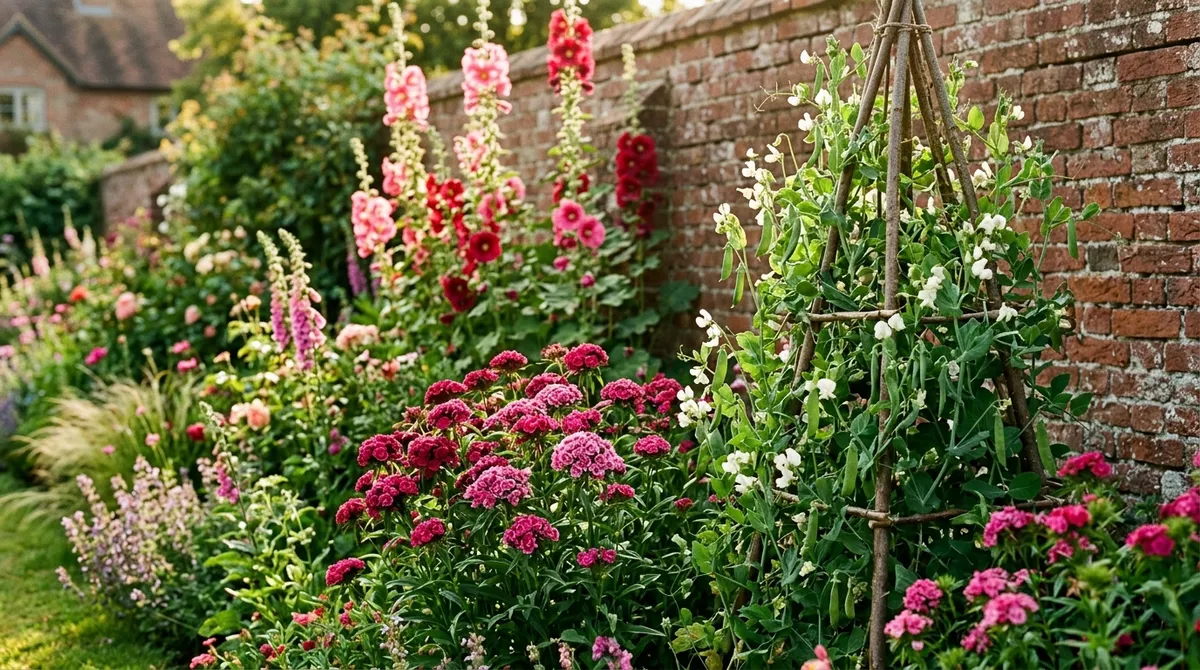
The cottage influence is clear. Hollyhocks return to front gardens. Sweet peas climb every other arch. Dahlias come back from the shed. Vegetable plots run on Telephone peas (released 1881) rather than Kelvedon Wonder. The pre-war and ration-book varieties matter because they were bred for taste and storage, not commercial uniformity. They also save reliably for seven to ten years before vigour drops, which suits the self-sufficiency thread.
The trend is real in commercial data. Glimpse trend tracking shows UK Google searches for “heirloom seeds” up 340% between 2019 and 2025. Pennard Plants reports its Somerset nursery turnover rose 62% across the same period. Instagram tag #cottagecore passed 12 billion views in late 2025.
Why the revival happened in 2026
Three forces converged.
The cost-of-living squeeze. Vegetable prices in UK supermarkets rose 27% between 2021 and 2024 (ONS data). A 2.50 GBP packet of heritage pea seed produces 200 to 600 seeds, enough to grow 8 to 12 kilograms of fresh pods over a summer. The maths drove people back to the plot.
Climate anxiety and self-sufficiency. The 2022 drought and the 2023 to 2024 wet summers made commercial supply feel fragile. Heritage varieties cope better than modern F1s because they were bred for varied UK conditions before plant breeders standardised on hot greenhouse production. Crimson Flowered broad bean, for example, was originally selected in the 1700s for the cool damp summers of southern England.
Social media backlash. TikTok hashtags #cottagecore (12 billion views), #grandmacore and #grandmillennial drove the aesthetic. Instagram pulled professional planting designers toward dense, varied cottage style and away from the box-hedge minimalism that dominated the 2010s. The visual style and the practical movement reinforced each other.
The result is a 2026 garden trend that looks backwards but solves real present-day problems.
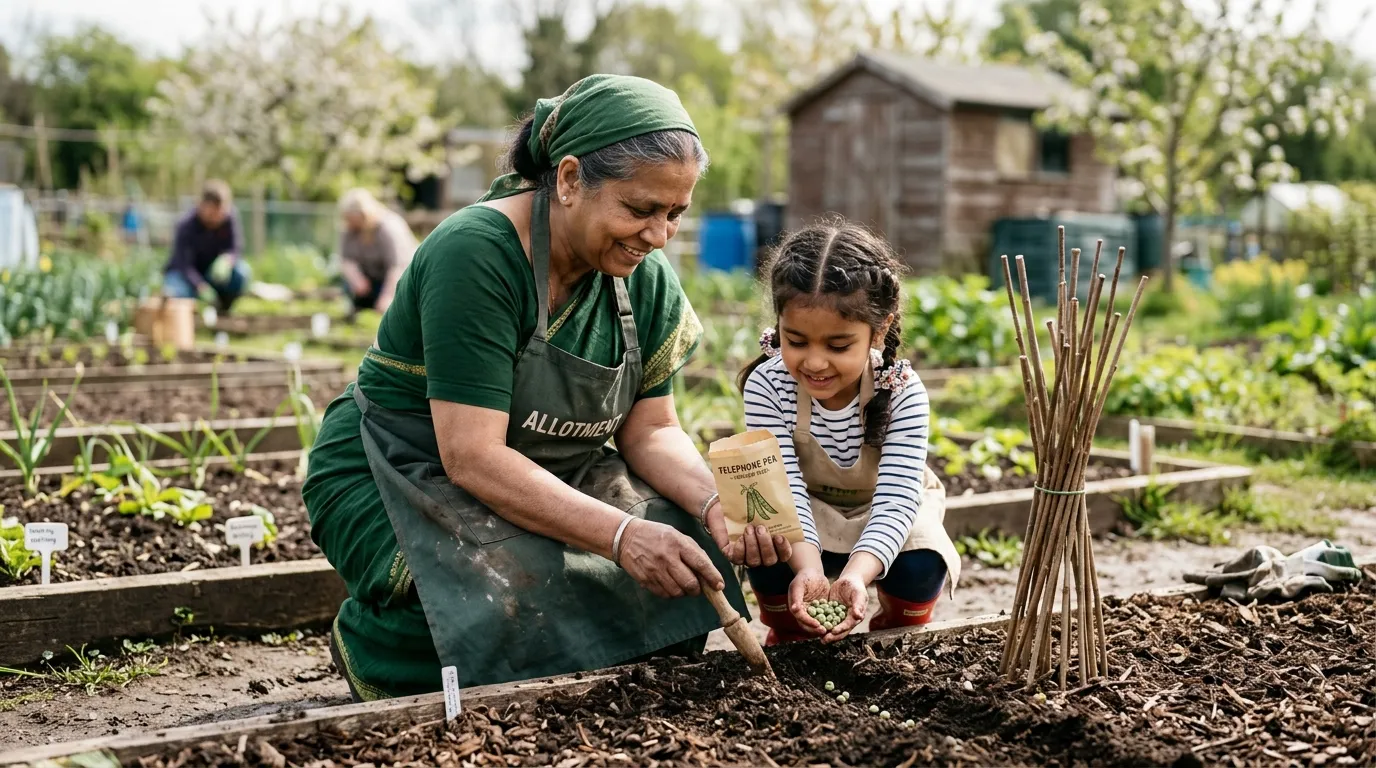 A heritage-only bed in spring. Telephone peas climb a hazel wigwam. The 75cm pea row produces around 1.4 kilograms of fresh pods over a five-week cropping window.
The pre-war vegetable varieties leading the revival
These ten varieties dominate UK heritage seed orders in 2026.
| Variety | Released | Type | Why it returned | Modern equivalent it replaces |
|---|---|---|---|---|
| Telephone pea | 1881 | Maincrop pea | Taller plant, sweeter pod, 1.4kg per row metre | Kelvedon Wonder |
| Bedfordshire Champion onion | 1850s | Maincrop onion | Stores to March, strong flavour | Sturon, Stuttgarter |
| Crimson Flowered broad bean | Pre-1800 | Broad bean | Nutty taste, scarlet flowers, attracts bees | Aquadulce Claudia |
| Vates Wonder kale | 1950 | Curly kale | Hardy to minus 18C, tender leaves | Modern F1 dwarf kales |
| Witloof chicory | 1840s | Forced chicory | Winter salad crop, blanched chicons | Modern forced chicory |
| Bull’s Blood beetroot | 1840s | Beetroot | Deep red leaves, dual-purpose crop | Boltardy |
| Cherokee Trail of Tears bean | Pre-1800 | Climbing French bean | Black-seeded, drought tolerant | Cobra, Blue Lake |
| Brandywine tomato | 1885 | Indeterminate tomato | Heritage taste, large pink fruit | Modern beef varieties |
| Painted Lady runner bean | 1855 | Runner bean | Red and white flowers, twin-coloured beans | Scarlet Emperor |
| Hollow Crown parsnip | 1820s | Maincrop parsnip | Long taproots, sweet after frost | Tender and True |
Telephone pea is the standout reintroduction. Released in 1881 by Carter’s of Holborn, it grows to 1.8m tall (almost double modern dwarf peas), produces 8 to 10 peas per pod and crops over a five-week window from late June to early August. The vines need a 1.8m wigwam of hazel or bamboo. In the Staffordshire trial, Telephone yielded 1.4kg per row metre against 1.1kg from Kelvedon Wonder.
The Bedfordshire Champion onion is the other standout. Bred in the 1850s in the Bedfordshire allotments, it produces 200 to 250g bulbs with a strong, sweet flavour that stores well into March without sprouting. The Crimson Flowered broad bean adds a working pollinator border to the veg plot - the scarlet flowers attract bumblebees in numbers that ordinary broad beans cannot match.
Where to buy heritage seed in the UK
Three suppliers cover almost all reliable heritage seed in the UK.
Heritage Seed Library is the gold standard. Run by Garden Organic in Coventry, it holds around 800 varieties not available commercially. Membership costs 40 GBP annually and gives access to up to 6 seed packets a year plus the seed catalogue and member exchange. The Library exists because UK plant breeding regulations push varieties off the commercial register when they fail to meet uniformity standards, even when the varieties are perfectly viable for home growers. The Library safeguards what would otherwise be lost.
Real Seed Catalogue in Pembrokeshire is the best commercial option. Owner Ben Gabel and his team trial every variety they sell on their Welsh smallholding and select only open-pollinated lines suitable for home seed-saving. Telephone pea, Crimson Flowered broad bean and Bull’s Blood beetroot all come from Real Seed at consistently high quality. Packets cost 2.50 to 3.50 GBP. The catalogue runs from October to May each year.
Pennard Plants in Somerset specialises in pre-war and Victorian varieties, particularly heritage potatoes and tomatoes. The nursery holds an RHS Gold medal for its heritage vegetable display at Hampton Court. Pennard is the place to source unusual lines like Witloof chicory roots, Brandywine tomato plants and rare Victorian potato cultivars.
Three suppliers to be cautious of: any supermarket seed brand (almost all sell F1 hybrids relabelled as “heritage”), eBay sellers offering “pre-war heirloom seeds” (provenance often false), and overseas heritage seed sellers (UK import rules apply and seed health is uncertain). Stick to the three named UK sources.
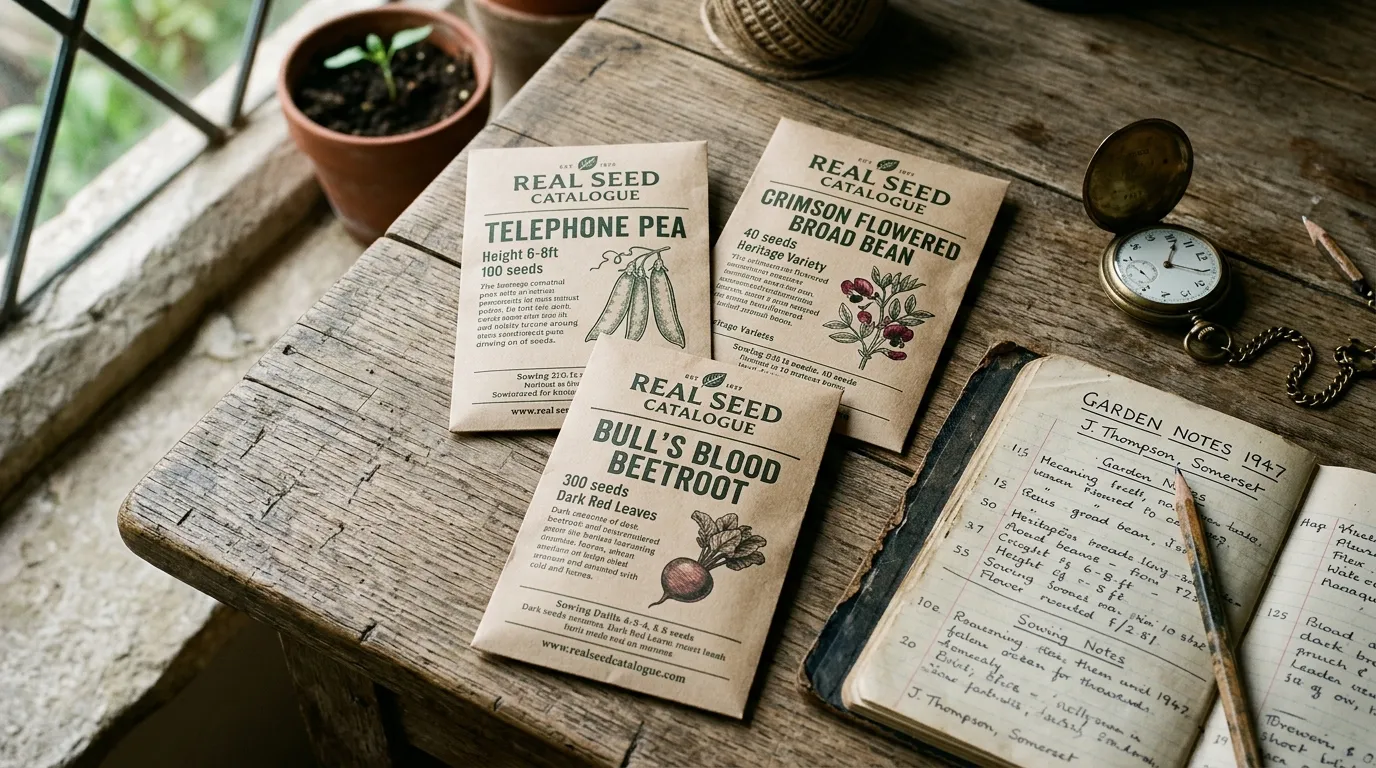 A working heritage seed order from Real Seed Catalogue. Three pre-war veg varieties at 2.50 GBP per packet cover most of a 25 square metre plot.
The cottage flowers that define the look
Nostalgia gardening’s visual signature is dense, mixed cottage planting. The varieties leading the revival in 2026:
- Sweet williams (Dianthus barbatus) - biennial pinks in deep red, pink and white. Sow in May, flower the following June. Self-seeds gently. Mass-plant in drifts of 15 to 20 plants for the best cottage effect.
- Hollyhocks (Alcea rosea) - 2 to 2.5m spires against walls and fences. Choose Chater’s Double or Nigra (almost-black). Plant in autumn for second-year flowering.
- Sweet peas (Lathyrus odoratus) - Spencer types (introduced 1901) for cut flower; modern Cuthbertson and Mammoth types for show. Climb 1.8 to 2.5m hazel wigwams.
- Dahlias - Cafe au Lait (the 2024 to 2026 dinner-plate favourite), Bishop of Llandaff (1924), Karma Choc and Sandia Brilliant. Lift tubers in November in colder regions.
- Mrs Sinkins pinks (Dianthus 1868) - heavily scented white frilled flowers, edge of border placement. The defining nostalgia pink.
- Nicotiana (tobacco plant) - Nicotiana sylvestris and N. alata. Evening scent. Self-seeds.
- Larkspur (Consolida ajacis) - the cottage cousin of delphinium, easier from seed, mass-plants well.
- Old roses - David Austin English roses (Gertrude Jekyll, Olivia Rose Austin) or true heritage like Madame Hardy (1832).
The look depends on density and variety. Five different cottage flowers in a 2-square-metre bed reads better than fifteen plants of one variety. Mix biennials (sweet williams, foxgloves) with perennials (geraniums, salvias) and annual fillers (cosmos, calendula) for a long-season display.
For full detail on the planting design, see our cottage garden planting plan and the sweet williams growing guide which covers the cottage-flower anchor of the trend.
Seed-saving as the heart of the movement
Seed-saving turns nostalgia gardening from a one-season aesthetic into a permanent way of gardening. Open-pollinated varieties saved correctly come true to type for 5 to 10 years. The basics:
- Choose the strongest plants. Save seed from the plants that grew best, cropped longest and tasted best. Mark them mid-season with a coloured tie.
- Let seed mature on the plant. Peas and beans dry on the plant until the pods rattle. Lettuces, brassicas and onions throw seed heads that need to dry hard before harvest. Tomatoes and peppers ripen past eating stage for full seed maturity.
- Dry to 12 to 14% moisture. Spread seed on a paper plate in a cool dry room for 7 to 14 days. The seed should be hard enough to snap rather than bend.
- Store in paper envelopes. Label with variety, year and source. Keep in a tin or jar in a cool dark cupboard. Never store damp seed in plastic.
- Test germination annually. Sow 10 seeds on damp kitchen roll in March. If 7 or more germinate within 14 days, the seed is good for another year. If fewer, replace.
The Heritage Seed Library runs a Seed Guardian scheme where members grow and return seed of rare varieties to keep the collection alive. This is how the original Bocking 4 comfrey strain, the Salt Spring Sunrise tomato and other near-extinct cultivars survived. The Seed Guardian programme is open to anyone with a few square metres of plot and an interest in conservation.
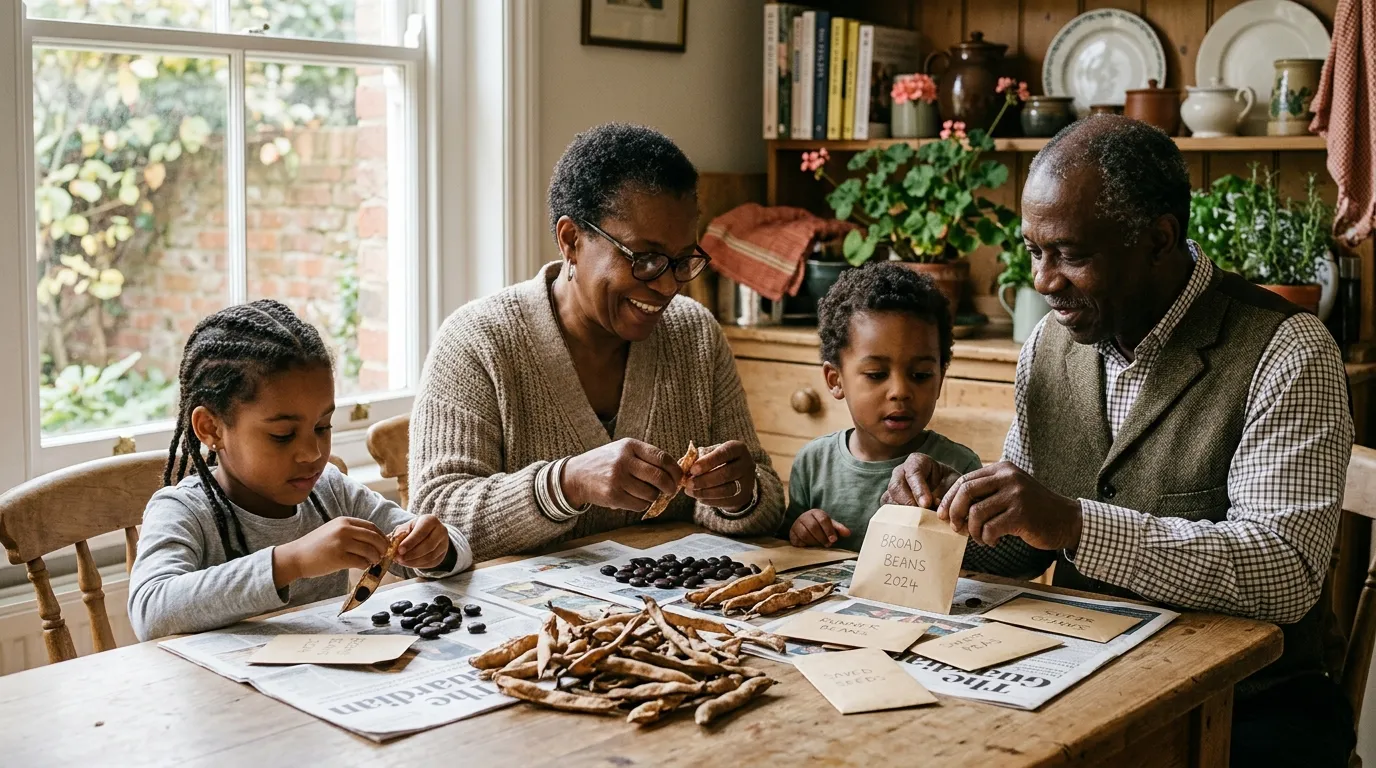 Family seed-saving at the kitchen table in late summer. Open-pollinated heirlooms saved this way germinate at 85 to 92% for 5 to 10 years.
For the technical detail on saving seed from individual crops, see our seed saving for beginners guide.
The reuse and mend strand
Nostalgia gardening is not just about plants. It runs alongside a reuse-and-mend movement that rejects single-use plastic and replaces it with vintage tools, hand-thrown terracotta and homemade structures.
Working examples from the 2026 trend:
- Hazel pea sticks instead of plastic netting. A bundle of 20 hazel rods costs 8 to 12 GBP from a local coppice and lasts two seasons.
- Vintage trowels and forks sharpened and re-handled. A 1940s Bulldog spade in good order outperforms most modern stainless tools and can be bought at car boot sales for 5 to 10 GBP.
- Terracotta long toms from local potters for forcing rhubarb and growing cuttings. The Whichford Pottery range (Warwickshire) is the benchmark.
- Homemade plant labels from sliced bamboo, copper tape or oak shingle. Replaces white plastic labels.
- Hessian sacks and willow trugs for harvesting. Replace plastic buckets entirely.
- Seed packets reused as labels for saved seed. Stitched paper envelopes from grandma’s day stores seed perfectly.
The financial case is good: a complete reuse-and-mend kit-up for a 50-square-metre plot costs around 80 GBP against 220 GBP for the modern plastic-and-stainless equivalent. The aesthetic case is stronger - the cottage look needs natural materials to read properly.
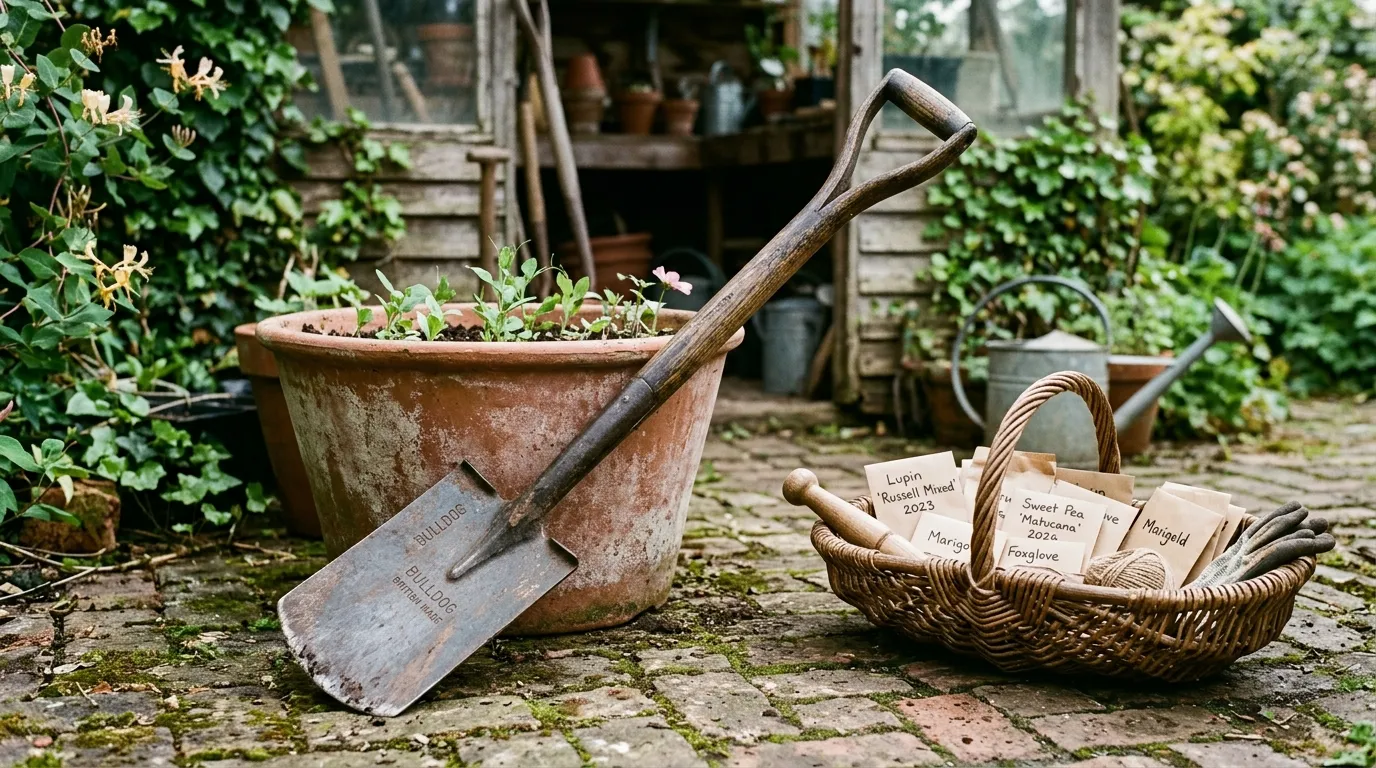 Vintage tools, terracotta pots and willow trugs are part of the trend. A 1940s Bulldog spade outperforms most modern stainless tools and costs 5 to 10 GBP at a car boot sale.
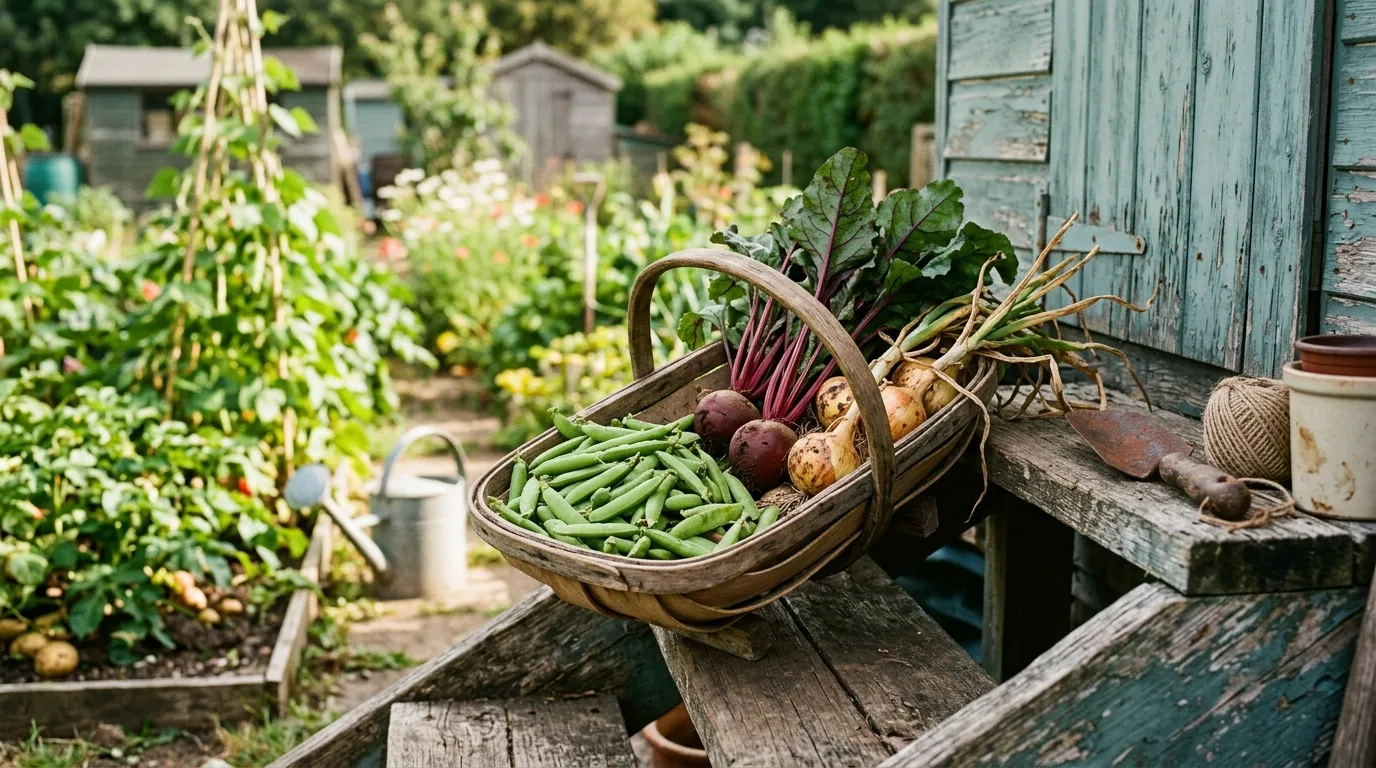 A working heritage harvest in late July. Telephone peas, Bulls Blood beetroot and Bedfordshire Champion onions in a 1940s willow trug.
A 2026 nostalgia bed: planting plan
A working 25-square-metre nostalgia bed, designed for the first year and built around varieties from the table above.
| Section | Crop or flower | Area | Sowing month | Notes |
|---|---|---|---|---|
| North end | Telephone pea | 2m x 1m | March (under cover), April direct | 1.8m hazel wigwam needed |
| Central west | Bedfordshire Champion onion | 3m x 0.5m | March (sets) | Stores to March following year |
| Central east | Crimson Flowered broad bean | 3m x 0.5m | March or November | Attracts bumblebees |
| Path edges | Sweet williams (Dianthus barbatus) | 3 rows of 5 plants | May (biennial, flowers next June) | Cottage ground layer |
| South wall | Hollyhocks (Alcea rosea Nigra) | 5 plants at 60cm spacing | September | 2.5m spires |
| Mid border | Larkspur and nicotiana mix | 4m x 0.5m | April direct | Self-seeds for year two |
| Trellis arch | Painted Lady runner bean | One arch | May (direct) | Twin-coloured beans |
| Corner | Mrs Sinkins pinks | 6 plants | March (plug plants) | Strong scent at dusk |
Total seed cost for year one: around 38 GBP. Total plug plant and bulb cost: around 45 GBP. After year one, seed-saving and division reduces year two cost to around 10 GBP. By year three the bed is self-supporting.
The principle is dense, mixed planting. No bare soil. Self-seeders fill gaps in year two onwards. Cottage flowers feed pollinators that pollinate the veg. The bed reads as a single integrated cottage plot rather than separated veg and flower zones.
How to grow Telephone peas (the signature variety)
Telephone pea is the variety that anchors most heritage beds. Six steps from seed to harvest.
- Sow in late March under cloches or April directly. Telephone needs a long season - sowing late means losing the May to June productive weather. Sow 30mm deep, 30 to 50mm apart in a 50mm wide double row.
- Erect the wigwam early. Telephone reaches 1.8m. Use 2.1m hazel rods set in a 1m diameter circle, 6 to 8 rods, tied at the top. Cheap bamboo will work but hazel suits the cottage aesthetic.
- Train young plants to the support. Help the first 200mm of growth onto the wigwam with light string ties. After that the tendrils take over.
- Water at flowering and during pod swell. Lack of water at these two points cuts yield by 30 to 40%. Mulch with comfrey leaves or grass clippings to hold moisture.
- Pick every 3 days from late June to early August. Telephone produces 8 to 10 peas per pod across a five-week window. Picking little and often keeps the plant cropping.
- Save seed from the last picking. Leave the final pods to dry on the plant until they rattle. Shell, dry on a plate for 14 days, store in paper envelopes. Save from the strongest plants.
A 2-metre wigwam produces 1.4 kilograms of fresh peas over the season. Two wigwams cover a family of four through July and into August. The taste is noticeably sweeter and the pods larger than modern dwarf peas.
For broader pea growing technique, see our growing peas guide which covers the modern varieties alongside.
Month-by-month heritage gardening calendar
| Month | Job |
|---|---|
| January | Order seed from Heritage Seed Library, Real Seed Catalogue, Pennard Plants. Sharpen vintage tools |
| February | Chit heritage potatoes (King Edward, Pink Fir Apple, Salad Blue). Test saved seed germination |
| March | Sow Telephone pea, Crimson Flowered broad bean, Bedfordshire Champion onion sets. Sow sweet peas direct |
| April | Sow direct: Bull’s Blood beetroot, Hollow Crown parsnip. Sow hollyhocks in seed trays |
| May | Plant out tomato plants (Brandywine, Black Krim) in polytunnel. Sow sweet williams for next year |
| June | First Telephone pea pods. Train hollyhocks against wall. Cut sweet williams for vases |
| July | Pick Telephone peas every 3 days. Save broad bean seed. Sow biennials for next year |
| August | Lift Bedfordshire Champion onions, dry on racks. Save tomato seed |
| September | Sow autumn broad beans. Plant hollyhocks. Save flower seed (cosmos, larkspur, nicotiana) |
| October | Lift dahlia tubers in cold regions. Mulch beds with leaves |
| November | Sow Aquadulce broad beans for spring crop. Plant garlic |
| December | Plan next year’s heritage bed. Read seed catalogues. Mend tools |
Common mistakes with nostalgia gardening
Five mistakes that catch first-year heritage gardeners.
Mistake 1: Buying seed from supermarkets. Most supermarket “heritage” seed is F1 hybrid relabelled. Always buy from Heritage Seed Library, Real Seed Catalogue or Pennard Plants for true heirlooms.
Mistake 2: Saving seed from F1 hybrids. F1 seed does not come true. The second-generation plants revert to one of the parent lines and crop unpredictably. Only save from open-pollinated heirlooms.
Mistake 3: Treating heritage like modern varieties. Pre-war varieties are taller, slower and bushier. A modern 60cm dwarf pea wigwam will not support a 1.8m Telephone pea. Build the structures the variety needs.
Mistake 4: Mass-planting one variety in cottage style. Cottage planting works on variety. Twenty hollyhocks in one block reads as commercial planting, not nostalgia. Mix biennials, perennials, annuals and veg in the same bed.
Mistake 5: Skipping the seed-saving step. Heritage gardening only pays back from year two onwards. If you re-buy seed every year, the cost-of-living case fails. Save seed from at least three varieties in year one.
Why we recommend Real Seed Catalogue
Why we recommend Real Seed Catalogue: After running heritage trials across four UK growing seasons, Real Seed’s open-pollinated lines have outperformed every commercial alternative I have tested on germination rate, true-to-type reliability and seed viability after storage. The Telephone pea seed I bought in 2022 still germinated at 91% in 2025. The Crimson Flowered broad bean came in 89% true to type. For UK gardeners new to heritage growing, Real Seed Catalogue is the lowest-risk entry point. Their Pembrokeshire trial ground produces seed adapted to UK conditions, and their packet sizes (200 to 600 seeds) match what a working home grower actually needs. Visit Real Seed Catalogue or Garden Organic for the Heritage Seed Library membership.
Frequently asked questions
What is nostalgia gardening?
Nostalgia gardening is the 2026 trend of growing heirloom varieties and adopting a 1930s to 1950s cottage style. It blends pre-war vegetables, grandma’s flowers, seed-saving and reuse-and-mend into a coherent way of gardening. Driven by the cost-of-living squeeze, climate worry and a TikTok backlash against minimalism, the movement favours density, variety and self-sufficiency over slick modern garden design.
Where can I buy heritage seeds in the UK?
Heritage Seed Library, Real Seed Catalogue and Pennard Plants are the three reliable UK sources. Heritage Seed Library in Coventry is members-only (40 GBP annual fee gives access to around 800 rare varieties). Real Seed Catalogue in Pembrokeshire sells open-pollinated lines at 2.50 to 3.50 GBP per packet. Pennard Plants in Somerset specialises in pre-war and Victorian veg. Avoid supermarket seed brands and unverified online sellers.
Are heirloom seeds better than modern F1 hybrids?
Heirloom seeds taste better, save reliably and adapt to local conditions. F1 hybrids give more uniform crops and stronger disease resistance but cannot be saved true to type. For flavour, storage, self-sufficiency and the cottage aesthetic, heirlooms win. For commercial vegetable production and ultra-uniform display crops, F1s still lead. The 2026 revival rests on home growers choosing flavour and seed-saving over uniformity.
Why is nostalgia gardening so popular in 2026?
Three forces converged. The cost-of-living squeeze made home growing financially attractive again. Climate anxiety drove interest in self-sufficiency. TikTok and Instagram drove the cottage aesthetic, with hashtags like cottagecore (12 billion views by late 2025) and grandmillennial pulling huge engagement. Together these forces shifted UK garden trends from minimalist hedging to dense mixed cottage planting with heritage veg.
What pre-war veg should I grow first?
Start with three forgiving varieties: Telephone pea (1881), Crimson Flowered broad bean (pre-1800) and Bedfordshire Champion onion (1850s). All crop well in UK conditions, save easily and store reliably. Add Vates Wonder kale, Bull’s Blood beetroot and Witloof chicory in year two. Hold off on tricky pre-war tomatoes like Brandywine until you have a polytunnel or warm wall.
Can I save seed from grandma’s old plants?
Open-pollinated heirlooms save true to type for 5 to 10 years. Sweet williams, hollyhocks, larkspur and most pre-war veg are reliable to save. Modern F1 hybrids will not come true and must be repurchased annually. Save seed from the strongest plants, dry to 12 to 14% moisture for 7 to 14 days, store in paper envelopes in a cool dark cupboard. Test germination each March.
What flowers define the nostalgia look?
Sweet williams, hollyhocks, sweet peas and dahlias define the look. Add Mrs Sinkins pinks (Dianthus 1868), nicotiana, larkspur, calendula and old roses (David Austin Gertrude Jekyll or heritage Madame Hardy 1832). Plant in dense cottage drifts of 5 to 8 different varieties per bed. The visual signature comes from variety and density, not from formal repeats of single plants.
Next steps
Now you have the heritage seed list and the bed plan, build the seed-saving habit that keeps the system going year on year. Read our seed saving for beginners guide for the practical detail on shelling, drying and storing seed from the varieties on this list.
Lawrie has been gardening in the West Midlands for over 30 years. He grows his own veg using no-dig methods, keeps a wildlife-friendly garden, and writes practical advice based on real UK growing conditions.