Key takeaways
- 9 climbers cover an ugly 1.8m UK fence within 1-3 years
- Russian vine grows 3-5m per year, the fastest UK climber
- Clematis montana adds 2-4m a year plus 5,000+ spring flowers
- Climbing hydrangea is the only fast self-clinger for shade
- Evergreen options: Clematis armandii and Akebia quinata
- Plant costs £14-£42 from a 3L pot at UK garden centres
A new fence panel looks bad. An old fence panel looks worse. The fastest way to make any UK fence look intentional rather than utilitarian is to grow climbers up it. The right climber covers a 1.8m fence panel within one to two years, screens the eyesore, supports pollinators, and turns a 5m boundary into a feature.
This guide ranks the nine fastest UK climbers by speed of coverage, then covers the wire trellis trick that cuts coverage time by 14 months, the planting routine, and the year-round care that keeps a climbed fence looking good for 20 years.
The 9 climbers ranked
By speed of coverage of a 1.8m UK fence panel, from fastest to slowest.
| Rank | Climber | Annual growth | Full coverage | Cost (3L) |
|---|---|---|---|---|
| 1 | Russian vine (Fallopia baldschuanica) | 3-5m | 6-12 months | £14-£18 |
| 2 | Clematis montana | 2-4m | 12-18 months | £18-£26 |
| 3 | Honeysuckle (Lonicera periclymenum ‘Serotina’) | 2-3m | 12-24 months | £15-£22 |
| 4 | Boston ivy (Parthenocissus tricuspidata) | 2-3m | 18-24 months | £18-£28 |
| 5 | Climbing hydrangea (H. anomala petiolaris) | 1-2m | 24-36 months | £22-£38 |
| 6 | Clematis ‘Etoile Violette’ | 1.5-2.5m | 18-24 months | £16-£24 |
| 7 | Clematis armandii (evergreen) | 1-2m | 24-30 months | £25-£42 |
| 8 | Akebia quinata (semi-evergreen) | 2-3m | 18-24 months | £22-£32 |
| 9 | Trachelospermum jasminoides | 0.5-1m | 36-48 months | £28-£42 |
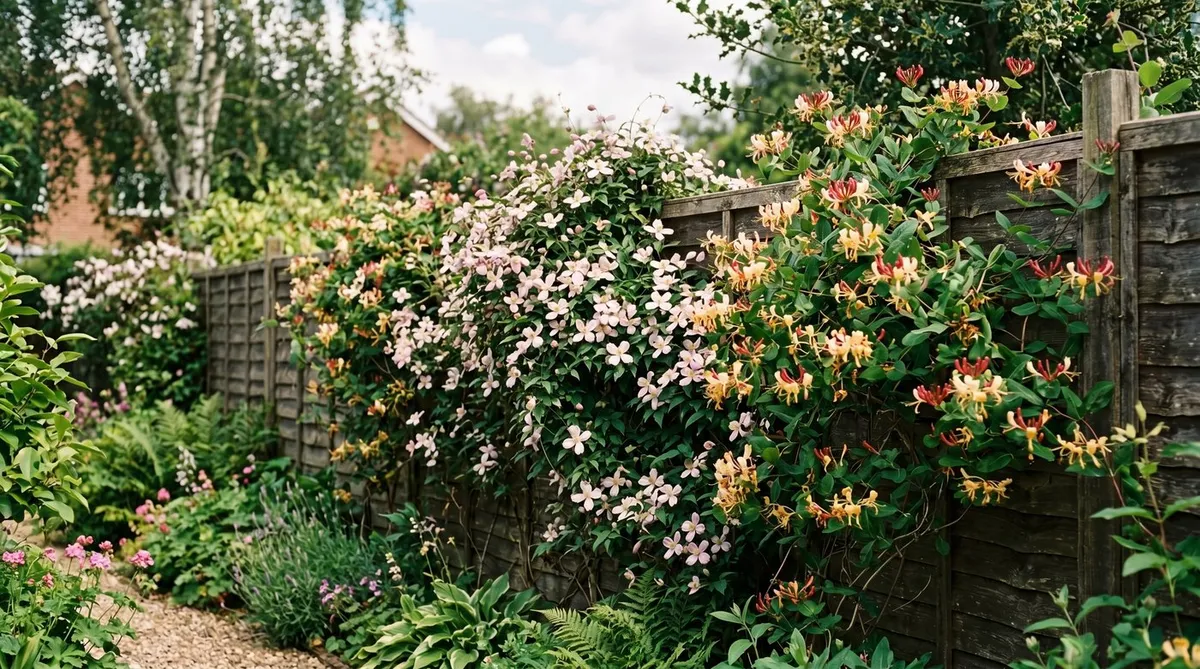
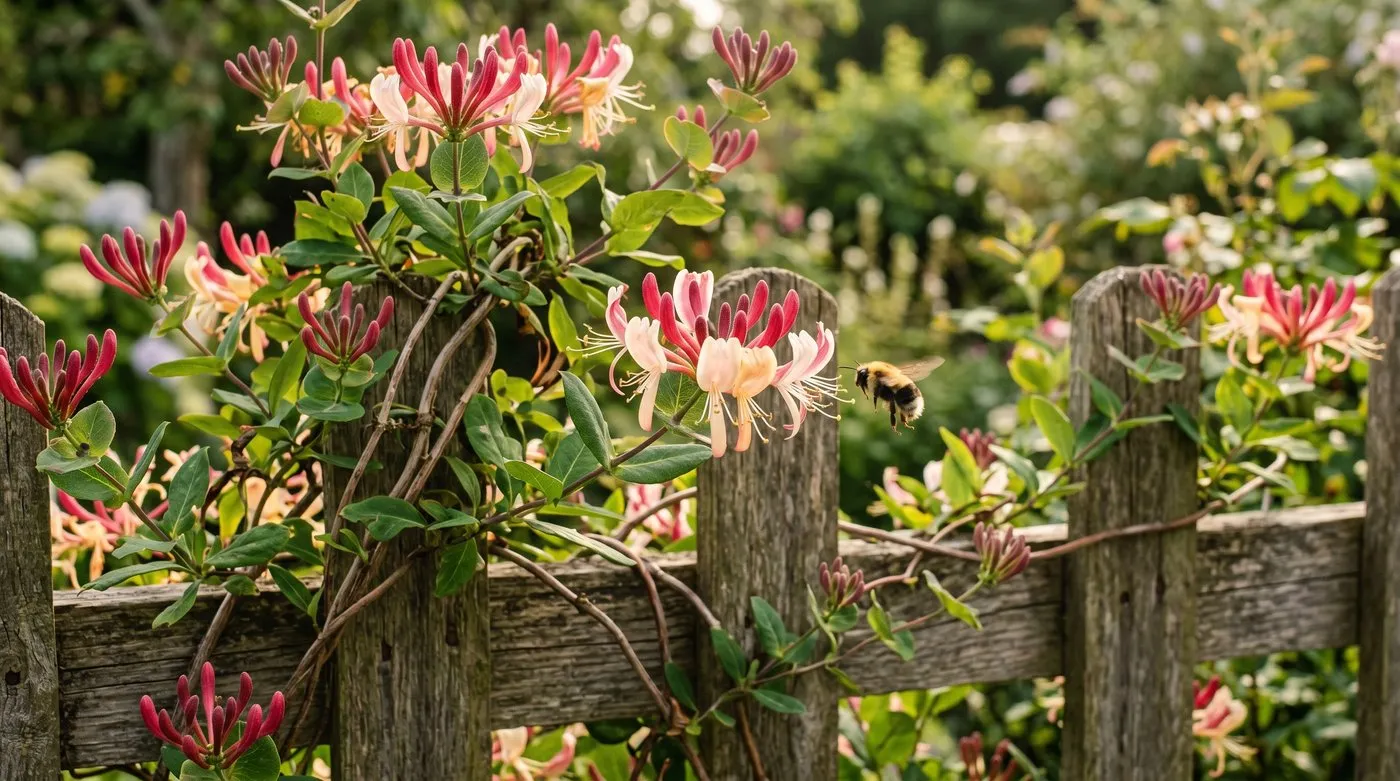 Honeysuckle (Lonicera periclymenum ‘Serotina’) in July, smothered in scented red-pink flowers. UK native, pollinator magnet, and grows 2-3 metres per year on wire trellis.
1. Russian vine (Fallopia baldschuanica) - the absolute fastest
Russian vine grows 3-5 metres per year. A 3L plant set against a 1.8m fence in March covers the whole panel by August. The white frothy flower clusters appear in August and September and are visited by hoverflies and small bees.
The downside: it is invasive. Russian vine roots aggressively underground and can pull up paving 2m from the planting position. Plant only if you can contain it. Avoid in shared gardens or near a neighbour’s boundary.
Use case: a fence you want covered in 6 months at the cost of any other planting nearby.
2. Clematis montana - the workhorse
The most reliable UK fast climber. Grows 2-4 metres a year. In April-May it produces 5,000+ pink or white flowers across a 5m fence run. The flowers do not repeat but the foliage is dense from June through October.
Varieties: ‘Tetrarose’ (deep pink, scented), ‘Elizabeth’ (pale pink), ‘Grandiflora’ (white). All grow at similar speed.
Use case: a fence you want covered in one season with stunning spring flowering.
3. Honeysuckle (Lonicera periclymenum ‘Serotina’)
UK native woodland honeysuckle. Scented red-pink flowers from June through September. Grows 2-3 metres a year. Pollinator magnet.
Plant ‘Serotina’ for late-summer scent. ‘Belgica’ flowers earlier (May-June). ‘Graham Thomas’ is yellow.
Use case: a sunny or partial shade fence where you want fragrance.
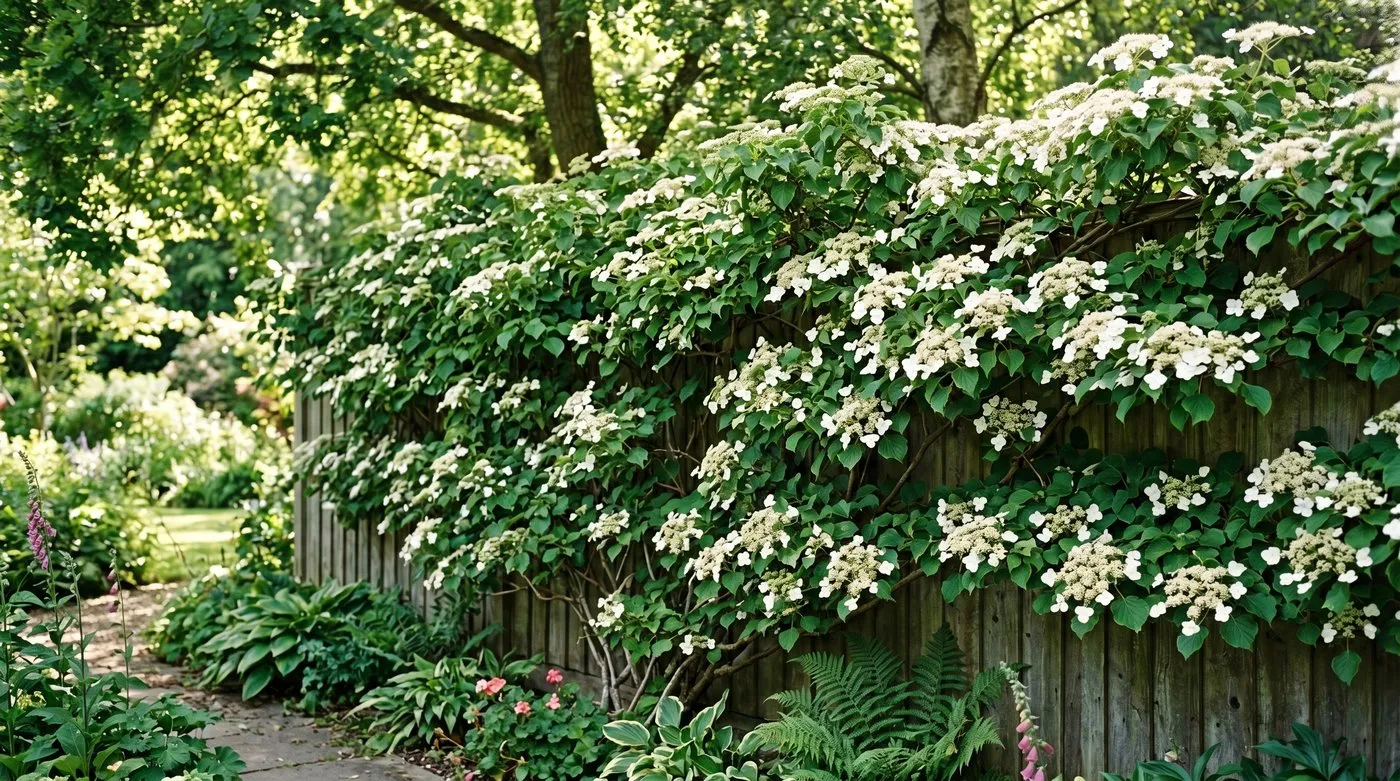 Climbing hydrangea (Hydrangea anomala petiolaris) covers a north-facing fence in dappled shade. Self-clinging once established, with 30cm wide white flower heads in June.
4. Boston ivy (Parthenocissus tricuspidata)
Self-clinging. Maple-like leaves turn fire red in October. Grows 2-3 metres a year once established. Best on brick walls or concrete, not panel fences (the suckers can damage panel timber).
Use case: a brick wall where you want autumn colour.
5. Climbing hydrangea (Hydrangea anomala petiolaris)
The only fast climber that thrives in deep shade. Self-clinging via aerial roots. Slow to start (years 1-2 add 30-50cm only), then accelerates to 1-2 metres per year in years 3-5. Stunning 30cm white flower heads in June.
Use case: a north-facing or shaded fence where flowering climbers normally fail.
6. Clematis ‘Etoile Violette’
A late-flowering Group 3 clematis. Smaller than C. montana but flowers July-September. Deep purple flowers with pale centres. Grows 1.5-2.5m a year and hard-prunes back to 30cm each spring.
Use case: alongside a spring-flowering climber to extend the season.
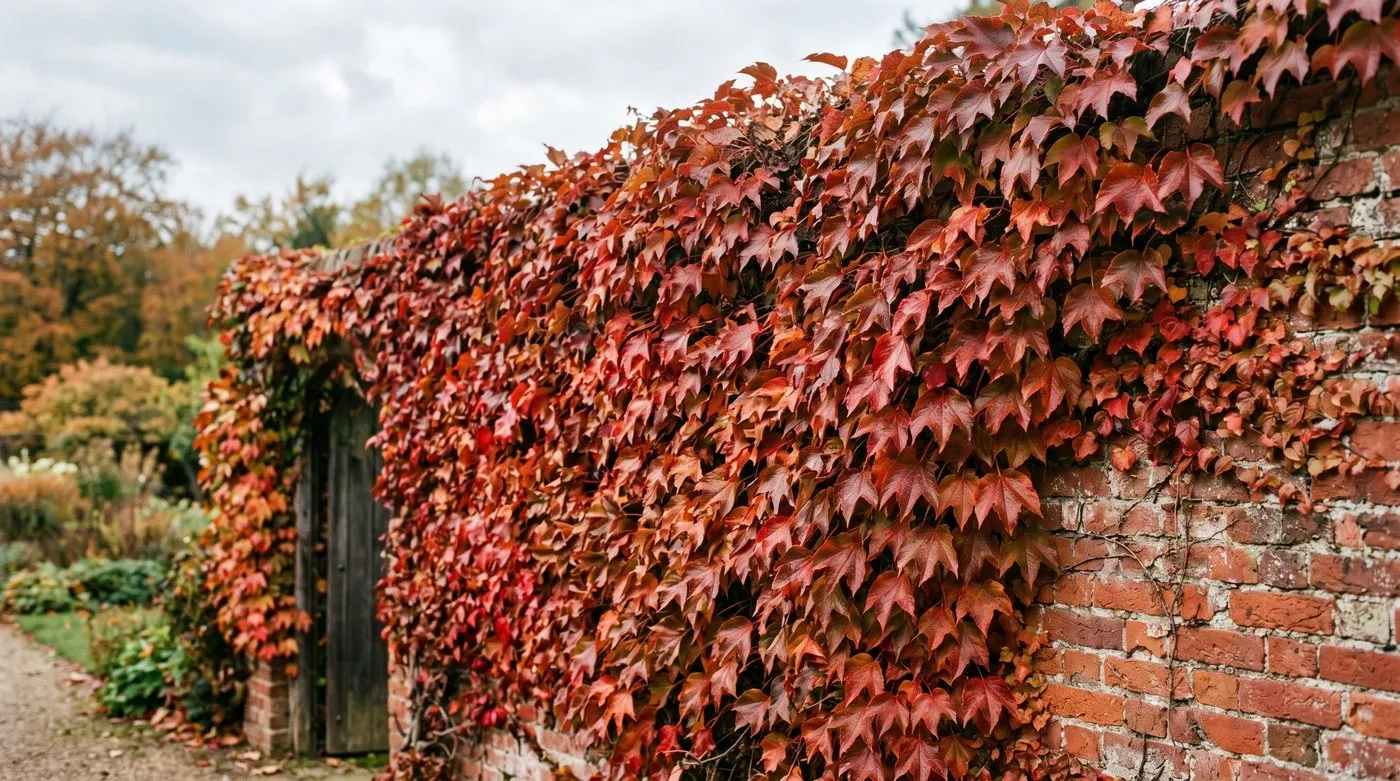 Boston ivy (Parthenocissus tricuspidata) in October. Self-clinging via tendrils, fire-red autumn colour, ideal for hiding ugly brick walls or concrete block boundaries.
7. Clematis armandii - evergreen
Holds leaves through UK winters. Lance-shaped dark green foliage. Almond-scented white flowers in April. Grows slower than montana at 1-2m per year and needs 24-30 months to fill a fence panel.
Use case: a fence where you want year-round screening, not just summer.
8. Akebia quinata - chocolate vine
Semi-evergreen (keeps leaves through mild winters, loses them in hard freezes). Grows 2-3 metres a year. Strange purple-brown chocolate-scented flowers in April-May. Followed by long fleshy seed pods.
Use case: a fence where you want unusual scent and an unusual flower.
9. Trachelospermum jasminoides - star jasmine
The slowest of the nine. Adds 0.5-1m a year in the UK climate (faster in southern UK). The reward is the intense gardenia-jasmine scent of the small white flowers in June-August, which carries 5-10m on a still evening.
Use case: near a seating area where scent matters more than coverage speed.
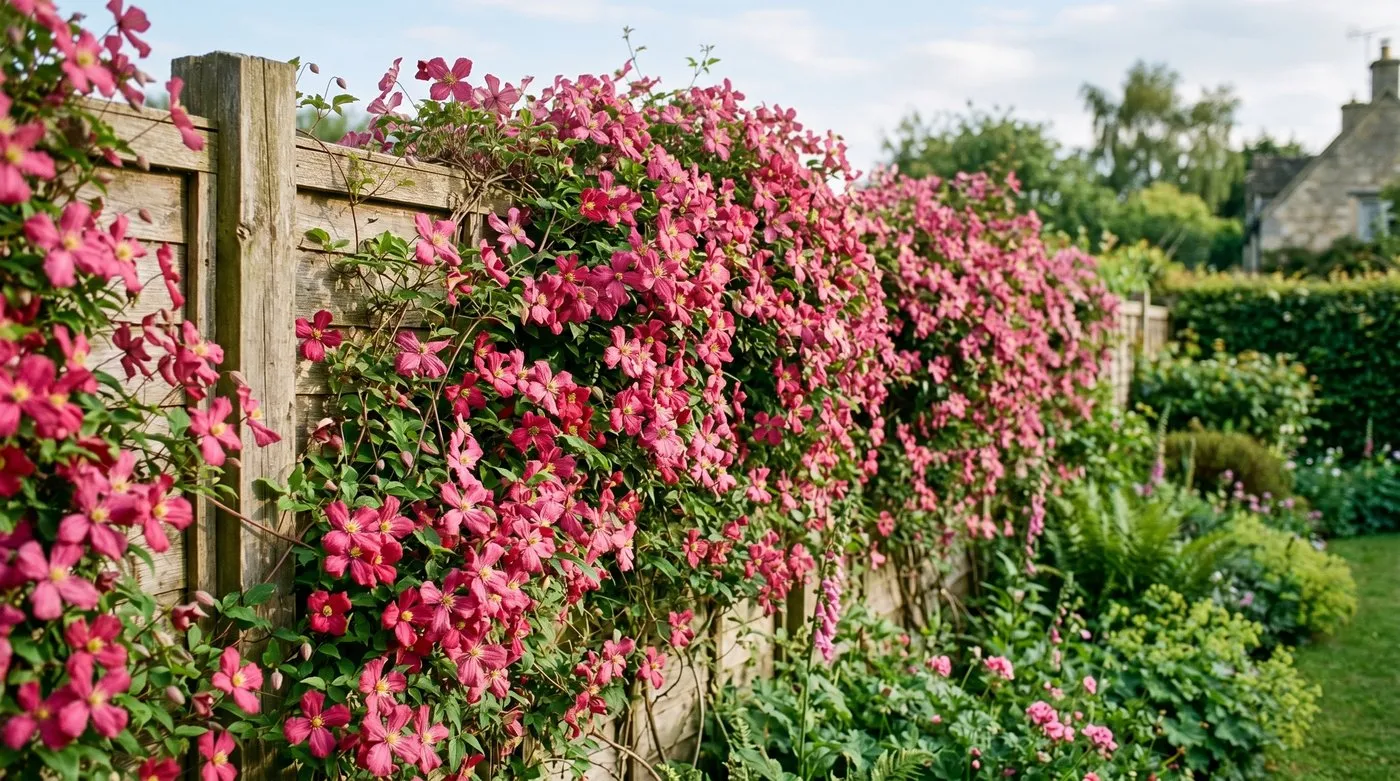 Clematis montana ‘Tetrarose’ in late May. A single 3-year-old plant on a 5m fence run produces 5,000+ deep pink scented flowers across April and May.
The wire trellis trick
Self-clinging climbers (Hydrangea anomala, Boston ivy) attach to brick and wood directly. Twining climbers (Clematis, honeysuckle, Akebia, Trachelospermum) need a support to wrap around.
A wire trellis is the cheapest, most effective support. The wire is invisible at 2m distance. Climbers attach faster than to a wooden trellis because the wire is thin and they wrap around it easily.
Wire trellis specification
- 3mm stainless steel wire (galvanised is okay but rusts after 10 years; stainless lasts 30+)
- M6 eye bolts at 30cm vertical spacing (so a 1.8m fence has 6 horizontal wire runs)
- 1.5m horizontal spacing for eye bolts (one per fence panel, more if panels are wider)
- Wall plugs into the fence post (M8 brown plugs for timber posts)
Cost per 5m fence run
| Item | Quantity | Cost |
|---|---|---|
| Stainless wire 3mm | 30m | £12-£18 |
| M6 eye bolts | 24 | £4-£8 |
| Wall plugs | 24 | £2-£4 |
| Total | £18-£30 |
Install time
90 minutes for a 5m fence run including drilling, plugging, fitting bolts, threading and tensioning wire.
How much it speeds up cover
Tip: Wire trellis can also be retrofitted to existing climbers. Cut back stems to 60cm, install the wire, then guide new growth onto the wire. Within one season the climber attaches and grows faster than before.
Comparison: which climber suits which fence
| Fence type | Best climbers | Notes |
|---|---|---|
| Wooden panel (south/west) | Clematis montana, honeysuckle, Clematis armandii, Akebia | Sunny, warm, fast cover |
| Wooden panel (north/east) | Climbing hydrangea, Hydrangea petiolaris | Shade-tolerant, slow start |
| Brick wall | Boston ivy, climbing hydrangea, Trachelospermum | Self-clinging or wire |
| Concrete block | Boston ivy, climbing hydrangea, Russian vine | Hide industrial-looking surface |
| Chain link | Russian vine, honeysuckle, clematis montana | Self-supporting on wire |
| New oak fence (don’t damage) | All clematis, honeysuckle | Light grip, avoid self-clinging |
Planting routine
Two climbers per 1.8m fence panel for fast cover. One climber per panel for slow elegance. Three climbers per panel for full evergreen winter coverage.
Planting steps
- Dig the hole 40cm from the fence base. Closer than this and the climber dries out in the fence shadow. Wider hole, 30cm wide x 30cm deep.
- Amend the soil. Mix in 50% topsoil and 25% well-rotted manure or compost.
- Plant with the root ball 5cm proud of soil level. Avoids stem rot.
- Mulch around the base with 5cm of bark or composted leaf mould to retain moisture.
- Tie new shoots to the wire trellis with soft twine or plant clips.
- Water deeply every 3 days for the first 6 weeks. Then every week through summer.
Establishing in year 1
The first year is mostly root growth. Above-ground progress feels slow. By autumn the climber will have 2-4m of stem length. Cut back the leader by 30cm in October to encourage side branching. The second spring is when growth accelerates. To hide the fence while a perennial climber settles in, sow a fast annual alongside it: the cup-and-saucer vine (Cobaea scandens) covers 3-5m of trellis in one season and pulls out cleanly at the end of the year.
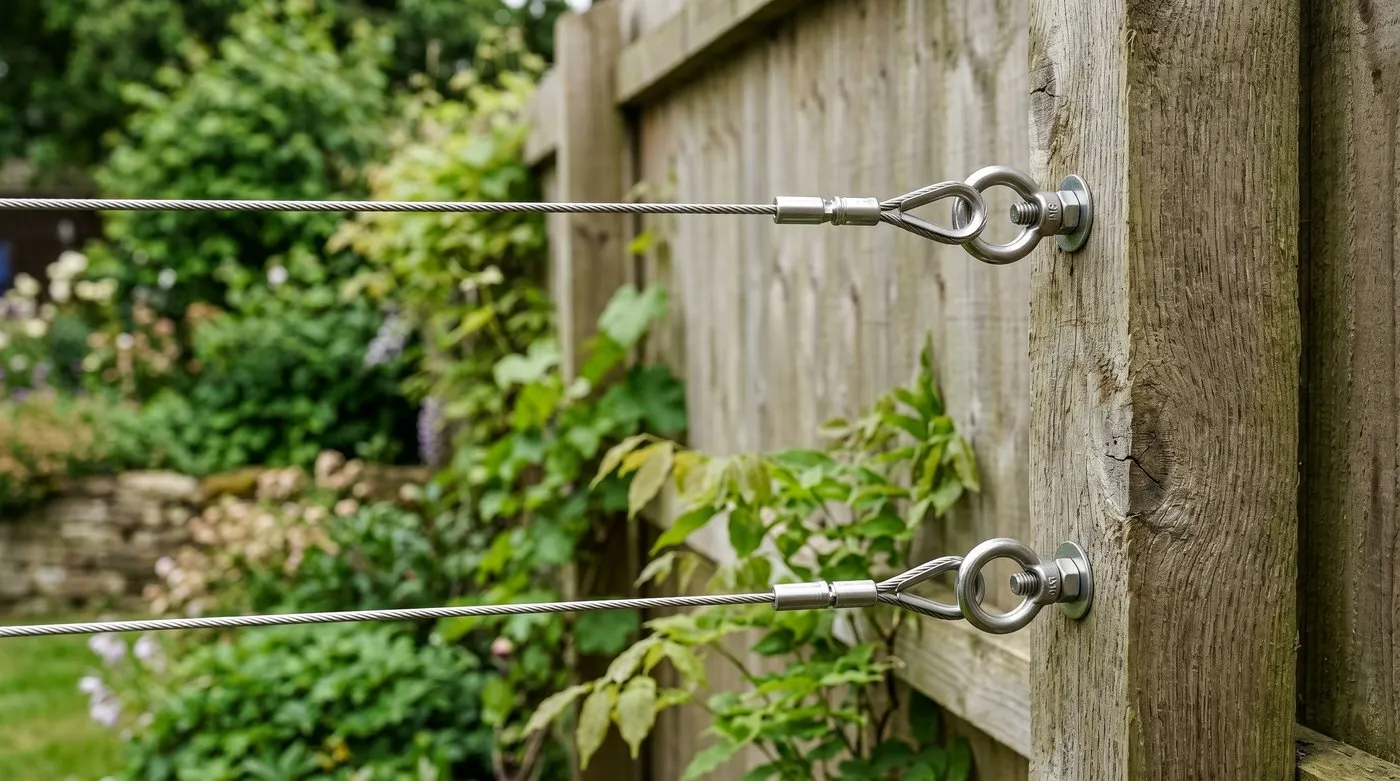 Stainless steel wire trellis fitted to a fence post at 30cm vertical spacing. The wire is invisible at 2m distance but supports any climber faster than wooden trellis.
Year-round climber care
A timetable for the planted fence.
March
- Apply slow-release feed at base (Vitax Q4 or similar)
- Check ties on previous year’s growth, retie any loose
- Prune Group 3 clematis (e.g. ‘Etoile Violette’) to 30cm
April
- First flush of growth begins
- Tie in new shoots to wire trellis weekly
- Mulch base with 5cm fresh compost
May
- Clematis montana flowering
- Inspect for slug damage on new shoots
- Continue tying in
June
- Prune Clematis montana immediately after flowering (cut back hard for shape)
- Climbing hydrangea flowering
- Begin liquid feed fortnightly through August
July
- Honeysuckle peak flowering
- Star jasmine scent peaks
- Water deeply once a week if rainfall under 30mm
August
- Prune honeysuckle (deadhead and shape)
- Russian vine in full flower
September
- Boston ivy autumn colour begins
- Last application of liquid feed
- Cut back excessive growth on Russian vine
October
- Boston ivy peak autumn colour
- Stop liquid feeding
- Tie any flopping growth back to wire
November
- Plant bare-root climbers (cheaper than pot-grown)
- Clear leaf litter from base
December - February
- Inspect supports for storm damage
- No watering or feeding
Common mistakes when planting climbers
Mistake 1: planting too close to the fence base
A climber planted within 20cm of a fence base sits in dry shadow. Most fence panels overhang by 5cm, the wood shelters the rain by another 15cm, so the planting hole stays bone dry through summer. Always plant 40cm out from the fence base.
Mistake 2: relying on self-clinging on panel fences
Self-clinging climbers (Hydrangea petiolaris, Boston ivy) need rough surface to attach to. New panel fence wood is too smooth. The climbers grow but do not stick, then collapse in the first storm. Always provide wire trellis even for self-clingers on smooth panel fences.
Mistake 3: not pruning montana hard enough
Clematis montana grows fast and tangles. Without hard pruning after flowering in June, the plant becomes an unkempt mound. Cut back hard to keep the structure visible. Don’t worry about hurting it - montana takes hard pruning easily.
Mistake 4: planting Russian vine next to a shared boundary
Russian vine is invasive. It will cross any fence and emerge in the neighbour’s garden. Avoid planting within 5m of a shared boundary unless you have permission to manage it from both sides.
Where to read more
The Royal Horticultural Society climbers pages cover most UK climbers including planting and pruning groups. The Garden Organic research library covers organic management of vigorous climbers like Russian vine.
Frequently asked questions
What is the fastest growing climber in the UK?
Russian vine (Fallopia baldschuanica), also known as mile-a-minute. It adds 3-5 metres a year and covers a 1.8m fence in one season. It is invasive though, so plant only where you can contain it. For a more controlled fast climber, Clematis montana grows 2-4 metres a year.
How do I hide an ugly UK fence quickly?
Install 3mm stainless wire trellis on the fence at 30cm vertical spacing first. Plant 2-3 climbers per 5m fence run. Choose a mix of fast-growing (Clematis montana, honeysuckle, Russian vine) and slower evergreen (Clematis armandii) for year-round cover. Coverage takes 12-24 months.
Can climbers damage a wooden fence?
Most climbers do not damage panel fences if grown on a separate trellis or wire. Heavy ivy and Boston ivy can pull moisture into the wood and shorten panel life by 4-6 years. Use wire trellis 50mm proud of the fence so the climber has air gap behind.
Which climbers are evergreen UK?
Clematis armandii (white spring flowers), Akebia quinata (semi-evergreen, chocolate scent), Holboellia coriacea, Trachelospermum jasminoides (star jasmine), and Lonicera henryi (evergreen honeysuckle). All hold leaves through UK winters at 1.8m fence height.
When should I plant climbers UK?
October to March for bare-root, year-round for pot-grown. Bare-root planting in November gives the climber 5 months to establish roots before spring growth. Pot-grown climbers in May are easier to manage but cost £8-£12 more per plant.
Do climbers need pruning?
Yes, annually. Clematis montana after flowering (June). Honeysuckle in August. Russian vine three times a year (it grows that fast). Climbing hydrangea in early summer if needed. Pruning prevents overcrowding and encourages flowering.
How many climbers do I need per fence panel?
Two per 1.8m wide fence panel for fast cover, or one if you have patience. Two climbers fill the panel in 12-18 months. One climber fills the same panel in 24-36 months. For evergreen winter cover, plant 3 per panel.
Now choose your climber
Nine options, ranked by speed. Pick the fastest if you need an ugly fence hidden by August. Pick the most beautiful (Clematis montana) for the dramatic spring flowering display. Pick the evergreen options for year-round screen.
Whichever you choose, install wire trellis first. The 14-month time saving is worth the £18-£30 in wire and the 90 minutes of installation time.
Our team produces practical UK gardening guidance from source research, contributor records and established horticultural practice. Editorial standards are overseen by Matt W.