Key takeaways
- Kelsae and Robinson's Mammoth Improved are the UK show standards
- Sow seeds late December-February under heat for full-season growth
- Plant out April after hardening off in cold frame
- Feed weekly with high-potash from May; switch to balanced in August
- Aim for 250g+ for village shows; 1kg+ for county-level competition
- Lift, dry 2 weeks, then tie up neck for show presentation
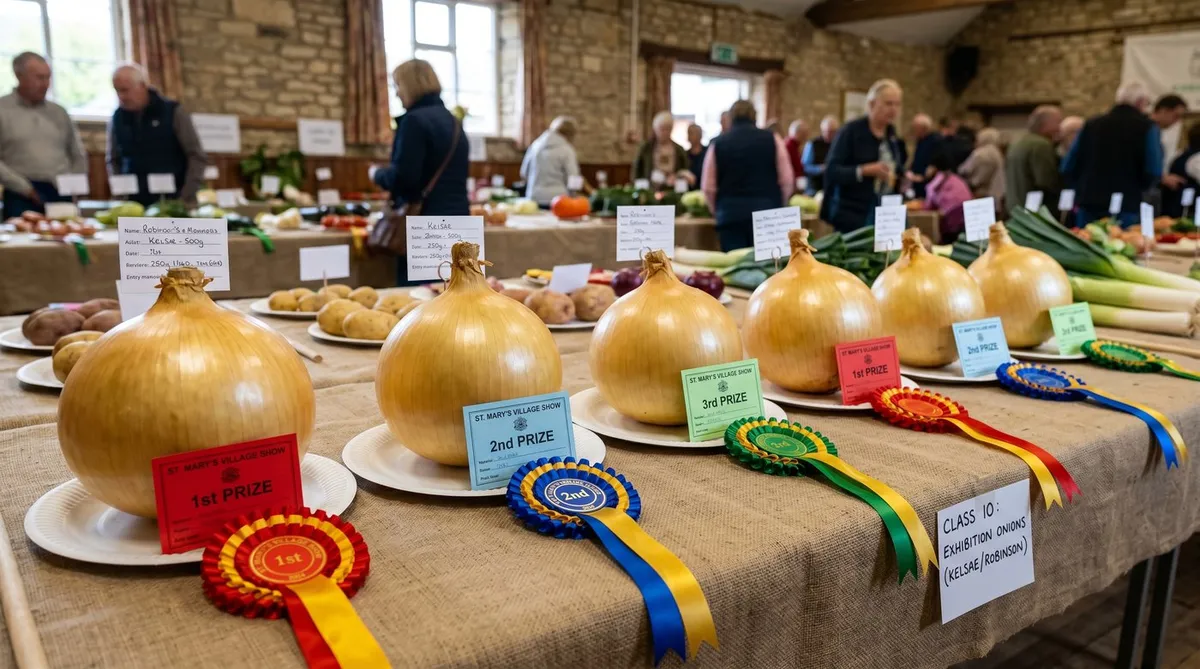
Exhibition onions are the showpiece crop of UK competitive vegetable growing. A 1kg Kelsae or Robinson’s Mammoth on a village hall show plate is the result of 9 months of careful cultivation - sowing in December, growing under glass through winter, planting out in April, weekly feeding through summer, harvesting in early autumn. Done well, the technique produces bulbs that dwarf supermarket onions while staying perfectly formed and stored for months.
For wider onion growing, see our how to grow onions UK and best UK onion varieties compared guides.
The UK exhibition classes
UK shows typically include:
| Class | Typical requirement | Best variety |
|---|---|---|
| Heaviest single onion | 1 bulb, any size | Robinson’s Mammoth |
| Single specimen, under 250g | 1 bulb under 250g | Centurion, Sturon |
| Single specimen, over 250g | 1 bulb 250g+ | Kelsae |
| Matched pair (450-700g) | 2 bulbs matched | Kelsae |
| Matched pair, large | 2 bulbs 700g+ | Kelsae, Mammoth |
| Matched set of 6 | 6 bulbs matched | Showmaster, Centurion |
| Best dressed pair | 2 bulbs with full top | Kelsae |
Always read the show schedule for the year - sizes and rules vary by show.
The top UK exhibition onion varieties
Kelsae (the gold standard)
The classic UK exhibition variety. Massive size potential (record 8kg+), round flat-base shape, golden skin, holds quality through storage.
- Typical exhibition size: 500-1,500g
- Sowing date: late December to mid-January for biggest size
- Day-length type: long-day (correct for UK summer)
- Best for: any UK show class
Robinson’s Mammoth Improved (heaviest class champion)
The variety to grow if going for the heaviest single onion class. World record holders consistently use this line.
- Typical exhibition size: 700-3,000g+
- Sowing date: late December for largest
- Day-length type: long-day
- Best for: heaviest single onion class
Showmaster
A newer UK exhibition variety. Cleaner uniform shape than Kelsae, slightly smaller maximum size but more reliable consistency.
- Typical exhibition size: 400-900g
- Sowing date: January
- Best for: matched pair and set-of-6 classes where uniformity matters
Ailsa Craig (heritage UK)
Traditional UK show onion, popular for over 100 years. Slightly smaller maximum than modern varieties but excellent flavour.
- Typical exhibition size: 400-700g
- Sowing date: January-February
- Best for: heritage/traditional classes, eating quality
The Kelsae
A more compact selection of Kelsae - same lineage, smaller size, often more uniform. Useful for the matched-set classes.
- Typical exhibition size: 350-600g
- Sowing date: January
- Best for: matched-set classes
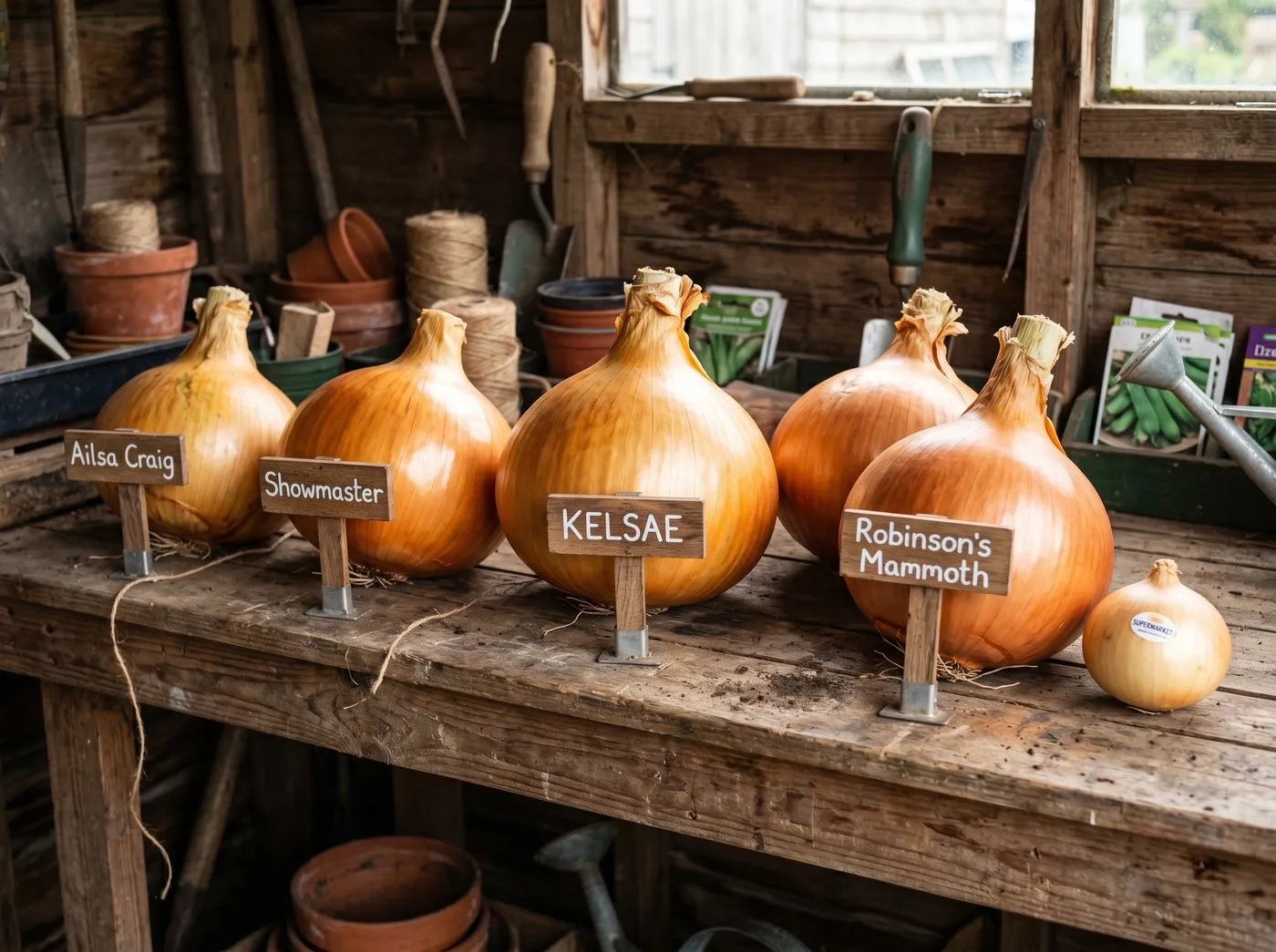 UK exhibition onion varieties at scale - Robinson’s Mammoth (right) at 1.4kg dwarfs the standard supermarket onion (foreground). Kelsae (centre) is the classic UK show pick.
The exhibition onion calendar
December
Late December sow. Single seeds into 5cm modules of seed compost. Cover with 5mm of compost. Water gently. Place in heated propagator at 18-20C. Most exhibition onions need 9-10 months from sowing to lifting; an end-of-December sowing means an end-of-September harvest.
Some show growers sow as early as late November. Two extra weeks of growing time adds about 100g to final bulb size. The earliest possible sowing gives the biggest bulbs.
January
Germination in 7-14 days at 18-20C. Move modules off direct heat once shoots emerge but keep in a bright cool room (10-15C) to prevent stretchy weak growth.
Light - exhibition onions need 14+ hours of light from January onwards. Use a grow light or sit on a south-facing windowsill in the lightest possible position.
Watering - mist daily; soak weekly. Avoid waterlogging - onion seedlings rot easily.
February
Transplant to bigger modules as roots fill the small modules. Use 9cm pots or large modules with peat-free compost.
Hardening off - move trays to an unheated greenhouse or cold frame on dry days from late February.
March
Hardening off continues through March. Goal: by end of March, plants are spending 24/7 outside in the cold frame.
Soil prep - apply 3-5cm of mature compost or well-rotted manure to the show onion bed. Fork in gently to the top 20cm. Don’t add fresh manure - causes thick necks and disqualification.
April
Plant out in early April for early-sown plants; mid-April for later. Spacing: 30cm between plants in row, 40cm between rows. Larger spacing means bigger bulbs.
Plant depth: the bulb just at the soil surface, with the root plate buried 5cm. Don’t plant deep - exhibition onions sit on top of the soil to swell.
Cover with fleece to protect from frost for 2 weeks.
May
Watering - 10-15 litres per square metre weekly if dry.
First feeding - start weekly liquid feeds. Use high-nitrogen for the first 4 weeks (encourages leaf growth that powers the bulb later).
Weeding - hand-weed only; don’t hoe near the bulbs.
June
Switch feed - move to a high-potash feed weekly (Sulphate of Potash or tomato food at half strength).
Watering - increase to 20-25 litres/m² weekly. Drip irrigation is the show-grower’s standard.
First bulbing - the base of the leaf starts to swell. From here onwards, no leaf damage or pest attack - every leaf contributes directly to bulb size.
July
Peak growth - bulb expanding rapidly. Continue weekly feed and watering.
Sun exposure - gently scrape soil away from the top of the bulb to expose the shoulder. This sets the classic flat-globe shape and starts hardening the skin.
Watering - continue heavy through July.
August
Tip-over begins - in early August the leaves start falling over naturally. This is the signal to stop high-potash feed and switch to a low-strength balanced feed (or stop feeding altogether for the heaviest single onion class).
Reduce watering in mid-August to start the skin-setting process.
Bend leaves over by hand if they haven’t naturally tipped, to redirect remaining sap into the bulb.
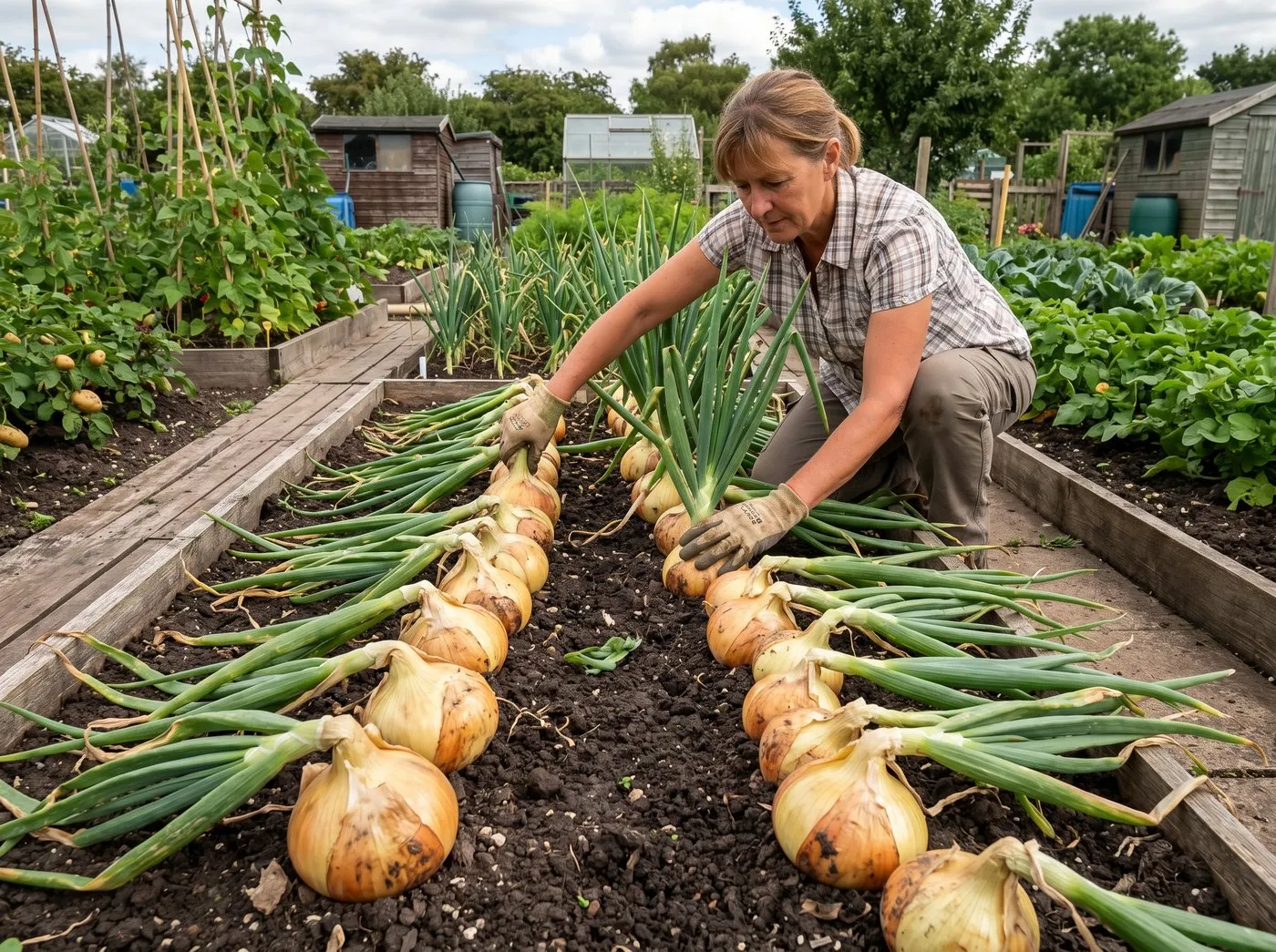 Bending leaves over in early August - the technique that pushes the last sap into the bulb. The bulb continues to expand and harden for 2-3 weeks after the leaves tip.
September
Final swell - bulbs continue to expand for 2-3 weeks after leaves fall.
Lift - 2-3 weeks before the show. Loosen with a fork from below; do not pull by the neck (snaps the neck and reduces show quality).
Dry - lay bulbs on a wire rack in a dry airy place. UK weather makes outdoor drying unreliable - a shed or greenhouse with good airflow works better.
Skin set - dry until the outer skin papers and the neck shrinks tight. Takes 7-14 days.
Show preparation
Selection
From your show bed (typically 12-16 plants), select the 6-8 best for the show table. Look for:
- Size - within class requirements
- Shape - round globe with flat base, not pear-shaped
- Skin - clean, golden, unblemished
- Neck - thin (10-25mm); thick necks score down heavily
- Uniformity - matched bulbs for paired/set classes
Cleaning
Remove only loose soil with a soft brush. Do NOT wash - water damages skin quality. Never peel back layers to make skin look fresh - this is disqualifying at most UK shows.
Tying
Trim the dried foliage tops to 3-5cm above the neck. Tie with raffia or thin natural twine to a neat point above the neck. Some shows require the top tied; others let it hang loose - check the schedule.
Trimming the roots
Trim the dried root plate flat but do not cut into the basal plate (the round disk at the bottom).
Transport
Wrap each onion in soft cloth or newspaper. Carry in a sturdy box; never piled together. Skin damage in transport is unrecoverable.
Show table arrangement
Most UK shows provide paper plates. Standard arrangement:
- Single specimen: centre of plate, neck pointing forward (toward judge)
- Matched pair: side by side, necks pointing forward
- Matched set of 6: 3 in front row, 3 in back row, all aligned
Some shows allow sphagnum moss bedding; check the schedule.
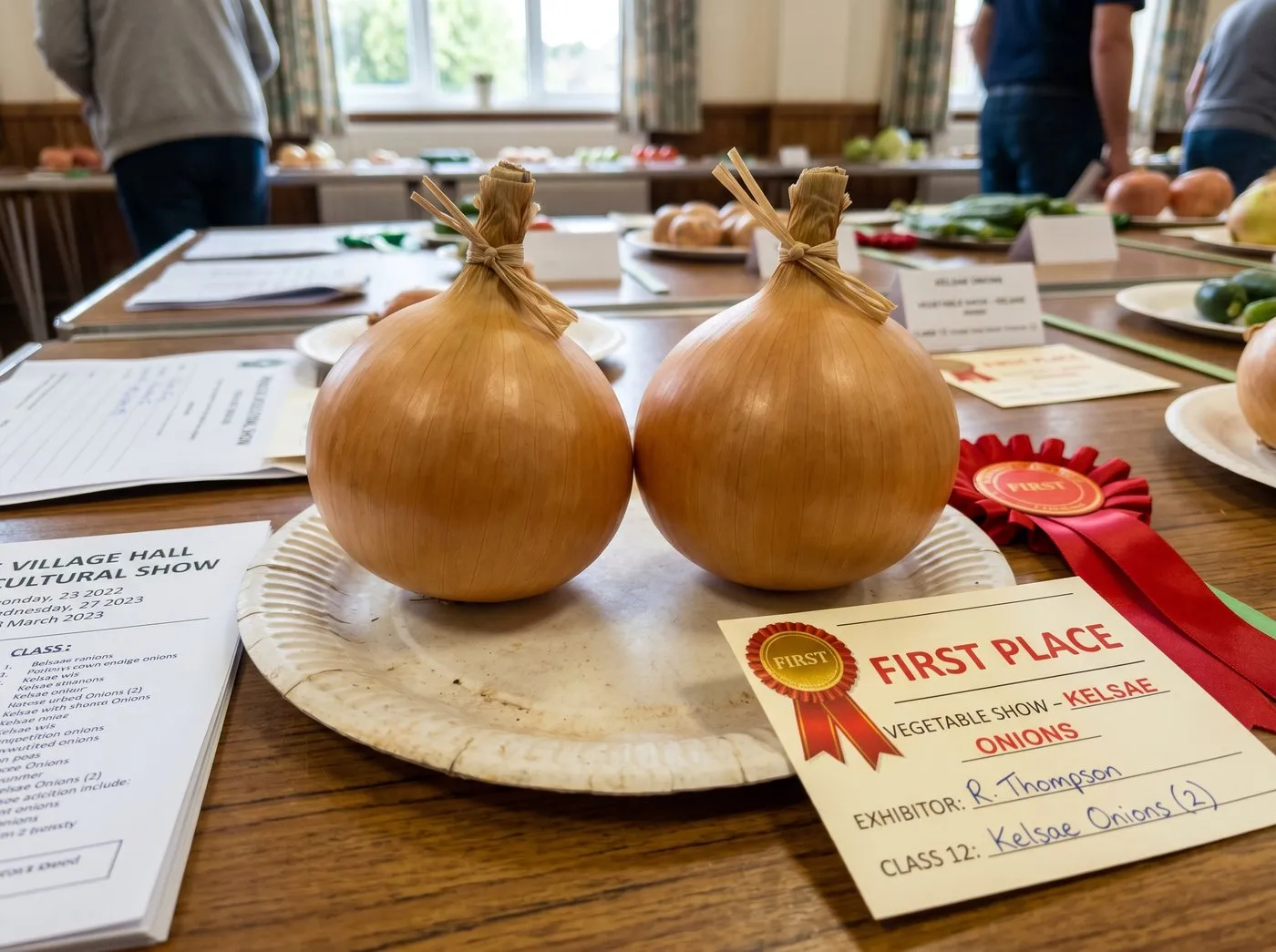 Matched pair of Kelsae on a UK show plate - tied tops, clean skins, identical size. The shape and skin quality that wins paired classes.
Common exhibition onion problems
Bolting (flowering before bulbing)
Cause: cold spell after planting out, or onion sets used instead of seed.
Solution: only grow from seed for exhibition; never use sets. Cover young transplants with fleece if April temperatures drop below 4C.
Thick necks (“bull necks”)
Cause: too much nitrogen during bulb formation, or fresh manure in the soil.
Solution: stop nitrogen feed in late June. Switch to high-potash only. Never use fresh manure - only well-rotted (12+ months).
Pear shape (not flat-based)
Cause: planting too deep; uneven watering; poor soil preparation.
Solution: plant with bulb at soil surface. Even watering throughout. Deep loose soil preparation in autumn.
Splitting (double bulbs)
Cause: variety not true to type; pest damage to growing point.
Solution: buy seed from reputable UK suppliers (Robinson’s Mammoth Improved direct from Robinson’s of Sunny Bank is the gold standard).
Onion fly maggots
Cause: maggots tunnel into bulbs.
Solution: cover with insect-proof mesh from planting until July. See our onion root fly prevention and control UK guide.
White rot
Cause: soil-borne fungal disease.
Solution: 6-7 year rotation between alliums. Once present, the bed is condemned for onions for a decade.
Bed preparation - the deep work
Exhibition onions need deeper soil preparation than kitchen onions:
Autumn before (year 0)
- Dig out 60cm of soil from the bed area
- Fill bottom 30cm with rough drainage (broken bricks, gravel, twiggy material)
- Refill with topsoil mixed with well-rotted farmyard manure at 1:5 ratio
- Cover with a layer of mature compost
- Leave to settle through winter
Year 1 spring
- Fork through to break any compaction
- Add 5cm of mature compost as top dressing
- Rake to fine tilth
The bed is now ready for one season of exhibition onions. After lifting, top-dress with compost and rest for a year (rotate to brassicas or roots). Don’t grow exhibition onions in the same bed two years running.
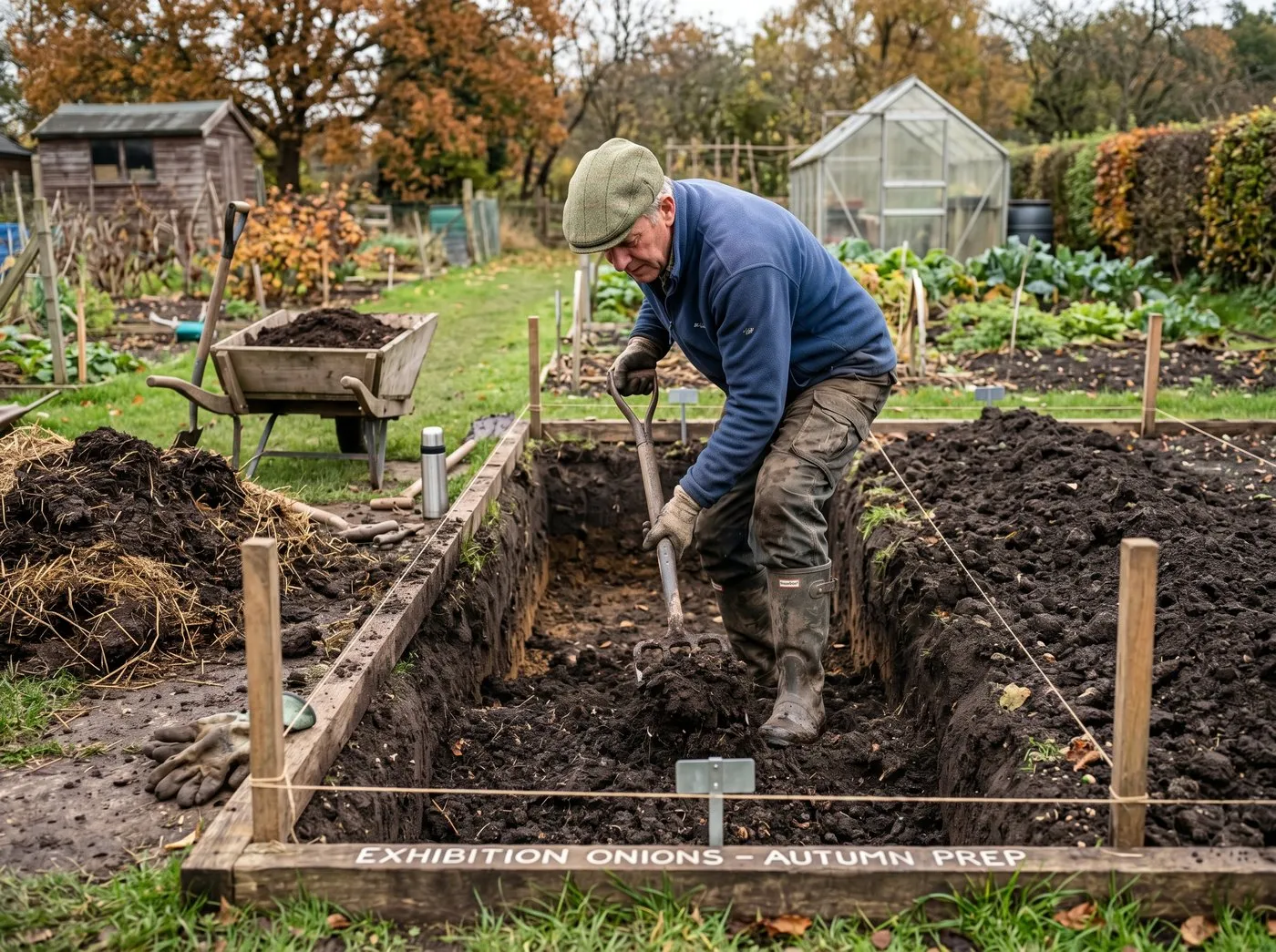 Bed preparation in October - 60cm of dug-out and refilled bed with composted manure. The work is paid back the following year in bulb size.
Feeding schedule
Standard exhibition onion feeding regime:
| Month | Feed | Strength | Frequency |
|---|---|---|---|
| May | High-nitrogen (urea or fish blood and bone) | Half strength | Weekly |
| Early June | Switch to high-potash (sulphate of potash) | Full strength | Weekly |
| Mid-June | Add liquid seaweed | Full strength | Fortnightly alternating |
| July | Continue high-potash | Full strength | Weekly |
| August | Stop fertilisers gradually | - | - |
| September | No feed | - | - |
Some specialist growers add foliar feeds (light spray of half-strength feed on leaves) every fortnight. This adds about 5-10% to final bulb size.
Costs of exhibition growing
| Item | Annual cost |
|---|---|
| Seed (Kelsae or Robinson’s Mammoth) | £4-£8 per packet |
| Compost (manure top-up) | £15-£30 |
| Slow-release fertiliser | £10 |
| Liquid feeds (high-potash, seaweed) | £20 |
| Insect mesh netting | £15 (lasts years) |
| Show entry fees | £5-£15 |
| Total | £70-£100 per year |
Typical UK village hall prize: £5-£20 + rosette. The cost-benefit is awful but the satisfaction is real. Many UK exhibition growers say the prize money is incidental - the social aspect of the village show is the real reward.
The path to a first show win
For a UK gardener who wants to enter their first exhibition onion class:
-
Read your local show schedule in October. Pick one class to focus on.
-
Order Kelsae seed from a UK supplier (Robinson’s, Marshalls, Suttons) in November.
-
Prepare the bed in October-November as described above.
-
Sow seeds December-January under heat.
-
Follow the calendar above through the season.
-
Lift, dry and tie 2-3 weeks before the show.
-
Enter your best bulb in the appropriate class.
Year 1: enter and learn. Year 2: aim to place. Year 3: aim to win.
Field note: Robinson’s Mammoth Onion Seed is the UK home of competition onion seed. The National Vegetable Society publishes show schedules and judging standards for UK exhibition vegetables.
A satisfying winter-to-autumn project
Exhibition onions span 9 months of the gardening year. Sowing happens when nothing else is growing. Growing under glass through winter gives a focus during dark months. Bedding out in April is one of the spring milestones. The crop matures slowly through summer. Lifting in September provides the climactic moment.
For UK gardeners who enjoy slow-build projects with a clear pay-off, exhibition onions are one of the most rewarding crops to take on. Even a third place at a village hall is a year of work paying off in a public moment.
Now you’ve got the technique
For more on allium-family cultivation, our how to grow onions UK, best UK onion varieties compared and storing onions, garlic and shallots UK guides cover the everyday onion growing that runs alongside competition work.
Our team produces practical UK gardening guidance from source research, contributor records and established horticultural practice. Editorial standards are overseen by Matt W.