Key takeaways
- Goji berries are fully hardy to -20C and need no winter protection anywhere in the UK
- Plants tolerate poor, alkaline, and sandy soils where most fruit crops struggle
- A mature bush yields 1-2kg of fresh berries per year from August to October
- Container growing in 40-50 litre pots controls vigorous suckering and root spread
- Berries contain more vitamin C than oranges and 12% protein by dry weight
- Plants fruit from their second year and remain productive for 15-20 years
- Prune hard each spring to encourage fruiting side shoots and control size
Goji berries are one of the hardiest and most forgiving fruit crops you can grow in a UK garden. These tough, drought-tolerant shrubs (Lycium barbarum) shrug off temperatures down to -20C, tolerate poor soil, and produce heavy crops of antioxidant-rich red berries from August to October. A single mature plant yields 1-2kg of fresh fruit per year.
Unlike blueberries that demand acidic soil, goji berries thrive in virtually any well-drained ground. They actually prefer the alkaline, chalky, and sandy soils that most fruit crops struggle in. This guide covers the best varieties for UK conditions, planting, pruning, container growing, harvesting, and drying.
What are goji berries?
Goji berries (Lycium barbarum), also called wolfberries, belong to the Solanaceae family alongside tomatoes, potatoes, and peppers. They originate from the Ningxia region of China, where they have been cultivated for over 2,000 years. The plant is a deciduous shrub with arching, slightly thorny branches that reach 2-3m tall and 1.5-2m wide.
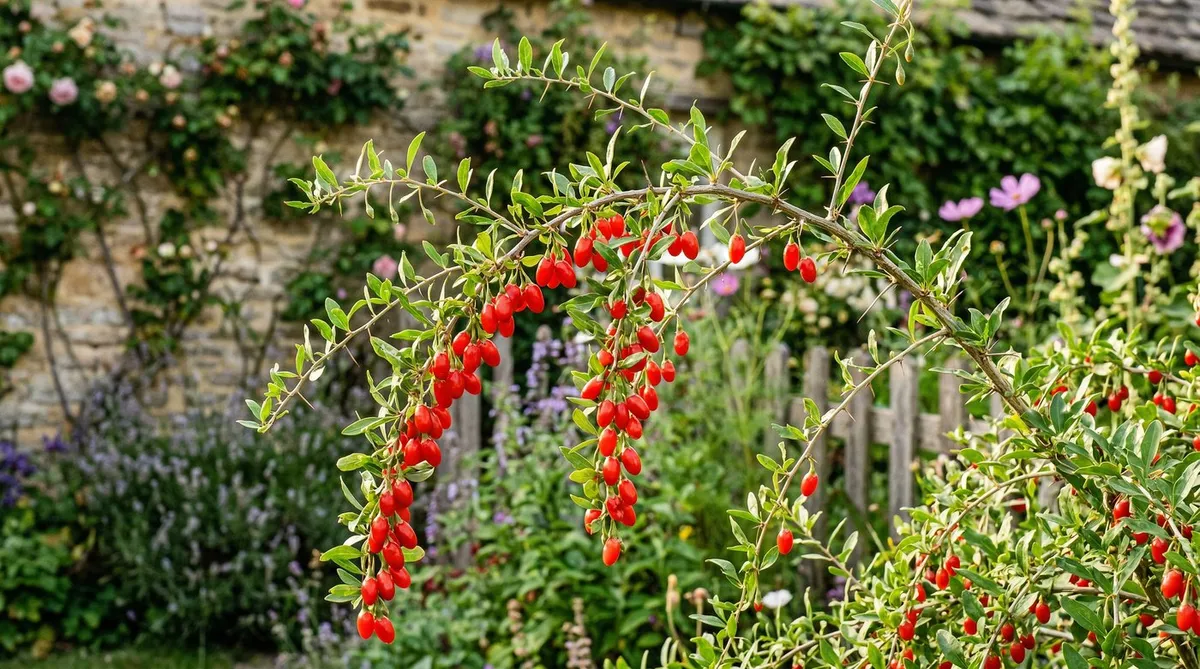
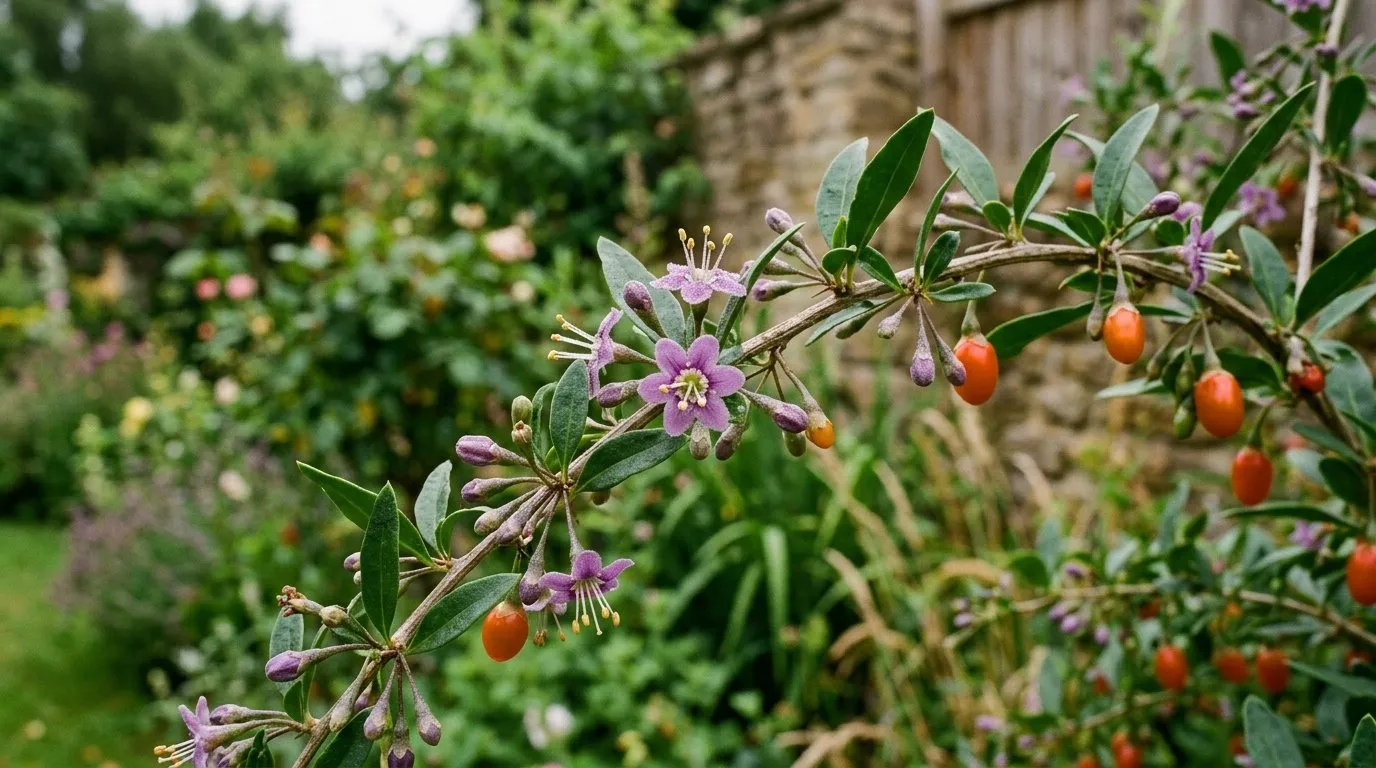 Goji berry plant laden with ripe red fruit in a UK garden. The arching branches produce berries along their entire length from August to October.
The berries are small, elongated, and bright red when ripe. Each berry is 10-20mm long. Fresh, they taste mildly sweet with a slight tomato-like aftertaste. Dried goji berries are the form most people recognise from health food shops, where they develop a sweeter, raisin-like flavour.
The RHS lists Lycium barbarum as fully hardy throughout the UK. Plants survive -20C without damage. They are deciduous, dropping their leaves in autumn and regrowing fresh foliage in April. No winter protection is needed anywhere in the British Isles.
Nutritional value
Goji berries have earned their “superfruit” reputation with genuine nutritional density. Per 100g of dried berries, they contain:
| Nutrient | Amount per 100g dried |
|---|---|
| Calories | 349 kcal |
| Protein | 12g |
| Vitamin C | 48mg (60% RDA) |
| Iron | 6.8mg (49% RDA) |
| Vitamin A | 26,800 IU |
| Fibre | 13g |
| Zeaxanthin | 200mg |
The zeaxanthin content is particularly notable. This carotenoid supports eye health and goji berries contain more of it per gram than any other food source. The protein content at 12% is exceptionally high for a fruit.
Best goji berry varieties for UK gardens
The straight species Lycium barbarum is the most commonly available and performs well. Several named cultivars offer improved berry size, flavour, or growth habit. All are self-fertile, meaning a single plant will produce fruit without a pollination partner.
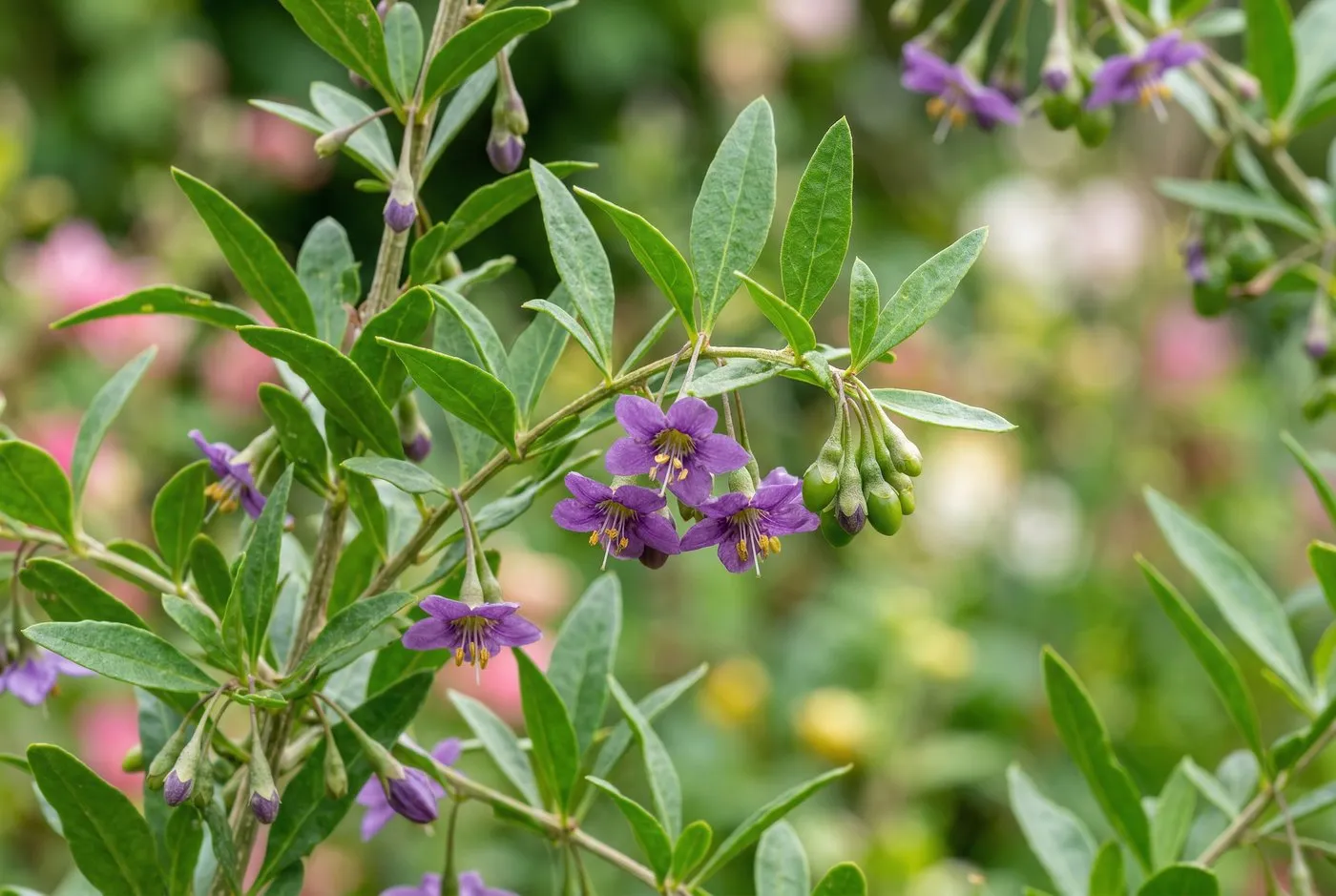 Purple trumpet-shaped goji flowers appear from June to September. Each flower develops into a single red berry over 6-8 weeks.
Lycium barbarum (straight species)
The standard species is widely available from nurseries and garden centres at around five pounds per plant. It produces abundant small berries of 10-15mm on vigorous, arching branches. Flavour is good when fully ripe. This is the hardiest and most disease-resistant option.
‘New Big’
A Chinese selection with significantly larger berries reaching 20-25mm long. The fruit is sweeter and fleshier than the standard species. Plants are slightly less vigorous at 1.5-2m tall. ‘New Big’ is the best choice for fresh eating. Widely available from specialist fruit nurseries.
‘Sweet Lifeberry’
Bred in Germany for improved sweetness and compact habit. Berries are 15-20mm with a notably sweet flavour. Plants reach 1.5m tall, making this variety suitable for smaller gardens and containers. ‘Sweet Lifeberry’ fruits slightly earlier than the species, with first berries in late July.
‘Crimson Star’
A Polish cultivar selected for the cooler European climate. Produces medium-sized berries of 15mm with good flavour. The plant is compact at 1.2-1.5m and less prone to suckering than the species. ‘Crimson Star’ is the best variety for container growing and restricted spaces.
Variety comparison table
| Variety | Height | Berry size | Flavour | Yield per plant | Suckering | Best for |
|---|---|---|---|---|---|---|
| L. barbarum (species) | 2-3m | 10-15mm | Mild, sweet | 1.5-2kg | Vigorous | Open ground, hedging |
| ’New Big’ | 1.5-2m | 20-25mm | Sweet, fleshy | 1-1.5kg | Moderate | Fresh eating, largest berries |
| ’Sweet Lifeberry’ | 1.5m | 15-20mm | Very sweet | 1-1.5kg | Low | Small gardens, early crop |
| ’Crimson Star’ | 1.2-1.5m | 15mm | Good, balanced | 0.8-1.2kg | Low | Containers, restricted spaces |
Gardener’s tip: If you want the biggest harvest, plant the straight species in open ground with room to spread. If you want the best fresh-eating experience from a contained plant, choose ‘New Big’ or ‘Sweet Lifeberry’ in a large pot.
Where to plant goji berries
Goji berries are remarkably tolerant of site and soil conditions. They evolved in the dry, rocky hills of northwest China and bring that toughness to UK gardens. Getting the position right means less work in future years.
Sunlight
Plant in full sun for the best berry production. Goji plants tolerate partial shade but crop noticeably less. A south-facing or west-facing position is ideal. Against a sunny wall or fence works well, where the reflected warmth ripens berries faster. Avoid north-facing sites, as the reduced light produces lots of leaf growth but few berries.
Soil requirements
Goji berries thrive in well-drained soil of any type. They actively prefer the poor, sandy, and alkaline soils that defeat many fruit crops. Heavy clay works if you improve drainage by adding grit. Waterlogged ground is the one condition they will not tolerate. Persistently wet roots cause crown rot over winter.
The ideal soil pH range is 6.5 to 8.0. This is the opposite of acid-loving fruits like blueberries. Most UK garden soils fall within this range without amendment. If your soil is very acidic (below pH 6.0), add garden lime before planting.
Wind and shelter
Goji plants tolerate moderate wind exposure. The flexible, arching branches bend rather than snap. However, strong coastal winds can strip flowers and developing berries. A sheltered position improves fruit set. In exposed gardens, a fence or hedge on the windward side provides sufficient protection.
How to plant goji berries
Plant container-grown goji berries at any time of year, though autumn (October-November) and spring (March-April) give the best establishment. Bare-root plants are available from specialist nurseries in winter and should be planted between November and March during dormancy.
Planting in open ground
Dig a hole twice the width and the same depth as the root ball. Mix the excavated soil with a handful of coarse grit if your soil is heavy clay. Do not add fertiliser. Goji plants establish best in unfed, well-drained soil. Rich soil produces leafy growth at the expense of fruit.
Plant at the same depth the plant sat in its nursery pot. Firm the soil gently. Water well to settle the roots. Space plants 1.5-2m apart if planting multiple bushes. For a goji hedge, plant 1m apart. Mulch with a 5cm layer of bark chip, keeping it 10cm away from the stem base.
Planting in containers
Container growing is the most practical method for most UK gardeners. It controls the vigorous suckering habit and lets you move the plant to the best sunny position. Our guide to growing fruit in pots covers the general principles.
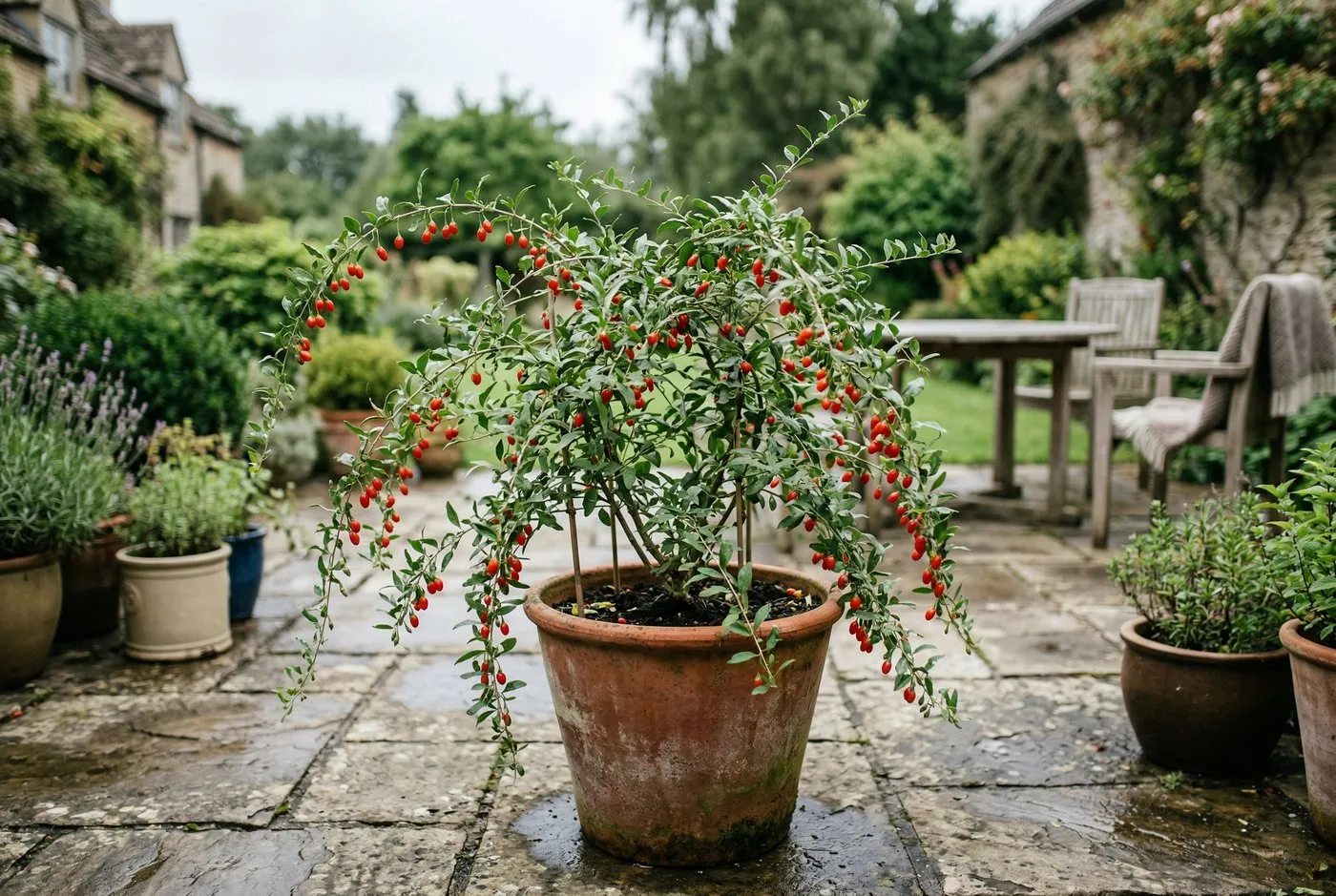 A goji berry bush fruiting in a container on a patio. Pots of 40-50 litres provide enough root room for good crops while stopping the suckering that makes goji invasive in open ground.
Use a pot of at least 40 litres. A 50-litre pot is better for long-term growing. Fill with standard multi-purpose compost mixed with 20% perlite or coarse grit for drainage. Goji berries do not need ericaceous compost. Standard compost at pH 6.5-7.0 is perfect.
Plant at the same depth as the nursery pot. Water thoroughly. Stand the pot on feet or bricks to prevent waterlogging. Place in the sunniest spot available.
The sunken pot method
Watering and feeding goji berries
Goji berries are drought-tolerant once established. They need far less water than most fruit crops. Overwatering causes more problems than underwatering.
Watering
In the first year after planting, water weekly during dry spells to help roots establish. From year two onward, established plants in open ground rarely need watering except during prolonged drought. Container plants need regular watering in summer. Check the compost every few days and water when the top 5cm feels dry.
Tap water is perfectly fine for goji berries. Unlike acid-loving plants, they are not affected by the alkalinity of mains water. In fact, the slightly alkaline pH suits them.
Feeding
Goji berries are light feeders. In open ground, they rarely need any fertiliser. Too much nitrogen produces excessive leafy growth with fewer berries.
For container plants, feed monthly from April to August with a liquid tomato fertiliser (high potassium). This encourages flower and fruit production. Stop feeding from September to let the plant harden off for winter. Avoid general-purpose feeds high in nitrogen.
How to prune and train goji berries
Pruning improves a goji plant from a tangled, unproductive mass into a manageable, heavy-cropping bush. Without pruning, the arching branches grow 2-3m long, flop onto the ground, and fruit sparsely. With correct pruning, the plant stays compact and covers itself in berries. Our shrub pruning guide covers the general principles that apply to goji.
First year pruning
After planting, cut the main stem back to 60cm tall. This feels drastic but it forces strong side branches to develop from the lower stem. Without this cut, the plant grows a single long whip with berries only at the tips.
Annual spring pruning (year two onward)
Prune in late February to early March before new growth starts. Goji berries fruit on the current season’s growth that sprouts from older wood. The pruning aim is to create a framework of short, stubby branches covered in new fruiting shoots.
Step-by-step method:
- Remove all dead, damaged, and crossing branches
- Cut back the previous year’s fruiting shoots to 2-3 buds from the main framework branch
- Remove any thin, wispy growth thinner than a pencil
- Cut out one or two of the oldest framework branches at the base each year to stimulate replacement growth
- Remove all suckers growing from the roots
Training on a support
Goji berries produce more fruit when trained against a wall, fence, or post-and-wire system. The arching branches respond well to being tied in. Fan-train the plant by selecting 4-6 main stems and tying them to horizontal wires at 30cm spacing. This exposes maximum leaf area to sunlight and makes harvesting far easier.
A single stout stake also works for a free-standing bush. Tie the main stem to the stake at 60cm and let the side branches arch outward naturally. This creates an umbrella shape that looks attractive and fruits well.
Controlling the spread of goji berries
Goji plants spread aggressively through root suckers in open ground. New shoots appear 1-2m from the parent plant and, if left unchecked, form a dense thicket. This is the plant’s main drawback and the reason many gardeners choose container growing.
Prevention methods
| Method | Effectiveness | Cost | Effort |
|---|---|---|---|
| Container growing (40-50L pot) | Excellent | Low | Low, repot every 3 years |
| Sunken pot in ground | Excellent | Low | Very low once installed |
| Root barrier membrane (60cm deep) | Good | Medium | Medium, install at planting |
| Regular sucker removal | Moderate | None | High, monthly from May to September |
| Raised bed with solid base | Excellent | Medium-high | Low once built |
The sunken pot method is the best balance of effectiveness, cost, and effort. If you plant in open ground without a barrier, plan to remove suckers monthly during the growing season. Pull them when young, as established suckers develop their own root system and become harder to remove.
How to harvest goji berries
Goji berries ripen over a long period from August to October in UK gardens. Not all berries on a branch ripen simultaneously, so you will harvest several times. This extended season is a bonus, providing fresh fruit for two months.
When to pick
Berries are ready when they turn fully red with no green or orange patches. Ripe berries feel slightly soft when squeezed gently. Underripe berries are bitter. Overripe berries drop to the ground and spoil quickly.
How to pick
Ripe goji berries bruise easily. The gentlest method is to shake the branch over a tray lined with a cloth. Ripe berries detach and fall while unripe ones stay attached. Alternatively, pick individual berries by hand. Wear gloves if the branches are thorny.
Handle berries with care. Fresh goji berries stain skin and clothing. The juice is bright orange-red and difficult to remove. Process or refrigerate berries within 24 hours of picking.
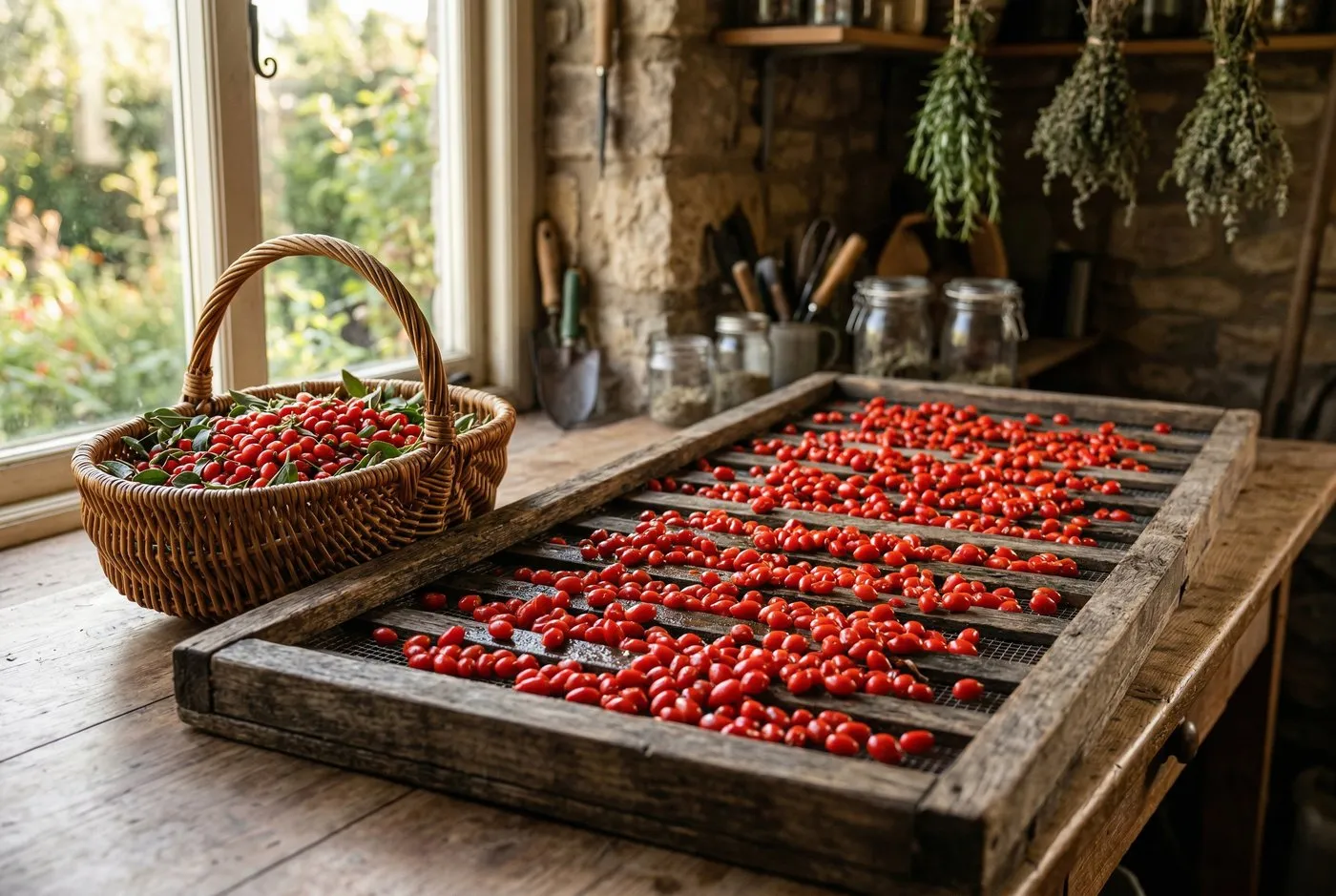 Fresh goji berries spread on a drying rack. Berries dry in 5-7 days at room temperature or 12-18 hours in a food dehydrator.
Fresh storage
Fresh goji berries keep for 2-3 days in the fridge. They do not store well fresh, which is why most commercial goji berries are sold dried. Use fresh berries immediately in smoothies, salads, or eat them straight off the plant.
How to dry goji berries at home
Drying is the traditional preservation method and concentrates the sweetness. Dried goji berries store for 12 months in airtight containers. Three methods work reliably at home.
Air drying (5-7 days)
Spread fresh berries in a single layer on a wire rack, bamboo tray, or wooden frame lined with muslin. Place in a warm, dry, well-ventilated room. A south-facing windowsill, airing cupboard, or conservatory works well. Turn the berries daily. They are done when they feel leathery and no longer sticky.
Food dehydrator (12-18 hours)
Set the dehydrator to 40-50C. Higher temperatures destroy some of the vitamin C and antioxidants. Spread berries on the trays without touching. Check at 12 hours. Berries are ready when leathery with no wet spots inside when squeezed.
Oven drying (8-12 hours)
Set the oven to its lowest setting, ideally 50C. Prop the door open 2-3cm with a wooden spoon to allow moisture to escape. Spread berries on baking trays lined with parchment paper. Check every 2 hours. This is the fastest method but uses the most energy.
Storage
Store dried berries in clean, airtight glass jars or zip-lock bags. Keep in a cool, dark cupboard. Properly dried goji berries maintain their flavour and nutrition for 12 months. For longer storage, freeze dried berries for up to 2 years.
Common pests and problems
Goji berries suffer fewer pest and disease problems than most fruit crops. Their tough constitution and Solanaceae family chemistry make them unpalatable to many insects.
Goji berry gall mite
This is the most common UK pest. Tiny mites cause swollen, distorted leaf buds that fail to open properly. Damage is mainly cosmetic and rarely affects fruit production on mature plants. Prune out affected shoots in spring. Severe infestations respond to sulphur-based sprays applied before flowering.
Aphids
Green aphids occasionally colonise young shoot tips in May and June. Blast them off with a strong jet of water or let natural predators (ladybirds, hoverfly larvae) control them. Aphid damage on goji plants is rarely severe enough to warrant chemical treatment.
Birds
Blackbirds and starlings eat ripe goji berries from August onward. Net the plant when berries start to colour if birds are a problem. Alternatively, accept some loss and harvest promptly when berries ripen. Planting fruit-bearing shrubs for wildlife elsewhere in the garden can distract birds.
Powdery mildew
A white powdery coating on leaves in late summer, especially in dry conditions with poor airflow. Improve air circulation through pruning. Water the base of the plant, not the foliage. Powdery mildew rarely kills goji plants but it weakens late-season fruit production.
Month-by-month goji berry calendar
This calendar covers the full growing year for UK goji berry plants. Adjust timings by one to two weeks for northern gardens and exposed sites.
| Month | Task |
|---|---|
| January | Order bare-root plants from nurseries. Plan planting positions. |
| February | Prune established plants hard before new growth. Cut fruiting shoots to 2-3 buds. |
| March | Plant new container or bare-root plants. Apply a thin mulch of bark chip. |
| April | New growth appears. Begin monthly tomato feed for container plants. Remove suckers. |
| May | Rapid growth. Tie in new shoots to supports. Pinch out tips to encourage branching. |
| June | Purple flowers appear. Bees pollinate. Continue feeding containers. Remove suckers. |
| July | Green berries developing. Water containers in dry weather. Early varieties start to colour. |
| August | Main harvest begins. Pick berries when fully red. Start drying surplus fruit. |
| September | Harvest continues. Late berries ripen. Reduce watering. Stop feeding. |
| October | Final harvest. Leaves begin to yellow and fall. Clear fallen fruit. |
| November | Plant is dormant. Plant bare-root stock. Tidy dead growth. Mulch base. |
| December | Dormant season. Plan next year’s pruning. Check stored dried berries. |
Growing goji berries alongside other fruit
Goji berries fit well into a mixed fruit garden. Their long harvest season fills the gap between summer raspberries and autumn apples. They combine naturally with other unusual crops that thrive in UK conditions.
Plant goji berries away from potatoes and tomatoes. As members of the same Solanaceae family, they can share diseases. A minimum distance of 3m reduces cross-infection risk. Good companions include lavender, rosemary, and other Mediterranean herbs that enjoy the same free-draining, sunny conditions.
For a productive patio display, grow a compact variety like ‘Crimson Star’ alongside blueberry bushes in ericaceous compost and a few pots of herbs. The different soil requirements make container growing ideal for this combination.
Frequently asked questions
Are goji berries easy to grow in the UK?
Yes, goji berries are one of the easiest fruiting shrubs for UK gardens. They are fully hardy to -20C and tolerate poor, alkaline, and dry soils. Plants need minimal feeding and rarely suffer from serious pests or diseases. The main challenge is controlling their vigorous suckering habit, which container growing solves.
How long do goji berry plants take to fruit?
Most goji plants produce their first berries in the second year. Expect a light crop of 200-500g in year two. Full cropping of 1-2kg per plant begins from year three. Plants remain productive for 15-20 years with annual pruning.
Can you grow goji berries in pots?
Yes, goji berries grow well in containers of 40-50 litres. Use standard multi-purpose compost with 20% perlite for drainage. Container growing is the best way to control the vigorous root suckers that spread through open ground. Water regularly in summer and feed monthly with liquid tomato fertiliser from April to August.
When do you harvest goji berries in the UK?
Harvest goji berries from August to October in UK gardens. Berries are ready when they turn fully red and feel slightly soft. Pick gently because ripe fruit bruises easily. Shake the branch over a tray lined with cloth for the most efficient harvest method.
How do you dry goji berries at home?
Spread fresh berries in a single layer on a wire rack or wooden tray. Place in a warm, dry, airy spot for 5-7 days until leathery. A food dehydrator at 40-50C takes 12-18 hours. Oven drying at 50C with the door ajar works in 8-12 hours. Dried berries store for 12 months in airtight jars.
Are goji berry plants invasive?
Goji plants spread vigorously through root suckers in open ground. New shoots can appear 1-2 metres from the parent plant. This makes them invasive in borders. Growing in containers or sinking a pot into the ground with the rim above soil level prevents spreading completely.
What do goji berry flowers look like?
Goji flowers are small purple trumpets, 10-15mm across, appearing from June to September. They grow in clusters of 1-3 along the arching stems. The flowers are self-fertile and pollinated by bees. Each flower develops into a single red berry over 6-8 weeks.
Our team produces practical UK gardening guidance from source research, contributor records and established horticultural practice. Editorial standards are overseen by Matt W.