Key takeaways
- Honeyberries ripen in May, making them the earliest fruit crop in UK gardens
- You must plant two different varieties for cross-pollination or you get no fruit
- Bushes are extremely hardy, surviving temperatures down to -45C
- Mature plants yield 2-5kg of fruit per bush each year for 30+ years
- Berries taste like a cross between blueberry and raspberry with a hint of blackcurrant
- Unlike blueberries, honeyberries tolerate most UK soils including clay and alkaline
Honeyberry is one of the most underrated fruit crops for UK gardens. This Siberian shrub (Lonicera caerulea) produces elongated blue berries from mid-May, making it the earliest fruiting plant you can grow outdoors in Britain. The berries taste like a blend of blueberry and raspberry with a tangy-sweet depth that improves with every season as the bush matures.
Unlike blueberries, honeyberries tolerate a wide range of soil types including heavy clay and alkaline conditions. They shrug off temperatures down to -45C, making them bulletproof through any British winter. A mature bush produces 2-5kg of fruit each year and stays productive for 30 years or longer. This guide covers everything you need to grow honeyberries successfully in the UK, from variety selection and pollination to planting, feeding, and harvesting.
What are honeyberries?
Honeyberry (Lonicera caerulea var. kamtschatica and var. edulis) is a deciduous fruiting shrub in the honeysuckle family. The plant originates from Siberia, northern Japan, and the Kuril Islands, where indigenous peoples have harvested wild berries for centuries. In Russia, it is known as zhimolost and has been cultivated commercially since the 1950s.
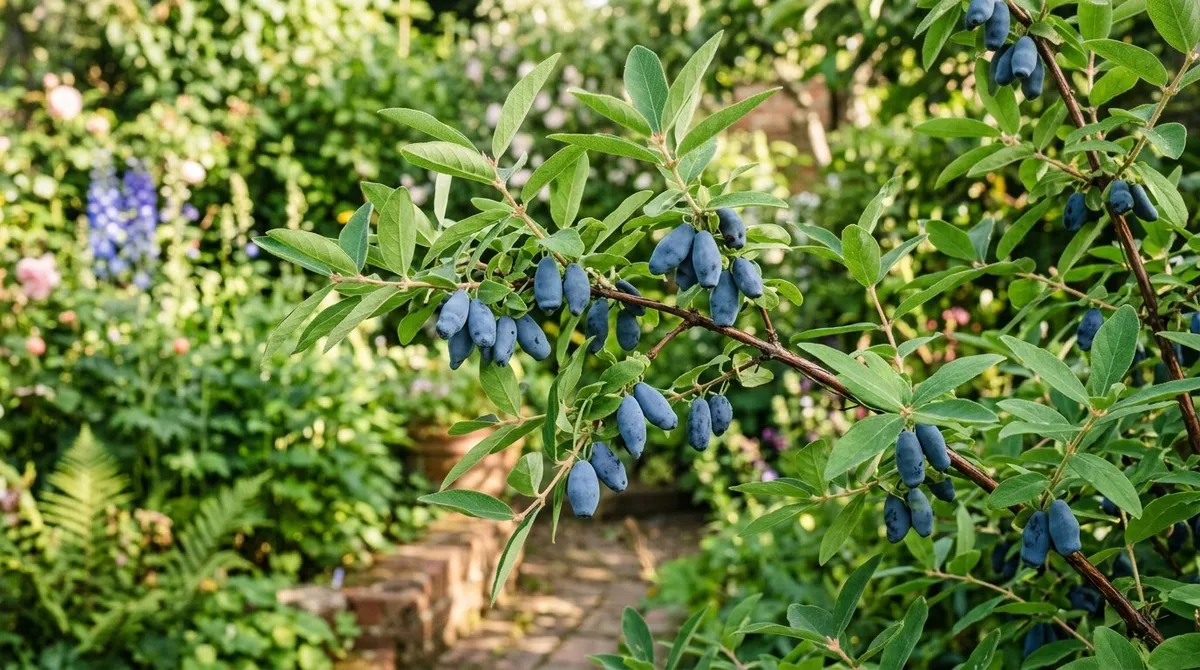
The berries are distinctive. They are elongated and cylindrical, roughly 1-3cm long, with a dark blue-purple skin covered in a waxy bloom. The flesh inside is deep red-purple. Each berry contains tiny seeds that are barely noticeable when eating. The flavour profile sits between blueberry and raspberry, with undertones of blackcurrant and occasionally grape depending on the variety.
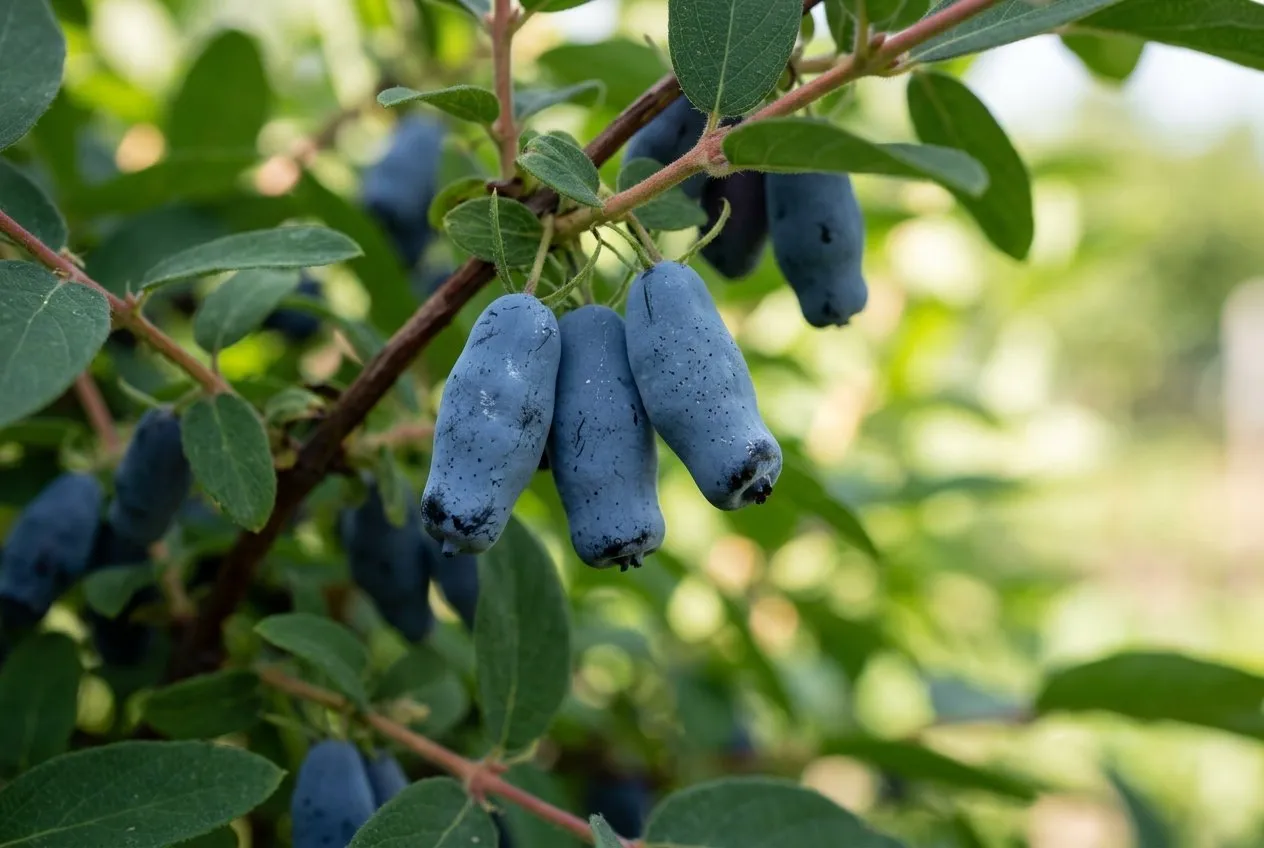 Ripe honeyberry fruit showing the distinctive elongated shape and blue-purple waxy bloom.
Bushes grow 1.2-1.8m tall and 1-1.5m wide. They are neat, compact, and well-behaved in a garden border. Leaves are oval, blue-green, and unremarkable. Small creamy-yellow flowers appear in pairs from February to April, providing early forage for bumblebees emerging from hibernation. The RHS honeyberry profile confirms their RHS Award of Garden Merit.
Honeyberries belong to the same genus as ornamental honeysuckle, but they are a bush form, not a climber. They do not spread invasively. Growth is slow in years one and two, then picks up from year three onward.
Why grow honeyberry in the UK?
Several characteristics make honeyberry uniquely suited to British conditions.
Earliest fruit crop. Honeyberries ripen from mid-May in southern England and late May in northern regions. This is two to three weeks before the first strawberries and a full two months before blueberries. No other outdoor fruit crop fills this gap in the British harvesting calendar.
Extreme hardiness. Originating from Siberia, honeyberry tolerates temperatures down to -45C. Flowers withstand -7C, which is significant because late spring frosts destroy blossom on many fruit crops. In the UK, this means honeyberry flowers almost never fail, even in frost pockets and northern gardens.
Soil flexibility. Honeyberries grow in acidic, neutral, and mildly alkaline soils (pH 4.5-7.5). They cope with heavy clay, sandy loam, and everything in between. This is a major advantage over blueberries, which demand acidic soil at pH 4.0-5.5. If your garden soil has defeated blueberry attempts, honeyberry is the answer.
Low maintenance. Honeyberries need minimal pruning, no staking, no special soil amendments, and very little feeding. They suffer from almost no pests or diseases in the UK. The biggest management task is netting against birds.
The cross-pollination rule
This is the single most important fact about growing honeyberries. You must plant at least two different varieties for fruit set. Honeyberries are not self-fertile. A lone bush flowers freely but sets no berries.
Cross-pollination requires genetically distinct cultivars. Two plants of the same variety will not pollinate each other because they are clones with identical genetics. You need two different named varieties, ideally from compatible pollination groups.
Pollination compatibility depends on flowering timing. Both varieties must bloom at the same time for bees to transfer pollen between them. Most modern cultivars recommended for UK growing have overlapping flowering periods, but check compatibility when buying. The table in the variety section below lists suitable pairings.
Plant your two varieties within 3 metres of each other. Bumblebees are the primary pollinators because they are active at the cool temperatures when honeyberry flowers in late winter and early spring. Attract them by avoiding pesticide use in February to April.
Best honeyberry varieties for UK gardens
Honeyberry breeding has progressed rapidly since the 2000s. The best varieties for UK growers come from Canadian, Russian, and Japanese breeding programmes. Here are five proven performers.
Blue Velvet
Blue Velvet is the top dessert variety for UK gardens. Berries are large (2-3cm), sweet, and low in acidity. Flavour is closest to blueberry with a honeyed finish. Bushes reach 1.5m tall and spread to 1.2m. Ripening starts in mid-May in southern gardens. Yields of 2-4kg per mature bush are typical. Pollinates well with Morena and Berry Blue.
Morena
Morena produces the largest berries of all widely available varieties, reaching 3cm long with excellent sweet-tart flavour. It was bred at the Pavlovsk Experimental Station in Russia specifically for fresh eating. Bushes grow to 1.7m tall. Morena is one of the earliest to ripen, often a few days ahead of Blue Velvet. Pollinates well with Blue Velvet and Honeybee.
Kamtschatica
Kamtschatica is a vigorous variety with the most complex flavour profile. Berries are medium-sized (1.5-2cm) with a sharp, tangy taste when first ripe, sweetening over the following week. This variety suits cooks who want berries for jams, sauces, and baking. Bushes reach 1.5m tall and are very hardy. Pollinates with Berry Blue and Morena.
Berry Blue
Berry Blue is a compact variety reaching 1.2m tall, making it the best choice for smaller gardens and container growing. Berries are medium-sized with a well-balanced sweet-tart flavour. Yields are moderate at 1.5-3kg per mature bush. Berry Blue has a long flowering window, making it an effective pollination partner for most other varieties.
Honeybee
Honeybee was bred as a universal pollinator. It flowers over a longer period than other varieties, overlapping with early, mid, and late cultivars. Berry size is small to medium (1-2cm) but flavour is good. Bushes grow to 1.5m. If you want a reliable third plant to maximise pollination across your honeyberry collection, Honeybee is the one.
Variety comparison table
| Variety | Berry size | Flavour | Height | Yield per bush | Best pollinators | Best for |
|---|---|---|---|---|---|---|
| Blue Velvet | 2-3cm, large | Sweet, honeyed | 1.5m | 2-4kg | Morena, Berry Blue | Fresh eating, dessert |
| Morena | Up to 3cm, largest | Sweet-tart, rich | 1.7m | 2-5kg | Blue Velvet, Honeybee | Biggest berries, early harvest |
| Kamtschatica | 1.5-2cm, medium | Tangy, complex | 1.5m | 2-3kg | Berry Blue, Morena | Cooking, jams, baking |
| Berry Blue | 1.5-2cm, medium | Balanced sweet-tart | 1.2m | 1.5-3kg | All varieties | Small gardens, containers |
| Honeybee | 1-2cm, small-medium | Good, mild | 1.5m | 1.5-2.5kg | All varieties | Universal pollinator |
the contributor’s recommended pairing: Blue Velvet and Morena together give you the best combination of flavour, berry size, and reliable cross-pollination. Both ripen early and produce large, sweet berries. Add Berry Blue or Honeybee as a third plant if space allows, to further improve pollination and extend picking slightly.
How to plant honeyberry
When to plant
Plant bare-root honeyberries from November to March while the plants are dormant. Container-grown plants go in at any time of year, but autumn planting (October to November) gives roots the longest establishment period before the first fruiting season. Avoid planting into waterlogged or frozen ground.
Choosing a site
Honeyberries prefer full sun to light partial shade. In full sun, berries are sweeter and yields are higher. Light afternoon shade is acceptable, particularly in southern England where summer heat can scorch foliage. Avoid deep shade, as cropping drops significantly.
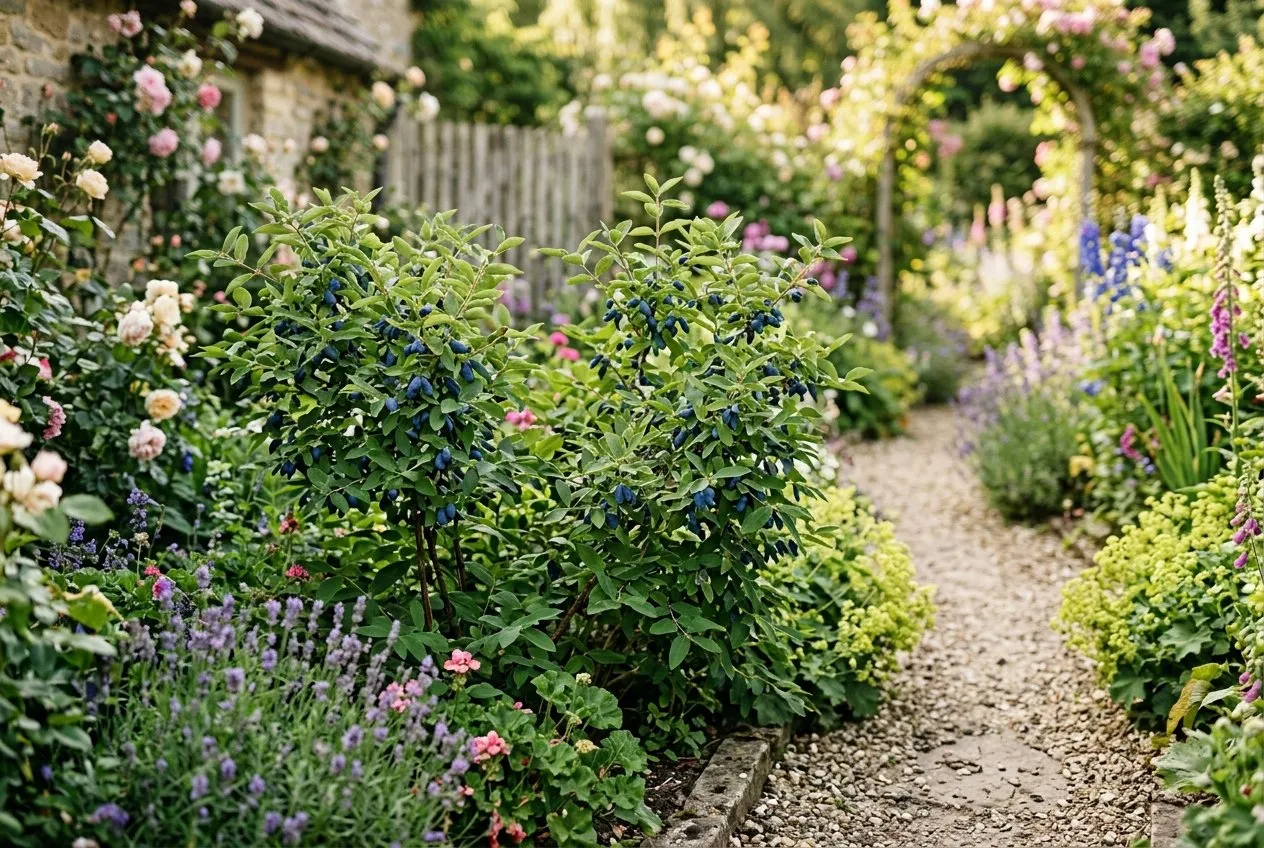 A pair of honeyberry bushes planted together for cross-pollination in a mixed cottage garden border.
Choose a sheltered spot if possible. Although the plants themselves are indestructible in cold, the early flowers benefit from protection against strong wind, which discourages pollinating bumblebees from visiting. A south or west-facing position against a fence or wall is ideal.
Soil requirements
Honeyberries tolerate a wide pH range from 4.5 to 7.5. They grow well in:
- Heavy clay, their natural Siberian habitat includes heavy mineral soils
- Sandy loam, good drainage suits them, though they need more watering
- Chalky/alkaline soil, unlike blueberries, they cope with lime
- Acidic soil, they thrive alongside ericaceous plants
Planting method
- Dig a hole 50cm wide and 40cm deep, roughly twice the width of the root ball.
- Fork over the base of the hole to loosen compacted subsoil.
- Mix the excavated soil with a bucketful of garden compost or well-rotted manure.
- Place the plant at the same depth it grew in its nursery pot. The soil mark on the stem should sit at ground level.
- Backfill, firming gently with your heel to remove air pockets.
- Water thoroughly with 10 litres of water.
- Apply a 7-8cm layer of bark chip or compost mulch around the base, keeping it clear of the stem.
- Space plants 1.2-1.5m apart. Remember, you need at least two different varieties.
Growing in containers
Honeyberries grow successfully in large pots of 40 litres or more. Use peat-free multi-purpose compost mixed with 20% perlite or grit for drainage. Place both pots (you still need two varieties) close together on a sunny patio or balcony. Water regularly in summer, as containers dry out faster than open ground. Feed fortnightly with a balanced liquid fertiliser from March to July. This is the same container fruit growing approach that works for blueberries and currants.
Caring for honeyberry bushes
Watering
Established honeyberries in open ground rarely need supplementary watering except during prolonged drought. Their deep root systems find moisture in most conditions. In the first two years after planting, water weekly during dry spells from April to September to help roots establish.
Container-grown plants need regular watering throughout the growing season. Check daily in summer heat. Push your finger 3cm into the compost. If dry, water thoroughly until liquid runs from the drainage holes.
Unlike blueberries, honeyberries are not fussy about water chemistry. Tap water is perfectly fine.
Feeding
Honeyberries are light feeders. Apply a general-purpose granular fertiliser (such as Growmore or blood, fish, and bone) in early March each year. Scatter a handful around the base of each bush and water in. This provides sufficient nutrition for the entire growing season.
Container plants benefit from fortnightly liquid feeding with a balanced fertiliser (NPK 10-10-10 or similar) from March to July. Stop feeding after fruit harvest to allow the plant to harden off for winter.
Avoid high-nitrogen feeds, which promote leafy growth at the expense of fruit. If your bushes are growing vigorously but fruiting lightly, reduce feeding and ensure the pollination partner is close enough.
Pruning
Honeyberries need very little pruning in the first four years. Leave the bush to establish its framework of branches. From year five onward, prune in late winter (January to February) while the plant is dormant.
Annual pruning routine:
- Remove any dead, damaged, or crossing branches.
- Cut out the two or three oldest stems at ground level each year to encourage fresh growth.
- Thin congested growth in the centre to improve air circulation and light penetration.
- Aim for an open vase shape with 8-12 main stems of mixed ages.
Honeyberries fruit on one-year-old wood (shoots produced the previous season). Removing very old wood stimulates new productive stems. Never prune in autumn, as this removes the flower buds for the following spring.
Harvesting honeyberries
When to pick
Honeyberries ripen from mid-May to early June depending on your location and the variety. Southern English gardens harvest first. Northern England, Wales, and Scotland typically pick from late May.
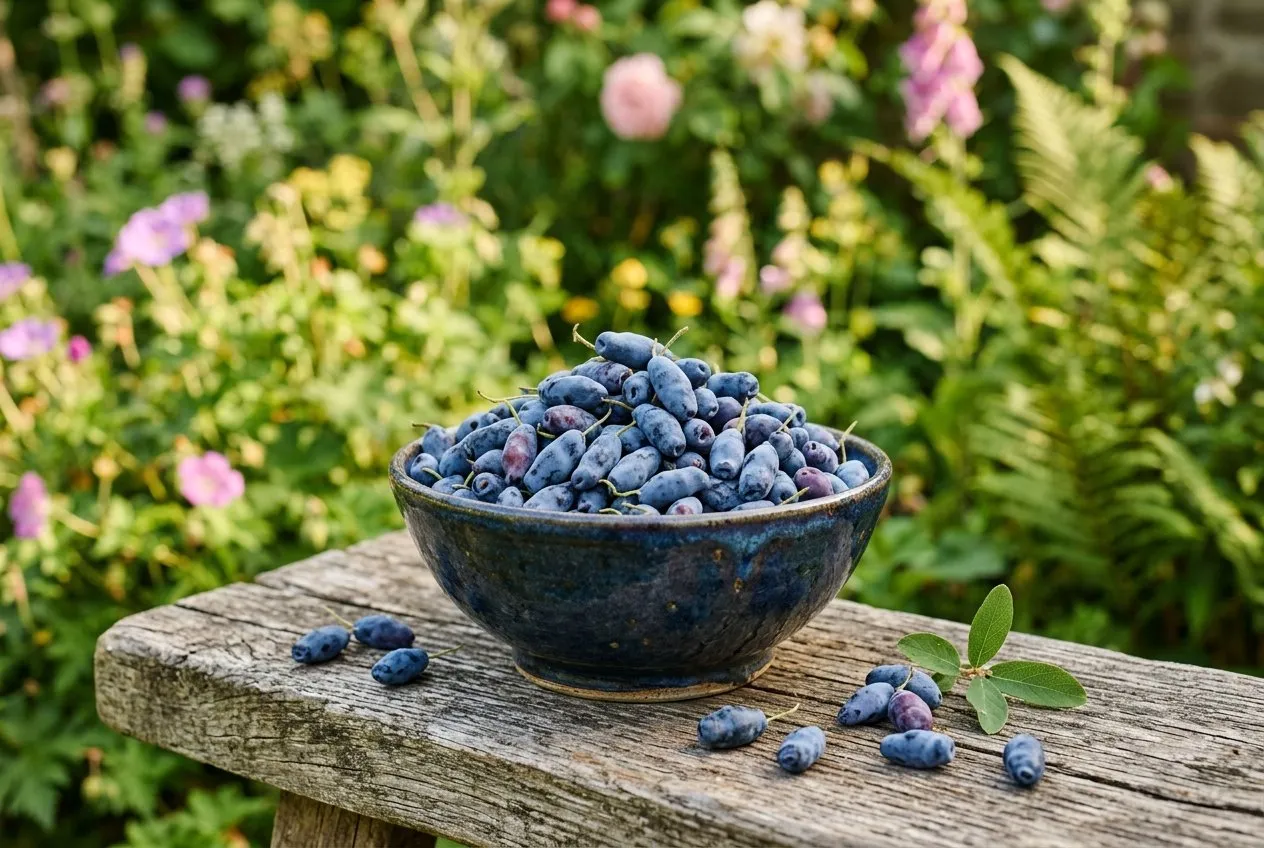 A bowl of freshly harvested honeyberries showing the characteristic elongated shape and blue-purple colour.
The berries look ready before they actually are. When the skin turns fully blue-purple, wait three to five more days. The flavour develops significantly in the final stage of ripening. Squeeze a berry gently. Ripe fruit is slightly soft and detaches easily from the branch. Unripe berries cling tight and taste bitter.
Picking technique
Pick honeyberries by hand, rolling each berry gently between thumb and forefinger until it detaches. Handle them carefully, as the skin bruises more easily than blueberries. Place berries in a shallow container to avoid crushing the bottom layer.
For larger harvests, lay a clean sheet or tray beneath the bush and shake the branches gently. Ripe berries drop while unripe ones stay attached. This method is faster but collects some leaf debris that needs sorting.
Yields and storage
Expect 1-2kg per bush in years three and four, rising to 2-5kg from year five onward. Morena and Blue Velvet are the heaviest croppers.
Fresh honeyberries keep for 3-5 days in the fridge. They are more perishable than blueberries, so eat or process them promptly. Freezing preserves them perfectly. Spread berries in a single layer on a baking tray, freeze solid, then transfer to bags. Frozen honeyberries keep for 12 months.
Uses in the kitchen
Honeyberries work everywhere blueberries do, with a more complex flavour profile:
- Fresh eating, the simplest and best way, straight from the bush
- Jam and preserves, high pectin content means they set easily without added pectin
- Smoothies, blend with yogurt, banana, and honey for a purple smoothie
- Baking, muffins, crumbles, pies, and cakes (substitute 1:1 for blueberries)
- Sauces, a tart honeyberry sauce pairs well with game and duck
- Wine and cordial, traditional use in Siberia and Japan
- Freezing, freeze for year-round use in cooking and baking
The berries are rich in vitamin C (up to 187mg per 100g, roughly three times the amount in blueberries), anthocyanins, and antioxidants. They also contain significant levels of potassium, calcium, and phosphorus.
Pests, diseases, and problems
Honeyberries are remarkably trouble-free in UK gardens. They suffer from none of the blueberry problems (soil pH issues, iron chlorosis) and avoid most of the diseases that plague other soft fruits.
Birds
This is the number one problem. Blackbirds, thrushes, starlings, and pigeons strip honeyberry bushes within days of the fruit ripening. Because the berries ripen in May, before most other fruit is available, birds target them heavily.
Net your bushes from late April. Use fine mesh netting (12mm or smaller) draped over a frame of canes or hoops. Never drape netting directly onto the bush, as birds get tangled and die. Secure the base of the netting to prevent blackbirds walking underneath. Remove netting after harvest to avoid trapping nesting birds.
Aphids
Honeysuckle aphids occasionally colonise young shoot tips in spring. They cause mild leaf curling but rarely affect fruit production. Squash them with your fingers or blast them off with a jet of water from a hose. Encourage ladybirds, hoverflies, and blue tits, which are natural predators. Chemical sprays are unnecessary and harm pollinators.
Powdery mildew
In hot, dry summers, a light dusting of powdery mildew may appear on older leaves. Improve air circulation by thinning congested growth. Water the base of the plant, not the foliage. Mildew on honeyberry is cosmetic and does not affect fruit quality or plant health.
Poor fruit set
If your bushes flower but produce no fruit, the cause is almost always inadequate cross-pollination. Check that you have two different named varieties. If both are the same variety (or unlabelled plants from the same nursery batch), add a genetically distinct cultivar. Also check that flowering periods overlap. If one variety flowers three weeks before the other, pollen transfer cannot happen.
Slow early growth
Honeyberries grow slowly in years one and two. This is normal and not a sign of problems. The root system establishes first, then top growth accelerates from year three. Resist the temptation to overfeed in an attempt to speed things up. Patience pays off with decades of reliable cropping.
Honeyberry compared to other soft fruit
Gardeners often ask how honeyberry compares to established favourites. Here is a direct comparison with raspberries, blueberries, and gooseberries.
| Feature | Honeyberry | Blueberry | Raspberry | Gooseberry |
|---|---|---|---|---|
| Harvest month | May-June | July-September | June-October | June-July |
| Soil pH | 4.5-7.5 (flexible) | 4.0-5.5 (acid only) | 5.5-6.5 | 6.0-6.5 |
| Self-fertile | No (needs 2 varieties) | Yes (improved with 2) | Yes | Yes |
| Hardiness | -45C | -20C | -20C | -25C |
| Productive life | 30+ years | 20+ years | 10-15 years | 15-20 years |
| Yield per plant | 2-5kg | 2-5kg | 2-4kg per row metre | 3-5kg |
| Maintenance | Very low | Moderate (pH management) | Moderate (training) | Low |
| Bird netting needed | Essential | Recommended | Recommended | Rarely |
Honeyberry fills a gap that no other fruit crop covers. Its May harvest comes when the fruit garden is otherwise empty. It thrives where blueberries fail. It outlives raspberries by decades. For gardeners who already grow the classic soft fruits, honeyberry is the obvious next addition.
Where to buy honeyberry plants in the UK
Honeyberry plants are increasingly available from specialist fruit nurseries. Expect to pay seven to twelve pounds per bare-root plant or ten to fifteen pounds for a container-grown specimen. Always buy named varieties so you can confirm pollination compatibility. Avoid unlabelled plants sold as “honeyberry,” as you cannot verify whether two plants are genetically different.
Reputable suppliers include specialist online fruit nurseries that ship bare-root plants from November to March. Garden centres sometimes stock container-grown plants in spring, but selection is limited. Buying direct from a fruit nursery gives the widest variety choice.
When purchasing, always buy at least two different named varieties. If you want to try dwarf fruit trees alongside your honeyberries, the two crops complement each other well in a mixed fruit garden since honeyberries harvest before tree fruit begins.
Month-by-month honeyberry calendar
| Month | Task |
|---|---|
| January-February | Prune established bushes (year 5+). Order bare-root plants from nurseries. |
| March | Apply granular fertiliser around each bush. Begin fortnightly liquid feeding for containers. |
| April | Check for early aphids on shoot tips. Erect bird netting before berries start colouring. |
| May | Harvest ripe berries. Continue watering container plants. Enjoy the earliest fruit of the year. |
| June | Complete harvest of late-ripening varieties. Remove bird netting. |
| July | Water during dry spells, especially first and second year plants. Stop liquid feeding containers. |
| August-September | No specific tasks. Bushes are low-maintenance in late summer. |
| October-November | Plant new bare-root or container-grown bushes. Apply a thick mulch of bark or compost. |
| December | No action needed. Bushes are fully dormant and completely frost-hardy. |
Frequently asked questions
What does honeyberry taste like?
Honeyberry tastes like a blend of blueberry and raspberry. The flavour has a tangy-sweet quality with hints of blackcurrant and grape. Sweetness varies by variety. Morena and Blue Velvet are the sweetest. Kamtschatica has a sharper, more complex taste. Ripe berries eaten straight from the bush have the best flavour.
Do I need two honeyberry plants to get fruit?
Yes, you must plant at least two different varieties. Honeyberries are not self-fertile. A single bush flowers but sets no fruit without pollen from a genetically different cultivar. Plant two or more varieties within 3 metres of each other. Bees and bumblebees transfer pollen between plants.
When do honeyberries fruit in the UK?
Honeyberries ripen from mid-May to early June in most UK regions. This makes them the earliest fruiting crop in British gardens, beating strawberries by two to three weeks. Southern gardens harvest first. Northern and Scottish gardens pick from late May onward.
Can I grow honeyberry in a container?
Yes, honeyberries grow well in large containers. Use a pot of at least 40 litres filled with peat-free compost mixed with grit for drainage. You still need two different varieties in separate pots for cross-pollination. Water regularly in summer and feed with a balanced liquid fertiliser fortnightly from March to July.
Are honeyberries the same as blueberries?
No, they are completely different plants. Honeyberries (Lonicera caerulea) belong to the honeysuckle family. Blueberries (Vaccinium) belong to the heather family. Honeyberries tolerate alkaline soil while blueberries need acid conditions at pH 4.0-5.5. Honeyberry fruit is elongated, not round.
How big does a honeyberry bush get?
Most honeyberry varieties reach 1.2-1.8m tall and 1-1.5m wide. They are compact, deciduous shrubs similar in size to a blackcurrant bush. Growth is slow in the first two years then speeds up. Bushes reach full size by year five.
Do birds eat honeyberries?
Yes, birds love honeyberries. Blackbirds, thrushes, and starlings strip bushes quickly once berries ripen. Net your plants from late April onward using fine mesh (12mm or smaller). Drape netting over a frame rather than directly on the bush to prevent birds getting tangled.
Our team produces practical UK gardening guidance from source research, contributor records and established horticultural practice. Editorial standards are overseen by Matt W.