Key takeaways
- Oyster mushrooms are the easiest species for UK beginners, fruiting in 7-14 days from a kit
- A ready-made mushroom growing kit costs 15-25 pounds and produces 500-800g across 2-3 flushes
- Shiitake logs inoculated with dowel spawn produce mushrooms for 4-6 years after an initial 6-12 month colonisation
- Indoor growing needs 15-21 degrees C, 80-90% humidity, and indirect light, making UK homes ideal
- Contamination is the main failure point: sterilise substrate, wash hands, and work in still air to prevent mould
Learning to grow mushrooms at home in the UK is one of the most rewarding and unusual food-growing projects you can start with almost no space, no garden, and no sunlight. Unlike every other crop, mushrooms thrive in cool, dark conditions that would kill most plants. A spare shelf in a kitchen, a shaded corner of a garage, or a patch of woodland is all you need.
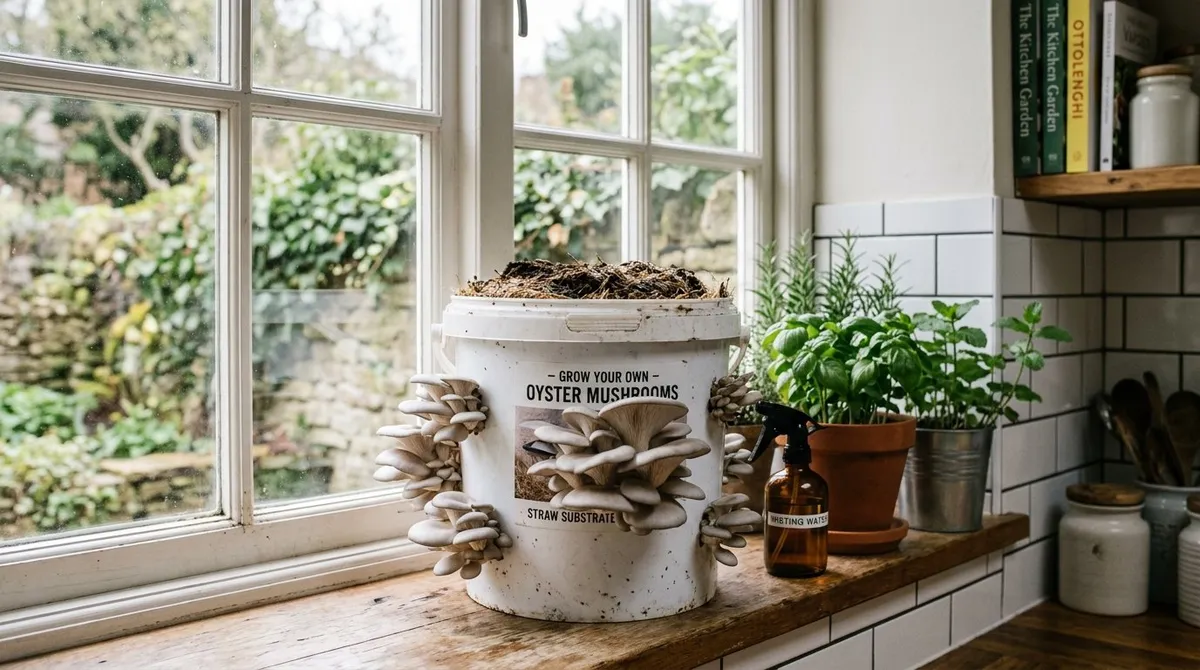
Oyster mushrooms are the easiest type to start with, grown in a bucket of pasteurised straw, as our guide to growing oyster mushrooms explains.
This guide covers four species suited to UK conditions, three growing methods, and a full cost breakdown based on three years of hands-on testing. If you are already composting kitchen waste, see our guide to making compost for substrate material ideas.
Which mushrooms can you grow at home in the UK?
Four species grow reliably in UK homes and gardens. Each has different flavour, texture, and growing requirements. The table below compares them side by side.
| Species | Difficulty | Temperature | Time to Harvest | Yield per Kit/Log | Flavour | Best Method |
|---|---|---|---|---|---|---|
| Oyster (Pleurotus ostreatus) | Easy | 10-24°C | 7-14 days | 500-800g | Mild, velvety | Straw bucket or kit |
| Shiitake (Lentinula edodes) | Moderate | 12-20°C | 6-12 months (log) | 1-2kg over 4-6 years | Rich, umami | Hardwood log |
| Lion’s Mane (Hericium erinaceus) | Moderate | 15-20°C | 14-21 days | 300-500g | Lobster-like | Supplemented sawdust |
| King Oyster (Pleurotus eryngii) | Moderate | 12-18°C | 14-21 days | 400-600g | Meaty, firm | Straw or sawdust |
Oyster mushrooms are the species to start with. They colonise substrate faster than competing moulds, tolerate temperature swings, and produce generous flushes. Grey and blue oyster varieties are hardiest for UK conditions. Pink and yellow oysters need warmer temperatures (18-24°C) and suit summer growing or heated spaces.
Shiitake is the best long-term investment. A single oak log inoculated with dowel spawn costs under 10 pounds to set up and produces 1-2kg of mushrooms over 4-6 years. The initial wait of 6-12 months tests your patience, but after that first flush the log fruits twice yearly with almost no maintenance.
How do mushroom growing kits work?
Ready-made mushroom growing kits are the fastest route to a first harvest. A kit contains a block of pre-colonised substrate, usually a mix of hardwood sawdust and grain, fully permeated with mushroom mycelium. You cut a slit or opening in the bag, mist it with water twice daily, and mushrooms appear within 7-14 days.
Most UK suppliers sell oyster, shiitake, lion’s mane, and king oyster kits for 15-25 pounds each. Expect 500-800g of mushrooms across two to three flushes from a single kit. After the third flush, yields drop and you should add the spent block to your compost bin or use it as mulch.
Kits are ideal for beginners because the substrate is already sterilised and colonised, removing the two steps where most DIY growers fail. Keep kits out of direct sunlight, away from radiators, and in a room at 15-21°C. A north-facing kitchen windowsill or a utility room works well. Mist the opening with a clean spray bottle morning and evening to maintain 80-90% humidity around the fruiting area.
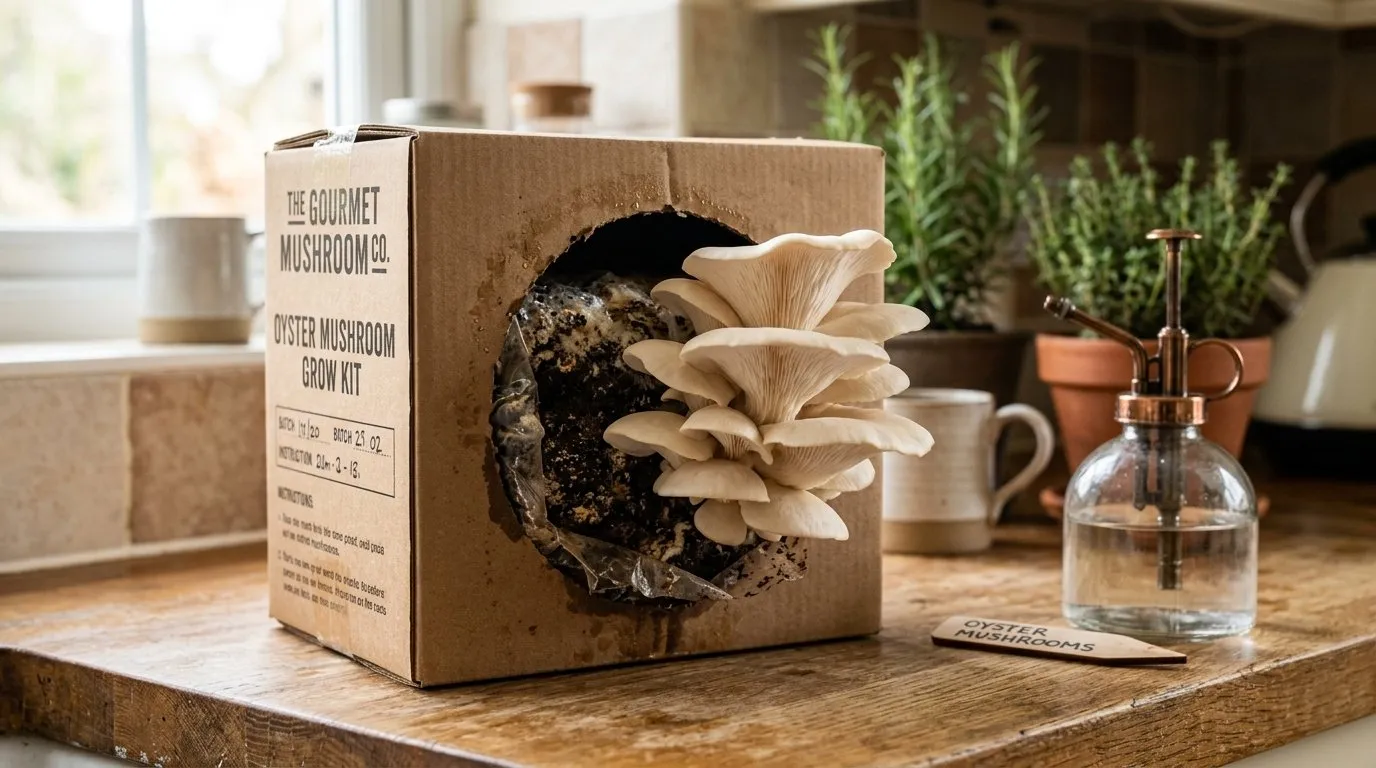 An oyster mushroom kit producing its first flush on a kitchen shelf. Kits cost 15-25 pounds and fruit in 7-14 days.
How do you grow mushrooms in buckets of straw?
Bucket growing is the most cost-effective DIY method. A 20-litre bucket with holes drilled in the sides, filled with pasteurised straw and grain spawn, produces 400-700g of oyster mushrooms per flush. Materials cost 5-8 pounds per bucket, roughly a quarter of a ready-made kit.
Step-by-step process:
A single bucket produces two to three flushes over 4-6 weeks. Soak the colonised straw block in cold water for 12 hours between flushes to rehydrate it.
How do you grow shiitake mushrooms on logs?
Log growing is the traditional outdoor method and the best way to produce shiitake in a UK garden. Freshly cut hardwood logs, ideally oak, beech, or birch, are drilled with holes, plugged with dowel spawn, sealed with wax, and left in a shaded spot to colonise over 6-12 months.
Requirements:
- Fresh-cut hardwood logs, 10-15cm diameter, 90-120cm long, felled within the last 4 weeks
- Dowel spawn (100 dowels cost 10-15 pounds, enough for 3-4 logs)
- A 10mm drill bit and drill
- Food-grade cheese wax or beeswax
- A shaded outdoor area with some rainfall
Drill holes 15cm apart in a diamond pattern along the log, push in dowel spawn, and seal each hole with melted wax to prevent contamination. Stack the inoculated logs in a shaded spot, off the ground on bricks or pallets. A north-facing fence line or under deciduous trees works well. The logs need rainfall to stay moist, so avoid covering them.
After 6-12 months, white mycelium appears on the cut ends of the log. To trigger fruiting, soak the entire log in cold water for 24 hours. Shiitake pins appear within 5-7 days. Each log produces two flushes per year, spring and autumn, for 4-6 years. A 120cm oak log weighing 8-10kg yields roughly 300-500g per year.
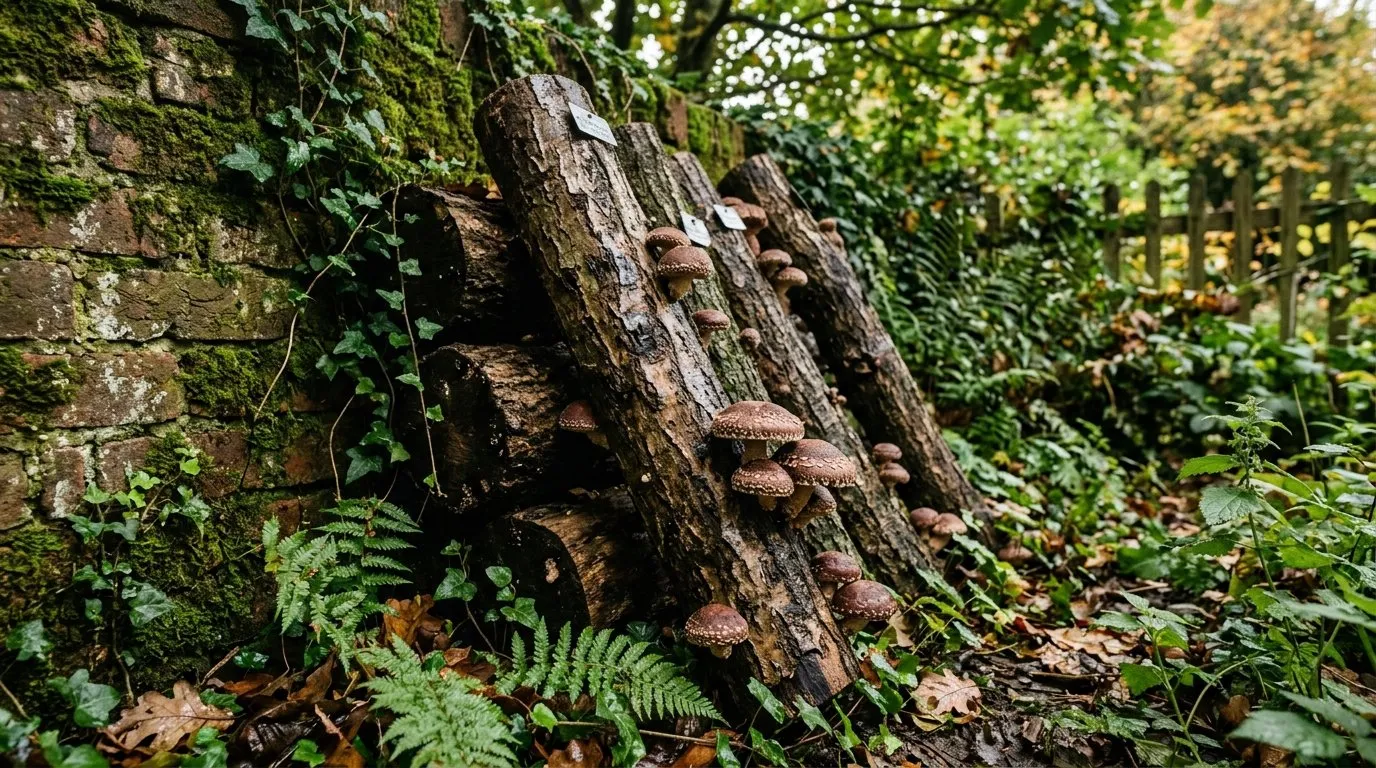 Shiitake mushrooms emerging from oak logs after 10 months of colonisation. Logs produce for 4-6 years in a shaded UK garden.
What temperature and humidity do mushrooms need?
Getting temperature and humidity right is the difference between a full harvest and a failed grow. Mushrooms have two distinct phases: colonisation (when mycelium spreads through substrate) and fruiting (when mushrooms form and grow). Each phase has different requirements.
Colonisation phase: Most species colonise best at 20-24°C in darkness with moderate humidity. This is when the mycelium network builds through the substrate. Colonisation takes 10-21 days depending on species, spawn rate, and temperature. Too cold and colonisation stalls. Too hot (above 30°C) and the mycelium dies or competitor moulds take over.
Fruiting phase: A temperature drop of 5-10°C triggers fruiting in most species. Oyster mushrooms fruit at 10-18°C, shiitake at 12-20°C, and lion’s mane at 15-20°C. UK homes in autumn and spring sit naturally in this range. Humidity must stay at 80-90% around the fruiting area. Mist with a clean spray bottle twice daily or place the grow near a tray of damp perlite. A humidity tent made from a clear plastic bag with holes punched in it works well for single kits.
Fresh air exchange matters during fruiting. Mushrooms release CO2 as they grow. High CO2 causes long, thin stems with tiny caps (a common sign of poor ventilation in oyster mushrooms). Open a window for 10 minutes twice daily or use a small fan on its lowest setting. Balance airflow against humidity: too much air movement dries out the fruiting bodies.
What are the most common mushroom growing problems?
Contamination, drying out, and poor fruiting account for nearly every failure. Each has a clear cause and a straightforward fix.
Green mould (Trichoderma) is the most common contaminant. It appears as bright green patches on the substrate and spreads rapidly. Causes include inadequate pasteurisation, dirty hands, airborne spores, or spawn that was already contaminated. Prevention: pasteurise substrate thoroughly, wash hands before handling, work in still air away from open windows, and use spawn from reputable UK suppliers. The same sterile approach applies to organic pest control in the garden. If green mould covers more than 30% of the substrate, discard the entire batch in your garden waste bin.
Drying out kills more grows than contamination. Mushrooms are 90% water. If the substrate dries below 60% moisture content, mycelium stalls and fruiting stops. Mist exposed surfaces twice daily. Check straw substrate by squeezing a handful: it should feel like a wrung-out sponge. If it crumbles, soak the entire block in cold water for 6-12 hours.
Leggy stems with small caps indicate too much CO2 and not enough fresh air. Increase ventilation by opening a window or moving the grow to a less enclosed space. This is especially common with oyster mushrooms grown in sealed cupboards.
No fruiting at all usually means the temperature is wrong or the substrate is exhausted. Check the temperature against the species requirements in the comparison table above. If the mycelium has colonised fully (visible white throughout) but nothing fruits after 3 weeks, try a cold shock: place the colonised block in a fridge at 2-5°C for 24 hours, then return it to fruiting conditions.
How do you harvest and store home-grown mushrooms?
Harvest mushrooms when the cap edges are still slightly curled under, before they flatten out and release spores. Twist and pull the entire cluster from the substrate in one piece. Cutting with a knife leaves a stump that can rot and attract contamination.
Timing matters. Oyster mushrooms double in size every 24 hours once they start fruiting. Check your grow morning and evening. A cluster that looks small at breakfast can be ready by dinner. Harvest the whole cluster at once rather than picking individual mushrooms.
Storage: Fresh mushrooms keep for 5-7 days in a paper bag in the fridge. Never store in plastic bags or sealed containers, as trapped moisture causes sliminess within 24 hours. Oyster mushrooms dry well in a dehydrator at 50-55°C for 6-8 hours or in an oven on its lowest setting with the door ajar. Dried mushrooms rehydrate in warm water in 20 minutes and keep for 12 months in an airtight jar.
Shiitake are best sliced and dried. Their umami flavour intensifies with drying. Lion’s mane does not dry well and is best eaten fresh, sliced and pan-fried in butter until golden.
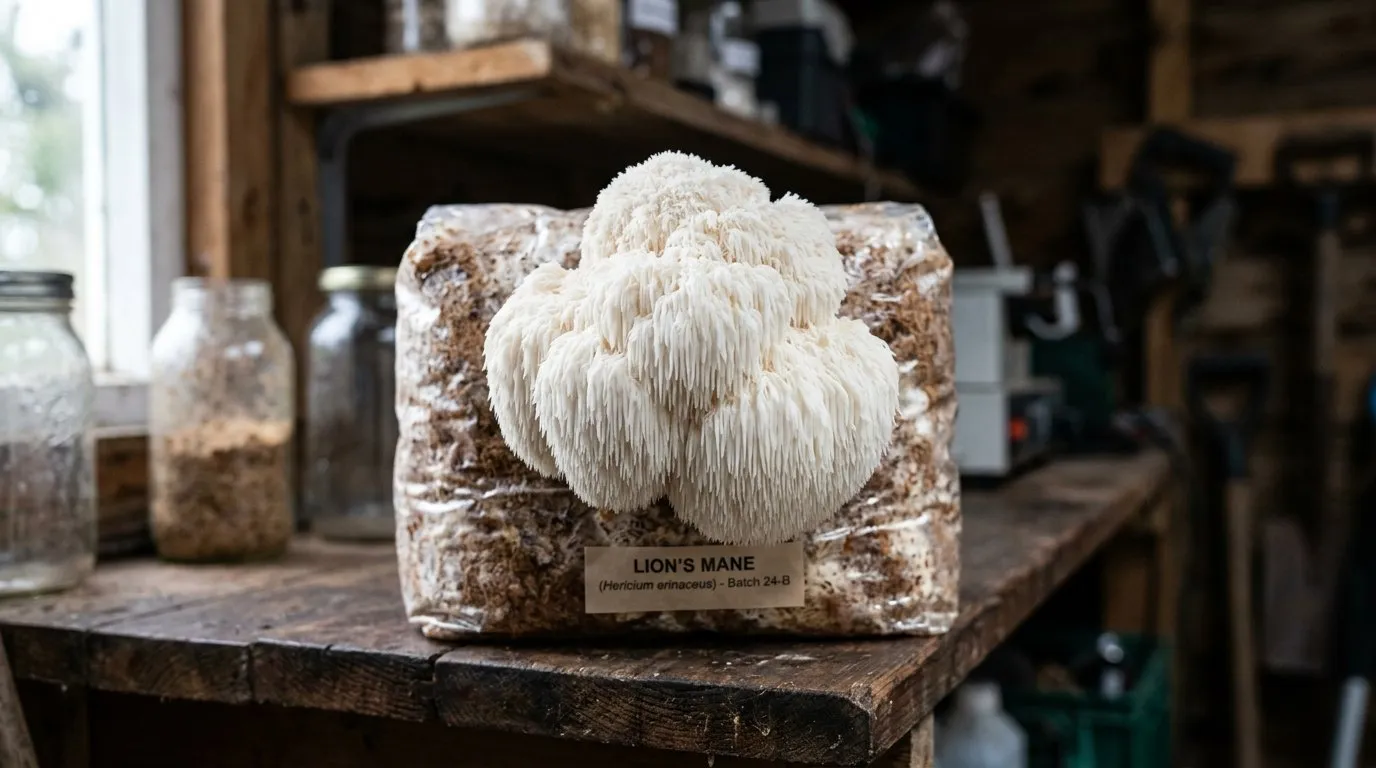 Lion’s mane mushroom fruiting from a supplemented sawdust block. This species has a lobster-like flavour and takes 14-21 days from inoculation to harvest.
How much does it cost to grow mushrooms at home?
Home mushroom growing is cheap compared to buying from shops. Supermarket oyster mushrooms cost 12-16 pounds per kilogram. Home-grown oyster mushrooms from a DIY bucket cost roughly 2-3 pounds per kilogram in materials.
| Method | Setup Cost | Ongoing Cost | Yield | Cost per kg |
|---|---|---|---|---|
| Ready-made kit | 15-25 pounds | None (single use) | 500-800g (2-3 flushes) | 20-50 pounds |
| DIY straw bucket | 8-12 pounds (bucket, drill bit) | 5-8 pounds per batch (straw + spawn) | 400-700g per flush | 2-3 pounds |
| Shiitake log | 10-15 pounds per log (spawn + wax) | None | 1-2kg over 4-6 years | Under 2 pounds |
| Supplemented sawdust block | 12-18 pounds (materials) | 6-10 pounds per block | 300-500g | 3-5 pounds |
Grain spawn is the main recurring cost for DIY growers. A 1kg bag costs 8-12 pounds from UK suppliers and inoculates 4-5 straw buckets. Straw costs 3-4 pounds per small bale from equestrian suppliers or farm shops. Hardwood sawdust pellets cost 5-8 pounds per 10kg bag from wood fuel suppliers.
The cheapest long-term method is shiitake log growing. After the initial spawn cost of 10-15 pounds per log, there is no further expense. A single log produces for 4-6 years. Three logs inoculated in rotation provide year-round harvests from a shaded corner of the garden that grows nothing else.
When is the best time to start growing mushrooms in the UK?
You can start growing mushrooms indoors at any time of year. Indoor temperatures in UK homes stay within the 15-21°C range that suits most species regardless of season. Autumn and spring are slightly easier because natural humidity is higher and temperature swings are smaller.
For outdoor log growing, the best time to inoculate is February to April. Freshly felled hardwood from winter tree surgery has the highest sugar content, which feeds the mycelium during colonisation. Logs cut in summer have lower moisture content and dry out faster. If you are planning to fell your own trees, check our no-dig gardening guide for ideas on using the cleared space.
Seasonal schedule for UK mushroom growers:
- January-February: Order spawn and kits from UK suppliers. Fell hardwood logs for shiitake.
- March-April: Inoculate shiitake logs. Start first indoor oyster mushroom kit or bucket.
- May-August: Peak fruiting season for indoor grows. Oyster mushrooms fruit faster in warm weather. Keep an eye on humidity levels, as summer heat dries substrate quickly.
- September-November: Soak shiitake logs to trigger autumn flush. Start lion’s mane or king oyster indoors.
- December: Maintain indoor grows at 15-18°C. This is ideal for slower-growing species like shiitake blocks.
King oyster mushrooms prefer cooler conditions (12-18°C) and fruit best in autumn and winter, making them a good complement to oyster mushrooms in summer. Rotating species means year-round harvests from the same growing space. For more seasonal growing ideas, see our seed sowing calendar.
Where do you buy mushroom spawn in the UK?
Buying quality spawn from a reputable UK supplier is the most important factor in a successful grow. Spawn that has been stored too long or shipped from overseas in warm conditions arrives partially colonised by contaminants before you even open the bag.
UK-based spawn suppliers include:
- Gourmet Mushrooms Ltd (Sussex) - grain spawn, dowel spawn, and ready-made kits for all major species
- Mushroom Box (Devon) - beginner kits and grow-your-own subscriptions
- Mycelium Emporium (Scotland) - grain spawn, agar cultures, and hardwood dowel spawn
- Forest Fungi (Somerset) - specialising in log-grown shiitake spawn and outdoor wine cap spawn
The Royal Horticultural Society recommends starting with a kit before progressing to DIY substrate growing. Spawn should arrive as a white, fully colonised bag of grain with no green, black, or orange patches. Store unused spawn in a fridge at 2-5°C and use within 4 weeks.
For outdoor growing, wine cap mushrooms (Stropharia rugosoannulata) deserve a mention. They grow on wood chip mulch spread directly on garden beds at 10-15cm depth. Inoculate in spring and harvest in autumn. Wine caps pair perfectly with raised bed gardening because the mycelium breaks down wood chip mulch into rich soil over a season, feeding the bed plants at the same time.
Can you grow mushrooms in a greenhouse?
A greenhouse provides excellent conditions for mushroom growing in autumn, winter, and early spring when temperatures drop and light levels fall. Most mushrooms prefer 12-20°C and indirect light, exactly the conditions in an unheated greenhouse from October to April. In summer, greenhouses are too hot for most species unless heavily shaded and ventilated.
Shade the greenhouse with 90% shade cloth or place grow bags under staging where light is lowest. Mushrooms pinned in direct sun develop dry, cracked caps. Humidity is naturally higher in a closed greenhouse, which benefits fruiting. Open vents for 30 minutes twice daily to provide fresh air exchange.
A north-facing greenhouse wall or the space under staging is ideal. Lion’s mane and king oyster grow particularly well in greenhouses because the stable overnight temperatures prevent the thermal shocks that stall fruiting in garages and sheds. For greenhouse growing in the warmer months, see our greenhouse growing calendar for ideas on what else to grow alongside mushrooms. Managing greenhouse ventilation and humidity is key to stopping condensation problems when growing mushrooms indoors.
How do you grow lion’s mane mushrooms at home?
Lion’s mane (Hericium erinaceus) is the gourmet species every serious home grower wants to try. Its flavour is often compared to lobster or crab, and it grows as a single shaggy white mass rather than conventional cap-and-stem mushrooms. It costs 25-40 pounds per kilogram in UK restaurants, making it the highest-value species for home growing.
Lion’s mane needs supplemented hardwood sawdust: 80% hardwood sawdust pellets mixed with 20% wheat bran by dry weight, hydrated to 60-65% moisture content, and sterilised in bags or jars at 15 PSI for 90 minutes in a pressure cooker. This is more demanding than pasteurised straw for oyster mushrooms, but the results justify the effort.
Inoculate the cooled, sterilised blocks with grain spawn at 5-10% by weight. Seal the bags and incubate at 21-24°C for 14-21 days until fully colonised. Cut a 5cm slit in the bag and mist twice daily. A single fruiting body grows to 200-400g in 7-10 days. Lion’s mane produces one to two flushes per block.
The spent blocks break down into rich organic matter. Add them to your wormery or dig directly into garden beds as a soil amendment. The enriched soil is excellent for growing herbs and leafy salads the following season.
Is it safe to eat home-grown mushrooms?
Yes, all mushrooms grown from commercial spawn on prepared substrate are safe to eat. The spawn comes from a controlled culture of a known edible species. There is no identification risk, unlike foraging, because you know exactly what species you inoculated.
The safety concern with home growing is not toxicity but contamination. Moulds like Trichoderma, Aspergillus, and Penicillium can colonise poorly prepared substrate. These moulds are visible as green, black, or orange patches. Never eat mushrooms from a contaminated substrate. If the mycelium is white and healthy and the mushrooms look normal with no unusual colours or smells, they are safe.
According to the British Mycological Society, the species most commonly grown at home in the UK (oyster, shiitake, lion’s mane, and king oyster) have no toxic lookalikes when grown on prepared substrate. Wild foraging requires expert identification skills, but home growing on commercial spawn does not.
Store harvested mushrooms in a paper bag in the fridge and consume within 5-7 days. Cook all mushrooms thoroughly before eating. Raw or undercooked shiitake can cause shiitake flagellate dermatitis, a temporary skin rash triggered by the compound lentinan in raw shiitake. Cooking for 10 minutes at high heat deactivates lentinan completely.
Frequently asked questions
What is the easiest mushroom to grow at home in the UK?
Oyster mushrooms are the easiest species for UK beginners. They tolerate a wide temperature range (10-24°C), colonise substrate fast, and resist contamination better than other species. Pink, yellow, blue, and grey oyster varieties all grow well in UK homes. A ready-made oyster kit fruits in 7-14 days with almost no effort beyond misting with water twice daily.
Can you grow mushrooms indoors all year round?
Yes, indoor mushroom growing works in every season in the UK. Most edible species fruit at 15-21°C, which matches typical UK indoor temperatures. Mushrooms need no sunlight, only indirect ambient light. Winter is actually ideal because central heating lowers humidity, which you control with a spray bottle. Rotate oyster and lion’s mane kits for continuous harvests every 2-3 weeks.
How much does it cost to grow mushrooms at home?
A ready-made kit costs 15-25 pounds and produces 500-800g of mushrooms. DIY bucket growing costs roughly 5-8 pounds per batch using straw (3-4 pounds per bale) and grain spawn (8-12 pounds per kg, enough for 4-5 buckets). Shiitake dowel spawn costs 10-15 pounds per 100 dowels, enough for 3-4 logs that fruit for 4-6 years. Per kilogram, home-grown mushrooms cost 70-80% less than supermarket equivalents.
How long does it take to grow mushrooms from scratch?
Oyster mushrooms fruit in 7-14 days from a colonised kit. DIY bucket grows take 2-4 weeks from inoculation to first harvest. Shiitake logs need 6-12 months of colonisation before producing their first flush, but then fruit twice yearly for 4-6 years. Lion’s mane takes 14-21 days from inoculation on supplemented sawdust. Total time depends on species and method.
Why do my mushroom growing kits keep getting green mould?
Green mould (Trichoderma) means contamination has outcompeted your mushroom mycelium. Common causes include non-sterile substrate, dirty hands, airborne spores from an open window, or a kit stored too long before use. Always wash hands before handling kits, mist with clean water only, and keep kits away from compost bins, houseplants, and fruit bowls. A kit with green mould covering more than 30% of the surface should be discarded.
Can you grow mushrooms on coffee grounds?
Coffee grounds work as a partial substrate but fail alone for most species. Fresh grounds are already pasteurised by the brewing process, which is their main advantage. However, their high nitrogen content and moisture make them prone to contamination within days. Mix grounds at no more than 20-30% with pasteurised straw or hardwood pellets. Use grounds within 24 hours of brewing. Oyster mushrooms are the only species that tolerate coffee ground mixes reliably.
What is the best substrate for growing mushrooms at home?
Pasteurised straw is the best all-round substrate for home growing. It is cheap (3-4 pounds per bale), widely available from farm shops and equestrian suppliers, and suits oyster, king oyster, and wine cap mushrooms. Hardwood sawdust pellets (5-8 pounds per 10kg bag) suit shiitake and lion’s mane. Supplemented sawdust (sawdust plus 10-20% wheat bran) increases yields by 30-50% but raises contamination risk. Fresh hardwood logs are best for outdoor shiitake.
Our team produces practical UK gardening guidance from source research, contributor records and established horticultural practice. Editorial standards are overseen by Matt W.