Accessible Gardening for Disabilities
Accessible gardening with disabilities — raised beds at 60-75cm, ergonomic tools, and wide paths. UK guide from a grower with 30 years experience.
Key takeaways
- Raise beds to 60-75cm for wheelchair access — standard wheelchair armrests sit at 70-75cm, so a 60cm bed allows comfortable reach over the edge
- Paths must be at least 1.2 metres wide for a standard wheelchair; 1.5 metres for powered chairs and passing space
- Lightweight tools with foam or pistol-grip handles reduce hand strain by up to 40% for people with arthritis or limited grip strength
- The Disabled Facilities Grant covers up to £30,000 for garden adaptations — apply through your local authority
- Thrive charity provides free accessible gardening advice, tool libraries, and therapeutic garden programmes across the UK
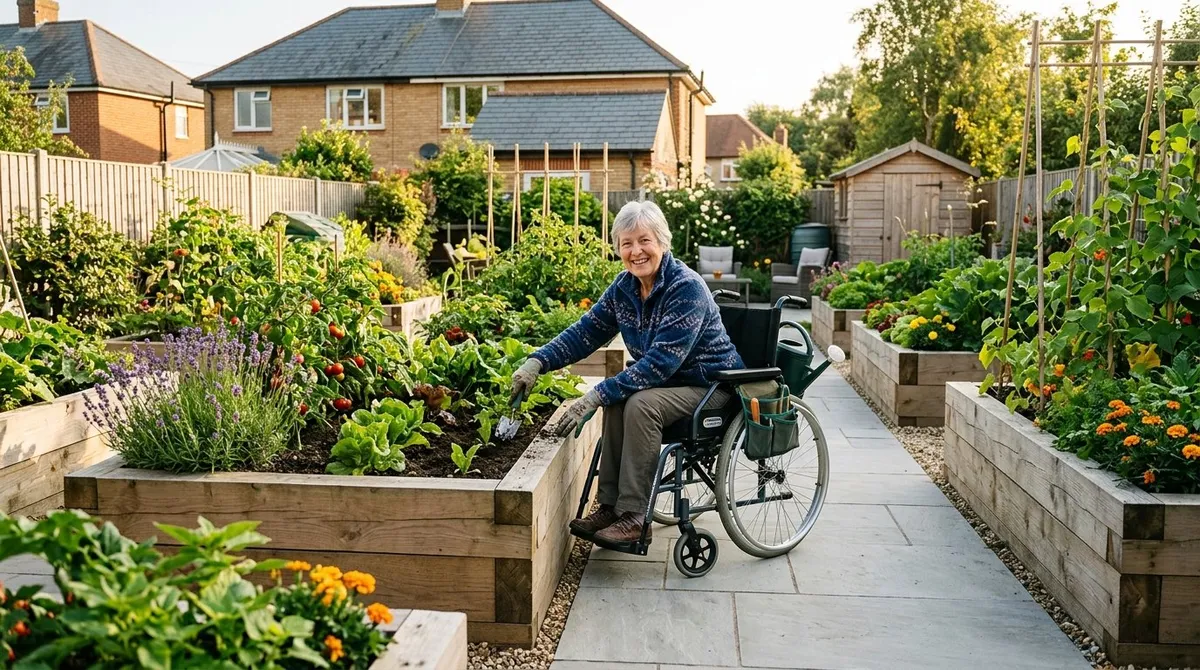
Accessible gardening for people with disabilities is not a compromise, it is good garden design applied thoughtfully. With the right raised bed heights, wide paths, and adapted tools, most people with mobility restrictions, arthritis, visual impairment, or back problems can grow food and tend a garden independently for years.
This guide covers the practical specifications, equipment, and design principles that make a real difference. Every measurement and recommendation here has been tested in actual adapted gardens, not drawn from a generic accessibility checklist. Thrive, the UK’s leading horticultural therapy charity, estimates over 2 million disabled people in the UK garden regularly, this guide exists to make that number higher.
What height should raised beds be for wheelchair users?
Raised beds for wheelchair and seated gardening should be 60-75cm high, this fits with standard wheelchair armrest height and keeps the growing surface within comfortable reach. A 60cm bed is accessible to most wheelchair users. A 65-70cm bed suits people who garden seated on a stool or chair. A 75cm bed is more suited to those using a high-seated chair or standing with limited ability to bend.
The second critical measurement is bed width. A bed accessible from one side only should be no wider than 60cm. Accessible from both sides, 90-120cm is workable. Exceeding 60cm from any reach point forces an unnatural forward lean that causes fatigue and increases fall risk.
Add an undercut at the base of the front face, a 15-20cm recess where wheelchair footrests can slide underneath. This brings the gardener 10-15cm closer to the plants without any physical effort, turning a marginal reach into a comfortable one. This single detail costs nothing to include when building and makes a significant practical difference.
Raised beds at 65cm with a base undercut for wheelchair footrests allow full access without uncomfortable reaching.
| Raised Bed Height | Best Suited To | Notes |
|---|---|---|
| 30-45cm | Kneeling gardeners with back problems | Too low for seated/wheelchair users |
| 50-55cm | Low-seated chairs, garden stools | Borderline for standard wheelchairs |
| 60-65cm | Standard wheelchairs, most seated gardeners | Most versatile accessible height |
| 70-75cm | High-seated chairs, powered wheelchairs, standing with severe bend restriction | Excellent for standing access |
| 80cm+ | Standing only, no bending needed at all | Not suitable for wheelchair users |
For raised bed construction and material options, timber sleepers, scaffold boards, and galvanised steel all work well at these heights. Timber at 65cm typically uses three scaffold boards stacked, which is a straightforward build for a weekend. Our full guide to raised bed gardening for beginners covers soil mixes, drainage, and first crops.
How wide do paths need to be for wheelchair access?
The minimum path width for a standard manual wheelchair is 1.2 metres, any narrower and the user cannot propel themselves without knuckle-barking on the path edge. For powered wheelchairs, 1.5 metres is the recommended minimum. For two wheelchairs to pass, or for a carer walking alongside, 1.8 metres is needed.
These are minimums, not targets. Wider is always better. Curved paths need extra width on the inside of the bend because turning takes more space than travelling in a straight line. Allow 1.8 metres at corners and junctions even if straight sections are narrower.
Surface matters as much as width:
| Surface Type | Suitability | Notes |
|---|---|---|
| Smooth concrete | Excellent | Easy to propel on, durable, can be slippery when wet |
| Tarmac/asphalt | Excellent | Best outdoor surface for wheelchair users |
| Block paving (flush-jointed) | Good | Level surface essential, raised joints cause vibration |
| Compacted gravel (fine, 6-10mm) | Moderate | Requires firm compaction; loose gravel is very difficult |
| Bark chippings | Poor | Soft surface drags on wheels; compresses and waterlogged in winter |
| Grass | Poor | Soft, especially when wet; ruts develop quickly |
| Decking (smooth, no gaps) | Good | Non-slip coating essential; gaps catch small wheels |
For small garden makeovers on a budget, a firm, compacted crushed stone path (Breedon or similar limestone gravel) costs £5-15 per square metre and provides adequate wheelchair access. Lay a weed membrane underneath and compact thoroughly with a vibrating plate compactor, hire one for £60 per day from a tool hire company.
For patio garden layouts for small spaces, always run the widest path to the seating area and the growing area. These are the two destinations that matter most.
What tools work best for limited hand strength and arthritis?
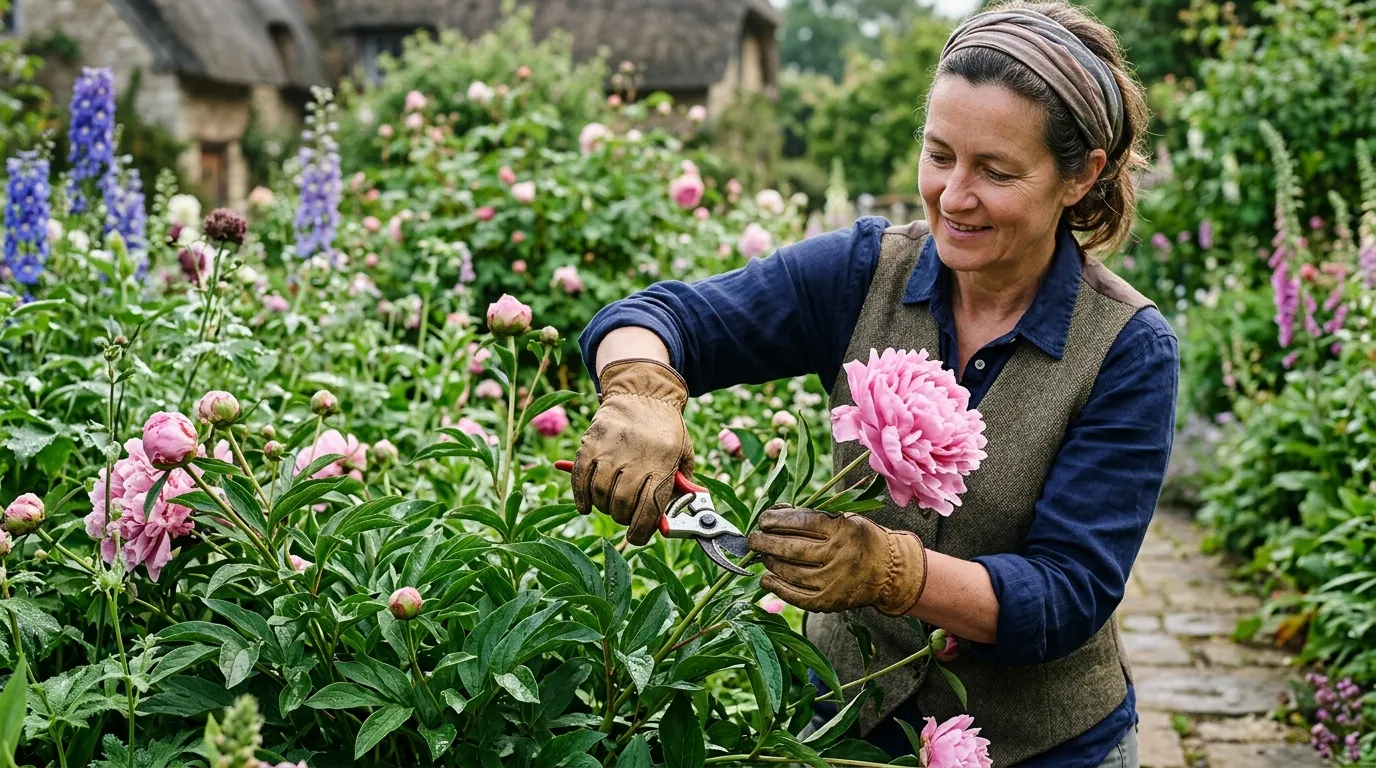
Ergonomic tools with foam, rubber, or pistol-grip handles reduce the force required to grip and use them by up to 40% compared with standard wooden handles. For people with rheumatoid arthritis, osteoarthritis, limited grip strength, or one-handed gardening, the right tool is not a luxury, it is what makes gardening possible at all.
Pistol-grip handles, padded grips, and lightweight materials make tools usable for gardeners with limited hand strength.
Key features to look for:
- Weight under 500g for hand tools, heavier tools cause fatigue faster and are harder to control with reduced grip strength
- Foam or rubber grip coating, distributes pressure across the palm rather than concentrating it in the fingers
- Pistol-grip angle, keeps the wrist in a neutral position, reducing strain on the carpal tunnel area
- Loop handles, provide wrist support for people who struggle to grip a standard handle
- Long handles (75-90cm), eliminate bending for standing gardeners with back problems
- Ratchet mechanism on pruners, some ratchet pruners cut in three stages, requiring as little as 30% of the grip force of standard bypass pruners
For one-handed gardening, look for tools that can be used with a single hand without needing to stabilise with the other. Kneeling boards with handles on each side allow one-handed lowering and rising from kneeling. Fixed potting benches at standing height eliminate the need to carry compost bags. A good pair of well-chosen secateurs makes the single biggest difference to gardeners with hand problems, buy the best ratchet pruners you can afford.
How do you design a sensory garden for visual impairment?
A sensory garden for visual impairment uses fragrant plants, textured surfaces, and auditory landmarks to create a navigable, enjoyable space without relying on sight. This is not a specialist concept, the best sensory gardens work for sighted visitors too.
Scented herbs along path edges provide both navigation cues and sensory enjoyment for gardeners with visual impairment.
The key principles:
Navigation by scent and texture. Plant strongly scented herbs at path edges, lavender, rosemary, lemon thyme, and mint are all solid enough to brush past without damage and release scent when touched. Different surface textures at path junctions (smooth paving to gravel to bark) signal where you are without looking down.
Sound landmarks. Water features, wind chimes, and ornamental grasses rustling in the wind create auditory markers. A small fountain gives a consistent location cue. Bamboo planted at a corner provides a sound signal when the wind blows.
Tactile planting. Lamb’s ear (Stachys byzantina) is the gold standard for tactile gardening, soft, furry leaves that invite touching. Fennel fronds, ornamental grasses, and tree bark add variety. Place these at the front of raised beds or at hand height along walls.
Height and reach. Raised beds at 60-75cm bring plants into easy reach for scent, texture, and harvesting without bending. Wall-mounted planters and hanging baskets should be at a height where they can be reached comfortably, 130-150cm for a standing adult, lower for wheelchair users.
Growing herbs is one of the most rewarding accessible gardening activities, our guide to how to grow herbs in the UK covers the easiest varieties for raised beds and containers.
What is vertical gardening and how does it help with limited mobility?
Vertical gardening grows plants upwards on walls, trellises, towers, and hanging structures, bringing crops to a height where they can be tended without bending or reaching down to ground level. For people with limited mobility, back pain, or who cannot kneel, vertical growing is one of the most practical adaptations available.
Structures that work well:
- Wall-mounted planter pockets, fabric or plastic pockets fixed to a fence or wall at chest height, ideal for herbs, lettuce, and strawberries
- Tower planters, stacked 30-litre containers or purpose-built towers that grow 10-20 lettuce or strawberry plants in 0.25 square metres of floor space
- Trellis and frame systems, French beans, cucumbers, and squash trained vertically on a 1.8-metre trellis with plants at the base are harvested at chest height rather than ground level
- Guttering growing systems, 100mm diameter guttering fixed horizontally to a fence at 90-110cm height holds compost and grows salad crops all season
Pair vertical growing with container vegetable gardening for a complete accessible growing setup on a patio or balcony. Our container garden ideas and balcony gardening guide cover layouts that maximise growing space at accessible heights.
How does automatic irrigation help disabled gardeners?
Drip irrigation systems connected to a timer eliminate daily watering entirely, the single most physically demanding routine task for disabled gardeners. A timer-controlled drip system runs at a preset time each day, delivering water directly to plant roots without the gardener needing to be present, carry a watering can, or operate a hose.
| Watering System | Cost | Labour Required | Best For |
|---|---|---|---|
| Watering can (9L) | Under £5 | High, lifting, carrying, refilling | Small setups, no access issues |
| Lightweight can (5L) | £10-20 | Moderate, lighter load | Arthritis, limited strength |
| Hand-held hose | £10-40 | Moderate, must carry hose, hold trigger | Larger areas, some grip required |
| Soaker hose + timer | £25-60 | Very low, set and leave | Raised beds, borders |
| Drip irrigation + timer | £40-120 | Minimal, check emitters weekly | Multiple beds, containers |
| Self-watering containers | £15-40 each | Very low, refill reservoir weekly | Balconies, patios, individual pots |
| Automated drip with soil sensor | £80-200 | Near zero, waters only when needed | Holidays, full independence |
For a single 2-metre raised bed, a basic drip kit costs around £25-40. Connect it to a battery-powered timer for an additional £15-20 and the bed waters itself every morning without any daily effort. Our full guide to watering your garden properly covers flow rates, timing, and avoiding common mistakes. For longer absences, our holiday watering guide covers self-watering systems in more detail.
What grants are available for accessible garden adaptations?
The Disabled Facilities Grant provides up to £30,000 for home adaptations that allow disabled people to live more independently, and garden modifications can qualify. The grant is means-tested and administered by local councils in England, Wales, and Northern Ireland. Scotland has its own scheme (Home Adaptation Grant). There is no upper age limit.
To qualify, the adaptation must be necessary for the disabled person’s independence or safety. An occupational therapist (OT) writes a supporting report confirming the need. The OT assessment is free through the NHS or local authority.
What garden adaptations have qualified:
- Raised beds replacing ground-level beds to enable independent gardening
- Hard-surface path construction to allow wheelchair access to the garden
- Gate widening for wheelchair clearance
- External ramp construction for level access from house to garden
- Automatic gate openers
The application process: contact your local council housing department, request a DFG assessment, an OT visits and writes the report, the council approves and funds the work. Allow 6-12 months from application to completion. Trusted trader schemes can recommend approved contractors.
The RHS accessible gardening guidance and Thrive’s resources both provide advice on applying for funding and finding specialist contractors.
What mental health benefits does accessible gardening provide?
Gardening for people with disabilities delivers the same cortisol-reducing, serotonin-boosting mental health benefits documented in clinical research, and for many people, the independence of tending their own garden has an additional psychological significance. Being able to grow your own food, tend plants, and maintain a garden independently is a meaningful measure of self-sufficiency.
The charity Thrive’s research shows that therapeutic gardening improves confidence, reduces anxiety, and builds social connection for people with physical and cognitive disabilities. Their programmes run across the UK and accept referrals from GPs, occupational therapists, and self-referrals. Our guide to gardening for mental health and wellbeing covers the clinical evidence in detail.
What are the easiest crops for accessible gardening?
Cut-and-come-again salad leaves, radishes, herbs, and bush tomatoes are the most productive and least demanding crops for disabled gardeners. They grow well in raised beds and containers, require no staking or complex training, and produce harvests over a long season.
| Crop | Container size | Harvest time | Difficulty | Notes |
|---|---|---|---|---|
| Cut-and-come-again lettuce | 20cm pot or trough | 4-6 weeks from sowing | Very easy | Sow little and often, harvest outer leaves |
| Radishes | Any 15cm deep container | 3-4 weeks from sowing | Very easy | Fastest edible crop available |
| Chives, mint, parsley | 15-20cm pot each | Harvest from planting | Very easy | Buy as plants rather than sow |
| Spring onions | Any 15cm deep trough | 8 weeks from sowing | Easy | Sow in blocks, harvest whole |
| Bush tomatoes | 30L container | 10-12 weeks from planting | Easy | No pinching out or staking needed |
| French beans (bush) | 30L container | 8-10 weeks from sowing | Easy | Productive, long season |
| Courgettes | 50L container or raised bed | 8-10 weeks from sowing | Easy | Very high yield, one plant enough |
| Strawberries | Tower planter or wall pockets | Second season onwards | Easy | Harvest at chest height in tower |
For detailed sowing advice on the easiest salad crop, our guide to growing lettuce in the UK covers varieties, sowing times, and container growing methods.
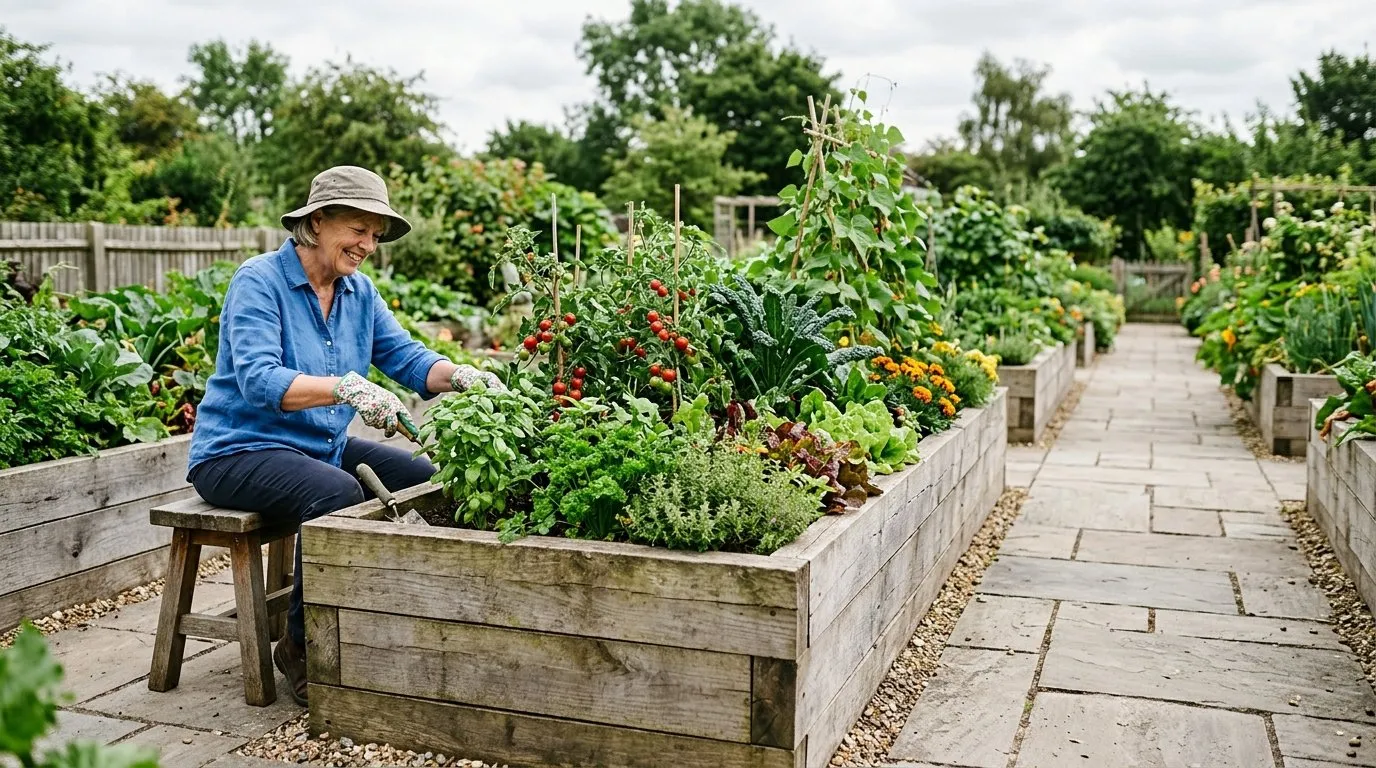
Raised beds at 60-75cm height allow comfortable gardening from a seated position or wheelchair.
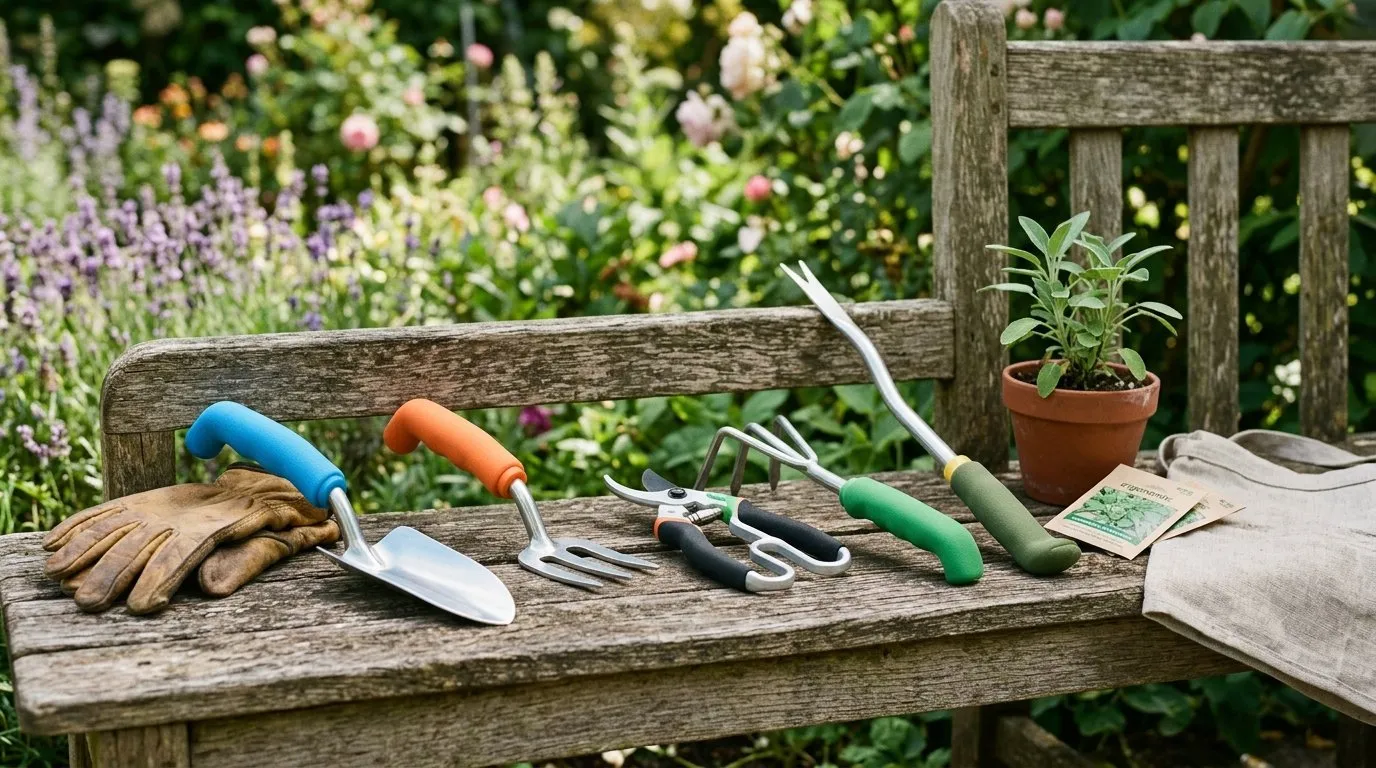
Ergonomic tools with padded grips, angled handles and lightweight construction reduce strain on joints and muscles.
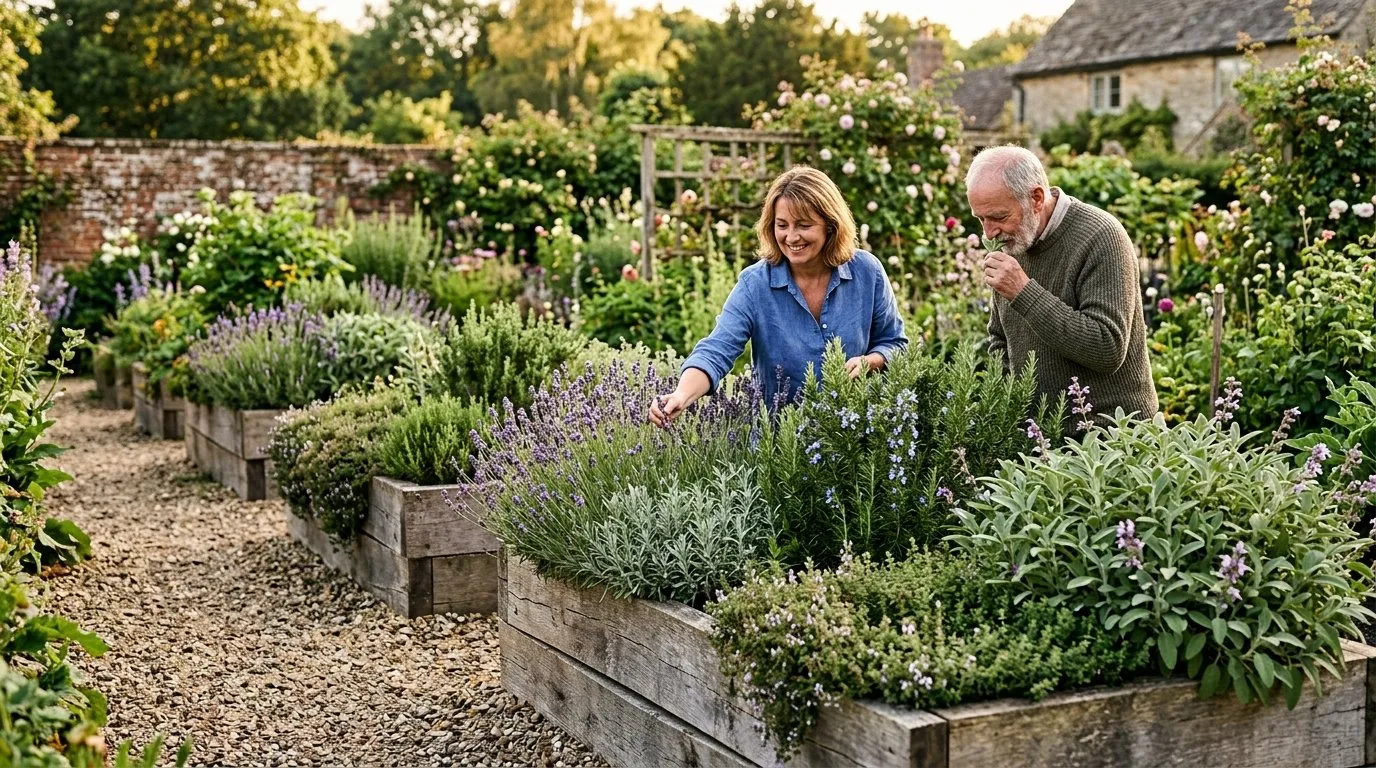
A sensory garden brings texture, scent and sound within arm’s reach. Herbs like lavender and rosemary release fragrance when touched.
Related reading
- Raised Bed Garden Design Ideas, design inspiration and construction options for raised beds at all heights
- Raised Bed Gardening for Beginners, soil mixes, drainage, and first crops for new raised bed growers
- Container Vegetable Gardening UK, growing food in pots on patios and balconies
- Patio Garden Ideas for Small Spaces, layouts and planting for compact accessible outdoor spaces
- Gardening for Mental Health and Wellbeing, the clinical evidence behind therapeutic gardening and how to start
Lawrie has been gardening in the West Midlands for over 30 years. He grows his own veg using no-dig methods, keeps a wildlife-friendly garden, and writes practical advice based on real UK growing conditions.