Key takeaways
- Dried vegetables store 12-24 months and use 1/10th the space of frozen
- Best UK dehydrator temps: 50C for soft veg, 55-60C for root veg
- Blanch most vegetables for 1-2 minutes before drying to set colour
- Soup mix: combine equal volumes of dried tomato, onion, carrot, celery
- Soak dried veg 20-30 minutes before adding to recipes
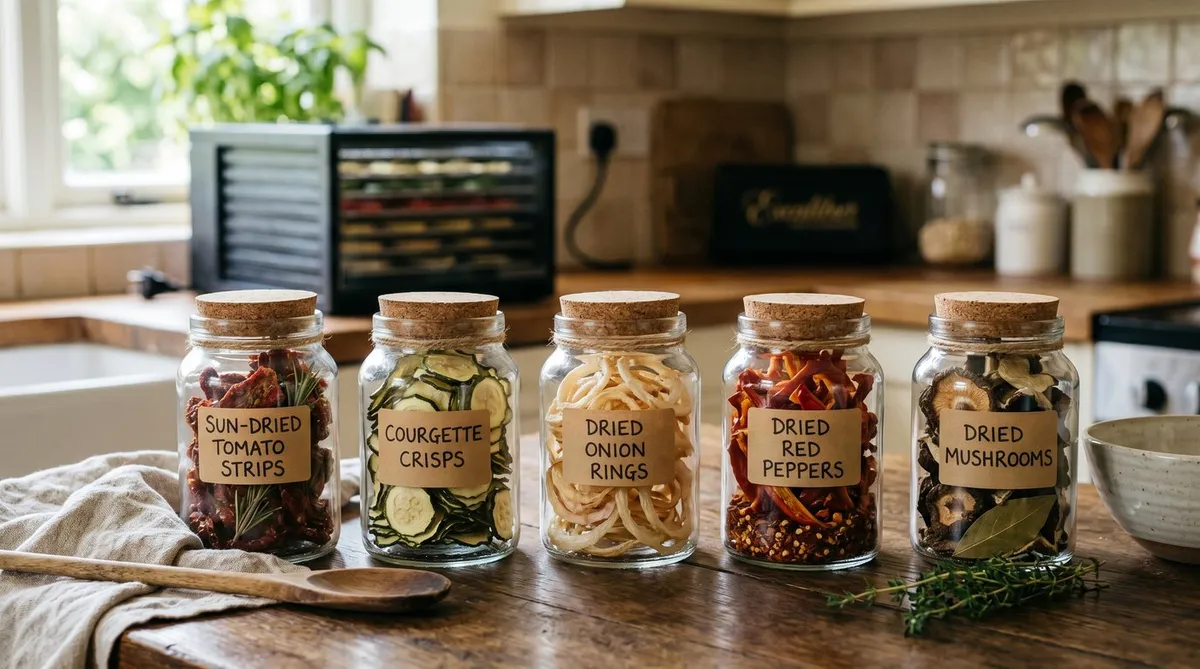
- Store in airtight jars with desiccant sachets in a dark cupboard
Drying vegetables preserves a UK garden harvest for 12-24 months in 1/10th of the storage space that frozen vegetables would take. A summer glut of tomatoes that filled the freezer becomes a row of small jars on the pantry shelf. The dried tomatoes then drop into winter soups and stews with intensified concentrated flavour.
For more preservation methods see our freezing vegetables UK, how to dry and dehydrate garden produce UK and drying apples and pears UK guides.
Why drying for UK gardens
Drying reduces vegetable water content from 80-95% down to 5-15%. The result preserves 70-90% of the nutritional value, concentrates flavour, and packs into a fraction of the original volume.
For UK home gardeners, the practical wins:
- Space: 8kg of fresh tomatoes becomes about 700g of dried tomato strips. That’s 11x more compact than the original fruit and roughly 10x more compact than frozen tomato slices.
- No electricity ongoing: unlike freezing, drying needs power only during the 8-12 hour drying cycle. Stored dried vegetables sit at room temperature indefinitely.
- Flavour concentration: dried tomatoes, dried peppers and dried mushrooms intensify in flavour by 3-5x vs fresh. They contribute deep umami to winter cooking that fresh substitutes cannot match.
- Long storage: 12-24 months reliably; up to 5 years if properly dried and stored.
The trade-offs:
- Equipment cost: £60-£200 for a dehydrator, or £0 if using the oven.
- Time: 8-12 hours per dehydrator run.
- Texture: dried veg never recover fresh crisp texture; suitable for cooked dishes only.
Equipment - dehydrator vs oven vs air-dry
Dehydrator (£60-£200)
The best tool for the job. Stockli, Excalibur, Lakeland and Sage all sell good UK units. Five horizontal trays = 0.5m² of drying surface, enough for 2-3kg of fresh produce per cycle.
Power use: 400-600W for 8-12 hours = 3-7 kWh per run. On UK 2026 electricity rates, that’s £1-£2 per drying session.
Oven method (£0 extra cost)
Set oven to lowest temperature (50-70C). Prop door open 2cm with a wooden spoon. Spread veg on baking trays lined with parchment. Stir every 2-3 hours. Takes longer than a dehydrator (10-15 hours) and uses more electricity overall.
Air drying (free but limited)
Stringing tomatoes or hanging chillies in a warm dry room works in UK summer if humidity is low. Less reliable than dehydrator-based methods - UK humidity often allows mould to start before drying completes.
Solar drying (free, weather-dependent)
A south-facing greenhouse bench in July-August reaches 40-50C on sunny days and dries thinly-sliced vegetables in 1-2 days. Unreliable in typical UK weather; works in occasional warm dry spells.
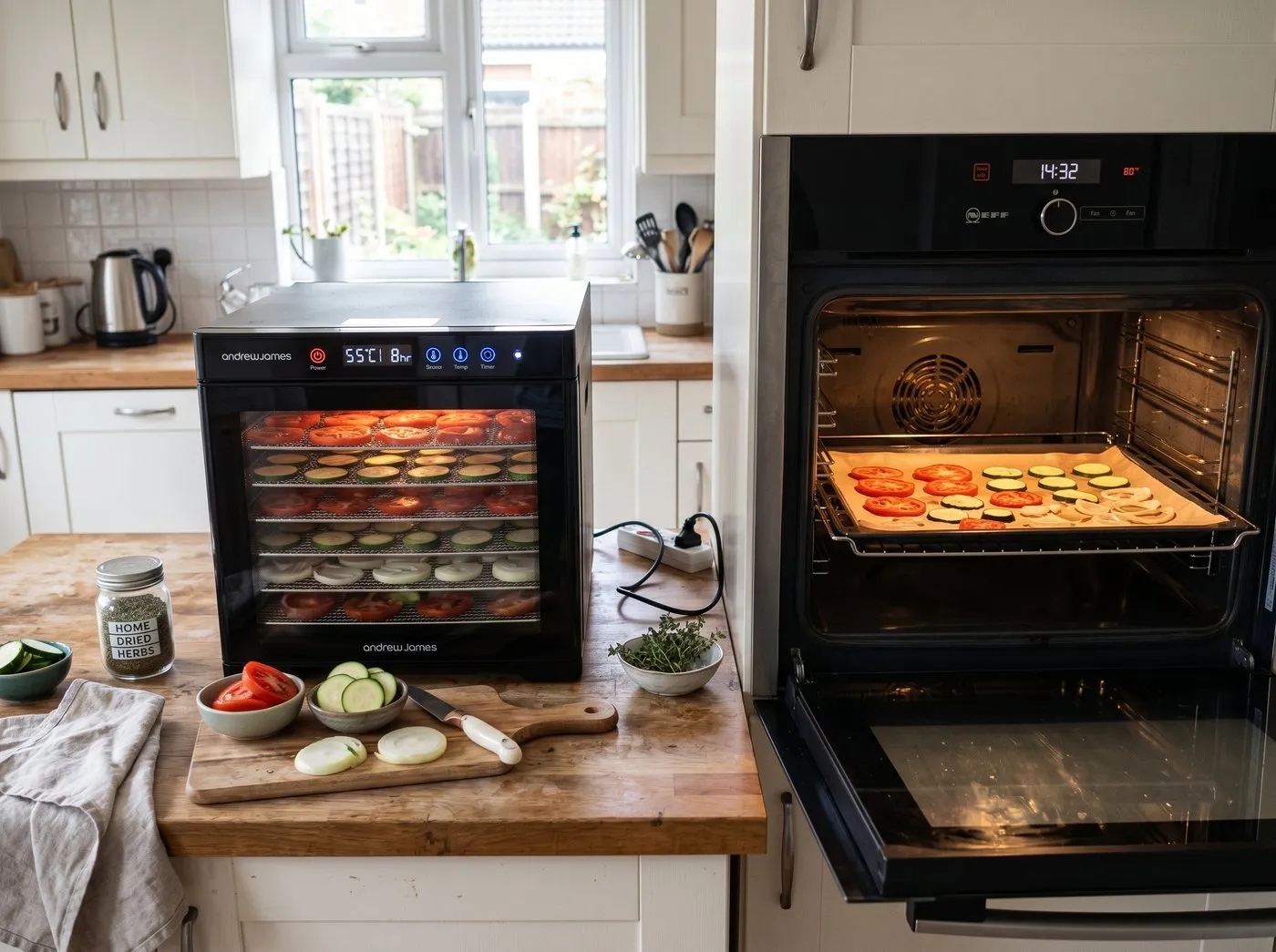 Dehydrator (left) and oven method (right) - the two routes most UK home gardeners use for vegetable drying.
Crop-by-crop drying guide
Tomatoes (the standout dried product)
Best UK varieties: San Marzano, Roma, Principe Borghese, Black Cherry. Plum and cherry types dry best - their thicker walls hold shape; beefsteak tomatoes turn to leathery rags.
Prep: slice 3-5mm thick. Halve cherry tomatoes. Lay cut-side up. Optional: salt lightly before drying for sun-dried-style flavour.
Dehydrator: 55C for 8-12 hours. Oven: 70C for 6-10 hours with door propped.
Done when: leathery and pliable, not brittle. Should feel like dried apricot.
Yield: 1kg fresh = 90-110g dried.
Storage: 18 months in airtight jars. Optional: store covered in olive oil in fridge for 3 months.
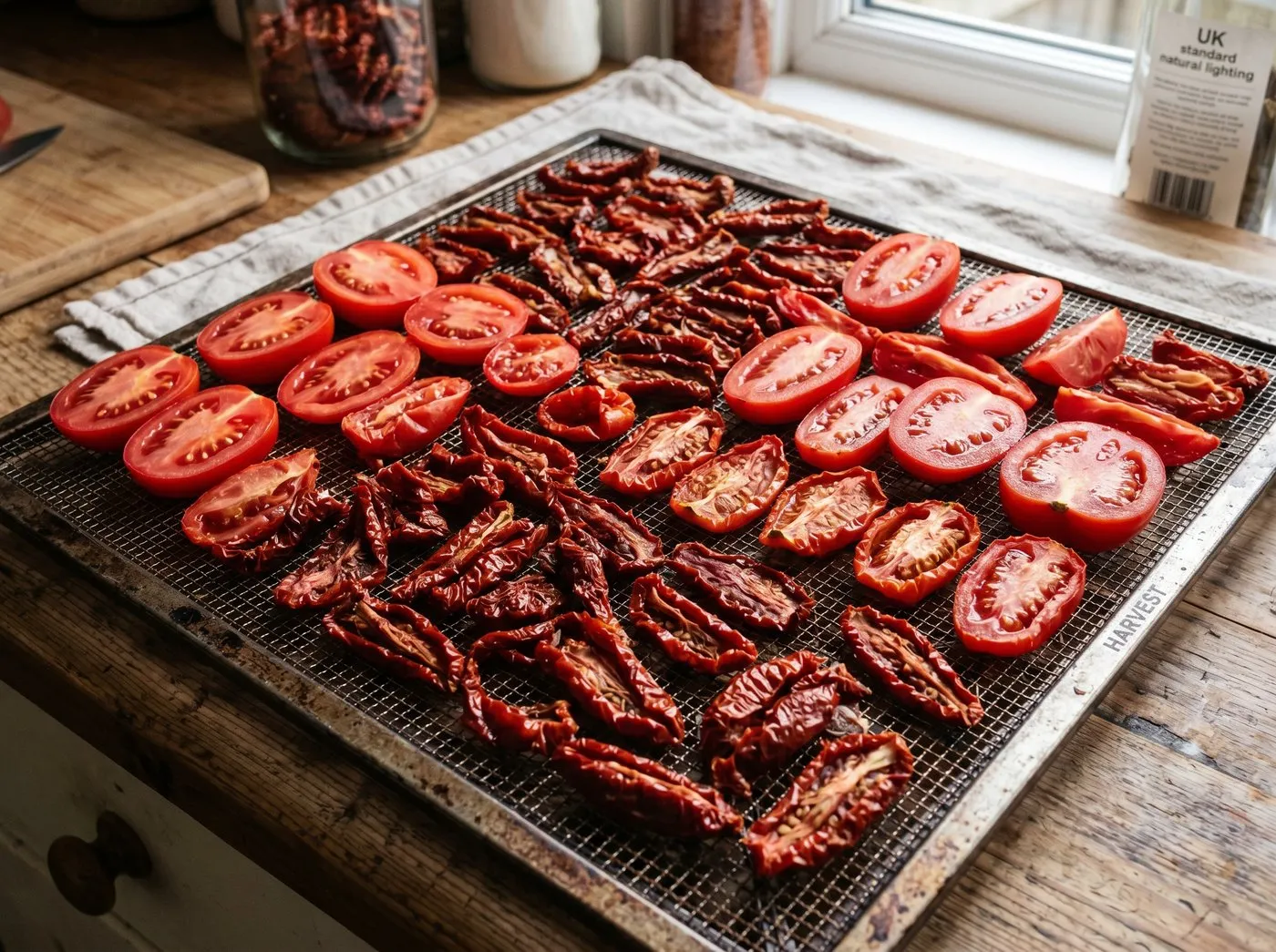 Roma and San Marzano tomatoes mid-cycle on a dehydrator tray. 10 hours at 55C produces UK sun-dried tomatoes from a UK harvest.
Courgettes (for crisps and soups)
Best UK varieties: any firm-fleshed variety. Defender F1, Yellow Sunstripe, Cocozelle.
Prep: slice 2-3mm thick. Optional pre-treatment: salt for 30 minutes, then pat dry to remove excess water. Speeds drying.
Dehydrator: 50C for 6-10 hours. Oven: 65C for 5-8 hours.
Done when: crisp and brittle for crisps; leathery for stews. Two textures, two final stages.
Yield: 1kg fresh = 60-80g dried.
Storage: 12-18 months. Crisp form softens quickly once jar opens; eat within 2 weeks.
Onions (the soup-mix essential)
Best UK varieties: any storage onion. Bedfordshire Champion, Centurion, Hercules.
Prep: slice 3-5mm rings or chop into 5mm dice. No need to blanch.
Dehydrator: 55C for 6-8 hours. Oven: 65C for 4-6 hours.
Done when: brittle and snap when bent. Should rattle like crisps.
Yield: 1kg fresh = 90-120g dried.
Storage: 24 months in airtight jars - the longest-keeping of all home-dried vegetables.
Tip: dried onions can be ground into onion powder using a coffee grinder. Sprinkle on roast potatoes, soups, anywhere fresh onion would go.
Peppers (sweet and chilli)
Best UK varieties: Sweet Banana, Sweet Italian, Marconi, Apache F1 (chilli), Hungarian Hot Wax.
Prep: halve, deseed, slice into 5mm strips. Chillies can stay whole if small.
Dehydrator: 55C for 6-10 hours. Oven: 70C for 5-8 hours.
Done when: leathery; chillies fully brittle.
Yield: 1kg fresh = 80-100g dried.
Storage: 24 months. Whole dried chillies last 2-3 years.
Root vegetables (carrot, beetroot, parsnip)
Best UK varieties: Autumn King carrot, Boltardy beetroot, Tender and True parsnip.
Prep: wash, peel, slice 3-4mm thick or grate. Blanch 2 minutes in boiling water before drying - essential for colour and texture.
Dehydrator: 55-60C for 8-12 hours. Oven: 70C for 6-10 hours.
Done when: brittle, snap when bent.
Yield: 1kg fresh = 100-150g dried.
Storage: 18 months.
Mushrooms (intensified flavour)
Best UK varieties: any cultivated or foraged. Field mushrooms, chestnut, oyster, shiitake.
Prep: wipe clean (don’t wash - they absorb water). Slice 3-5mm thick. No blanching.
Dehydrator: 45-50C for 6-10 hours. Oven: 65C for 5-8 hours.
Done when: brittle and crumble when squeezed.
Yield: 1kg fresh = 80-100g dried.
Storage: 12-18 months.
Use: soak 20 minutes in warm water before adding to risottos, sauces, soups. The soaking water becomes an excellent mushroom stock - use it.
Green beans
Best UK varieties: Cobra (climbing French), Hestia (dwarf French).
Prep: trim, cut into 25mm lengths. Blanch 2 minutes before drying.
Dehydrator: 55C for 8-12 hours. Oven: 70C for 6-10 hours.
Done when: brittle.
Yield: 1kg fresh = 80-100g dried.
Storage: 12-18 months.
Note: Less successful than other dried veg - texture once reconstituted is more like canned than fresh. Use in soups and stews where texture matters less.
Celery (essential soup mix ingredient)
Prep: wash, slice 5mm thick across the stalk. Include leaves - they dry separately and intensify flavour. No blanching.
Dehydrator: 50C for 6-10 hours. Oven: 65C for 5-8 hours.
Done when: crisp.
Yield: 1kg fresh = 90-110g dried.
Storage: 18 months. Can be ground into celery salt with an equal weight of fine sea salt.
The blanching step - when and why
Blanching = brief boiling water dip (1-2 minutes) followed by ice water cooling.
Always blanch: carrots, beetroot, parsnips, green beans, peas, sweetcorn, cabbage, broccoli, brussels sprouts.
Optionally blanch: courgettes (improves colour), aubergines (prevents browning).
Never blanch: tomatoes, peppers, onions, garlic, mushrooms, leafy herbs.
Why blanch: surface enzymes continue working even at drying temperatures, causing browning, off-flavours and nutritional loss. Blanching kills these enzymes. The downside is a small loss of water-soluble vitamins; the trade-off favours blanching for most root and brassica vegetables.
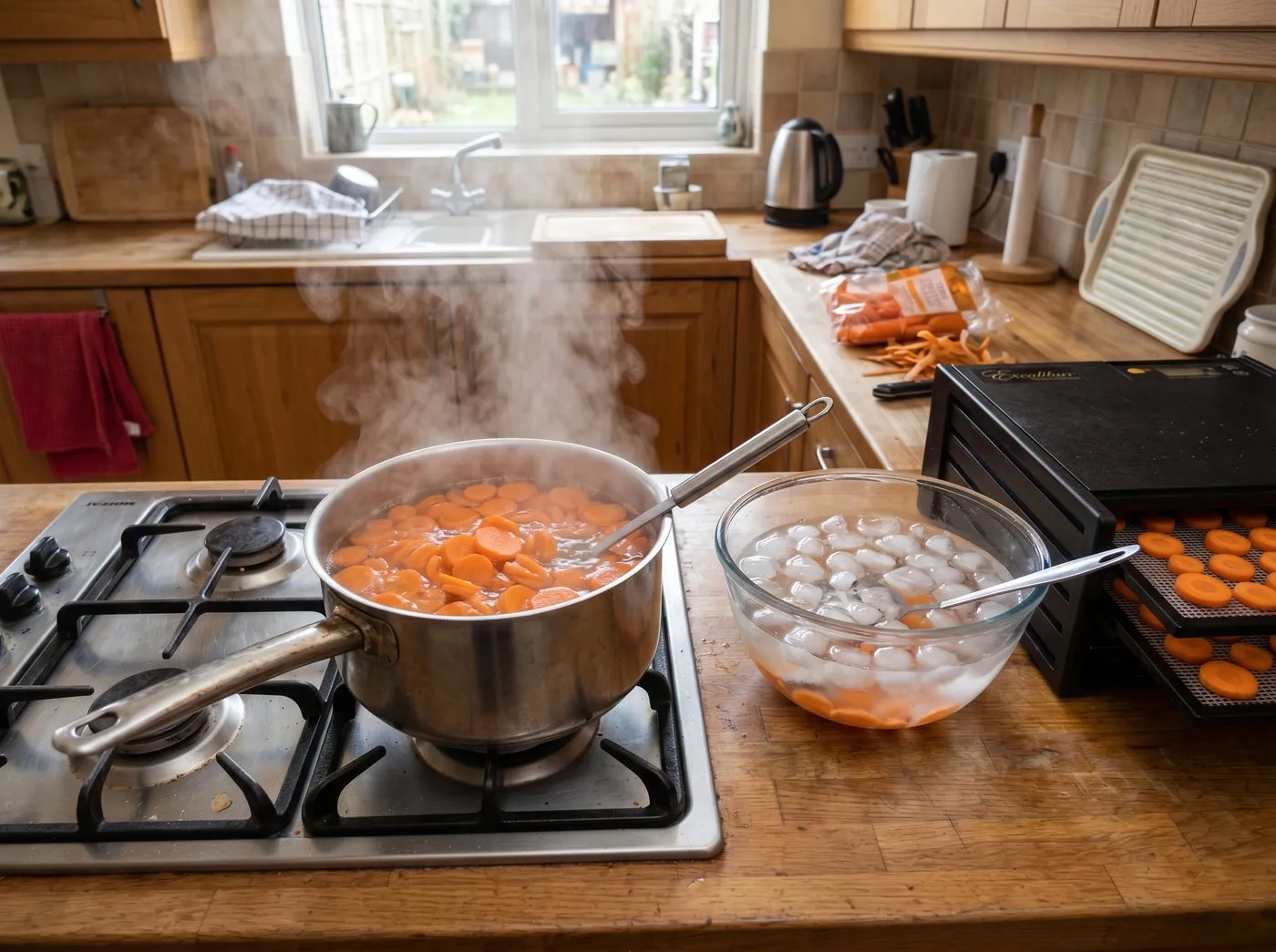 Blanching - 90 seconds in boiling water then straight into ice water. Sets colour, kills browning enzymes, and improves dried-vegetable texture.
The UK soup mix recipe
The single most useful product to make from dried vegetables. Combine in equal volumes:
- Dried tomato strips
- Dried onion dice
- Dried carrot slices or grated carrot
- Dried celery slices and leaves
- Dried pepper strips (optional)
- Dried mushroom slices (optional)
- Dried herbs - parsley, thyme, bay leaf (small amount)
Store in a labelled jar in the pantry. A 250ml jar makes about 8 winter soup servings.
Soup method
- Place 30-40g of soup mix in a saucepan
- Add 750ml cold water and 1 stock cube
- Bring to gentle simmer
- Simmer 25-30 minutes
- Optionally add a tin of beans, fresh garlic, fresh herbs
- Season with salt and pepper at the end
The dried vegetables rehydrate as the soup simmers. The flavour is concentrated and savoury - better than most supermarket soups for a fraction of the cost.
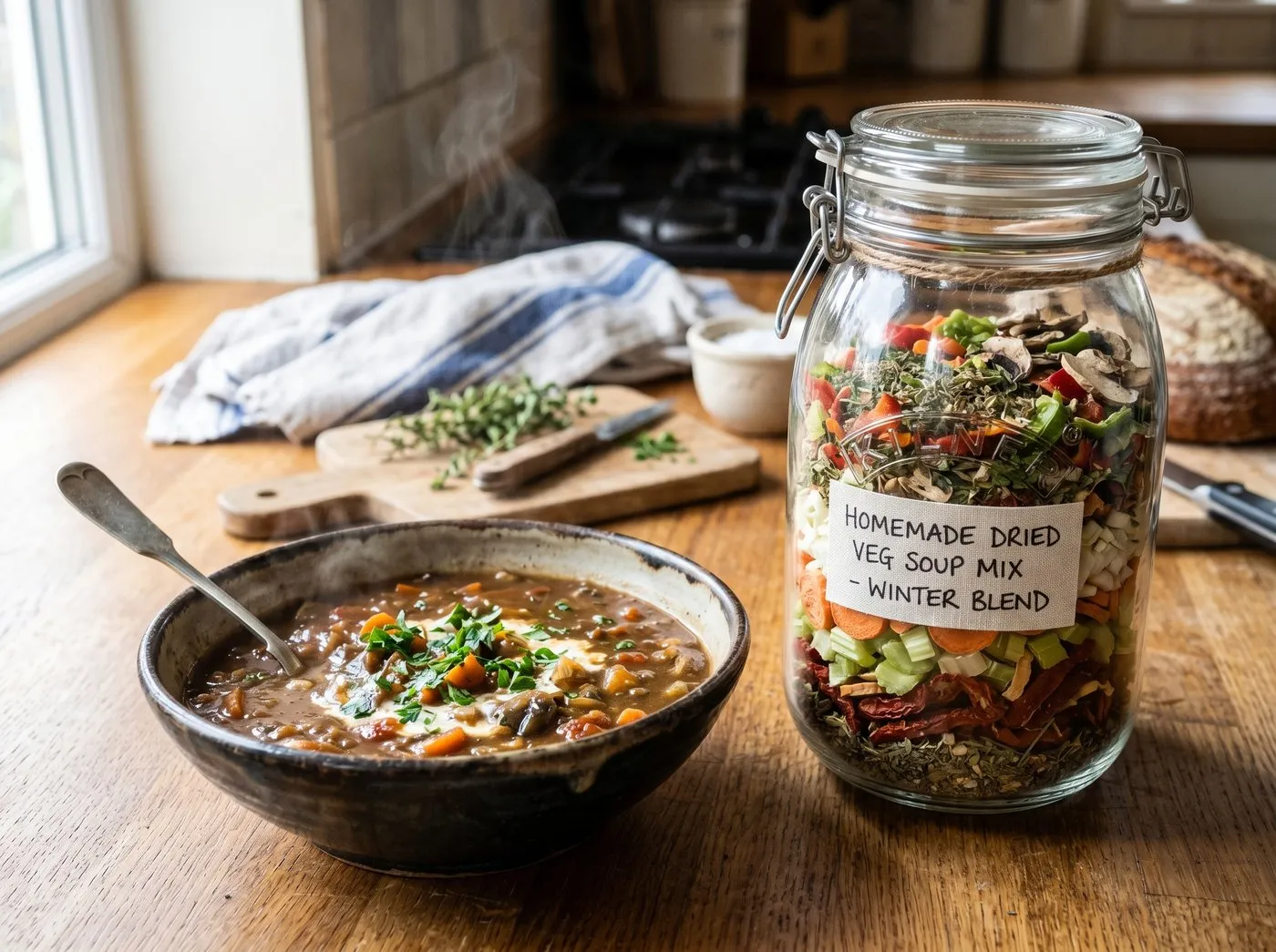 Home-made soup mix in a 500ml jar - 8 winter meals from one summer’s drying. Total cost: about 10p per portion of finished soup.
Other useful dried-vegetable products
Vegetable powder
Grind dried vegetables in a coffee grinder or spice mill. Use as:
- Tomato powder - sprinkle on pasta, eggs, popcorn. Concentrated umami.
- Onion powder - replace shop-bought onion powder. Use anywhere onion would go.
- Garlic powder - dry whole peeled cloves, grind. Far better than shop powder.
- Mushroom powder - add to gravies, risottos, slow-cooker stews.
Vegetable crisps
Snack-worthy dried vegetables:
- Courgette crisps - thin slices, lightly salted, dried to crisp
- Beetroot crisps - thin slices, dried to crisp, dust with sea salt
- Sweet potato crisps - thin slices, brushed with olive oil before drying
- Kale crisps - whole leaves with stems removed, dried until brittle
Concentrated tomato paste
Process dried tomatoes with a little olive oil in a blender to make a thick paste. Store in jars topped with oil for 2-3 weeks in the fridge, or freeze in ice cube trays.
Storage - get this right
The longevity of dried vegetables depends entirely on moisture exclusion.
Containers:
- Glass jars with rubber-sealed lids (Le Parfait, Kilner): ideal
- Mason jars with tight lids: good
- Plastic Lock&Lock: acceptable
- Vacuum-sealed bags: excellent for very long storage
- Paper bags or plastic bags: not airtight - avoid
Desiccants: Add one silica gel sachet per jar. They absorb residual moisture. Renew or dry out every 12 months by warming in an oven at 80C for 1 hour.
Location: dark cupboard, room temperature (15-22C). Avoid sunlight (bleaches colour and destroys vitamins) and damp areas.
Labelling: variety, date dried, drying notes (especially salting/blanching status).
Common drying problems
Pieces stick together in the jar. Not dry enough. Re-dry at 50C for 3-4 hours and test before re-jarring.
Pieces go soft 2-4 weeks after jarring. Residual moisture migrated. Re-dry as above and add a silica desiccant.
Colour fades to brown over months. Light damage. Move jars to a fully dark cupboard.
Mould visible in the jar. Drying step incomplete or jar not airtight. Discard the entire batch - mould toxins are not killed by cooking.
Insects in stored dried veg. Pantry moth or weevils came in with the produce. Freeze for 48 hours at -18C before storage to prevent.
Pieces taste burnt or smoky. Drying temperature too high. Drop to 50C for soft veg, 55-60C max for root veg. Higher temperatures degrade flavour faster than they speed drying.
Cost reality
Equipment cost (year 1): £80-£150 for a mid-range dehydrator. Half that for second-hand.
Running cost: £1-£2 per drying session (3-7 kWh at UK 2026 prices).
Storage cost: about £5 for 10 Kilner jars and £4 for 50 silica sachets, one-off.
Supermarket equivalent: a 50g jar of sun-dried tomatoes is £3-£5. Home-dried tomato strips cost roughly 30p per 50g once you’ve paid for the equipment.
The equipment pays back in the first full summer if you dry an active allotment harvest. Subsequent years are essentially free dried vegetables.
A working drying calendar
| Month | Crops to dry |
|---|---|
| July | First peas, courgettes, herbs, broad beans |
| August | Tomatoes, courgettes, runner beans, French beans, peppers |
| September | Tomatoes (main run), peppers, onions, garlic |
| October | Onions, beetroot, carrots, late tomatoes, apples and pears |
| November | Mushrooms (forage), winter root crops |
| Year round | Use what’s stored |
Field note: The UK Food Standards Agency dehydrating guidance covers home drying safety basics. The Excalibur dehydrator manual is the most thorough commercial reference for times and temperatures across all crops.
A simple kitchen-garden practice
Drying vegetables shifts the kitchen-garden output from “what can we eat this week” to “what can the pantry hold for next year”. One summer afternoon of drying gives 6-12 months of soup mix, pasta sauce base, and risotto flavouring at near-zero ongoing cost.
The first summer feels slow. By summer two the routines are automatic, the jars line up on the pantry shelf, and the winter cooking gets noticeably better.
Now you’ve got the technique
For the rest of the preserve-the-harvest year, our freezing vegetables UK, drying apples and pears UK and how to bottle and can fruit and vegetables UK guides cover the full kitchen-garden preservation kit.
Our team produces practical UK gardening guidance from source research, contributor records and established horticultural practice. Editorial standards are overseen by Matt W.