Key takeaways
- Dry on the plant until pods rattle; finish indoors for 7-14 days at 18-22C
- Best UK drying varieties: Borlotti, Czar, Cannellini, Marrowfat, Carlin
- Seeds are dry when they bite hard and shatter rather than dent
- Store in airtight glass jars with a desiccant sachet; lasts 2-3 years
- Freeze for 48 hours before storage to kill bean weevil eggs
- Soak overnight then simmer 60-90 minutes for soups and stews
Drying beans and peas is the simplest way to preserve pulses for winter soups, stews and cassoulets - and one of the oldest UK kitchen-garden techniques. A 4m row of borlotti dried on the plant yields 2-3kg of stored beans for less than £3 in seed costs. The dried beans then last 2-3 years in airtight jars and cook to a softer, fuller-flavoured result than anything in a supermarket bag.
What is drying for storage actually doing
Fresh garden beans contain 60-70% water. Wet beans rot within a week at room temperature because fungi and bacteria multiply rapidly in moist tissue. Drying reduces water content to under 13%, below the threshold where most spoilage organisms can grow.
The remaining 13% bound moisture is enough to keep the seed alive (technically you can plant your dried beans next year as seed - they germinate normally). But it’s too dry to support rot. Properly dried beans store for years; under-dried beans go mouldy within months.
The drying process happens partly in the field and partly in the kitchen. UK weather typically delivers about 70-80% of the drying outdoors; the final indoor finish handles the last 20-30%.
Best UK varieties for drying
Borlotti Lingua di Fuoco (top all-round pick)
The standout UK drying bean. Cream-and-red speckled seeds, large pods, reliable cropping, easy threshing. Tastes excellent in soups, salads and Italian-style dishes.
- Yield: 1.5-2.5kg dried per 4m row
- Drying time: 3-5 weeks on plant, 7-14 days indoors
- Seed weight: 0.5-0.7g each
- Storage: 2-3 years
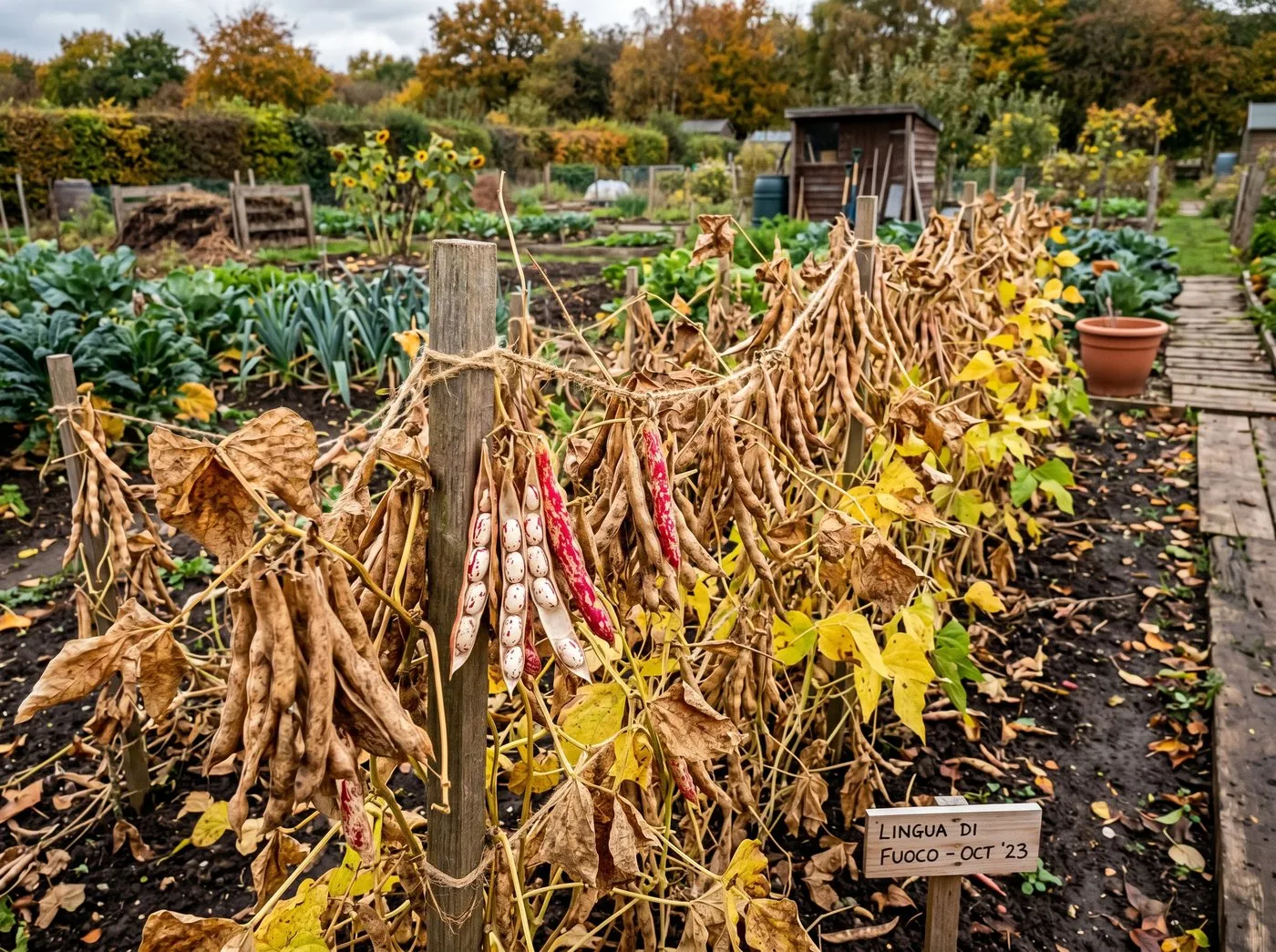 Borlotti Lingua di Fuoco drying on the vine in October - the pods turn red, then brown, then brittle. Pick when they rattle.
Czar runner bean (large white seeds)
The traditional UK runner bean for drying. Large white butter-bean style seeds, soft texture once cooked, excellent for stews and casseroles.
- Yield: 1.5-2kg dried per 4m row
- Drying time: 4-6 weeks on plant, 10-14 days indoors
- Seed weight: 1.2-1.5g each
- Storage: 2-3 years
Cannellini (Italian classic)
White kidney-shaped seeds, classic Italian cassoulet bean. Less common in UK gardens but grows well in a long warm summer.
- Yield: 1.2-1.8kg dried per 4m row
- Drying time: 4-6 weeks
- Seed weight: 0.5g each
Marrowfat pea (traditional UK pea)
The pea for mushy peas. Larger and starchier than garden peas, dries beautifully. Modern varieties include Maro and Princess.
- Yield: 0.8-1.5kg dried per 4m row
- Drying time: 3-4 weeks
- Seed weight: 0.4g each
Carlin pea (heritage UK)
Heritage UK pea, brown-skinned with savoury flavour. Used for traditional Carlin Sunday meals in north-east England. Dries excellently.
- Yield: 1-1.5kg dried per 4m row
- Drying time: 3-4 weeks
- Seed weight: 0.3g each
Black Turtle (Mexican-style)
Glossy black beans for refried beans and bean soup. Needs a long warm summer; suits south of England better than Scotland.
- Yield: 0.8-1.5kg dried per 4m row
- Drying time: 5-7 weeks
- Seed weight: 0.25g each
Soissons (French haricot)
Classic French haricot - white, oval, the bean for cassoulet. Long-season variety; needs a warm UK summer.
- Yield: 1-1.5kg dried per 4m row
- Drying time: 5-6 weeks
- Seed weight: 0.4g each
When to leave fresh-eating crops for drying
You can dry the seeds of most UK bean and pea crops, including:
- Climbing French beans (any green-podded variety left to mature)
- Runner beans (any variety left to mature on the vine)
- Broad beans (older pods that develop tough black scar; seeds dry to large flat tan/brown disks)
- Garden peas (any variety left to mature into yellowing pods)
These work but are not optimised for drying - they’re bred for fresh tender eating. The dedicated drying varieties above give 30-50% better yield, easier drying and more consistent quality.
The exception: if you have a row of climbing French beans (e.g. Cobra, Blue Lake) that you grew for fresh eating, leave the last 30-40 pods on the vine to mature for seed. Free dried beans without using extra growing space.
When to harvest for drying
The plant tells you when. Look for these signs:
- Pods turn from green to yellow to tan to brown.
- Pods become brittle and rattle when shaken.
- Leaves yellow and drop.
- The whole plant looks dying-back.
UK timing typically:
- French/climbing beans for drying: late September to mid-October
- Runner beans for drying: early to mid-October
- Garden peas for drying: late August to mid-September
- Marrowfat/Carlin peas: September
If wet autumn weather threatens before pods are fully brown, lift the whole plants by the roots and hang upside down in a frost-free shed, greenhouse or porch. They finish drying off the ground.
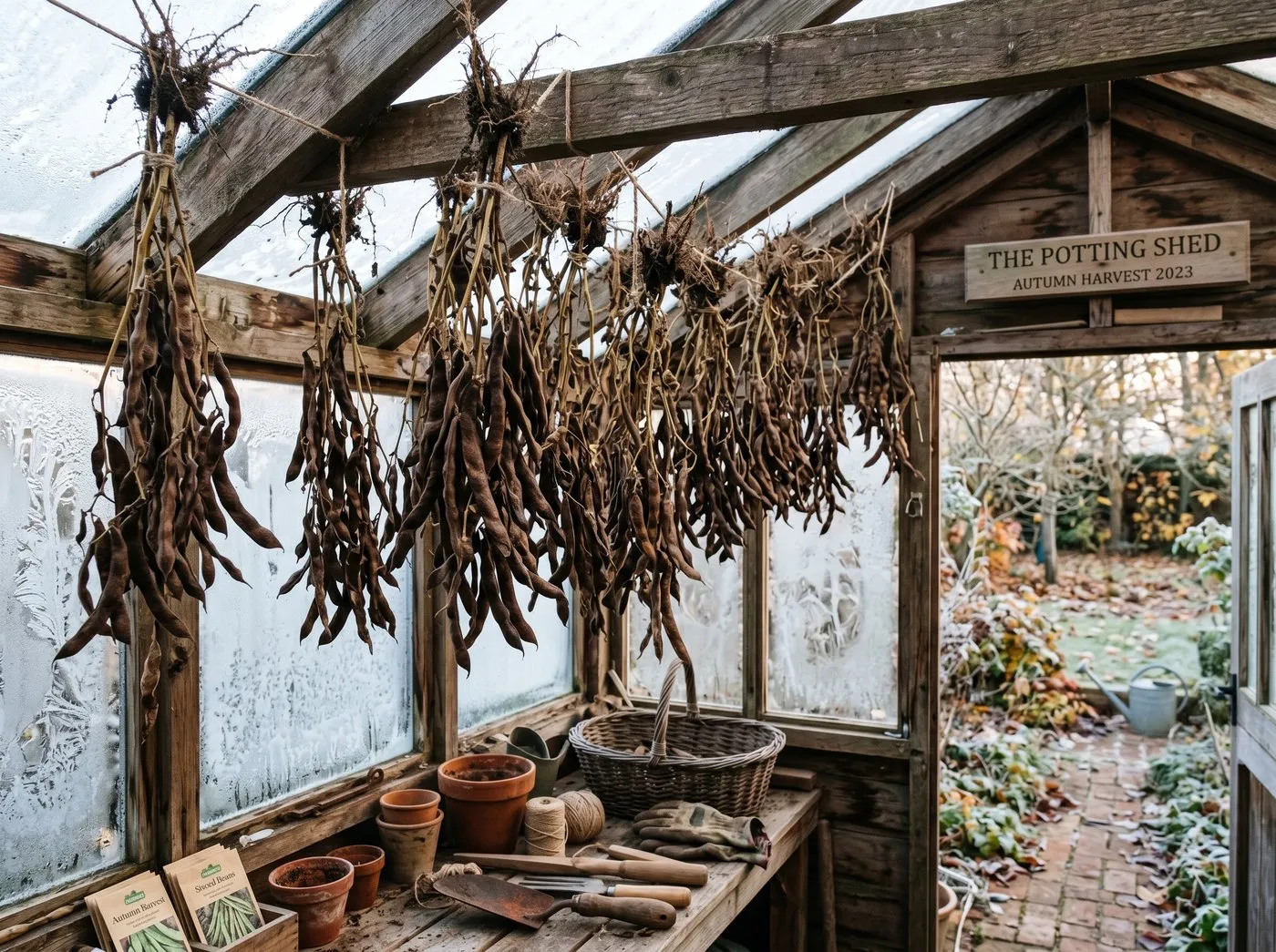 Plants lifted in early October and hanging upside down in a frost-free shed to finish drying. UK autumn weather often forces this finish indoors rather than on the plant.
Indoor drying - the final step
Once pods are dry enough to rattle, bring them indoors for final drying. This is the step that takes them from 20% moisture to under 13%.
Method 1: Rack drying (small batches)
Spread shelled or unshelled pods in a single layer on baking trays lined with kitchen paper. Place in a warm dry room (kitchen, airing cupboard, greenhouse on a sunny day). Stir daily for 7-14 days.
Test: bite a bean. If it shatters cleanly with no dent, it’s dry. If it dents at all, keep drying.
Method 2: Hanging dry (whole plants)
For runner beans and tall climbing beans, hang the whole plant upside down by string in a shed or porch. The pods continue to mature and dry. Once pods rattle, strip pods from the stems.
Method 3: Mesh-bag drying (peas)
For peas - shell from pods first, then spread in a single layer on a mesh frame (an old window screen works) in a warm dry place. Air circulates around each pea. Takes 5-10 days.
Method 4: Dehydrator (fastest)
A food dehydrator at 35-40C dries shelled beans in 8-12 hours. Useful if autumn weather has been damp and you need a fast finish. Don’t go above 40C or the beans become brittle and split.
Threshing - getting beans out of pods
Once pods are fully dry, you need to separate beans from pods. Three methods:
Hand-shell
Open each pod and tip out the beans. Slow but careful - useful for small batches and for show-quality beans you want unbroken.
Bag-and-stamp
Pile pods in a thick canvas or cotton sack. Walk on the bag or beat with a stick. Pods shatter; beans fall to the bottom of the bag. Then pour into a wide bowl and winnow.
Winnowing
After threshing, the bowl contains beans plus pod fragments and chaff. Take outside on a breezy day and pour the contents slowly from one bowl to another in front of a gentle wind. The light chaff blows away; the heavy beans fall straight down. Or use a fan indoors.
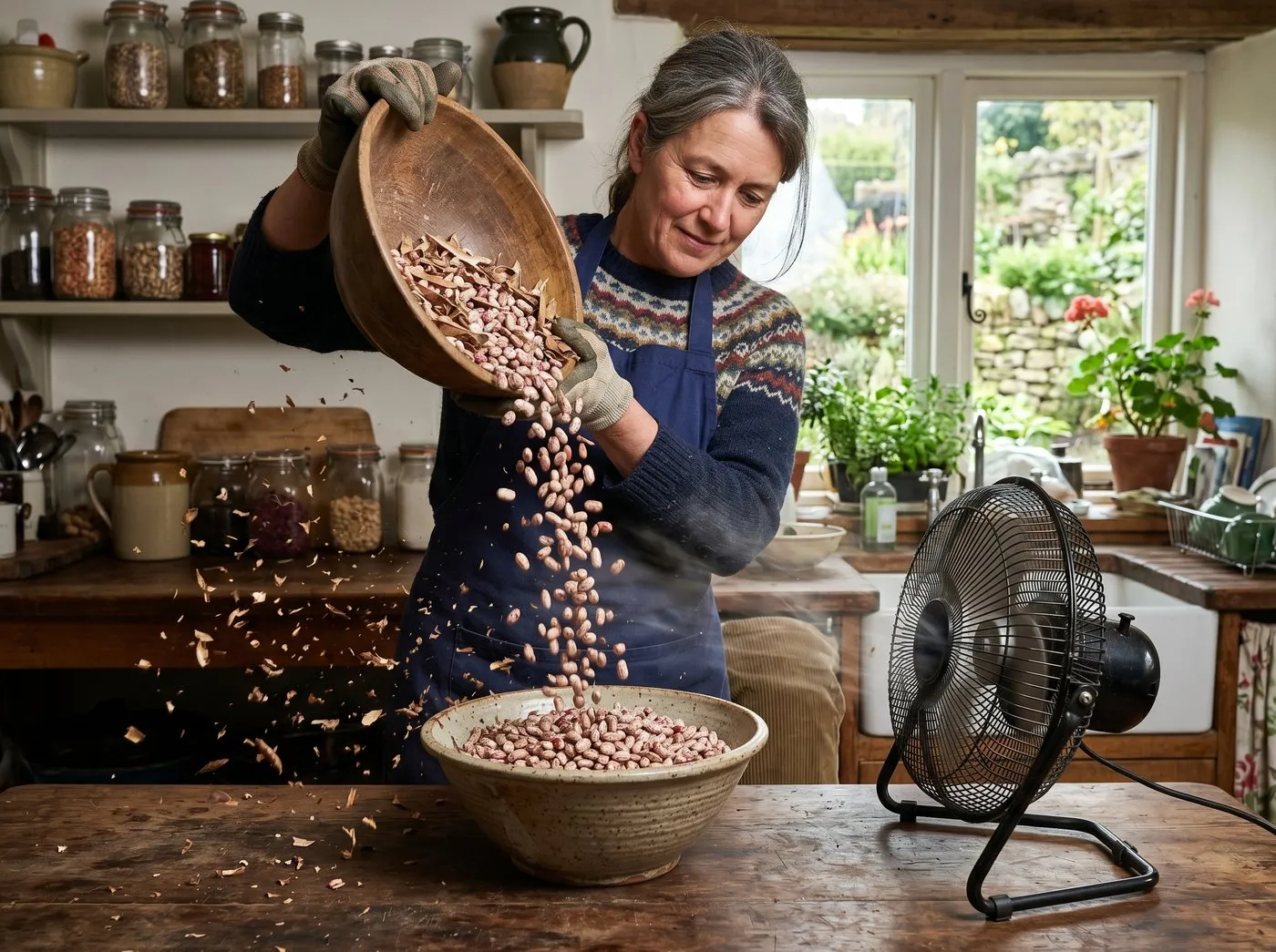 Winnowing dried beans - the heavy seeds fall straight down, the light pod chaff blows away. A bowl, a breeze and 5 minutes per kilo.
The 48-hour freezer trick - essential for storage
Before transferring dried beans to long-term storage jars, freeze the dried beans at -18C for 48 hours. This kills any bean weevil eggs laid in the developing pods. Without this step, weevil eggs hatch in storage 6-12 months later and ruin the batch.
After freezing, let the beans return to room temperature in a sealed bag (to prevent condensation), then pour into airtight jars.
Storage
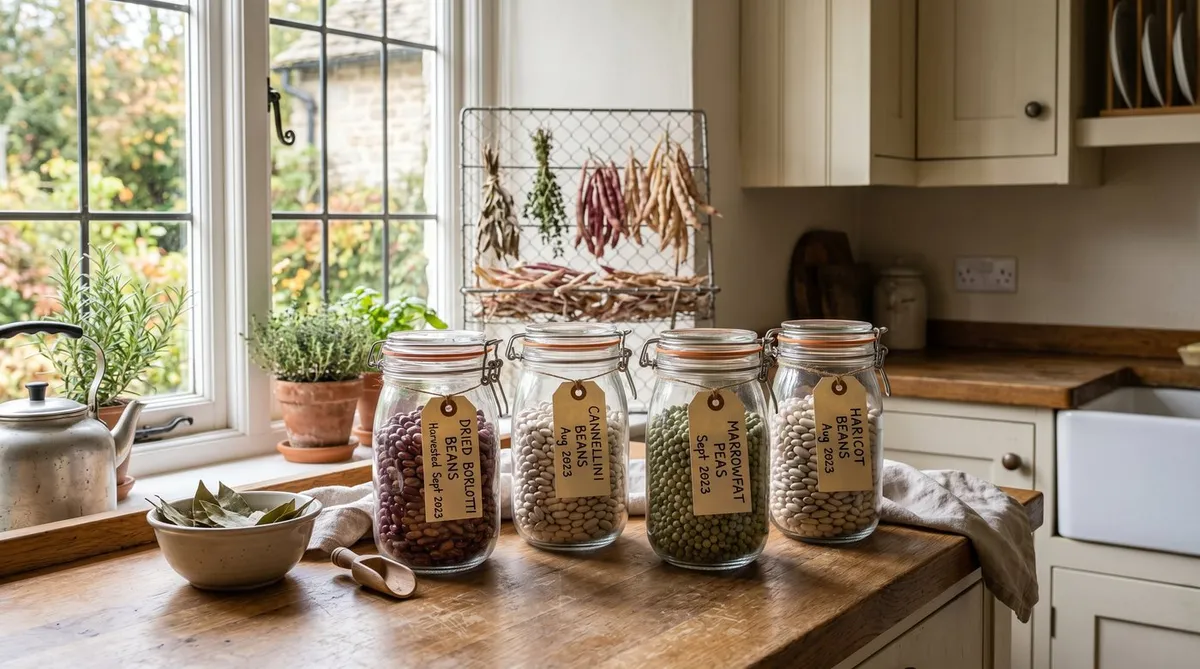
Glass jars with rubber-sealed lids (Le Parfait, Kilner, Mason) are ideal. Plastic Lock&Lock containers work but are less air-tight. Avoid paper bags - moisture and insects get in.
Label each jar with:
- Variety name
- Date dried
- Weight
Add a small silica gel desiccant sachet to each jar to absorb any residual moisture. These are sold for £5 per 50 sachets at hardware stores.
Storage location: room temperature, away from direct sunlight. A cupboard or pantry shelf is ideal.
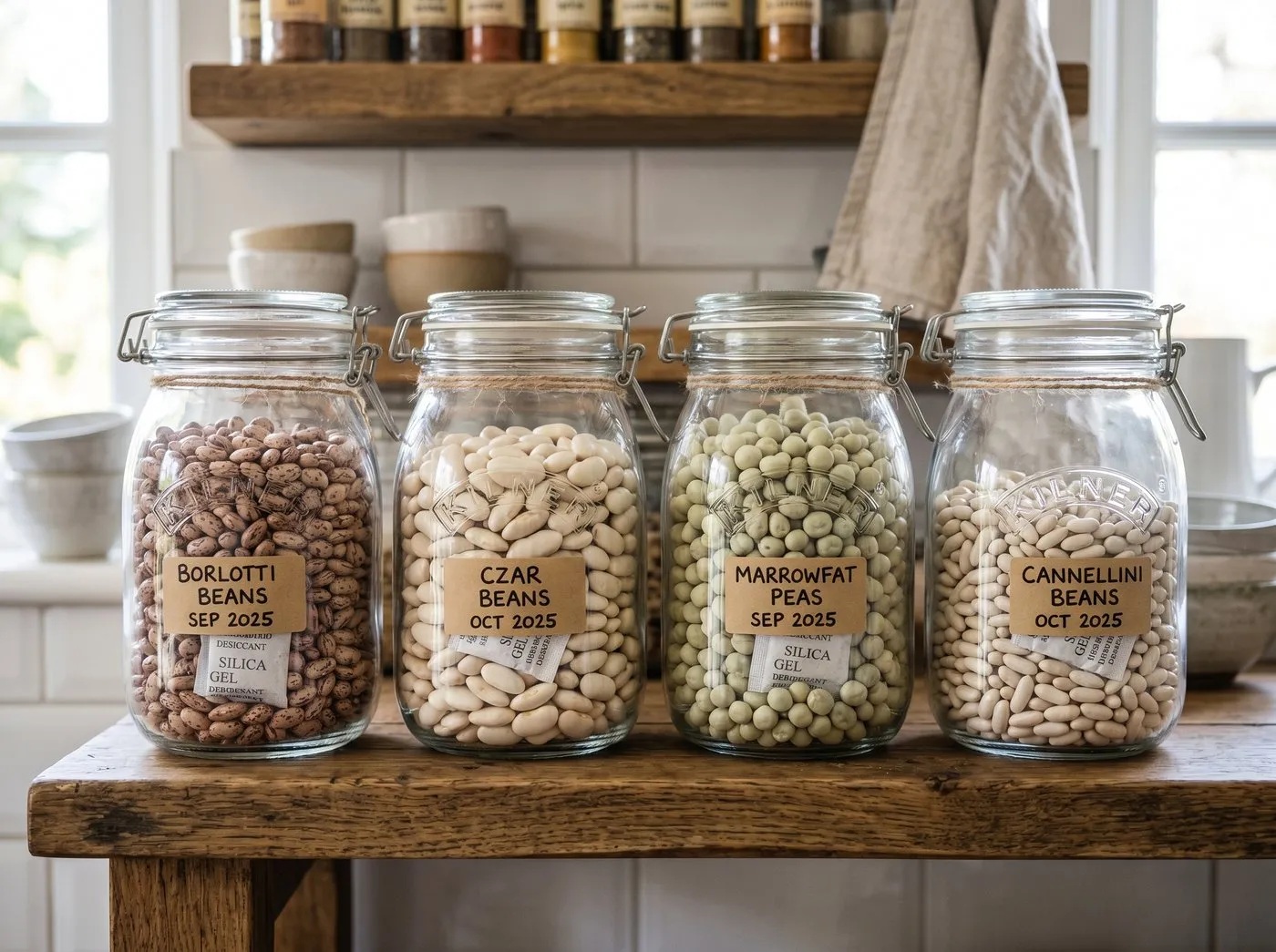 Labelled Kilner jars with desiccant sachets - the proven storage system. Beans keep cooking quality for 2-3 years at room temperature.
Cooking with home-dried beans
Dried beans need rehydrating before cooking. The basic method:
- Pick over - remove any damaged or shrivelled beans, any small stones.
- Rinse in cold water.
- Soak overnight in plenty of cold water (3x volume of beans). 8-12 hours.
- Drain and rinse.
- Simmer in fresh water 60-90 minutes for beans, 30-45 minutes for marrowfat peas.
- Salt at the end - adding salt early toughens the skins.
Use in:
- Borlotti: minestrone, Tuscan beans on toast, salad
- Cannellini: white bean soup, cassoulet, Italian stews
- Czar: butter bean stew, casseroles, hearty soups
- Marrowfat peas: mushy peas, pea soup, traditional Sunday dinner
- Carlin peas: Carlin Sunday (slow-cooked with bacon)
- Soissons: French cassoulet
Cooked beans freeze well for 6 months. Cook a batch on Sunday, freeze in 250g portions, use through the week.
Quick-soak alternative
If you forget to soak overnight, the quick-soak method works:
- Cover beans with water in a pot.
- Bring to a rolling boil for 2 minutes.
- Remove from heat, cover and leave 1 hour.
- Drain, rinse, and cook in fresh water as normal.
Slightly less effective than overnight soak (beans take 15-20 minutes longer to cook) but gets you out of trouble.
Cost and yield reality
Compare to supermarket dried pulses at £3-£5 per kg, or organic at £6-£8 per kg.
The economic case is real but modest - the bigger win is flavour. Home-dried beans cook softer and taste fresher than supermarket pulses that have been sitting in warehouse stock for 2-5 years.
The annual drying calendar
| Time | Action |
|---|---|
| Late March - early April | Sow under cloches or in modules |
| Mid-May | Plant out after last frost |
| June - August | Standard plant care; pick fresh-eating crops as wanted |
| Late August | Stop picking fresh pods; let remaining mature |
| September | Pods yellowing on plants |
| Early October | Test pods - if rattle, harvest. If not, leave on plant. |
| Mid-October | Lift remaining plants if wet weather forecast; hang in shed |
| Late October - early November | Thresh, winnow, freeze for 48hr, jar |
| November onwards | Soup and stew season |
Common drying problems
Mould on dried beans in storage. Beans not dry enough. Re-test with the bite-shatter method. If borderline, dry another 7 days at 18-22C before re-storing.
Holes in stored beans, small adult insects appearing. Bean weevil. The 48-hour freezer step prevents this; once visible, the batch is ruined - dispose and start clean next year.
Beans rattle but pods are still green-tinged. Underripe. Let dry another week before threshing - the pod colour is the proxy for seed moisture content.
Slow or uneven cooking. Beans over 3 years old, or stored in damp conditions. They’re still safe to eat; just allow 30-40% longer cooking time.
Pods covered in spots or rust patches. Could be bean rust or anthracnose - cosmetic on the pod but check seeds carefully. Mottled or weak seeds: do not save. Clean firm seeds: dry as normal.
Field note: Garden Organic’s heritage seed library preserves traditional UK pulse varieties including heritage Borlotti, Cannellini and Carlin lines. Members receive seeds annually for trial.
A simple kitchen-garden upgrade
For most UK allotment holders, adding 4m of drying beans to the normal bean rotation is a 30-minute decision that yields 1.5-2kg of stored pulses per year for the next decade. The seed packet costs £3-£5. The drying equipment is a shed corner and a few baking trays. The kitchen reward is a winter pantry of home-grown pulses for soups and stews.
Three years of doing this and the practice becomes invisible - dried beans become as routine a garden output as new potatoes or autumn raspberries.
Now you’ve got the drying technique
Our team produces practical UK gardening guidance from source research, contributor records and established horticultural practice. Editorial standards are overseen by Matt W.