Key takeaways
- Bottom watering eliminates damping off by keeping the compost surface dry
- Stand trays in 1cm of water for 5-10 minutes, then drain to avoid waterlogging
- Rainwater outperforms tap water for basil, primula, and lettuce (chlorine and pH)
- Capillary matting works for repeat watering 7-day stretches without re-soaking
- Algae and salt crust on the surface signal too much water or chlorinated supply
- Switch to top watering only after the first true leaves appear and stems harden
Bottom watering is the single biggest survival upgrade for UK seed sowing. The technique replaces a fine-rose watering can with a 1cm reservoir of water and a 5 to 10 minute soak. The compost surface stays dry, the seed stays in place, and damping off losses drop from around 39% to around 5% on susceptible species. This guide covers the soak method, capillary mat setup, the right water to use, and the species that depend on it.
Why bottom watering beats top watering
Top watering does four things wrong even with a fine rose:
- Wets the compost surface. Damping off fungi (Pythium ultimum, Rhizoctonia solani, Phytophthora cryptogea) need a wet film at the soil-air interface to germinate their spores. A dry surface stops them dead.
- Compacts the surface. Fine droplets seal the top 2mm of compost into a crust. Air exchange to the roots drops. Surface seeds (lobelia, foxglove, primula) cannot push through.
- Displaces seeds. Light seeds float and wash to one side of the tray. Module sowings clump.
- Wets the foliage. Wet leaves at 12-18C overnight grow botrytis (grey mould) within 72 hours.
Bottom watering reverses every one of these. The water enters from below through the drainage holes and rises through the compost by capillary action. The surface dries between waterings. The roots draw water as they grow downward into a moisture gradient from dry (top) to damp (bottom). This downward root-seeking habit produces a stronger root mass.
For the underlying biology of damping off, see the RHS damping off guide. For wider context on seed sowing, our seed germination temperatures and seed sowing calendar UK guides cover timing and species.
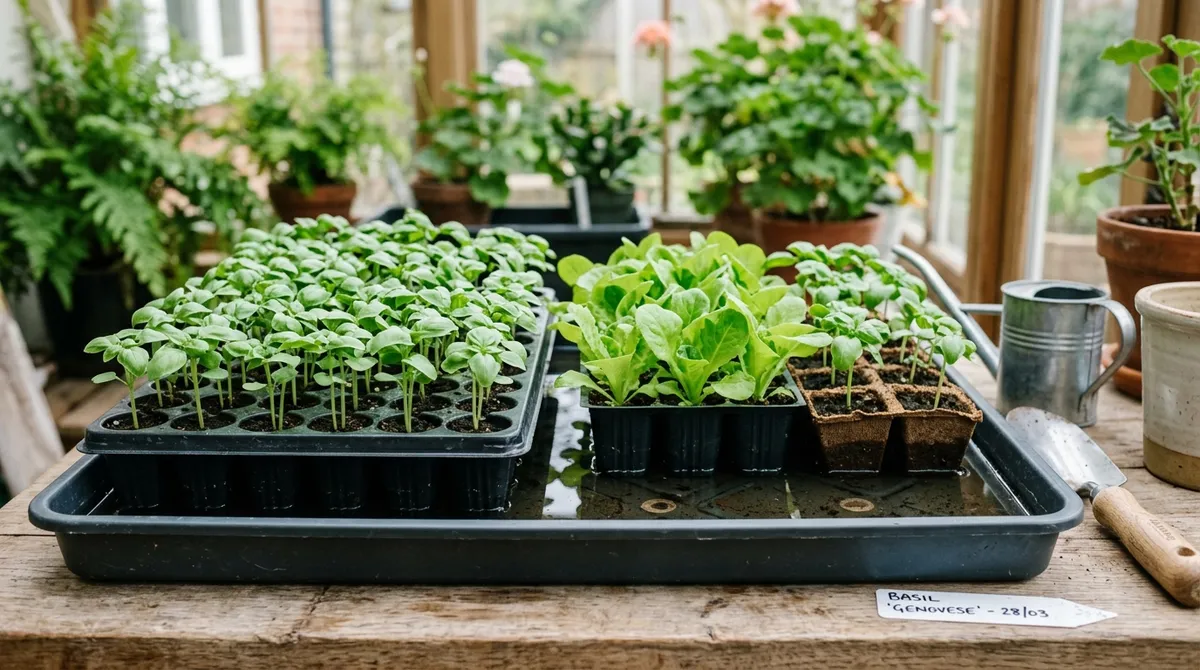
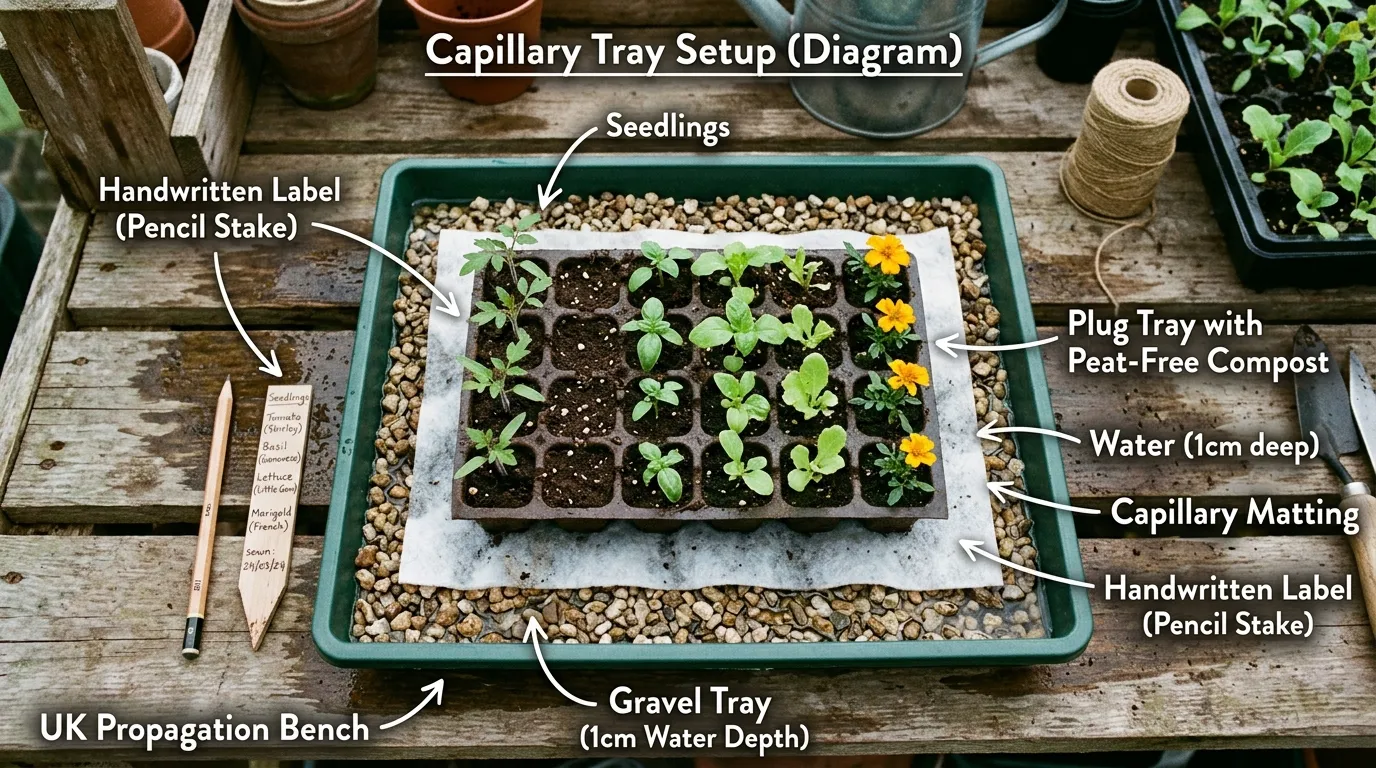 The basic kit: a flat outer tray, 1cm of rainwater, a plug tray of seedlings standing on top.
The kit you need
The whole system costs under £20 and lasts a decade:
- Flat outer tray. A 12-litre paint roller tray, a stiff plastic seed tray base, or a builders’ mortar tub. Must be wider than your plug trays and at least 4cm deep at the lip.
- Plug trays or pots. Standard 38, 60 or 84-cell module trays. 7cm or 9cm pots also work.
- Watering can. For filling the outer tray with measured water.
- Capillary matting (optional). 5mm thick polyester wicking mat. Lets you load several days of water at once.
- Vermiculite or fine horticultural grit. A thin top dressing keeps algae off the compost surface.
- Rainwater butt. 200-litre minimum for the spring season.
The single biggest mistake is using an outer tray that is too shallow. A 1cm depth of water in a 2cm tray leaves no room for the plug tray to sit. The plug tray either floats (and seeds wash out) or sits too low and the compost stays sodden. The outer tray needs 4cm of usable depth minimum.
The 5-step soak method
- Fill the outer tray with 1cm of tepid rainwater. For a tray 30cm by 20cm, that is roughly 600ml. Use a measuring jug the first few times until your eye learns the line.
- Stand the plug tray or pots in the water. The water level should not touch the compost surface; only the drainage holes at the bottom.
- Set a timer. 5 minutes for 4cm plug trays. 8 minutes for 6cm modules. 10 minutes for 7cm pots. 15 minutes for 9cm pots. Adjust by 2-3 minutes for very dry or already-damp compost.
- Watch the compost surface darken. The moisture front rises through capillary action. When the top 5mm darkens visibly, the soak is complete.
- Lift the tray and drain on a slatted bench. Let any excess drip out for 3-5 minutes before returning to the windowsill or heated propagator. Never leave the tray sitting in residual water.
The method takes 7 minutes per tray batch start to finish. A morning soak on Sunday plus a midweek top-up is enough for 38-cell trays in most UK spring conditions.
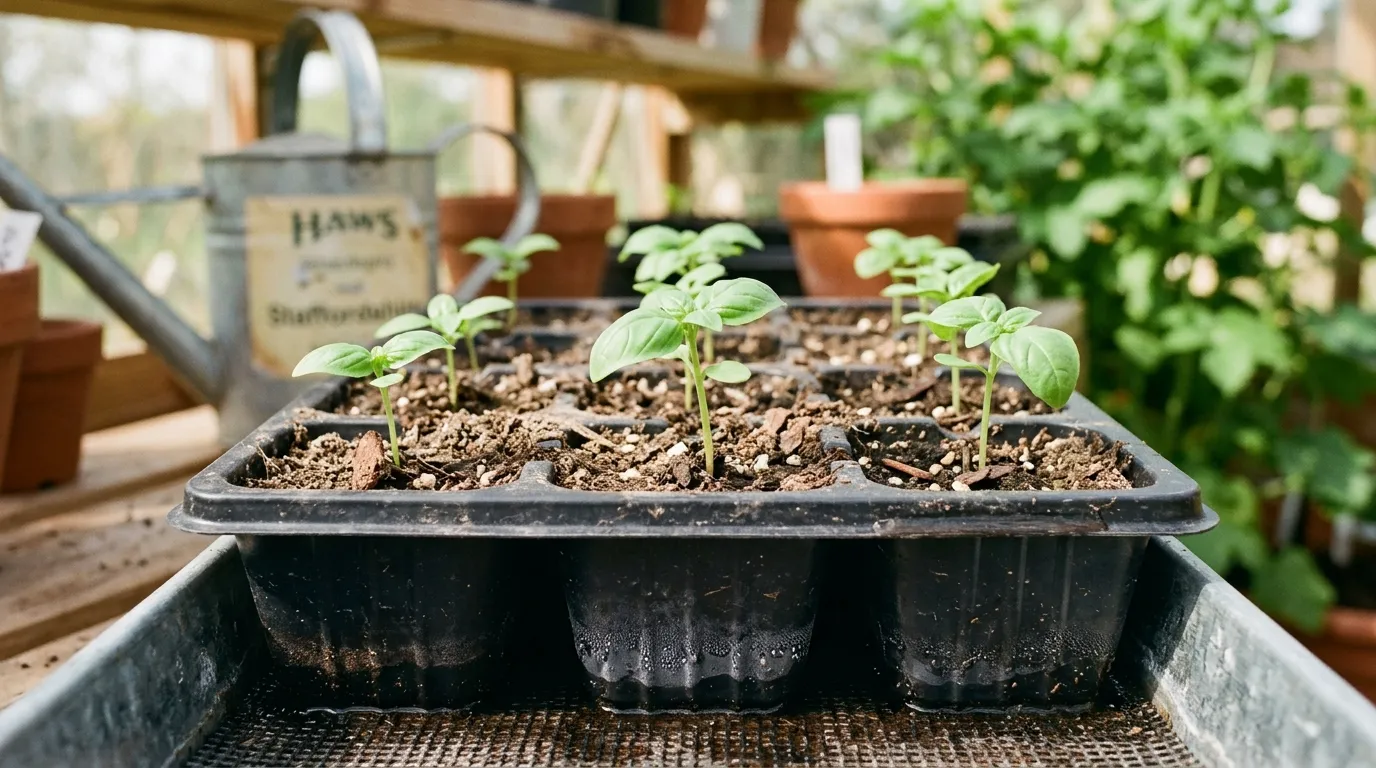 The post-soak result: dry surface (no damping off) and moist lower compost (active root growth).
The 8 species that need bottom watering
Some species germinate and grow fine with careful top watering. Others fail repeatedly under top water and only thrive with the bottom soak method.
| Species | Why bottom water | Trial survival vs top |
|---|---|---|
| Basil (Ocimum basilicum) | Damping off prone, hates wet leaves | +33 points |
| Lettuce (Lactuca sativa) | Surface-sown, washes easily | +28 points |
| Primula (auricula, vulgaris) | Surface-sown, hates surface crust | +22 points |
| Lobelia (Lobelia erinus) | Tiny seed, washes to corners | +30 points |
| Antirrhinum (Antirrhinum majus) | Damping off prone in cool springs | +18 points |
| Begonia (Begonia semperflorens) | Surface-sown, hates surface compaction | +25 points |
| Foxglove (Digitalis purpurea) | Surface-sown, very fine seed | +20 points |
| Tobacco plant (Nicotiana) | Surface-sown, washes easily | +24 points |
The pattern is clear: any species that is surface-sown or damping off prone benefits dramatically. Buried-seed crops like courgette, broad bean, sunflower and runner bean show smaller gains (typically 5-10 points) because the seed sits below the wet surface anyway.
Capillary matting for hands-off watering
Capillary matting is the upgrade from manual soaking. A 5mm polyester wicking mat sits in the bottom tray and stays permanently moist; the plug trays sit on top and draw moisture continuously. The system holds 5 to 7 days of water in a UK spring without intervention.
The setup:
- Cut the capillary mat 30mm shorter than the outer tray on each side.
- Lay the mat in the dry outer tray.
- Fill with 1.5cm of rainwater (slightly more than the soak method because the mat retains 0.5cm).
- Soak the mat by hand for the first 5 minutes to expel air, then place the plug trays on top.
- Top up to the 1.5cm line every 5-7 days.
The mat must dry out completely once every 4 weeks. Permanently wet matting grows algae and a salt crust. A weekly inspection lets you spot problems before they spread.
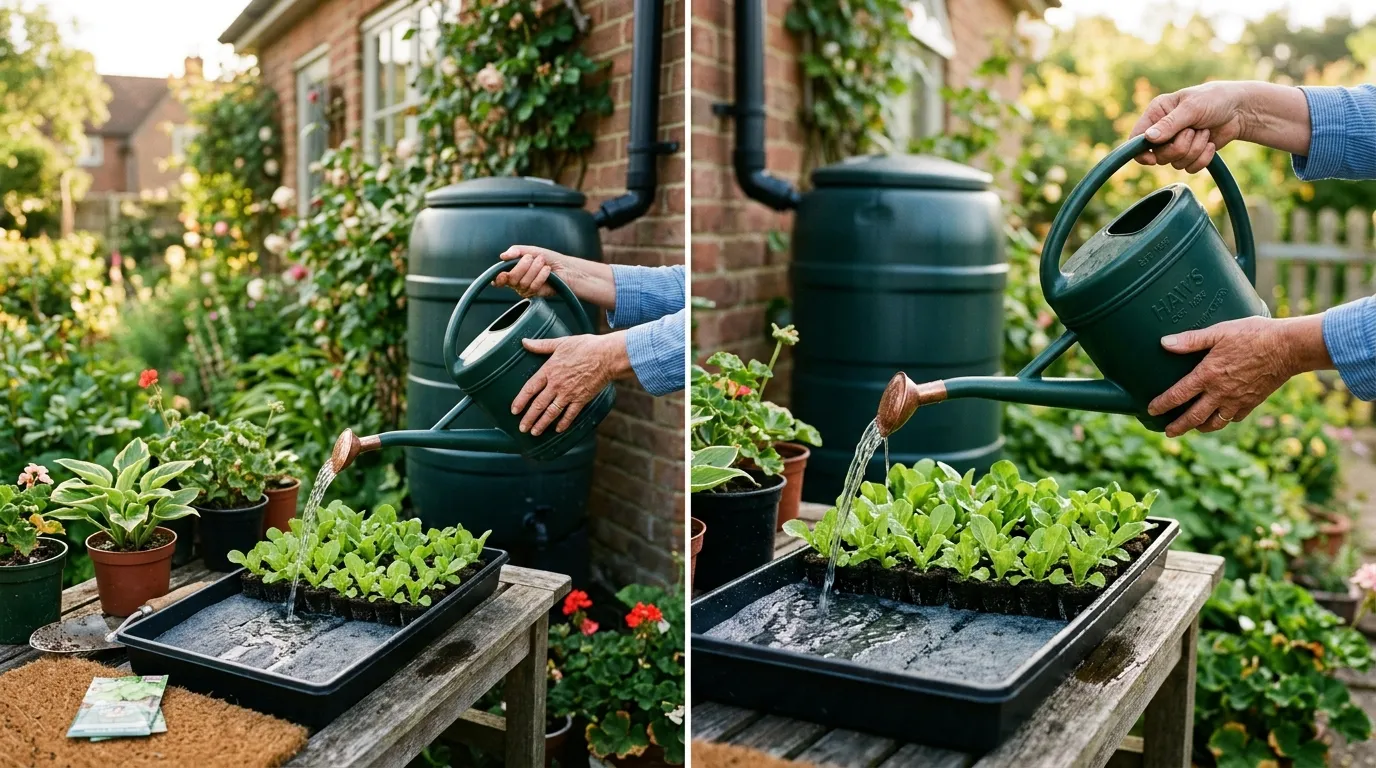 Rainwater from a 200-litre butt topping up a capillary mat tray. The mat distributes evenly across all plug trays on top.
Tap water versus rainwater: the chlorine and pH question
UK tap water sits at pH 7.5-8.0 in most regions and contains 0.5-2.0mg/L of free chlorine. Both are issues for sensitive seedlings:
- pH. Most seedling compost is at pH 5.5-6.5. Tap water at pH 8.0 used repeatedly drives the root zone pH upward by 0.5-1.0 units over 4 weeks. Acid-loving species (basil, primula, blueberry, ericaceous) struggle above pH 6.5.
- Chlorine. Free chlorine kills beneficial soil bacteria. Trichoderma, mycorrhizal fungi and other beneficials drop to zero within 2-3 watering cycles. The root system loses its natural disease defence.
The two practical fixes:
- Stand tap water overnight. A watering can left open for 12 hours loses 80% of its chlorine to evaporation. Use it tepid (16-20C), never straight from the cold tap.
- Switch to rainwater for sensitive species. A 200-litre butt fitted to a downpipe holds enough for a full UK spring sowing season. Always cover the butt to keep algae and mosquito larvae out.
Hard water areas (London, much of southern England, East Anglia) gain the most from rainwater. Soft water areas (the West Country, Cumbria, much of Wales and Scotland) can use tap water with minimal effect on seedlings.
Troubleshooting: algae, salts and slow drainage
Three problems show up on bottom-watered trays. All are easy to fix:
- Green algae on the compost surface. Cause: too much water in too much light. Fix: reduce soak time by 2-3 minutes, drain the tray fully, top-dress with 3mm of horticultural vermiculite to block light from the surface.
- White or yellow crust on the surface. Cause: salts drawn upward by repeated bottom watering. Fix: flush the tray once a month by top-watering with rainwater until water runs out of the drainage holes (5-10 seconds of pouring).
- Slow drainage from the tray after the soak. Cause: compost is too fine (multipurpose rather than seed compost) and the drainage holes are blocked. Fix: switch to a proper peat-free seed sowing compost and check that all drainage holes are clear before sowing.
The salts issue is the one most growers miss. Bottom watering pulls salts upward as water evaporates from the surface. A monthly top-watering flush keeps the root zone balanced.
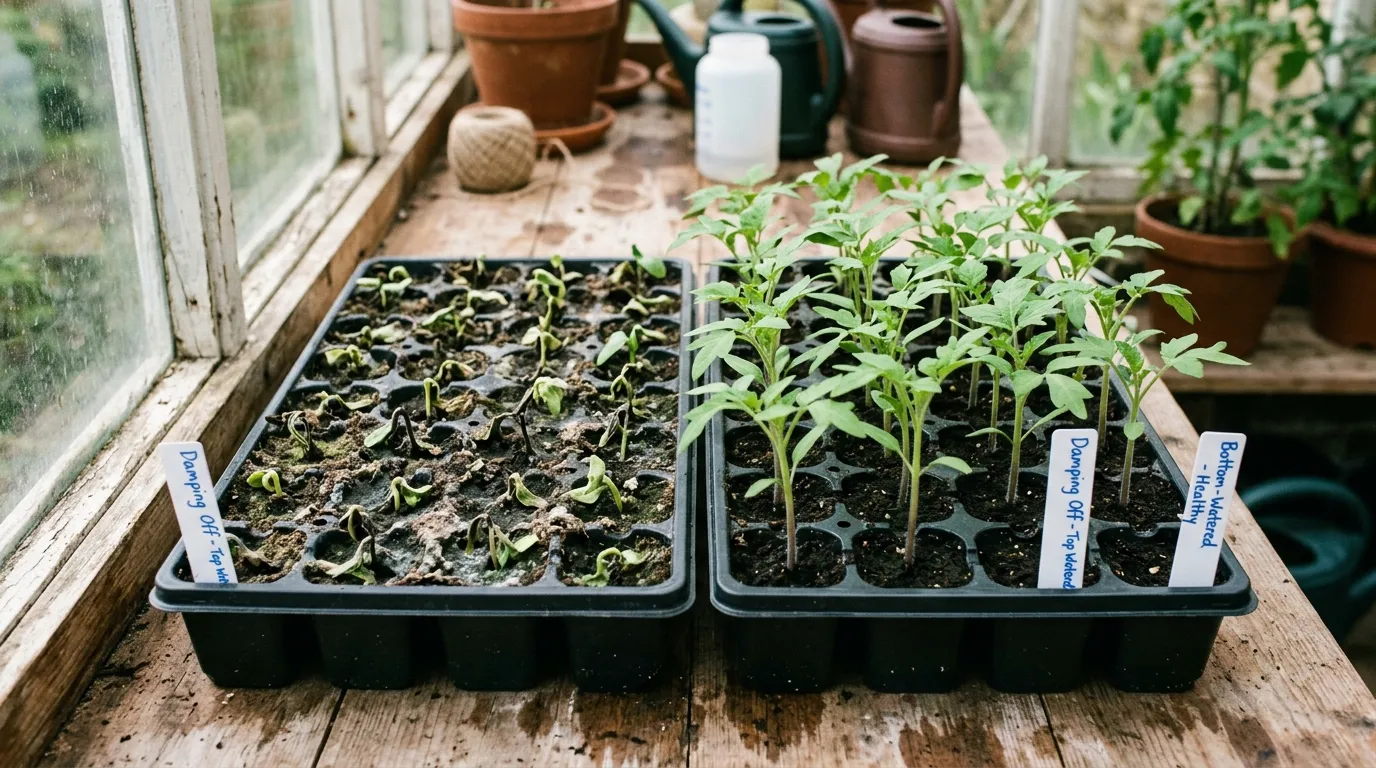 The damping off difference: the left tray was top-watered, the right tray bottom-watered. Same compost, same seed packet, same bench.
How often to bottom water
The frequency depends on the stage of growth, the weather and the propagator:
| Stage | UK spring frequency | UK summer frequency |
|---|---|---|
| Sowing to germination (0-10 days) | Every 3-4 days | Every 2 days |
| First true leaves (10-21 days) | Every 5-7 days | Every 3-4 days |
| Pricked out into 7cm pots (21-42 days) | Every 7-10 days | Every 4-5 days |
| Hardened off, ready to plant | Daily check, water as needed | Daily check, water as needed |
The signal to soak again is the dry feel of the compost surface plus a light tray weight when lifted. Never water on a strict schedule; always check by hand and by lifting.
The 4 common mistakes
- Leaving the tray sitting in residual water. A plug tray standing in 3cm of water for an hour drowns the roots. Always drain on a slatted bench after the soak.
- Using cold tap water from the tap. Cold water (under 12C) shocks the root system and slows growth by 4-7 days. Always use tepid water from a watering can stood overnight.
- Skipping the monthly salt flush. Salts build invisibly over 4-6 weeks and stunt growth at the second true-leaf stage. A monthly top-watering rinse keeps the root zone fresh.
- Continuing bottom watering past the hardening-off stage. Once the plant has 2-3 true leaves and is moving to the cold frame, switch to top watering with a fine rose. The plant needs the stem-strengthening cycle of damp-then-dry that top watering gives.
Frequently asked questions
Will the seeds rot from too much water in bottom watering?
Not if the soak time is correct and the tray drains afterward. The 5-10 minute soak wets the compost enough to germinate the seed without saturating it. Seeds rot from continuous wet, not from a brief soak with proper drainage.
Can I bottom water seedlings on a heated propagator?
Yes. Stand the propagator base tray in a slightly larger flat tray of water for the soak, then return the propagator to the bench to drain. Do not leave the heated base sitting in water continuously; it can damage the thermostat.
How do I know when to switch to top watering?
When the seedlings have 2-3 true leaves and the stems have hardened (typically 3-4 weeks from germination), switch to a fine rose watering can. The plant now needs the dry-down between waterings to harden off for planting out. Continue using rainwater where possible.
Does bottom watering work for vegetable seedlings?
Yes for all vegetable seedlings during the propagator stage. Brassicas, lettuces, tomatoes, peppers and herbs all benefit. Once pricked out into individual 9cm pots, top watering with a fine rose works equally well because the deeper compost holds moisture longer. See our seed germination temperatures guide for full sowing data.
Can I reuse the soak water?
Yes if it stays clean. Pour the residual water from the outer tray back into the rainwater butt or into a clean watering can for the next batch. Discard any water that has compost crumbs or visible debris. Replace the water entirely once a week to avoid algae build-up.
Stop top-watering your seed trays. The 5 to 10 minute bottom soak with rainwater drops damping off losses from 39% to 5% on susceptible species and eliminates the surface compaction that ruins fine-seed sowings. Pair the method with our seed sowing calendar UK and May sowing priorities guides for a full UK propagation schedule. For tender crops grown under cover, the polytunnel productivity guide and growing tomatoes UK guides cover the next stage.
Our team produces practical UK gardening guidance from source research, contributor records and established horticultural practice. Editorial standards are overseen by Matt W.