Key takeaways
- Lift onions when 50 per cent of the tops have fallen over, between mid-August and mid-September in most of the UK
- Sun cure on a slatted rack outdoors for 2-3 weeks in dry weather, or 4-6 weeks hung in an airy shed in wet years
- Curing is complete when outer skins rustle, the neck is dry and tight, and bulbs sound papery when tapped
- Best UK keepers are 'Sturon' and 'Stuttgarter Giant' (5-8 months); 'Long Red Florence' and overwintered 'Senshyu' keep 2-3 months only
- Store cured onions in hessian sacks or net bags at 4-10C and 60-70 per cent humidity in a frost-free shed or pantry
- Stored onions sprout when temperatures rise above 12C or humidity stays above 80 per cent; the fix is cooler darker storage
Drying and curing onions is the step that separates a fortnight of fresh onions in August from a year-round supply that takes you through to the next harvest. A well-cured ‘Sturon’ from an August allotment lift sits in a hessian sack for eight months without sprouting and tastes essentially as it did at lifting. A poorly cured one rots inside the sack by November and you find the rest of the bag is sticky and acrid by Christmas.
This guide covers when to lift, two UK curing methods (outdoor rack and shed hang), the plaiting technique that works for soft-necked storage onions, the five UK varieties worth growing for long storage, and the temperature and humidity rules that decide whether your onions last six months or two. For wider storage see storing onions, garlic and shallots UK, and for grow-it-yourself foundation how to grow onions UK.
When to lift onions for curing
The most important variable in onion drying is the moment of lifting. Too early and the bulbs have not fully developed; too late and the neck rots in the ground before you start curing.
The 50 per cent rule
Lift when half the tops have fallen over of their own accord. This is the plant’s biochemical signal that bulb development has stopped and the outer skins are starting to set. The flopping happens at the base of the green stem, just above the bulb, when the cells lose pressure. It usually appears mid-August to mid-September in most of England and Wales, mid-September to early October in Scotland.
Do not bend tops by hand
Some old UK gardening books recommend “knocking the tops over” to hurry maturity. Modern research has shown this damages the neck tissue and gives rot a route into the bulb during curing. Let the tops fall naturally. Bulbs that resist falling are still actively growing and benefit from another week or two in the ground.
Choose a dry day
Lift on a dry morning with a 3-5 day clear forecast. The Met Office five-day chart is the relevant tool. Wet lifting means wet curing, and wet curing means rot. If your lift window coincides with a wet spell, postpone by a week if possible; if not, lift and dry indoors in an airy shed from day one.
Use a fork, not a pull
Slide a fork in 15-20cm from the row and lever upwards. The bulbs come out of the loosened soil cleanly with the basal plate (the disc of tissue at the bottom of the bulb) intact. Pulling by the tops tears the basal plate and creates a wound that lets in rot during curing. A torn basal plate halves storage life.
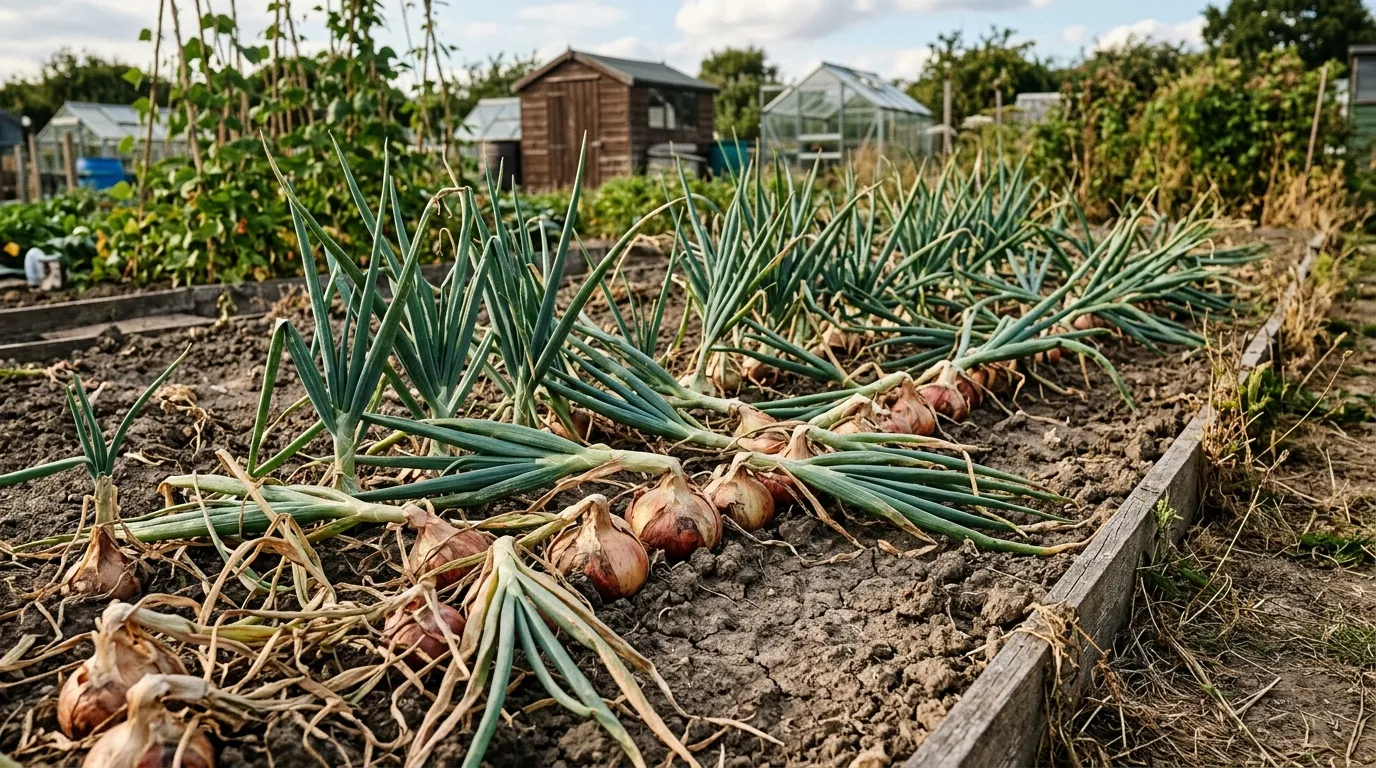 Lift onions when 50 per cent of the tops have fallen over naturally. Bending them by hand damages the neck and shortens storage life.
The science of curing onions
Curing is the process of drying the outer skins, the neck and the basal plate to the point where the bulb seals itself against rot and water loss. Four things happen in parallel.
- The outer scales lose water. Two to four layers of fleshy skin dry to a papery shell that protects the inner flesh from pathogens and water vapour movement.
- The neck collapses and dries. The bundle of vascular tissue at the top of the bulb dehydrates and seals off the route by which most rot enters. A properly cured neck is dry, tight and twisted.
- The basal plate hardens. The disc at the bottom of the bulb (the bit roots grow from) dries and seals. A wet basal plate is the second most common entry point for rot.
- Surface microbes die back. The drying process kills surface bacteria and fungal spores that would otherwise grow during storage.
Done well, all four happen evenly across every bulb. Done poorly, one or more steps stays incomplete and rot finds the gap. The single most overlooked element is neck drying; this is the part that takes longest and is the cause of nine out of ten storage failures.
Method 1: outdoor sun curing on a slatted rack
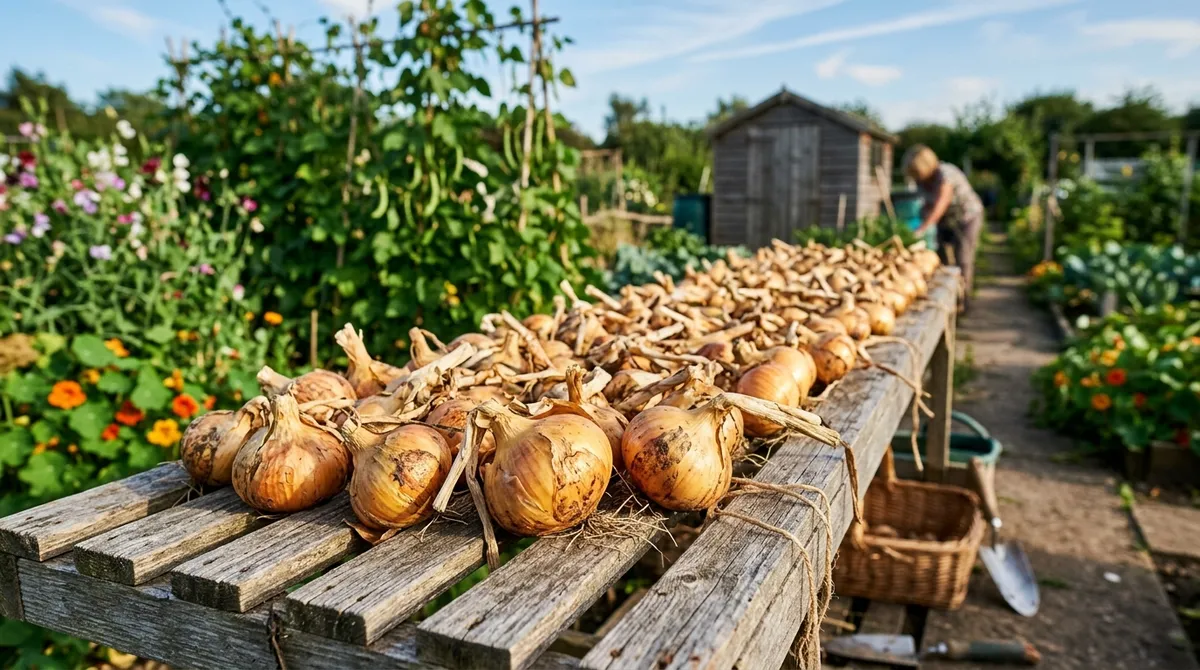
The traditional UK method and the one that works best in a normal August-September dry spell. Needs 2-3 weeks of good weather but produces the most thoroughly cured bulbs.
- After lifting, brush off the worst of the soil clinging to the basal plate. Do not wash. Leave skins as they are.
- Lay bulbs on a wooden slatted rack or a sheet of chicken wire stretched over a frame, raised 30cm off the ground so air flows underneath.
- Position the rack on a south-facing patio, allotment shed roof or driveway in full sun.
- Space bulbs so they do not touch. Crowded bulbs cure unevenly.
- Turn every 2-3 days so all sides see the sun.
- Bring under cover overnight only if rain is forecast. The sun and air are doing the work.
- Total time 2-3 weeks. Done when necks are dry to the touch and outer skins rustle.
A 4x2 foot slatted rack holds about 5kg of medium onions in a single layer. For a 20kg harvest you need either three racks rotating through the curing process or a longer setup.
Method 2: shed curing on hanging twine or racks
The UK fallback for wet seasons and the only realistic method for plots without a sun-trap south-facing area. Slower than outdoor curing but reliable in any UK weather.
- After lifting, brush off worst soil and place bulbs in an airy shed, garage or covered allotment structure with cross-ventilation.
- Option A: lay flat on a slatted rack as for outdoor curing, but indoors.
- Option B: tie bulbs in bundles of 6-8 by the tops with twine and hang from rafters or a horizontal bar. Necks pointing down.
- Either way, leave gaps between bulbs and bundles for air to circulate.
- Run a small fan on a low setting in damp weather to maintain airflow.
- Total time 4-6 weeks because air movement is slower than outdoors. Done when necks are dry to the touch and outer skins rustle.
Cross-ventilation matters more than temperature in shed curing. A breezy 14C shed cures faster than a still 22C one. Open windows or doors at opposite ends to create a draft. The Royal Horticultural Society guidance on harvesting and storing onions covers similar curing principles.
Shed curing takes 4-6 weeks. Cross-ventilation and a vertical hanging position both speed the process. Necks pointing down doubles airflow around each bulb.
How to test for full cure
Three checks for done-ness. All three must pass before bulbs go into storage.
- Skin rustle test. Pick up a bulb and rub the outer skin between thumb and forefinger. A properly cured skin rustles like dry paper. An underdried skin feels soft and slightly damp.
- Neck pinch test. Pinch the neck (the dried stem just above the bulb) between thumb and forefinger. It should feel tight, dry and woody. A spongy or wet feel means more curing time needed.
- Sound test. Tap two cured bulbs together. They should sound papery and hollow. A wet bulb sounds dull and muffled.
Bulbs that fail any test go back on the rack for another week. Bulbs that pass all three can be cleaned, trimmed and stored.
Final cleaning before storage
Once cured:
- Cut tops 2-3cm above the bulb with sharp scissors. Do not cut closer; the dry neck stub protects the bulb during storage.
- Trim roots flush with the basal plate.
- Brush off any remaining dry soil with a soft brush or gloved hand.
- Discard any bulb with a thick neck, soft spot or damaged skin. Use these fresh within two weeks.
A typical UK allotment harvest of 25kg yields roughly 22kg of properly cured storage bulbs after culling for use-first stock. That 12 per cent cull is normal and not a sign of poor cultivation.
Plaiting onions: technique for soft-necked storage varieties
A traditional UK method that turns a harvest into a kitchen feature and an easy-access storage system. Only works for soft-necked varieties.
Which varieties plait
- ‘Sturon’: soft-necked once cured, holds a plait well. The UK plaiting onion.
- ‘Stuttgarter Giant’: similar neck type, ideal for plaits.
- ‘Bedfordshire Champion’: older variety, plaits beautifully.
- ‘Ailsa Craig’: very mild flavour, plaits well but is best eaten fresh.
Which do not plait
- ‘Red Baron’: hollow-necked once cured, snaps. Use net bags.
- ‘Long Red Florence’: salad onion, no real neck. Eat fresh.
- ‘Senshyu Yellow’ overwintered: hollow-neck. Use net bags.
- ‘Radar’ Japanese: same problem.
The basic technique
- Cut a 1 metre length of strong garden twine and fold it in half. Tie a loop in the middle for hanging.
- Take three medium cured onions with tops 15-20cm long.
- Tie the three by their tops to the bottom of the twine, evenly spaced.
- Add bulbs one at a time, weaving each top into the twine and pressing the bulbs together.
- Alternate which side of the twine each onion sits on so the plait stays balanced.
- Continue until you have 12-15 bulbs in the plait, leaving 20cm of twine free at the top for a hanging loop.
- Tie off the top with a double knot.
A finished plait weighs 1.5-2 kilograms and hangs from a beam, hook or wall peg in a frost-free shed, pantry or porch. Take bulbs from the bottom up; the lower bulbs cured longest and are first off the plait.
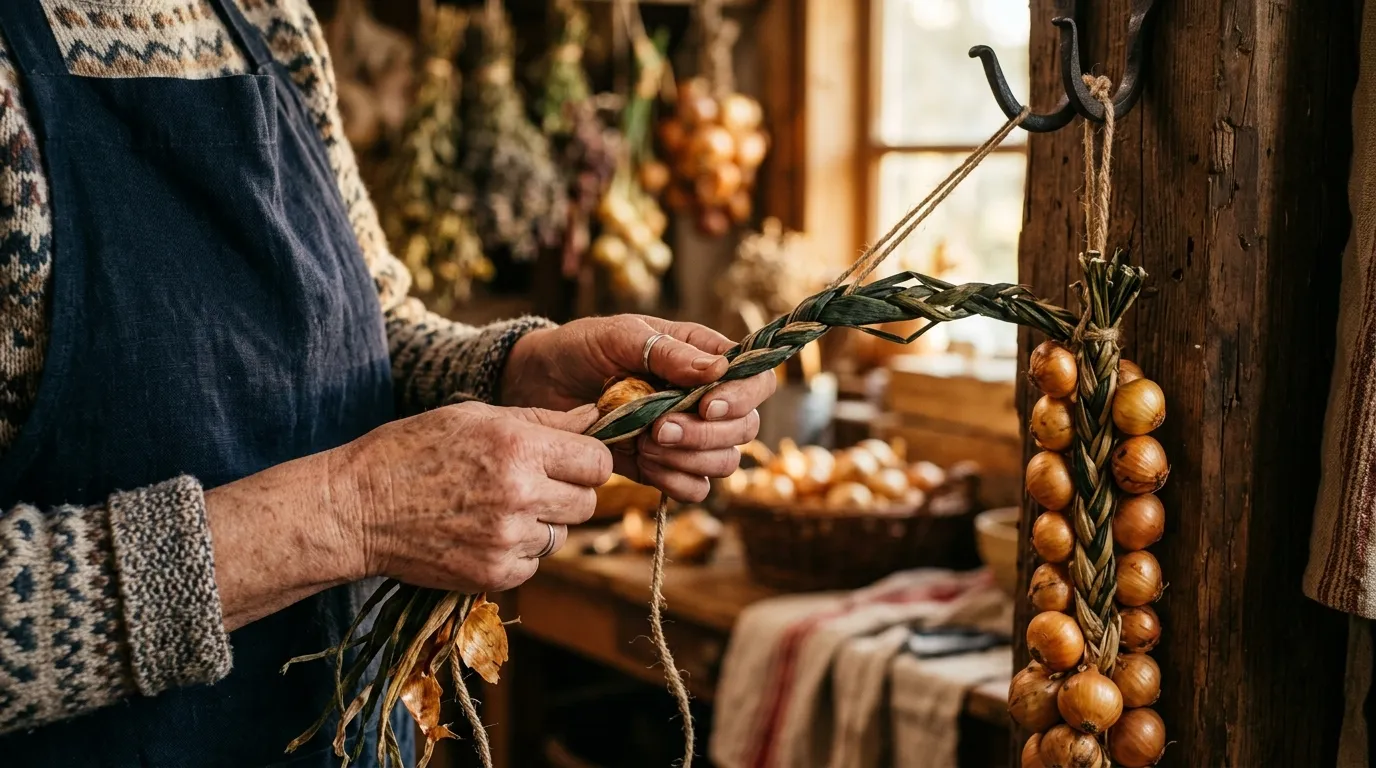 Plaiting works only with soft-necked storage varieties like ‘Sturon’ and ‘Stuttgarter’. Red and Japanese onions have hollow necks and snap when woven.
The best UK onion varieties for storage
The headline lesson from nine seasons of testing: ‘Sturon’ and ‘Stuttgarter Giant’ are the only varieties worth growing in volume for long storage. ‘Red Baron’ is the best red but lasts shorter. Overwintered Japanese types like ‘Senshyu’ fill the hungry gap between stored crop and new harvest (April-July) but never keep into winter.
For the full varietal comparison see best UK onion varieties compared, and for show-quality growing exhibition onions UK.
Storage conditions: 4-10C and 60-70 per cent humidity
After curing comes the storage stage where most UK home onion crops fail. The same bulbs that emerge cured in October rot or sprout by January in the wrong conditions.
Temperature
The ideal range is 4-10C. Below 4C the bulbs may freeze and turn mushy on thawing. Above 12C sprouting starts within weeks. A frost-free shed, an unheated porch, or a stone-floored pantry all work. A heated kitchen does not.
Garage storage is risky in UK winters because temperatures drop below 0C in cold snaps. Insulate against frost but accept that a UK garage in February is often too warm by day and too cold by night for stable onion storage. If garage storage is the only option, monitor with a min-max thermometer and move bulbs to a cooler space if the swings get severe.
Humidity
60-70 per cent relative humidity is the target. Too low (below 50 per cent) and bulbs dry out and shrink. Too high (above 80 per cent) and rot takes hold. A small dial hygrometer for a few pounds tells you the room conditions.
A typical UK shed in autumn sits at 60-75 per cent humidity, which is ideal. By February-March some sheds rise to 85 per cent as the ground warms; this is when stored onions start to soften.
Container
Three workable options:
- Hessian sacks: the classic. Breathable, holds 5-10kg, allows visual checks if you tip the contents into a tray. Available from agricultural merchants for 2-3 pounds.
- Net bags: plastic mesh sacks like supermarket onion bags scaled up. Cheap, breathable, hang from a hook. Buy 25kg sacks from online sources.
- Wooden crates with slatted bottoms: ideal for layered storage. Place a single layer of bulbs, separate with newspaper, add another layer. Maximum two layers deep.
Avoid plastic bags (sweat with temperature changes, instant rot), cardboard boxes (absorb humidity, soft within weeks) and any container without ventilation.
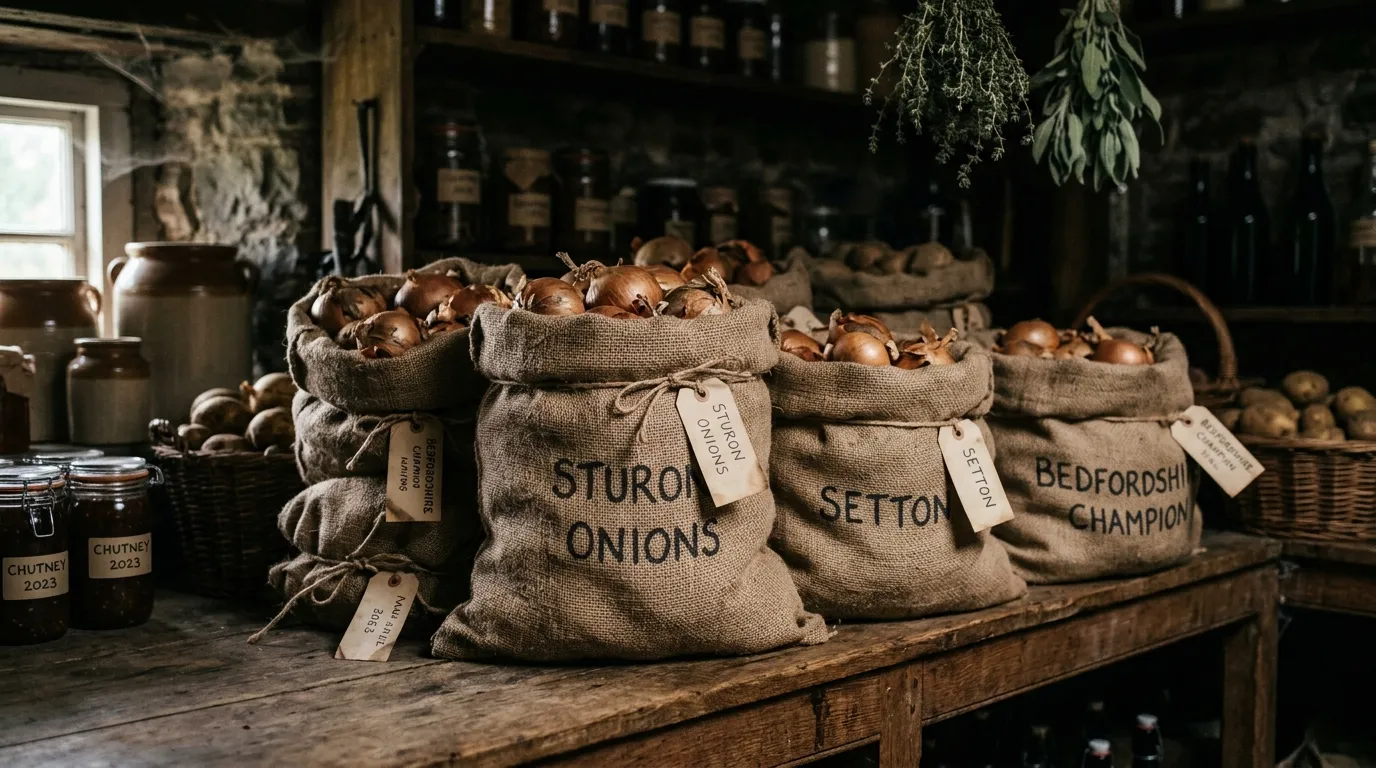 Store cured onions in hessian sacks or wooden crates at 4-10C and 60-70 per cent humidity. Label each sack by variety and date.
Why stored onions sprout (and the fix)
The single most common UK onion storage failure is spring sprouting. The bulbs go in well-cured in October, look fine in December, and burst into green growth by late February. Two factors trigger it.
Temperature above 12C
UK garages, porches and outhouses warm up rapidly from late February as the sun strengthens. Once daytime storage temperature exceeds 12C, bulbs sense spring conditions and break dormancy. The green sprout grows from the centre of the bulb, draws nutrients out, and softens the flesh.
The fix is to move sacks to a cooler darker space for the last 2-3 months of storage. A north-facing shed, a stone pantry, an unheated cellar or even a fridge salad drawer (for the last month) all work.
Humidity above 80 per cent
UK spring brings rising humidity as the ground warms and evaporation begins. When storage humidity exceeds 80 per cent for sustained periods, the basal plate rehydrates and roots start to emerge. This is a different failure from sprouting but the result (loss of bulb mass to root growth) is similar.
The fix is to ventilate the storage space. Open shed doors on dry days, run a fan in damp weather, or add a small dehumidifier in a problem space.
Are sprouted onions still safe to eat?
Yes. Remove the green sprout (cut down the centre, scoop out the shoot), and use the bulb within a week. The flesh will be softer than fresh-cured but is fully edible. Sprouted bulbs do not last in storage; bring sprouted ones to the kitchen for immediate use.
UK month-by-month onion calendar
| Month | Task |
|---|---|
| January | Order onion sets from suppliers (Marshalls, Suttons, T&M) |
| February | Plant overwintered sets (‘Senshyu Yellow’, ‘Radar’) if not already in ground |
| March | Plant main-crop sets (‘Sturon’, ‘Stuttgarter Giant’, ‘Red Baron’) |
| April | Hoe between rows; do not let weeds compete |
| May | Liquid feed every 3 weeks with seaweed feed |
| June | Stop feeding from mid-June so bulbs start to set |
| July | Lift overwintered varieties for fresh use |
| August | Main-crop tops start to fall over; first lifting from mid-month |
| September | Main-crop lifting and start of outdoor curing |
| October | Finish curing, plait soft-necked varieties, bag the rest |
| November | Storage check: look for soft bulbs and remove |
| December-February | Use stored crop; check sacks fortnightly for early sprouters |
For the wider winter storage strategy across all root crops see how to store root vegetables in winter UK, and for the long-keeper allium specialism storing onions, garlic and shallots UK.
Common UK mistakes and their fixes
- Lifting too early. Tops still upright means bulbs still growing. Wait for 50 per cent to fall naturally. Lift early and the bulbs never fully cure.
- Washing the bulbs. Water rewets the dry skins and rot follows. Brush off mud, never wash.
- Bending tops by hand. Damages neck tissue and lets rot in. Let tops fall naturally; some varieties never do, in which case lift on the calendar (mid-September).
- Insufficient airflow during cure. Crowded bulbs cure unevenly. Space them properly on the rack and run a fan in still weather.
- Cutting tops too close. Removes the protective dry neck stub. Always leave 2-3cm of dry stem above the bulb.
- Warm storage in late winter. Above 12C and sprouting starts. Move to cooler storage by February.
For the deeper diagnostic look at storage failures see the storing onions, garlic and shallots UK pillar guide, which covers garlic and shallot variations on the same theme.
Salvaging a poorly cured batch
If you lifted in a wet week and notice rot starting at week 4-6 of storage, three options can salvage the rest:
- Tip the sack and sort. Discard any bulb with a soft neck, sticky skin, or musty smell. Wash hands between handling each bulb to avoid spreading bacteria.
- Use up the slightly-soft. Bulbs that are still firm but showing skin-discolouration go to the kitchen for immediate use: soups, ragu base, French onion soup. They keep their flavour even if the texture has softened.
- Pickle the borderline. Bulbs that are firm but showing early sprouting peel down to a usable core. Pickle in vinegar (the pickling onions UK approach) to extend shelf life by months.
Drying spring onions and salad onions
A different proposition from main-crop storage onions. Spring onions (‘White Lisbon’, ‘Performer’, ‘Ishikura’) do not cure or keep; they are used fresh from harvest. For winter spring onions see how to grow spring onions UK which covers the autumn-sown ‘White Lisbon Winter Hardy’ for March-April harvest.
For drying the green tops to use as a chive substitute: cut tops, dehydrate at 45C for 2-3 hours, store in airtight jars. Useful for cooking but lacks the snap of fresh.
For the wider allium family see the guides on garlic and shallot drying within storing onions, garlic and shallots UK. The same curing principles apply: lift on a dry day, cure 2-4 weeks, store cool and dry.
Related guides
For grow-it-yourself foundations see how to grow onions UK, best UK onion varieties compared, how to grow spring onions UK and exhibition onions UK for the show-grower’s approach. For winter storage across all root crops see how to store root vegetables in winter UK.
Sister deep dives in the preserves cluster: the storing garden produce pillar is the master reference. The storing onions, garlic and shallots UK guide covers the wider allium family. For other UK produce see drying apples and pears UK and drying vegetables UK soup mix.
Now you have the curing, plaiting and storage methods compared, read our guide on storing onions, garlic and shallots UK for the wider allium-family storage approach including hard-necked garlic and the soft-stem shallot.
Our team produces practical UK gardening guidance from source research, contributor records and established horticultural practice. Editorial standards are overseen by Matt W.