Key takeaways
- Bedding plants need 10-14 days of hardening off, not the 7 days that works for vegetable seedlings
- Half-hardy annuals (cosmos, marigolds, zinnias) collapse below 7C - protect until soil reaches 12C
- Tender perennials (pelargoniums, fuchsias, salvias) need 10C overnight minimum throughout hardening off
- Wind damage causes more bedding losses than cold in UK May conditions - shelter for the first 5 days
- Container-grown herbaceous perennials shipped in spring are partially hardened but need 14-21 days more
- Use 15 May (south), 20 May (Midlands), 25 May (north) as the UK frost-safe planting date
Hardening off is the controlled introduction of indoor-raised plants to outdoor conditions. The process matters more for bedding plants, half-hardy annuals and tender perennials than for vegetable seedlings - these ornamentals are pushed harder under glass to produce flowering-sized stock by April-May, leaving them softer and more vulnerable than a cold-frame-raised lettuce.
This guide picks up where our seedling hardening off guide leaves off. That earlier piece covers the basic 7-day schedule for vegetable transplants. This one covers the harder cases: bedding pelargoniums, dahlias raised under heat, cosmos in plug trays, half-hardy salvias, and the mail-order herbaceous perennials that arrive at peak shipping season already pushed to flowering size.
Why bedding plants need longer than vegetable seedlings
A vegetable seedling raised at 18-21C in a heated propagator carries 15-25 days of growth before being planted out. Its tissue is softer than open-grown stock but the difference is manageable across a 7-day hardening off schedule.
Bedding plants are different. A commercial pelargonium bought in flower in early May has been raised at 16-22C since November. It carries 5-6 months of indoor growth, and its leaves and stems have never experienced UK wind, direct outdoor UV, or temperature swings below 10C. The transition from heated polytunnel to UK May garden is more dramatic than any seedling experiences.
The result: bedding plants need 10-14 days of staged exposure, sometimes longer for the most heat-sensitive species. Truncating the schedule to 7 days produces visible stress (leaf curl, flower bud abortion, stem scorching) that takes 2-3 weeks to recover from once planted out.
For the wider seasonal context on what should be growing under glass at which dates, see our cold frame gardening UK guide.
The three hardness categories
UK bedding falls into three groups by cold tolerance. Each needs a different schedule.
Hardy bedding (frost tolerant)
Pansies, violas, primulas, polyanthus, sweet williams, wallflowers, English daisies, and forget-me-nots. These survive overnight temperatures down to -5C once established. They need 5-7 days of hardening off, can go outside from late March in most of the UK, and tolerate planting through April even with night frosts.
Half-hardy annuals (frost-sensitive)
Cosmos, French marigolds, lobelia, alyssum, nemesia, ageratum, lavatera, nicotiana, zinnia. These die below 0C. The seed germinates at 18-22C in February-March; the seedlings spend April under glass and harden off through the first two weeks of May. Plant out after 15-20 May depending on UK region. Celosia belongs in this group too and sulks after any chill, so hold it under cover until nights stay above 10C.
Tender perennials (collapse below 5-10C)
Pelargoniums, fuchsias, tender salvias, gazania, osteospermum, dahlias (raised under heat), heliotrope, coleus, impatiens, begonias. These die below 5C and some (coleus, impatiens) below 10C. They need the longest hardening off (12-16 days) and the latest planting-out date. Plant out only after 20-25 May with the night-time forecast cleared for 10C+ minimum.
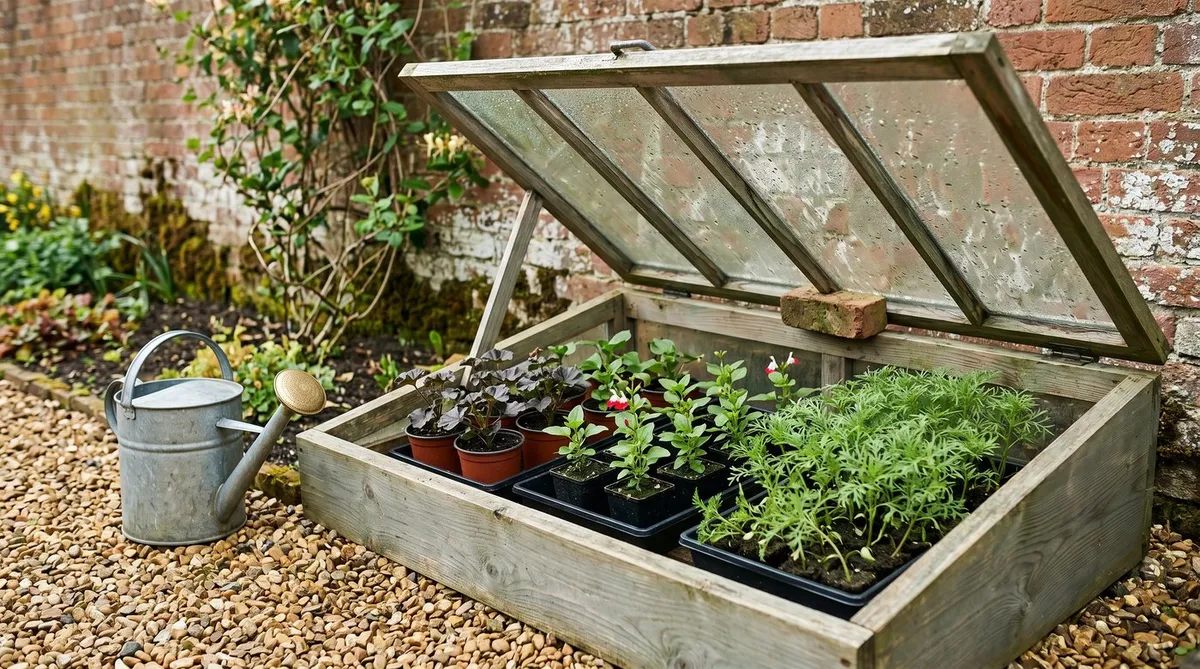
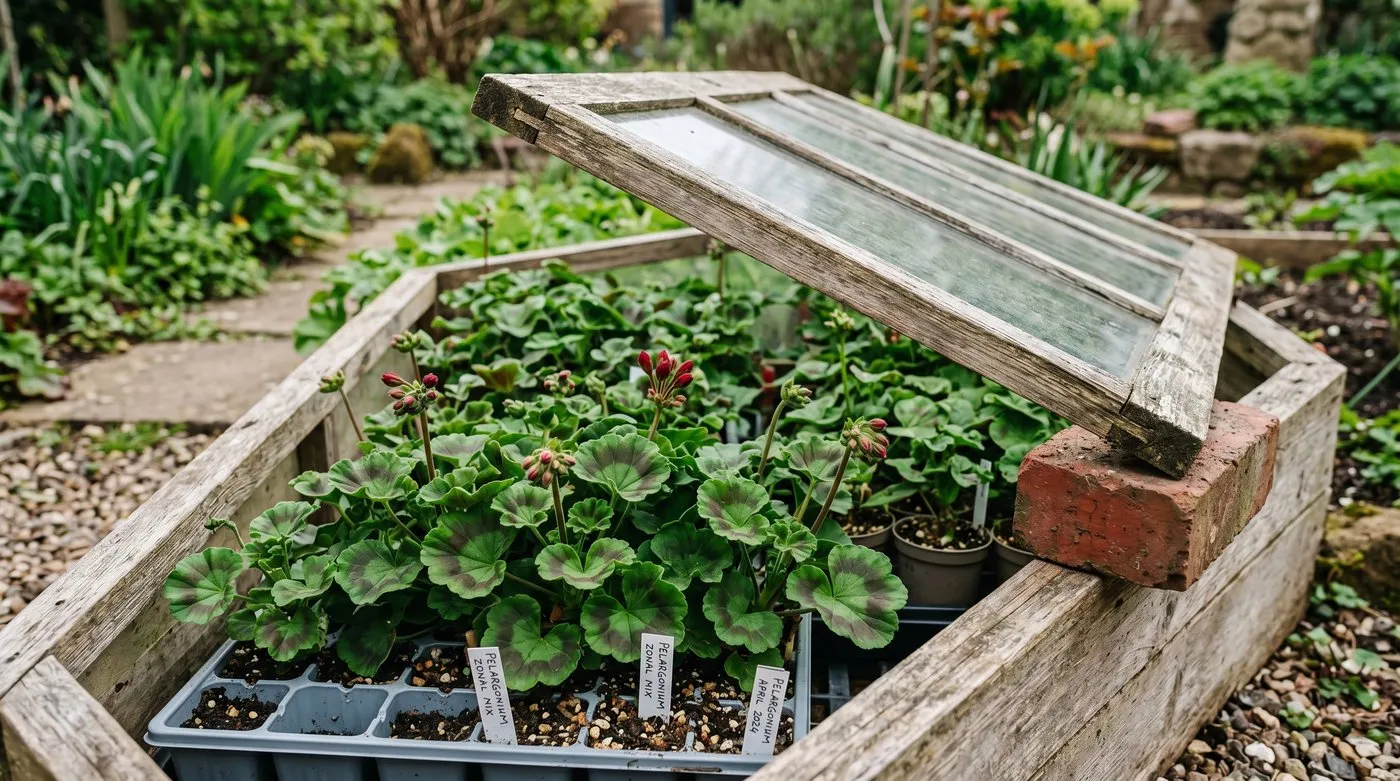 Pelargoniums hardening off in late April. The lid sits propped on a wooden brick - the gap increases by 5cm each day for 10 days.
The 14-day schedule for tender perennials
The schedule below works for pelargoniums, fuchsias, tender salvias, and similar tender perennials. Start when night temperatures in your area are reliably 8C+ (usually 20-25 April in southern England, 1-5 May further north).
| Day | Position | Hours outside | Night protection |
|---|---|---|---|
| 1 | Sheltered patio, dappled shade | 2 hours mid-afternoon | Greenhouse |
| 2 | Sheltered patio, dappled shade | 3-4 hours | Greenhouse |
| 3 | Sheltered patio, dappled shade | 5-6 hours | Greenhouse |
| 4 | Sheltered patio, half sun | 8 hours | Cold frame, lid closed |
| 5 | Sheltered patio, half sun | 10 hours | Cold frame, lid propped 5cm |
| 6 | Sheltered patio, half sun | All day | Cold frame, lid propped 10cm |
| 7-8 | Open position, full sun morning | All day | Cold frame, lid propped 15cm |
| 9-10 | Open position, full sun | All day | Cold frame, lid half open |
| 11-12 | Final outdoor position | All day | Cold frame, lid fully open |
| 13-14 | Final outdoor position | All day & night | Outdoors, fleece on cold nights |
| Day 15 | Plant out | - | Fleece in pocket for emergencies |
The transition from full cold frame to outdoor overnight (day 12-13) is the highest-risk step. Check the 48-hour forecast for night minima above 8C, no rain, and no wind above 25mph. If conditions are wrong, hold for another 2-3 days inside the cold frame.
The 10-day schedule for half-hardy annuals
Cosmos, marigolds, nicotiana, lobelia, lavatera and similar half-hardy annuals tolerate slightly more abuse than tender perennials but still need a staged approach.
| Day | Position | Hours outside | Night protection |
|---|---|---|---|
| 1-2 | Sheltered position, dappled shade | 4 hours per day | Greenhouse |
| 3-4 | Sheltered position, half sun | 6-8 hours | Cold frame, lid mostly closed |
| 5-6 | Open position | All day | Cold frame, lid propped 10cm |
| 7-8 | Open position | All day | Cold frame, lid half open |
| 9-10 | Final position | All day & night | Outdoors, fleece available |
| Day 11 | Plant out | - | Fleece if frost forecast |
Half-hardy annuals get away with the slightly faster schedule because the seedlings are smaller and the cell walls more flexible. Tender perennials carry more mass and need the extra days to adapt.
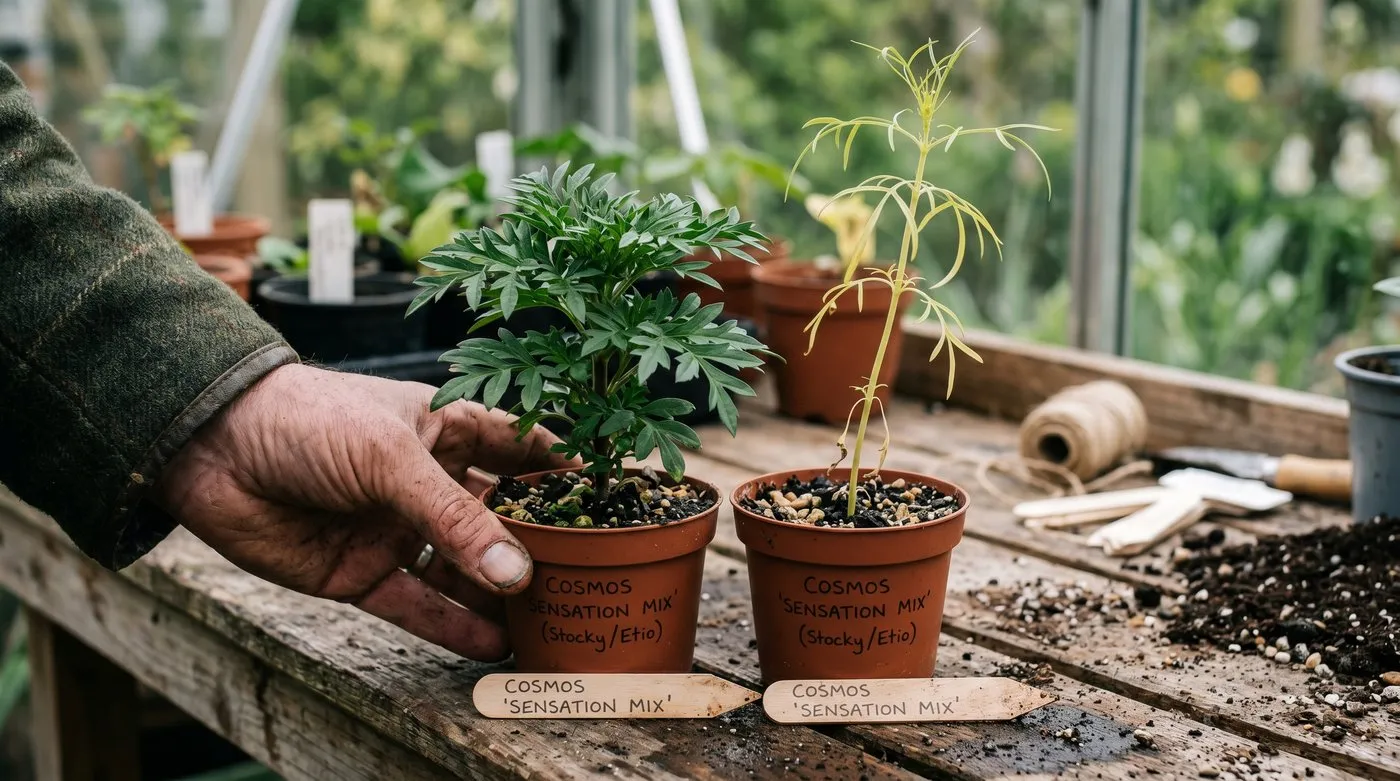 Hardened cosmos (left) versus under-hardened cosmos (right). The hardened plant is shorter, darker green, with thicker stems. The under-hardened plant is leggy and pale - it will collapse at the first wind exposure.
Dahlias - a special case
Dahlias raised from tubers in heated greenhouses need particularly careful hardening off. The shoots emerge soft and pale because they have grown in low light, and the tubers themselves do not tolerate cold storage in moist compost.
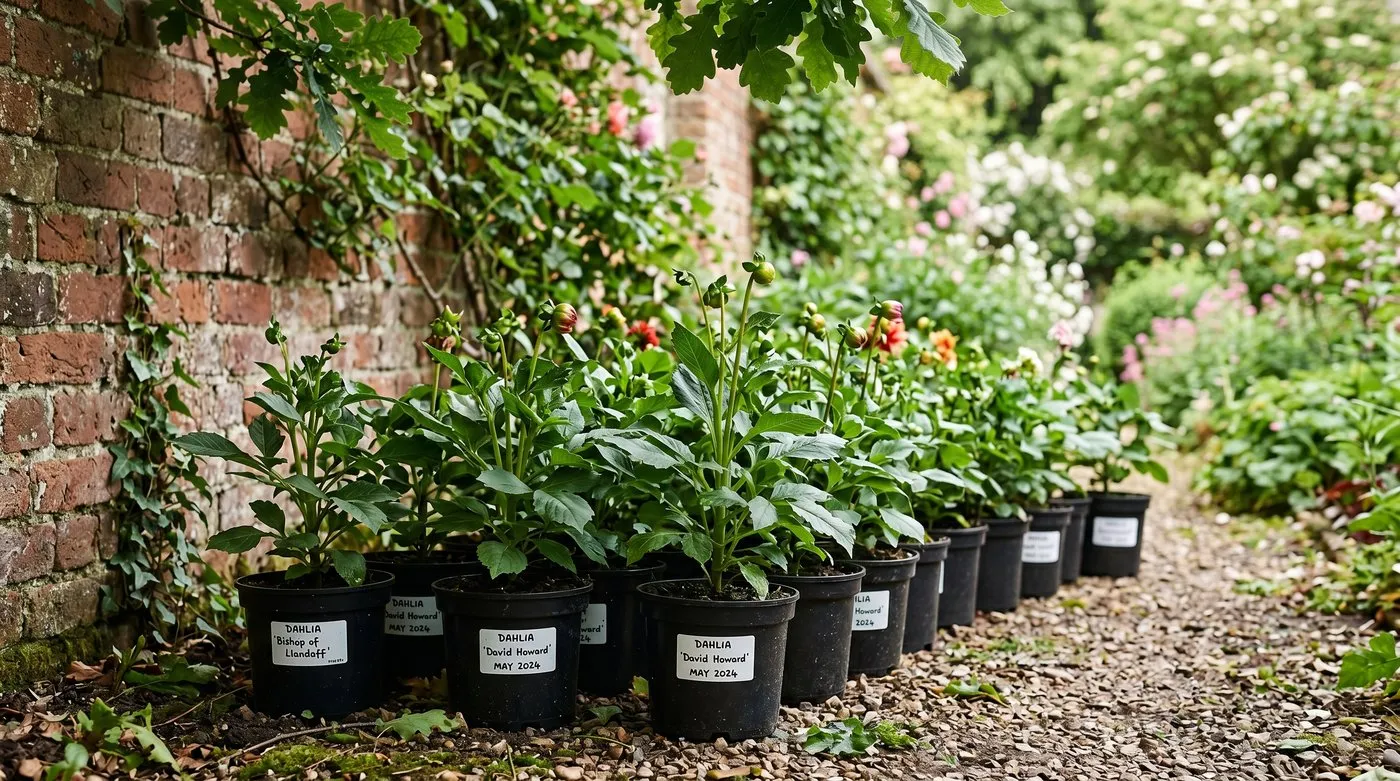 Dahlia plants being acclimatised in dappled shade beside a south-facing brick wall. The wall holds residual heat that protects against overnight chills during the 14-day schedule.
The dahlia schedule:
- Days 1-3: Move from the greenhouse into a sheltered cold frame for daytime only. Bring back inside overnight.
- Days 4-7: Cold frame day and night with the lid propped at 5-10cm. Overnight minimum must stay above 8C.
- Days 8-10: Move pots to the planting position (still in containers). Allow outdoor exposure day and night. Fleece overnight if temperatures drop below 7C.
- Days 11-14: Plant into final position. Stake immediately - tall dahlia varieties snap at the base in spring wind without support.
Tubers stored dry over winter and planted directly into outdoor soil on 1-15 May skip the hardening off requirement entirely. They emerge slowly into outdoor conditions and arrive at flowering size as hardened plants.
Container-grown perennials - the mail-order problem
Mail-order herbaceous perennials shipped in spring arrive at the customer in a halfway state. They have been raised in heated polytunnels to peak shipping condition, then sealed in a dark box for 24-72 hours.
The dark transit period is particularly stressful for the foliage. Light-deprivation triggers chlorophyll breakdown, leaves yellow at the edges, and the plant shifts to root-focused recovery for the first 48 hours after arrival.
The recovery schedule for mail-order perennials:
- Hour 0-48: Unpack immediately. Water if dry. Place in shaded sheltered spot. Do not expose to direct sun, wind, or temperature swings.
- Days 3-7: Move to dappled shade outdoors. Increase exposure by 2-3 hours per day.
- Days 8-14: Move to half-sun position. Allow overnight exposure if night temperatures stay above 7C.
- Days 15-21: Final hardening into planting position. Plant out at the end of the third week.
This 21-day schedule extends well beyond standard hardening off because the dark transit period adds extra recovery time on top of the normal acclimatisation. Many UK gardeners skip this and plant their mail-order perennials immediately, then wonder why 30-50% of the order fails.
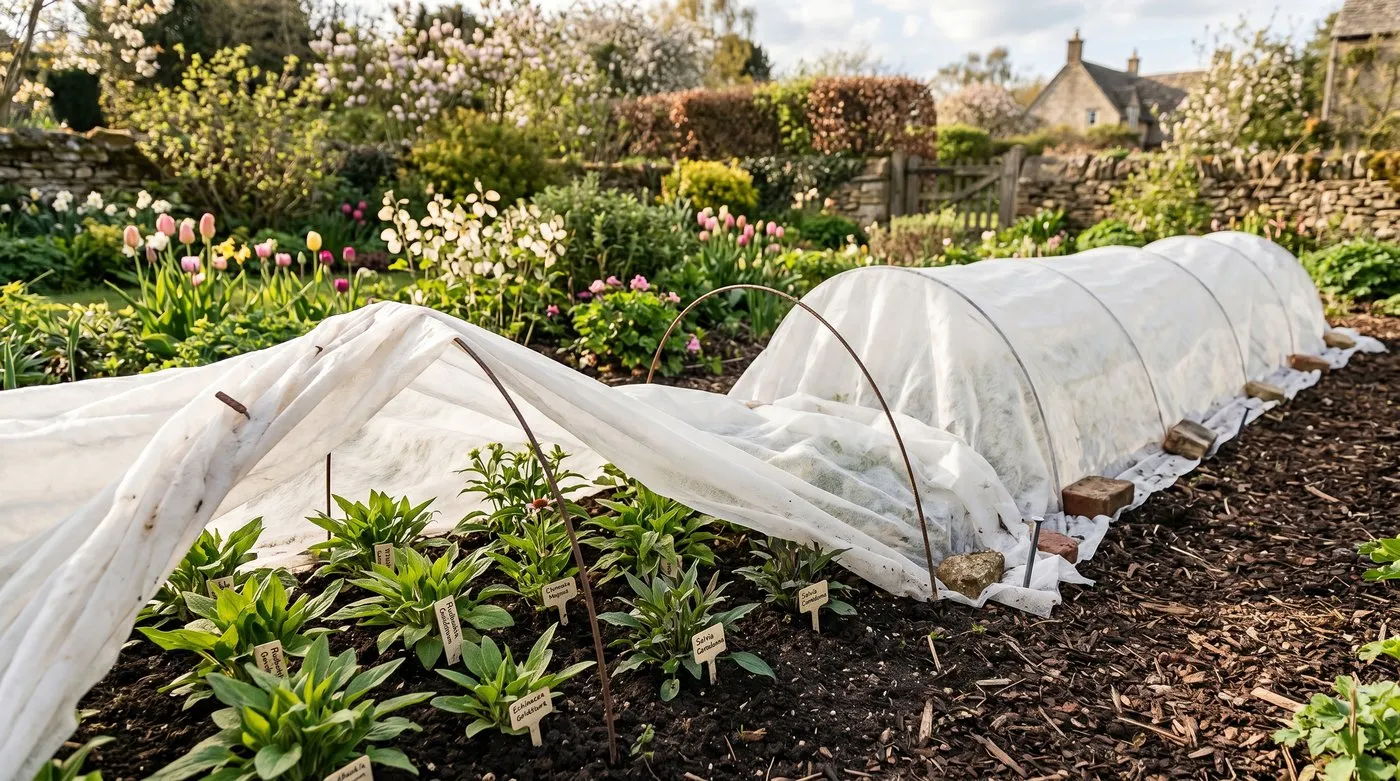 Newly-planted herbaceous perennials under fleece on hoops. The fleece comes off during the day and goes back on at dusk for the first week.
For more on choosing perennials that thrive once established, see our guide to low maintenance perennial flowers.
Wind - the underrated killer
Wind is the variable that catches most UK gardeners out in May. A 15-20 mph breeze is enough to scorch leaves on freshly-planted half-hardies. A 30mph gust shreds leaves and snaps soft stems.
The Met Office records show that May is the windiest non-winter month in most UK regions, averaging 8-12 days of moderate-to-fresh wind. The probability of a 25mph+ gust during any 7-day period in mid-May is roughly 60-70%.
Three rules to manage wind:
- Check the Met Office 48-hour forecast before final planting. Delay if gusts above 25mph are predicted.
- Plant in the lee of a wall, hedge, or shrub for the first season - even 1-2m of shelter cuts wind speed at ground level by 40-60%.
- Stake half-hardy annuals over 30cm tall (cosmos, lavatera, nicotiana) from day one. Bamboo canes plus soft tie at one-third and two-thirds plant height.
Cold frames - the workhorse tool
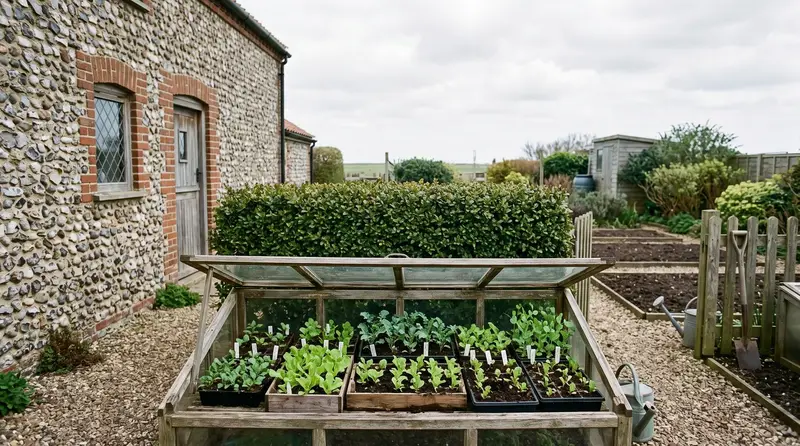
A traditional UK cold frame is the most useful hardening off equipment for amateur use. Even a basic frame raises overnight minimum temperatures by 2-3C and protects plants from direct wind.
What a cold frame does:
- Raises minimum temperature 2-3C above ambient on clear nights
- Cuts wind speed at plant level by 70-80%
- Reduces UV intensity by 15-25% (clear plastic less than glass)
- Buffers temperature swings during the day
What a cold frame does not do:
- Heat the soil significantly (the warming effect is on air temperature, not soil)
- Protect against hard frost (below -3C) - the trapped air still freezes
- Eliminate the need for staged exposure - it is part of the schedule, not a shortcut
For more on getting the most from a cold frame, see our cold frame gardening UK guide.
Common mistakes
Mistake 1: Following a vegetable seedling schedule for bedding plants. The 7-day schedule that works for cabbage transplants is too short for bedding pelargoniums. Always add 5-7 days for tender perennials.
Mistake 2: Planting on a windy day. The first 24 hours outdoors are when plants are most vulnerable. Plant in the calm of early morning or evening, not during a windy afternoon.
Mistake 3: Hardening off and planting the same day. The hardening off schedule ends with 2-3 days of overnight outdoor exposure before planting. Skipping this step adds transplant shock on top of acclimatisation shock.
Mistake 4: Watering with cold tap water on cold days. Cold tap water in May is 8-12C. Pouring it onto already-stressed roots causes thermal shock. Use rainwater from the butt, or fill a watering can the night before and let it warm to ambient.
Mistake 5: Trusting the average last frost date too literally. The 15 May date for southern England is an average across decades. In any given year, frost can occur up to 7-10 days later. Always check the 10-day forecast before planting half-hardies, even if the calendar says safe.
Regional UK planting-out dates
| Region | Average last frost | Safe planting date |
|---|---|---|
| Cornwall, Devon, S Wales coast | 1-15 April | 1 May |
| South-east England, S Midlands | 25 April-5 May | 15 May |
| Central England, N Wales, N Midlands | 10-20 May | 20-25 May |
| Yorkshire, Lancashire | 15-25 May | 25-30 May |
| Scottish Borders, Northumberland | 20-30 May | 30 May-5 June |
| Scottish Highlands, Aberdeenshire | 25 May-5 June | 5-10 June |
These dates reflect the average last frost (the 50-percentile date). Some years are later. For planning, use these dates as the earliest sensible plant-out target and adjust based on the 10-day forecast at the time.
Field note: The Met Office keeps long-term climate data for every UK region. Their “frost frequency” maps are the authoritative source for choosing your local planting date. A 30-second check of the local site forecast on the morning of planting is more reliable than the average date alone.
Month-by-month UK hardening off calendar
| Month | What to harden | Method |
|---|---|---|
| March | Hardy annuals (pansy, primula), sweet pea seedlings | Cold frame only, 5-day schedule |
| Early April | Hardy bedding, brassica transplants | Cold frame, 5-7 day schedule |
| Mid-April | Tomato plants for unheated greenhouse | 5-day schedule for under-glass planting |
| Late April | Half-hardy annuals start - cosmos, marigold seedlings | Begin 10-day schedule |
| Early May | Half-hardy annuals, tender perennials begin | 10-14 day schedule |
| Mid-May | Bulk hardening off period for all half-hardies | Final week of schedules ends 15 May+ |
| Late May | Plant out half-hardies in southern UK | Plant out from 20 May north |
| Early June | Plant out tender exotics (coleus, impatiens) | Wait for 10C+ overnight |
| June onwards | Top up replacements | 5-day schedule for replacement bedding |
When indoor stays the right answer
Five situations where you should hold a plant indoors rather than start hardening off:
- Forecast nights below 5C in the next 10 days. Wait for the weather to settle.
- Sustained winds above 30mph forecast. Multi-day wind events damage even cold-frame protected plants.
- Plant showing stress symptoms (yellow leaves, soft growth, pest pressure). Fix the issue first.
- No time to manage the daily moves for the full 10-14 day schedule. Half-finished hardening off is worse than none.
- Cold frame full of earlier batches. Don’t crowd the frame - each batch needs its own space and airflow.
For the basic seedling-stage process that precedes this article, revisit our hardening off seedlings UK guide.
Gardener’s tip: Buy a digital max-min thermometer and leave it in your cold frame for the season. The overnight minimum reading at 6am tells you whether the previous night’s conditions matched your plan. Two consecutive nights below 5C in the frame is a sign to retreat for 2-3 days before resuming the schedule.
Final planting day - the 5-point checklist
Run this checklist before moving any plant from the cold frame to the final position:
- Temperature: Last 3 nights have been 7C+ for half-hardies, 10C+ for tender perennials.
- Wind: Next 24 hours forecast is below 25mph.
- Soil: Garden soil is 12C+ at 5cm depth (test with a probe thermometer).
- Watering: Plants have been watered the previous evening, not on planting day.
- Fleece in pocket: Even with all the above, a length of fleece nearby covers an unexpected cold night.
The fleece-in-pocket habit is the most useful single insurance policy in UK May gardening.
Now you’ve mastered hardening off
For the next steps on getting bedding plants into the ground successfully, read our guide to low maintenance perennial flowers which covers the species that survive most reliably once planted out.
Our team produces practical UK gardening guidance from source research, contributor records and established horticultural practice. Editorial standards are overseen by Matt W.