How to Grow Mulberry Trees in the UK
UK guide to growing mulberry trees. Covers black, white, and red species, planting, pruning, harvesting berries, and month-by-month care.
Key takeaways
- Black mulberry (Morus nigra) produces the richest-flavoured fruit and is the best species for UK gardens
- Plant bare-root trees November to March in full sun with shelter from north and east winds
- Trees begin fruiting at 5-8 years old, with a mature tree yielding 15-30kg per season
- Mulberries need minimal pruning. Only cut in late autumn or winter to avoid heavy sap bleeding
- Harvest berries daily from late July when they turn deep purple-black and fall at a touch
- Hardy to -15C and suited to all soil types except waterlogged ground
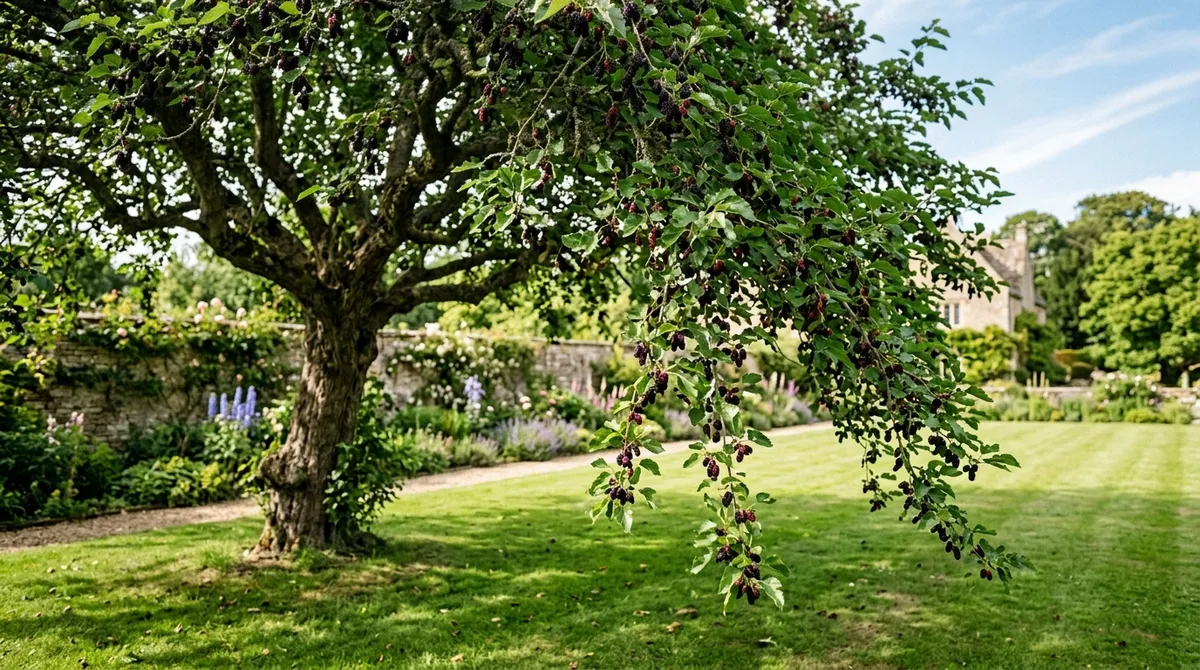
Mulberry trees are among the longest-lived and most rewarding fruit trees you can grow in a UK garden. Black mulberry has grown in Britain since Roman times. The fruit tastes like a richer, more complex blackberry with wine-dark juice that stains everything it touches.
Growing mulberry trees in the UK is straightforward once you choose the right species and site. These trees are self-fertile, need almost no pruning, and tolerate most soil types. A single mature tree produces enough fruit each summer to fill the freezer, make jam, and still feed the blackbirds.
Which mulberry species should I grow in the UK?
Three mulberry species grow in the UK, but only one is worth planting for fruit. Black mulberry (Morus nigra) produces berries with the deepest flavour and has thrived in British gardens for over 400 years.
Black mulberry (Morus nigra) is the gardener’s choice. It grows into a broad, spreading tree reaching 8-12m over decades. The heart-shaped leaves are rough-textured and 8-12cm long. Fruit ripens from late July to September, turning from green to red to deep purple-black. The flavour is intense, sweet-sharp, with more complexity than any other soft fruit. Black mulberry is slower to establish than white, but outlives everything else in the garden. Some UK specimens are over 500 years old.
White mulberry (Morus alba) grows faster and taller, reaching 15-18m. The leaves are glossy, smooth, and lighter green. This is the species used to feed silkworms. The fruit is pale pink to white and tastes insipid compared to black mulberry. It has some value as an ornamental or shade tree, but the fruit is not worth growing for eating.
Red mulberry (Morus rubra) is a North American native rarely sold in the UK. It hybridises freely with white mulberry and produces acceptable fruit, but offers no advantage over black mulberry in British conditions.
| Feature | Black mulberry | White mulberry | Red mulberry |
|---|---|---|---|
| Botanical name | Morus nigra | Morus alba | Morus rubra |
| Ultimate height | 8-12m | 15-18m | 10-15m |
| Ultimate spread | 8-12m | 10-14m | 10-12m |
| Growth rate | Slow (20-30cm/year) | Fast (40-60cm/year) | Moderate (30-40cm/year) |
| Fruit colour | Deep purple-black | White to pale pink | Dark red to purple |
| Fruit flavour | Intense, wine-like, sweet-sharp | Bland, watery, sweet | Good, similar to black |
| Years to first fruit | 5-8 | 3-5 | 4-6 |
| Mature yield | 15-30kg per tree | 20-40kg per tree | 15-25kg per tree |
| UK hardiness | -15C (H5) | -20C (H6) | -15C (H5) |
| Lifespan | 500+ years | 200-300 years | 200+ years |
| UK availability | Widely available | Available | Rare |
| RHS AGM | ’Chelsea’ | No | No |
Why we recommend black mulberry: After growing both species side by side on Staffordshire clay since 2019, the black mulberry fruit is in a different league. One punnet of black mulberries has more flavour than a full harvest bucket of white. The white mulberry grew faster, but the birds ate most of the bland fruit before we could pick it. Black mulberry berries are worth racing the blackbirds for.
How do I plant a mulberry tree?
Mulberry trees need full sun and shelter from cold winds. A south or south-west facing position against a wall is ideal. The reflected heat from brickwork speeds ripening and protects spring growth from late frosts. This is the same principle that makes fig trees thrive against warm walls in UK gardens.
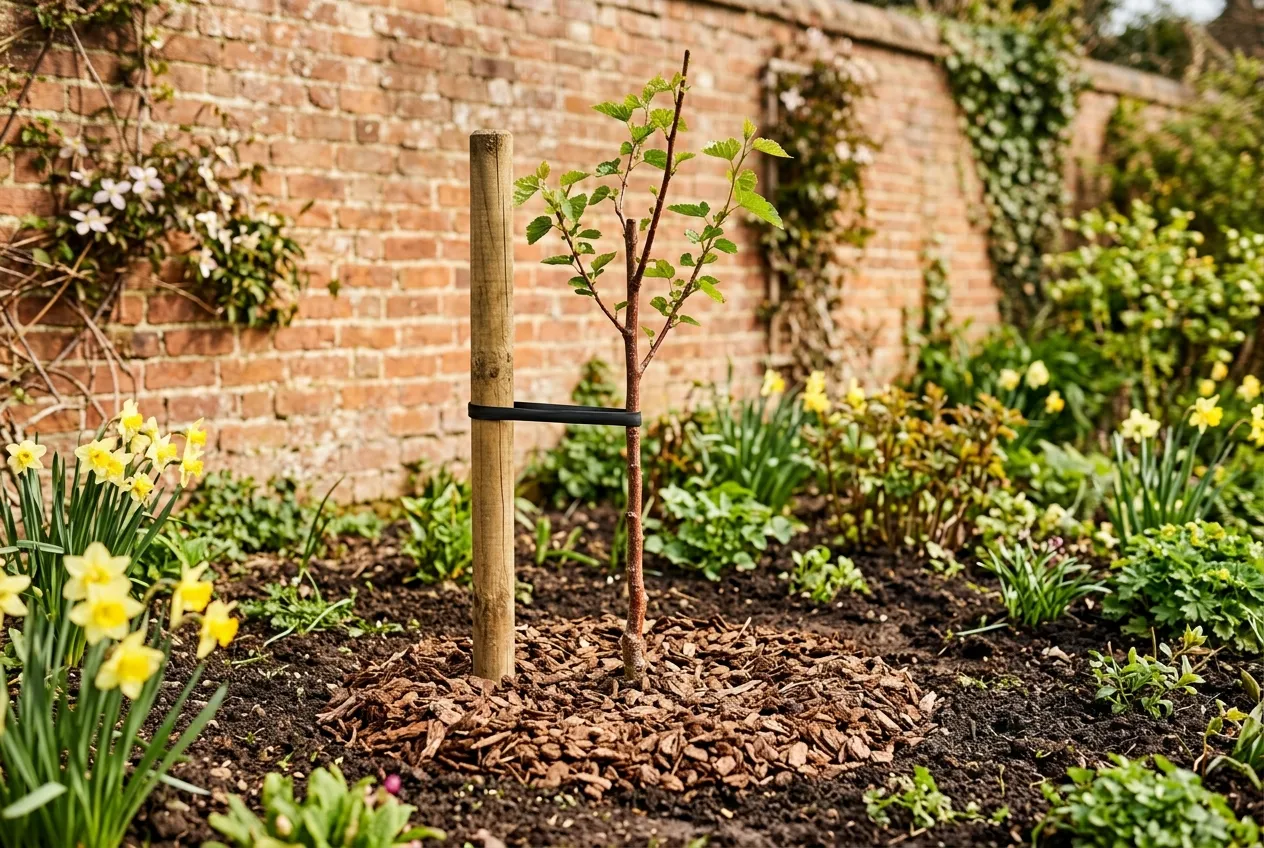 A newly planted mulberry tree with stake, tree tie, and bark mulch ring. Spring planting against a south-facing wall gives the best start.
Site preparation (autumn before planting):
- Dig a planting pit 60cm wide and 45cm deep
- Fork over the base to break up compaction
- Mix the excavated soil with one bucket of well-rotted farmyard manure
- If the soil is heavy clay, add a 10cm layer of gravel to the pit base for drainage
- For root restriction (recommended on fertile soil), line three sides with paving slabs or sink a 45-litre fabric root-control bag
Planting method (November to March for bare-root):
- Soak bare roots in a bucket of water for 2 hours before planting
- Set the tree at the same depth as the nursery soil mark on the trunk
- Backfill with the improved soil mix and firm gently with your foot
- Drive a stake at 45 degrees on the windward side. Secure with a rubber tree tie at one-third of the trunk height
- Water in with 10 litres and apply an 8cm bark mulch in a 60cm ring around the trunk. Keep the mulch 10cm clear of the trunk to prevent collar rot
- In exposed gardens, wrap the trunk with horticultural fleece for the first two winters
Spacing: Allow 8-10m between standard trees. For wall-trained fans or restricted forms, allow 4-5m along the wall.
How do I prune a mulberry tree?
Mulberry trees need very little pruning. This is one of their greatest advantages. Over-pruning causes heavy sap bleeding from late winter onwards, weakening the tree and inviting disease.
When to prune: Only prune in late November or December when the tree is fully dormant and sap flow has stopped. Never prune in spring or summer. Even minor cuts in the growing season cause the tree to weep sticky white sap for weeks. This is the single most important rule of mulberry care.
Formative pruning (years 1-5): Remove crossing branches and any shoots growing towards the centre of the tree. Aim for an open goblet shape with 4-5 main framework branches radiating from the trunk at roughly equal spacing. Keep the centre open to allow light and air into the canopy.
Mature tree maintenance: Remove dead, damaged, or diseased wood only. Cut back any branches that drag on the ground. Old mulberry trees develop characterful, gnarled forms with low-sweeping branches. This is normal and desirable. Do not attempt to “tidy” an old mulberry into a neat shape.
Wall-trained fans: Tie in new shoots during summer to horizontal wires spaced 30cm apart on the wall. Remove outward-growing shoots and any vertical water sprouts. Fan-trained mulberries produce heavier crops than open-grown trees because the wall warmth aids fruit ripening.
If you are new to fruit tree care, mulberries are among the most forgiving trees to learn on. The biggest risk is doing too much, not too little.
When and how do I harvest mulberries?
Ripe mulberries fall from the tree at the slightest touch. This is both the sign of perfect ripeness and the main harvesting challenge. The berries are extremely soft and stain everything they contact with deep purple juice.
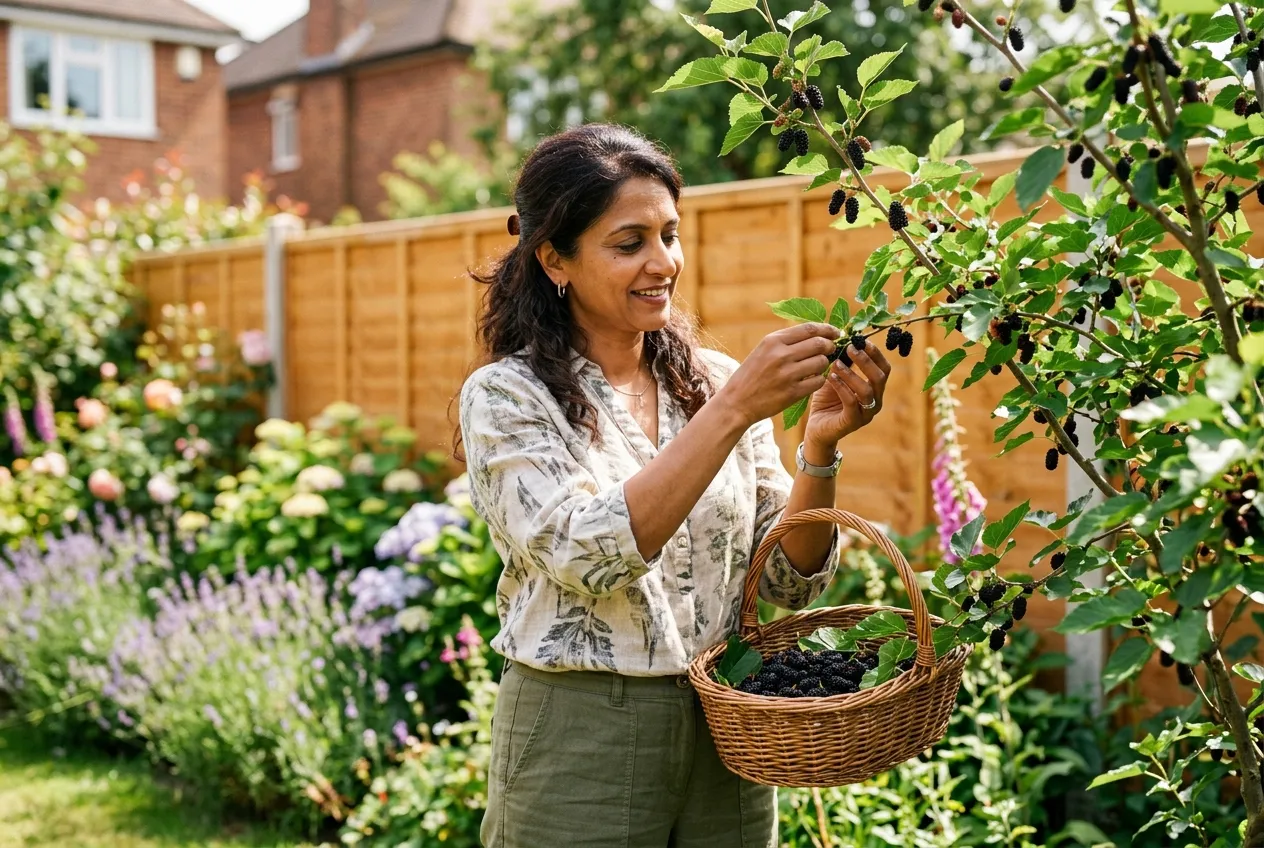 Picking mulberries by hand into a shallow basket. Harvest daily from late July when berries turn deep purple-black and drop at a touch.
Harvesting method: Spread a clean sheet or tarpaulin under the tree canopy. Gently shake individual branches and collect the fallen berries. Alternatively, pick by hand, but only handle ripe berries. They crush easily between fingers. A mature black mulberry yields 15-30kg of fruit over a 6-8 week period from late July to early September.
Ripeness indicator: Berries change from green to red to deep purple-black. Ripe berries detach from the stem with zero resistance. If you have to tug, the berry is not ready. Check the tree every morning during the fruiting season. Berries left on the ground for more than a few hours ferment or attract wasps.
Storage and preservation:
- Fresh: Eat within 24 hours. Do not wash until ready to eat
- Frozen: Spread berries on a baking tray in a single layer. Freeze for 4 hours, then transfer to bags. Keeps 12 months
- Jam: Use 1kg berries, 750g sugar, juice of 2 lemons. Simmer 20 minutes to a soft set
- Cordial: Crush 500g berries with 200g sugar and 500ml water. Strain through muslin. Keeps 2 weeks refrigerated
- Dried: Dehydrate at 55C for 12-16 hours. Dried mulberries taste like sweet raisins with a floral note
Mulberries also make outstanding wine and pair well with other home-grown fruit in crumbles and summer puddings.
Month-by-month mulberry care calendar
| Month | Task |
|---|---|
| January | Check stakes and ties. Order bare-root trees from nurseries if not yet planted. |
| February | Prepare planting site. Fork in well-rotted manure. Install root restriction if planned. |
| March | Plant bare-root trees before bud break. Water in well. Apply 8cm bark mulch ring. |
| April | New leaf growth appears. Water weekly if spring is dry. Watch for late frost on young trees. |
| May | Feed with a general-purpose fertiliser (blood, fish, and bone at 70g per square metre). |
| June | Early fruit begins to form. Water established trees during prolonged dry spells only. |
| July | First ripe berries from late July. Spread sheets under canopy. Harvest daily. |
| August | Peak harvest period. Freeze surplus berries. Net tree if bird damage is severe. |
| September | Final berries ripen. Remove fallen fruit from ground to prevent wasp problems. |
| October | Leaves turn golden yellow. Prepare for leaf fall. Compost fallen leaves. |
| November | Prune only if essential (dead, damaged, crossing branches). Stake check. |
| December | Plant bare-root trees. Mulch established trees with 5cm well-rotted compost. |
This calendar complements the broader companion planting guide for planning what to grow alongside your mulberry.
Can I grow a mulberry tree in a small garden?
Yes, with the right variety and training method. Mulberry trees respond well to restriction and can be kept to 3-4m height through container growing or wall training.
Dwarf varieties for small spaces:
- Morus rotundiloba ‘Charlotte Russe’ grows to just 1.5m. Compact, bushy habit. Produces full-sized black fruit from year 3. Ideal for large pots on patios
- Morus nigra ‘King James’ (also sold as ‘Chelsea’) can be trained as a fan against a wall within a 4m span
- Morus alba ‘Pendula’ is a weeping form reaching 3m. Ornamental first, with small white fruit as a bonus
Container growing: Use a pot of at least 50 litres with drainage holes. Fill with 70% John Innes No.3 and 30% perlite. Position in full sun against a south-facing wall. Water daily in summer. Feed fortnightly with liquid tomato food from May to August. Repot every 3-4 years, root-pruning by one-third when you do.
Container mulberries fruit 1-2 years earlier than open-ground trees because root restriction triggers reproductive growth. This is the same principle that drives dwarf fruit trees to crop heavily in small spaces.
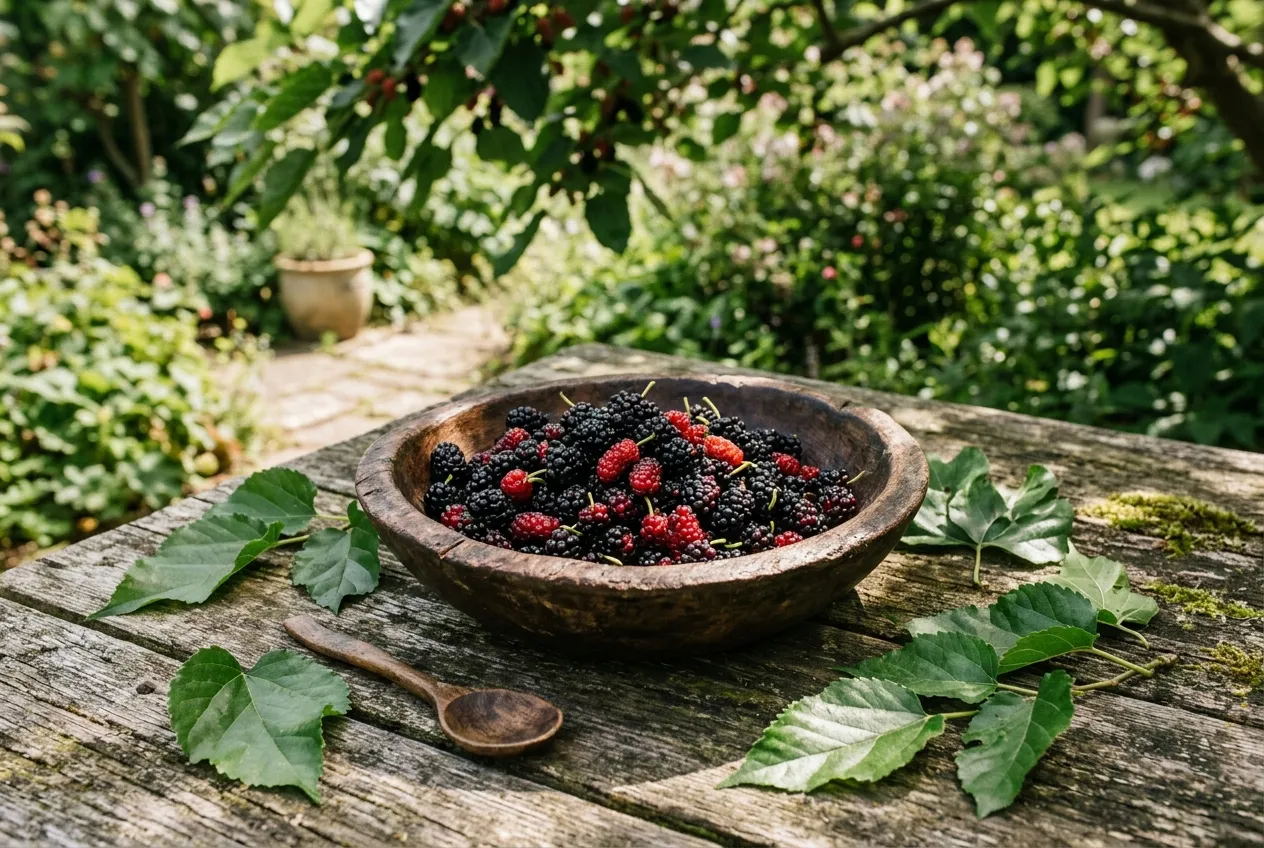 A harvest of black mulberries showing the range of ripeness from red to deep purple-black. Fully ripe berries are the darkest colour and fall at a touch.
What pests and diseases affect mulberry trees?
Mulberry trees are remarkably trouble-free. They suffer fewer problems than almost any other fruit tree, which is one of the reasons they have survived in British gardens for centuries.
Canker (Nectria cinnabarina) occasionally appears as coral-pink pustules on dead wood. Cut out affected branches 15cm below the visible infection and burn the prunings. Canker is more common on trees weakened by waterlogging or severe drought. Our guide to canker in fruit trees covers identification and treatment in detail.
Bacterial leaf scorch is extremely rare in the UK. Leaves develop brown margins and drop prematurely. There is no chemical treatment. Affected branches should be removed. The disease is more prevalent in hot, dry climates than in British conditions.
Mulberry leaf spot causes brown spots on leaves in wet summers. It is cosmetic and does not affect fruit production or tree health. No treatment is needed.
Birds are the main competitor for ripe fruit. Blackbirds, thrushes, and starlings strip berries within hours. Net the tree with 18mm mesh from early July, or accept a shared harvest. Some growers plant a white mulberry nearby as a sacrifice tree. The birds prefer the white fruit, leaving the black mulberry crop intact.
Frost damage affects young growth in spring. Late frosts in April and May can burn new shoots and destroy flower buds, reducing that season’s crop. Protect young trees with horticultural fleece on forecast frost nights. Established trees recover quickly.
What soil and conditions do mulberry trees need?
Mulberry trees tolerate most UK soils from heavy clay to sandy loam, provided drainage is adequate. They will not survive waterlogged conditions. The ideal pH range is 5.5-7.0, making them suitable for the majority of British gardens.
On heavy clay: Improve drainage by digging in generous amounts of horticultural grit and well-rotted organic matter. Raised planting on a mound 15-20cm above the surrounding soil level helps in the wettest gardens. Our clay soil guide covers soil improvement techniques.
On sandy soil: Mulch annually with 8-10cm of well-rotted manure or compost to build moisture retention. Sandy soils drain too quickly for young mulberries in their first 3 years. Water weekly during dry spells until established.
Shelter: Mulberries break bud late (usually mid-May in southern England), which naturally protects them from most spring frosts. However, cold north and east winds can desiccate young growth. Plant on the south or west side of a building, wall, or mature hedge.
Sunlight: A minimum of 6 hours direct sun daily is essential for fruit ripening. In partial shade, the tree will grow well but produce fewer berries with lower sugar content. The warmest, sunniest position in the garden always produces the best fruit.
The Royal Horticultural Society recommends mulberry as a specimen tree for medium to large gardens and has awarded AGM status to the variety ‘Chelsea’.
Mulberry tree history in the UK
Mulberry trees have a rich history in Britain stretching back nearly 2,000 years. The Romans introduced black mulberry to England as a fruiting tree. Medieval monasteries grew them in enclosed gardens, and Tudor and Jacobean estates planted avenues of mulberries for fruit production.
King James I ordered the planting of 100,000 mulberry trees in 1609 to establish a British silk industry. He made a critical error: he planted black mulberry instead of white. Silkworms feed exclusively on white mulberry leaves and refused the black. The silk industry failed, but the trees survived. Many of these 400-year-old Jacobean mulberries still stand in cathedral precincts, college gardens, and historic houses across England.
Notable surviving specimens include mulberries at Charlton House (1607), Hatfield House, and several Cambridge colleges. The Woodland Trust records black mulberry as one of the longest-lived introduced trees in Britain. These ancient trees still produce fruit every summer, demonstrating the extraordinary longevity of the species.
This heritage makes mulberry one of the most historically significant trees you can grow in a British garden, alongside native species covered in our forest gardening guide.
Frequently asked questions
How long does a mulberry tree take to fruit?
A mulberry tree takes 5-8 years to produce its first crop. Trees grown from cuttings or grafted onto established rootstock fruit sooner than seed-raised specimens. Root restriction using buried slabs or a large container can bring fruiting forward by 1-2 years. Once established, a mulberry fruits reliably every summer for centuries.
Can you grow a mulberry tree in a pot?
Yes, mulberry trees grow well in large containers of 50 litres or more. Use a free-draining mix of 70% loam-based compost and 30% perlite. Container growing restricts the root system and encourages earlier fruiting. Dwarf varieties such as Morus rotundiloba ‘Charlotte Russe’ reach just 1.5m tall, making them ideal for patios and balconies. Water daily in summer and repot every 3-4 years.
What is the best mulberry tree for the UK?
Black mulberry (Morus nigra) is the best species for UK gardens. It produces the largest, most flavourful berries and is fully hardy across England and Wales. The variety ‘Chelsea’ is widely available from UK nurseries, fruits from a young age, and has RHS Award of Garden Merit. White mulberry grows faster but produces bland, watery fruit.
When should I plant a mulberry tree?
Plant bare-root mulberry trees between November and March when the tree is dormant. Container-grown trees can go in at any time of year, but autumn planting gives the best establishment. Avoid planting during frozen ground or waterlogged conditions. Spring planting in April also works well if you water regularly through the first summer.
Do mulberry trees damage foundations?
Mulberry tree roots are not aggressive enough to damage modern foundations. The RHS classifies mulberry as a low-risk tree for subsidence. Plant at least 5m from buildings as a standard precaution. On clay soils prone to shrinkage, increase the distance to 8m. The shallow, spreading root system is less problematic than species like oak, willow, or poplar.
Are mulberries safe to eat straight from the tree?
Yes, ripe mulberries are completely safe to eat raw. They are non-toxic to humans, dogs, and cats. The fruit is rich in vitamin C, iron, and anthocyanins. Only eat fully ripe berries that are deep purple-black and fall at a gentle touch. Unripe green or red berries can cause stomach upset and have a mildly laxative effect.
Why is my mulberry tree not fruiting?
The most common reason is age. Mulberry trees need 5-8 years to reach fruiting maturity. Excess nitrogen from rich soil or fertiliser pushes vegetative growth at the expense of fruit. Poor sunlight below 6 hours daily also reduces cropping. Late spring frosts can destroy flower buds in exposed gardens. Root restriction and full sun are the two most reliable ways to encourage earlier fruiting.
Now you know how to grow mulberry trees in the UK, explore our guide to grafting fruit trees to learn how to propagate your favourite mulberry onto new rootstock.
Lawrie has been gardening in the West Midlands for over 30 years. He grows his own veg using no-dig methods, keeps a wildlife-friendly garden, and writes practical advice based on real UK growing conditions.