Key takeaways
- Standard UK rose arch dimensions: 2.2m tall x 1.2m wide x 60cm deep. Posts sunk 600mm into the ground for wind stability
- Pressure-treated softwood: 95 GBP materials, 12-15 year life. English oak: 280 GBP, 30-plus year life
- Plant two climbing roses, one each side, 30cm out from the posts to clear the post bases
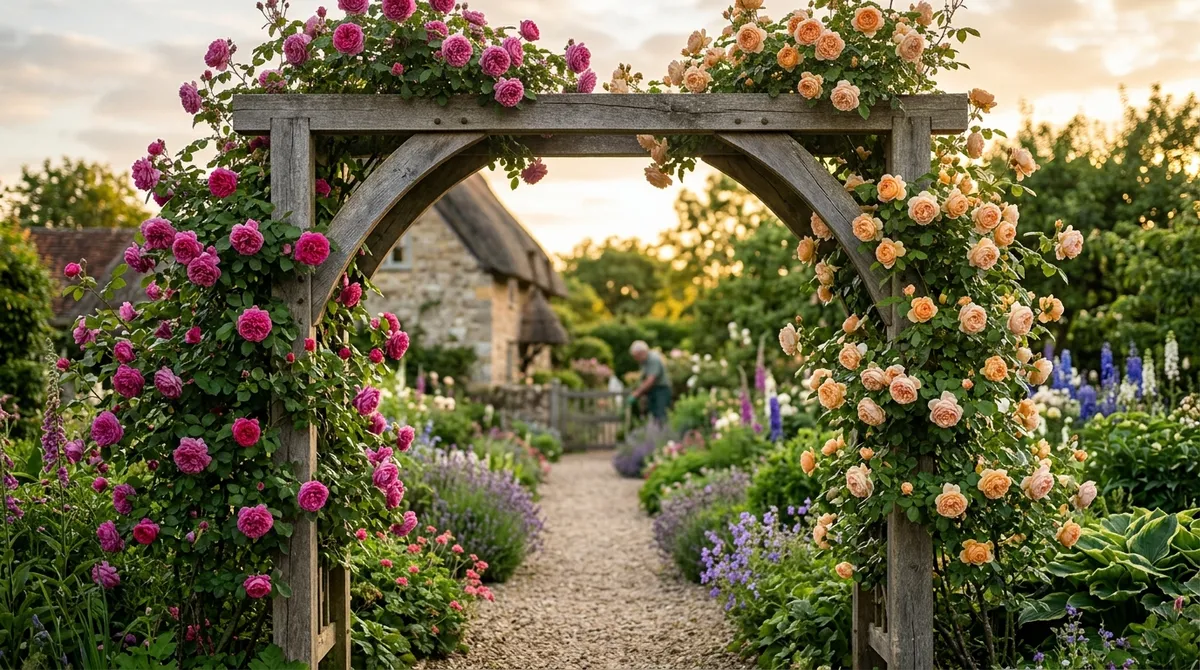
- Best UK pairing: David Austin Gertrude Jekyll (pink, scented) with Wollerton Old Hall (apricot, repeat flowering)
- Use a stainless steel wire trellis between the uprights to give the rose canes something to hold onto
- Set posts in concrete (Postcrete, 20kg per post) or use galvanised Met Post anchors for hard ground
A free-standing wooden rose arch is one of the most rewarding weekend builds in the UK garden. It costs 95 GBP in materials for pressure-treated softwood, takes around 14 working hours across two days, and stands for 12 to 30 years depending on the timber choice. Done properly, it carries two mature climbing roses producing 300 to 400 blooms a year and becomes the visual anchor of the garden within three seasons. This guide covers the standard UK dimensions, materials, timber comparison, post-setting method, wire trellis, and the rose pairings that actually thrive on a UK arch.
Standard UK rose arch dimensions
The dimensions that work in 90% of UK gardens are 2.2m tall, 1.2m wide and 60cm deep. These numbers are not arbitrary. They balance four things: headroom for tall walkers, path width for comfortable use, depth for structural rigidity, and visual proportion against typical UK garden borders.
| Dimension | Standard | Range | Reason |
|---|---|---|---|
| Height (overall) | 2.2m | 2.0m to 2.5m | Roses arch above head height, 1.9m clear under cross-beam |
| Width (external) | 1.2m | 1.0m to 1.5m | Suits 1.0m path with 10cm clearance each side |
| Depth (front to back) | 60cm | 50cm to 80cm | Minimum to stop cross-beam sagging under load |
| Post size | 100mm x 100mm | 75mm to 125mm | Resists wind load on mature rose-laden arch |
| Post depth in ground | 600mm | 600mm to 800mm | Below frost line, holds against 80mph gusts |
| Post length above ground | 2.2m | 2.0m to 2.5m | Matches overall height |
| Post length total | 2.8m | 2.6m to 3.3m | Above-ground height plus burial depth |
The single most common mistake on home-built arches is going smaller than 1.0m wide. Below that the path narrows once the roses fill out, and clothing catches the thorns. The second most common mistake is sinking posts only 300 to 400mm. A mature climbing rose in full leaf catches wind like a sail - 600mm is the absolute minimum.
Pressure-treated softwood vs hardwood: the timber question
Pressure-treated softwood and English oak sit at the two ends of the spectrum. Both make excellent arches. The choice comes down to budget and how long the build needs to last.
| Timber | Materials cost | Life | Maintenance | Notes |
|---|---|---|---|---|
| Pressure-treated softwood | 95 GBP | 12-15 years | Re-stain every 3 years | Best value, widely available |
| Cedar (Western red) | 140 GBP | 20-25 years | None required | Silvers naturally, light to handle |
| Sweet chestnut | 220 GBP | 25-30 years | None required | British-grown, tough as oak |
| English oak | 280 GBP | 30 plus years | None required | The gold standard, very heavy |
| Untreated softwood (avoid) | 60 GBP | 4-6 years | Constant | Rots fast, false economy |
Pressure-treated softwood is what 70% of UK gardeners use. Buy from a fencing supplier rather than a DIY chain because the treatment penetration is deeper. Look for “Tanalised” or “Use Class 4” stamped on the end of the post. Use Class 4 means the timber is rated for direct ground contact and lasts the full 12 to 15 year span.
Sweet chestnut is the British alternative if oak feels too expensive. It is naturally rot-resistant (high tannin content), takes screws cleanly and finishes a warm honey-brown that silvers to a similar grey to oak. Available from coppice merchants in southeast England and Wales.
Cedar is light, easy to cut and naturally durable, but the timber is softer than oak and a heavy rose in a storm can pull screws through it. Use 100mm posts not 75mm if going cedar.
Never use untreated softwood. The DIY chains sell whitewood timber that looks fine on the rack but rots within 5 years in ground contact. It is a false economy.
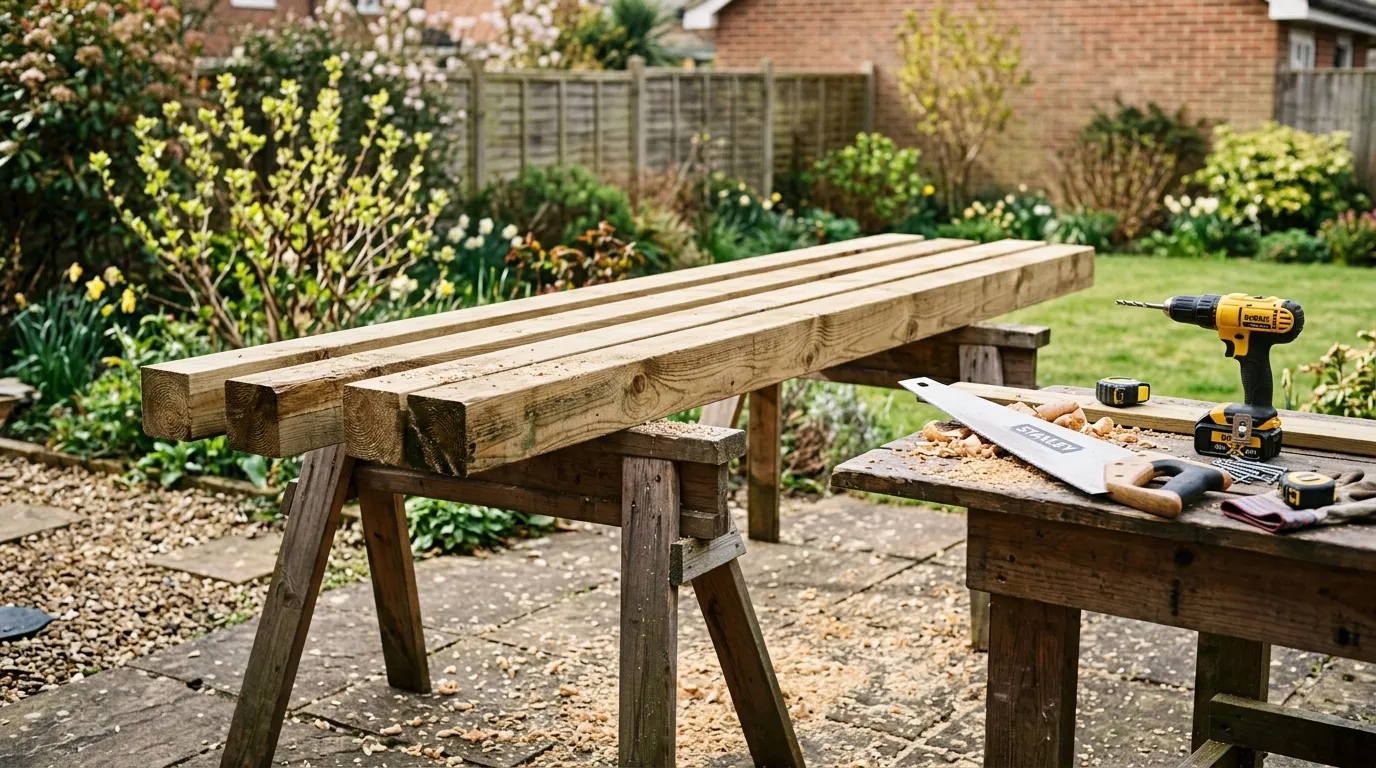 Pressure-treated softwood posts, side-beams and arched tops cut and ready for assembly. A standard 95 GBP material list for a 2.2m x 1.2m arch.
Tools and materials list
Materials for the standard 2.2m x 1.2m x 60cm pressure-treated softwood arch:
- Four 2.8m x 100mm x 100mm pressure-treated posts (one per corner) - around 22 GBP each from a fencing supplier
- Two 1.4m x 75mm x 50mm cross-beams (front and back top rails)
- Two 800mm x 75mm x 50mm side-beams (left and right top rails closing the depth)
- Two 1.4m x 100mm x 50mm arched top pieces (the curved decorative tops)
- Two 20kg bags of Postcrete (rapid-set fence concrete, 8 GBP per bag)
- 12 metres of 2mm stainless steel wire for the climbing trellis (around 15 GBP)
- Eight wire tensioners rated 50kg minimum (around 12 GBP for 8)
- Sixteen 75mm stainless steel coach screws (M8 thread, 10 GBP for a box)
- Two climbing roses in bare root or 5-litre container (35 GBP each from David Austin)
Tools:
- Spade and post-hole auger or borer (hire for 25 GBP a day if not owned)
- Cordless drill with 5mm and 25mm bits
- Hand saw or mitre saw
- Spirit level (1m or 1.2m)
- Tape measure, pencil and square
- Safety glasses and gardening gloves
- Stepladder (1.5m minimum for the cross-beam fitting)
Total material cost: 95 GBP for the timber and fixings, plus 70 GBP for two David Austin roses. Total project cost around 165 GBP for a structure that lasts 12 to 15 years.
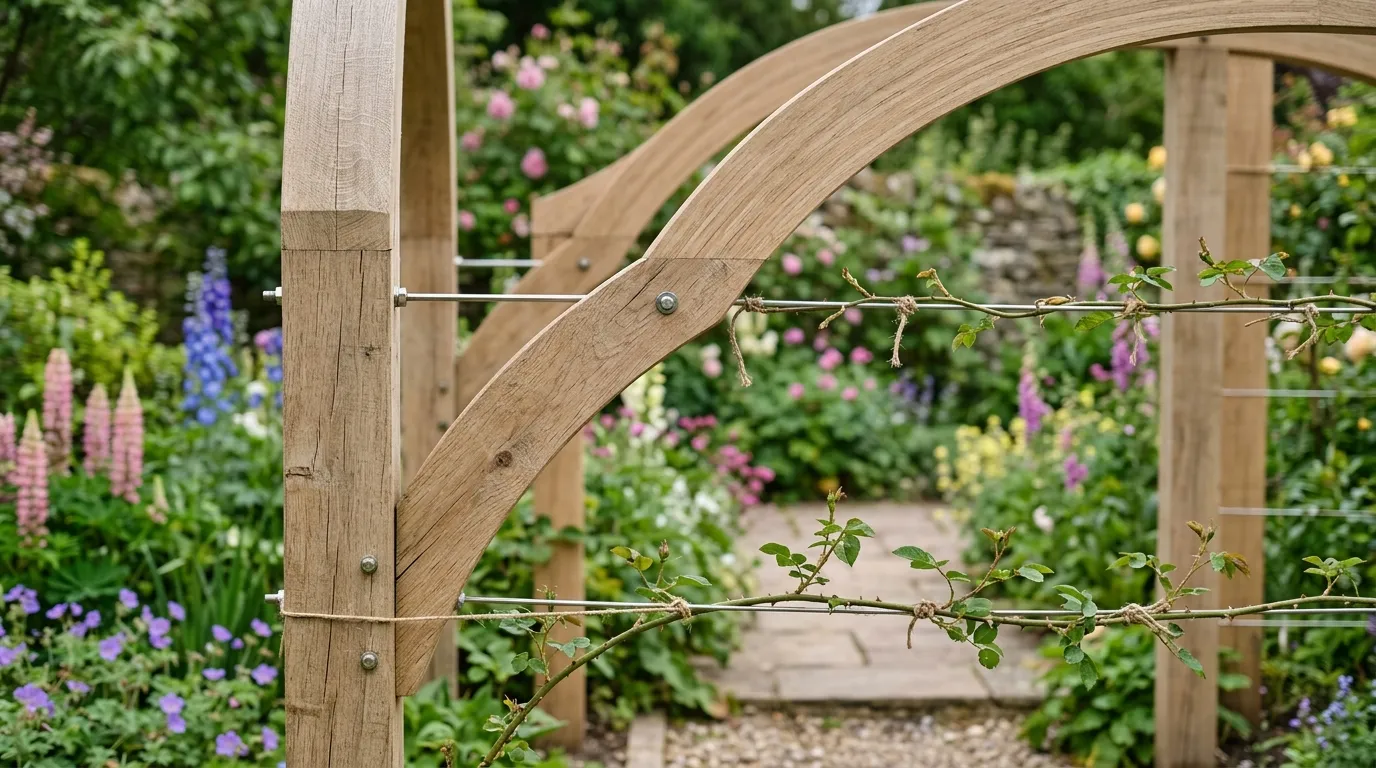 Detail of the finished frame and stainless steel wire trellis. The horizontal wires at 400mm, 900mm, 1400mm and 1900mm give the rose canes something to tie into during training.
Step by step: the weekend build
1. Mark out the arch footprint. Choose a level spot in full sun for at least 6 hours a day. Mark out a rectangle 1.2m x 0.6m using string and 4 pegs. Check the corners are square using the 3-4-5 method (a triangle with sides 300mm, 400mm and 500mm forms a right angle if the long side is 500mm). The longer 1.2m sides will face the path.
2. Dig the four post holes. Dig 4 holes 600mm deep and 250mm across at each corner. A post-hole auger makes this 30 minutes’ work; a spade-only dig takes 90 minutes. Heap the spoil to one side - you will not need most of it back.
3. Set the four posts in Postcrete. Drop each 2.8m post into its hole. Brace each post vertically with two off-cuts of timber screwed temporarily to adjacent posts. Pour the Postcrete dry into the hole around the post, add the specified water (3.5 litres per 20kg bag), and tamp gently with a stick. Check plumb with the spirit level on two adjacent faces of each post. Postcrete sets hard in 5 to 10 minutes. Work fast on one post at a time. Leave the braces in place for 24 hours.
4. Fit the cross-beams. Remove the temporary braces. Cut the two 1.4m cross-beams. Pre-drill 5mm pilot holes at each end. Position horizontally across each pair of posts on the long sides of the arch, 50mm down from the top. Fix with two 75mm coach screws per joint. Check level with the spirit level - small adjustments are fine here, large ones mean the post-setting was off.
5. Fit the side-beams and arched top. Cut the two 800mm side-beams to close the top frame between the cross-beams. Cut a gentle arched top from each 1.4m x 100mm x 50mm piece using a jigsaw or careful hand-sawing - a 300mm rise across the 1.4m length looks balanced. Fit the arched tops on top of the frame, screwed down with 75mm coach screws into the cross-beams and side-beams below.
6. Add the stainless steel wire trellis. Drill 8 holes (4 in each vertical post pair) at 400mm, 900mm, 1400mm and 1900mm above ground level. Fit wire tensioners into the outer face of each hole. Run 2mm stainless steel wire horizontally between each pair of posts on both long sides of the arch, tightening with the tensioners until the wire is taut. The wires give the rose canes something to grip while you train them in the early years.
7. Plant the two climbing roses. Dig two planting holes 30cm out from the posts (one each side, on the outer face of the arch). Each hole should be 50cm deep and 50cm wide. Mix in two spades of well-rotted compost and a handful of bonemeal. Plant the rose with the graft union (the knobbly bit between the roots and the canes) 50mm below soil level - this prevents suckers from the rootstock. Backfill, firm in with the heel of your boot, water in with 5 litres per plant. Stake the leading cane gently to the lowest wire.
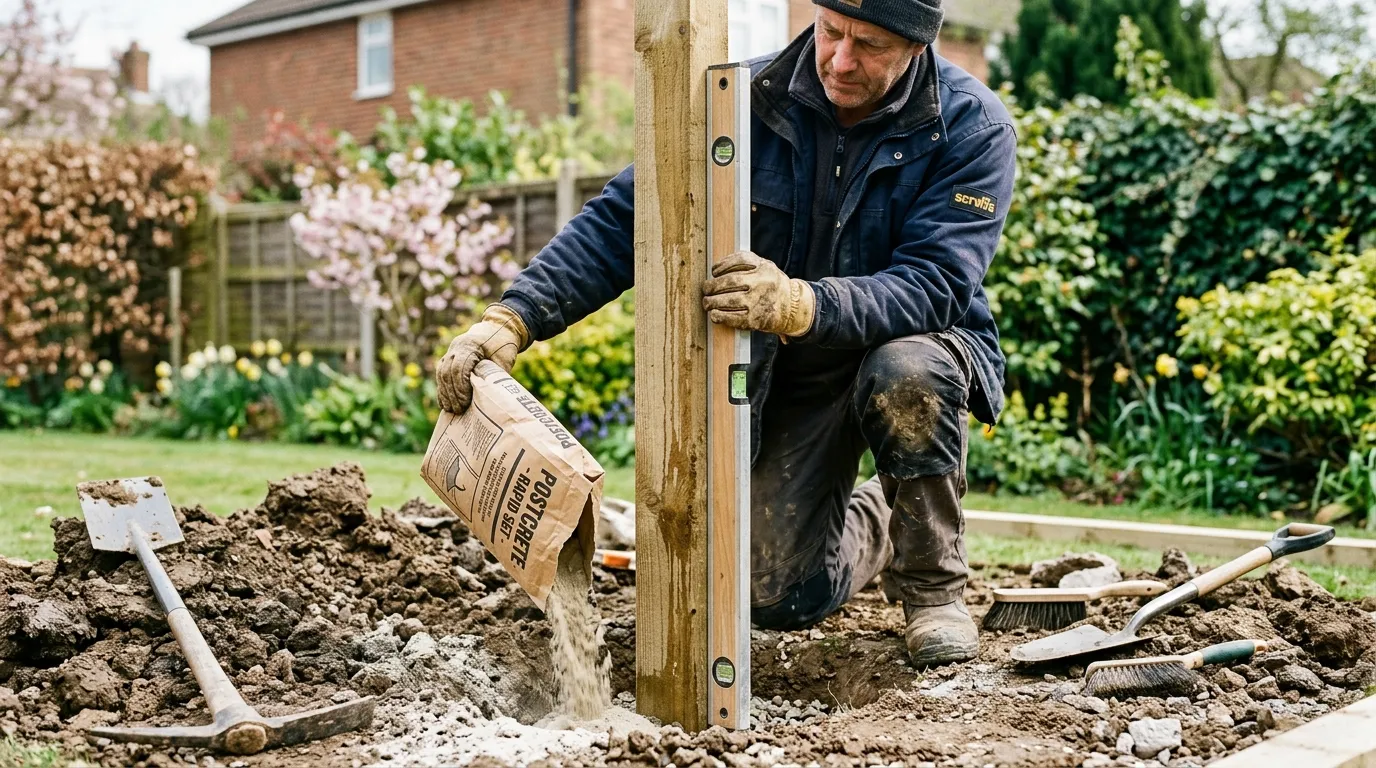 Setting posts vertical with Postcrete is the make-or-break step. 600mm burial depth is the minimum for a 2.2m arch to survive UK named storms.
The best climbing roses for UK arches
Two climbing roses, one per side, planted 30cm out from the posts so the canes can be trained inwards onto the wire trellis. Picking the right two is the difference between a 5-year struggle and a 20-year ornament.
| Rose | Bloom | Scent | Repeat | Height | Notes |
|---|---|---|---|---|---|
| Gertrude Jekyll | Deep pink | Strong old rose | Yes | 3.5m | David Austin, the standard arch rose |
| Wollerton Old Hall | Apricot | Strong myrrh | Yes | 3.5m | David Austin, pairs well with Gertrude |
| Generous Gardener | Soft pink | Strong | Yes | 4.5m | David Austin, vigorous, needs annual prune |
| Mortimer Sackler | Soft pink | Light old rose | Yes | 3m | David Austin, almost thornless |
| New Dawn | Pale pink | Light | Yes | 3.5m | Hardy, disease resistant, prolific |
| Madame Alfred Carriere | Cream-white | Strong | Yes | 5m | Noisette, classic Edwardian arch rose |
| Albertine (avoid) | Salmon pink | Strong | No | 6m | Too vigorous, pulls arches apart |
| Rambling Rector (avoid) | White | Light | No | 8m | Way too vigorous for any garden arch |
The standard UK pairing is Gertrude Jekyll and Wollerton Old Hall. Both are David Austin English roses, both reach around 3.5m, both repeat flower from June to October, and the deep pink with apricot is a colour combination that has dominated UK arch builds since the early 2000s. Order bare root from David Austin between November and February (35 GBP per plant including delivery). Plant within 5 days of delivery.
Avoid old ramblers like Albertine and Rambling Rector on a structural arch. They reach 6 to 8m and the sheer weight of mature canes will eventually pull the structure apart. Ramblers belong on barns, walls and large pergolas, not 2.2m arches.
For container growing detail on smaller climbers, see our growing roses in containers guide.
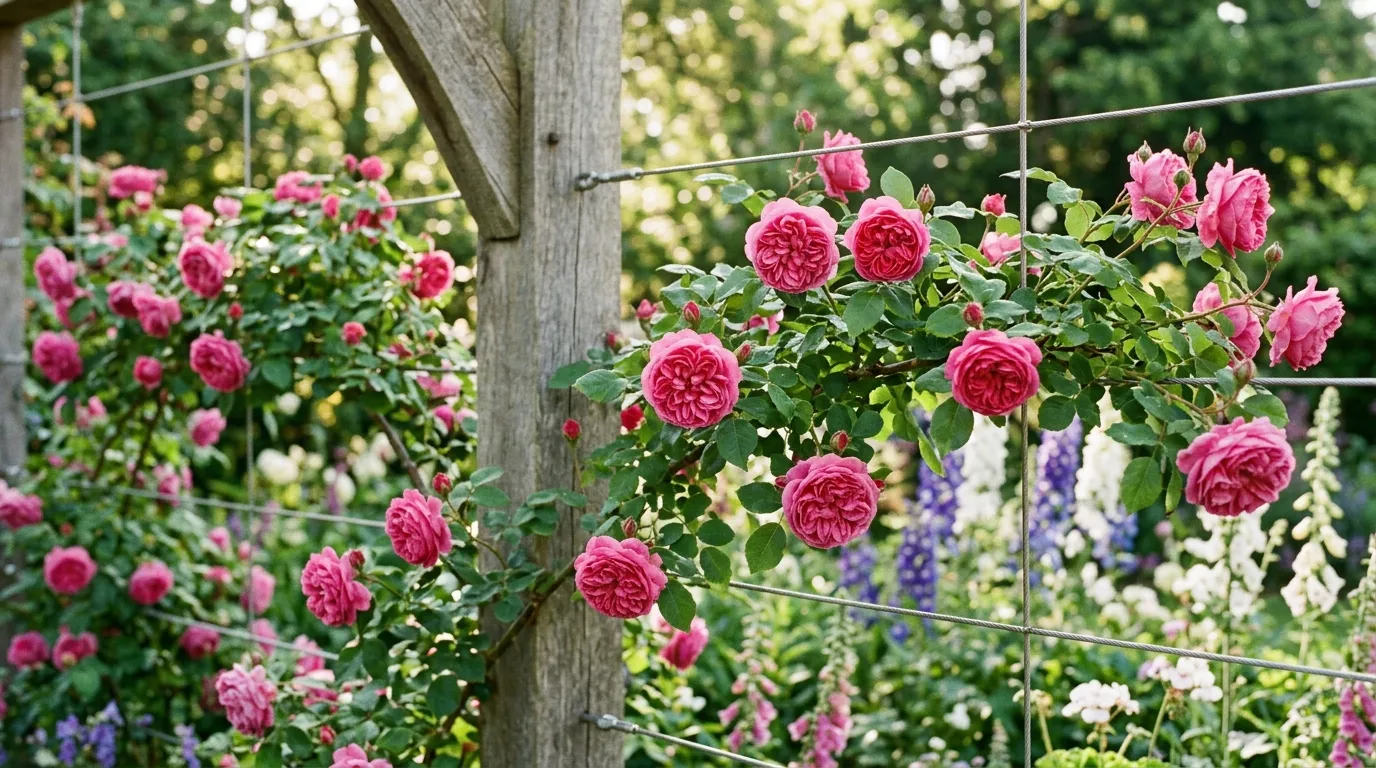 David Austin Gertrude Jekyll in full June flower. Trained horizontally to the wires, every leaf node along the cane produces a flowering shoot.
Planting and training the roses
The first three years of an arch rose are critical. Get the training right and the arch fills evenly. Get it wrong and you end up with two bare stems and a 4m tangle on the top.
Year 1 (planting year):
- Plant in November to March (bare root) or March to April (container). Soak the root ball for an hour before planting.
- Cut the leading cane back to 30cm above ground level to force basal shoots. This feels brutal but it is the single most important thing you can do.
- Tie any new shoots horizontally to the lowest two wires as they grow. Horizontal training forces flowering buds along the cane rather than at the tip.
- Water deeply once a week through the first summer. 10 litres per plant per watering. Mulch with 50mm of compost or composted bark.
Year 2:
- Select 4 to 6 strong main canes and tie horizontally to the lower wires. Cut everything else out.
- Allow side-shoots to form on the horizontal canes. These will be the main flowering wood.
- Continue weekly watering through June to August.
- Feed once with rose fertiliser (sulphate of potash) in late February.
Year 3:
- Tie main canes up to the cross-beam level (1.9m). Train the upper sections horizontally across the top of the arch.
- Start the regular pruning cycle in February: remove dead wood, cut side-shoots back to 15cm, leave the main framework canes intact.
- Expect 150 to 200 blooms per plant from June onwards if the variety repeat-flowers.
For full pruning detail at this stage, our pruning roses guide covers the cuts year by year. For companion planting under the arch, see companion plants for roses.
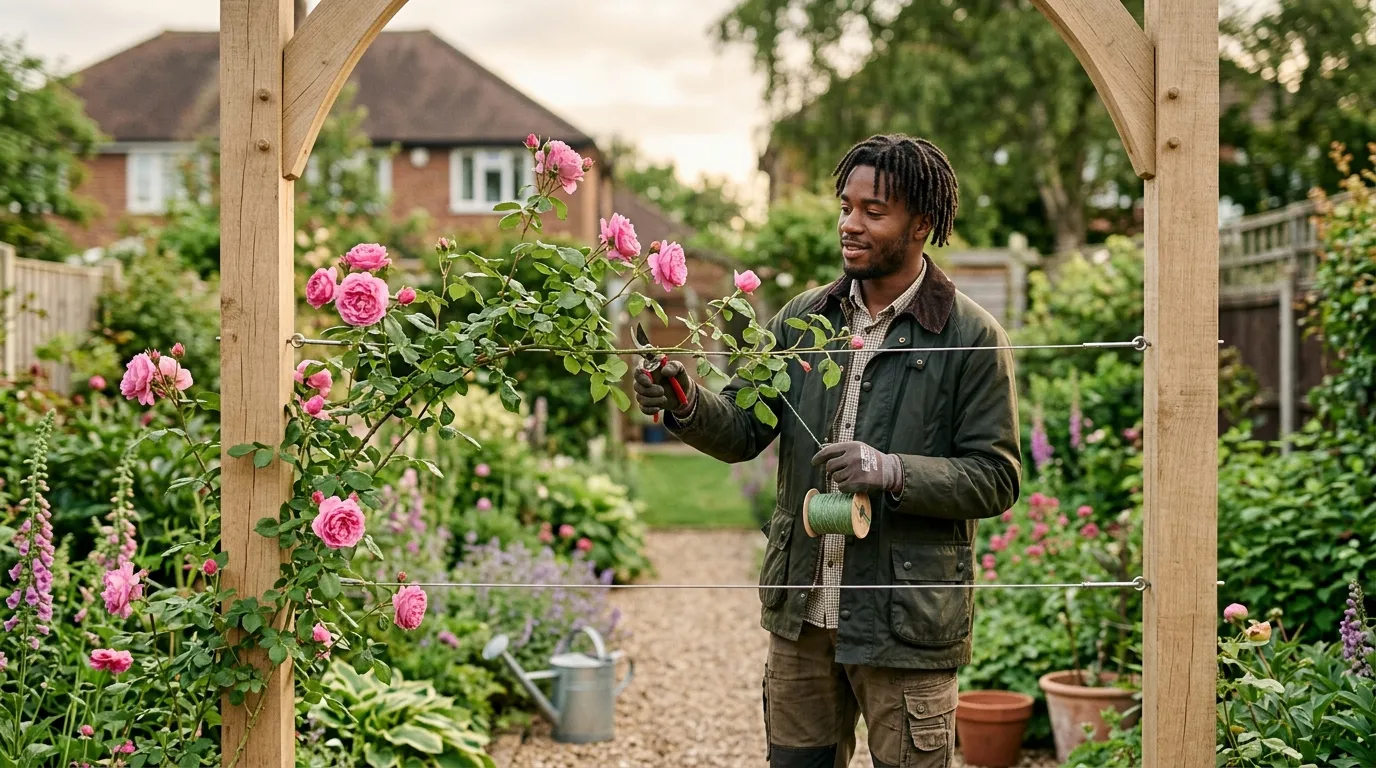 Training canes horizontally to the lower wires in year one forces flowering buds along the length of the cane. This is the single most important step in the first three years.
UK weather considerations: wind, frost, exposure
UK garden arches face four real weather risks. None are insurmountable, but the build choices change depending on the site.
Wind. A mature rose arch in full leaf catches wind like a small sail. Recent named storms have brought 70 to 90 mph gusts to most of the UK (Storm Eunice 2022 peaked at 122 mph at the Needles). A 2.2m arch with posts sunk 600mm in Postcrete will survive 80 mph in inland gardens. In coastal or upland sites, increase post length to 3.0m and sink 800mm. Add diagonal bracing inside the top frame if exposure is severe.
Frost. UK frost penetrates 300 to 450mm in most regions in an average winter. Posts sunk 600mm sit safely below the frost line. Posts in shallower sets (300mm or less) lift and tilt with frost-heave.
Rain and rot. Treated softwood survives 12 to 15 years in UK ground contact. The first place to fail is always the post at ground level, where it sits in alternately wet and dry soil. Two ways to extend life: (1) coat the buried portion of the post in bitumen paint before sinking, or (2) use galvanised post supports (Met Posts) so the timber sits above ground.
Exposure to sun. Pressure-treated timber and untreated hardwoods both silver to grey in 18 to 24 months of UK sun. This is cosmetic, not structural. Re-stain treated timber every 3 years if you want to keep the original colour. Oak, cedar and sweet chestnut should be left to silver naturally.
Common mistakes (and how to avoid them)
Mistake 1: Posts sunk too shallow. 300 to 400mm post depth is not enough. The arch tilts in the first storm. Always 600mm minimum, 800mm in exposed sites.
Mistake 2: Cheap untreated timber. DIY-chain whitewood looks fine but rots in 4 to 6 years. Pay the extra for Tanalised or Use Class 4 stamped timber.
Mistake 3: Wrong climbing rose choice. Old ramblers like Albertine grow to 8m. They pull the arch apart by year 5. Stick to climbers under 3.5m.
Mistake 4: Planting too close to the posts. Roses planted within 10cm of posts struggle for root space and water. Plant 30cm out, on the outside of the arch, so the canes train inwards.
Mistake 5: Skipping the year-one hard prune. New climbing roses need to be cut back to 30cm in year one to force basal shoots. Skip this and you get two bare stems with a 4m tangle on top.
Mistake 6: No wire trellis between the uprights. Rose canes need horizontal wires to tie to. Without them you get sprawling growth, broken canes and uneven flowering.
A month-by-month rose arch maintenance calendar
| Month | Job |
|---|---|
| January | Order bare root roses if planting this winter |
| February | Hard prune mature arch roses. Remove dead wood. Cut side-shoots to 15cm. Feed with sulphate of potash |
| March | Plant new bare root roses if not already done. Re-stain timber if needed |
| April | Tie in new canes to wires. Mulch with 50mm compost or composted bark |
| May | Spray for blackspot if needed. Water in dry spells |
| June | First flush of bloom. Deadhead by snapping off spent flowers above the next leaf |
| July | Continue deadheading. Water deeply once a week |
| August | Train this year’s new canes horizontally to the wires |
| September | Last summer pruning of side-shoots. Stop deadheading by mid-September to allow hips to form |
| October | Tip-prune very long canes to reduce wind catch. Check post bases for rot |
| November | Plant new bare root roses. Mulch with leaves or composted manure |
| December | Tighten wire tensioners. Plan any new training |
Related reading: A green alternative to timber, see our guide to building arches from living willow.
Frequently asked questions
How long does it take to build a rose arch?
One full weekend, around 12 to 14 working hours. Day 1 covers marking out, digging post holes and setting four posts in Postcrete (4 to 5 hours). Day 2 covers cutting and fitting the cross-beams, side-beams, arched tops and stainless steel wire trellis (8 to 9 hours). Plant the roses in the following dormant season (November to March) for the best establishment.
What size should a UK rose arch be?
Standard UK dimensions are 2.2m tall, 1.2m wide and 60cm deep. The 2.2m height gives 1.9m clear headroom under the cross-beam. 1.2m external width suits a 1.0m garden path with 10cm clearance each side. 60cm depth is the minimum to support a 1.4m cross-beam without sagging under a mature rose load.
What is the best wood for a rose arch?
Pressure-treated softwood for budget builds, English oak for longevity. Treated softwood lasts 12 to 15 years at 95 GBP in materials. Oak lasts 30 plus years untreated at 280 GBP. Cedar splits the difference (140 GBP, 20 plus years). Sweet chestnut is the British grown equivalent of oak at 220 GBP and 25 plus years. Never use untreated DIY-chain softwood.
What roses should I plant on a rose arch?
Two climbing roses, one each side, planted 30cm out from the posts. The standard UK pairing is David Austin Gertrude Jekyll (deep pink, scented, 3.5m) with Wollerton Old Hall (apricot, repeat flowering, 3.5m). Avoid old ramblers like Albertine (6m) and Rambling Rector (8m) which grow too vigorously and pull arches apart by year 5.
How deep should I set rose arch posts?
600mm minimum, 800mm in exposed sites. A 2.2m arch loaded with mature rose growth catches wind like a sail. Posts sunk 300 to 400mm pull free in storms above 50mph. Use 2.8m posts for the standard 2.2m arch (600mm in ground, 2.2m above). For coastal or upland sites, use 3.0m posts and sink 800mm.
When should I build a rose arch?
Build in autumn or early spring so the roses can be planted bare root in the dormant season. October to November is ideal because the ground is workable, settling for winter, and the roses establish a root system before the spring flush. Avoid building in midsummer because dry hard ground is brutal on post-hole augers and roses planted in heat fail to establish.
Should I use concrete or Met Posts?
Postcrete for permanent builds, Met Posts only for hard or shallow ground. Postcrete sets in 5 to 10 minutes, costs 8 GBP per 20kg bag and holds the post for the life of the timber. Met Posts (galvanised spike anchors) install fast on hard ground but allow the post to wobble in soft soil. Use Postcrete by default, Met Posts only when bedrock sits within 400mm.
How wide should the path be under a rose arch?
1.0m to 1.1m gives a comfortable single-person walk through. The arch itself is 1.2m wide externally, leaving 1.0m clear between the inside faces of the posts. For wheelbarrow or two-person use, build a 1.5m wide arch on a 1.3m wide path. Below 0.9m the rose thorns catch clothing as you pass.
Next steps
Now you have the arch built, the next job is getting the climbing roses trained properly through their first three years. Read our pruning roses guide for the year-by-year cuts that turn two bare canes into a fully covered arch by season three.
Our team produces practical UK gardening guidance from source research, contributor records and established horticultural practice. Editorial standards are overseen by Matt W.