Key takeaways
- Lunar gardening links planting to moon phases on a 28-day cycle
- Traditional rule: above-ground crops in waxing moon, below-ground in waning moon
- Peer-reviewed UK research finds no consistent yield effect from lunar timing
- Small documented effect on seed water-uptake during full moon (not yield)
- Useful as a structured timing framework rather than a productivity boost
- Free to try - costs nothing beyond paying attention to a moon-phase calendar
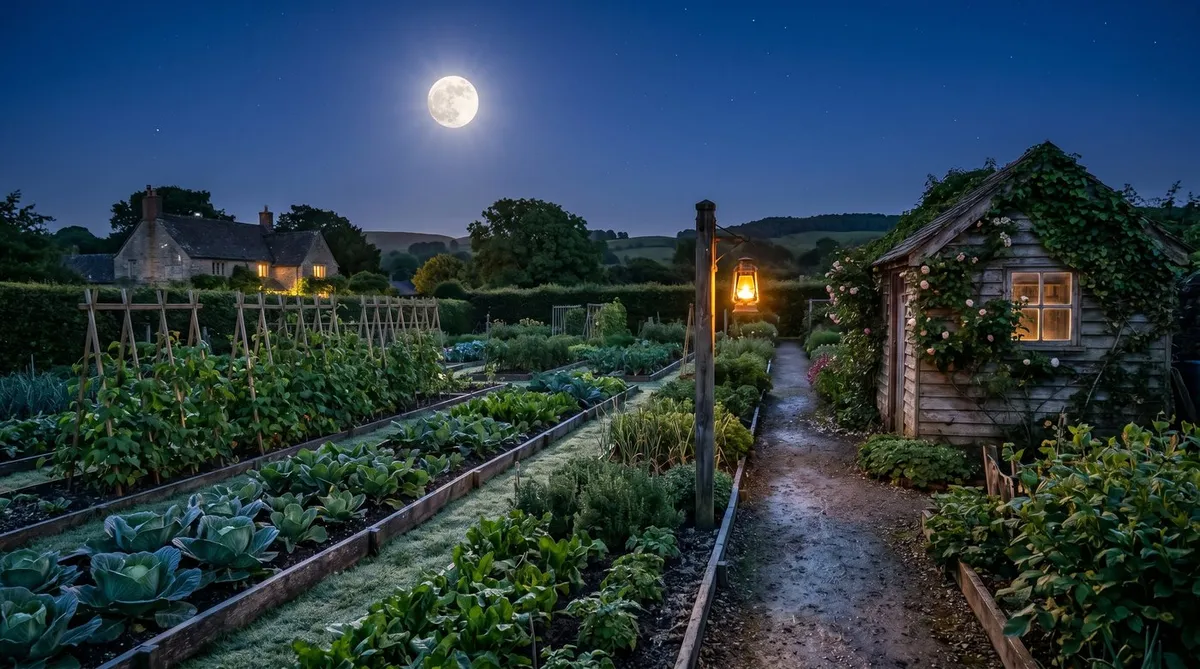
Lunar gardening is the practice of timing garden activities to the phases of the moon. The tradition runs deep in UK gardening folklore - from Roman agricultural texts to the medieval almanacks to modern biodynamic farming. The claims are bold: that the moon’s gravity, reflected light, and energy cycles affect plant growth in ways that change harvest yields, storage life and disease resistance.
This guide explains the lunar gardening system as practised in the UK, summarises the actual evidence (what the research shows), and gives an honest answer to whether it is worth doing. The short version: lunar gardening is harmless, costs nothing, and may help some growers stick to a planting schedule - but does not measurably affect yields in side-by-side trials.
For the evidence-based growing signals that genuinely affect crops, see our soil testing and pH adjustment UK guide and crop rotation planner UK guide.
What is lunar gardening?
The basic lunar gardening rules across most UK systems:
-
Waxing moon (new moon to full moon) - sow above-ground crops (leafy greens, tomatoes, beans, peas, lettuce, fruit). The growing moon is said to draw moisture upward, favouring leafy and fruiting growth.
-
Waning moon (full moon to new moon) - sow below-ground crops (carrots, potatoes, onions, beetroot). The shrinking moon is said to direct energy downward, favouring root development.
-
Full moon (1-2 days around) - good for transplanting, watering, harvesting for immediate use. Some systems say avoid sowing.
-
New moon (1-2 days around) - rest period in many systems. Some say good for pruning and weed removal.
More elaborate versions add zodiac constellations the moon passes through, dividing each day into “leaf days”, “root days”, “fruit days” and “flower days” based on the constellation - this is the biodynamic gardening system originated by Rudolf Steiner in 1924.
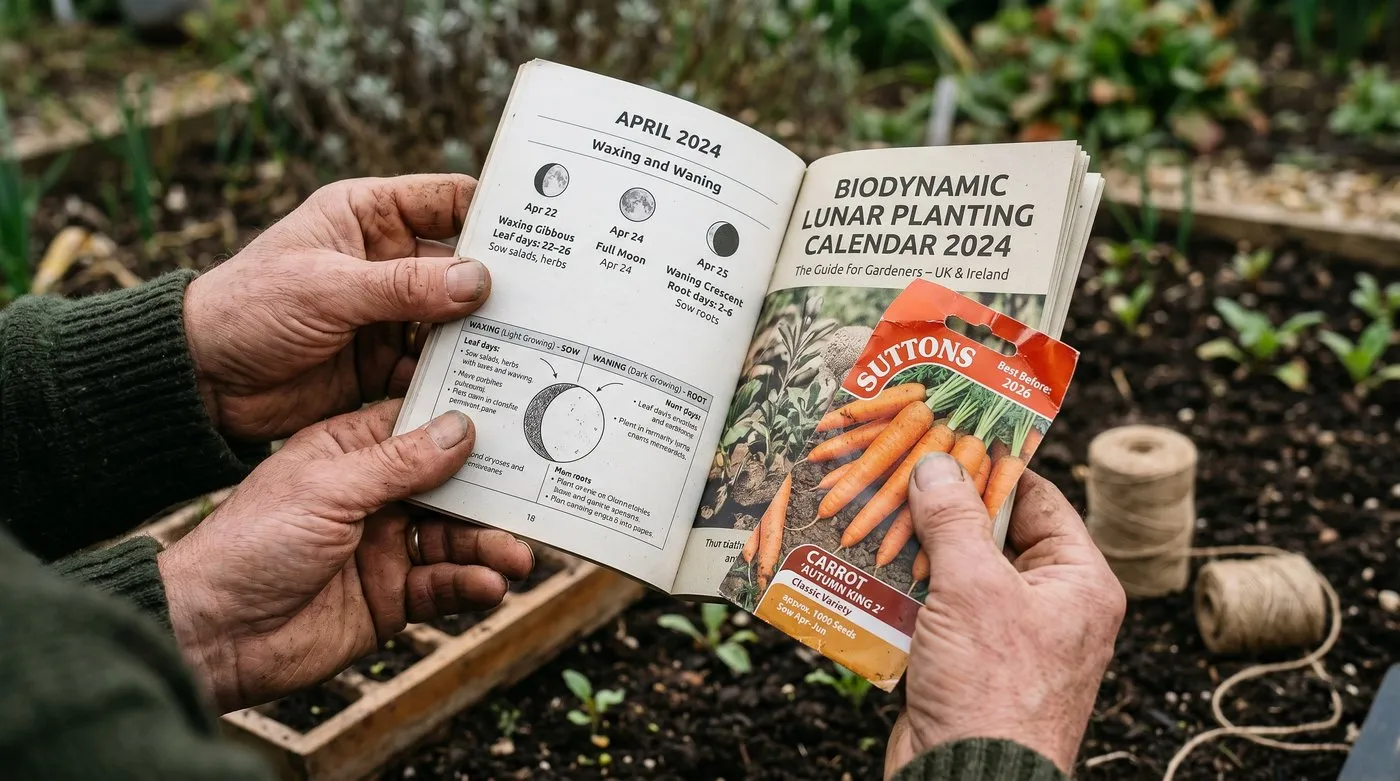 A typical UK biodynamic calendar marking moon phase and zodiac constellation for each day. The Old Moore’s Almanack runs the basic version annually.
The science evidence
Claim 1: Lunar gravity affects soil moisture
The theory: the moon’s gravitational pull lifts ocean tides; it must therefore lift water in plant tissue and soil moisture.
The evidence: lunar tidal effects on land water exist but are tiny. The gravitational pull of the moon at Earth’s surface is roughly one millionth the strength of Earth’s own gravity. The effect on soil moisture is far smaller than the effect of a light shower of rain, a passing cloud, or an irrigation event. No measurable plant response to lunar tidal moisture changes has been reproducibly demonstrated.
Claim 2: Reflected moonlight affects plant photoperiod
The theory: full moon adds light to the night, extending the effective day length.
The evidence: full moonlight at the Earth’s surface produces around 0.25 lux of illumination. The threshold for triggering phytochrome (the plant protein that measures day length) is around 1-5 lux for most species. Moonlight falls well below this threshold and does not affect day length perception in the vast majority of UK garden plants. A small number of species (some night-flowering moths, a few coral species) respond to lunar light but the documented effects on garden vegetables are negligible.
Claim 3: Cosmic energy rhythms affect plant vitality
The theory: plants respond to cosmic energies channelled through moon and planet positions.
The evidence: there is no scientific mechanism by which cosmic positioning would affect plant growth, and no peer-reviewed trials have demonstrated measurable yield effects from biodynamic preparations or planet-aligned planting timing. The largest study (Reganold et al. 1993, on biodynamic vs conventional dairy farms over 9 years) found yields comparable to organic farming but no benefit attributable to the specifically biodynamic elements.
What HAS been measured
Two small effects have been documented in controlled studies:
Seed water uptake is slightly higher around full moon in some species, by 5-15%. This is real but does not translate to consistent yield differences at harvest.
Plant water content varies slightly with moon phase, by 1-3%. Again real, again does not translate to yield.
The honest summary: lunar effects exist at the millimetre and millilitre scale. They do not exist at the kilogram and harvest scale.
The variation between identical beds within the same year was as large as the variation between moon-phase treatments. The variation between seasons was 5-10% larger than either. This is the textbook signal of no real effect - the moon-phase signal is buried within normal year-to-year noise.
Published commercial trials show the same pattern. A 2010 trial by Florida State University on lima beans across 17 plantings found no significant yield difference between moon phases. A 2005 UK biodynamic onion trial at Elm Farm Research Centre found yields within 4% of conventional timing - well inside the normal trial error margin.
Why some gardeners insist it works
Lunar gardening practitioners often report excellent results. Three explanations:
1. Confirmation bias. Lunar gardeners track moon phases and remember successes that align with the theory. Failures are dismissed as caused by other factors (wrong variety, wrong weather, pest pressure). Yield records are rarely kept rigorously.
3. Genuine small effects with selective recall. The documented small effects on seed water uptake and germination may produce marginal benefits in some conditions, which lunar gardeners notice and conventional gardeners do not.
The conclusion: structured planting timing helps, but the moon is not what makes it work. Any consistent system would produce similar improvements through the same attentional mechanism.
The traditional UK lunar planting calendar
For UK gardeners who want to try lunar planting anyway, the simplified system:
Waxing moon (new moon to full moon)
First quarter (new moon to first quarter): sow above-ground crops with seeds inside the fruit (tomatoes, peppers, beans, peas).
Second quarter (first quarter to full moon): sow above-ground crops with seeds outside the fruit (lettuce, cabbage, spinach, leafy greens).
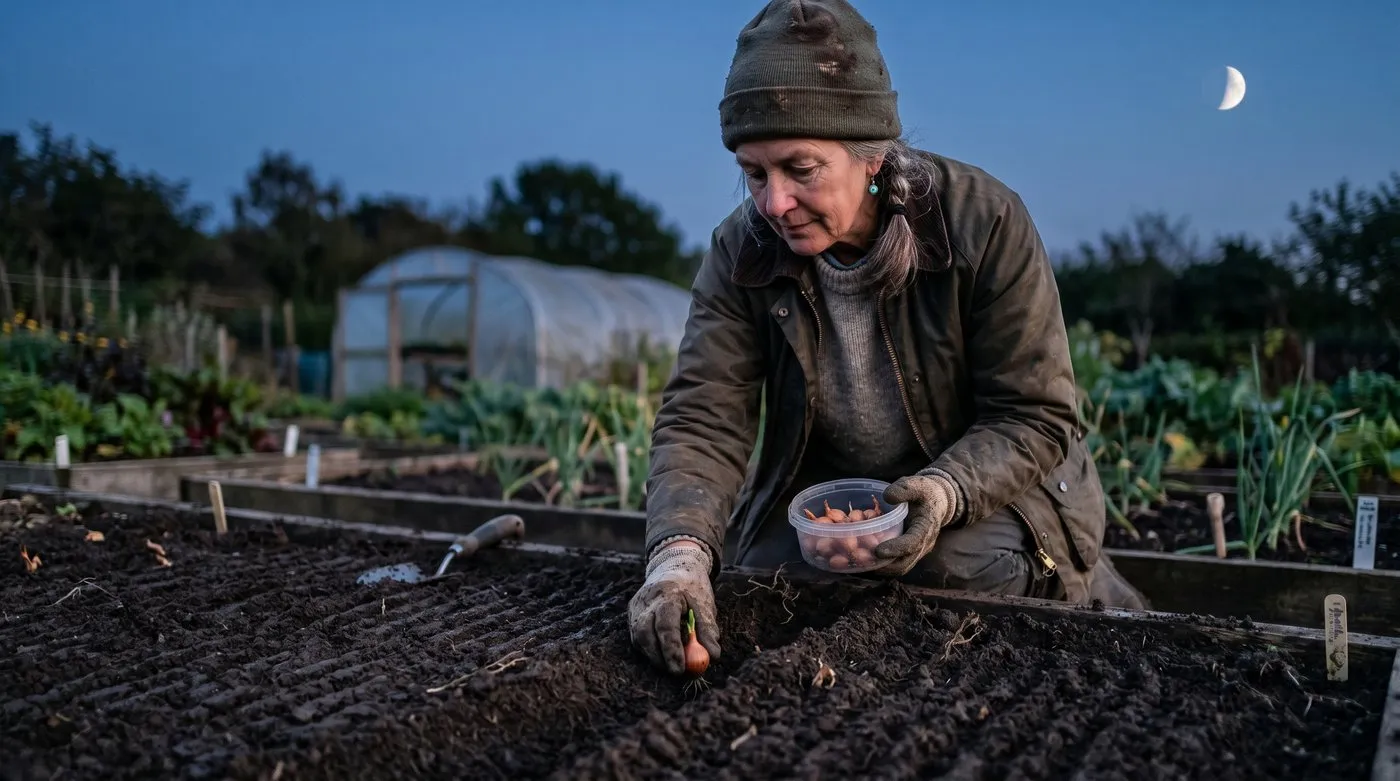 Planting onion sets on a waning moon evening - the traditional time for below-ground crops in lunar gardening. The visual ritual matters more than the measurable effect.
Waning moon (full moon to new moon)
Third quarter (full moon to last quarter): sow below-ground crops (carrots, parsnips, beetroot, onions, potatoes).
Fourth quarter (last quarter to new moon): rest period. Cultivate, weed, harvest for storage. Do not sow.
Dates for 2026
Reference moon phases for the 2026 UK growing season (approximate UK times):
- 18 May - Full moon
- 26 May - Last quarter
- 2 June - New moon
- 10 June - First quarter
- 17 June - Full moon (summer solstice within days)
- 25 June - Last quarter
- 1 July - New moon
- 10 July - First quarter
- 16 July - Full moon
A free online moon-phase calendar from any UK weather site or the Royal Astronomical Society gives daily updates.
Should you bother?
Three honest answers based on use case:
If you are an organised, schedule-driven gardener already
Lunar gardening will not improve your yields measurably. Stick with your existing rotation, soil-prep and variety-choice system. The moon adds friction without benefit.
If you are a chaotic gardener who plants when you remember
Lunar gardening will probably improve your yields because it forces structured timing. Same effect would come from any consistent calendar. The moon happens to be a free, well-known reminder system.
If you find lunar gardening enjoyable
Then continue. It is harmless, free, and provides a satisfying rhythm to the garden year. The ritual matters even if the mechanism does not. Plenty of UK gardeners enjoy traditional rhythms and the lunar calendar fits that tradition.
The single thing not to do is pay for expensive biodynamic preparations (sealed cow horns of fermented manure, ash of burned weed seeds spread under specific planetary alignments). These cost real money, take real time, and have no peer-reviewed evidence base.
Lunar gardening alongside evidence-based practice
If you are trying lunar gardening, do not skimp on the non-lunar fundamentals:
- Soil pH and structure matters far more than moon phase. See our soil testing and pH adjustment UK guide.
- Crop rotation matters far more than moon phase. See our crop rotation planner UK guide.
- Companion planting matters far more than moon phase. See our companion planting guide UK guide.
- Compost and soil-building matter far more than moon phase. See our how to make compost at home guide.
Get those four right and the moon phase is statistical noise. Get those four wrong and no moon-phase calendar will rescue the crop.
A balanced view from the UK gardening tradition
UK gardening has always blended folk wisdom with empirical observation. Old gardeners’ rules like “plant onion sets when the daffodils flower” are evidence-based proxies for soil temperature. Rules like “plant potatoes on Good Friday” are evidence-based for the typical UK last-frost timing. Both work because they encode genuine seasonal signals.
Lunar gardening does not encode a genuine signal - the moon phase is decoupled from soil, weather and day length. But it sits comfortably alongside the older folklore as a structured framework, and many UK gardeners find that the framework alone is useful.
The honest verdict: try it if curious, drop it if it doesn’t fit, and don’t argue with anyone who insists it works for them. The garden is bigger than the moon.
Field note: The Royal Astronomical Society publishes free moon-phase data for the UK. The Old Moore’s Almanack is the traditional UK source for biodynamic-aligned planting calendars and still sells well annually.
Common UK lunar gardening mistakes
Mistake 1: Believing lunar timing will rescue poor practice. No moon phase compensates for wrong soil pH, poor variety choice, or skipped watering.
Mistake 2: Buying expensive biodynamic preparations. Cow-horn manure preparations and similar cost £15-£40 for a small batch and have no evidence base.
Mistake 3: Skipping plantings to wait for the “right” moon phase. Better to plant on the available calm day than to wait for ideal lunar conditions and miss the season.
Mistake 4: Following one almanack rigidly. Different lunar systems contradict each other. Internal consistency matters more than which system you pick.
Mistake 5: Arguing with conventional gardeners about it. The evidence base is what it is. Lunar gardening is a personal practice, not a yield system to evangelise.
A simple monthly framework
For UK gardeners who want a structured planting calendar without committing to full biodynamic practice:
| Month | Moon-aligned approach | Conventional approach |
|---|---|---|
| Feb-Mar | Indoor sowing on waxing moon | Indoor sowing when soil reaches 5C |
| Apr | First outdoor sowing on waxing moon | First outdoor sowing after last frost |
| May | Plant out tender crops on waxing moon | Plant out tender crops after 15 May |
| Jun | Sow root crops on waning moon | Sow second-cropping carrots |
| Jul | Successional salads on waxing moon | Successional salads every 3 weeks |
| Aug | Plant overwintering onions on waning | Plant overwintering onions Aug-Sept |
| Sep-Oct | Plant garlic on waning moon | Plant garlic Oct-Nov |
| Nov-Dec | Prune on waning moon | Prune in dormant period |
The right-hand column produces the same crop yields as the left-hand column. Pick whichever system you find motivating.
Now you’ve understood lunar gardening
For the evidence-based signals that actually drive UK plant growth, read our soil testing and pH adjustment UK and crop rotation planner UK guides.
Our team produces practical UK gardening guidance from source research, contributor records and established horticultural practice. Editorial standards are overseen by Matt W.