Key takeaways
- NPK = Nitrogen, Phosphorus, Potassium - the three macronutrients on every fertiliser bag
- Numbers show percentage by weight - 7-7-7 means 7% N, 7% P, 7% K, the rest is filler
- Nitrogen drives leaves and stems; phosphorus drives roots and flowers; potassium drives fruit and ripening
- Match the ratio to the crop stage - balanced for general feeding, high-N for leaves, high-K for fruit
- UK soil tests rarely show nitrogen deficiency but often show low phosphorus on clay and low potassium on sandy soils
- Apply at the manufacturer's rate - over-fertilising is the most common UK garden mistake
NPK is the three-number code printed on every fertiliser bag sold in the UK. It tells you exactly what plant nutrition the product delivers. The numbers refer to nitrogen, phosphorus and potassium - the three major nutrients plants need in large quantities to grow properly.
This guide explains what each number means, what each nutrient actually does in the plant, when to use which ratio, and how to read past the marketing on UK fertiliser bags to choose the right feed for your crop, lawn or border.
The basic rule is simple: nitrogen for leaves, phosphorus for roots and flowers, potassium for fruit and ripening. Everything else in this article is detail.
What the three numbers mean
A bag of fertiliser marked 7-7-7 contains:
- 7% nitrogen (N) by weight
- 7% phosphorus (P) by weight (technically phosphate, P₂O₅)
- 7% potassium (K) by weight (technically potash, K₂O)
The remaining 79% is the carrier - sand, dolomite, organic matter or wetting agents that bulk out the nutrient content into a product you can spread evenly.
The percentages add up to whatever the product spec is. A high-nitrogen lawn feed at 24-0-0 delivers 24% nitrogen by weight, no phosphorus and no potassium - the other 76% is carrier. A tomato feed at 4-3-8 delivers 4% N, 3% P and 8% K, with the other 85% being carrier or trace minerals.
The three numbers always appear in the same order - N then P then K. Memorising “leaves, roots, fruit” reading from left to right is the quickest way to make sense of any fertiliser bag at the garden centre.
For the wider context of UK soil testing, see our soil testing and pH adjustment guide.
What each nutrient does in the plant
Nitrogen (N) - the leaf builder
Nitrogen drives leafy green growth and stem development. It is the primary component of chlorophyll (the molecule that makes leaves green and runs photosynthesis) and of all proteins inside plant cells. A plant with adequate nitrogen looks dark green, grows fast, and produces large leaves.
Symptoms of nitrogen deficiency:
- Older leaves turn pale yellow first (nitrogen is mobile - the plant pulls it from older leaves to feed new growth)
- Whole plant looks small and stunted
- Growth slows dramatically in spring
 Classic nitrogen deficiency on tomato. The yellow leaf shows the uniform pale colour that signals low N, especially when it appears on older leaves first.
Symptoms of nitrogen excess:
- Lush dark green soft growth that flops or breaks easily
- Reduced flowering and fruiting (the plant prioritises leaves over reproduction)
- Increased pest pressure (aphids and slugs love high-N growth)
Crops that demand high nitrogen: lettuce, spinach, kale, chard, brassicas, lawns in spring, leafy herbs (parsley, basil, coriander).
UK sources of nitrogen:
- Sulphate of ammonia (21-0-0) - inorganic, fast-acting, acidifies soil
- Pelleted poultry manure (4-2-1) - organic, slow-release
- Fresh grass clippings (0.5-0-0.3) - free, dig into beds
- Comfrey leaves - high in N, brew into liquid feed
- Liquid seaweed feed (1-0-2) - balanced organic boost
Phosphorus (P) - the root and flower builder
Phosphorus supports root development, flowering and seed formation. It is essential for energy transfer inside cells (the ATP molecule that powers all plant processes contains phosphorus). A plant with adequate P develops strong root systems, flowers profusely and sets seed reliably.
Symptoms of phosphorus deficiency:
- Leaves turn purple, especially on the underside (anthocyanin accumulates when P is short)
- Stunted growth despite adequate water and other nutrients
- Poor flower and fruit set
- Roots stay shallow and weak
Symptoms of phosphorus excess:
- Locks out iron, zinc and copper uptake
- Brown leaf tips in young plants
Crops that demand high phosphorus: root crops (carrots, parsnips, beetroot), bulbs at planting, fruit trees at establishment, flowering annuals through bud development.
UK sources of phosphorus:
- Bone meal (4-15-0) - organic, slow-release, ideal at planting
- Superphosphate (0-44-0) - inorganic, fast-acting, intensive use
- Rock phosphate (0-32-0) - very slow-release, organic
- Wood ash (0-1-3) - small amounts of P, more K, alkaline
Potassium (K) - the fruit and ripening driver
Potassium drives fruit production, sugar accumulation, disease resistance and frost hardiness. It regulates the opening and closing of stomata (the breathing pores on leaves), drives water movement through the plant, and is essential for the sugar synthesis that produces sweet fruit and ripens crops.
Symptoms of potassium deficiency:
- Yellowing leaf edges turning to brown scorch, especially on older leaves
- Weak stems that flop in wind
- Reduced fruit production and small under-developed fruit
- Increased disease susceptibility, especially fungal infections
Symptoms of potassium excess:
- Locks out calcium uptake (causes blossom end rot in tomatoes)
- Locks out magnesium uptake (causes interveinal chlorosis)
Crops that demand high potassium: tomatoes, peppers, courgettes, cucumbers, all fruit crops, dahlias, chrysanthemums, lawns in autumn.
UK sources of potassium:
- Sulphate of potash (0-0-50) - inorganic, fast-acting
- Wood ash (0-1-3) - free if you burn untreated wood
- Comfrey liquid feed (varies, K-rich) - free from a comfrey patch
- Tomato feed (typically 4-3-8) - liquid, balanced for fruiting
For a full UK feeding comparison across product types, see our best fertilisers UK gardens guide.
Reading a UK fertiliser bag
Here are the NPK ratios you will see most often in UK garden centres:
| NPK | Type | Best for |
|---|---|---|
| 7-7-7 | Balanced general fertiliser | All-purpose vegetable beds, mixed borders |
| 6-3-3 | Slightly N-leaning | Lawns in late spring/summer |
| 24-0-0 | High nitrogen straight | Lawn spring boost, leafy crops |
| 15-5-5 | High N, low P/K | Lawns early spring, leaf crops |
| 5-5-5 | Mild balanced | Light feeding, new plantings |
| 4-3-8 | High K (tomato feed) | Tomatoes, peppers, fruit, flowers in bud |
| 0-0-50 | Pure potash | Targeted K boost mid-season |
| 4-0-14 | Autumn lawn feed | Lawns September-October |
| 4-15-0 (bone meal) | High P slow-release | Bulb planting, fruit tree planting |
| 2-2-1 (chicken manure pellets) | Low balanced organic | Annual mulch, general feeding |
The first useful skill when fertiliser-shopping in the UK is reading the numbers and translating them straight into “this is for leaves” or “this is for fruit” without needing to look at the marketing on the front of the bag.
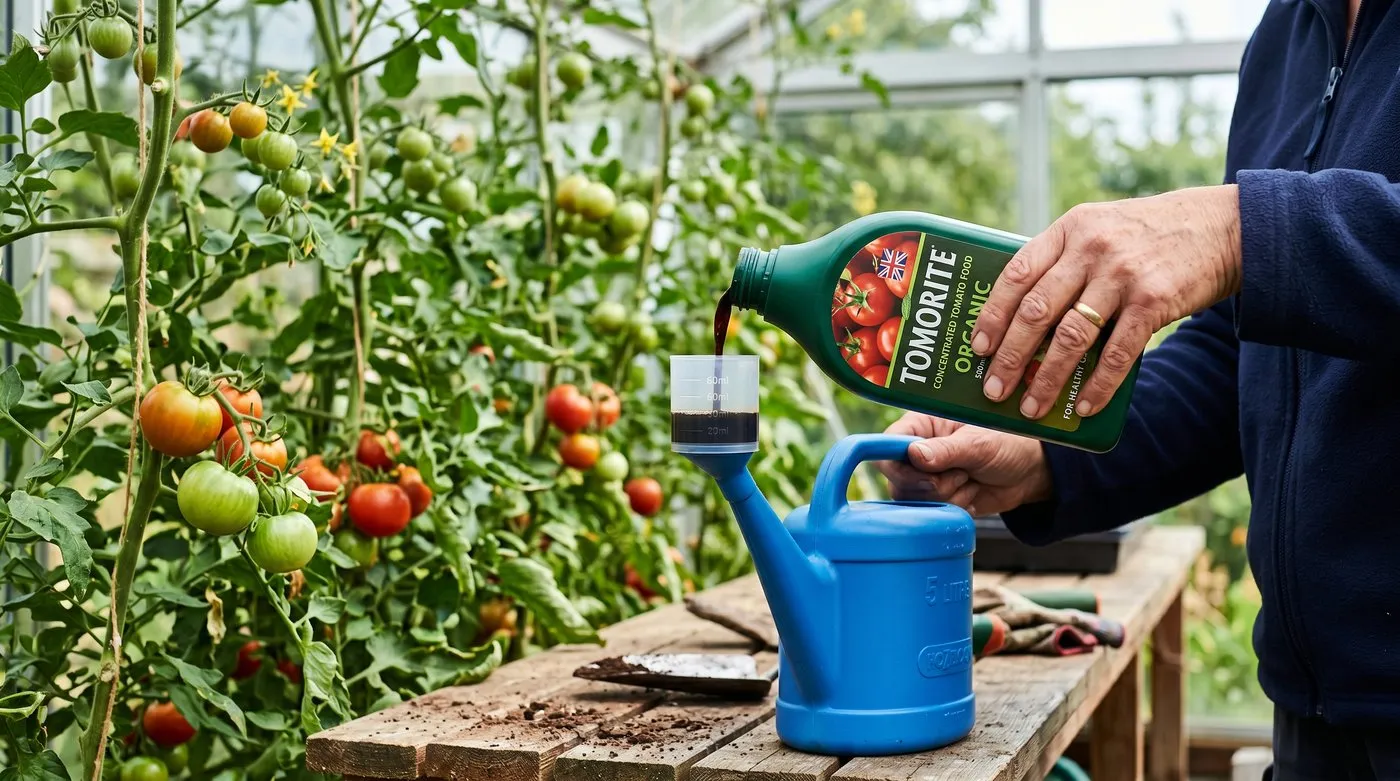 Liquid tomato feed at typical 4-3-8 NPK ratio. The high potassium drives fruit production through the growing season.
Inorganic vs organic NPK sources
UK gardeners can choose inorganic (synthetic) or organic (plant or animal-derived) fertiliser sources. Both deliver the same NPK chemistry but with different release rates and soil-health impacts.
Inorganic (synthetic):
- Fast-acting, water-soluble, immediate plant uptake
- Precise NPK ratios, easy to dose
- Cheaper per kg of nutrient
- No contribution to soil biology
- Can damage soil microbes with repeated heavy use
- Risk of leaching into watercourses
Organic (plant/animal-derived):
- Slow-release as soil microbes break down the material
- Variable NPK ratios depending on source
- More expensive per kg of nutrient
- Improves soil structure and feeds microbiology
- Lower leaching risk
- Slow to correct acute deficiencies
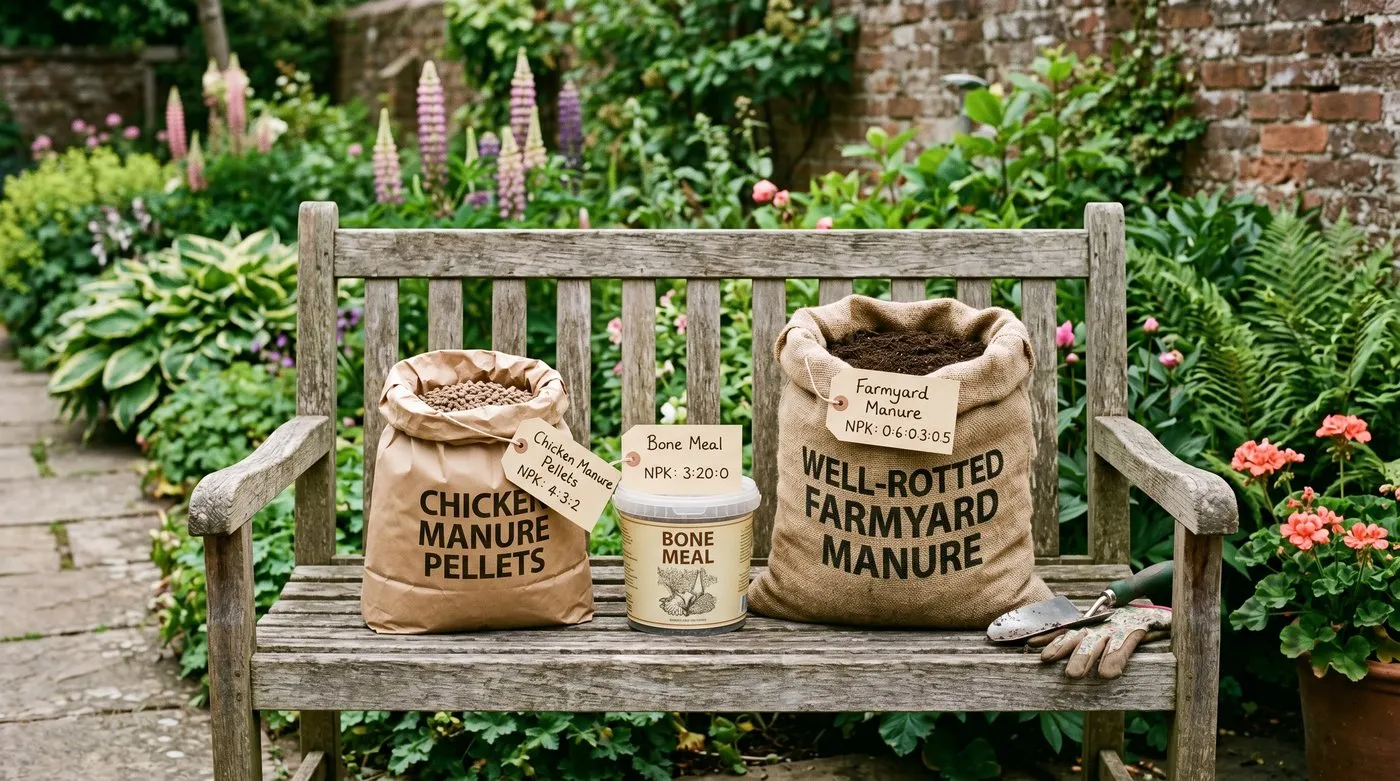 Common UK organic fertilisers compared. The slower release rate of organic sources means you apply less frequently but the soil benefits accrue over years.
Most UK gardeners use a mix - organic mulch and bulky manure for soil-building, with targeted inorganic or concentrated organic liquid feeds for specific crop demands at peak growing stages.
NPK ratios by crop
The right NPK ratio depends on the crop and the growing stage. Here is the UK feeding pattern:
Tomatoes, peppers, aubergines, cucumbers, courgettes
- At planting: balanced 7-7-7 worked into the soil
- First 4-6 weeks (vegetative growth): weekly liquid balanced feed at half strength
- From first flower truss: switch to high-K tomato feed (4-3-8 or similar) at full strength weekly
- Until end of cropping: continue high-K weekly
Brassicas (cabbage, broccoli, kale, sprouts, cauliflower)
- At planting: high-N or balanced 7-7-7
- Mid-growth: top-dress with high-N feed at 50g per square metre
- Heading stage: balanced feed weekly
- No K boost needed - brassicas are leaf crops
Leafy salads (lettuce, spinach, chard, rocket, pak choi)
- At sowing: weak balanced feed in the seed bed
- Through growth: weekly half-strength high-N liquid feed
- No K phase - all leaf crops want N throughout
Root crops (carrots, parsnips, beetroot, swede, turnip)
- At sowing: low-N or no N to prevent leafy growth at the expense of roots
- Mid-season: balanced 7-7-7 if growth is slow
- No nitrogen boost - high N produces forked roots
Potatoes
- At planting: high-N balanced feed (6-6-6 or similar)
- First earthing-up: top-dress with sulphate of ammonia or chicken pellets
- Tuber-formation stage: high-K feed to boost yield and dry matter
Fruit trees and bushes
- Early spring (March): balanced feed at the dripline
- Pre-flowering (April): high-K feed to support flower-to-fruit transition
- Post-harvest (September): light potash to harden wood for winter
Lawns
- Spring (March-April): high-N 15-5-5 or 24-0-0 for green-up
- Summer (June-August): balanced 7-7-7 every 4-6 weeks
- Autumn (September-October): high-K 4-0-14 to harden grass and reduce disease
- Winter: no feeding
Flowering annuals and perennials
- At planting: balanced 7-7-7
- Pre-flowering: high-K feed (4-3-8 or rose feed)
- Through flowering: continue high-K every 2-3 weeks
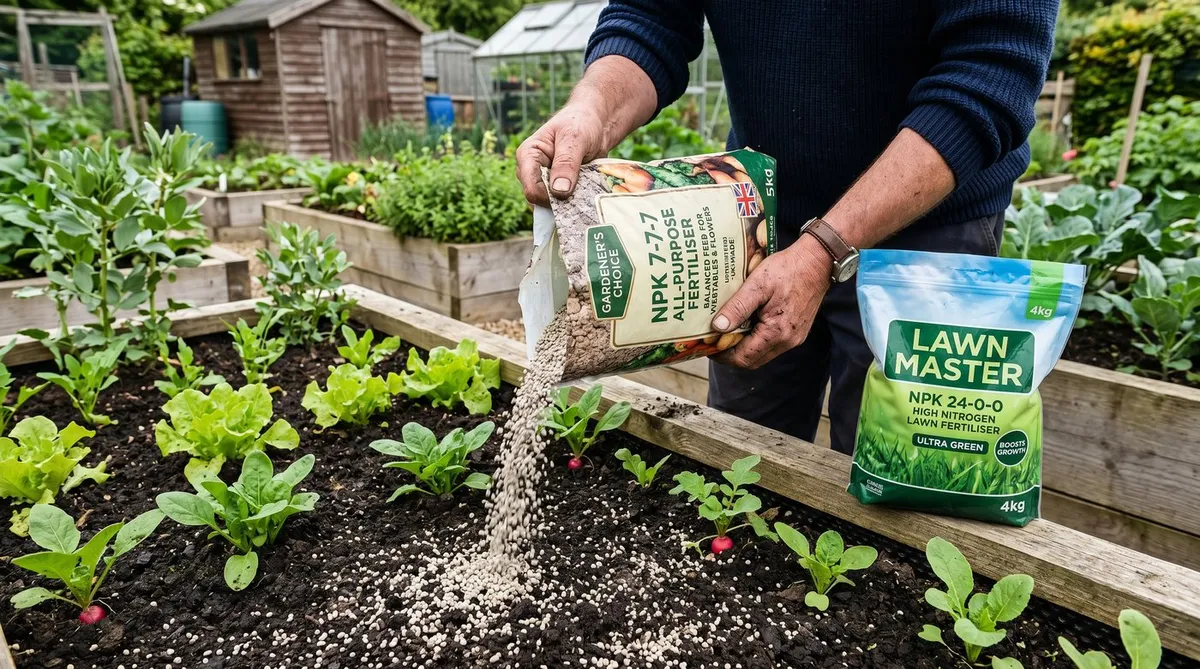
For a healthy UK garden bed showing the result of correct seasonal feeding:
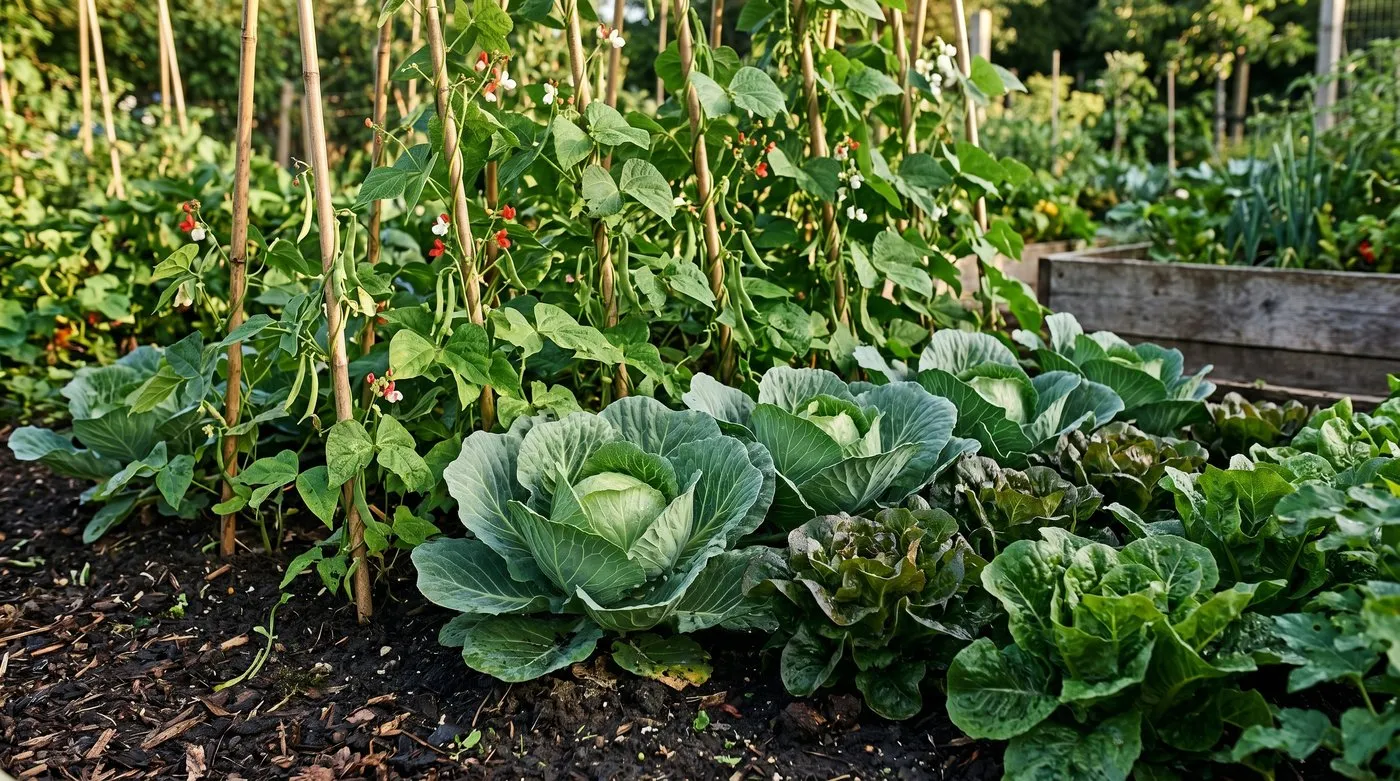 A vegetable bed receiving balanced NPK at the right ratio for each crop. Brassicas are dark green from adequate N, beans have high pod set from balanced feeding.
How much to apply
The UK fertiliser label is the most reliable guide. Manufacturer rates are based on real trials and over-application is the most common cause of crop damage from over-feeding.
Rough rules of thumb for typical UK garden products:
| Product | Typical rate | When to apply |
|---|---|---|
| Granular balanced 7-7-7 | 70-100g per square metre | Spring, work into surface |
| Chicken manure pellets | 100-150g per square metre | Spring or autumn mulch |
| Bone meal (slow-release P) | 50-100g per planting hole | At planting |
| Tomato feed (liquid) | Per pack - usually 10ml per litre water | Weekly when fruiting |
| Sulphate of ammonia | 20-30g per square metre | Top-dress through season |
| Sulphate of potash | 30-50g per square metre | Once per season |
| Liquid seaweed | 10-20ml per litre water | Weekly across season |
| Wood ash (homemade) | 100g per square metre max | Once per year - alkalising |
The fertiliser industry rule of thumb is “weak and often beats strong and seldom” for liquid feeds. A half-strength feed every week produces better results than a full-strength feed once a month, because the plant uses the nutrient as it grows rather than dumping it through the system in a single hit.
Common UK mistakes
Mistake 1: Using lawn feed on vegetable beds. Lawn feeds at 24-0-0 or 15-5-5 are too high in nitrogen for most vegetables. The excess N produces leafy growth that does not fruit and attracts aphids.
Mistake 2: Using tomato feed on lawns. The high K and low N produces yellowing rather than greening, and the cost per square metre is far higher than purpose-made lawn feed.
Mistake 3: Applying high-N feed in autumn. Soft growth produced after September cannot harden off before winter. The plants suffer frost damage and disease over winter. All autumn feeds should be low N, high K.
Mistake 4: Over-applying granular fertilisers in dry weather. Granules need moisture to dissolve and become available to plants. Apply just before rain or water in heavily after spreading.
Mistake 5: Mixing fertilisers without checking compatibility. Some inorganic fertilisers react chemically when mixed - sulphate of ammonia plus calcium nitrate, for example, can lose nitrogen as ammonia gas. Apply each product separately if combining.
Mistake 6: Ignoring trace elements. NPK is the macro story. Micronutrients (magnesium, iron, calcium, sulphur, boron) also matter - blossom end rot on tomatoes is a calcium issue, not a K problem. A general-purpose fertiliser with trace elements (Vitax Q4, Growmore plus) handles both.
Slow-release vs liquid feeds
The choice between granular slow-release fertilisers and liquid feeds depends on the timeframe and the crop:
Slow-release granules:
- Apply once in spring, feed for 3-6 months
- Best for permanent plantings - shrubs, perennials, fruit trees
- Best for soil-building - chicken manure pellets, bone meal
- Slower visible response (2-4 weeks)
- Lower risk of over-application
Liquid feeds:
- Weekly or fortnightly application
- Best for container plants, hanging baskets, intensive crops
- Best for crops with rapidly changing needs - tomatoes flipping from vegetative to fruiting
- Faster visible response (3-7 days)
- Higher risk of over-application
Most UK gardens benefit from both - slow-release applied at the start of the season for baseline nutrition, plus liquid feeds applied weekly to crops in heavy production.
For the specific clay-soil context where nutrient lock-up is common, see our how to improve clay soil guide.
When to test soil rather than guess
Apply NPK fertilisers based on what the crop needs and what the soil already provides. UK garden soil typically:
- Holds enough phosphorus if well-manured for years
- Loses potassium on sandy soils because K leaches with rain
- Loses nitrogen every year - the gardener’s main task is to top up N
A basic soil test in early spring tells you whether your soil is short of any major nutrient. Most UK garden centres sell soil test kits at £8-£15, or a professional lab analysis costs £35-£65. Worth doing every 3-5 years on serious vegetable plots.
Field note: The RHS holds detailed UK research on plant nutrition. Their plant-feeding pages are the standard reference for UK conditions and worth bookmarking.
Reading the label - what to check at the garden centre
When you pick up a UK fertiliser bag, check four things in this order:
- NPK ratio - does it match the crop you are feeding?
- Form - granular, pellet, liquid concentrate, ready-to-use spray?
- Application rate - how much per square metre and how often?
- Approved usage - is it labelled for edible crops (this matters legally for some chemicals)?
The ratio drives 90% of the decision. Everything else is application detail.
Now you’ve understood NPK
The next foundational step is understanding soil pH - which determines whether the NPK in your soil is actually available for plants to absorb. Read our soil pH testing and adjustment guide for the pairing chemistry that decides whether your feeding strategy actually delivers nutrients to the crop.
Our team produces practical UK gardening guidance from source research, contributor records and established horticultural practice. Editorial standards are overseen by Matt W.