Key takeaways
- Rosemary will not regrow from bare brown wood, unlike lavender or hyssop, so hard pruning to the base kills 80% of mature plants
- The 3-year staged cut reduces one third of stems each April to just above the lowest green needles
- Take 6 to 12 softwood cuttings in May or June as the insurance plan before starting any rejuvenation cut
- Layering a low flexible branch into gritty compost roots in 8 to 12 weeks for a backup plant
- Plants over 10 years old or with no green growth on the lower 200mm are usually beyond saving
- Replace with named cultivars like Miss Jessopp's Upright for hedging or Severn Sea for ground cover
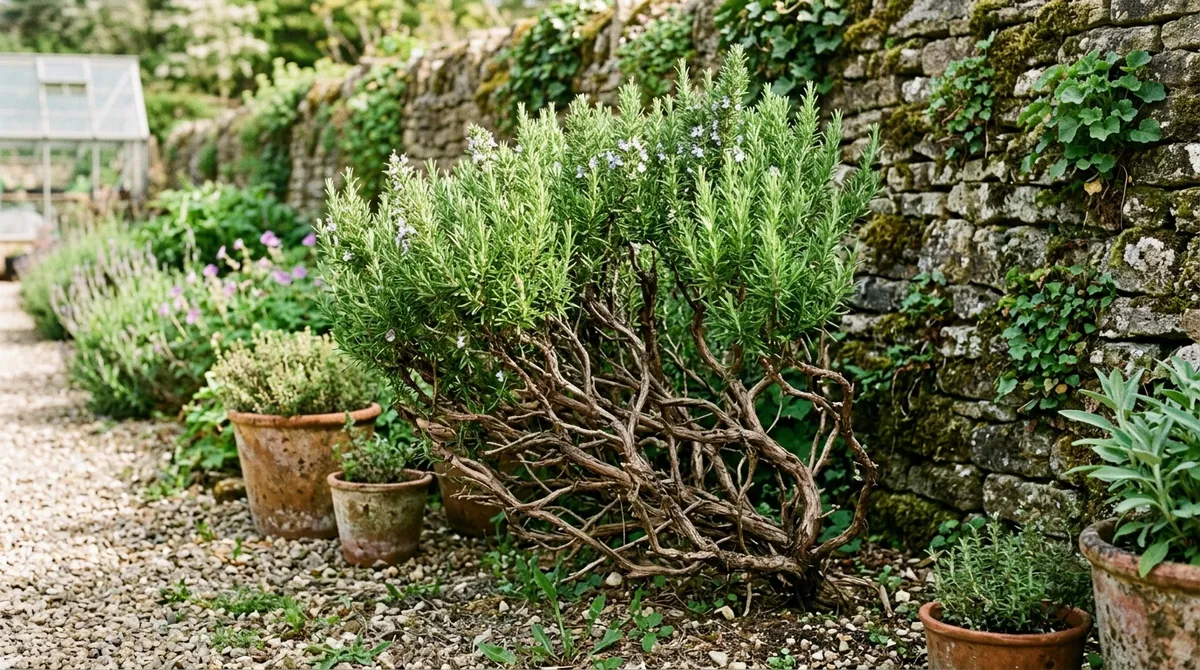
Old rosemary plants in UK gardens almost always end up the same way: a leggy bush with bare brown woody stems at the base and a thin layer of green needles only at the tips. The gardener’s instinct is to cut it back hard to encourage fresh growth, the way you would with lavender. That instinct kills the plant in 8 out of 10 cases.
Rosemary (Salvia rosmarinus, formerly Rosmarinus officinalis) is not lavender. It does not have dormant buds in the bare brown wood at its base. Cut into that wood and the cut does not heal. The plant browns down to the roots within weeks.
This guide covers the only reliable way to revive a woody rosemary in the UK, the cuttings and layering routine that gives you backup plants in case the original dies, and the point at which an old plant is simply beyond saving.
The biological reason rosemary cannot be cut hard
Lavender, hyssop and sage all have dormant buds buried in the bare wood at the base of the shrub. Cut hard into that wood in April and the buds break, pushing new shoots from the woody base. The plant regenerates from inside the existing structure.
Rosemary lacks those dormant buds. The bare brown wood at the base of an old rosemary is dead in terms of regeneration. New growth comes only from existing green tissue. Cut all the green off and the plant has nothing to grow from.
This is why every authoritative UK source agrees that rosemary must be pruned above the lowest green growth on each stem. Cut below the lowest green needles and that stem dies. Cut whole sections of the plant below the green and whole sections die. Cut the entire plant below the green and the whole plant dies.
For the underlying biology see the Royal Horticultural Society’s rosemary pruning advice which reaches the same conclusion based on extensive trials.
The 3-year staged cut-back
A 6 to 10-year-old rosemary with woody bare lower stems and green only at the tips can still be revived if there is some green growth on the lower 200mm of the plant. Inspect each main stem carefully. If you can find at least a few green needles on the lower third of every stem, the staged cut will work.
The routine:
- April or May, year one: Identify the oldest one third of the main stems (the thickest, tallest, woodiest). On each of those stems, cut down to just above the lowest patch of green needles. This is typically 200 to 400mm above the base, well above the bare wood.
- June year one: The cut stems should be pushing fresh side shoots from the green tissue below the cut. If a cut stem is not regrowing by mid-June, the lowest green was too marginal. Leave it alone.
- April or May, year two: Identify the next one third of oldest stems. Repeat the cut above the lowest green on each.
- April or May, year three: Cut the final one third of original stems.
- By year four: The plant is a fresh multi-stemmed bush with new growth at every height.
The total height of the plant does not reduce by much during this process. A 900mm plant ends up 700 to 800mm tall, just with younger more productive wood and fewer bare leggy stems.
For other Mediterranean shrubs that follow similar rules see our how to prune lavender guide which contrasts the much harder pruning lavender will tolerate.
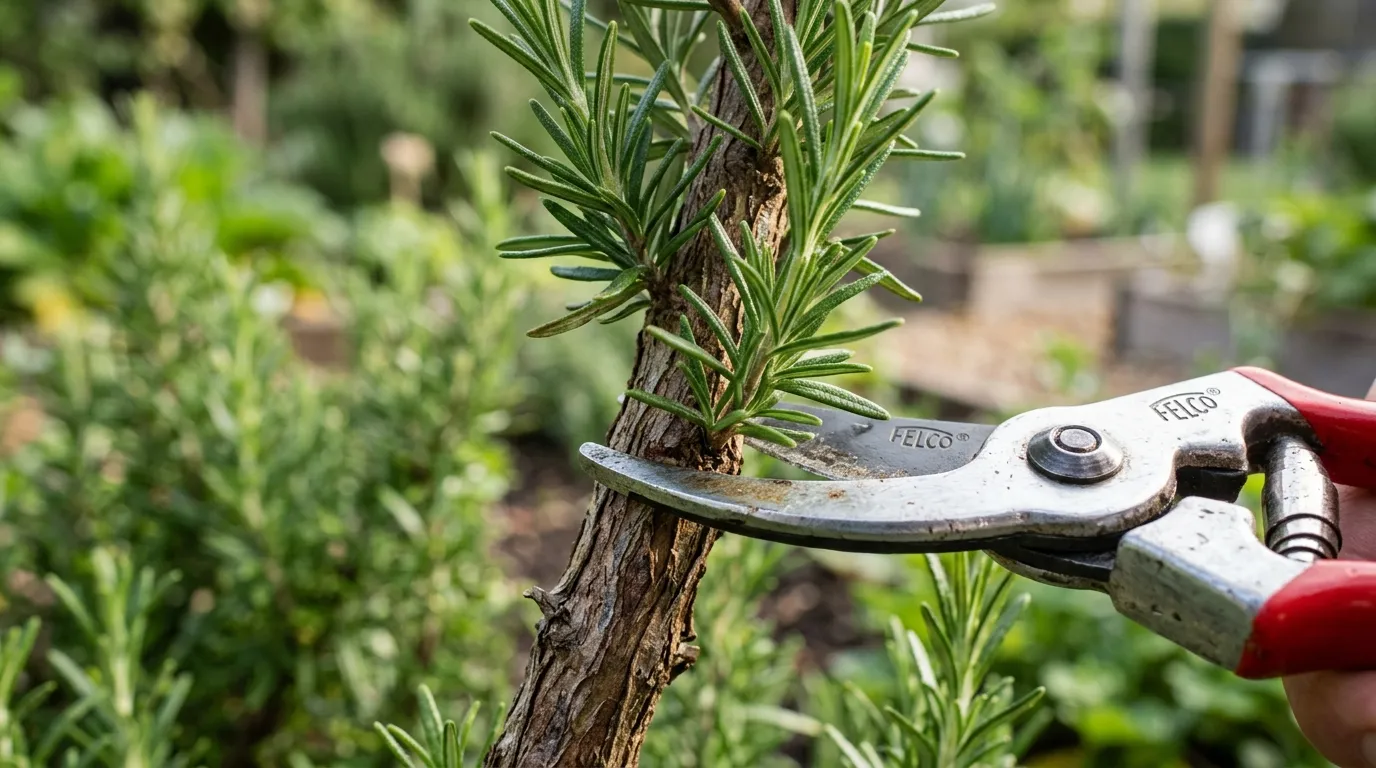 The cut point: just above the lowest patch of green needles on the stem. Anywhere below this and the stem dies. The green tissue is what regrows the new shoots.
Cuttings and layering as the insurance plan
Before you start any rejuvenation cut, take 6 to 12 softwood cuttings from the existing plant in May or June. This is the insurance plan. If the rejuvenation fails the cuttings give you replacement plants from the same genetic line.
Cuttings routine:
- Cut 100mm lengths from non-flowering side shoots. Choose stems that are soft and pliable, not fully woody.
- Strip the lower 50mm of needles by sliding finger and thumb down the stem.
- Dip the cut end in rooting hormone powder (Doff or similar).
- Push the prepared cutting into a 7-litre pot of gritty compost (50/50 multi-purpose and horticultural grit), three cuttings per pot.
- Water lightly and place in dappled shade.
- Bag the pot in a clear polythene bag for the first three weeks to maintain humidity.
- Cuttings root in 6 to 8 weeks. A gentle tug confirms root resistance.
- Pot on into individual 1-litre pots in John Innes No 1.
- Plant out the following April after a winter under cold protection.
Layering is the alternative. A low flexible branch can be pinned to the ground with a metal staple, a small heap of gritty compost piled over the contact point, and a stone weight placed on top. Roots form at the contact point in 8 to 12 weeks. Sever the rooted section from the parent plant the following April and pot it on.
For the wider technique on cuttings, division and layering see our guide to plant propagation by cuttings, division and layering.
 Six rosemary softwood cuttings in a 7-litre terracotta pot of 50/50 multi-purpose and grit. Cuttings root in 6 to 8 weeks in dappled shade.
When to give up and replace
Not every old rosemary can be saved. The signs that a plant is beyond rejuvenation:
- No green growth on the lower 200mm of any stem. Without lower green you have no cut point. The plant is structurally dead at the base.
- Plant over 10 years old. Lifespan of a vigorous garden rosemary in the UK is 8 to 15 years. Past 10 the plant slows even with the right pruning.
- Persistent winter brown-back. If the plant turns brown each spring after a wet winter, the roots are rotting and the plant is on the way out regardless of pruning.
- Hollow centre. Older plants develop a hollow dead centre with green only on the outer skirt. Once hollow, the plant is structurally compromised.
- Lifted by wind. A rosemary that rocks in the wind has lost its anchor roots and will not recover.
When the plant is beyond saving, replace it. Replace with a named UK cultivar rather than a generic supermarket rosemary, which is usually a tender Italian seed line that struggles through UK winters.
The reliable UK rosemary cultivars:
| Cultivar | Habit | Mature size | Best for | Hardiness |
|---|---|---|---|---|
| Miss Jessopp’s Upright | Upright columnar | 1.5 to 2m H x 600mm W | Hedging, formal structure | Hardy to -10C |
| Tuscan Blue | Upright bushy | 1.2 to 1.5m H x 800mm W | Culinary, broad needles | Hardy to -8C |
| Severn Sea | Prostrate trailing | 300mm H x 1m W | Ground cover, low walls | Hardy to -8C |
| Sissinghurst Blue | Upright bushy | 1m H x 600mm W | Mixed border, intense blue flowers | Hardy to -10C |
| Capri | Compact bushy | 600mm H x 600mm W | Patio containers | Hardy to -8C |
| Boule | Compact rounded | 500mm H x 500mm W | Knot gardens, edging | Hardy to -8C |
| Pyramidalis | Tight upright | 1.2m H x 400mm W | Narrow specimens | Hardy to -10C |
Miss Jessopp’s Upright is the best UK choice for an informal hedge. Tuscan Blue is the strongest culinary variety for kitchen use. Severn Sea trails beautifully over low walls or container edges. All three hold the RHS Award of Garden Merit.
Soil, drainage and replanting
A replacement rosemary needs the right site or it will end up just as woody and miserable as the one it replaced. Rosemary wants:
- Free-draining soil. Wet feet in winter kills more rosemary than any other cause. On clay, plant on a 200mm raised mound with 50% added grit.
- South or south-west aspect. Six hours of direct sun a day. North-facing borders kill rosemary within two seasons.
- Soil pH 6.5 to 7.5. Slightly acid to slightly alkaline. Strongly acid soils need lime added.
- Spacing 600 to 900mm from neighbours. Crowded rosemary develops poor airflow and rots from the base in damp UK summers.
- No high-nitrogen feed. Mediterranean plants do best on a lean soil. Avoid composted manure.
Planting routine:
- Dig a hole 450mm wide and 300mm deep.
- Mix the excavated soil 50/50 with horticultural grit.
- Backfill the bottom 100mm.
- Set the rootball with its top level with the surrounding soil (no deeper). Rosemary roots want to be near the surface.
- Backfill, firm gently.
- Water in with 4 litres.
- Mulch 25mm thick with gravel or pea shingle (NOT bark or composted manure).
The gravel mulch is critical. Organic mulches hold moisture against the stem base and rot the plant. Mineral mulches drain freely and reflect heat onto the lower stems.
Layering as a low-effort backup
If you want a replacement plant without the work of cuttings, layering is the easiest method on a low-growing rosemary. Most prostrate cultivars layer themselves naturally where stems touch the ground.
The deliberate technique:
- Identify a low flexible branch that can be bent down to ground level without snapping.
- Strip the needles from a 100mm section midway along the branch.
- Scrape the lower bark on that stripped section with a knife to wound the cambium.
- Pin the wounded section to the ground with a metal staple.
- Mound 75mm of gritty compost over the contact point.
- Place a stone weight on top.
- Leave alone for 8 to 12 weeks. Check by gently lifting the stone.
- Once rooted, sever the rooted section from the parent the following April.
- Pot up into a 2-litre pot of John Innes No 2.
- Plant out 12 weeks later.
 Layering a low rosemary branch: stripped midway, pinned with a metal staple, mounded with gritty compost and weighted with a stone. Roots form at the contact point in 8 to 12 weeks.
Month-by-month rosemary calendar
| Month | What to do |
|---|---|
| January | Brush snow off shrubs to prevent stems snapping. NO PRUNING. |
| February | Inspect for winter dieback. Plan year’s rejuvenation. NO PRUNING. |
| March | Flowering begins on Tuscan Blue and Sissinghurst Blue. NO PRUNING. |
| April | Stage one of the rejuvenation cut. Take initial soft cuttings if early shoots are ready. |
| May | Main flowering on most cultivars. Light shaping after flowers fade. Take 6 to 12 softwood cuttings. |
| June | Check progress on rejuvenation cuts. Pot on rooted cuttings. Layer low flexible branches. |
| July | Light shaping only. Water container plants twice a week in dry spells. |
| August | Watch for rosemary leaf beetle (metallic green and purple stripes). Hand-pick adults. |
| September | Reduce watering. Allow stems to harden for winter. |
| October | Apply gravel mulch top-up. Cover container plants with horticultural fleece if very cold. |
| November | Move tender cultivars (Tuscan Blue, Capri) into a cold greenhouse if in containers. |
| December | Check stakes on Miss Jessopp’s Upright. Tall stems break in winter winds. |
Common mistakes to avoid
- Hard pruning to the base. Rosemary does not regrow from bare brown wood. Around 80% of mature plants die from this single cut.
- Pruning in autumn or winter. Wet cold weather invites infection at the cut wounds. Pruning window is April to June only.
- Organic mulch against the stem. Holds moisture and rots the plant. Use gravel or pea shingle only.
- Heavy clay without amendment. Wet feet kills more rosemary than any other cause. Plant on a mound with 50% added grit.
- Buying supermarket “rosemary plants”. Usually tender Italian seed lines that fail in UK winters. Buy named cultivars from a UK nursery.
- Planting too deep. Rosemary roots want to be near the surface. Set the rootball flush with the surrounding soil.
Frequently asked questions
Can you cut rosemary back hard?
No. Rosemary does not regenerate from bare brown wood. Cutting an old plant hard back to the base kills around 80% of mature specimens within eight weeks. Use a 3-year staged cut taking one third of stems each April to just above the lowest green needles.
When should I prune rosemary in the UK?
Prune lightly after flowering in late April or May. The shrub flowers between March and May in the UK depending on the cultivar. Avoid pruning in autumn or winter as wet cold weather invites infection at the cut wounds.
How do you propagate rosemary from cuttings?
Take 100mm softwood cuttings in May or June from non-flowering stems. Strip the lower leaves, dip in rooting hormone, push into gritty compost in a shaded position and water in. Cuttings root in 6 to 8 weeks. Pot on once roots fill the original pot.
Why is my rosemary turning brown?
The most common cause is winter wet on heavy clay soil. Roots rot, the shrub browns from the tips, and the foliage does not recover. Improve drainage with horticultural grit and consider replanting on a slight mound. Aphid damage and rosemary leaf beetle are other causes.
What is the best rosemary variety for UK gardens?
Miss Jessopp’s Upright is the best UK cultivar for hedging at 1.5 to 2m. Tuscan Blue is the strongest culinary variety with broad needles. Severn Sea is the prostrate ground-cover form for low walls. All three have an RHS Award of Garden Merit.
How long does a rosemary plant live in the UK?
A vigorous well-sited UK rosemary lives 8 to 15 years. Past 10 the plant slows even with the right pruning. Replace older specimens with younger plants grown from cuttings or from a named-cultivar nursery to keep the herb bed productive.
Next steps
Now you can stage the rejuvenation cut and prepare cuttings as the insurance plan, the next step is matching the wider Mediterranean herb-bed routine. Read our guide on how to grow rosemary in the UK for the full planting, watering and feeding detail for new plants.
Our team produces practical UK gardening guidance from source research, contributor records and established horticultural practice. Editorial standards are overseen by Matt W.