Key takeaways
- Lavender (Lavandula angustifolia): prune late July to early August, take off all spent flowers plus 25mm of soft green growth
- Wisteria: summer prune in July or early August, cut all whippy new growth back to 5 to 6 buds from the main framework
- Philadelphus (mock orange): prune immediately after flowering in June to July, remove a third of the oldest stems at ground level
- Deutzia: prune immediately after flowering in June, cut spent flowering stems back to a strong sideshoot
- Weigela: prune immediately after flowering in June to July, take out a third of the oldest stems and tip-prune the rest
- Never cut lavender into the woody base because dormant buds are absent below the green growth
Five UK garden shrubs need a summer prune rather than the standard winter cut: lavender, wisteria, philadelphus, deutzia and weigela. The reason is the same for all five. They flower on growth made in the previous season. Cut them in winter or early spring and you remove the buds that produce next summer’s display. Cut them within four weeks of flowering finishing and the new growth has time to mature for next year. This guide covers the exact timing, the cuts to make, the common mistakes, and the renewal pruning cycle that keeps each shrub productive for 15 to 30 years.
For wider pruning context, see our pruning shrubs guide and the pruning lavender guide which goes into more detail on the lavender cut specifically.
Why these five shrubs need a summer prune
The pruning rule for any shrub is: prune by following the wood. Spring-flowering shrubs flower on the previous year’s wood; prune immediately after flowering so the new growth has a full summer to ripen. Summer-flowering shrubs that bloom on new wood (buddleja, hardy hibiscus) prune in late winter or early spring. Summer-flowering shrubs that bloom on old wood (the five in this article) need a summer prune within four weeks of the flowers finishing.
The window matters. Cut too early and you remove green growth that the plant needs for photosynthesis through August. Cut too late (after mid-August) and the new growth has too little time to harden before frost. Flowers next year are sparse and the shrub looks tired by midsummer.
The five shrubs in this guide are the most common cases where home gardeners get the timing wrong. All of them are popular in UK gardens. All of them respond well to a single summer prune. None of them need anything elaborate.
| Shrub | Latin name | Flowers | Best prune | Cut to make |
|---|---|---|---|---|
| Lavender | Lavandula angustifolia | July | Late July to early August | 25mm into green growth |
| Wisteria | Wisteria sinensis | May to June | Mid July to early August | Whippy growth to 5-6 buds |
| Philadelphus | Philadelphus coronarius | June to July | Immediately after flowering | Remove 1/3 oldest stems |
| Deutzia | Deutzia x hybrida | May to June | Immediately after flowering | Back to strong sideshoot |
| Weigela | Weigela florida | May to June | Immediately after flowering | Remove 1/3 oldest stems |
1. Lavender (Lavandula angustifolia)
Lavender is the most pruned and most ruined shrub in UK gardens. Get the timing and the cut right and a plant lasts 10 to 15 years. Get either wrong and you kill it within 18 months.
When to prune: Late July to early August. The flower spikes have just faded but the leaves below are still active green. This window is short, usually 2 to 3 weeks, and varies by 7 to 10 days from south to north. South coast plants are ready in late July; Cumbria and southern Scotland often early to mid-August.
The cut: Take off all spent flower spikes plus 25mm of the soft green growth below them. Use sharp bypass secateurs. Cut to a tidy dome shape, slightly rounded on top, keeping the overall plant shape compact. The cut should be just above a pair of leaves. Do not cut into the woody brown base.
Why the cut depth matters: Lavender has no dormant buds in the woody brown stems. If you cut below the green growth into the bare wood, that section of plant will not regrow. The plant dies. This is the single most common lavender mistake in UK gardens. Always stay 25mm above the woody base.
The exception: Lavandula stoechas (French lavender) flowers in May to June rather than July. Prune it in late June to early July, on the same principles. Lavandula x intermedia (Grosso, Provence) flowers August to September. Prune in late September.
Pruning at the right time gives a tidy dome shape that holds through autumn and winter, with fresh growth flushing in March and the next year’s flower buds setting by mid-May.
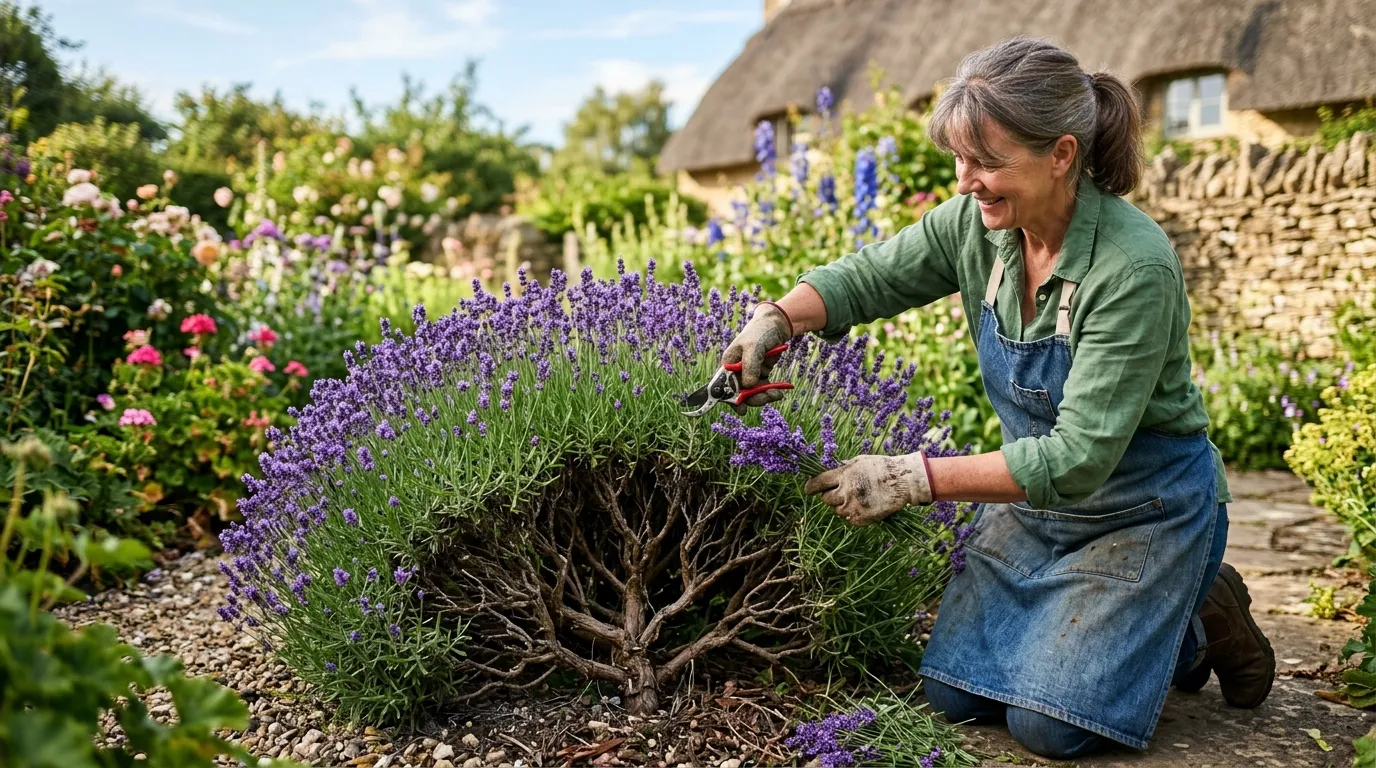 The right lavender cut: take off spent flowers plus 25mm of soft green growth. Never cut into the woody base because dormant buds are absent below the green.
2. Wisteria
Wisteria is the headline summer-prune climber. Done properly it produces hundreds of trailing flower racemes in May and June. Left unpruned it produces leaves, climbing tendrils, more leaves and almost no flowers.
When to prune (summer cut): Mid July to early August. The new whippy growth from the spring is long, soft and ready to be shortened. Wisteria gets two prunes a year - this is the first.
The cut: Identify the main structural framework (the heavy old branches trained along the wall or pergola). Leave those alone. Find the whippy new growth - long thin shoots that grew this year and are now waving in the wind. Cut each one back to 5 to 6 buds (around 150mm) from the framework. Make the cut just above a bud, angled slightly away from the bud.
Why two cuts a year: The summer prune concentrates the plant’s energy into forming flower buds rather than producing more leaves. The winter cut (January to February) takes the same shoots back further, to 2 to 3 buds, exposing the buds to spring sun and forcing them to plump up into flower buds rather than vegetative buds.
Common mistake: Cutting the structural framework along with the whippy growth. This sets the plant back two to three years. Look carefully. Old structural canes are darker, woodier and follow a clear training line. New whippy growth is paler, softer and waves around aimlessly.
For the full two-cut cycle, see our pruning wisteria guide which covers the winter prune in detail.
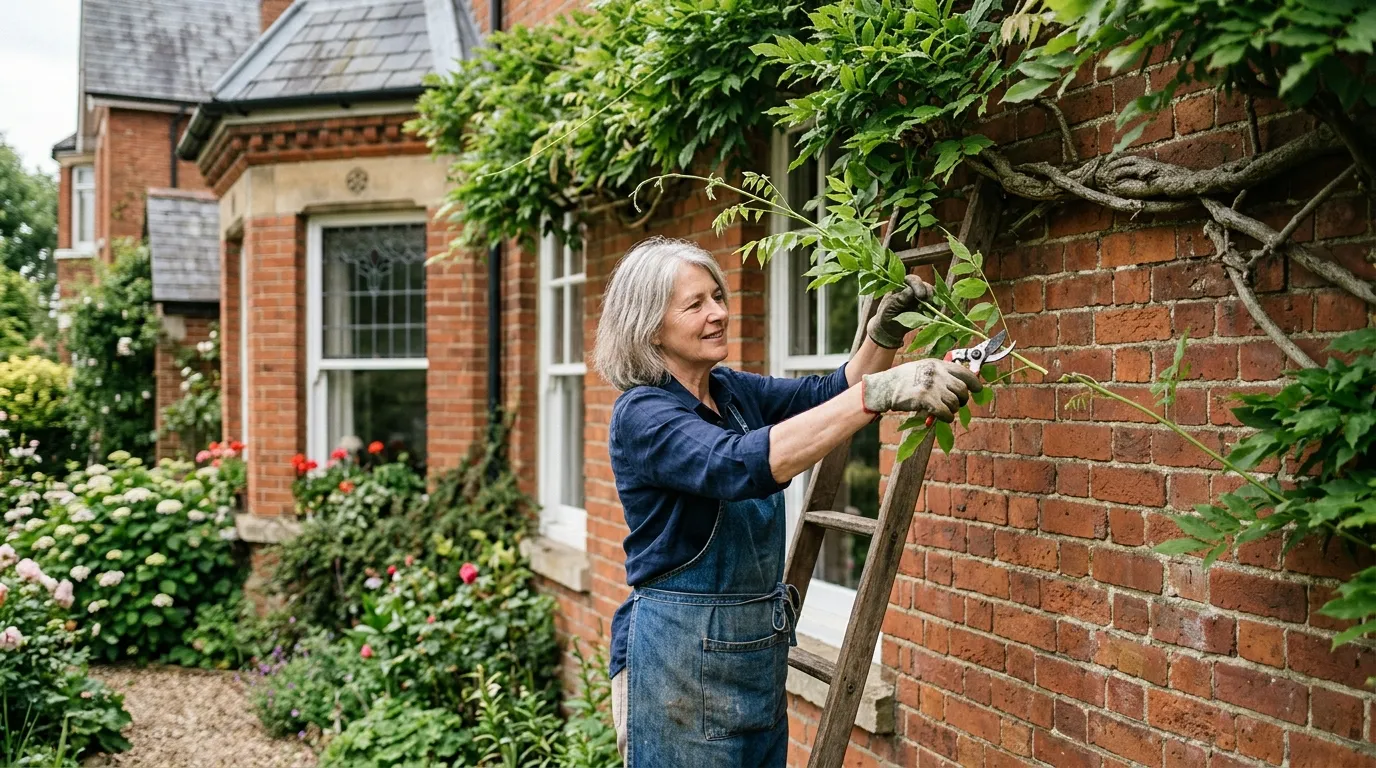 The summer wisteria cut: shorten all whippy new growth to 5 to 6 buds (around 150mm) from the framework. Leave the structural canes alone.
3. Philadelphus (mock orange)
Philadelphus is the orange-blossom scented shrub of UK summer gardens. The white flowers crowd along arching stems in June to July, then drop. Without an annual summer prune the shrub becomes a tangled mess with flowers only at the top.
When to prune: Immediately after flowering, usually mid to late July. Within four weeks of the last flower dropping.
The cut: Two things in one pass.
- Remove the oldest stems for renewal. Identify the three or four oldest, thickest, greyest stems at the base of the plant. Cut them out at ground level using loppers. This forces new strong shoots from the base for next year.
- Shorten the spent flowering stems. On the remaining stems, cut each spent flowering shoot back to a strong sideshoot lower down on the same stem. This sideshoot will be next year’s flowering wood.
Annual renewal pruning gives a steady supply of young productive wood. Skip a year and the shrub still flowers but the display retreats upward as the lower stems shade themselves out.
Common mistake: Pruning in winter or early spring. Philadelphus flowers on the previous year’s wood. A winter prune removes all the buds. Plants pruned in February produce a green shrub with no flowers in June.
Renovation: A neglected philadelphus can be cut hard to 300mm above the ground in late winter (February). The shrub sacrifices the next summer’s flowers but regrows fresh wood that flowers the following year.
 Renewal pruning a philadelphus: remove a third of the oldest stems at ground level immediately after flowering. The remaining stems push fresh growth for next year.
4. Deutzia
Deutzia is the cottage-garden shrub that produces a foam of small white or pink flowers in late May to early June. Like philadelphus, it flowers on the previous year’s wood and benefits from annual summer pruning.
When to prune: Immediately after flowering, late June to early July. As soon as the last flowers brown, get the secateurs out.
The cut: Cut each spent flowering stem back to a strong sideshoot lower down. Look at the stem and you will see the long, flowered top section and a few healthy sideshoots emerging lower down. Cut just above one of those sideshoots. The sideshoot will grow into next year’s flowering wood.
Every third year, also remove a third of the oldest stems at the base using loppers. This is renewal pruning, the same principle as philadelphus.
Common mistake: Treating deutzia as a winter-pruned shrub. Cutting it in February removes next summer’s flowers entirely. You get a green shrub with no flowers.
Long-term care: A well-pruned deutzia lives 20 to 30 years and stays productive throughout. The varieties most commonly grown in UK gardens are Deutzia x hybrida ‘Mont Rose’ (pink), Deutzia gracilis (white, dwarf) and Deutzia x rosea (pale pink). All respond identically to the same summer prune.
5. Weigela
Weigela is the workhorse of UK summer gardens. The trumpet-shaped pink, red or white flowers cover arching stems in late May to June and the foliage stays attractive through autumn. Annual summer pruning keeps the shrub flowering hard year after year.
When to prune: Immediately after flowering, June to July. Within four weeks of the last flowers dropping.
The cut: Same two-step approach as philadelphus.
- Remove a third of the oldest stems at ground level. Identify the thickest, greyest stems. Cut at the base with loppers.
- Tip-prune the rest. Cut each remaining flowering stem back to a strong outward-facing sideshoot lower down.
The combination of renewal pruning and tip-pruning keeps the plant compact, productive and well shaped. Without it the shrub spreads outwards by 100 to 150mm each year and starts to flop into neighbouring plants.
Common mistake: Tip-pruning only and never removing old stems. After 5 to 8 years the plant is a tangled mass of old grey stems with flowers only at the outer edges. Renewal pruning prevents this. Take three or four old stems out each year.
Variegated weigelas: Weigela florida ‘Variegata’ has cream-edged leaves. Treat exactly the same as the green-leaved species. Variegation does not change the pruning timing or technique.
 Tip-pruning a weigela immediately after flowering. Cut each spent flowering stem back to a strong outward-facing sideshoot below.
Summer pruning calendar at a glance
| Month | Shrub | Job |
|---|---|---|
| Early June | Deutzia | Prune immediately after flowering. Cut to sideshoot. Renewal every third year |
| Mid to late June | Weigela | Prune immediately after flowering. Tip-prune all stems, remove 1/3 oldest at base |
| Late June to mid July | Philadelphus | Prune immediately after flowering. Cut to sideshoot, remove 1/3 oldest stems |
| Mid July to early August | Wisteria | Summer cut: whippy growth back to 5-6 buds. Leave framework alone |
| Late July to early August | Lavender (English) | Cut to 25mm into green growth. Tidy dome shape. Never into woody base |
| Late August to early September | Lavandula x intermedia | Hidcote Giant, Grosso, Provence flower later, prune later |
Tool selection and technique
Good summer pruning needs three tools.
Sharp bypass secateurs for stems under 20mm. Felco 2 or Felco 6 are the UK gold standard, around 50 GBP, a lifetime tool with replaceable parts. Sharpen with a 600-grit ceramic stone every 30 days of use. Blunt secateurs crush stems rather than cutting cleanly, which lets disease in.
Loppers for stems 20 to 50mm (the renewal cuts on philadelphus, weigela and old wisteria). Felco 21 or ARS bypass loppers. Around 80 GBP. Same maintenance as secateurs.
Pruning saw for stems over 50mm. The Silky Pocketboy 170 is the standard - a folding pull-saw that cuts cleanly without crushing. Around 50 GBP.
Sterilise tools between plants with methylated spirits if you suspect any disease. Crushed stems heal slowly and let in honey fungus, coral spot and rose dieback. A clean cut with sharp tools heals within 2 to 3 weeks.
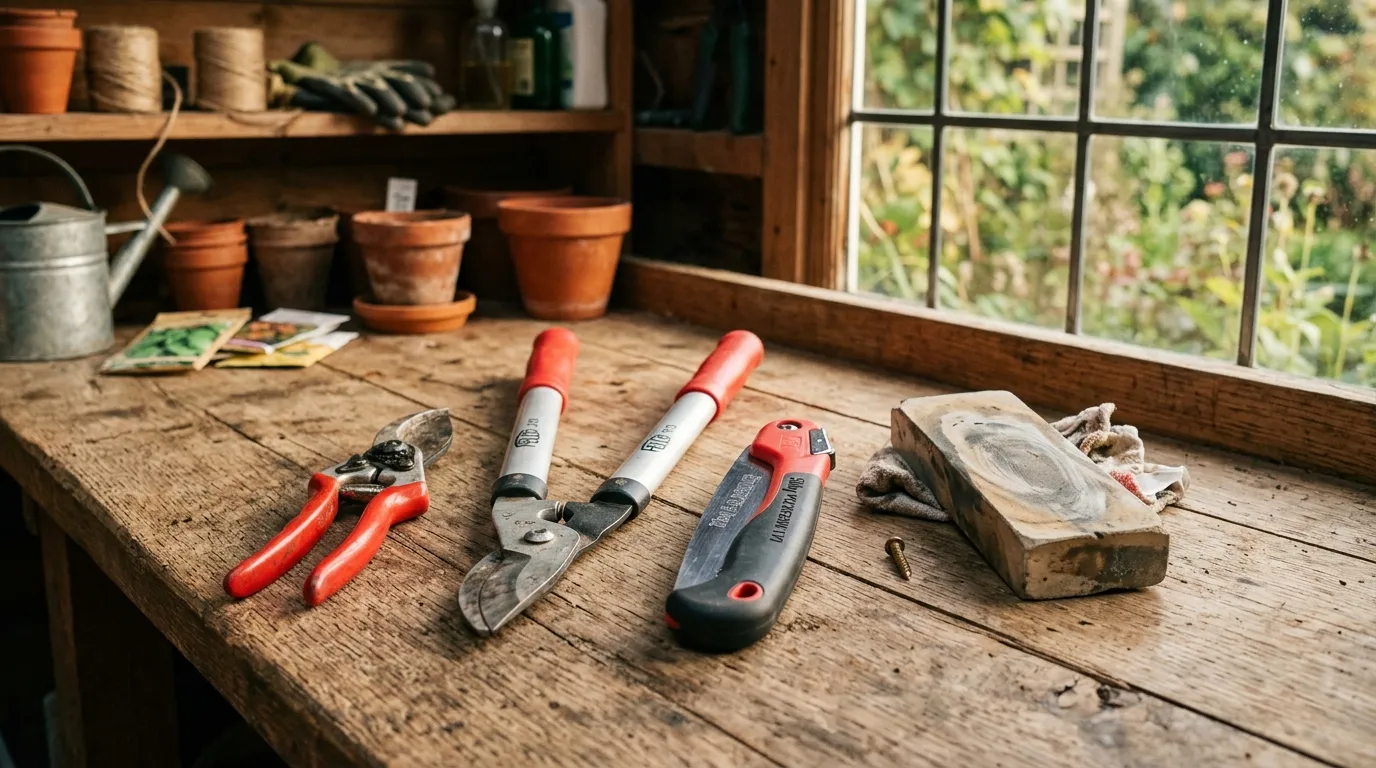 The three-tool kit for summer pruning: bypass secateurs for stems under 20mm, loppers for 20 to 50mm and a Silky Pocketboy folding saw for anything thicker.
Common mistakes across all five shrubs
Mistake 1: Pruning at the wrong time of year. All five flower on the previous year’s wood. Winter or early spring pruning removes next summer’s flowers. The calendar above shows the right window for each.
Mistake 2: Cutting too late in summer. After mid-August new growth does not have time to harden before frost. Aim for within 4 weeks of flowering finishing.
Mistake 3: Cutting lavender into bare wood. Lavender has no dormant buds below the green growth. Cut into the woody base and that section dies. Always stay 25mm above the woody zone.
Mistake 4: Pruning wisteria framework instead of whippy growth. The structural canes are next year’s flowering platform. Only cut the new whippy growth in summer.
Mistake 5: Skipping renewal pruning on philadelphus, deutzia and weigela. Tip-pruning only is not enough. Remove a third of the oldest stems at ground level every year (philadelphus and weigela) or every third year (deutzia). Without renewal the plant becomes top-heavy and flowers only at the edges.
Mistake 6: Using blunt secateurs. A crushed stem heals slowly and lets disease in. Sharpen secateurs every 30 days of use, or replace blades.
Renovation cuts for neglected shrubs
What about a lavender, wisteria, philadelphus, deutzia or weigela that has been left unpruned for years? Each one has a different renovation answer.
Wisteria: Hard renovation is possible. Cut the entire plant back to 1m above ground in February. The plant regrows from the base over 3 to 4 years, producing nothing in year one, foliage in year two, and a few flowers in year three. By year five it should be flowering normally again.
Philadelphus: Hard renovation works. Cut to 300mm above ground in late winter. Skip the next summer’s flowers. Plant regrows and flowers the following year.
Deutzia: Hard renovation possible. Cut to 200mm above ground in late winter. Same recovery pattern as philadelphus.
Weigela: Hard renovation works well. Cut to 300mm above ground in late winter. Plant regrows strongly and flowers the following year.
The general rule: renovation works for all five except lavender. Lavender is the only one where replacement beats renovation. For wider context on lavender renewal options, see our growing lavender guide and the growing wisteria guide which covers wisteria recovery in more depth.
Frequently asked questions
Why prune some shrubs in summer rather than winter?
Summer-flowering shrubs that bloom on the previous year’s wood need a summer prune so new growth has time to mature into next year’s flowering wood. Lavender, wisteria, philadelphus, deutzia and weigela all flower on old wood. Winter pruning these shrubs removes the buds. Prune within four weeks of flowering finishing to give the new growth a full late summer to harden off.
When should I prune lavender in the UK?
Prune English lavender (Lavandula angustifolia) in late July to early August, immediately after the flower spikes fade. Take off all spent flowers plus 25mm of soft green growth. Cut to a tidy dome shape. Never cut into the woody brown base because lavender has no dormant buds there. French lavender (L. stoechas) and L. x intermedia varieties prune at different times.
How do I summer prune wisteria?
In July or early August, cut all the whippy new growth back to 5 to 6 buds (around 150mm) from the main framework. Leave the structural canes alone. This is the first of two annual prunes. The second is in January or February, cutting the same shoots further back to 2 to 3 buds. Summer pruning concentrates energy into flower bud formation.
When do I prune philadelphus (mock orange)?
Prune philadelphus immediately after flowering, usually June to July. Remove a third of the oldest stems at ground level using loppers, then cut the remaining flowering stems back to a strong sideshoot lower down. This renewal pruning maintains a steady supply of young flowering wood. Skipping it leaves the shrub top-heavy with flowers only at the edges.
What is the biggest summer pruning mistake?
Leaving the prune too late in the season. After mid-August the new growth has too little time to harden before frost and next year’s flower buds do not form properly. Always prune within 4 weeks of flowering finishing. The second biggest mistake is hard pruning into woody old growth on lavender, which kills the plant because lavender has no dormant buds below the green.
Next steps
You have the timing for these five summer-prune shrubs. The next step is the technique for individual stems and the year-on-year pruning cycle. Read our pruning shrubs guide for the full method that covers all major UK shrubs including the ones not in this article.
Our team produces practical UK gardening guidance from source research, contributor records and established horticultural practice. Editorial standards are overseen by Matt W.