Key takeaways
- Container roots cool to outside air temperature; ground roots stay 4-6C warmer
- Wrap pots in hessian or bubble-wrap below -5C
- Move tender fruit (figs, peaches, citrus) under cover at first frost
- Mulch pot surface with 5cm of bark or straw for insulation
- Reduce watering October-March but never let compost dry fully
- Repot or top-up compost in March before bud break
Winter care for potted fruit trees matters more than for ground-grown trees because the limited soil volume of a pot cannot buffer cold. In the ground, the soil 30cm down stays 4-6C warmer than the air thanks to thermal inertia. In a pot, the compost freezes solid within 24-48 hours of overnight air temperatures dropping below freezing. Roots in frozen compost suffer damage that kills tender species and weakens even hardy ones.
For wider container-fruit context, see our dwarf fruit trees for small gardens, how to grow fruit trees UK and how to prune fruit trees UK guides.
Why containers freeze faster than ground
Three reasons potted fruit trees lose to winter more often than ground-grown trees:
Limited thermal mass. A 50-litre pot holds 0.05m³ of compost; a ground bed root zone is more like 0.5-2m³. The smaller volume cools faster and re-warms faster, but the troughs are deeper.
Pot walls expose roots. Cold air contacts the pot on all sides. Ground-grown roots are insulated by surrounding soil.
Drying out. Container compost loses water faster in cold dry winter winds than ground soil. Dehydrated roots are far more frost-susceptible than well-hydrated ones.
The protection job: insulate the pot, shelter from wind, maintain moisture without flooding, and shield evergreen tender species (citrus, some figs) from the worst frosts.
Fruit hardiness in containers - the UK table
| Fruit | Container hardiness | Notes |
|---|---|---|
| Apple (M27, M9 rootstock) | -10C with protection | Most reliable container fruit |
| Pear (Quince C rootstock) | -10C with protection | Sheltered position helps |
| Plum (Pixy rootstock) | -10C with protection | Late frost protects blossom |
| Cherry (Gisela 5) | -10C with protection | Bird netting in summer |
| Damson | -12C | Toughest stone fruit |
| Fig (Brown Turkey) | -8C with shelter | Lose figlets in hard winters |
| Peach (Bonanza dwarf) | -8C with greenhouse | Needs covered position |
| Apricot | -7C with greenhouse | Earliest blossom; frost risk |
| Citrus (Meyer lemon, kumquat) | +5C minimum | Must come inside Oct-March |
| Olive | -8C with shelter | Coastal/sheltered only |
| Pomegranate | -10C | Hardier than expected |
The hardiness assumes UK winter conditions: cool wet autumns, occasional frosts to -5C, the odd cold snap to -10C. Beat-the-extreme-temperatures protection extends each line by 3-5C.
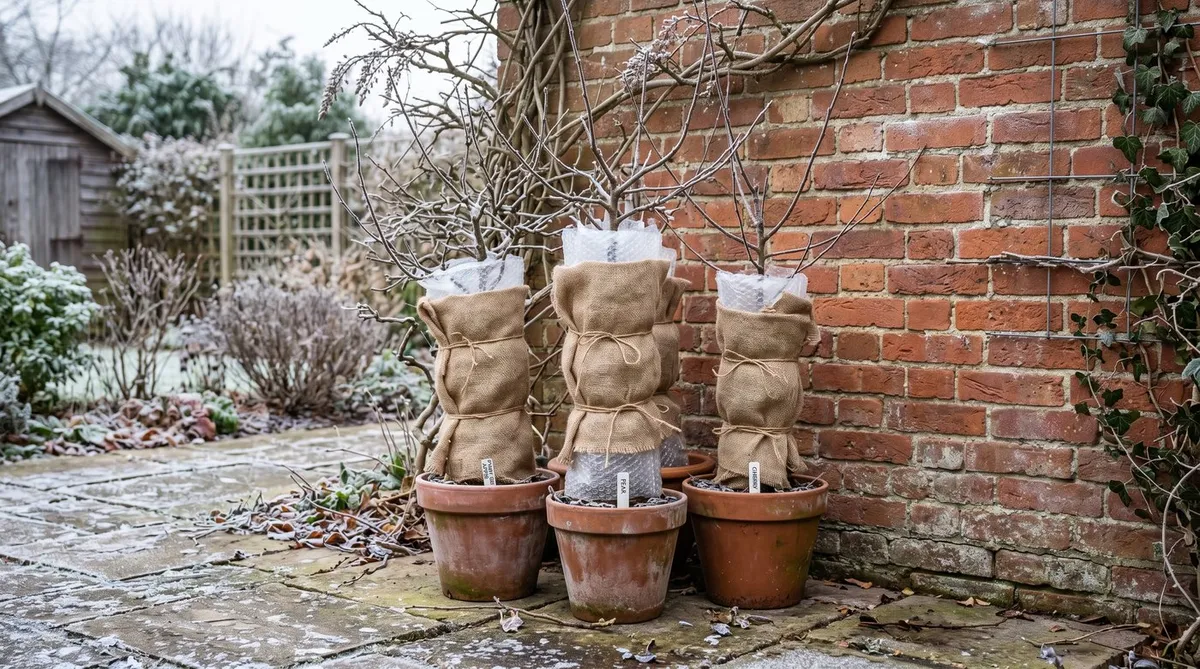
 Late-October pot wrapping - hessian and bubble-wrap before the first hard frost. 20 minutes per tree, lasts the whole winter.
The 4 winter protection methods
1. Wrap the pot (insulate roots)
The single highest-impact winter protection step. Material options:
- Hessian sacks - traditional, breathable, looks tasteful. £3-£5 each.
- Bubble-wrap (large bubble) - cheapest, ugliest, very effective. £5 per 5m roll.
- Thick cardboard - free, decent insulation, single-season life.
- Garden fleece (twin-wall) - light but effective. £8-£15 per piece.
- Polystyrene panels - excellent insulation, hold in place with twine. £4-£8 per piece.
Method: wrap one layer (or two for tender species) around the pot, secure with garden twine. Cover the rim and at least 5cm of pot height above the compost.
Don’t wrap the foliage or trunk above the rim - that’s where the tree wants air circulation.
2. Move to a sheltered position
A south or southwest-facing wall reflects heat and blocks the coldest north and east winds. Pots sited against such a wall run 3-5C warmer overnight than open-patio pots.
Group pots together in a cluster - the centre pots get further insulation from the surrounding ones. Tender species in the centre, hardier ones at the perimeter.
Hardy fruit (apple, pear, plum, damson) can stay outdoors all winter in a sheltered position. Tender fruit (citrus, fig in cold areas, peach, apricot) goes into a frost-free greenhouse, conservatory, or porch.
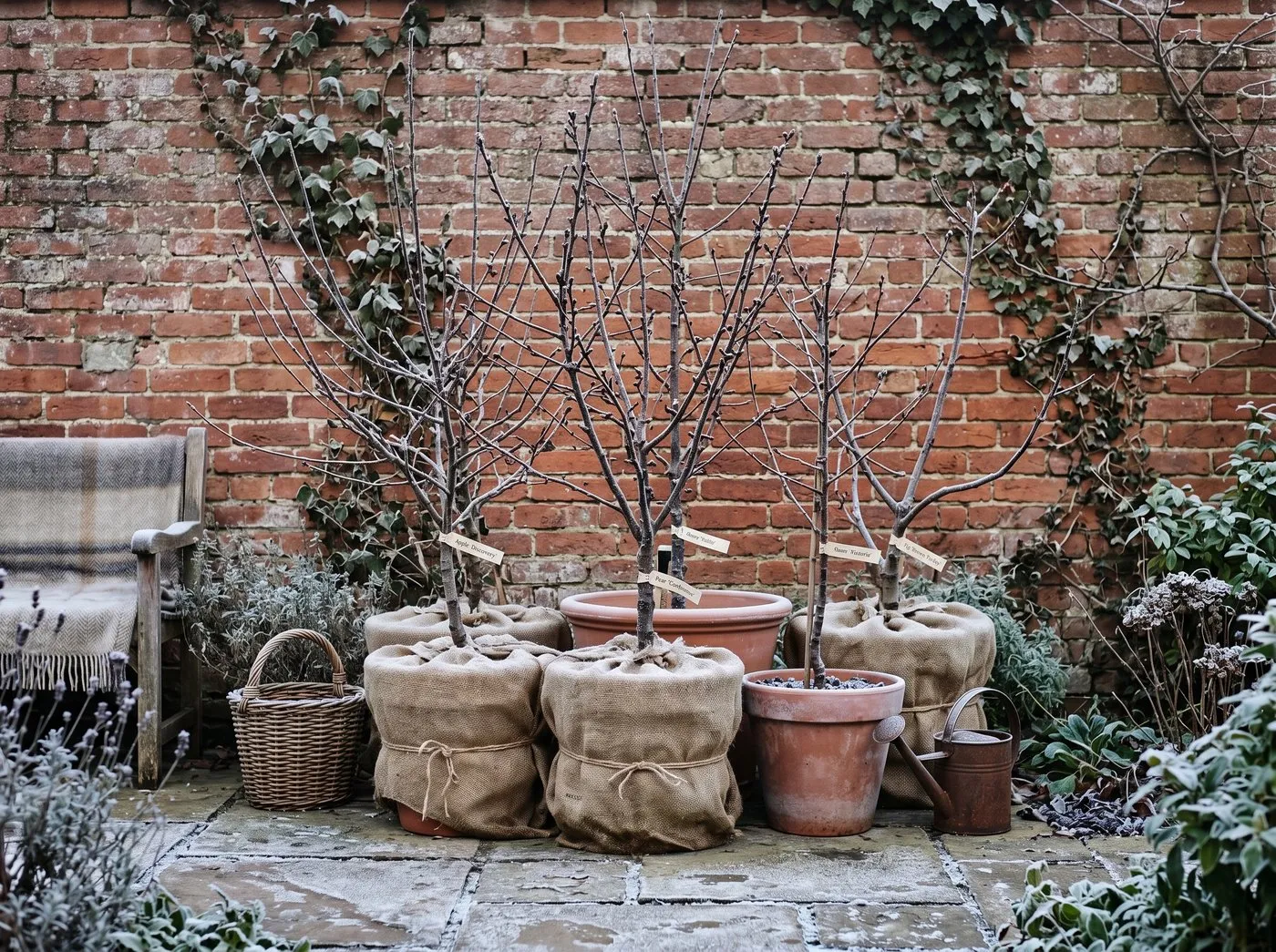 Grouped against a south-facing wall - the wall reflects daytime warmth, the cluster shares insulation. The centre pots stay 5-6C warmer than open patio.
3. Mulch the compost surface
Cover the compost surface with 5cm of insulating mulch:
- Pine bark chip - the best mulch for fruit trees. £8 per 100l bag covers about 8 pots.
- Straw - cheap, slightly less effective.
- Composted leaves (leafmould) - free if you make your own.
- Coarse compost - acceptable but breaks down fast.
The mulch traps air pockets that insulate the root zone from above. Combined with pot wrapping, it adds 2-3C of root-zone warmth.
Remove or rake back in March before bud break to let the soil warm up faster for spring growth.
4. Lift pots off cold ground
A pot sitting on cold paving or wet earth loses heat from underneath. Raise pots on pot feet, bricks or a wooden pallet. The air gap underneath prevents direct conductive heat loss to the ground.
Bonus: improved drainage. Pots that sit in standing water freeze worse and rot roots in winter wet.
Tender fruit - the special cases
Citrus (Meyer lemon, kumquat, calamondin)
Hardiness: +5C minimum. Cannot tolerate frost.
Winter routine: move indoors October when night-time temperatures drop below 10C. Place in a bright cool room - conservatory, porch, unheated greenhouse with frost protection. 10-15C is the sweet spot - too warm encourages soft pest-prone growth.
Watering: every 7-10 days; let surface dry between waterings. Citrus rot if waterlogged in cold compost.
Feed: none October-March.
Move back out: late April after last frost. Acclimatise gradually over 7-10 days.
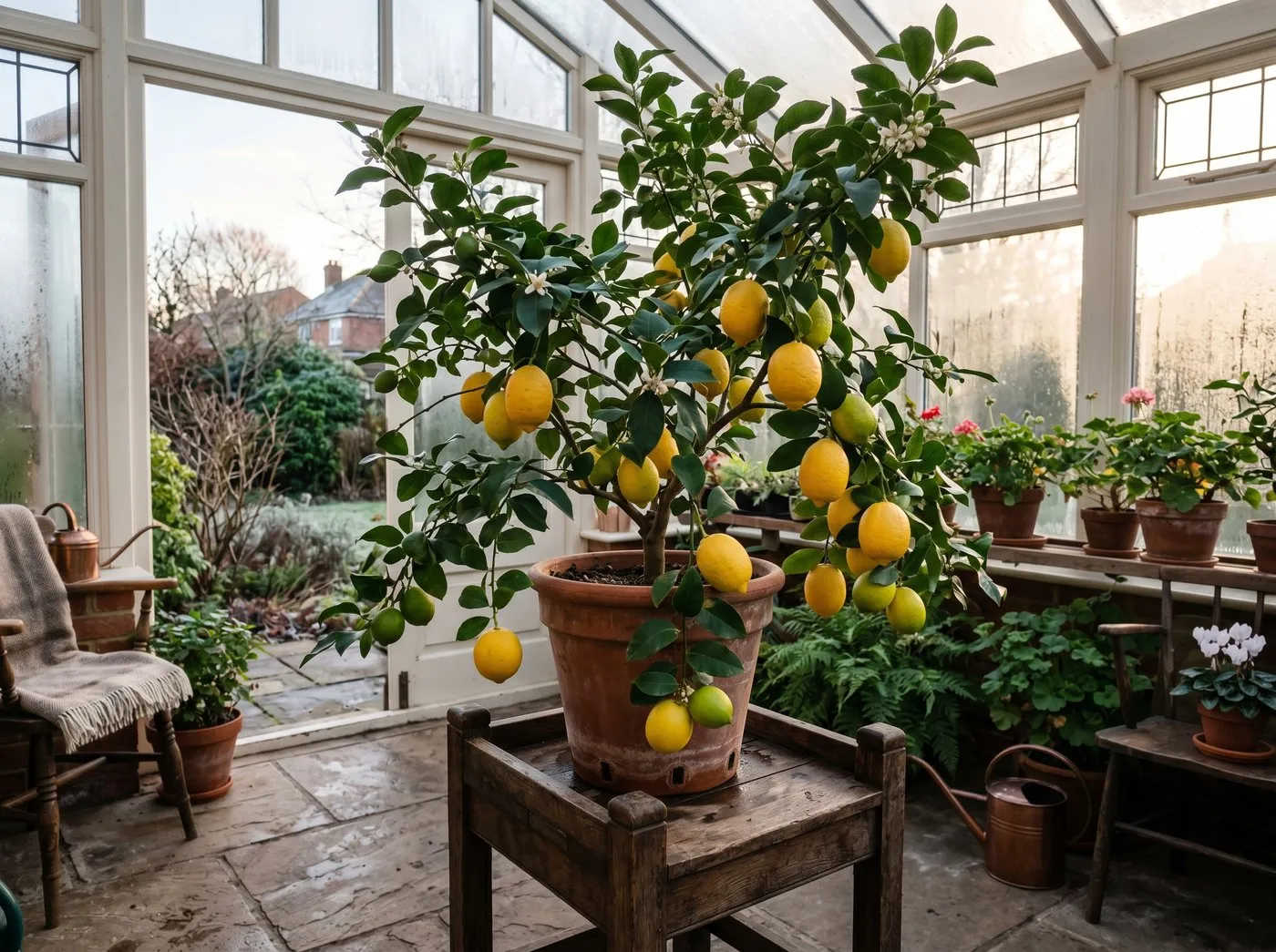 Meyer lemon overwintering in a UK conservatory - 10-15C bright cool conditions, ripe fruit in February, ready to move outdoors in May.
Fig (Brown Turkey, White Marseilles)
Hardiness: -8C with shelter; foliage hardy to -10C; figlets (overwintering small fruits) sensitive to -3C.
Winter routine: the foliage tolerates frost, but the overwintering figlets (which become next summer’s main crop) suffer. Wrap the canopy with horticultural fleece if temperatures forecast below -5C. Wrap the pot with double layer of hessian.
Watering: every 10-14 days; less than other fruit. Figs prefer drier winter roots.
Move: stay outside in milder UK areas; into an unheated greenhouse in colder zones.
Peach, nectarine, apricot
Hardiness: -8C foliage; blossom susceptible to frost from -1C.
Winter routine: the tree is hardy, but the very early blossom (February-March) faces UK late frosts. Move into a cold greenhouse or against the warmest wall for blossom period. Hand-pollinate with a soft brush in March-April if no pollinators are around.
Peach leaf curl: plastic cover from December-May prevents the fungal disease that destroys leaves. This is THE biggest cultivation challenge for potted peaches in UK climate.
Hardy fruit - the easy ones
Apple (especially M27, M9, M26 rootstocks)
Hardiness: -10C with pot wrap.
Winter routine: pot wrap, bark mulch, sheltered south-facing position. No further special treatment.
Pruning: winter prune December-February for shape and renewal. Summer prune July-August to control vigour.
Pear (Quince C rootstock)
Hardiness: -10C.
Winter routine: same as apple. Slightly more wind-sensitive - shelter is more important.
Pollination: most pears need a pollinator partner - keep two compatible varieties together (Conference + Doyenne du Comice; Williams + Concorde).
Plum (Pixy, St Julien A rootstocks)
Hardiness: -10C.
Winter routine: same as apple. Plums tolerate winter very well in pots.
Pruning: never prune December-March (silver leaf disease risk). Prune June-July immediately after fruit set.
Cherry (Gisela 5 rootstock)
Hardiness: -10C.
Winter routine: same as apple. Bird netting in summer is the bigger issue than winter cold.
Damson
Hardiness: -12C. Toughest container stone fruit.
Winter routine: basic pot wrap only. Survives the worst UK winters with minimal protection.
The autumn-to-spring routine
September
- Final liquid feed of the year (low-nitrogen, high-potash)
- Top-dress compost with mature garden compost or fresh peat-free mix
- Check tree stakes; replace any rotten
October
- Move citrus and any pre-existing indoor tender fruit indoors
- Stop fertilising hardy fruit trees
- Clear fallen leaves and remove from around pots (reduce disease overwintering)
- Mulch compost surface with 5cm of bark or leafmould
November
- Wrap pots of hardy fruit with hessian or bubble-wrap
- Move tender outdoor fruit (figs in colder zones) into shelter
- Raise all pots off cold ground onto pot feet or bricks
- Check drainage holes are clear
- Last summer prune of any plums, cherries, damsons (silver leaf risk after)
December-February
- Check pots weekly. Water if top 5cm of compost is dry.
- Check pot wraps weekly. Replace if torn or fallen.
- During hard frosts (-5C and below), double-check protection on tender species.
- Winter prune apples and pears (December-February).
March
- Remove pot wraps as last frost risk recedes
- Rake back winter mulch to let soil warm
- Repot or top-dress with fresh peat-free compost
- First liquid feed (balanced or seaweed) at bud break
- Move citrus and other indoor tender fruits back outdoors after last frost
April
- Full feeding regime resumes
- Watch for late frosts on blossom; cover with fleece overnight if forecast
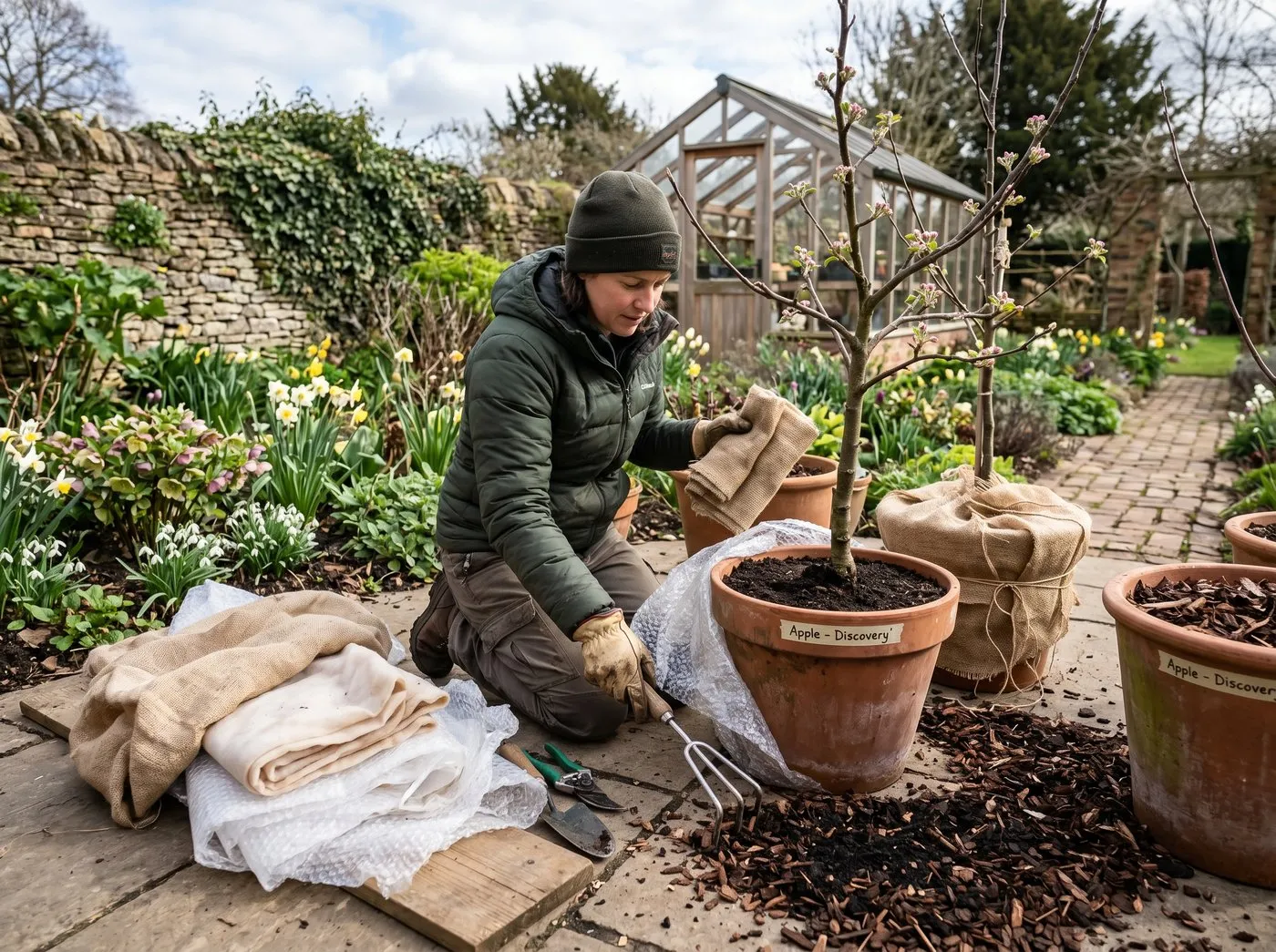 Spring un-wrapping in March - hessian off, mulch raked back, compost top-dressed. The whole job takes 30 minutes for 6-8 pots and returns trees to growth-mode.
Watering in winter - the surprise problem
A common UK mistake: assuming winter rain handles container watering. It doesn’t always. Three reasons:
- Evergreen trees (citrus, some figs) keep transpiring through winter and need regular watering.
- Cold dry winds strip moisture from container compost faster than from ground soil.
- Hardy trees in dormancy still need root hydration - dry roots are far more vulnerable to frost than well-hydrated roots.
Watering rule: check every 7-10 days. If the top 5cm of compost is dry, water. Aim for a gentle wetting of the rootball without flooding the pot.
Avoid watering immediately before a hard frost - wet root zones freeze worst.
Repotting and root-pruning - the spring task
Every 2-3 years for dwarf fruit (M27, M9 apple, Pixy plum), every 3-4 years for slightly larger trees, fruit trees in pots need root attention.
Option 1: Pot up one size
Move into a pot 5cm wider in diameter. Add fresh peat-free compost around the rootball. This gives 1-2 more years of root run before further intervention.
Option 2: Root prune in the same pot
Lift the tree out. Trim 20-30% of the rootball by shaving the outer ring and bottom with a sharp knife or saw. Tease out matted roots. Replant in fresh compost in the same pot.
Root pruning extends pot life indefinitely - keeps the tree small and productive without ever needing a bigger pot.
Option 3: Move into ground
If the tree has outgrown sensible container size (50-60 litres is usually the practical limit), plant out in the ground. Many UK fruit trees originally grown in pots transplant well in early March.
Field note: The RHS guide to fruit trees in containers covers UK variety choice and rootstock selection. Pomona Fruits is the standard UK specialist supplier with knowledgeable advice on container-friendly varieties and rootstocks.
Common winter problems
Pot cracked by frost. Terracotta is vulnerable; use frost-proof terracotta or plastic pots. Replace cracked pots in spring.
Leaves yellowing in midwinter on evergreen fruit. Usually overwatering or root chill. Reduce watering frequency, move to warmer position.
No spring buds on hardy fruit. Possible frost damage to flower buds. Some loss is normal; complete failure suggests rootstock or trunk damage - assess in May.
Dead branches in spring. Frost damage. Cut back to healthy wood once new growth shows where the damage stops.
Citrus dropping leaves in winter. Usually shock from move indoors. Increase humidity; reduce temperature swing. Plants recover by spring.
A simple working setup
For most UK gardens with 4-8 pot fruit trees:
- Cluster pots against the warmest wall for the winter (south or southwest aspect).
- Wrap each pot with hessian in late October.
- Mulch compost surfaces with 5cm of bark chip.
- Raise pots on pot feet to prevent ground-cold conductive loss.
- Move any tender species indoors by mid-October.
- Check weekly through winter for watering and wrap condition.
- Un-wrap in mid-March, top-dress compost, resume feeding.
Total time investment: about 90 minutes in autumn, 60 minutes in spring, and 5-minute weekly checks. The reward is healthy productive fruit trees that survive UK winters in pots indefinitely.
Now you’ve got the protection routine
For the wider container-fruit picture, our dwarf fruit trees for small gardens, how to grow apple trees UK and how to prune fruit trees UK guides cover the rest of the year’s growing.
Our team produces practical UK gardening guidance from source research, contributor records and established horticultural practice. Editorial standards are overseen by Matt W.