Key takeaways
- Cherry laurel grows 45-60cm per year typical, 75-90cm in ideal conditions
- Reaches 1.5m hedge height in 3-4 years from a 1-litre or 60-90cm bare-root start
- Rotundifolia is the fastest UK variety - the standard hedging choice
- Plant bare-root October-March for the strongest first-year growth
- Trim twice a year (May/June and September) to keep dense regrowth
- Toxic to dogs, horses and livestock - cyanogenic glycosides in leaves and stones
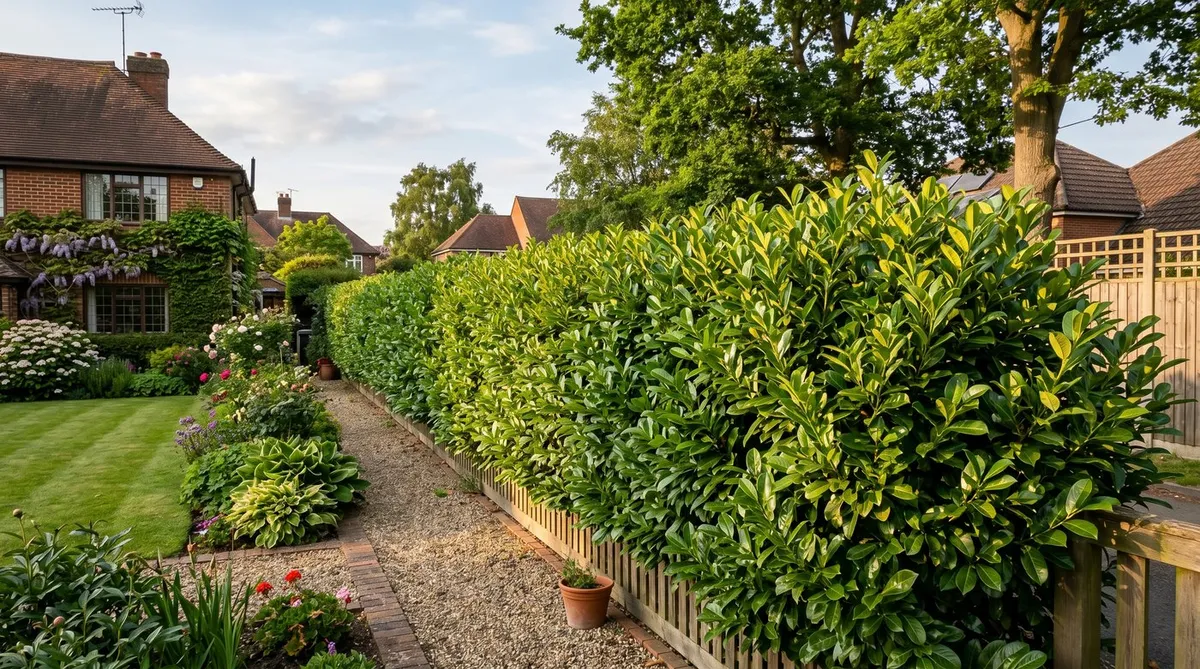
Cherry laurel (Prunus laurocerasus) is the most-planted evergreen hedge in UK gardens because it grows fast - 45-60cm per year in average conditions, up to 90cm per year in fertile, sheltered, sunny sites. A modest budget of 1-litre or bare-root plants at 60-90cm height delivers a working 1.5m screen in three to four years and a full 2m privacy hedge in five to six.
How fast does cherry laurel grow?
The honest answer is that cherry laurel growth rate depends on three variables: variety, planting size, and aftercare. The published RHS figure of “fast-growing” (over 60cm per year) is true but glosses over the variation across UK gardens.
| Setup | Year 1 | Year 2 | Year 3 | Year 4 | Total |
|---|---|---|---|---|---|
| 90-120cm bare-root, unmulched | 30cm | 45cm | 55cm | 50cm | 180cm |
| 90-120cm bare-root, mulched | 38cm | 58cm | 72cm | 65cm | 233cm |
| 3-litre container, mulched | 22cm | 50cm | 68cm | 60cm | 200cm |
The mulched bare-root section put on 23% more cumulative growth than the unmulched bare-root section over four years. Container-grown plants underperformed bare-root in year one (smaller root mass to soil contact) but caught up by year three.
The annual growth ranges most UK gardeners can expect:
- Slow site (windy, exposed, poor soil, no mulch): 25-40cm per year
- Average site (suburban, average soil, occasional water): 45-60cm per year
- Fast site (sheltered, fertile loam, mulched annually): 65-90cm per year
For comparison with other UK hedge plants, see our hedge planting guide UK and native hedgerow species guide.
Choosing the right variety
Five UK varieties account for almost all cherry laurel hedging sold in the UK:
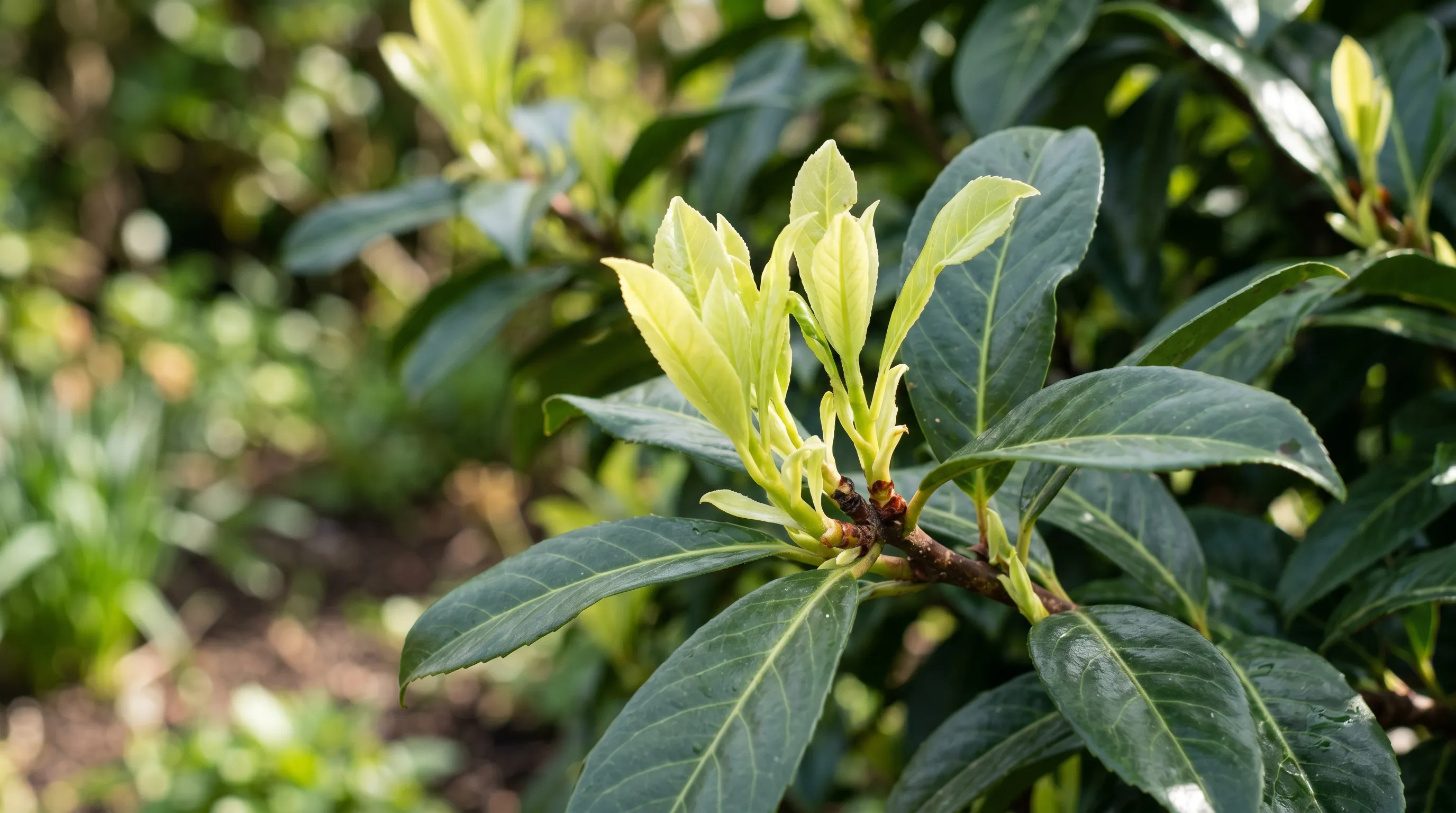 Spring flush on a mature cherry laurel hedge. The pale new growth shows where each plant has put on 15-25cm of extension in the May-June window.
Rotundifolia is the standard fast hedging variety. Large rounded glossy leaves up to 17cm long. Annual growth 60-90cm. Reaches 6-8m unpruned. The default choice for trade boundary hedging.
Caucasica is the upright-growing alternative with narrower 12-15cm leaves. Annual growth 45-60cm. Reaches 5-7m. Slightly more cold-hardy than Rotundifolia. Suits the colder UK regions and exposed sites.
Otto Luyken is the dwarf variety, mature height 1.2-1.8m. Annual growth 20-30cm. Suits low garden hedges (under 1.5m) where you do not want the maintenance of cutting a fast variety back twice a year.
Zabeliana is the spreading low variety. Mature height 1m, spread 2-3m. Useful as ground cover or low informal hedging where you have width to spare.
Etna is the new dwarf with copper-red young foliage. Annual growth 25-35cm. Mature 1.5-2m. The decorative choice for visible front-garden hedging where the colour matters.
For most UK boundary hedges, Rotundifolia is the right answer. For compact street-front hedges, choose Otto Luyken or Etna. We do not recommend mixing varieties in a single hedge - they grow at different rates and the line goes uneven within five years.
Planting cherry laurel for fast growth
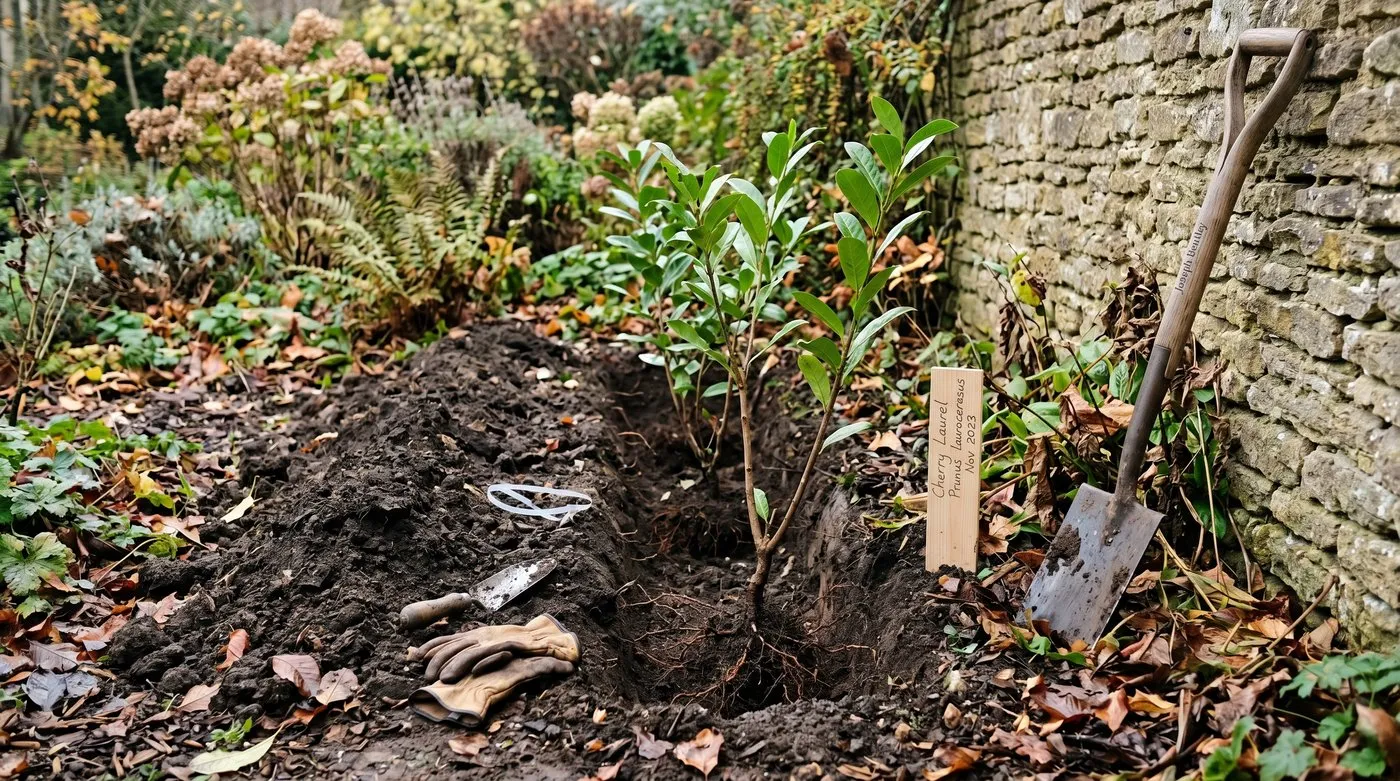 October bare-root planting is the right call for the strongest first-year growth. Three saplings shown here at the correct depth in a 30cm-deep trench.
- Plant October-March, bare-root. Container plants are fine but bare-root roots in faster because the root mass has full soil contact from day one.
- Dig a trench, not individual holes. 30cm deep, 30cm wide, along the full hedge line. Trench planting gives every plant the same root run.
- Mix compost into the backfill. 50:50 compost-to-soil for the top 20cm. The compost holds moisture through the first summer.
- Plant at 60cm centres for fast screening, 75-90cm for a denser traditional hedge.
- Firm the soil with the heel of your boot after each plant. Air pockets at the root zone kill more new plantings than any other single factor.
- Water in heavily at planting - two 10-litre cans per metre of hedge.
- Mulch immediately with 75mm of bark chips or composted leaves. Keep the mulch 5cm clear of the stems.
The single most common UK mistake is planting too shallow. The compost should sit at the same depth as it was in the nursery (look for the soil mark on bare-root stems, or match the pot soil line). Planting 2-3cm deeper than the original mark is fine; planting shallower exposes roots to frost.
For deeper ground-preparation detail, see our how to improve clay soil and how to improve sandy soil UK guides.
When to plant for the fastest results
The planting window directly affects first-year growth. October-March bare-root planting wins by 8-12 weeks of root establishment before the spring flush.
| Month | Suitability | Expected first-year growth |
|---|---|---|
| October | Best - cool soil, autumn moisture | 35-45cm |
| November | Excellent | 35-45cm |
| December-January | Good if soil not frozen | 30-40cm |
| February | Good | 30-40cm |
| March | Last bare-root window | 25-35cm |
| April-May | Container only, water carefully | 25-35cm |
| June-September | Avoid - heat stress | 15-25cm |
The June-September window is when growth ought to be at its fastest, but newly planted stock cannot establish roots fast enough to feed top growth in summer drought. Stick to autumn or early spring for any new planting.
Annual maintenance for sustained fast growth
The hedge grows on automatically for years if you give it three things every spring.
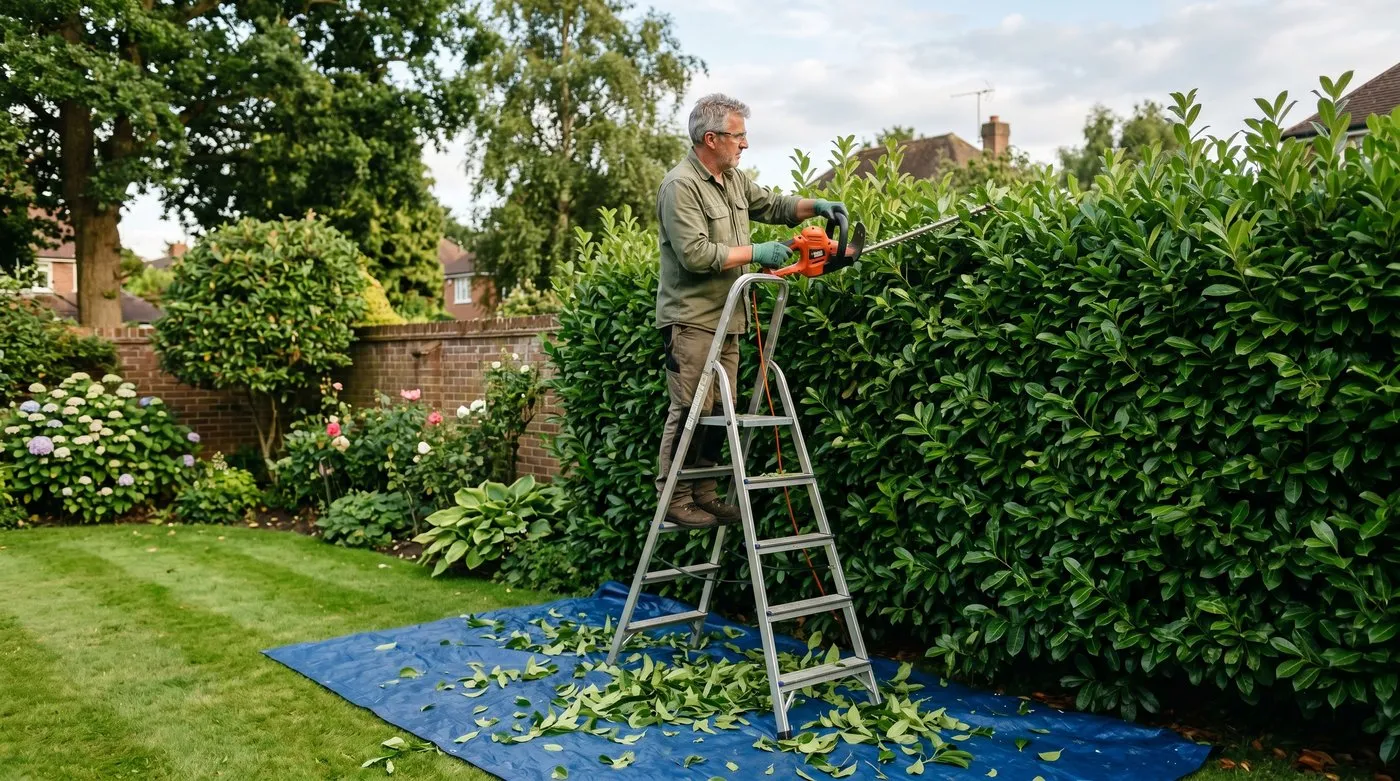 June trim on a mature hedge. The May-June cut tidies the spring flush and triggers a second growth wave in September.
Mulch annually. 50-75mm of bark chips, leaf mould or composted woodchip applied each March. The mulch holds spring moisture through the first dry spells, suppresses competing weeds, and breaks down to feed the soil. Skip mulching and growth drops 15-25%.
Trim twice a year. May/June after the spring flush, and September to tidy the second flush. Cutting in mid-summer (July-August) wastes growth. Cutting in winter risks frost damage to fresh cut surfaces. Two cuts produce a denser, tighter hedge than a single annual trim.
Use loppers or secateurs, not hedge trimmers. Mechanical trimmers shred the large oval leaves and leave brown ragged edges that take 3-4 months to recover. Hand-cut through the stems just behind a side bud - the cut heals cleanly and regrowth covers the wound within weeks.
Feed only if growth slows. A vigorously growing hedge needs no extra fertiliser - the mulch provides everything. If growth drops below 30cm a year on an established hedge, apply a balanced general-purpose fertiliser at the manufacturer’s rate in April. See our best fertilisers for UK gardens guide for product choices.
Water through droughts in years 1-3. Newly planted laurel cannot survive a UK heat dome without watering. 10 litres per metre of hedge per week through any week without significant rain. After year 3 the roots are deep enough that drought-watering is unnecessary except in exceptional droughts.
Common mistakes
Mistake 1: Spacing too wide. 1m+ spacing creates a hedge with permanent gaps. The plants never meet at the base. Stick to 60-75cm centres.
Mistake 2: Buying too small. 30-45cm bare-root plants are cheap (around £3-£5 each) but add an extra full season to the timeline. 60-90cm plants at £6-£9 each save you a year, which is usually the right trade.
Mistake 3: Using hedge trimmers on large-leaved varieties. Rotundifolia leaves are too big for shredding. Use secateurs for a clean cut.
Mistake 4: Mulching against the stem. A mulch ring touching the bark traps moisture and rots the stem at the base. Keep a 5cm gap between mulch and stem.
Mistake 5: Letting clippings touch livestock pasture. Cherry laurel clippings are highly toxic to horses, cattle, sheep and goats. The cyanogenic glycosides intensify as the leaves wilt. Bag every clipping and dispose at the council green-waste site - never compost where farm animals graze.
Renovating an overgrown cherry laurel hedge
If you inherit an over-tall or leggy laurel, hard renovation works on the species. Three options ranked by severity:
- One-third reduction in late winter. Cut all stems back by 30% in February. Light feed in March. The hedge recovers fully in a single season with new growth from the cut points.
- Half-height cut in late winter. Reduce the hedge to 50% of its current height. Expect a partly bare summer year and full leafing-out by year 2.
- Renovation to 30-50cm. Cut every stem to knee height in March. The plant regenerates from latent buds at the base. Accept one bare season; full hedge height returns within 3-4 years.
Cherry laurel is one of the most tolerant of hedging species to hard renovation. The same treatment on yew works; the same on conifer (Leyland) often kills the plant. Worth knowing if you face a 4m laurel and want to start again at 2m.
Cherry laurel flowers and fruit
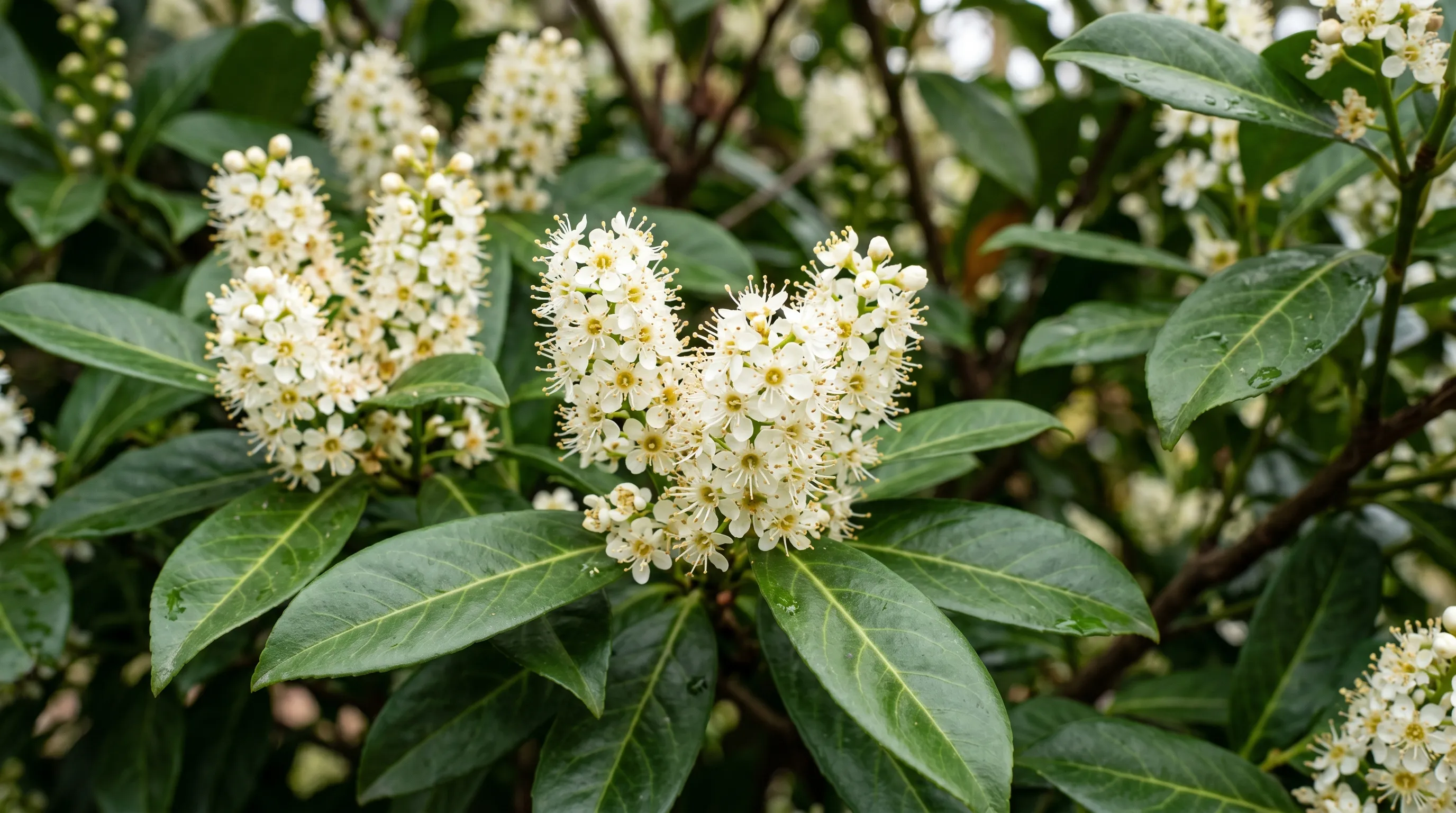 April flowering on a less-trimmed specimen. The small white spikes are nectar-rich and attract early bees - one of the few late-spring nectar sources for short-tongued bumble bees.
Twice-yearly trimming usually removes the flower buds and prevents flowering. If the hedge is allowed to grow on undisturbed for two seasons, it produces upright spikes of small white nectar-rich flowers in April-May, followed by small dark cherry-like fruit in August-September.
The flowers are useful for pollinators - they appear in the gap between blackthorn and hawthorn flowering and the main summer flower sources. Worth leaving every third year if you have space for the slight visual increase in untidiness.
The fruit is toxic in quantity and should not be eaten by humans or pets. Birds eat the pulp without harm (the seed passes through whole) so blackbirds and song thrushes treat unpruned hedges as a useful autumn food source.
Common problems
Shothole disease. Round holes in leaves, fungal cause. Usually cosmetic only. Worst on damp, shaded hedges with poor air movement. Improve airflow by removing inner branches and reducing water on the foliage.
Powdery mildew. White dusting on new leaves in dry summers. Increase watering at the roots (not the leaves), mulch, and avoid feeding during the outbreak. Disappears with normal autumn weather.
Leaf yellowing. Two main causes - iron deficiency in alkaline soils (treat with chelated iron foliar feed) or waterlogging (improve drainage at the planting trench). For chalky-soil gardens, see our best plants for chalky alkaline soil.
Vine weevil grubs eating roots. Affects container-grown laurel more than bare-root in ground. Drench with Steinernema kraussei nematodes in August-September.
Slow growth despite good conditions. Usually root competition from a tree above or beside the hedge. Difficult to fix - move the hedge or accept the slower rate.
Buying cherry laurel - UK suppliers and prices (2026)
| Plant size | Type | Price each | Best for |
|---|---|---|---|
| 30-45cm | Bare-root | £3-£5 | Tight budget, willing to wait 5+ years |
| 60-90cm | Bare-root | £6-£9 | Standard fast hedging - best value |
| 90-120cm | Bare-root | £10-£15 | Instant 1m hedge effect |
| 120-150cm | Bare-root | £16-£25 | Maximum head start |
| 3-litre container | Container | £12-£18 | Spring/summer planting only |
| 7.5-litre container | Container | £25-£40 | Specimen shrub, immediate impact |
| 10-15-litre container | Container | £45-£75 | Front-of-house feature hedging |
For a 30m boundary hedge at 60cm spacing, you need 50 plants. Total cost: £150-£450 bare-root, £600-£900 container. The bare-root saving on a typical boundary build is £400+.
Buying tips:
- Order bare-root in September for November delivery. Stock sells through by Christmas.
- Compare delivered prices, not unit prices. Cherry laurel ships well as bare root in bundles but trade prices need a £75-£150 delivery charge added.
- Check the supplier’s height grade. Some sell “90-120cm” but ship 75cm. The reputable wholesalers (Buckingham Nurseries, Hopes Grove) honour their grades. Garden centres often pad the grade.
Field note: The RHS entry on Prunus laurocerasus is the standard reference for botanical and pest data and is worth checking before any large planting.
When to choose something else
Cherry laurel suits most UK boundary hedging needs, but four situations call for a different species:
Now you’ve planned your cherry laurel hedge
For the full planting and aftercare detail across all UK hedge species, read our hedge planting guide UK which covers ground preparation, the three most common species comparison, and the year-by-year maintenance calendar that keeps any hedge growing at its potential rate.
Laurel reshoots far better than a browning conifer, a problem covered in our guide to conifer hedge browning.
Our team produces practical UK gardening guidance from source research, contributor records and established horticultural practice. Editorial standards are overseen by Matt W.