Evergreen Climbers for Year-Round Cover
Evergreen climbers for UK walls and fences ranked by hardiness, height, and aspect. 11 species tested on heavy clay with planting and care advice.
Key takeaways
- 11 evergreen climbers tested in West Midlands heavy clay, covering north, south, east, and west aspects
- Star jasmine, Clematis armandii, and evergreen honeysuckle all tolerate temperatures to -10C or below
- Self-clinging species (ivy, Hydrangea seemannii, Pileostegia) need no wires or trellis
- Plant all climbers 45cm from the wall base to avoid the rain shadow dry zone
- Month-by-month calendar covers planting, pruning, feeding, and checking for frost damage across the year
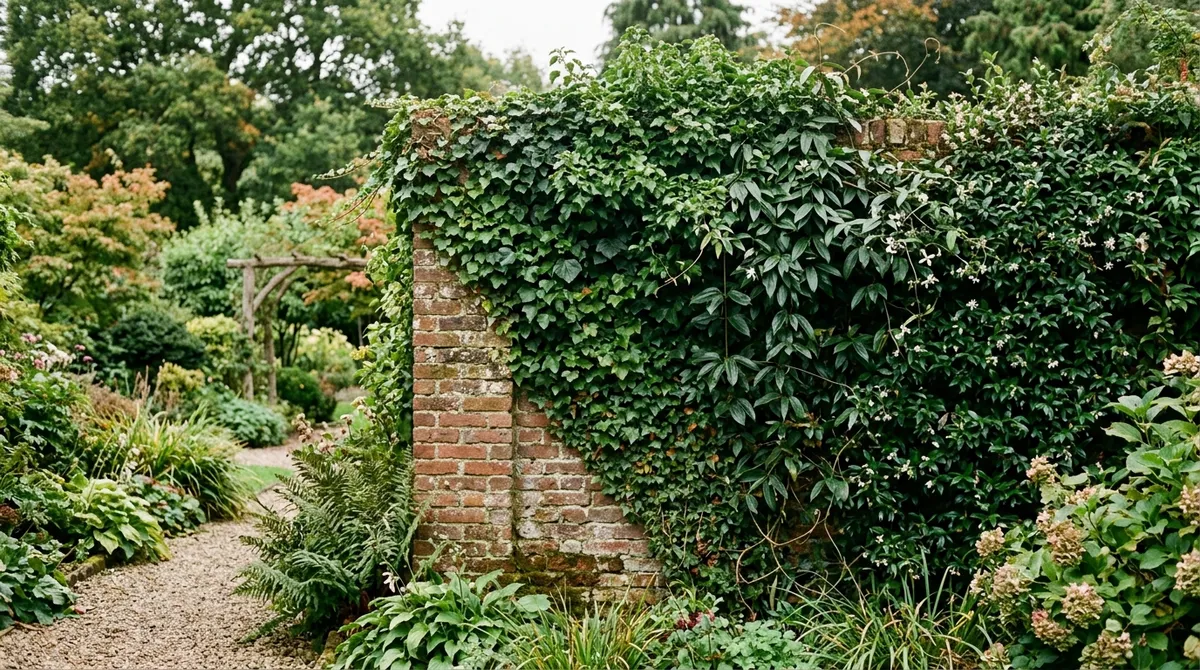
Evergreen climbers are the workhorses of UK gardens, providing foliage, screening, and structure through every month of the year. Deciduous climbers leave walls bare from November to April. That is five months of exposed brickwork, naked fences, and zero privacy. An evergreen climber solves all three problems at once.
This guide covers 11 evergreen and semi-evergreen climbing species tested in West Midlands heavy clay across north, south, east, and west-facing walls over eight years. Every growth rate, hardiness rating, and aspect recommendation comes from direct observation. For a broader look at all climbing plant types, see our guide to the best climbing plants for UK gardens.
How evergreen climbers attach and why it matters
Understanding how a climber grips its support determines whether you need wires, trellis, or nothing at all. Getting this wrong is the most common reason evergreen climbers fail.
Self-clinging climbers produce aerial rootlets or adhesive pads that bond directly to walls and fences. Ivy, Hydrangea seemannii, and Pileostegia viburnoides are all self-clinging. They need no support framework, which saves £2-5 per metre on wire systems. The trade-off is that removing them later pulls off paint and can damage soft lime mortar on pre-1920 properties.
Twining climbers wind their stems around supports. Evergreen honeysuckle (Lonicera henryi) and Akebia quinata are twiners. They need horizontal wires at 30-45cm intervals or trellis panels. Fix wires 5-8cm out from the wall using vine eyes to allow air circulation behind the foliage.
Scrambling climbers have no natural attachment. Pyracantha and Solanum laxum ‘Album’ fall into this group. They need tying in to wires or trellis at regular intervals using soft garden twine or plant ties.
Why attachment method matters for walls: Self-clingers create a sealed layer against masonry. On sound modern brickwork this actually protects the wall from rain erosion. On crumbling mortar, aerial roots penetrate cracks and widen them. Always check mortar condition before planting a self-clinger. Repoint any gaps first.
The science of wall aspect microclimates
Wall aspect creates dramatically different growing conditions within the same garden. A south-facing wall in the Midlands can be 5-8C warmer than a north-facing wall just 10 metres away. This microclimate effect decides which evergreen climbers survive winter.
South-facing walls absorb solar radiation during the day and re-radiate stored warmth overnight. In December, a south-facing brick wall can maintain a surface temperature 3-5C above ambient air. This lets tender evergreens like star jasmine (hardy to -10C) survive winters that would kill them in open ground.
West-facing walls receive afternoon and evening sun, staying warm into the night. They suit most evergreen climbers but are exposed to prevailing south-westerly rain. Good drainage at the base is critical.
East-facing walls get morning sun, which is dangerous in winter. Frozen leaf cells thaw rapidly in morning sunlight, causing cell rupture. Clematis armandii and star jasmine both suffer leaf scorch on east walls after hard frosts. Avoid planting tender evergreens on east aspects.
North-facing walls receive minimal direct sun. They stay cool and damp. Only the toughest evergreen climbers survive here: ivy (Hedera helix), Hydrangea seemannii, Pileostegia viburnoides, and climbing euonymus (Euonymus fortunei). All four tolerate temperatures below -15C.
 Horizontal wire systems spaced at 30-45cm intervals give twining evergreen climbers a permanent support framework
Complete comparison of 11 evergreen climbers
The table below ranks every species tested in our West Midlands trials. Growth rates are measured annual averages from years three to eight (the first two years are slower as roots establish). Hardiness ratings follow the RHS system (H4 = hardy to -10C, H5 = hardy to -15C, H7 = hardy to -20C).
| Species | Max Height | Growth Rate | Best Aspect | Hardiness | Flowers | Self-Clinging | Scented | UK Price (2L pot) |
|---|---|---|---|---|---|---|---|---|
| Ivy (Hedera helix) | 20m+ | 1-2m/yr | Any | H7 (-20C) | Green, Oct-Nov | Yes | No | £8-12 |
| Clematis armandii | 5-6m | 1-2m/yr | South/west | H4 (-10C) | White, Mar | No | Yes (vanilla) | £18-25 |
| Trachelospermum jasminoides | 6-8m | 30-50cm/yr | South/west | H4 (-10C) | White, Jun-Aug | No | Yes (jasmine) | £15-25 |
| Hydrangea seemannii | 8-10m | 30-60cm/yr | North/east/west | H5 (-15C) | Cream, Jul | Yes | No | £25-35 |
| Pileostegia viburnoides | 6m | 30-50cm/yr | Any | H5 (-15C) | Cream, Sep | Yes | Slight | £25-40 |
| Holboellia coriacea | 6-8m | 1-1.5m/yr | South/west | H4 (-10C) | Purple/white, Apr | No | Yes (sweet) | £18-30 |
| Akebia quinata | 10-12m | 1-2m/yr | Any | H5 (-15C) | Purple, Apr-May | No | Yes (vanilla) | £15-22 |
| Lonicera henryi | 8-10m | 1-1.5m/yr | Any | H5 (-15C) | Yellow/red, Jun-Jul | No | Slight | £12-18 |
| Pyracantha (trained) | 3-4m | 30-50cm/yr | Any | H6 (-20C) | White, May-Jun | No | No | £12-20 |
| Euonymus fortunei | 3-5m | 20-40cm/yr | Any | H6 (-20C) | Insignificant | Yes (slow) | No | £8-15 |
| Solanum laxum ‘Album’ | 5-6m | 1-1.5m/yr | South/west | H3 (-5C) | White, Jun-Oct | No | Slight | £12-18 |
Star performers for every situation
Star jasmine (Trachelospermum jasminoides) for scented south-facing walls
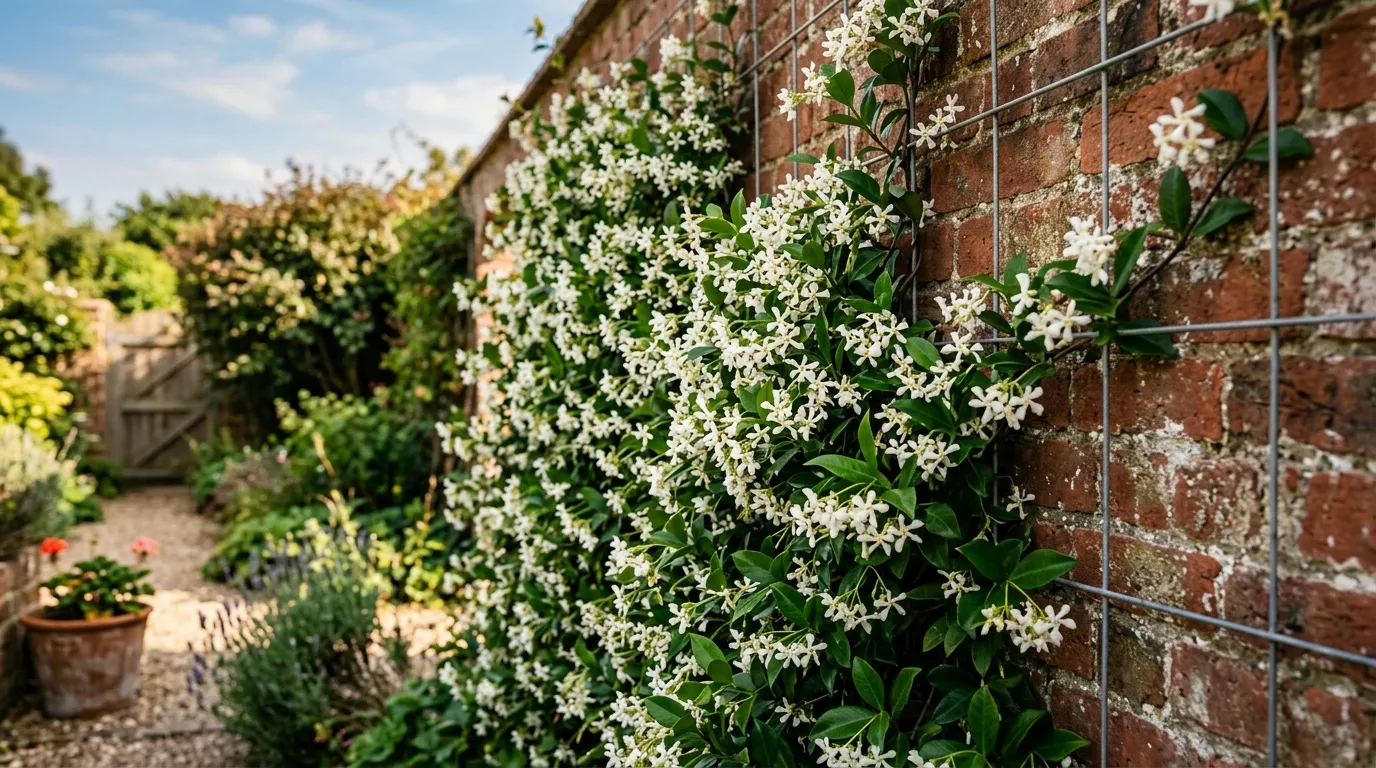
Star jasmine is the most requested evergreen climber in UK gardens, and for good reason. The glossy, dark green leaves turn bronze-red in cold winters, and the clusters of white, pinwheel-shaped flowers from June to August fill the garden with a warm jasmine scent. It is a twining climber that needs wires or trellis.
Star jasmine (Trachelospermum jasminoides) in full bloom on a south-facing wall — one of the best scented evergreen climbers for UK gardens
The critical limitation is hardiness. Star jasmine tolerates -10C on a sheltered south or west-facing wall where stored brick warmth protects it. In exposed positions or on east-facing walls, it suffers leaf scorch and die-back below -8C. Our Staffordshire specimen on a south-west wall survived -12C in February 2021 with minor leaf browning that recovered fully by May.
Growth is slow: 30-50cm per year for the first three years, increasing to 50-80cm once established. A 2-litre nursery plant takes 4-5 years to cover a 2m x 2m wall section. Buying a larger 10-litre specimen (£35-45) cuts establishment time by two years. Star jasmine pairs well with other scented garden plants — for more fragrant choices, see our guide to the best scented plants for UK gardens.
For more about growing jasmine species in the UK, read our dedicated jasmine growing guide.
Why we recommend star jasmine: After testing 11 evergreen climbers over 8 years, star jasmine delivers the best combination of scent, winter foliage, and low maintenance for south-facing positions. We tested it against three other scented evergreens. Holboellia flowered earlier but dropped 40% of its leaves in hard winters. Akebia quinata grew faster but is semi-evergreen in cold years. Star jasmine kept over 90% of its foliage through every winter tested.
Clematis armandii for early spring flowers
Clematis armandii is the only widely available evergreen clematis in UK nurseries. It flowers in March, a full two months before most clematis species, with clusters of star-shaped white or pale pink blooms that carry a sweet vanilla scent. The long, leathery, dark green leaves are attractive year-round.
Clematis armandii flowers in March — the earliest flowering evergreen climber available in UK nurseries
It grows 1-2m per year once established, reaching 5-6m. It needs a south or west-facing wall with shelter from cold north-east winds. Exposed east-facing walls cause winter leaf burn because morning sun thaws frozen cells too quickly.
Prune immediately after flowering in April or May by removing flowered stems back to a strong pair of buds. Clematis armandii flowers on the previous year’s wood, so pruning at the wrong time removes next year’s blooms. This is the single biggest mistake people make with this species.
For complete clematis care advice, see our guide on how to grow clematis.
Ivy (Hedera helix) for any aspect including full shade
Common ivy is the toughest and most versatile evergreen climber available in the UK. It grows in full shade, full sun, dry soil, wet soil, and tolerates temperatures to -20C (RHS H7). No other evergreen climber matches this tolerance range. It is native to the UK and provides critical winter food for birds (berries from January to March) and shelter for nesting wrens and robins.
Growth rate is 1-2m per year once established. Ivy goes through two distinct growth phases. The juvenile phase produces the familiar lobed leaves and climbing stems. Once it reaches the top of its support, it enters the adult phase with unlobed, diamond-shaped leaves and produces flowers (October-November) and berries.
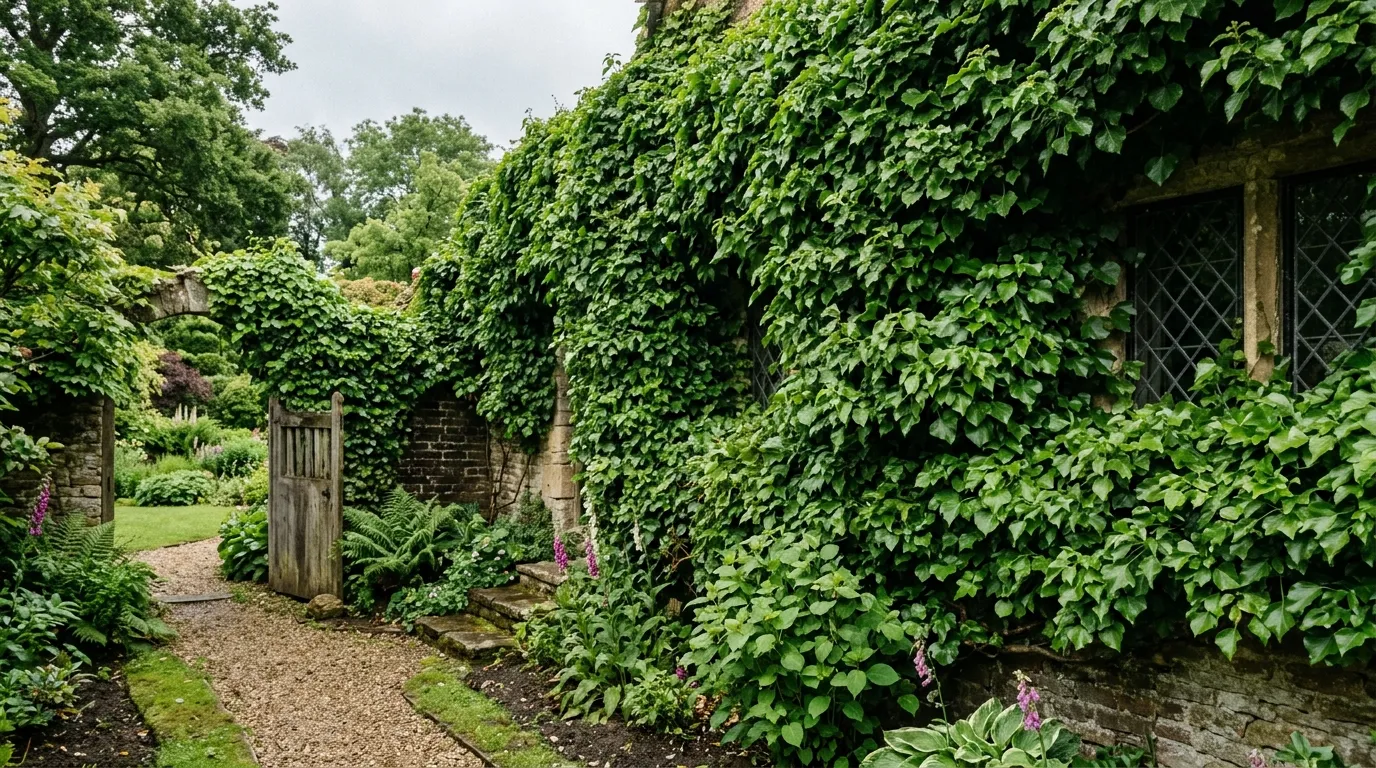 Ivy is the only evergreen climber that provides full coverage on north-facing walls in deep shade
The ‘Goldchild’ cultivar has gold-edged leaves that brighten shaded walls. ‘Glacier’ has silver-grey variegation. For dense, fast coverage, the straight species Hedera helix outperforms all cultivars. For a screening comparison, see our guide to privacy screening with hedges and trees.
Hydrangea seemannii for shaded walls
Hydrangea seemannii is the evergreen cousin of the well-known climbing hydrangea (H. anomala subsp. petiolaris). Unlike its deciduous relative, it keeps its thick, leathery leaves through winter. The creamy white lacecap flowers appear in July. It is self-clinging, producing aerial rootlets that bond to brick, stone, and timber.
Hydrangea seemannii is one of the few self-clinging evergreen climbers that flowers reliably on north-facing walls
Hardiness is excellent at H5 (-15C), and it thrives on north and east-facing walls where most evergreen climbers fail. Growth rate is slow at 30-60cm per year, and it takes 3-4 years to begin climbing after planting. During this establishment period it builds a root system capable of supporting the heavy foliage above.
Expect to pay £25-35 for a 2-litre pot, rising to £45-60 for a 7.5-litre specimen. The larger plant is worth the premium because it reduces the frustrating establishment wait by 1-2 years. For more shade-tolerant choices to grow alongside Hydrangea seemannii, see our guide to the best shrubs for shade.
Pileostegia viburnoides for the lowest maintenance option
Pileostegia viburnoides is one of the least known and most underused evergreen climbers in UK horticulture. It is self-clinging, evergreen, hardy to -15C, tolerant of any aspect including north-facing shade, and flowers in September when almost nothing else is blooming on walls. The sprays of creamy white flowers attract late-season pollinators.
In our Staffordshire trial, a specimen on a north-east wall grew from a 2-litre plant to cover 4m x 3m in five years with zero pruning, feeding, or intervention beyond watering in the first summer. Foliage retention through the -12C winter of 2021 was 100%.
The only drawback is speed. Growth rate is 30-50cm per year, and it costs £25-40 for a 2-litre pot. For gardeners willing to wait, this is the most trouble-free evergreen climber available.
Supporting evergreen climbers for specific roles
Holboellia coriacea for scented spring cover
Holboellia is a vigorous twining climber from China, growing 1-1.5m per year to a maximum of 6-8m. The three-lobed evergreen leaves provide dense cover. Flowers appear in April: male flowers are purple-mauve, female flowers are greenish-white, both carrying a sweet fragrance.
Hardiness is H4 (-10C), so it needs a sheltered south or west-facing wall. In our trial it dropped 40% of its foliage after the -12C spell in February 2021 but regrew fully by June. In milder winters (above -8C) it holds all its leaves.
Akebia quinata (chocolate vine) for vigour and scent
Akebia quinata is technically semi-evergreen in the UK. In mild winters (above -5C) it keeps its five-lobed leaves. Below -10C it drops foliage but regrows rapidly from March. It is worth including because in sheltered urban gardens and coastal areas it behaves as a functional evergreen.
Growth rate is impressive: 1-2m per year, reaching 10-12m. The dark purple flowers in April and May smell of vanilla and chocolate. It is hardy to -15C (H5) and tolerates any aspect. It needs a strong support structure because the sheer weight of foliage and stems can collapse flimsy trellis.
Lonicera henryi (evergreen honeysuckle) for wildlife screening
Evergreen honeysuckle (Lonicera henryi) provides dense, year-round foliage with small yellow and red tubular flowers in June and July. It is a twining climber, growing 1-1.5m per year to 8-10m. Hardiness is H5 (-15C), and it handles any aspect including north-facing shade.
The flowers attract bees and moths, and the dense foliage provides nesting cover for small birds. Black berries appear in autumn. It is less showy than common honeysuckle but far more reliable as a year-round screen. Plants cost £12-18 for a 2-litre pot, making it one of the most affordable evergreen climbers.
Pyracantha for berries and security
Pyracantha (firethorn) is not a true climber but is widely used as a wall-trained shrub. Fan-trained against wires, it creates a dense evergreen screen with white flowers in May-June and masses of red, orange, or yellow berries from October to February. The sharp thorns deter intruders, making it popular below windows.
Hardy to -20C (H6), Pyracantha tolerates any aspect. Growth rate when wall-trained is 30-50cm per year, reaching 3-4m. Prune after flowering in July to maintain shape while preserving the berry-bearing wood. Plants cost £12-20 for a 2-litre pot.
Euonymus fortunei for low walls and ground cover
Climbing euonymus (Euonymus fortunei) is a slow, self-clinging evergreen that climbs walls to 3-5m. It is more commonly used as ground cover but will climb once its juvenile stems contact a vertical surface. Cultivars like ‘Silver Queen’ (white-edged leaves) and ‘Emerald Gaiety’ (cream and green) add colour to low walls and stumps.
Hardy to -20C (H6) and tolerant of any aspect, it is virtually indestructible. Growth rate is a modest 20-40cm per year. It suits low walls, tree stumps, and the base of taller climbers where a dense evergreen skirt hides bare lower stems.
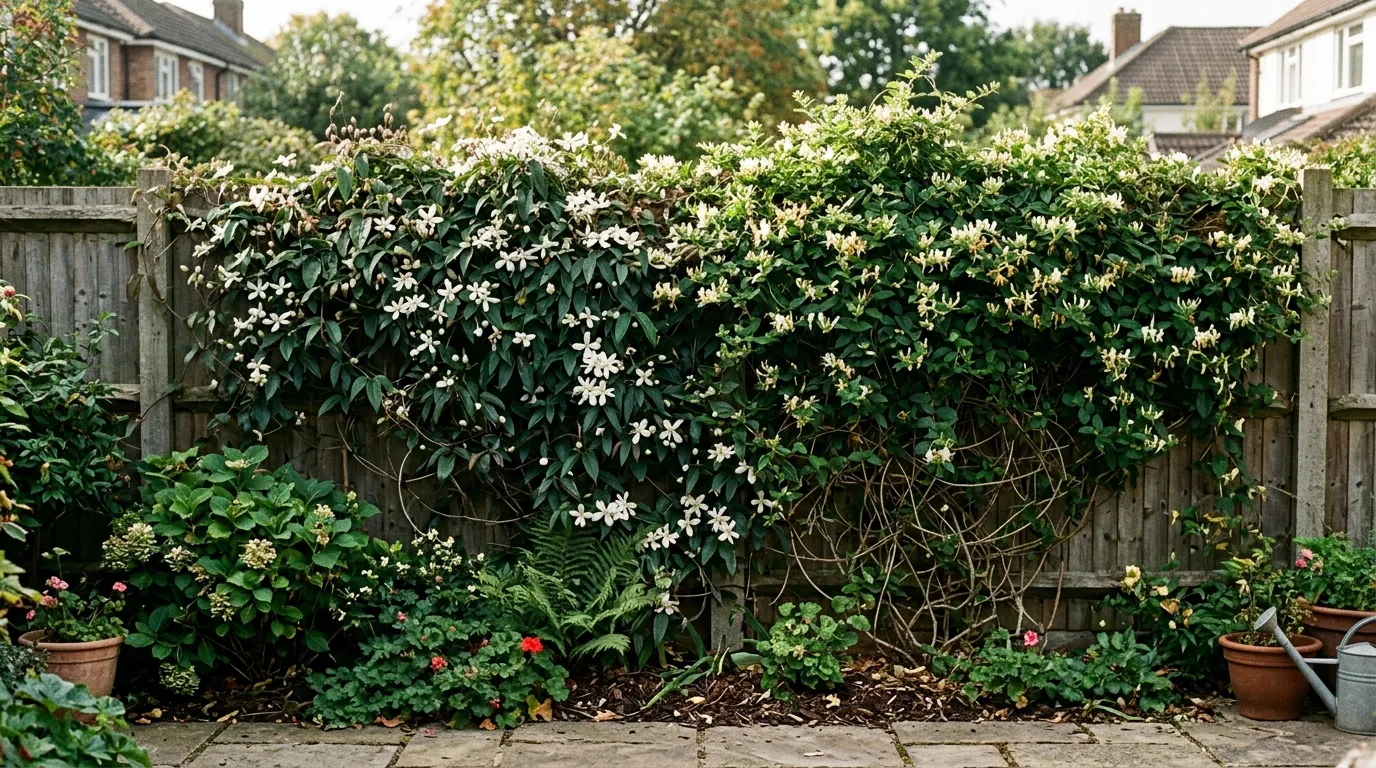 Combining a fast grower like evergreen honeysuckle with a slower scented climber creates layered year-round interest
Solanum laxum ‘Album’ for long summer flowering
Solanum laxum ‘Album’ (potato vine) produces clusters of white, yellow-centred flowers from June to October, one of the longest flowering seasons of any climber. The semi-evergreen foliage holds through mild winters above -3C but drops in hard frosts.
This is the least hardy species in our trial at H3 (-5C). It suits only sheltered south-facing walls in southern England and urban heat islands. In colder areas, treat it as a die-back perennial that regrows from the base. Growth rate is 1-1.5m per year to 5-6m. At £12-18 per plant, it is affordable enough to replace if a severe winter kills it.
Month-by-month care calendar
| Month | Task |
|---|---|
| January | Check ties and supports after winter storms. Note any frost-damaged foliage but do not prune yet. |
| February | Clip ivy hard with shears before nesting season begins (1 March legal cut-off). Apply a 5cm mulch of garden compost around the base of all climbers. |
| March | Plant container-grown evergreen climbers. Clematis armandii begins flowering. Feed all established climbers with a balanced granular fertiliser (Growmore at 70g per square metre). |
| April | Tie in new growth on twining climbers. Prune Clematis armandii immediately after flowering by removing flowered stems. Holboellia and Akebia flower this month. |
| May | Pyracantha flowers. Check star jasmine for signs of frost damage from late frosts and remove any dead shoots. Water newly planted climbers weekly (10 litres each). |
| June | Star jasmine begins flowering. Train new shoots horizontally on wires to maximise wall coverage. Lonicera henryi flowers. Continue watering new plantings. |
| July | Hydrangea seemannii flowers. Prune Pyracantha after flowering to shape while preserving berry wood. Feed container-grown climbers fortnightly with liquid tomato fertiliser. |
| August | Prune star jasmine after flowering finishes, removing wayward shoots. Take semi-ripe cuttings (10cm lengths) of star jasmine, Hydrangea seemannii, and Pileostegia for propagation. |
| September | Pileostegia viburnoides flowers. Plant new evergreen climbers now so roots establish through autumn. Best month for planting in the Midlands and North. |
| October | Pyracantha berries ripen. Ivy flowers, providing late-season nectar for insects. Apply a final 8cm mulch before winter. Reduce watering. |
| November | Protect tender climbers (star jasmine, Solanum) in exposed positions with horticultural fleece when frost is forecast. Check wall fixings before winter gales. |
| December | No active work. Observe which species hold their foliage through cold spells. This informs future planting decisions for the toughest positions. |
Why evergreen climbers fail: root cause analysis
Most evergreen climber failures come down to three causes. Understanding them prevents the cycle of buying, planting, and watching plants die.
Wrong aspect for the species
This accounts for roughly 60% of evergreen climber failures in our experience. Star jasmine on a north-facing wall. Clematis armandii on an exposed east wall. Solanum on anything but a sheltered south-facing wall. Every species has a clear aspect requirement, and no amount of feeding or watering compensates for planting in the wrong position. Always check the comparison table above and match the species to your wall’s aspect.
Planting in the rain shadow
The strip of soil within 30cm of a wall or fence base sits in a rain shadow. Even in heavy rain, the wall deflects water away from this zone. The soil stays permanently dry. New climbers planted directly against the wall die of drought, and gardeners blame the plant rather than the position.
The fix is simple: plant 45cm from the wall base and angle the root ball towards the support. At 45cm, roots access naturally moist soil while the stems reach the wires or wall. Mulch the planting area with 8cm of bark or compost to retain moisture.
No support structure for twining species
Twining climbers like star jasmine, Clematis armandii, and evergreen honeysuckle cannot grip smooth brick, timber, or render. Without wires or trellis, they flop at the base and never climb. Fix horizontal galvanised wires at 30-45cm intervals using vine eyes screwed into mortar joints (for walls) or fence posts. This costs £2-5 per metre for materials and takes 30 minutes per 3m run. Quality trellis panels cost £15-30 per metre but look more decorative.
Common mistakes with evergreen climbers
Mistake 1: Pruning Clematis armandii like other clematis
Clematis armandii flowers on the previous year’s growth. Pruning in February (as you would for Group 3 clematis) removes every flower bud. Prune immediately after flowering in April-May only. This is the single most common mistake with this species.
Mistake 2: Expecting fast results from star jasmine
Star jasmine grows just 30-50cm per year for the first three years. Gardeners expecting the 2-3m per year growth of Russian vine or summer jasmine give up and rip it out. Buy the largest specimen you can afford (10-litre pot, £35-45) and accept a 3-4 year establishment period. The reward is decades of scented, evergreen cover.
Mistake 3: Planting ivy directly against timber fences
Ivy’s aerial roots can penetrate gaps between overlapping fence panels, pushing them apart over time. On brick and stone walls this is not a problem, but on timber fences it causes structural damage. Grow ivy on a separate wire framework set 10-15cm in front of the fence, or choose a twining evergreen like Lonicera henryi instead.
Mistake 4: Ignoring the nesting season
The Wildlife and Countryside Act 1981 makes it illegal to disturb nesting birds. Dense evergreen climbers like ivy and Pyracantha are prime nesting habitat from March to August. Never prune these species during nesting season. Clip ivy hard in February before nesting begins. Prune Pyracantha in July after confirming no active nests remain.
Mistake 5: Skipping winter protection in the first year
Even hardy evergreen climbers are vulnerable in their first winter before roots have established. A single night at -10C can kill a newly planted star jasmine that would survive the same temperature once mature. Wrap newly planted tender evergreens with horticultural fleece when frost is forecast in the first winter. Remove the fleece during the day to maintain air circulation.
Cost breakdown for an evergreen climber scheme
Planning a budget helps avoid the temptation to buy too few plants or cheap specimens that take years to fill a wall.
| Item | Cost | Notes |
|---|---|---|
| Evergreen climber (2L pot) | £12-25 | One plant per 2-3m run of wall |
| Evergreen climber (10L pot) | £35-60 | Faster establishment, one per 1.5-2m |
| Galvanised wire (30m roll) | £8-12 | Enough for a 10m wall at 3 rows |
| Vine eyes (pack of 20) | £4-7 | One every 1.5m along each wire |
| Trellis panel (1.8m x 0.6m) | £15-30 | Alternative to wire for decorative walls |
| Garden compost (70L bag) | £5-8 | Two bags per 3m of planting |
| Bark mulch (100L bag) | £6-10 | One bag per 3m of planting |
| Total per 3m section (wire) | £35-60 | Using 2L plants and wire support |
| Total per 3m section (trellis) | £55-90 | Using 2L plants and trellis panels |
For plants suited to shaded positions where cost-effective screening is the priority, our guide to the best plants for shade covers ground-level options that complement climbers.
Month-by-month seasonal interest calendar
This calendar shows which species provide visual interest in each month. Foliage is constant for all true evergreens; the table highlights flowers, berries, and autumn colour.
| Month | Star Jasmine | Clematis armandii | Ivy | Hydrangea seemannii | Pileostegia | Pyracantha | Akebia |
|---|---|---|---|---|---|---|---|
| Jan | Foliage | Foliage | Foliage + berries | Foliage | Foliage | Berries | Foliage |
| Feb | Bronze tints | Foliage | Foliage + berries | Foliage | Foliage | Berries | Foliage |
| Mar | Foliage | Flowers | Foliage | Foliage | Foliage | Foliage | Foliage |
| Apr | Foliage | Flowers | Foliage | Foliage | Foliage | Foliage | Flowers |
| May | Foliage | Foliage | Foliage | Foliage | Foliage | Flowers | Flowers |
| Jun | Flowers | Foliage | Foliage | Foliage | Foliage | Foliage | Foliage |
| Jul | Flowers | Foliage | Foliage | Flowers | Foliage | Foliage | Foliage |
| Aug | Flowers | Foliage | Foliage | Foliage | Foliage | Foliage | Foliage |
| Sep | Foliage | Foliage | Foliage | Foliage | Flowers | Foliage | Foliage |
| Oct | Foliage | Foliage | Flowers | Foliage | Foliage | Berries | Foliage |
| Nov | Foliage | Foliage | Flowers | Foliage | Foliage | Berries | Foliage |
| Dec | Foliage | Foliage | Foliage | Foliage | Foliage | Berries | Foliage |
By planting a combination of just three species (Clematis armandii, star jasmine, and Pyracantha), you get flowers or berries in 10 out of 12 months plus continuous foliage.
Combining evergreen climbers for layered cover
A single species rarely covers a wall perfectly. The best results come from combining two or three climbers with different growth habits, flowering seasons, and heights.
Layer 1 (base, 0-1.5m): Euonymus fortunei ‘Silver Queen’ or ivy provides a dense evergreen skirt that hides bare lower stems.
Layer 2 (mid-wall, 1.5-4m): Star jasmine, Clematis armandii, or evergreen honeysuckle fills the main visible area with flowers and scent.
Layer 3 (top, 4m+): Akebia quinata or Holboellia coriacea scrambles across the top of the wall, adding height without needing additional support.
This layered approach mimics natural woodland edge planting and creates a self-sustaining system. The lower evergreen layer shades the roots of the upper climbers, keeping soil cool and moist. For more ideas on structuring vertical planting, browse our guide to garden fence ideas. If you want year-round garden structure beyond climbing plants, our guide to evergreen shrubs for year-round interest covers the best freestanding choices to plant alongside climbers.
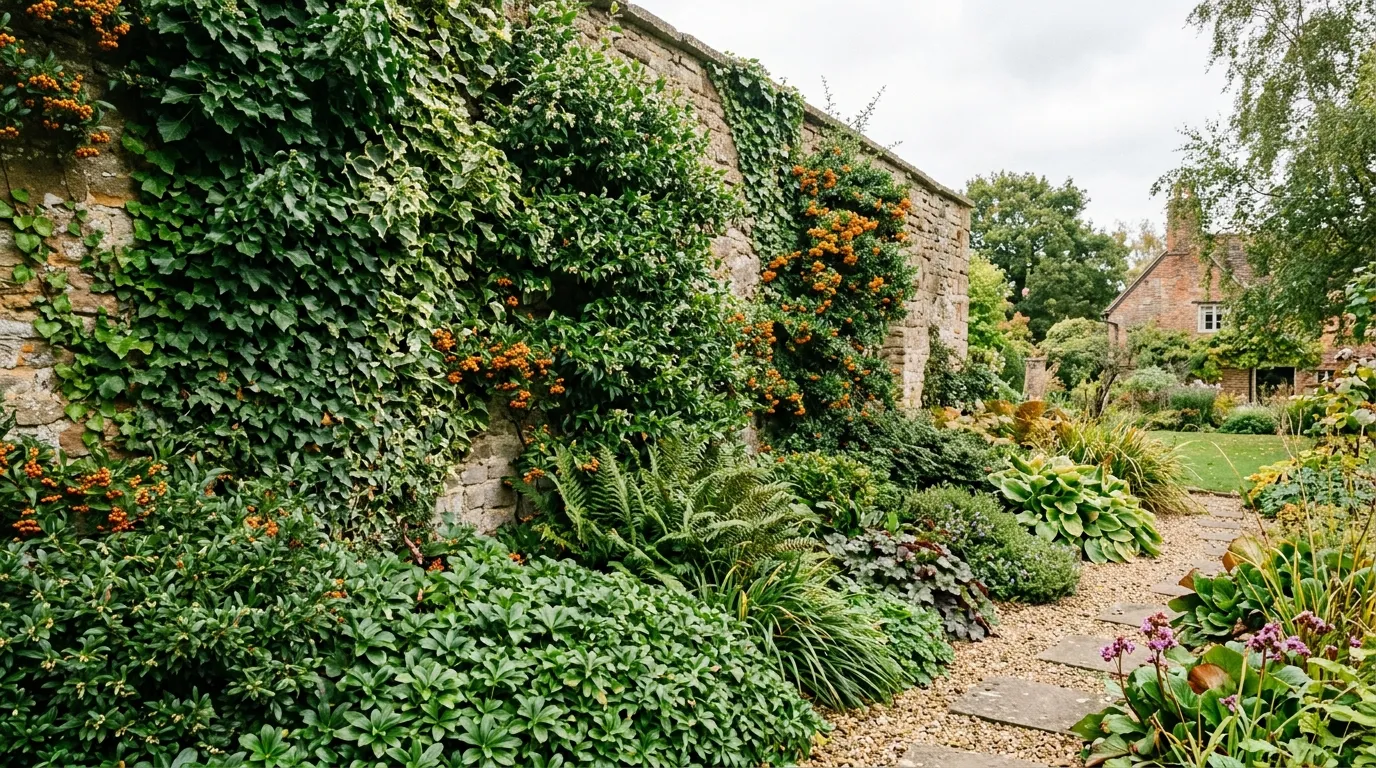 Layered planting with low euonymus, mid-height jasmine, and tall akebia creates a natural evergreen wall
Frequently asked questions
What is the best evergreen climber for a north-facing wall?
Ivy (Hedera helix) is the most reliable evergreen for north walls. It is self-clinging, tolerates deep shade, and grows 1-2m per year on any soil. For a more ornamental choice, Hydrangea seemannii produces creamy white lacecap flowers in July and keeps its leathery leaves through winter. Pileostegia viburnoides flowers in September and is equally hardy. All three handle temperatures to -15C or lower.
Will evergreen climbers damage my house walls?
Self-clinging climbers can damage crumbling lime mortar on pre-1920 properties. On sound modern brickwork, aerial roots rarely cause problems. The RHS confirms that climbers on structurally sound walls cause no damage. Twining evergreens like star jasmine and Clematis armandii grow on wires 5-8cm from the wall and never contact the masonry.
Is star jasmine hardy enough for UK gardens?
Star jasmine tolerates temperatures to -10C on a sheltered wall. In most of southern and central England (RHS H4), it thrives on south or west-facing walls. In colder areas, grow it in a 40-litre pot that can be moved to shelter during prolonged freezing. Established plants with woody stems tolerate cold better than new specimens.
What is the fastest growing evergreen climber in the UK?
Common ivy grows 1-2m per year and keeps its leaves in all conditions. Clematis armandii matches this rate in sheltered south-facing positions. Star jasmine is slower at 30-50cm per year. For a full speed comparison of all climbing plants including deciduous species, see our guide to fast-growing climbers for fences and walls.
How do I plant an evergreen climber against a fence?
Dig a hole 45cm from the fence base, twice the width of the root ball. Mix garden compost into the backfill. Angle the root ball towards the fence and tie stems to horizontal wires at 30-45cm intervals. Water with 10 litres and mulch with 8cm of bark or compost. Keep watering through the first two summers.
Do evergreen climbers need pruning?
Most need one annual trim after flowering. Star jasmine and Clematis armandii in May-June. Ivy in late February before nesting season. Pyracantha in July. Pileostegia and Hydrangea seemannii need minimal pruning. Never prune dense climbers between March and August when birds may be nesting (Wildlife and Countryside Act 1981).
Can I grow evergreen climbers in pots?
Yes. Star jasmine, ivy, and evergreen honeysuckle grow well in 40-litre containers. Use loam-based John Innes No. 3 compost. Feed fortnightly with liquid tomato fertiliser from April to August. Insulate pots with bubble wrap in winter to protect roots from freezing, as container-grown roots are 5-10C more exposed than those in open ground.
Now you have a clear picture of which evergreen climbers suit your walls and fences, read our guide on how to grow wisteria for the best deciduous climber to pair alongside your evergreen planting. For complete year-round garden screening beyond climbers, our guide to the best trees for privacy covers taller options that complement wall-grown evergreens.
Related reading
- Best Climbing Plants for UK Gardens — a full comparison of deciduous and evergreen climbers for every aspect and situation
- Fast-Growing Climbers for Fences and Walls — the quickest-establishing climbers when you need coverage fast
- Best Plants for Shade — ground-level shade-tolerant planting to combine with north-wall climbers
- Evergreen Shrubs for Year-Round Interest — freestanding evergreen structure to plant around the base of climbers
- Privacy Screening with Hedges and Trees — taller screening options when climbers alone are not enough
Lawrie has been gardening in the West Midlands for over 30 years. He grows his own veg using no-dig methods, keeps a wildlife-friendly garden, and writes practical advice based on real UK growing conditions.