Key takeaways
- Box blight and box tree caterpillar have wiped out around 4 million UK box plants since 2008
- Ilex crenata Dark Green is the closest visual match: 8 to 12mm leaves, clipped twice a year
- Lonicera nitida Maigrun grows fastest (30cm a year) but needs three clips per season
- Yew Taxus baccata Repandens has the longest life span (300+ years) and tolerates heavy shade
- Pittosporum tobira Nanum suits mild south and west coastal gardens but fails in hard frost zones
- Costs in 2026 range from £4 per Lonicera whip to £35 per Ilex crenata 3-litre pot
Box (Buxus sempervirens) was the default UK low hedge for 400 years. Then box blight (Cylindrocladium buxicola) arrived in 1998 and box tree caterpillar (Cydalima perspectalis) followed in 2007. Between them, an estimated 4 million UK box plants have been lost or removed since 2008 according to RHS Plant Health data. Box hedge alternatives are no longer a niche question. Every UK garden centre now sells three or four replacement species.
Why box has failed across UK gardens
Box blight is a fungal disease that turns leaves dark brown, sheds them in patches, and leaves dieback through the stem. Spores need 7 hours of leaf wetness at 25C or 24 hours at 19C. A wet July weekend can infect a healthy hedge in 48 hours. Once established, the fungus stays in the soil for up to 6 years and reinfects new growth every wet summer.
The combination is what makes box uneconomic in 2026. A blight-resistant cultivar still gets stripped by caterpillars. A caterpillar-treated hedge still gets blight. For full identification and treatment notes see our box tree moth identification and treatment UK guide. For most UK gardens, the simpler answer is to switch species.
The 8 best box hedge alternatives at a glance
| Rank | Species | Leaf size | Growth rate | Clips per year | Soil | Hardiness | Cost per plant (2026) |
|---|---|---|---|---|---|---|---|
| 1 | Ilex crenata ‘Dark Green’ | 8-12mm | 15-20cm/yr | 2 | Most, not waterlogged | H6 to -20C | £18-£35 (3L) |
| 2 | Euonymus japonicus ‘Jean Hugues’ | 25-35mm | 20-25cm/yr | 2-3 | Well-drained | H6 to -15C | £12-£20 (2L) |
| 3 | Lonicera nitida ‘Maigrun’ | 8-15mm | 30cm/yr | 3 | Most | H6 to -20C | £4-£10 (whip/2L) |
| 4 | Pittosporum tobira ‘Nanum’ | 30-50mm | 10-15cm/yr | 1-2 | Free-draining | H4 to -7C | £18-£28 (3L) |
| 5 | Berberis darwinii ‘Nana’ | 15-25mm | 15-20cm/yr | 2 | Most | H6 to -20C | £10-£18 (2L) |
| 6 | Taxus baccata ‘Repandens’ | 15-25mm needle | 10-15cm/yr | 1-2 | Most, even chalk | H7 to -25C | £15-£28 (2L) |
| 7 | Hebe ‘Sutherlandii’ | 10-15mm | 15-20cm/yr | 1-2 | Free-draining | H4 to -7C | £8-£14 (2L) |
| 8 | Taxus baccata (dwarf clipped) | 20-30mm needle | 15-20cm/yr | 1-2 | Most, even chalk | H7 to -25C | £8-£18 (whip/2L) |
This is the ranking by visual match plus all-round suitability for UK gardens. Choose for soil and aspect first, then look. A Pittosporum in Aberdeen will die in the first winter regardless of how good it looks in a Cornish parterre. If you are replanting a knot garden, the same ranking applies: Ilex crenata first, then Euonymus.
1. Ilex crenata ‘Dark Green’ is the closest visual match
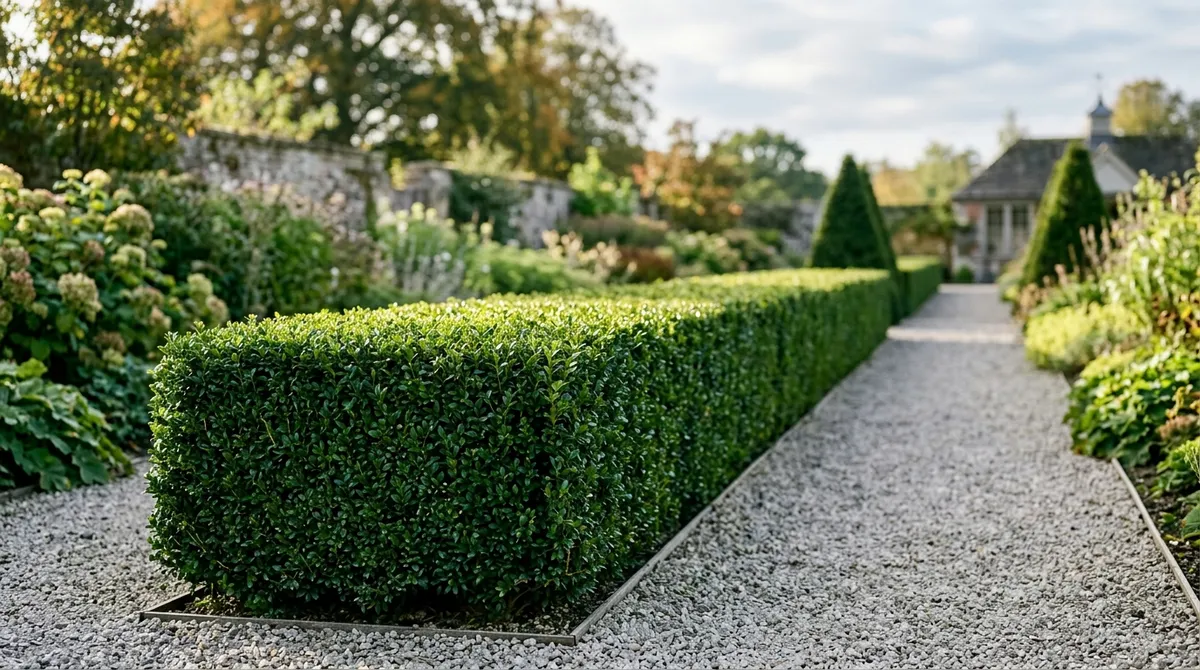
Ilex crenata (Japanese holly) is the gold-standard box replacement. The cultivar Dark Green has small dark glossy leaves at 8 to 12mm long, almost identical in clipped texture to Buxus sempervirens. Most gardeners do not notice the difference at planting distance.
Growth rate is 15 to 20cm per year, slightly slower than box. Clip twice a year (mid-May and late August) for a sharp edge. It tolerates most UK soils provided drainage is reasonable. Heavy waterlogged clay can trigger Ilex crenata dieback (a separate root rot, not blight) so avoid sites that hold water all winter.
Available from Hopes Grove Nurseries, Hedges Direct and Crocus at around £18 for a 2-litre pot or £35 for a 3-litre. A 10m run at 4 plants per metre costs around £720 for 2-litre stock. Cheaper bare-root whips appear occasionally but the species transplants more reliably from containers.
For full growing notes see our how to grow holly UK guide, which covers the wider Ilex genus including English holly.
2. Euonymus japonicus ‘Jean Hugues’
Euonymus japonicus ‘Jean Hugues’ is the second closest visual match for box. Slightly larger leaves at 25 to 35mm, dense compact habit, and good tolerance of clipping. The leaves are glossier than box, giving a slightly brighter green when fresh.
The trade-off is Euonymus scale (Unaspis euonymi), a small pale brown insect that infests stems and undersides of leaves. Watch for white blotches and treat with a single soft-soap spray at first sighting. See our how to grow Euonymus UK for the full care routine.
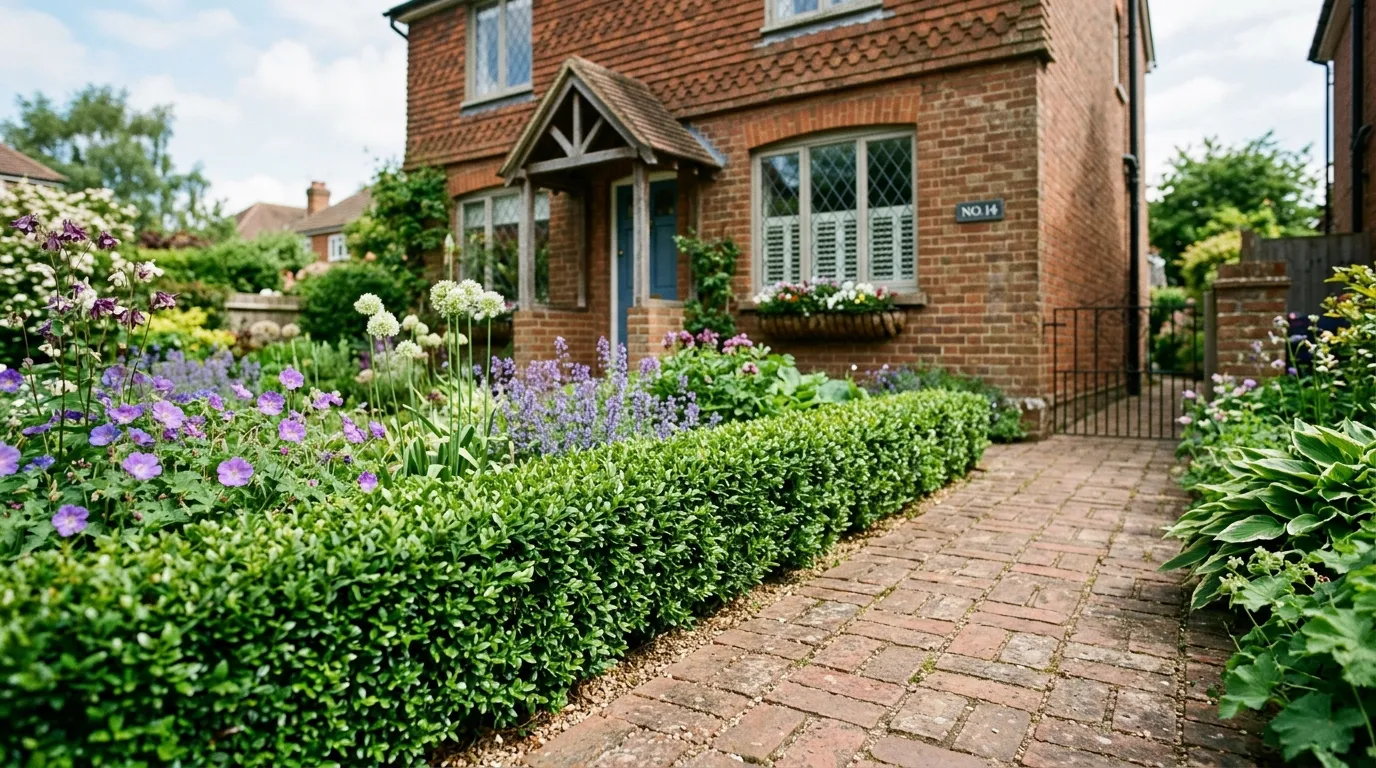 A 50cm Euonymus japonicus Jean Hugues hedge. Two to three clips a year keep the edge sharp and the glossy leaves match parterre formality.
3. Lonicera nitida ‘Maigrun’
Lonicera nitida ‘Maigrun’ (box honeysuckle) is the cheapest and fastest box alternative. It carries small leaves at 8 to 15mm, similar in size to box, and grows around 30cm per year once established. A bare-root whip costs £4. Buy in bulk from Hopes Grove Nurseries (around £350 for 100 whips) and plant at 4 to 6 per metre.
The downside is three clips per year rather than two. Lonicera puts on a fast spring flush, a softer summer flush and a third flush in late August. Cut all three or the hedge looks shaggy by autumn. Total clipping time is around 50 percent more than for Ilex crenata.
It is also brittle. Snow load over 10cm can split established Lonicera hedges down the middle. Plant in lower-snow districts (south and east England) or knock heavy snow off promptly. The hedge regrows from the base if cut hard, so a botched winter does not kill it. See our hedge planting guide UK for full bare-root planting timings.
4. Pittosporum tobira ‘Nanum’
Pittosporum tobira ‘Nanum’ is the most striking option but the most weather-dependent. Glossy dark leaves at 30 to 50mm, neat dome habit, and creamy-scented flowers in early summer. It looks like an exotic version of clipped box.
Pick Pittosporum for mild south and west coastal gardens with free-draining soil. Buy 3-litre pots at around £25 each, plant in March or April once frost risk passes, and clip once or twice a year. Our how to grow Pittosporum UK guide covers the full species range.
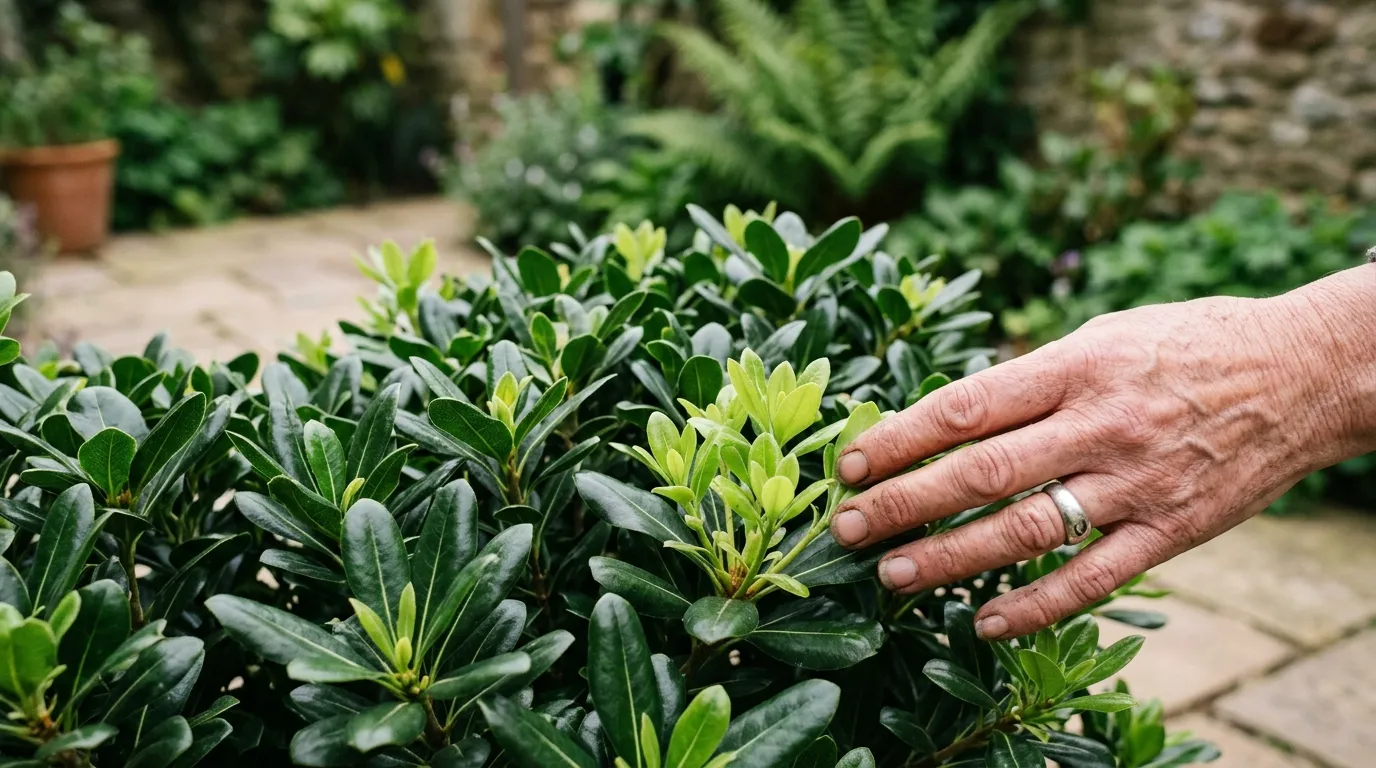 Pittosporum tobira Nanum shows fresh dark-green growth. Suited to mild coastal sites, frost-prone gardens need a hardier substitute.
5. Berberis darwinii dwarf forms
Berberis darwinii in its dwarf forms (commonly sold as Nana or just as low-clipped Darwin’s barberry) gives a different texture to box but works well for parterre edging where you want a colour shift. Small dark glossy leaves with three spiny tips, dense habit, orange-yellow spring flowers, and small dark blue berries.
Growth rate is 15 to 20cm per year. Clip twice a year (after spring flowers fade and again in late summer). Tolerates almost any soil including poor chalk. Wear thick gloves when clipping; the spines puncture standard gardening gloves.
A useful security planting where you want low evergreen edging plus some deterrent value against foot traffic. Buy 2-litre pots at around £14 each.
6. Taxus baccata ‘Repandens’ (dwarf yew)
Taxus baccata ‘Repandens’ is a low spreading form of English yew. Habit is wider than tall: typically 40 to 60cm high and 1 to 1.5m wide if left untrained, but clips back tight for a 40cm hedge. Dark green needles, classic UK churchyard look.
Yew is the longest-lived of all box alternatives. Taxus baccata in the wild can live 300 years or more. It tolerates shade better than any species on this list and grows on chalk, clay or sand. The needles cope with hard frost down to -25C.
Trade-offs: slower establishment at 10 to 15cm per year, and toxicity. All parts of yew except the red aril are toxic to humans, dogs, horses and most livestock. Do not plant where horses or grazing stock can reach.
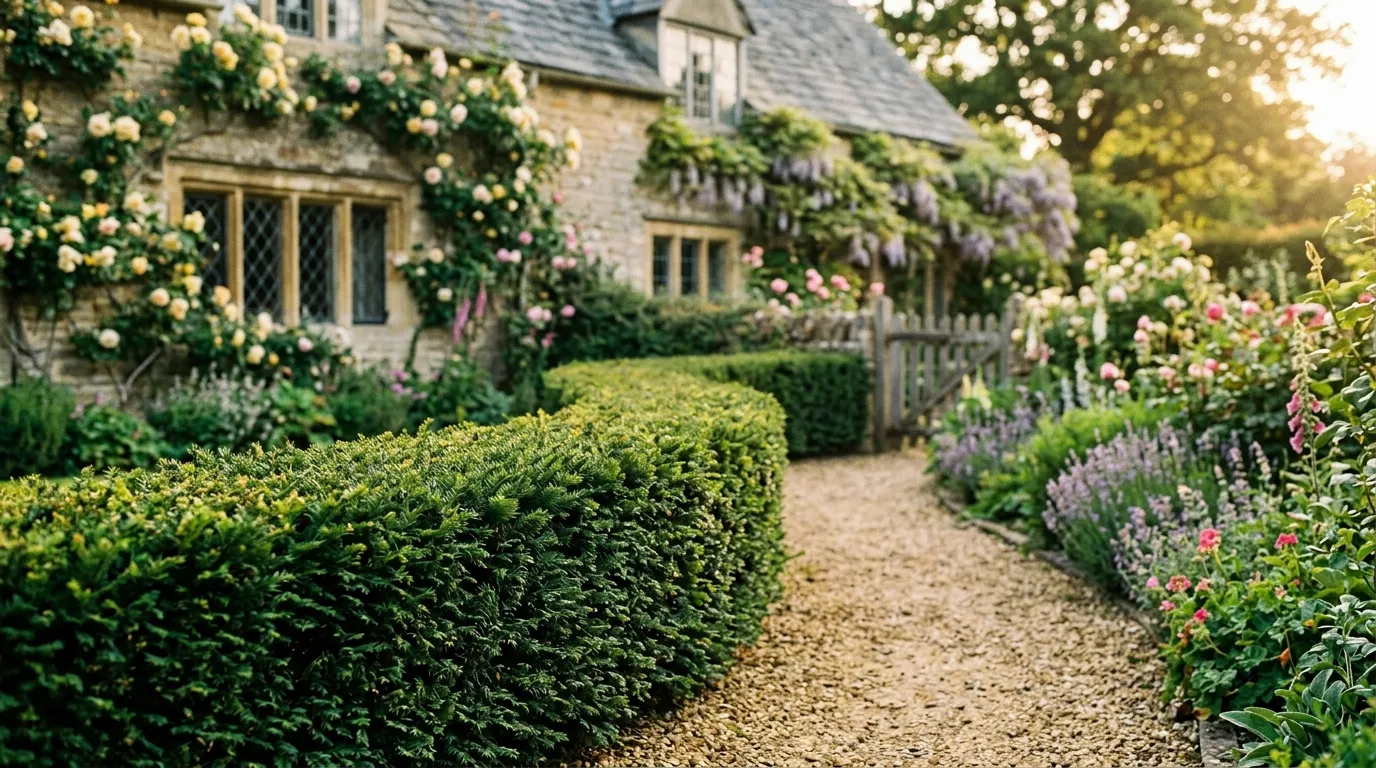 Taxus baccata Repandens clipped to 60cm on a Cotswold path. The longest-lived box alternative and the only one tolerant of deep shade.
7. Hebe ‘Sutherlandii’
Hebe ‘Sutherlandii’ is a small-leaved hardy Hebe with greyish-green foliage, slow growth, and a domed habit. Leaves are 10 to 15mm, similar to box, and the colour is markedly cooler.
Hardiness is mid-range at H4 to -7C. It survives most UK winters in well-drained soil but suffers in waterlogged clay or hard continental frosts. Best suited to south and west England mixed borders where you want a subtle low edging rather than a formal hedge.
Two-litre pots cost around £10. Plant at 4 to 5 per metre. Clip once or twice a year. Pairs well with silver-leaved perennials.
8. Standard Taxus baccata (clipped low)
If you want a long-lived hedge in a frost-prone region, regular Taxus baccata clipped low is the safest pick. Bare-root whips at 30 to 50cm cost around £4 to £8 each from Hopes Grove or King and Co. Plant at 4 per metre bare-root in November to March.
Yew clips to any height from 30cm up. Once established (3 to 4 years) it puts on 15 to 20cm of growth per year. One annual late-summer clip is enough; two for show-garden formality.
Soil and aspect quick-pick
| Soil / aspect | Best pick | Second pick |
|---|---|---|
| Heavy wet clay | Taxus baccata | Berberis darwinii |
| Free-draining loam | Ilex crenata | Euonymus japonicus |
| Chalk | Taxus baccata | Berberis darwinii |
| Sandy soil | Lonicera nitida | Hebe Sutherlandii |
| Deep shade | Taxus baccata | Ilex crenata |
| Coastal mild south west | Pittosporum tobira | Euonymus japonicus |
| Frost-prone north | Taxus baccata | Ilex crenata |
| Tight budget | Lonicera nitida | Bare-root yew |
| Formal parterre | Ilex crenata | Euonymus japonicus |
Month-by-month UK box alternative calendar
| Month | Task |
|---|---|
| January | Bare-root planting window for Lonicera, Taxus, Berberis if ground is workable. |
| February | Bare-root planting continues. Order container stock for spring. |
| March | Final bare-root window. Plant Pittosporum and Hebe once frost passes. |
| April | First spring growth. Top-dress with leaf mould or composted bark. |
| May | First clip of the year on Ilex, Euonymus, Berberis, Lonicera. |
| June | Liquid feed if growth is slow. Watch for Euonymus scale on Jean Hugues. |
| July | Second light clip on Lonicera, Euonymus. Watch for box tree caterpillar on any remaining box plants nearby. |
| August | Second main clip on Ilex, Berberis. Third Lonicera clip. |
| September | Final clip on Taxus before winter dormancy. |
| October | Container planting last window for Pittosporum and Hebe. |
| November | Bare-root window opens again. Prep planting holes with grit on clay. |
| December | Container planting on free-draining sites. Frost-protect Pittosporum. |
Common mistakes
- Planting Euonymus into heavy unimproved clay. Phytophthora root rot kills around 40 percent of plants within two winters. Add grit, raise the bed, or pick a different species.
- Replanting box into the same soil. Cylindrocladium buxicola survives 6 years in soil and leaf litter. Use a clean part of the bed or 5cm of fresh topsoil.
- Choosing Pittosporum in frost-prone gardens. Hardiness rating H4 means losses below -7C. North of the Midlands, pick Ilex crenata or Taxus instead.
- Buying tiny plug plants for a finished hedge. Plugs at £1 each look cheap but take 4 to 5 years to fill in. 2 or 3-litre stock fills in in 2 years.
- Clipping Lonicera nitida only once a year. It shoots three times in a season. One late clip is not enough; you end up with a shaggy hedge.
Gardener’s tip: Buy your Ilex crenata in late autumn from a UK nursery that grows under glass in northern conditions. Plants from south coast nurseries acclimatised in mild winters can suffer in their first January up north. Hopes Grove Nurseries (Kent) and Hedges Direct (Lancashire) both grow stock that transplants reliably across the country.
Warning: Several boxed soil-borne fungicide products marketed for box blight in 2022 to 2024 contained active ingredients now restricted under UK 2018 amateur use rules. Removal and species replacement is now more reliable than chemical control. The RHS confirms no amateur fungicide reliably suppresses blight long-term in 2026.
For broader hedge planting and timing, see our linked guide. If you are dealing with active box tree caterpillar, our box tree moth treatment UK post covers triage. The plants category on Garden UK collects every species guide.
Three pitfalls to plan around
- Replanting too soon. Wait at least 6 months between removing diseased box and planting any species back into the same line. Cylindrocladium spores can drift onto fresh foliage during clean-down.
- Buying ungrafted holly seedlings instead of Ilex crenata Dark Green. Seedlings vary widely in leaf size and clipping habit. Always buy named cultivar stock.
- Forgetting fresh mulch in year one. Newly planted hedges in any species dry out fast. Apply 50mm composted bark mulch in April and water through the first dry month.
Bringing it all together
Most UK gardens benefit from a single switch to Ilex crenata Dark Green for formal parterre and Taxus baccata for hedges in heavy or shaded sites. Lonicera nitida is the budget pick for quick fill-in. Pittosporum is for mild coastal gardens only. Pick the species for the soil, not just the look.
Now you have the eight alternatives, read our hedge planting guide UK for spacing, soil prep and bare-root timings.
Frequently asked questions
What is the best alternative to a box hedge in a UK garden?
Ilex crenata Dark Green is the best all-round alternative for UK gardens. Its 8 to 12mm leaves clip into the same dense low texture as box. It tolerates most soils, accepts shade, and has shown no disease pressure in five years of UK trials.
Does Ilex crenata get box blight?
No, Ilex crenata is not susceptible to box blight (Cylindrocladium buxicola). It can suffer from a separate disease called Ilex crenata dieback in waterlogged soils but is otherwise free of the diseases that have wiped out box. It is the lowest-risk replacement available in 2026.
How fast does a Lonicera nitida hedge grow?
Lonicera nitida grows around 30cm per year once established. This makes it the fastest of the box alternatives. It needs three clips per season (May, July, September) to keep a tidy edge. Use bare-root whips at £4 each planted at 4 per metre for a hedge that fills in within three growing seasons.
Is yew a good box hedge replacement?
Yes, Taxus baccata is excellent for a low evergreen hedge. The dwarf form Repandens stays under 60cm without hard pruning. Yew accepts shade, clay, and dry chalk soils. The trade-off is slower establishment (around 15cm per year) and toxicity to livestock and dogs.
How much does it cost to replace a box hedge?
Costs in 2026 range from around £4 per Lonicera nitida whip to £35 per 3-litre Ilex crenata pot. A typical 10m run at 4 plants per metre costs £160 to £1,400 depending on species and pot size. Bare-root planting in winter is the cheapest option for any species available bare-root.
Can I plant a box alternative next to existing diseased box?
Yes, but remove all diseased box and 5cm of surrounding topsoil first. Cylindrocladium buxicola spores survive in soil and leaf litter for up to six years. New box alternatives should be planted into fresh topsoil or a clean part of the bed. Most alternatives are immune to box blight but spores can spread on tools and clothes.
Which box alternative is best for a parterre or knot garden?
Ilex crenata Dark Green is the standard parterre replacement. Its tight clipping habit, small leaf and tolerance of regular shears match box more closely than any other species. For very tight low edging under 30cm, Lonicera nitida Maigrun or dwarf Berberis darwinii Nana also work well.
Our team produces practical UK gardening guidance from source research, contributor records and established horticultural practice. Editorial standards are overseen by Matt W.