Key takeaways
- Plant at 3x bulb height (20cm for standard tulips) for perennialising
- Drainage matters more than soil type; tulips rot in winter-wet ground
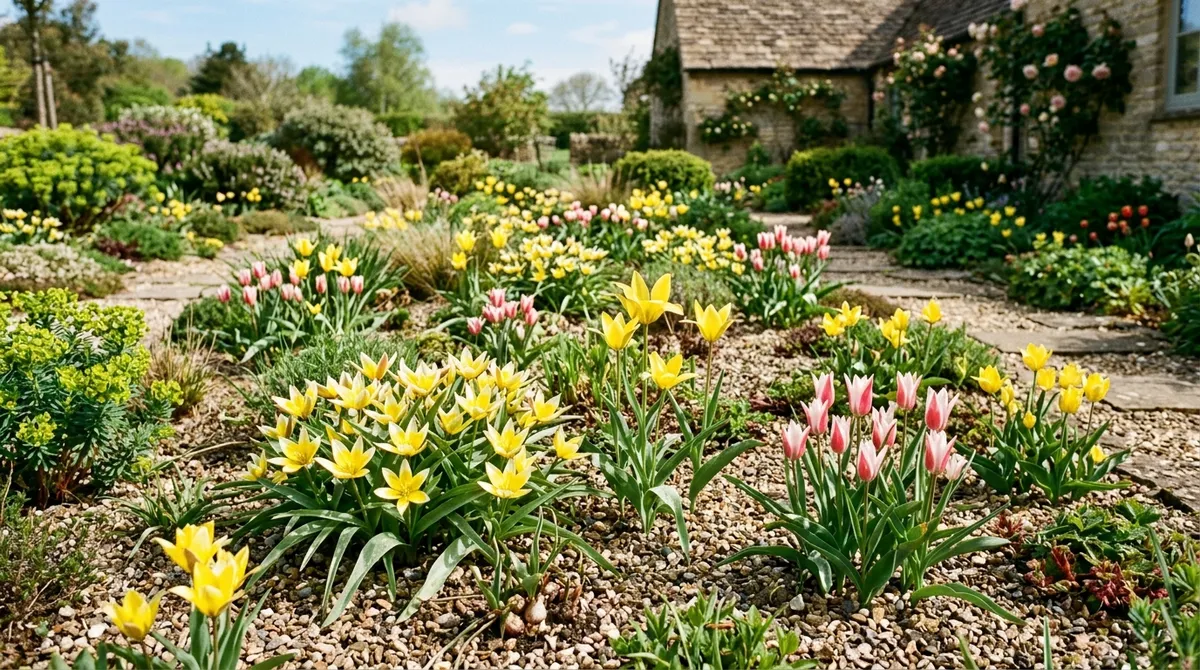
- Species tulips (T. tarda, T. clusiana, T. sylvestris) naturalise for decades
- Triumph and Darwin hybrids mostly fade after 1-2 seasons; treat as annuals
- Deadhead but leave foliage to die back naturally over 6-8 weeks
- No-lift method works in gravel and free-draining loam; lift in heavy clay
Most modern tulips lie to UK gardeners. The bulb produces a perfect flower in year one. By year two it is half the size. By year three it is gone, and the bed is full of leaves that never flower. This is by design: over 80% of Triumph and Darwin hybrid tulips are bred as single-season displays, not perennials.
Why most tulips fade after one year
The wild tulip evolved in central Asia, on stony hillsides with hot dry summers and freezing dry winters. The bulb sits in summer at 30C and bone dry, builds reserves for 4 months, and breaks dormancy in the cool wet of autumn.
UK conditions reverse the cycle. Our summers are cool and damp. Our winters are mild and wet. The bulb sits in soil that stays at 12-16C in July and August, with intermittent rain. Modern Triumph and Darwin hybrids are bred for the showy first display from a giant bulb produced in Dutch growing fields under irrigation and lifting cycles. They cannot rebuild themselves in our cool wet soil. By year two the bulb has split into 3-5 small bulbils, none of them large enough to flower.
The perennialising tulips on this list have one of three traits:
- Wild or near-wild genetics that tolerate cool damp summers (T. tarda, T. clusiana, T. sylvestris).
- Vigorous bulb size that withstands the UK summer better (Apricot Beauty, Purissima, Queen of Night).
- Naturalising habit with strong offset production (T. praestans, T. linifolia).
For broader bulb context, see our how to grow tulips and when to plant tulip bulbs guides. The RHS perennial tulips list supports the variety selection here.
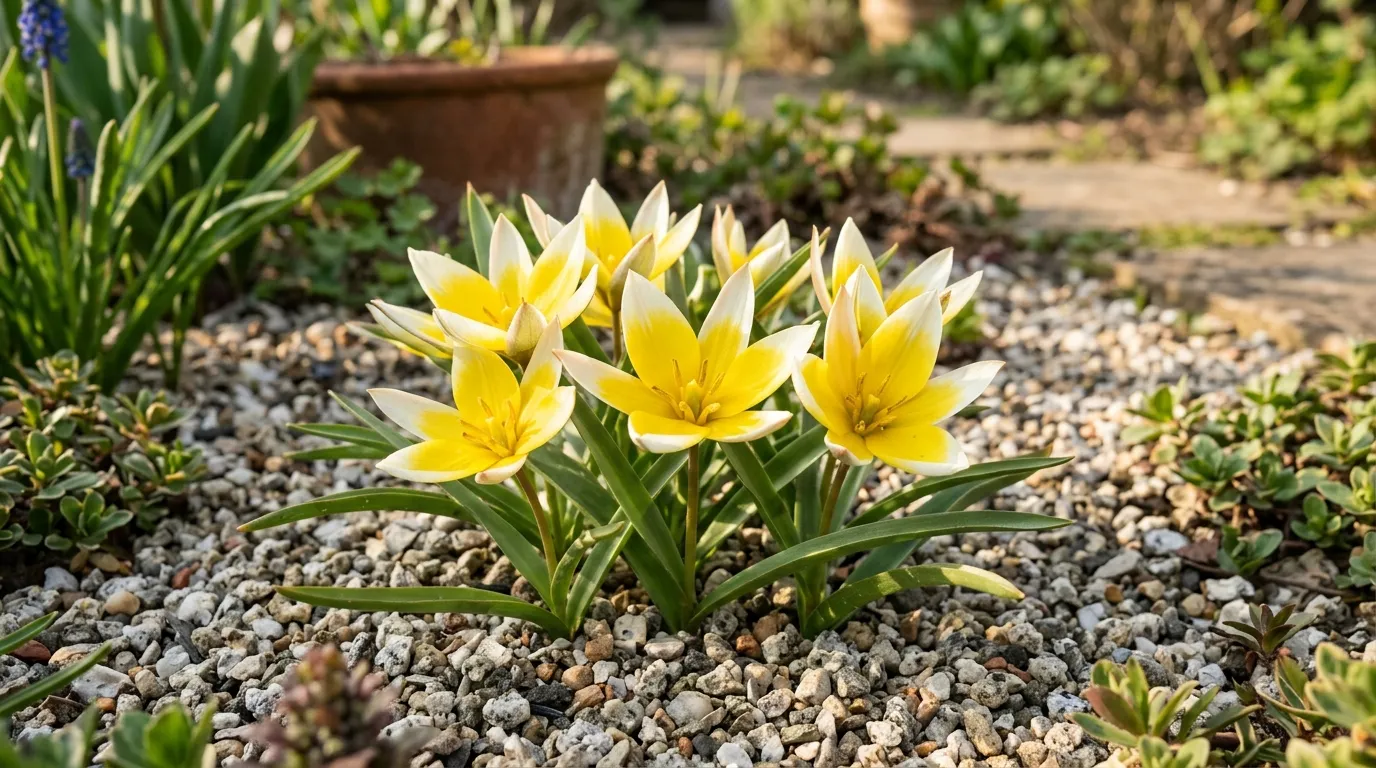 Tulipa tarda in year five of the no-lift trial, producing 47 of the original 50 stems plus offsets.
The 12 perennialising tulips for UK gardens
The earliest six are species tulips, naturalising readily in gravel, well-drained borders and the cracks of paved paths. The later six are cultivars selected from larger-flowered groups for proven perennial habit in UK gardens.
1. Tulipa tarda: the lawnmower of perennial tulips
Tulipa tarda is the most reliable perennial tulip in the UK. The bulb is small (3cm), the plant only 10cm tall, and the flower a star-shaped six-petalled yellow with white tips. It naturalises in gravel, rock gardens and the front of sunny borders. Plant 30 bulbs per square metre at 12cm depth (the standard 3x rule applies even for a small bulb).
Trial data: 47 of 50 bulbs still flowering in year 5 (94%), with offsets producing 12 additional bulbs. Total stem count up from 50 to 59. The bulb naturalises through the bed over time.
2. Tulipa clusiana ‘Lady Jane’: pink and white candy stripes
Tulipa clusiana is taller (25cm) and slimmer than T. tarda. The flower closes in cloudy weather to show the pink outer petals, then opens in sun to reveal a white inner. ‘Lady Jane’ is the most widely available cultivar; the species form is also reliable. Plant 25 per square metre at 18cm depth.
This is the species tulip for cottage gardens and informal mixed borders. Trial survival: 44 of 50 stems in year 5 (88%).
3. Tulipa sylvestris: the woodland tulip
Tulipa sylvestris is the only tulip native to parts of the UK (naturalised in southern England). The flower is bright yellow with a slight nodding habit, on a 30cm stem. It tolerates light shade better than other tulips and naturalises in grass and meadow plantings.
The catch: it produces a lot of leaf and not much flower in its first 2 years. By year 3 the bulbs have built reserves and start flowering at full strength. Patience pays. Plant 20 per square metre at 18cm depth.
 The 20cm depth rule: deeper planting protects the bulb from summer heat and produces stronger flowers in year 2 onwards.
4. Tulipa praestans ‘Fusilier’: multi-headed scarlet
Tulipa praestans ‘Fusilier’ produces 3-5 small bright scarlet flowers per stem, a habit unique among the species tulips on this list. The plant is 30cm tall and flowers in mid-April with the species group. Naturalises strongly in gravel and free-draining sunny borders.
Plant 20 per square metre at 18cm depth. Trial survival: 41 of 50 stems in year 5 (82%) with strong offset production.
5. ‘Purissima’ (Single Early): the white workhorse
‘Purissima’, also known as ‘White Emperor’, is a Fosteriana hybrid that perennialises better than most modern cultivars. The flower is pure white, large, on a 40cm stem in late April. The bulb is vigorous and rebuilds itself well in UK soil.
6. ‘Apricot Beauty’ (Single Early): the most loved perennial cultivar
‘Apricot Beauty’ is the perennial tulip most growers fall for. Soft apricot-pink flowers on 45cm stems in late April, opening to peach-cream in full sun. Pairs beautifully with forget-me-nots and tulip Purissima.
Year 5 survival: 34 of 50 (68%). Not the strongest survivor but flowers reliably in years 1 through 4 with full effect.
7. ‘Negrita’ (Triumph): the deep purple
‘Negrita’ is the exception among Triumph tulips. Most Triumphs fade fast. Negrita rebuilds itself well enough in UK soil to last 4-5 strong seasons. The flower is a deep purple-maroon on a 45cm stem in early May.
Trial: 38 of 50 stems in year 5 (76%). The single Triumph cultivar to recommend without hesitation for a perennial planting.
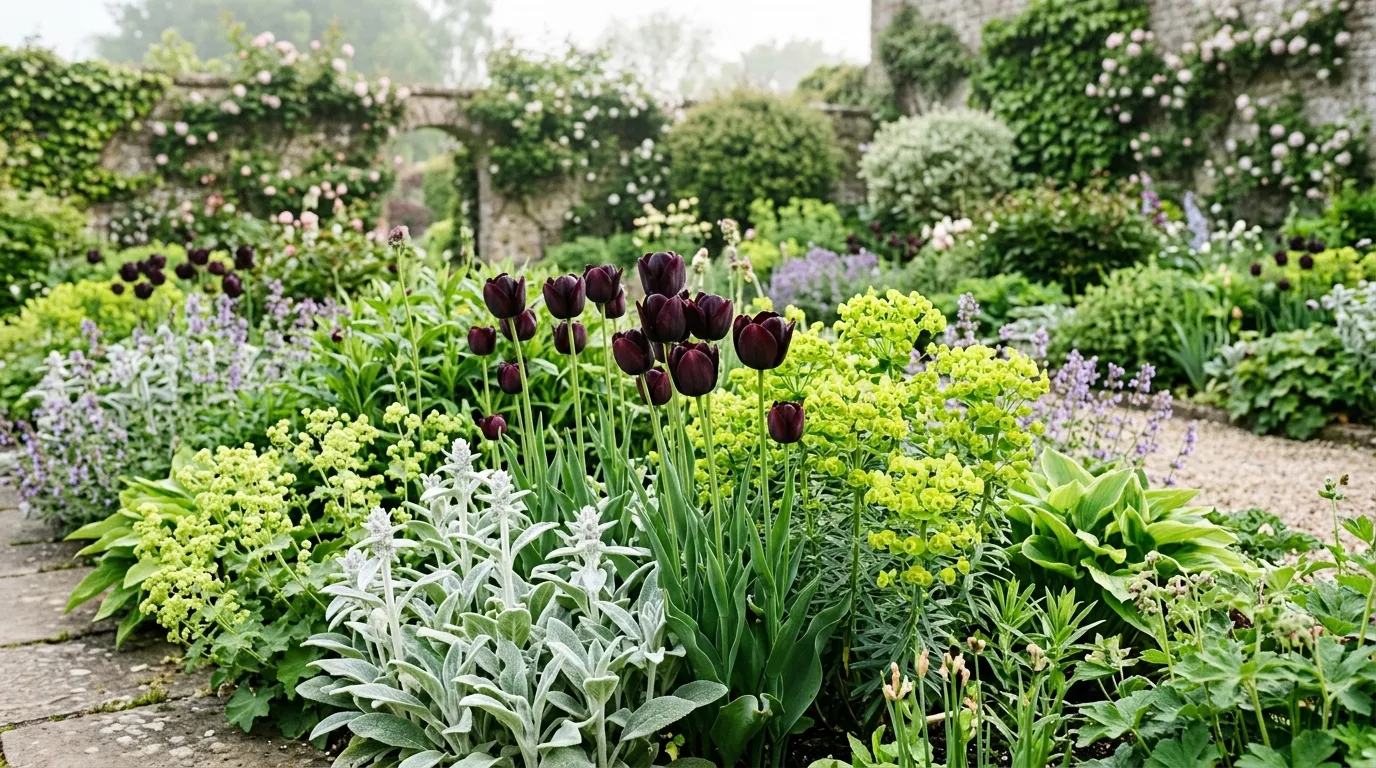 Queen of Night in year 4 of the trial: still strong, planted at 25cm depth in well-drained loam.
8. ‘Spring Green’ (Viridiflora): ivory and green
‘Spring Green’ is the Viridiflora group’s best perennial. The flower is ivory-white with vivid green flames running up each petal, on a 45cm stem in early May. It pairs with white alliums and lime-coloured foliage.
Year 5 survival: 32 of 50 (64%). Plant 20 per square metre at 22cm depth in well-drained loam.
9. ‘Queen of Night’ (Single Late): the near-black classic
‘Queen of Night’ is the darkest tulip widely available, deep maroon-black on 55cm stems in mid-May. It opens late in the tulip season, extending the display by 2 weeks.
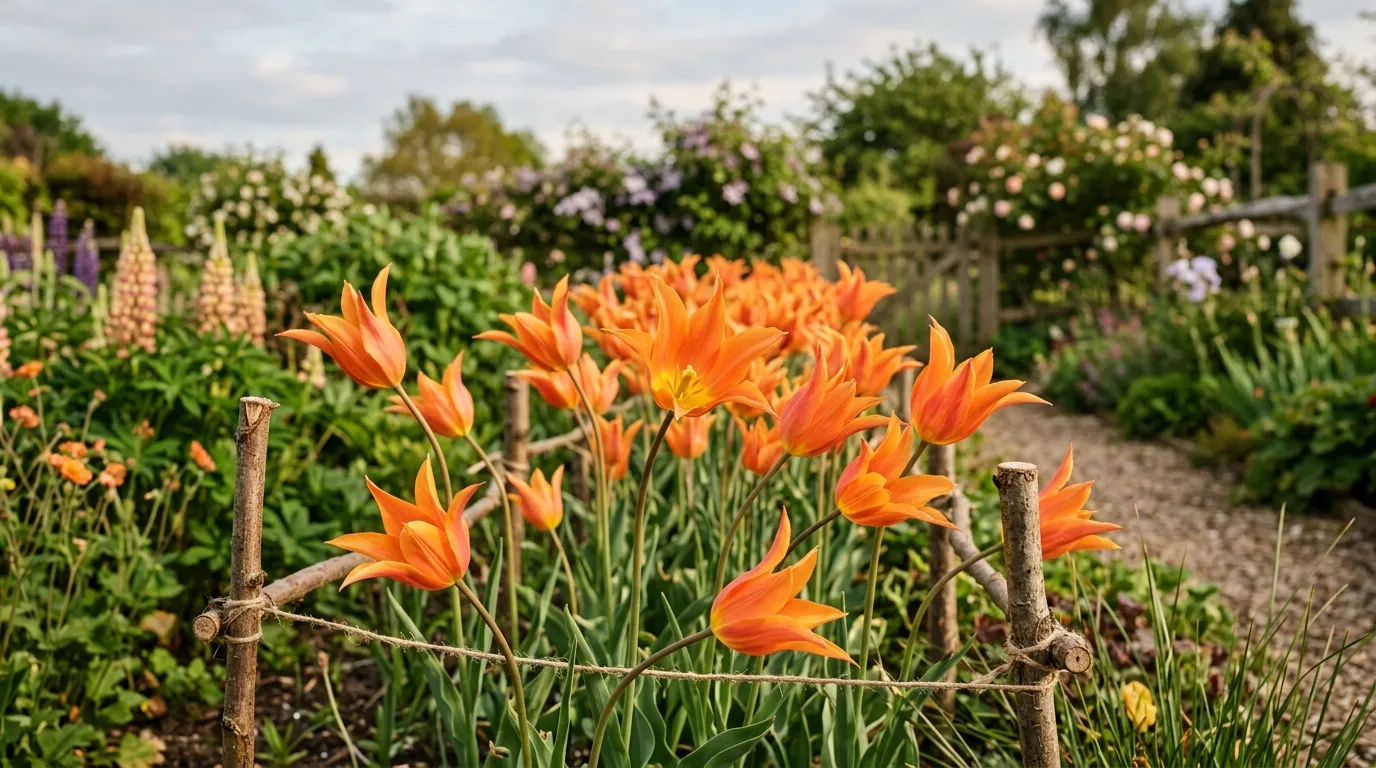
10. ‘Ballerina’ (Lily-flowered): orange flames
‘Ballerina’ is the most fragrant tulip on the list. The flower is orange-tangerine with pointed reflexed petals (the lily-flowered shape), on a 55cm stem in mid-May. The scent is sweet and carries across a border on a still afternoon.
Year 5 survival: 34 of 50 (68%). The lily-flowered form is light and elegant in vases; the perennial habit is a bonus.
11. Tulipa linifolia: the red ground-hugger
Tulipa linifolia is a low species tulip (15cm) with brilliant red flowers and a dark black centre. The leaves are linear and grass-like, almost invisible after flowering. Excellent for the front of a south-facing gravel border.
Year 5 survival: 32 of 50 stems (64%) with steady offset production. Plant 30 per square metre at 12cm depth.
12. Tulipa orphanidea: the bronze-orange wilding
Tulipa orphanidea is the least-known species tulip on this list. The flower is bronze-orange with a yellow centre, on a 25cm stem in mid-April. It naturalises in poor stony soil where other tulips fail.
Year 5 survival: 31 of 50 (62%). Plant 25 per square metre at 18cm depth. Source from specialist bulb suppliers; less commonly stocked than the better-known species.
The no-lift method that works for 5+ years
The traditional advice is to lift tulip bulbs after flowering, dry them, store them, and replant in autumn. This works but loses 10-15% of the bulbs to storage rot each year. The no-lift method skips all of this.
The method:
- Plant at 20cm depth (or 3x bulb height for small species). This is the single most important step. Deep planting protects the bulb from summer heat above 25C and from fork damage during border work.
- Choose well-drained soil. Gravel, sandy loam, raised beds. Heavy clay needs lifting unless improved with grit before planting.
- Plant 100mm apart minimum for full-sized cultivars, 50mm for species. Tight planting forces competition and weakens the bulbs.
- Deadhead after flowering. Remove the seed pod within a week of petals dropping. The bulb redirects energy from seed to next year’s flower.
- Leave foliage to die back naturally. 6-8 weeks of green leaf builds the next year’s bulb. Never knot, fold or cut the leaves. Cut down only when fully yellow and pulled away easily.
- No summer water. Once the foliage dies back, the bulb wants a dry rest. A drip irrigation system running through summer ruins perennial tulips.
- Top-dress with grit in autumn. A 25mm layer of horticultural grit each November keeps the surface drained over winter.
The mistake is lifting too early. Cutting the foliage before it yellows starves the bulb of the photosynthesis it needs to rebuild for next spring.
The UK tulip year
| Month | Job |
|---|---|
| September | Order bulbs from specialist suppliers |
| Mid to late October | Plant at 20cm depth, water once |
| November | Top-dress with 25mm horticultural grit |
| December-February | Leave alone, no winter water |
| March | Watch for emergence; protect from late frost only if needed |
| April-May | Flowering window for the 12 cultivars |
| Early June | Deadhead within a week of petal drop |
| June-July | Leave foliage to die back naturally |
| August | Once foliage is fully yellow, cut to ground |
| September | Mulch lightly; no fertiliser needed |
The 4 common mistakes
- Planting too shallow. Most bulb packs say 10-15cm. Trial data shows 20cm gives 5-year survival twice as high as 10cm. Plant deeper.
- Lifting Triumph and Darwin hybrids and expecting them back. Most modern hybrids are bred as annuals. Lift, plant new bulbs each autumn, treat the planting as a single-season display.
- Watering through summer. Tulips need a dry summer dormancy. A border watered weekly through July-August rots the bulbs.
- Cutting foliage too early. Yellow leaves means ready to cut. Green leaves means the bulb is still feeding.
Related reading: Some bulbs are better forced indoors than perennialised, as our guide to growing paperwhites for Christmas shows.
Frequently asked questions
Will perennial tulips survive in pots?
Yes for 2-3 seasons but not for the full 5+ years of in-ground planting. Pot soil heats up too much in summer and freezes too hard in winter. Plant in pots for the first year, then transplant to a free-draining border in autumn for long-term perennial returns.
Do squirrels and mice eat the bulbs?
Yes, especially in the first 4 weeks after planting. Deep planting at 20cm helps; rodents typically dig only the top 10cm. A layer of chicken wire 50mm below the surface stops them entirely. Mice are the bigger problem in UK gardens than squirrels.
Can I mix species and cultivar tulips in the same bed?
Yes, with timing in mind. Species tulips flower mid-April, cultivars early to mid-May. A mixed planting gives 6 weeks of continuous tulip colour. Use species at the front (10-30cm) and cultivars at the back (40-55cm).
Do I need to fertilise tulip bulbs?
No annual fertiliser for established perennial tulips. A light top-dressing of bone meal at planting (one handful per square metre) supports root development. Heavy nitrogen feeds produce floppy foliage and weak flowers.
Why have my Apricot Beauty tulips faded after 2 years?
Three likely causes: planted too shallow (under 15cm), summer watering keeping the bulbs damp, or foliage cut too early. Replant the bulbs at 20cm depth in autumn, stop summer watering, and let next year’s leaves yellow fully before cutting.
Most tulips are annuals in disguise. Plant the 12 species and cultivars on this list at 20cm depth in well-drained soil, deadhead after flowering, and let the foliage die back naturally. The bed flowers for 5 years or more without lifting. Pair with our how to grow tulips and when to plant tulip bulbs guides, and the cutting garden layout guide for tulips as cut flowers.
Our team produces practical UK gardening guidance from source research, contributor records and established horticultural practice. Editorial standards are overseen by Matt W.