Key takeaways
- Philadelphus flowers on old wood in June and July - prune immediately after flowering, never in winter
- Belle Etoile is the best variety for small gardens at 1.5m tall with maroon-centred flowers
- Manteau d'Hermine stays under 1m and suits containers and front borders
- Take semi-ripe cuttings in July for free plants - root in 4-6 weeks at 15-18C
- Grows in any soil including heavy clay and chalk, tolerating pH 5.5-8.0
- Old unpruned plants can be renovated by cutting the entire shrub to 30cm in March
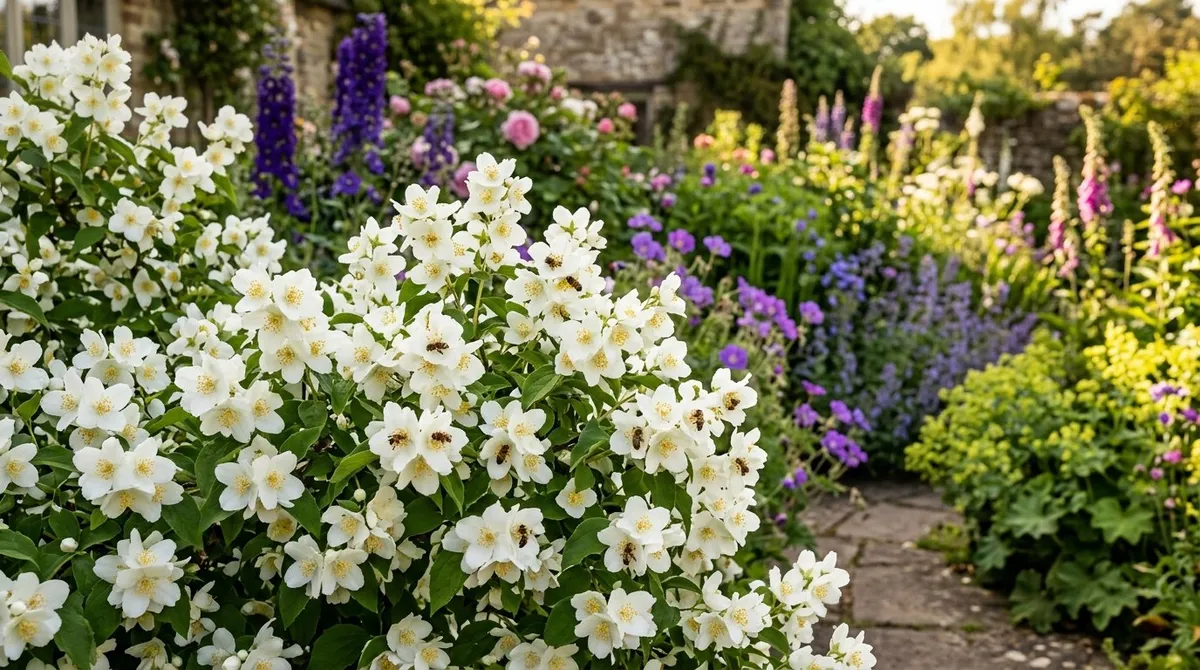
Philadelphus is one of the most intensely fragrant shrubs you can grow in a British garden. The common name, mock orange, comes from the scent of the white flowers, which closely resembles orange blossom. A single mature bush scents an entire garden in June and July. It grows on almost any soil, shrugs off hard winters, and forgives neglect. Few shrubs offer this combination of perfume, hardiness, and low maintenance.
The genus includes around 60 species, but only a handful matter for UK gardeners. This guide covers the best varieties for different garden sizes, the correct pruning method (get this wrong and you lose a full year of flowers), and how to propagate new plants from summer cuttings. Whether you have a cottage garden border or a small paved courtyard, there is a philadelphus to fit.
Which philadelphus variety should I choose?
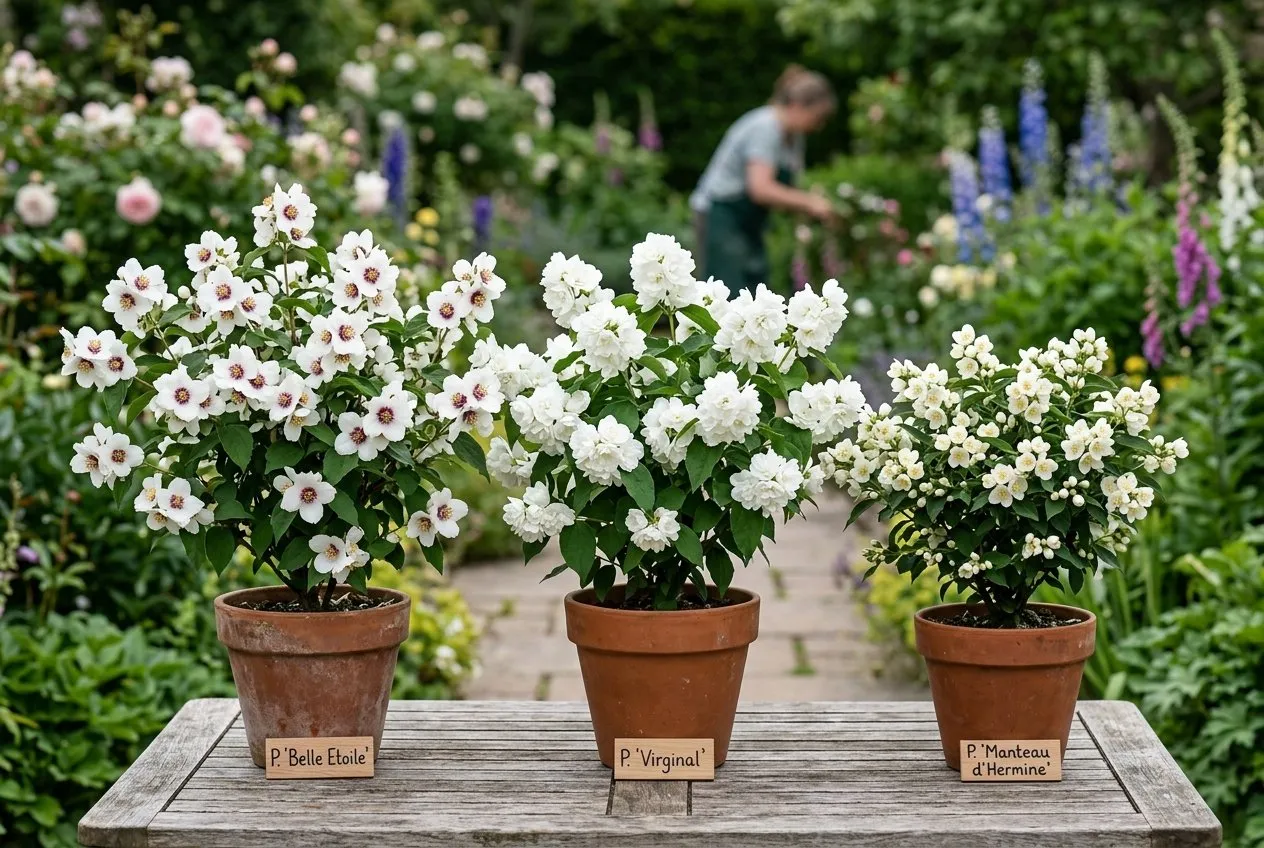 Three popular philadelphus varieties compared: the compact Belle Etoile, fully double Virginal, and dwarf Manteau d’Hermine.
Best for small gardens
Manteau d’Hermine stays under 1m and works well in large containers or at the front of a border. The double cream-white flowers appear in dense clusters along arching stems. It is the most compact philadelphus available and suits small gardens where space is tight.
Best for hedging and screening
P. coronarius is the traditional cottage garden species. It grows vigorously to 4m tall and 3m wide, making it ideal for informal boundary hedging. The cream-white flowers appear in early June and the scent carries 15-20 metres on still evenings. For a flowering screen, plant at 1.5m intervals and allow to grow unpruned for the first 3 years. After that, remove one in three of the oldest stems annually to keep the hedge thick from base to top. This approach works well alongside other flowering shrubs for a mixed native-style boundary.
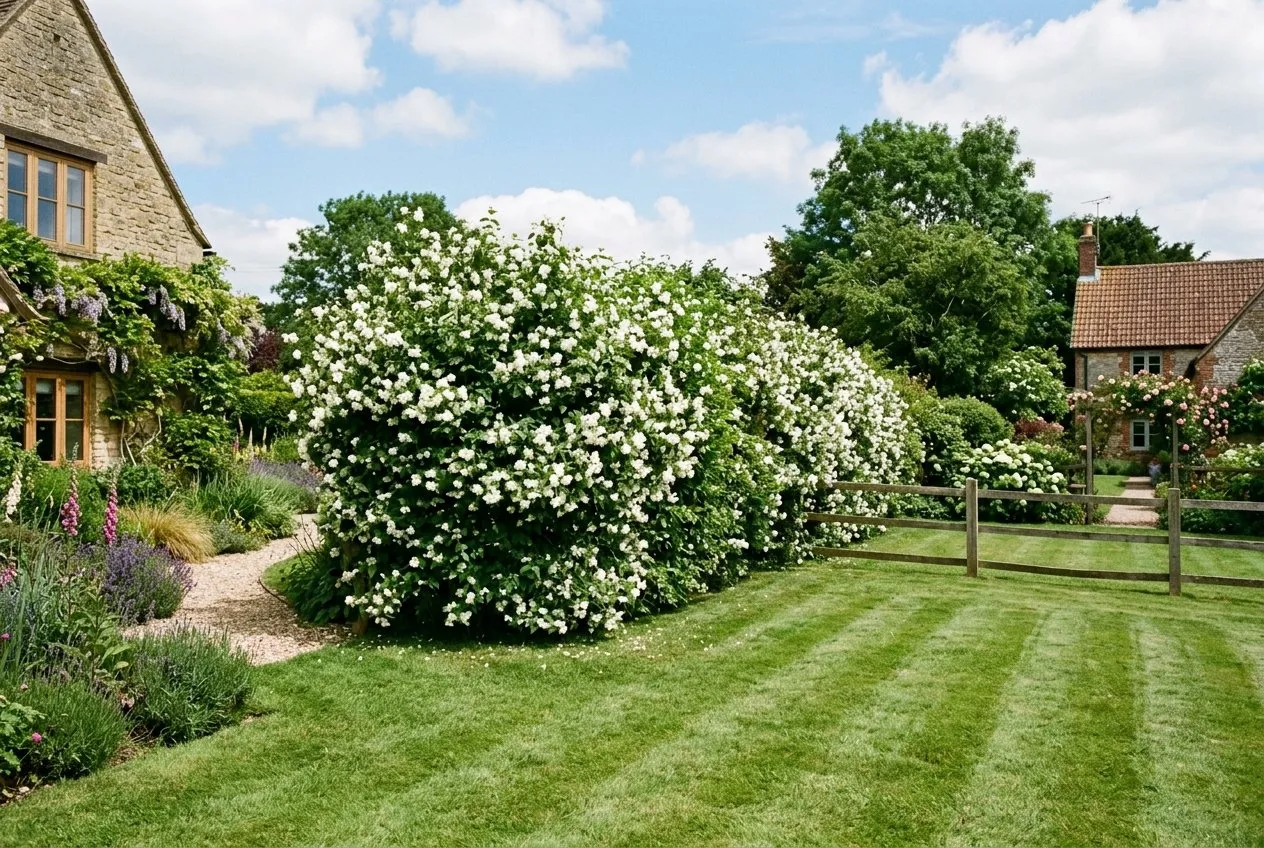 A mature Philadelphus coronarius hedge forming a dense, fragrant boundary between two gardens.
Where to plant philadelphus
Philadelphus grows in any well-drained soil with a pH between 5.5 and 8.0. It thrives on heavy clay, chalk, loam, and sandy ground. This is one of the most soil-tolerant shrubs available to UK gardeners.
Spacing depends on intended use. For a specimen shrub, allow the full expected spread plus 30cm on each side. For an informal hedge, plant at half the expected spread. P. coronarius at 1.5m centres forms a solid screen within 4 years.
Planting time is October to March, while the plant is dormant. Container-grown plants can go in at any time, but autumn planting gives roots 5-6 months to establish before the first summer drought. Dig a hole twice the width of the rootball and the same depth. Mix in a handful of bone meal and backfill with the original soil. Water thoroughly and mulch with 7-8cm of bark or garden compost.
How to prune philadelphus after flowering
Pruning timing is the single most important thing to get right with philadelphus. The shrub flowers on stems produced the previous summer. Cutting at the wrong time removes every flower bud and costs a full year of bloom.
Prune within two weeks of the last flowers fading, typically in late July. The method is straightforward:
- Identify the oldest, thickest stems. These are grey-barked and carry the spent flower heads.
- Cut one in three of these old stems to ground level using loppers or a pruning saw.
- Leave all young green shoots untouched. These will carry next year’s flowers.
- Remove any crossing, dead, or damaged branches.
- Stand back and check the shape. The remaining framework should be open and vase-like.
This annual cycle keeps the plant producing strong flowering wood. Skip pruning for 3-4 years and the shrub becomes a dense thicket of old wood with flowers only at the very top, out of reach and out of sight.
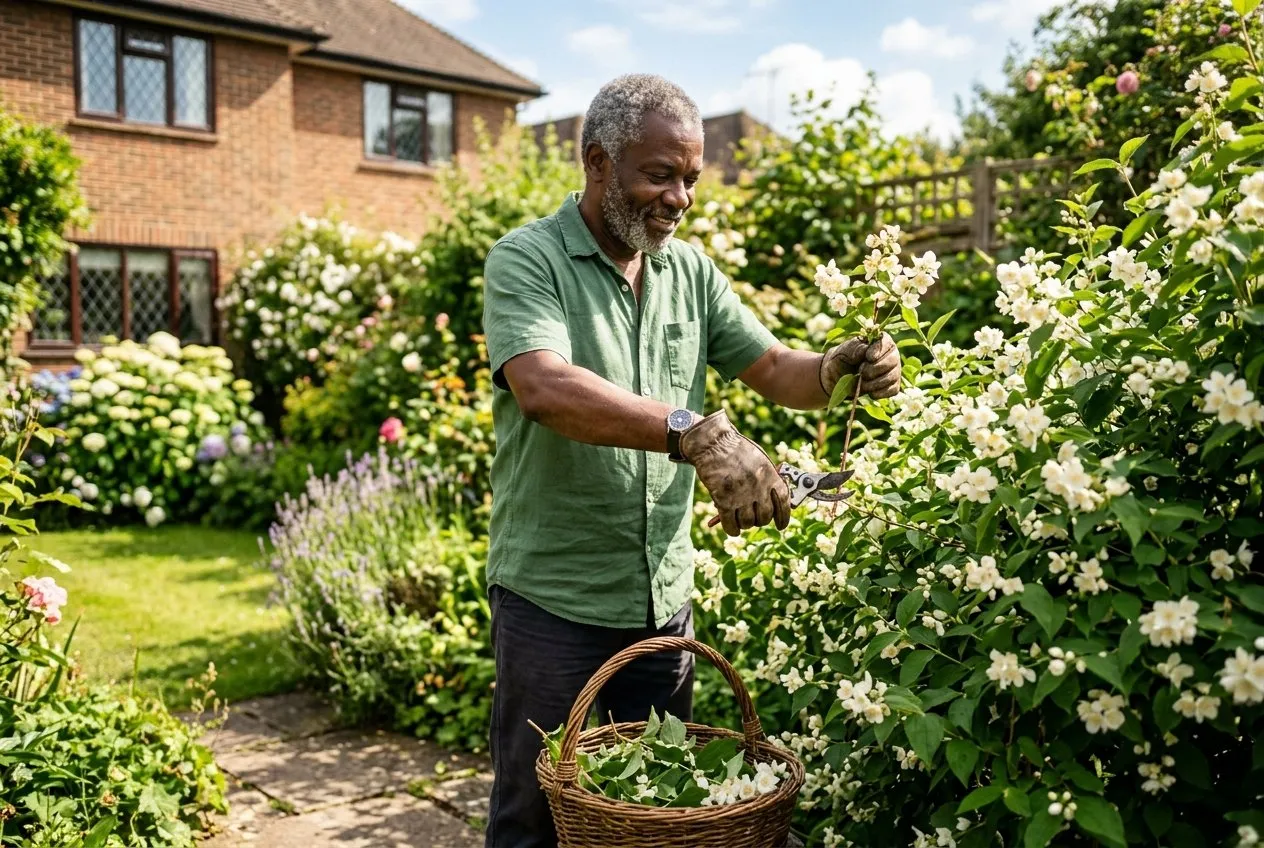 Pruning philadelphus immediately after flowering. Cut one in three of the oldest stems to ground level each July.
Renovating an old, neglected philadelphus
An overgrown philadelphus that has not been pruned for years responds well to hard renovation. In March, cut the entire plant to 30cm from ground level. Every stem. It looks brutal, but philadelphus is one of the most resilient shrubs in UK gardens. New shoots appear within 6-8 weeks and grow 1-1.5m in the first season. Expect light flowering in the second summer and full flowering by the third. Feed with a general-purpose fertiliser (Growmore at 70g per square metre) after hard pruning to fuel the regrowth.
How to propagate philadelphus from cuttings
Semi-ripe cuttings taken in July root easily and produce free plants identical to the parent. This is the standard propagation method and works for all varieties.
- Select a healthy, non-flowering shoot of the current year’s growth. It should be firm at the base but still soft at the tip.
- Cut a 10-15cm length, making the bottom cut just below a leaf node.
- Strip the lower two-thirds of leaves, leaving 2-3 pairs at the top.
- Dip the cut end in hormone rooting powder (0.4% IBA strength).
- Insert into a 50:50 mix of perlite and peat-free multipurpose compost, burying the bottom third.
- Water lightly. Cover the pot with a clear polythene bag or place in a propagator at 15-18C.
- Roots form in 4-6 weeks. Tug gently to test for resistance.
- Pot individually into 9cm pots in September. Overwinter in a cold frame or sheltered spot.
- Plant out the following autumn, when the root system is well established.
Gardener’s tip: Take 50% more cuttings than you need. Expect a 70-80% success rate with semi-ripe material. Softwood cuttings taken in June root faster but have a higher failure rate of around 40%.
Philadelphus care calendar
| Month | Task |
|---|---|
| January-February | Check for wind damage on exposed plants. No pruning. |
| March | Feed established plants with Growmore at 70g/m². Hard-renovate neglected plants now if needed. |
| April | Mulch with 7-8cm of bark or compost. Water newly planted shrubs if dry. |
| May | New growth extends rapidly. Tie in wayward stems on wall-trained plants. |
| June | Flowering begins. Enjoy the scent. Do not prune yet. |
| July | Main flowering peaks mid-month. Prune immediately after last flowers fade. Take semi-ripe cuttings. |
| August | New shoots grow strongly on pruned plants. Water in prolonged dry spells. |
| September | Pot up rooted cuttings individually. |
| October-November | Plant new philadelphus. Best planting window for bare-root stock. |
| December | No action needed. Philadelphus is fully hardy to -20C. |
Common mistakes when growing philadelphus
Pruning in winter or spring. This is the number one error. Every cut removes a flower bud that formed the previous summer. Always prune in July, within two weeks of flowering finishing.
Planting in deep shade. Philadelphus tolerates light shade but produces dramatically fewer flowers without sun. A plant in full shade may produce just 5-10% of the flowers compared to one in full sun.
Overfeeding with nitrogen. High-nitrogen feeds (lawn fertiliser, fresh manure) promote leafy growth at the expense of flowers. Use a balanced fertiliser like Growmore or mulch with compost. The best fertilisers for gardens guide covers feeding shrubs in more detail.
Never pruning at all. Left unpruned for 5+ years, philadelphus becomes a bare-stemmed thicket that flowers only at the very top. Annual one-in-three removal keeps the plant productive from ground level upwards.
Planting too close to walls. The arching habit needs space. Allow at least 60cm between the stem base and any wall or fence. Cramped plants develop lopsided growth and poor air circulation, increasing the risk of powdery mildew.
Philadelphus pests and diseases
Powdery mildew appears as a white dusty coating on leaves in late summer, particularly in dry, still conditions. It rarely causes serious harm. Improve air circulation by thinning crowded stems. Avoid overhead watering. Severe cases respond to a sulphur-based fungicide spray.
Aphids occasionally colonise soft shoot tips in May and June. A strong jet of water knocks them off. Encourage natural predators, especially ladybirds and lacewings, by planting bee-friendly plants and avoiding pesticides. Aphid damage on philadelphus is almost always cosmetic and does not affect flowering.
Companion planting with philadelphus
Philadelphus peaks in June and July, leaving a gap for the rest of the year. Underplanting with complementary species extends the interest across all four seasons.
Spring partners: Early-flowering bulbs (snowdrops, narcissus) carpet the ground beneath deciduous philadelphus before the leaves emerge. Brunnera ‘Jack Frost’ adds silver foliage and blue flowers from April.
Summer partners: Hardy geraniums, especially G. ‘Rozanne’, flower continuously from June to October and cover the base of the shrub. Digitalis purpurea (foxglove) adds vertical spikes behind compact varieties. These combinations work particularly well in mixed borders.
Autumn and winter interest: The deciduous habit of philadelphus means winter structure must come from evergreen companions. Box, euonymus, or low-growing sarcococca provide green bulk from November to March. Sarcococca confusa adds winter scent, keeping the fragrance theme alive year-round. See our guide to white flowers for UK gardens for more pairing ideas.
Frequently asked questions
When should I prune philadelphus?
Prune immediately after flowering in July. Philadelphus blooms on wood produced the previous summer. Cut one in three of the oldest, thickest stems to ground level each year. This encourages vigorous new shoots that carry next year’s flowers. Never prune in winter or early spring, as you will remove every flower bud.
Can philadelphus grow in shade?
Philadelphus tolerates partial shade but flowers best in full sun. In deep shade it becomes leggy with sparse blooms. A site receiving at least 4 hours of direct sunlight produces the strongest scent and most flowers. North-facing walls suit shade-tolerant varieties like P. coronarius, though flowering drops by roughly 30%.
How do I take cuttings from philadelphus?
Take semi-ripe cuttings in July. Select healthy non-flowering shoots 10-15cm long. Remove the lower leaves, dip in hormone rooting powder, and insert into a 50:50 mix of perlite and peat-free compost. Keep at 15-18C under a clear polythene cover. Roots form in 4-6 weeks. Pot up individually in autumn.
Why is my philadelphus not flowering?
Wrong pruning timing is the most common cause. Winter or spring pruning removes the flower buds that formed the previous summer. Other causes include too much shade, excessive nitrogen fertiliser (which promotes leaves over flowers), and very young plants that need 2-3 years to reach flowering maturity.
How big does philadelphus grow?
Size depends on variety. Manteau d’Hermine stays under 1m. Belle Etoile reaches 1.5m. Virginal grows to 3m. P. coronarius can reach 4m and 3m wide. Most garden varieties settle between 1.5-2.5m in 5-7 years. Hard pruning each year keeps plants smaller without reducing flower count.
Is philadelphus good for wildlife?
Philadelphus is excellent for pollinators. The open, single-flowered varieties attract honeybees, bumblebees, and hoverflies. Dense growth provides nesting cover for small birds including wrens and dunnocks. The Bumblebee Conservation Trust lists it among the top 50 garden plants for wild bees in the UK.
Can I hard prune an old overgrown philadelphus?
Yes, philadelphus tolerates hard renovation pruning. Cut the entire shrub to 30cm from ground level in March. It will resprout vigorously and return to full flowering within 2 seasons. This is the quickest fix for a neglected plant that has become bare and woody at the base.
Now you know how to grow and prune philadelphus, read our guide to the best perennial plants for UK gardens for ideas on underplanting your mock orange border.
Our team produces practical UK gardening guidance from source research, contributor records and established horticultural practice. Editorial standards are overseen by Matt W.