Key takeaways
- Pieris needs acid soil at pH 4.5-6.0 — grow in ericaceous compost if your soil is neutral or alkaline
- New leaf colour is the main attraction: red, pink, salmon, or cream depending on variety
- 'Forest Flame' (AGM) is the most reliable UK variety, reaching 3m with vivid red new growth
- Container growing in ericaceous compost is the best option for gardens on chalk or limestone
- Shelter from cold east winds and morning sun prevents frost damage to new spring growth
- Feed with ericaceous liquid fertiliser monthly from April to August for the strongest colour
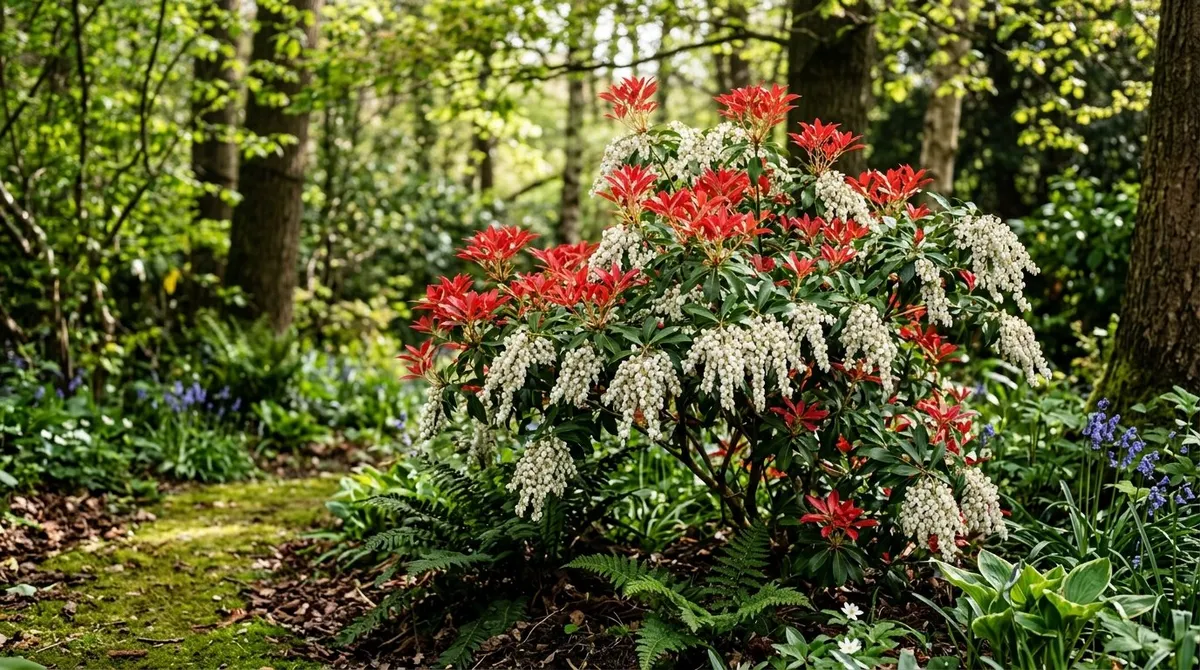
Pieris japonica is one of the finest evergreen shrubs for UK gardens, producing a dramatic flush of coloured new leaves in spring that rivals any flower. The young foliage emerges in shades of vivid red, salmon pink, or creamy white before maturing to dark glossy green. Pendulous chains of white bell-shaped flowers appear from March to May, providing early nectar when few other shrubs are in bloom.
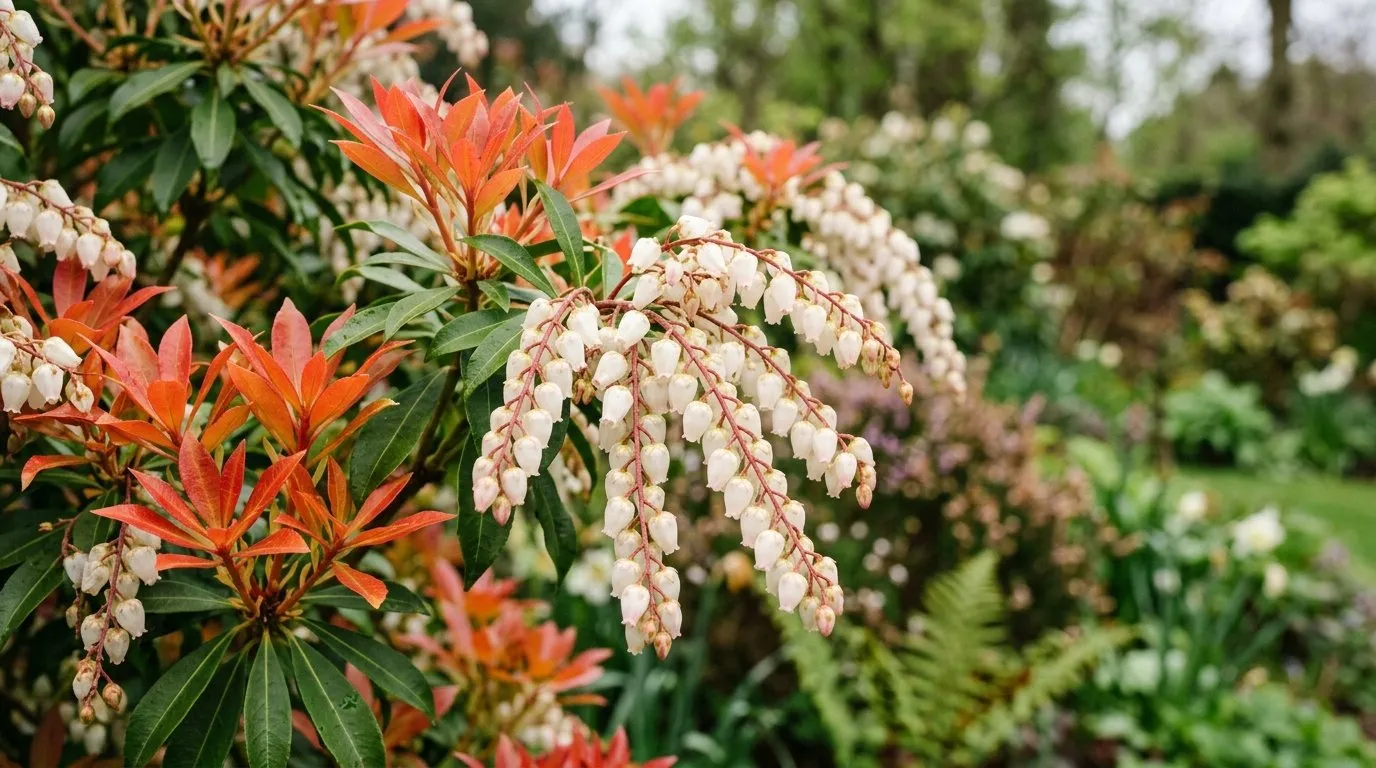
Pieris japonica ‘Forest Flame’ in full spring display, with bright red new leaves and cascading white flowers.
Why grow pieris in a UK garden?
Pieris delivers two seasons of impact from a single plant. The spring leaf colour show lasts 4-6 weeks as new growth matures from red through pink and cream to green. The flower display overlaps, running from March to May depending on variety. The rest of the year, dense glossy evergreen foliage provides solid structure and screening.
Pieris belongs to the Ericaceae family alongside rhododendrons, camellias, and heathers. All share the requirement for acid soil. The genus contains around 7 species, but Pieris japonica and its cultivars dominate UK gardens. Native to the mountain forests of Japan, Taiwan, and eastern China, the species evolved in cool, humid conditions that closely match the British climate.
Hardy varieties tolerate UK winter temperatures to -15C, making them suitable for all regions except the most exposed highland sites. The RHS rates P. japonica at H5 hardiness (hardy in most of the UK). Mature plants reach 2-4m over many years, forming a dense, rounded habit that needs minimal pruning. Growth rate is slow at 10-15cm per year, which keeps maintenance demands low.
Best pieris varieties for UK gardens
Pieris japonica ‘Forest Flame’ (AGM)
‘Forest Flame’ is the benchmark pieris for UK gardens. New growth emerges vivid scarlet-red, changing through pink and cream before settling to dark green over 6-8 weeks. White flower panicles appear in April. Reaches 3m tall and 2m wide when mature. Hardy to -15C. The most widely available variety in UK garden centres, typically 12-20 pounds for a 3-litre pot.
Pieris japonica ‘Mountain Fire’
‘Mountain Fire’ produces the most intense red new growth of any pieris, deeper and more vivid than ‘Forest Flame’. Slightly more compact at 2-2.5m. White flowers from March to April. Excellent in containers where you can appreciate the colour close up. Hardy to -15C. Slightly harder to find but stocked by specialist nurseries at 15-25 pounds.
Pieris japonica ‘Flaming Silver’
A variegated sport of ‘Forest Flame’ with white-edged leaves year-round. New growth is vivid pink-red. Slower growing at 8-10cm per year, reaching 1.5-2m. The variegation brightens shady corners where solid green varieties recede into the background. Needs more shelter from cold winds than green-leaved forms. Hardy to -12C.
Pieris japonica ‘Little Heath’
A compact dwarf variety reaching just 60-80cm, well suited to containers and small gardens. New growth is cream and pink rather than red. White-edged variegated foliage all year. Rarely flowers. Ideal for the front of an acid border or a large pot on a patio. Hardy to -15C. Available at most garden centres for 10-15 pounds.
Pieris japonica ‘Valley Valentine’
Unique among pieris varieties for its deep rose-pink flowers rather than the standard white. New growth is bronze-red. Reaches 2m. Flowers February to April, earlier than most. An excellent choice if you want flower colour as well as leaf colour. Hardy to -12C. Specialist nurseries stock it at 18-25 pounds.
Pieris varieties at a glance
| Variety | New leaf colour | Mature height | Flower colour | Flowering | Hardiness | AGM |
|---|---|---|---|---|---|---|
| ’Forest Flame’ | Scarlet-red | 3m | White | April | -15C | Yes |
| ’Mountain Fire’ | Deep red | 2-2.5m | White | March-April | -15C | No |
| ’Flaming Silver’ | Pink-red | 1.5-2m | White | April | -12C | No |
| ’Little Heath’ | Cream-pink | 60-80cm | Rarely flowers | , | -15C | Yes |
| ’Valley Valentine’ | Bronze-red | 2m | Rose-pink | Feb-April | -12C | No |
| ’Debutante’ | Bronze | 1m | White | March-April | -15C | Yes |
| ’Purity’ | Pale green | 1.5m | White (large) | March-May | -15C | Yes |
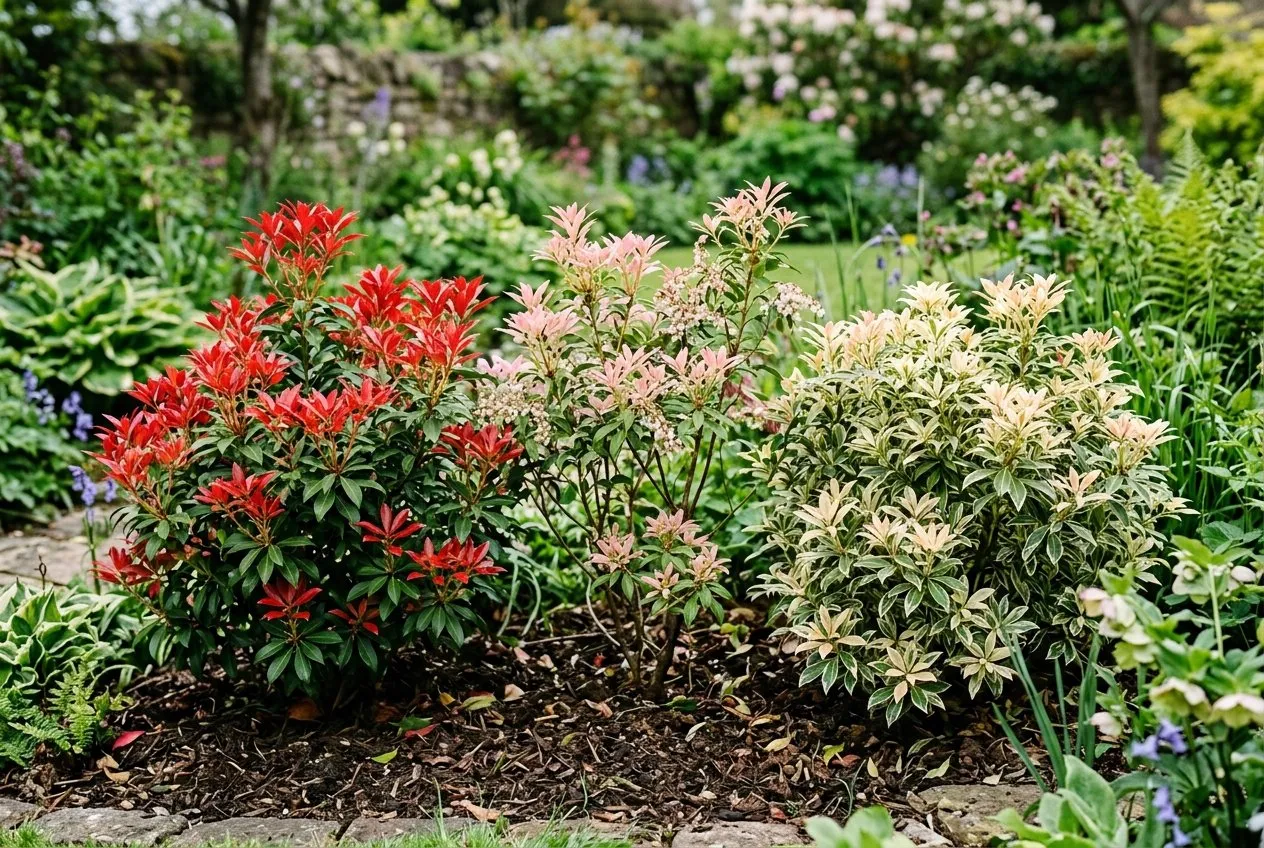
Three pieris varieties side by side showing the range of spring leaf colour, from vivid red through pink to cream variegation.
How to plant pieris
Soil requirements
Pieris needs acid soil at pH 4.5-6.0. This is non-negotiable. Above pH 6.0, iron becomes locked in the soil and the plant develops lime-induced chlorosis, yellow leaves with green veins that weaken and eventually kill it. Test your soil with a kit costing 5-8 pounds from any garden centre before buying a pieris.
Much of Scotland, Wales, the Lake District, and parts of the West Midlands has naturally acid soil. Chalk downlands, the Cotswolds, and limestone areas are too alkaline for ground planting. For a detailed breakdown by region, see our UK soil types identification guide.
Choosing a position
Pieris prefers dappled shade or a west-facing aspect. The ideal position provides 3-4 hours of filtered light and shelter from cold east winds. Avoid:
- Full south-facing sun, scorches new growth and fades leaf colour
- East-facing sites exposed to morning sun, frozen new growth that thaws rapidly suffers cell damage, turning tips brown
- Deep shade, fewer than 2 hours of light reduces flower production and dulls new leaf colour
- Frost pockets, late April frosts burn the emerging red growth that is the plant’s main feature
Pieris makes an excellent companion for rhododendrons and camellias in an acid border, sharing identical soil and shade requirements.
Planting step by step
- Dig a hole twice the width of the root ball and the same depth
- Mix excavated soil with equal parts ericaceous compost
- Position the plant so the top of the root ball sits level with the surrounding soil, never deeper
- Backfill with the ericaceous mix, firming gently
- Water deeply with rainwater, at least 10 litres per plant
- Apply a 5-7cm mulch of composted pine bark or bracken around the base, keeping it clear of the stems
Plant from October to March while dormant. Autumn planting is best because roots establish over winter before spring growth demands moisture. Container-grown plants can go in at any time, but summer planting needs daily watering.
Autumn planting gives roots time to settle before spring growth, provided the soil is not waterlogged. Spring is also suitable, especially in colder or wetter gardens, but new plants need closer attention to watering as temperatures rise.
Growing pieris in containers
Container growing is the best option for gardeners on neutral, alkaline, or chalky soil. You control the compost pH entirely, removing the single biggest risk factor.
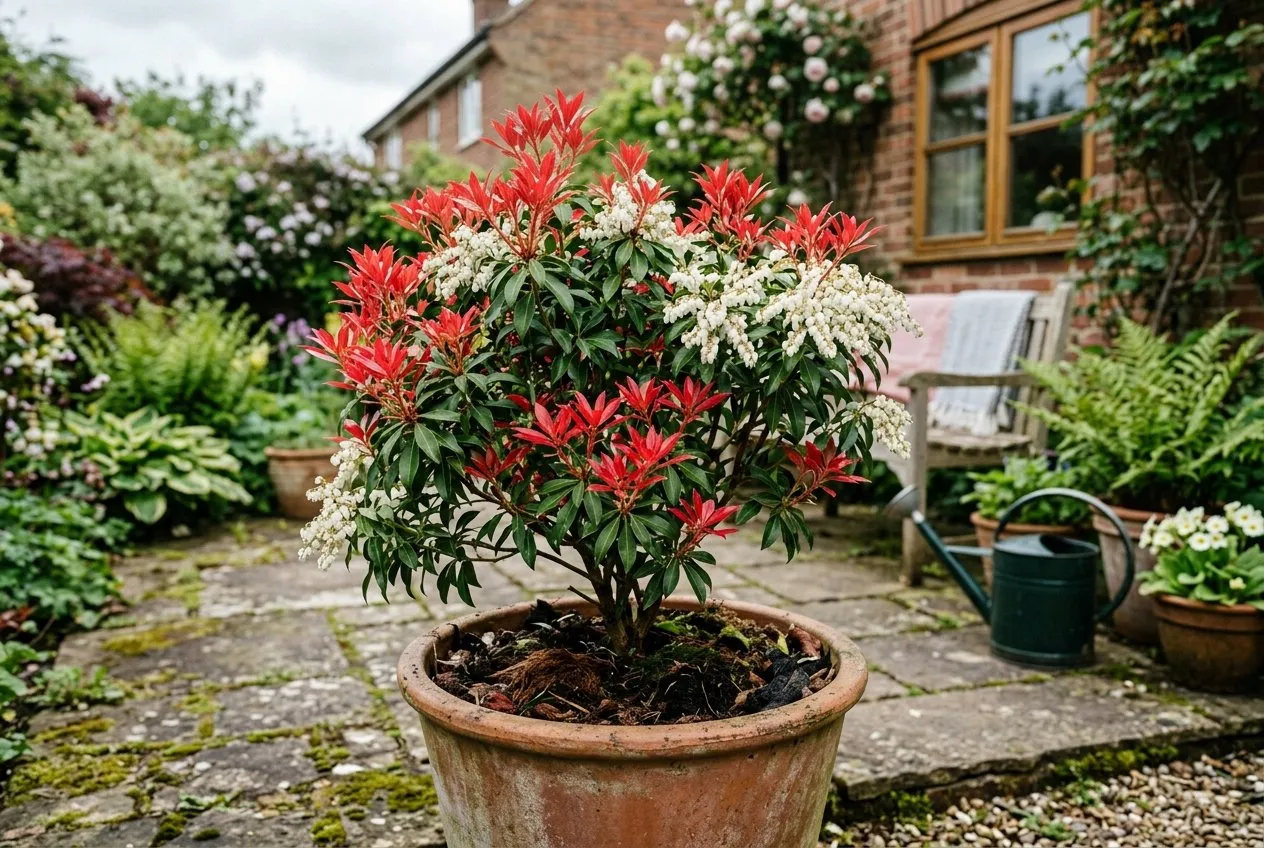
Pieris thrives in large containers filled with ericaceous compost, making it possible to grow on any soil type.
Container essentials
- Pot size: Minimum 40 litres with drainage holes. Pieris has a shallow, fibrous root system that spreads outward rather than downward
- Compost: 100% ericaceous compost. Never mix with standard multipurpose or add garden soil
- Watering: Rainwater only. Tap water in hard water areas contains calcium that raises pH over time. Install a water butt if you do not have one
- Feeding: Ericaceous liquid fertiliser monthly from April to August. Follow the dilution rate on the packet
- Repotting: Every 3-4 years into a slightly larger pot with fresh ericaceous compost
- Winter protection: Move pots against a sheltered wall from November. Wrap the pot (not the plant) with bubble wrap to prevent root freezing in severe winters below -10C
For more container growing ideas, including combining pieris with other acid-loving plants, see our best plants for pots year-round guide.
Seasonal care calendar
| Month | Task | Detail |
|---|---|---|
| January | Inspect | Check for wind damage after storms. Remove broken branches |
| February | Prepare | Apply 5cm pine bark mulch around the base |
| March | Protect | Cover with fleece if frost forecast, new growth is vulnerable |
| April | Feed | Start monthly ericaceous liquid feed. Water regularly |
| May | Prune | Deadhead spent flowers. Light shape if needed |
| June | Water | Increase watering in dry spells, 10 litres per plant twice weekly |
| July | Check | Look for lacebug damage on leaf undersides |
| August | Feed | Last ericaceous feed of the season |
| September | Mulch | Top up pine bark mulch before winter |
| October | Plant | Best month for planting new pieris |
| November | Shelter | Move containers against a sheltered wall |
| December | Rest | No action needed. Admire the evergreen foliage |
Pruning pieris
Pieris needs very little pruning. The slow growth rate and natural dome shape mean most plants maintain a tidy form without intervention. When pruning is needed, timing is critical.
When to prune: Immediately after flowering in May or June. This gives the plant a full growing season to produce new wood that carries next year’s flower buds. Never prune in autumn or winter, you remove the developing buds and lose the following spring’s display.
How to prune:
- Remove dead, damaged, or crossing branches at the base
- Cut back any leggy or bare stems to a pair of healthy buds
- Shape the canopy if needed, cutting no more than a third of the plant
- For overgrown specimens, renovation pruning to 30-40cm above ground in April triggers regrowth from dormant buds, but flowering is lost for 1-2 seasons
For broader guidance on timing and technique, see our spring pruning guide.
Common problems and solutions
Yellow leaves (lime-induced chlorosis)
Yellow leaves with green veins are the most common pieris problem. The cause is soil pH above 6.0, which locks up iron in the soil. Treat with sequestered iron chelate at 15g per 10 litres of water as a soil drench. Long-term, lower soil pH with sulphur chips at 100g per square metre. For container plants, switch to rainwater and repot in fresh ericaceous compost. Our soil testing and pH adjustment guide covers the process in detail.
Lacebug (Stephanitis takeyai)
Pieris lacebug is an increasingly common pest in southern England. Adults and nymphs feed on the undersides of leaves, causing mottled brown or silvery patches on the upper surface. Check leaf undersides from May onwards. Spray with organic contact insecticide in early June when nymphs are small. Remove badly affected leaves. Good air circulation and avoiding dry conditions reduce risk.
Frost damage to new growth
Late April and May frosts scorch the vivid new leaf tips, turning them brown and papery. Drape horticultural fleece over the plant when frost is forecast. The damage is cosmetic rather than fatal, the plant pushes fresh growth from lower buds. Planting in a sheltered, west-facing position minimises the risk.
Phytophthora root rot
Waterlogged soil causes root rot in pieris. Symptoms include wilting despite wet soil, and browning of stems from the base upward. Improve drainage before planting by adding 30% bark or grit to the planting hole. Avoid heavy clay sites without drainage improvement. There is no chemical cure for established root rot, remove and destroy affected plants to prevent spread.
Warning: All parts of pieris are toxic to cats, dogs, horses, and humans. The plant contains grayanotoxins that affect the heart and nervous system. Keep pets away from fallen leaves and flowers. If ingestion is suspected, contact your vet or NHS 111 immediately.
What to plant with pieris
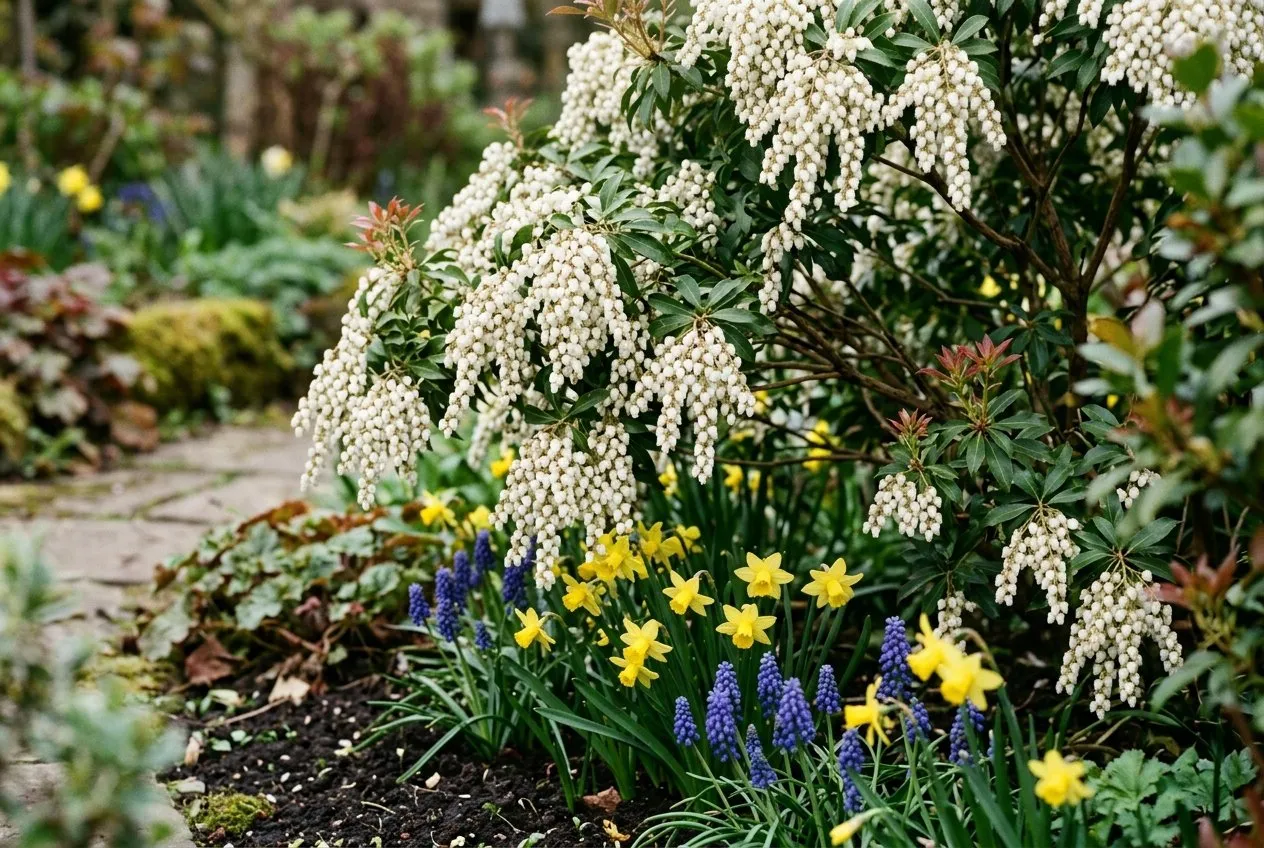
Pieris flowers combine with spring bulbs planted in the acid soil beneath the canopy.
Pieris fits naturally into acid-loving plant schemes. The best companions share the same pH requirement and light preference:
- Rhododendrons, flower at the same time, filling the middle and back of the border with bold colour
- Camellias, flower earlier (January to April), extending the acid border’s season
- Japanese maples, provide autumn colour contrast against pieris’s evergreen backdrop
- Ferns, textural ground cover that thrives in the same dappled shade
- Bluebells and cyclamen, woodland bulbs for underplanting, naturalising in acid leaf litter
- Heathers (Calluna and Erica), low ground cover in the same pH range, providing winter flowers
For ideas on combining different shrubs and perennials for year-round interest, see our guide to the best plant combinations for UK borders.
Where to buy pieris in the UK
Expect to pay 10-25 pounds for a 3-5 litre pot from garden centres and online nurseries. Specialist acid-plant nurseries offer rarer varieties. Larger specimens in 10-20 litre pots cost 30-60 pounds. Buy in autumn for the best selection and immediate planting.
Reputable UK suppliers include Burncoose Nurseries (Cornwall), Millais Nurseries (Surrey, specialists in ericaceous plants), and Hillier Nurseries. All three ship nationwide. Your local garden centre will stock ‘Forest Flame’ and ‘Little Heath’ as a minimum.
Frequently asked questions
What soil does pieris need?
Pieris needs acid soil at pH 4.5-6.0. Above pH 6.0, iron becomes chemically unavailable and the plant develops yellow leaves with green veins. Test your soil with a kit costing 5-8 pounds from any garden centre. If your soil is neutral or alkaline, grow pieris in containers filled with ericaceous compost instead.
Can I grow pieris in a pot?
Yes, pieris grows very well in containers. Use a pot of at least 40 litres with drainage holes and fill with ericaceous compost. Water with rainwater, not tap water, to keep the compost acidic. Feed monthly with ericaceous liquid fertiliser from April to August. Repot every three to four years when roots fill the container.
Why is my pieris not turning red?
Weak colour usually means insufficient light or poor feeding. Pieris needs 3-4 hours of direct light daily for vivid new growth colour. Feed with ericaceous fertiliser monthly from April. Also check your variety, ‘Little Heath’ produces cream new growth, not red. Only ‘Forest Flame’, ‘Mountain Fire’, and ‘Flaming Silver’ give intense red.
When should I prune pieris?
Prune immediately after flowering in May or June. This gives the plant a full growing season to produce next year’s flower buds. Remove dead branches, shape if needed, and cut back leggy stems. Never prune in autumn or winter as this removes developing flower buds and costs you next spring’s display.
Is pieris toxic to pets?
Yes, all parts of pieris are toxic to cats, dogs, horses, and humans. The plant contains grayanotoxins that affect the heart and nervous system if ingested. Symptoms include vomiting, drooling, and weakness. Keep pets away from fallen leaves and flowers. Contact your vet immediately if you suspect ingestion.
How fast does pieris grow?
Pieris grows slowly at 10-15cm per year in average UK conditions. A plant bought at 60cm will take roughly 10 years to reach 2m. This slow growth rate makes pieris very low-maintenance once established. It rarely needs pruning to control size and holds its natural dome shape without intervention.
What can I plant with pieris?
Plant pieris alongside other acid-loving shrubs such as rhododendrons, camellias, and Japanese maples. Underplant with woodland bulbs like bluebells, cyclamen, and snowdrops. Heathers and ferns work well at the base. All these companions share the same soil pH requirement and thrive in the dappled shade that suits pieris.
Next step: If you are starting an acid-loving plant collection, read our guide to the best flowering shrubs for UK gardens for more year-round colour ideas.
Our team produces practical UK gardening guidance from source research, contributor records and established horticultural practice. Editorial standards are overseen by Matt W.