Key takeaways
- Pyracantha grows in any soil, any aspect, and every UK region — one of the toughest shrubs available
- Prune immediately after flowering in July to preserve developing berry clusters for autumn
- Orange Glow and Soleil d'Or produce the heaviest berry crops but are susceptible to pyracantha scab
- The Saphyr range (Rouge, Orange, Jaune) offers excellent scab resistance bred by INRA in France
- Plant hedging at 45cm spacing for a dense, impenetrable security boundary within three years
- Berries feed blackbirds, redwings, fieldfares, and waxwings from September through to late February
Pyracantha is one of the best shrubs you can grow in a UK garden for year-round interest. This thorny evergreen produces masses of white flowers in early summer, followed by heavy clusters of berries from September right through to February. Few other plants offer four-season value like this. The berries feed visiting birds through the coldest months while the dense, spiny growth makes a natural security barrier that no fence can match.
Commonly called firethorn, pyracantha belongs to the rose family (Rosaceae) and is native to southern Europe and western Asia. It has been grown in British gardens since the 1600s. The Royal Horticultural Society gives several cultivars the Award of Garden Merit, confirming their reliability in UK conditions. Whether you want a wall-trained specimen, a boundary hedge, or a freestanding shrub, pyracantha delivers. This guide covers planting, training, pruning, variety selection, and pest management from eight years of hands-on growing in Staffordshire.
What is pyracantha?
Pyracantha is an evergreen shrub armed with sharp thorns up to 2.5cm long. The glossy dark green leaves stay on the plant throughout winter, giving structure when deciduous plants are bare. In June, dense clusters of small white flowers cover every branch. These flowers are rich in nectar and pollen, attracting honeybees, bumblebees, and hoverflies in large numbers.
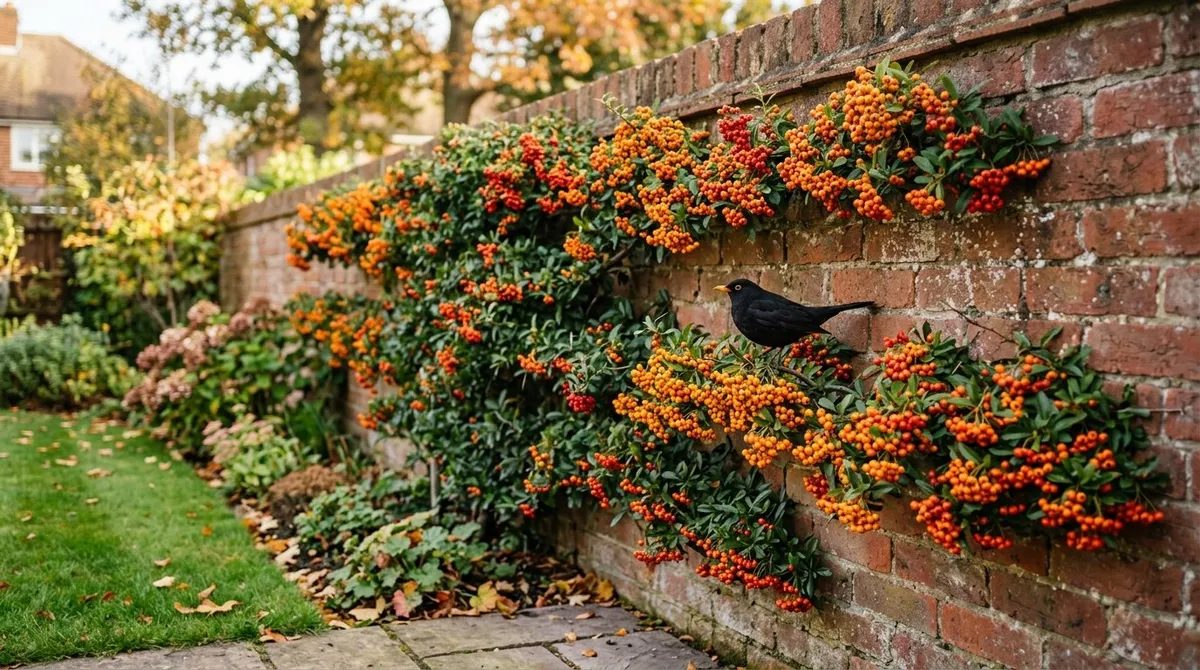
The flowers develop into berries (technically pomes, like tiny apples) that ripen from September onward. Berry colour depends on cultivar: orange, red, or yellow. The berries persist on the plant for months, gradually softening through winter until birds strip them bare. A mature pyracantha on a south-facing wall can carry thousands of berries in a good year. The combination of evergreen foliage, spring blossom, autumn berries, and spiny security makes pyracantha one of the most useful garden shrubs available in the UK.
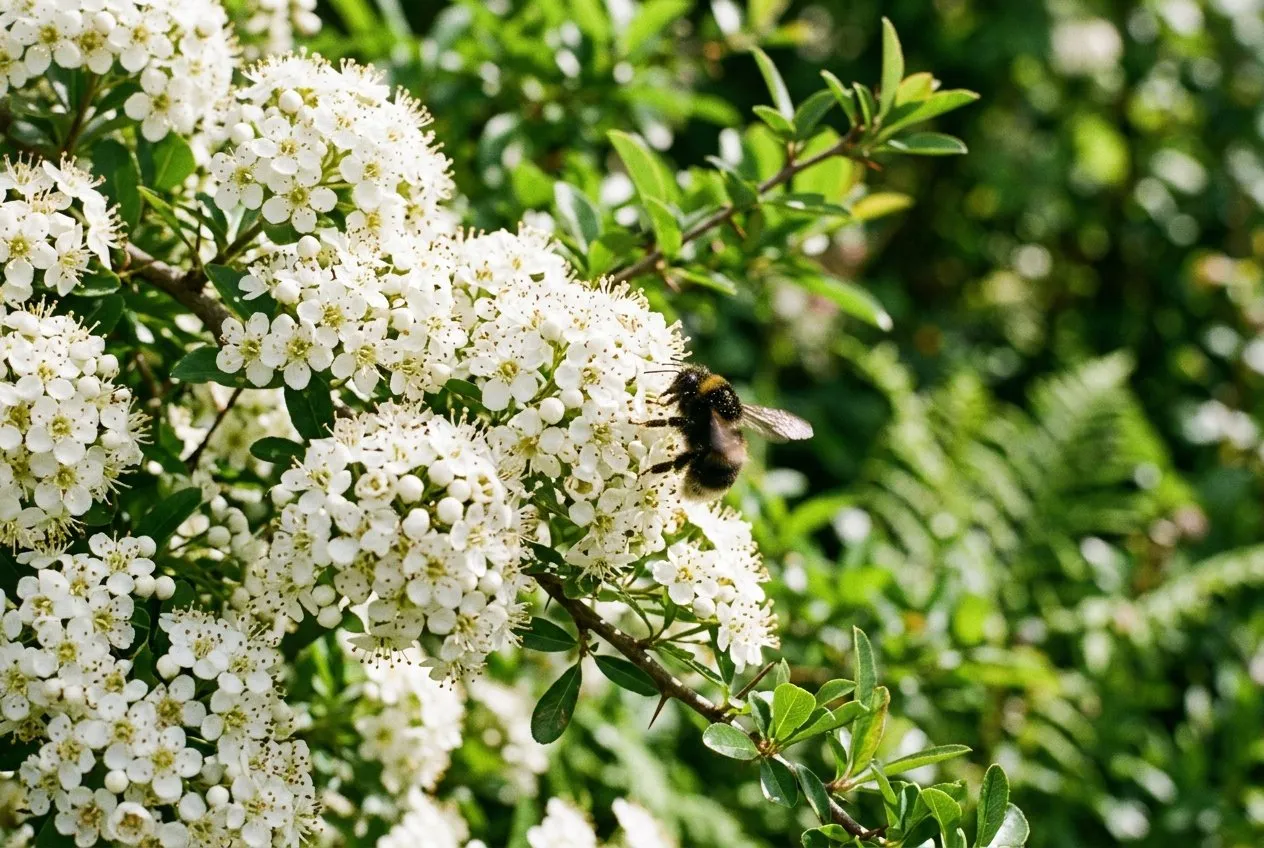
Pyracantha flowers in June attract bees and hoverflies in large numbers
Why grow pyracantha in your garden?
Pyracantha earns its place in any garden on practical grounds alone. The thorny growth makes a genuinely impenetrable barrier. Police crime prevention officers recommend it as one of the best deterrent plants for boundary planting. A mature hedge stops intruders far more effectively than a standard 1.8m fence panel, and it looks far better too.
For wildlife gardeners, pyracantha is outstanding. The flowers support pollinators in early summer. The berries feed blackbirds, thrushes, redwings, and fieldfares from autumn through winter. Dense evergreen growth provides nesting sites for robins, wrens, and dunnocks. The British Trust for Ornithology lists pyracantha berries among the top winter food sources for garden birds. A single well-grown plant can support a surprising number of species across all four seasons.
Best pyracantha varieties for UK gardens
Choosing the right cultivar matters. Berry colour, growth habit, ultimate size, and scab resistance all vary between varieties. Here are the five most reliable cultivars for British conditions, based on eight years of side-by-side growing.
Orange Glow is the most widely planted pyracantha in the UK. It produces enormous clusters of bright orange berries and grows vigorously to 4m. The one drawback is susceptibility to pyracantha scab in wet seasons. Despite this, Orange Glow remains the top choice for sheer berry volume.
Soleil d’Or carries golden-yellow berries that ripen slightly later than orange cultivars. It reaches 3-4m and has a slightly more upright habit. Yellow berries are often the last to be eaten by birds, extending the display into February.
Red Column has a strongly upright growth habit, making it the best choice for narrow spaces. Bright red berries cover the plant from September. It reaches 3m tall but stays compact at around 1.5m wide. This is the cultivar to choose for wall training where width is limited.
Mohave is an American-bred hybrid with heavy crops of orange-red berries. It has better disease resistance than Orange Glow and strong vigour. Mohave is widely used in commercial landscaping because it is tough and reliable.
Saphyr range (Rouge, Orange, and Jaune) were bred by INRA in France specifically for scab resistance. If pyracantha scab is a problem in your area, the Saphyr cultivars are the solution. Berry production is good though not quite as heavy as Orange Glow.
How to plant pyracantha
Pyracantha tolerates almost any growing conditions. It thrives in full sun but also grows well in partial shade and even on north-facing walls. Any well-drained soil suits it: clay, loam, chalk, or sand. The only requirement is that the ground does not become waterlogged in winter. Container-grown plants from garden centres can be planted at any time of year, though autumn planting gives roots time to establish before the growing season.
Dig a hole twice the width of the rootball and the same depth. Mix in garden compost if the soil is poor. Set the plant at the same depth it was growing in the pot. Water thoroughly and mulch with a 5cm layer of bark or compost. For wall-trained plants, position the rootball 30-45cm away from the base of the wall where soil tends to be dry. Lean the stems toward the wall and tie to horizontal wires from the start.
Water new plants regularly through their first two summers. Once established, pyracantha needs no supplementary watering except during prolonged drought. It rarely needs feeding either. An annual mulch of garden compost in spring provides all the nutrients a healthy plant requires.
Training pyracantha against walls and fences
Wall training improves pyracantha into a flat, productive screen that maximises berries and saves space. Fix horizontal galvanised wires to the wall at 30cm intervals using vine eyes. Start the first wire 45cm from the ground and continue up to the desired height. Use 10cm spacer vine eyes to hold the wires away from the brickwork, allowing air to circulate behind the plant.
Tie in the main stems as fans, spreading them evenly across the wires. Use soft garden twine or flexible plant ties. As new side shoots grow through spring and summer, select those that grow parallel to the wall and tie them in. Remove or shorten any shoots that grow straight outward. The goal is a flat framework of branches that sits tight against the wall surface.
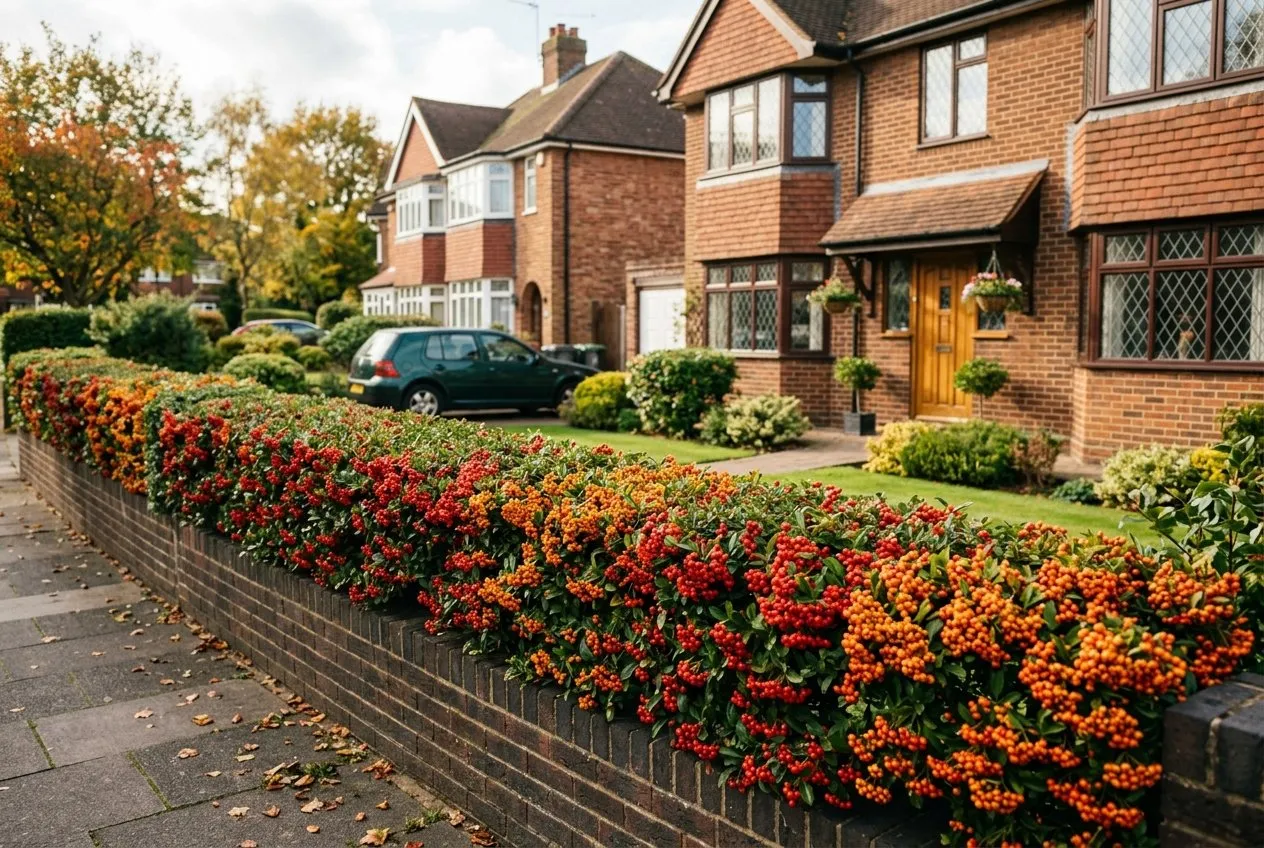
A well-clipped pyracantha hedge makes a dense, colourful boundary
How to prune pyracantha for maximum berries
Pruning timing is critical. Pyracantha flowers on wood produced the previous year. The flowers appear in June and develop into berries from July onward. If you prune in winter or spring, you cut away the flowering wood and lose that year’s berry crop entirely. The correct time to prune is immediately after flowering finishes, usually late July.
Use sharp secateurs and long-handled loppers. Wear thick gloves and eye protection, the thorns are vicious. Cut back outward-facing shoots to two or three buds from the main framework. This keeps the plant flat against the wall while leaving the short spurs that carry next year’s flowers. Remove any dead, damaged, or crossing branches at the same time.
For freestanding shrubs, the same principle applies. Prune after flowering to preserve berry development. Shape the plant as desired, but avoid cutting into old bare wood unless you are renovating a neglected specimen. Pyracantha does regenerate from hard pruning, but recovery takes two to three years before full berry production returns.
Growing pyracantha as hedging
Pyracantha makes one of the best security hedges available. The combination of dense evergreen growth and vicious thorns makes a barrier that no one wants to push through. A pyracantha hedge is more effective than a 1.8m close-board fence for deterring intruders, and it provides far more wildlife value.
Plant container-grown specimens at 45cm spacing for a single-row hedge. For an extra-dense barrier, stagger plants in a double row at 60cm spacing with 30cm between rows. Choose a single cultivar for a uniform appearance, or mix varieties for a blend of red, orange, and yellow berries. Red Column is the best hedging variety due to its upright habit, though Orange Glow works well if you have room for its wider spread.
Clip twice a year: once in late July after flowering and again in early September. Use hedge shears or a powered trimmer with a long blade. The July clip shapes the hedge and removes outward growth. The September clip tidies any late shoots without removing significant berries. A pyracantha hedge reaches its full height of 2-3m within four to five years from planting. It needs a width of at least 60cm to be genuinely impenetrable.
Pyracantha pests and diseases
Pyracantha scab is the most serious problem. This fungal disease (Venturia inaequalis var. pyracanthae) causes olive-brown to black lesions on berries and leaves. Infected berries shrivel and turn dark. In severe cases, entire berry clusters are lost. Wet summers make scab worse. Remove and destroy infected growth promptly. Avoid overhead watering. Plant scab-resistant cultivars like the Saphyr range if the disease is persistent in your garden.
Woolly aphid occasionally attacks pyracantha, appearing as white waxy tufts on stems and branches. Infestations are usually minor and can be controlled by scrubbing affected areas with a stiff brush dipped in soapy water. Encourage natural predators like ladybirds and lacewings. Chemical treatment is rarely necessary.
Fireblight is a bacterial disease that can affect pyracantha. Symptoms include blackened, wilted shoot tips that look scorched. Cut out affected growth at least 30cm below visible damage. Sterilise pruning tools between cuts. Fireblight is a notifiable disease in the UK, so report suspected cases to DEFRA. In practice, it is uncommon in garden pyracanthas.
Birds and wildlife value
Pyracantha is one of the most valuable garden plants for British birds. The berries ripen from September and persist until February or even March in a mild winter. Blackbirds are usually the first to feed, followed by song thrushes, mistle thrushes, and starlings. In cold winters, visiting redwings and fieldfares from Scandinavia descend on pyracantha berries in flocks. Waxwings, the most spectacular winter visitor, sometimes strip an entire plant in a single day.

Redwings from Scandinavia feed on pyracantha berries through the coldest UK months
The dense thorny growth provides safe nesting sites for smaller birds. Robins, wrens, dunnocks, and blackbirds all nest in pyracantha. The thorns deter cats and magpies from reaching the nest. A wall-trained pyracantha on a house wall offers a sheltered, south-facing nesting spot that birds return to year after year.
In June, the mass of white flowers supports pollinators. Honeybees, buff-tailed bumblebees, and various hoverfly species all visit pyracantha flowers. A single mature plant in full bloom can attract dozens of bees simultaneously. This makes pyracantha a useful addition to any pollinator-friendly planting scheme.
Pyracantha variety comparison
| Variety | Berry colour | Height | Spread | Scab resistance | Growth habit | AGM |
|---|---|---|---|---|---|---|
| Orange Glow | Bright orange | 4m | 3m | Low | Spreading | Yes |
| Soleil d’Or | Golden yellow | 3.5m | 3m | Moderate | Upright-spreading | Yes |
| Red Column | Bright red | 3m | 1.5m | Moderate | Strongly upright | Yes |
| Mohave | Orange-red | 4m | 3m | Good | Vigorous spreading | No |
| Saphyr Rouge | Deep red | 2.5m | 2m | Excellent | Compact | Yes |
| Saphyr Orange | Orange | 2.5m | 2m | Excellent | Compact | Yes |
| Saphyr Jaune | Yellow | 2.5m | 2m | Excellent | Compact | No |
Orange Glow and Soleil d’Or produce the heaviest berry crops but are most vulnerable to scab. The Saphyr range trades some berry volume for near-total scab immunity. Red Column is the best choice for narrow spaces, vertical training, or formal hedging where you need a tight, upright shape. Mohave is the safest all-round choice if you want good berries, reasonable disease resistance, and vigorous growth without fuss.
For shaded positions, all pyracantha varieties perform acceptably, though berry production is lighter than in full sun. On north-facing walls, expect roughly half the berry crop compared to a south-facing position. Even so, a north-wall pyracantha still outperforms most other wall shrubs for winter berry display.
Companion planting and design ideas
Pyracantha works brilliantly alongside other evergreen structure plants in mixed borders. Underplant a wall-trained pyracantha with shade-tolerant perennials like epimedium, hellebore, or brunnera. The dark evergreen foliage makes a superb backdrop for snowdrops and cyclamen in winter.
For boundary planting, combine pyracantha hedging with native hawthorn and holly to create a mixed wildlife hedge. Thorny berberis is another good partner in a security hedge, adding spring flowers and autumn berries alongside its sharp spines. This provides berries from September through to April as different species ripen at different times. Add a climbing rose or clematis to grow through the hedge for summer colour between the pyracantha’s June flowering and September berries.
In a formal garden, train pyracantha as an espalier with three or four horizontal tiers. This makes a structured, architectural feature that produces berries in neat horizontal bands. Clip precisely in July for clean lines. The combination of formal training and wild berry production is a distinctive look that few other plants can offer.
Frequently asked questions
Is pyracantha easy to grow in the UK?
Pyracantha is one of the easiest shrubs to grow in Britain. It tolerates any well-drained soil, grows in full sun or partial shade, and is fully hardy across all UK regions. It handles coastal exposure, pollution, and neglect. The only situation it dislikes is waterlogged ground where roots sit in standing water over winter.
When is the best time to prune pyracantha?
Prune pyracantha in late July, immediately after flowering finishes. This timing preserves the developing berry clusters that form on the current year’s growth. If you prune in winter or early spring, you remove the wood that carries next autumn’s berries. Light tidying of long shoots can be done in early September without losing significant fruit.
Does pyracantha damage walls and fences?
Pyracantha does not damage walls or fences when trained properly. Unlike ivy, it has no aerial roots or adhesive pads. It needs tying to horizontal wires or a trellis fixed with vine eyes. The stems press against the wall surface but do not penetrate mortar joints. Use 10cm spacer vine eyes to allow airflow behind the plant.
How fast does pyracantha grow?
Pyracantha grows 30-60cm per year in average UK conditions. A container-grown plant from a garden centre typically reaches 2m within three years. Growth is fastest in full sun with regular watering during the first two summers. Established plants on a south-facing wall can reach 4m or more without any feeding.
What is the best pyracantha variety for berries?
How do I treat pyracantha scab?
Pyracantha scab causes dark brown or black lesions on berries and leaves. Remove and destroy affected growth immediately. Improve airflow by thinning congested branches. Avoid overhead watering which spreads fungal spores. The most effective long-term solution is to plant scab-resistant cultivars from the Saphyr range, bred specifically to resist this disease.
Can I grow pyracantha as a hedge?
Pyracantha makes an outstanding hedge. Plant container-grown specimens at 45cm spacing for a dense barrier within three years. Clip once in late July after flowering and once in early September. The thorns create a genuine security boundary that deters intruders more effectively than a fence. A mature pyracantha hedge reaches 2-3m tall.
Our team produces practical UK gardening guidance from source research, contributor records and established horticultural practice. Editorial standards are overseen by Matt W.