Key takeaways
- 12 peony varieties stand out for UK conditions across three plant types
- Herbaceous peonies last 80-100 years in one position
- Tree peonies reach 1.5m woody shrub form after 15 years
- Itoh intersectional hybrids combine herbaceous habit with tree peony flower size
- Double peonies need staking; single varieties stand up to UK weather alone
- Fragrance varies: Sarah Bernhardt scented, Bowl of Beauty unscented
Peonies are the longest-lived perennial flower in any UK garden border. A well-planted herbaceous peony outlives the gardener who planted it. A tree peony outlives the children. The choice of variety matters because you are selecting a plant your grandchildren will see flowering in the same position you placed it.
The three groups of peony
Understanding the three plant types matters because each behaves differently and demands different positioning, planting depth, and care.
1. Herbaceous peonies (Paeonia lactiflora and hybrids)
The classic UK garden peony. Dies back to ground each winter. Regrows from underground crowns each spring. Height 70 to 100cm, spread 60 to 100cm. Single, semi-double, double, and bomb flower forms available. Flowers May to June.
Lifespan 80-100 years in one position. Cost £14-£28 for a 3L pot. Planting depth critical: eyes (pink growing points) must be no more than 25mm below the soil surface.
2. Tree peonies (Paeonia suffruticosa and Paeonia rockii)
Woody shrubs. Keep stems through winter. Grow into a 1.2-2m rounded shrub over 15 years. Flowers larger than herbaceous (up to 25cm across), often with dramatic blotched centres. Flowering April to early May, two to three weeks earlier than herbaceous.
Lifespan 60+ years. Cost £35-£85 for a 3L grafted plant. Planting depth different: graft union must be 80-100mm below soil surface to allow the suffruticosa scion to root and eventually replace the herbaceous understock.
3. Intersectional Itoh hybrids
Crosses between herbaceous Paeonia lactiflora and tree Paeonia suffruticosa. The plant dies back to ground each winter like a herbaceous peony, but the flowers are tree-peony-sized (up to 20cm across) and the colour range includes yellows that herbaceous peonies cannot produce.
Height 80-100cm. Lifespan 60-80 years. Cost £45-£85 for a 3L plant (still relatively expensive). Planting depth as for herbaceous: 25mm.
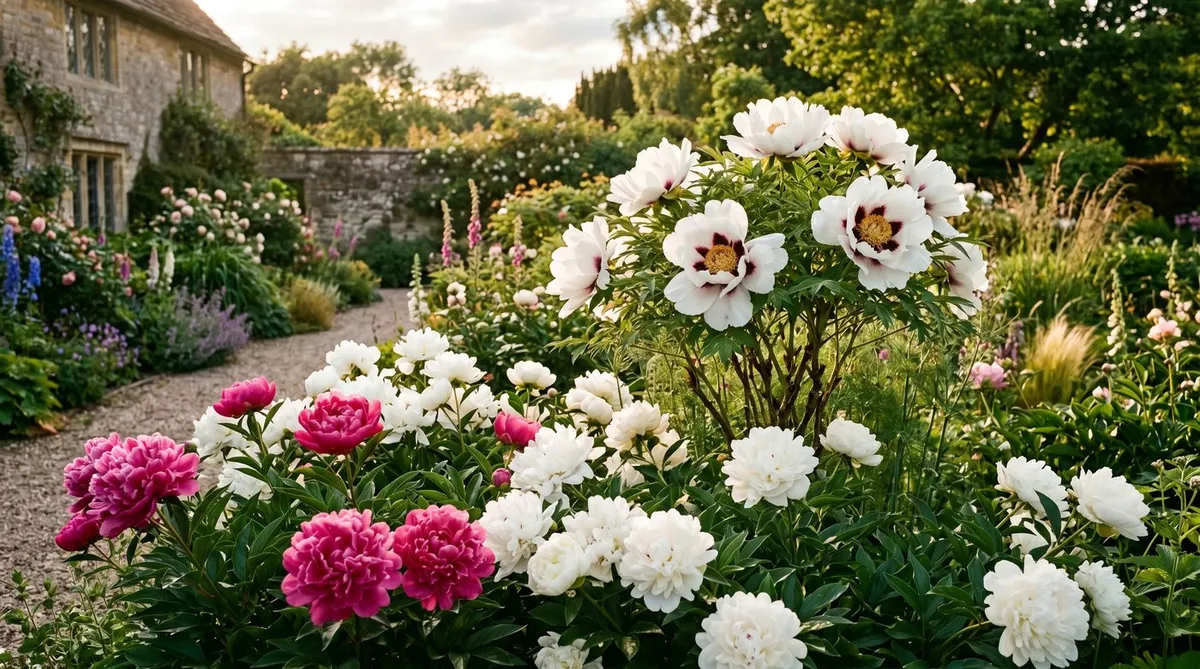
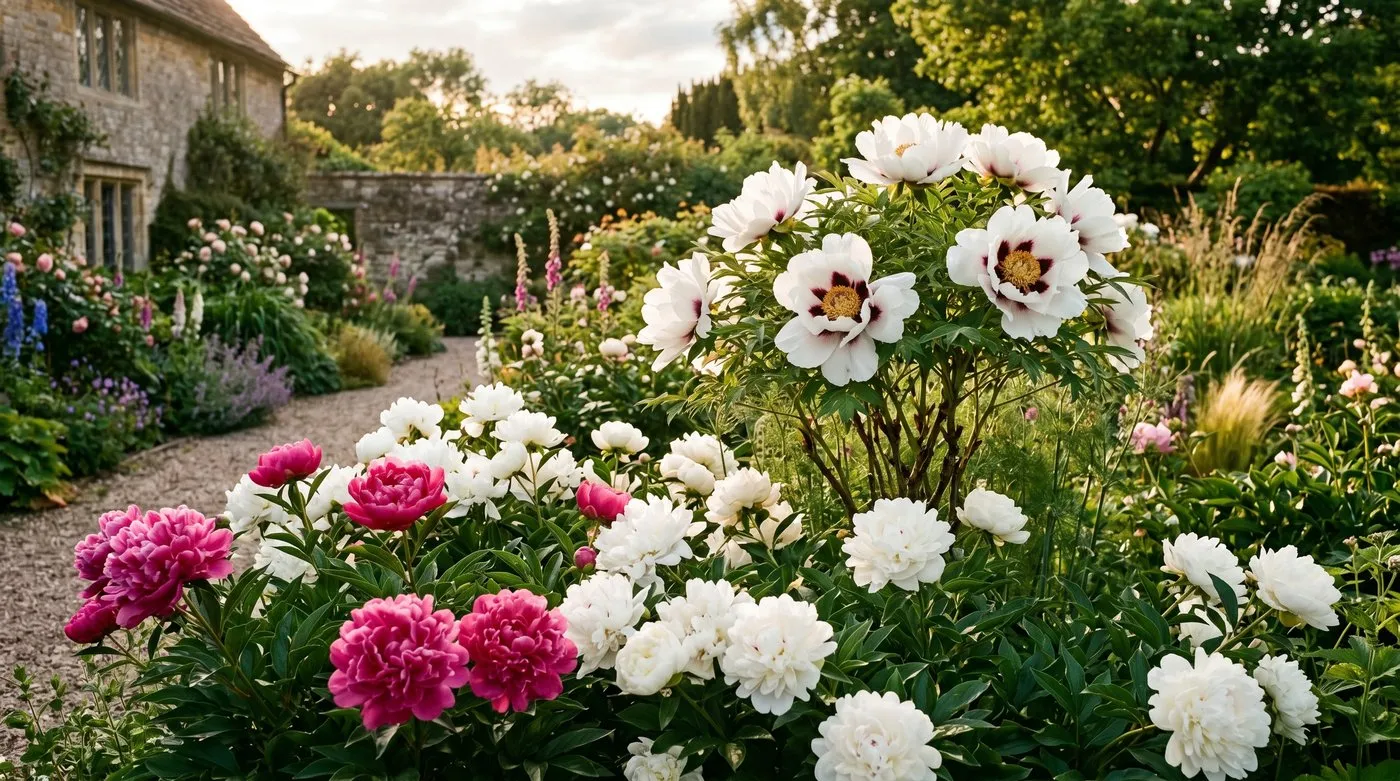 A mixed peony border in mid-June. Herbaceous (foreground), tree peony ‘Joseph Rock’ (background), and intersectional Itoh ‘Bartzella’ (yellow centre). Eight weeks of peony display from late April.
The 6 best herbaceous peonies
1. ‘Sarah Bernhardt’ (pink, double, fragrant)
The standard UK peony. Large double pale pink flowers with petals that fade silver-pink at the edges. Heavy fragrance. Mid-season flowering (early to mid-June).
Stems need staking (heavy flowers). Reliable, long-lived, widely available.
Cost £14-£22. Flowers from year 2.
2. ‘Bowl of Beauty’ (pink with cream centre, semi-double)
Cup-shaped flowers with pink outer petals and a tight cluster of cream-yellow stamens in the centre (called petaloids). Mid-season.
No fragrance. Stems are stronger than ‘Sarah Bernhardt’ and rarely need staking. The unusual flower form makes it the second most-planted UK peony after ‘Sarah Bernhardt’.
Cost £14-£22. Flowers from year 2.
3. ‘Coral Charm’ (coral changing to pale yellow, semi-double)
Opens deep coral-peach, fades through pale apricot to cream-yellow over 10 days. Mid-season. No fragrance.
The colour-changing flower habit is the headline. Stems strong, no staking needed.
Cost £22-£32. Flowers from year 2-3.
4. ‘Festiva Maxima’ (white with red flecks, double, fragrant)
Pure white double with random crimson flecks deep inside the petals. Heavy fragrance. Mid-season.
Bred in 1851 and still one of the best UK peonies. Stems strong despite the heavy double flowers. Reliable.
Cost £16-£24. Flowers from year 2-3.
5. ‘Karl Rosenfield’ (deep red, double)
Deep crimson-red full double flowers. Mid-season. No fragrance.
The colour is the headline. Best red peony for UK conditions. Stems need light staking.
Cost £16-£24. Flowers from year 2-3.
6. ‘Duchesse de Nemours’ (white, double, fragrant)
Pure white double with yellow stamens visible through the petals. Strong fragrance. Mid-season.
The classic white peony. Bred in 1856 and still planted in major UK gardens. Stems moderate, light staking helps.
Cost £18-£26. Flowers from year 2-3.
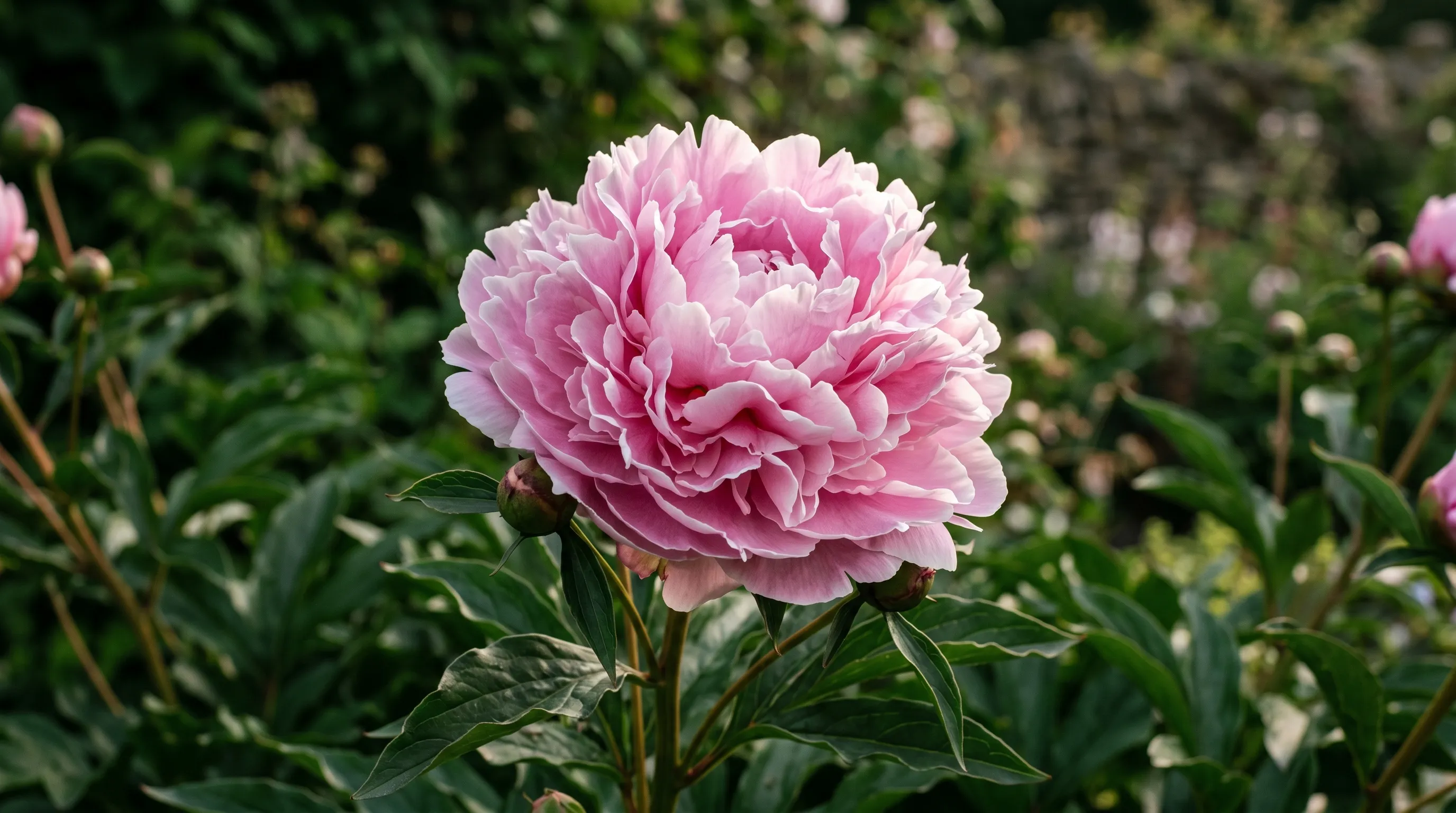 Paeonia lactiflora ‘Sarah Bernhardt’ in mid-June. The most widely planted UK herbaceous peony. Heavy fragrance, large fully double pink flowers, reliable across all UK regions.
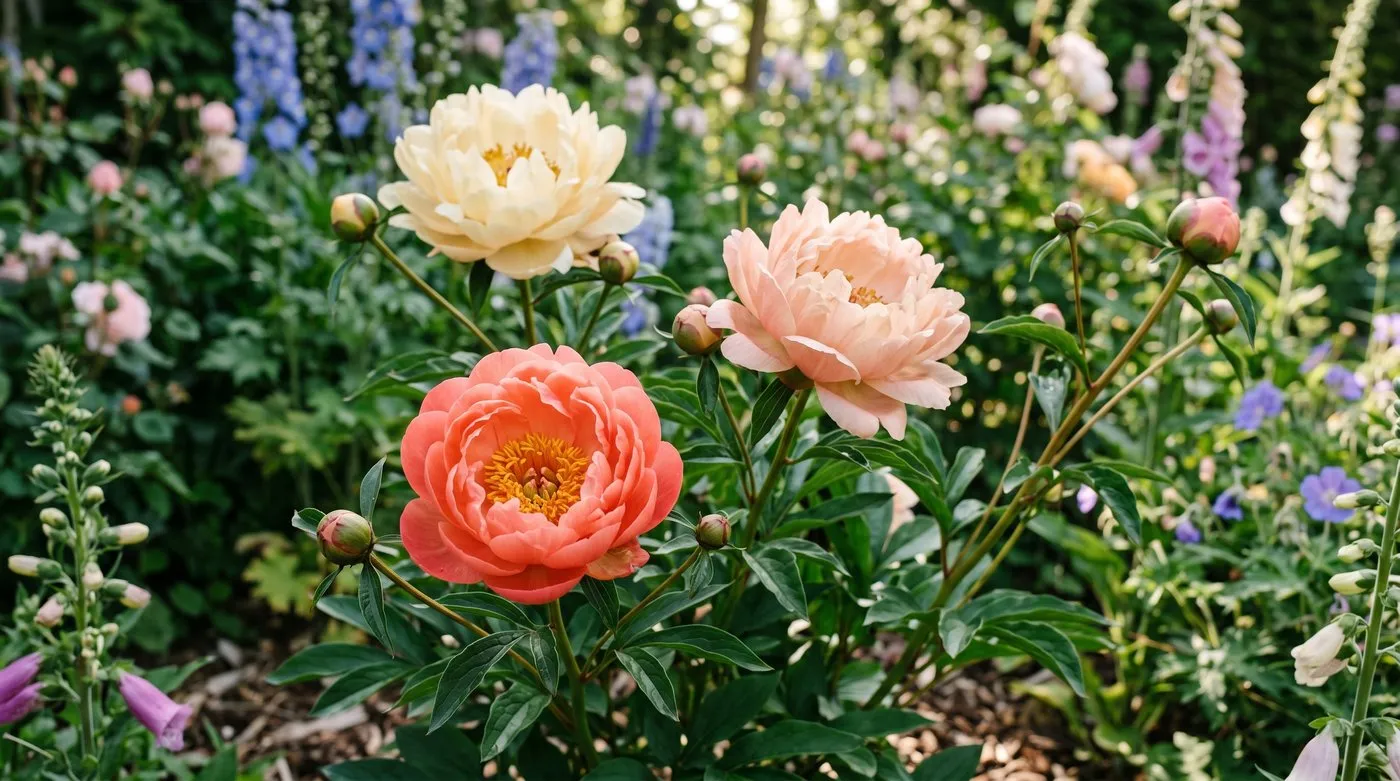 Paeonia ‘Coral Charm’ over ten days. Opens deep coral-peach (foreground), fades through pale apricot (background), and finishes cream-yellow. A single plant shows three colours simultaneously across its flowers.
The 4 best tree peonies
Tree peonies are slower, more expensive, more rewarding. These four perform in UK conditions.
7. ‘Joseph Rock’ (Paeonia rockii, white with dark maroon flares)
The most photographed tree peony in the world. Pure white single flowers up to 25cm across with dramatic dark maroon “flares” radiating from the centre. Late April to early May.
Reaches 1.2-1.5m at 10 years. Lightly fragrant. The slowest of the four to establish but the most spectacular.
Cost £55-£85. First flowers in year 3-5.
8. ‘Souvenir de Maxime Cornu’ (yellow, double, fragrant)
Yellow double tree peony. Very heavy flowers that often nod downward. Strong fragrance. Late April.
Bred in France in 1919. Slow grower, reaches 1m at 10 years. The yellow colour is rare in tree peonies and worth the wait.
Cost £45-£75. First flowers in year 3-5.
9. ‘Black Pirate’ (deep maroon-red, single)
Deep maroon-red single flowers with darker centre. Late April to early May. Light fragrance.
Stems strong, reaches 1.3m at 10 years. The deepest colour in any tree peony.
Cost £45-£65. First flowers in year 3-4.
10. ‘High Noon’ (pale yellow, semi-double)
Pale yellow semi-double tree peony. Strong stems. Late April. Light fragrance.
The most reliable yellow tree peony for UK conditions. Reaches 1.5m at 10 years.
Cost £45-£65. First flowers in year 3-4.
The 2 best intersectional Itoh peonies
The newest group, created from 1948 onwards through complex breeding. Combines herbaceous habit with tree peony flower size and colour.
11. ‘Bartzella’ (yellow, double)
The benchmark Itoh hybrid. Bright lemon-yellow double flowers, 18-20cm across. No fragrance. Late May to early June. Strong stems that never need staking.
Each plant produces 30-50 flowers per season at maturity. Reaches 80-100cm tall. Dies back fully each winter.
Cost £55-£85. First flowers in year 2-3.
12. ‘Cora Louise’ (white with purple flare, semi-double)
White with deep purple flare radiating from the centre. Single to semi-double. 16-18cm flowers. Light fragrance. Late May to early June.
Strong stems, 80cm tall. Heavy bloomer once established.
Cost £55-£75. First flowers in year 2-3.
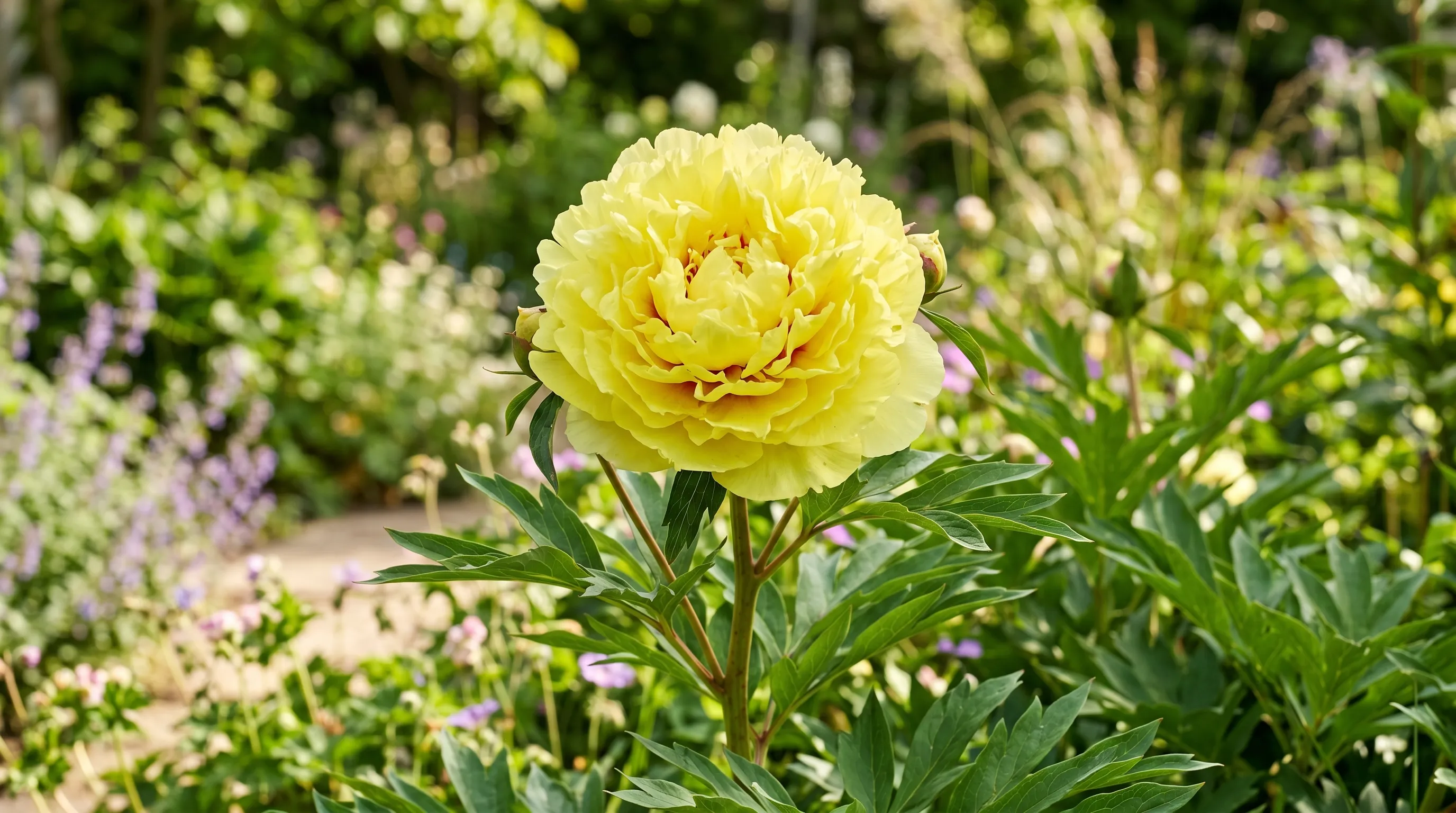 Itoh ‘Bartzella’ in late May. Lemon-yellow doubles 18-20cm across on strong upright stems. Combines herbaceous habit (dies back in winter) with tree peony flower size.
Comparison: which peony for which use
| Use case | Best variety | Why |
|---|---|---|
| Best all-rounder | ’Sarah Bernhardt’ | Reliable, fragrant, widely available |
| Most unusual flower | ’Bowl of Beauty’ | Cream centre with pink petals |
| Colour-changing | ’Coral Charm’ | Coral to yellow over 10 days |
| Strong fragrance | ’Sarah Bernhardt’ or ‘Festiva Maxima’ | Both heavily scented |
| No staking needed | ’Bowl of Beauty’, Itoh Bartzella | Strong stems |
| Deepest red | ’Karl Rosenfield’ | Crimson double |
| Pure white | ’Duchesse de Nemours’ | White double with yellow stamens |
| Earliest flower | Tree peony ‘Joseph Rock’ | Late April |
| Latest flower | Itoh ‘Cora Louise’ | Early June |
| Yellow flowers | Itoh ‘Bartzella’ | Strong lemon yellow |
| Smallest space | ’Coral Charm’ | 70cm tall, no staking |
| Largest flower | Tree ‘Joseph Rock’ | 25cm across |
Flowering calendar across the three groups
| Week | Tree peonies | Herbaceous | Itoh |
|---|---|---|---|
| Late April | ’Joseph Rock’, ‘High Noon’ begin | ||
| Early May | All tree peonies in flower | Buds forming | Buds forming |
| Mid May | Tree peonies ending | First herbaceous opens | First Itoh opens |
| Late May | ’Sarah Bernhardt’ peak | ’Bartzella’ peak | |
| Early June | ’Bowl of Beauty’ peak | ’Cora Louise’ peak | |
| Mid June | Late herbaceous ending | Itoh ending |
A garden with one tree peony, two herbaceous, and one Itoh has 8 weeks of peony display from late April to mid-June.
Planting depth: the rule that breaks 80% of UK peony plantings
The single biggest mistake in UK peony cultivation is planting too deep.
Herbaceous peonies
The “eyes” (the small pink-tipped growing points on the crown) must sit 25mm or less below the soil surface in heavy soil. In light sandy soil, 30-40mm depth is acceptable. Deeper than 50mm and the plant produces foliage but no flowers, sometimes for 5+ years.
To check depth: scrape away the top 25mm of soil around an existing peony in autumn. The eyes should be visible or just covered.
Tree peonies
Different rule. The graft union (the visible swelling at the base of the woody stem where the suffruticosa scion meets the lactiflora understock) must sit 80-100mm below soil surface. This allows the scion to develop its own roots and eventually replace the herbaceous understock.
Planted too shallow, the understock takes over and the named variety dies out within 3-5 years.
Itoh peonies
As for herbaceous: eyes 25mm below soil surface, no deeper.
Warning: Garden centre tags often say “plant at the same depth as the pot.” This is wrong for peonies in heavy UK soils. Always plant herbaceous and Itoh peonies with eyes at 25mm depth, regardless of how deep they sat in the pot.
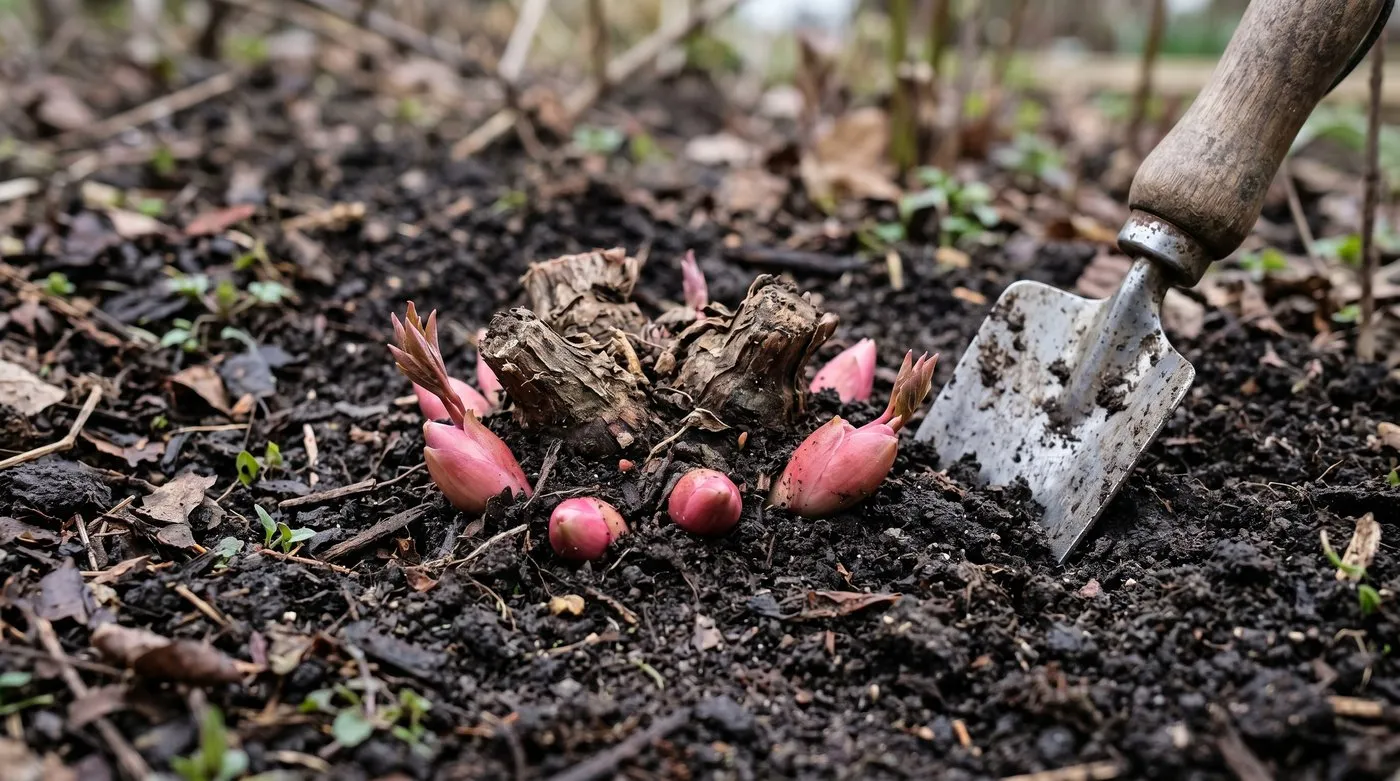 The pink-tipped “eyes” on a herbaceous peony crown. These must sit no more than 25mm below the soil surface for reliable flowering. Plant deeper and the plant produces foliage but no flowers.
Growing peonies in a UK garden
Site
- 6+ hours of direct sun daily
- Well-drained soil, pH neutral to slightly alkaline
- Sheltered from strong wind (heavy flowers blow over otherwise)
- Avoid frost pockets (tree peonies in particular)
Soil preparation
Dig a 50cm wide x 40cm deep planting hole. Mix into the excavated soil:
- 5 litres well-rotted manure or compost
- 100g bonemeal
- 50g sulphate of potash
Backfill the hole, place the peony with eyes/graft union at the correct depth, water in well.
Annual care
| Month | Task |
|---|---|
| March | Apply 50g per plant of sulphate of potash and a 5cm compost mulch |
| April | Install grow-through plant supports for double varieties at 30cm shoot height |
| May | First flowering for tree peonies. Watch for botrytis in wet weather. |
| June | Peak flowering. Deadhead immediately after each flower fades to retain energy in the crown. |
| July | Apply liquid feed if foliage looks pale. Stop deadheading - let any remaining seedpods ripen. |
| August | Foliage begins to brown on herbaceous varieties. |
| September | Cut back herbaceous foliage to ground level after first frost. |
| October | Plant new peonies. Best time for transplanting. |
| November | Apply 50mm mulch of well-rotted manure or compost around the crown but NOT covering the eyes. |
Pests and diseases
- Peony wilt (botrytis paeoniae): Cut affected stems back to ground, dispose, do not compost.
- Honey fungus: Tree peonies vulnerable. Avoid planting where honey fungus has been recorded.
- Slugs: Damage emerging shoots in March. Use copper rings or organic slug pellets.
Tip: When deadheading, cut the stem back to the first set of healthy leaves, not all the way to the ground. The leaves continue to photosynthesise and build the crown for next year’s flowers.
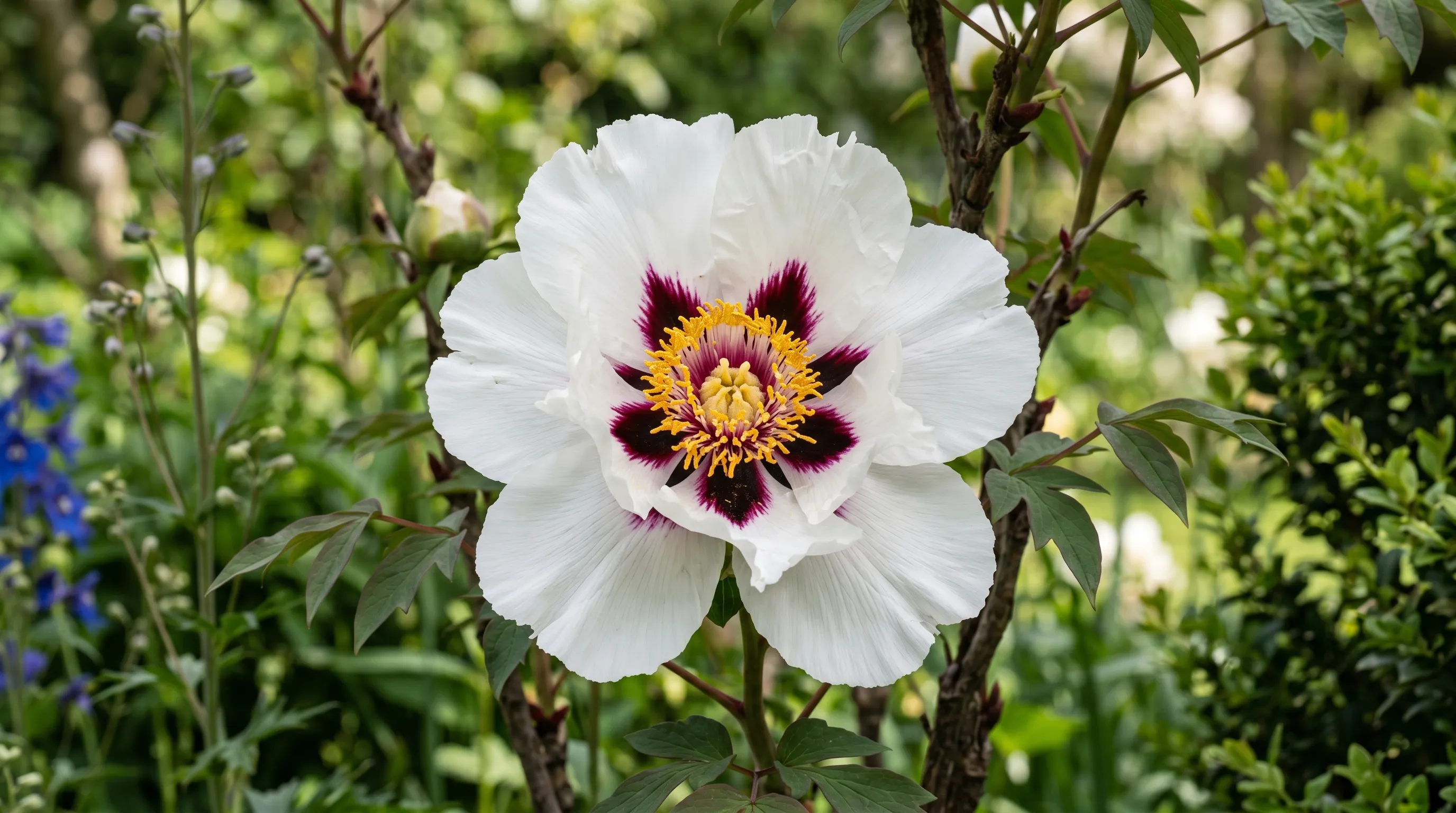 Paeonia rockii ‘Joseph Rock’ in late April. White single flowers up to 25cm across with dramatic maroon flares from the centre. The benchmark tree peony for UK gardens.
Where to buy in the UK
Three specialist UK peony nurseries.
- Kelways Plants (Somerset). The original UK peony nursery, founded 1851. Holds the National Collection. Mail order. kelways.co.uk
- Claire Austin Hardy Plants (Shropshire). Wide range of herbaceous and intersectional Itoh. claireaustin-hardyplants.co.uk
- Phedar Nursery (Stoke-on-Trent). Tree peony specialist with the widest UK range of Paeonia rockii and lutea hybrids. phedar.com
All three are mail order and ship UK-wide. Order in September for autumn planting.
Common peony mistakes
Mistake 1: planting too deep
Already covered above. Worth repeating: eyes 25mm below soil surface. No deeper. The single biggest reason UK peonies fail to flower.
Mistake 2: cutting back too early in autumn
Cut herbaceous peonies only after the first hard frost has browned the foliage. Cutting earlier removes photosynthesising leaves and weakens the crown. November or December is the right time.
Mistake 3: moving an established peony
A herbaceous peony settled into a good position resents being moved. Moves typically delay flowering by 2-3 years. Avoid transplanting unless absolutely necessary. If you must move, do it in October and replant at the correct depth (eyes 25mm below soil).
Mistake 4: not deadheading
Each spent flower head left on the plant ripens seeds. Seed production diverts energy from next year’s flower development. Deadhead every flower as it fades, cutting back to the first healthy leaf set on each stem.
Mistake 5: too much nitrogen feed
Peonies in beds with high-nitrogen fertilisers (lawn feed runoff, fresh manure) produce lush foliage but few flowers. Use bonemeal and sulphate of potash rather than nitrogen-heavy feeds.
Where to read more
The Royal Horticultural Society peony pages cover varieties and cultivation. The Hardy Plant Society publishes detailed peony cultivation notes in their journal. Visit the Kelways display garden in Somerset in May-June to see most UK varieties in flower side by side.
Frequently asked questions
Which peony variety is best for UK gardens?
Paeonia lactiflora ‘Sarah Bernhardt’ for fragrance and reliability. ‘Bowl of Beauty’ for unusual semi-double form. ‘Coral Charm’ for changing colour from coral to pale yellow. ‘Karl Rosenfield’ for deep red doubles. For tree peonies, ‘Joseph Rock’ (Paeonia rockii) is the standard, with white flowers and dark maroon centre flares.
What is the difference between herbaceous and tree peonies?
Herbaceous peonies (Paeonia lactiflora) die back to ground each winter and regrow from underground crowns in spring. Tree peonies (Paeonia suffruticosa) keep woody stems through winter and grow into 1.5-2m shrubs over 15 years. Intersectional Itoh hybrids combine both: herbaceous habit, tree-peony-sized flowers.
Why is my peony not flowering?
The most common cause is planting too deep. The eyes (pink-tipped growing points on the crown) must be no more than 25mm below the soil surface. Other causes: too much shade (peonies need 6+ hours direct sun), recent transplanting (allow 2-3 years), or excess nitrogen feeding.
When do peonies flower UK?
Tree peonies in late April to mid-May. Herbaceous in late May to mid-June. Intersectional Itoh hybrids in late May. A garden with one of each group has 8-10 weeks of peony flowering from late April through end of June.
Are peonies fragrant?
Some varieties are highly fragrant, others have no scent. ‘Sarah Bernhardt’, ‘Festiva Maxima’, ‘Edulis Superba’, and ‘Duchesse de Nemours’ are strongly fragrant. ‘Bowl of Beauty’, ‘Coral Charm’, ‘Karl Rosenfield’ have no scent. Always check the variety description if scent matters.
Do peonies need staking?
Double-flowered varieties need staking. The heavy flower heads bend the stems after rain. Use grow-through plant supports (link stakes) installed in April when shoots are 30cm tall. Single-flowered and Itoh varieties have lighter blooms and usually stand alone.
How long do peonies live?
Herbaceous peonies live 80-100 years in the same position once established. Tree peonies live 60-100 years and produce more flowers each year. The longevity makes peonies a generational plant - the one you plant for your daughter is the one her granddaughter will inherit.
Now choose your peonies
Twelve varieties, three plant groups, eight weeks of UK flowering from late April to mid-June. Pick one tree peony for the earliest flowers. Pick two or three herbaceous for the main June display. Pick one Itoh for the strong yellows that herbaceous cannot produce. Plant at the correct depth. The same plants will outlast everyone reading this guide.
Our team produces practical UK gardening guidance from source research, contributor records and established horticultural practice. Editorial standards are overseen by Matt W.