Key takeaways
- Mophead and lacecap hydrangeas (H. macrophylla) change colour with soil pH — blue below 5.5, pink above 6.5
- Paniculata types flower on new wood: late frost never destroys buds, and hard pruning in February is safe
- Climbing hydrangea (H. petiolaris) is the best self-clinging shade climber for north-facing walls, reaching 10–15m
- Oakleaf hydrangeas (H. quercifolia) offer three seasons of interest: flowers in summer, autumn leaf colour, and winter bark
- H. arborescens 'Annabelle' produces the largest flower heads of any type — up to 30cm — but needs staking in exposed spots
The five types of hydrangeas grown in UK gardens each bring a distinct flower form, pruning group, and set of site requirements. Knowing which type you have, and which type suits your soil and aspect, is the difference between a plant that thrives for decades and one that limps along without ever flowering properly.
This is a companion piece to our guide on how to grow hydrangeas in the UK, which covers planting, feeding, and general care. Here the focus is identification, variety selection, and matching the right type to the right spot.
How to identify the five types of hydrangeas
Before choosing a variety, it helps to know what distinguishes each type at a glance. Flower shape is the quickest identifier.
| Type | Botanical name | Flower form | Colour changes with pH | Pruning group | Max height |
|---|---|---|---|---|---|
| Mophead | H. macrophylla | Large globe, 15-25cm | Yes, blue to pink | Old wood (late March) | 2m |
| Lacecap | H. macrophylla | Flat, open ring of florets | Yes, blue to pink | Old wood (late March) | 1.8m |
| Panicle / Paniculata | H. paniculata | Cone-shaped panicle | No (white, pink, green) | New wood (late February) | 3m |
| Climbing | H. anomala petiolaris | Flat lacecap, self-clinging | No (white) | Minimal (remove outward stems) | 15m |
| Oakleaf | H. quercifolia | Cone-shaped, lobed leaves | No (white) | Light tidy in late April | 2m |
This table is the essential reference for UK gardeners. Use it to identify what you already have, and to choose the right type before buying. For the full pruning calendar, see our dedicated guide on how to prune hydrangeas in the UK.
Mophead hydrangeas (Hydrangea macrophylla)
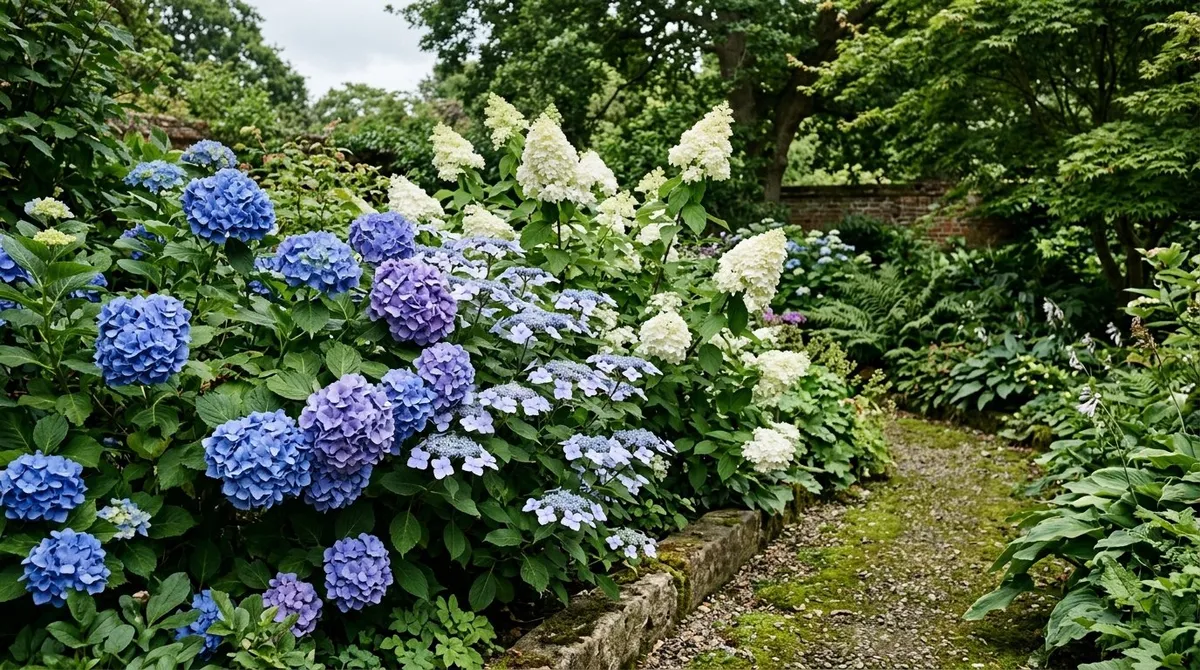
Mophead hydrangeas are the most-planted type in Britain. Their large, round flower heads measure 15-25cm across and contain only sterile florets, which is why they last so long on the plant, from July through to October. Colour is determined entirely by soil chemistry: acid soil (pH below 5.5) produces vivid blue; alkaline soil (pH above 6.5) produces pink; neutral soil gives mauve or purple.
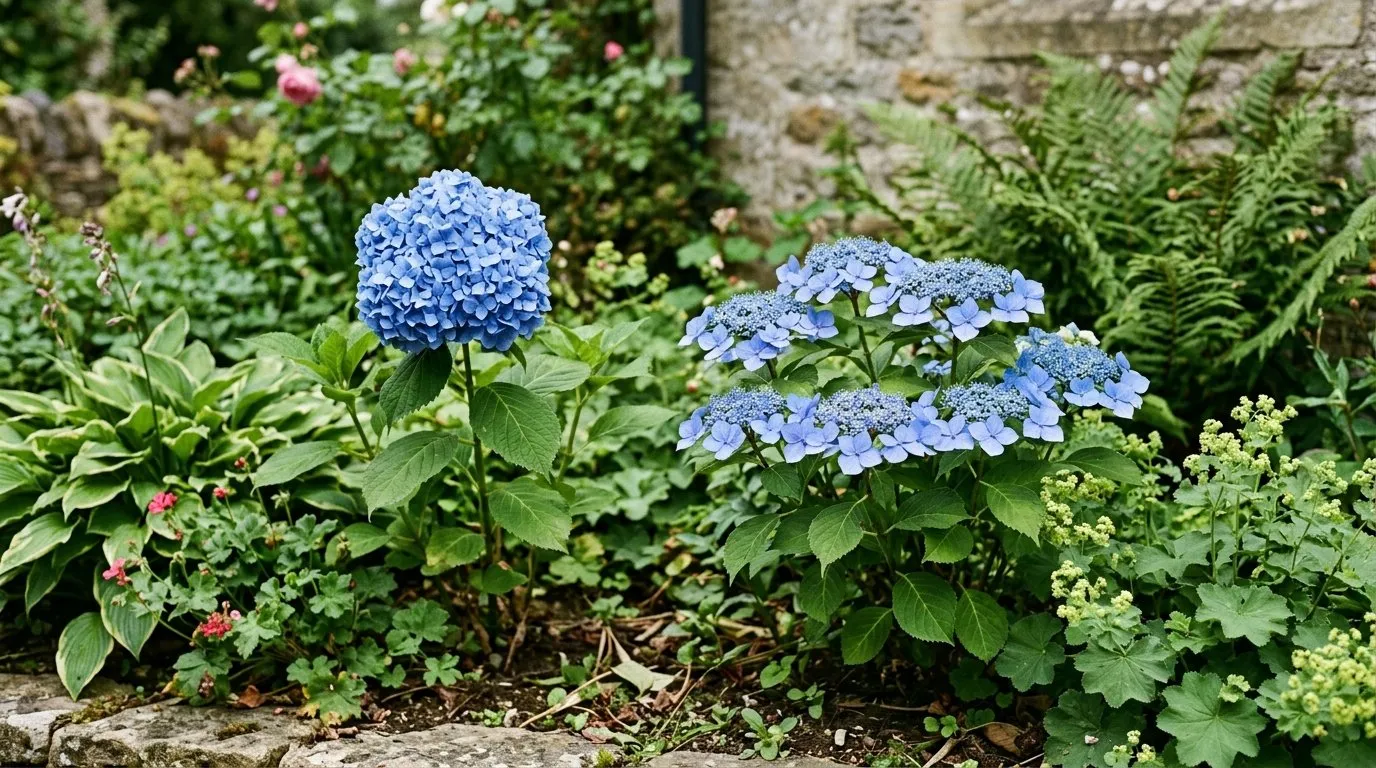
Mophead (left) vs lacecap (right). Both are H. macrophylla and change colour with soil pH.
They grow best in partial shade, with morning sun and afternoon shelter from hot afternoon light. On south-facing, fully exposed sites, leaf scorch and wilting are common in July and August. In the UK’s wetter western and northern regions, mopheads generally perform better than in the drier east.
Identification
Round, dense flower heads with no visible centre. All florets are the large, showy sterile type. Leaves are broad, dark green, and slightly glossy. Stems are stout, woody, and hold old flower heads through winter.
Best UK mophead varieties
Endless Summer is the most useful mophead for UK gardeners. It is the only widely available variety that flowers on both old and new wood, meaning late frosts or a heavy-handed prune will not cost you the whole display. Blue in acid soil, pink in alkaline. Reaches 1-1.2m. It is sold as a re-blooming variety, though in a poor summer the second flush can be modest.
Nikko Blue delivers one of the deepest, most reliable blues in acid soil. It reaches 1.2m with a neat, compact habit and flowers consistently from July to September. In neutral soil it turns mauve; in alkaline soil, it goes pink. A strong performer on clay soils.
Madame Emile Mouillere is a classic white mophead, one of the oldest named varieties still widely grown. White flowers with pink or blue eyes depending on soil pH. Vigorous, reaching 1.5-2m. A good choice where you want white flowers that will not fade pink, though the eye colour still varies with pH.
Left: mophead Nikko Blue with dense globe flowers. Right: lacecap Blue Wave showing the open, flat flower head with fertile centre.
Mopheads and lacecaps both fall in pruning Group 1. For detailed colour-change technique, see our guide on how to change hydrangea colour.
Lacecap hydrangeas (Hydrangea macrophylla)
Lacecap hydrangeas belong to the same species as mopheads but have a completely different flower form. The flat, open head consists of a ring of large sterile florets surrounding a centre of tiny fertile flowers. The effect is airier and more naturalistic than the heavy mophead globe.
Both types share the same colour-change behaviour, pruning group, and aspect preferences. Lacecaps are generally considered more pollinator-friendly, the fertile central flowers provide accessible nectar for bees and hoverflies, which are unable to reach nectar in the sterile mophead florets.
Identification
Flat, plate-like flower head with a visible fertile centre. The outer ring of florets is large and showy; the inner cluster is small and often a contrasting colour. Stems and foliage are identical to mopheads. In bud, the central fertile flowers appear first, creating a distinctive two-stage opening.
Best UK lacecap varieties
Lanarth White is one of the most reliable lacecaps for UK conditions. White sterile florets surround a blue or pink fertile centre depending on soil pH. Vigorous, reaching 1.5m, with a loose, open habit that suits woodland-style planting. Hardy and tolerant of heavier soils.
Blue Wave (also sold as Mariesii Perfecta) produces large flat heads in deep blue on acid soil and rose-pink on alkaline. Vigorous at 1.5m. One of the most striking lacecaps when grown in naturally acid ground in the UK’s west and north.
Teller series, a group of compact lacecaps bred for reliability in UK conditions. Teller Blue, Teller Red, and Teller White all reach around 1m and are excellent for smaller gardens. Well suited to containers in ericaceous compost. The RHS has awarded several Teller varieties the Award of Garden Merit.
Lacecaps pair well with shade-tolerant shrubs such as skimmia, mahonia, and ferns. Their open, naturalistic flower form also suits container gardening schemes where a large pot with a trained lacecap makes a strong centre piece.
Panicle hydrangeas (Hydrangea paniculata)
Hydrangea paniculata is the most adaptable type for UK gardens. Cone-shaped flower panicles rather than round heads. Flowers are produced on the current year’s new growth, which means late spring frosts never destroy the buds, a significant advantage in Britain’s unpredictable climate. Hard pruning in late February is safe and recommended.
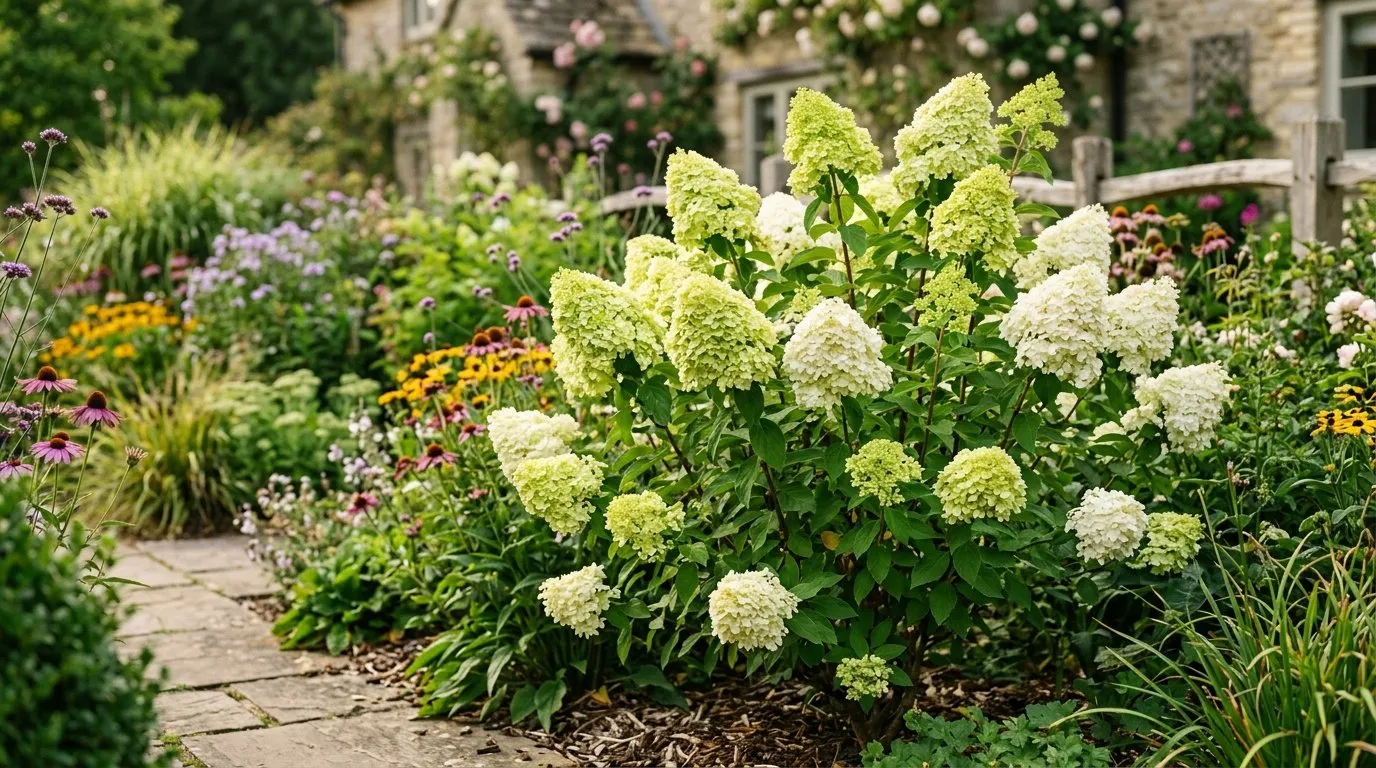
H. paniculata Limelight. Panicle hydrangeas flower on new wood, so pruning timing is more forgiving.
Paniculata types tolerate more sun than mopheads, cope with clay soils, and are hardy to minus 25°C, far hardier than the macrophylla types. Flower colour is not affected by soil pH. Most varieties open creamy white, then age through pink to deep wine or bronze by October.
Identification
Elongated, cone-shaped panicles 15-40cm long. Flowers open white or cream and change colour through the season, first green-tinged, then white, then pink, then deeper pink or red. Stems are more vigorous than mopheads. After hard pruning, new shoots reach 1.5-2m in a single season.
Best UK paniculata varieties
Vanilla Fraise offers the most striking colour progression of any paniculata. Flowers open creamy white, then develop strawberry-pink flush from the base upwards, creating a two-tone effect in late August. Compact at 1.5m. Excellent as a specimen plant or the centrepiece of a mixed border.
Little Lime is the dwarf form of Limelight, reaching just 80cm–1m. It produces the same lime-green to pink colour sequence in miniature. The ideal paniculata for a small garden or a large container. Flowers on new wood, so it can be cut hard each February without any risk.
Hydrangea paniculata ‘Limelight’ in August, panicles at the lime-green stage before ageing to cream and pink.
Paniculatas work well with other sun-tolerant shrubs in a mixed border. They also pair strongly with acid-loving plants such as rhododendrons and pieris in a shrub bed, as paniculata tolerates both acid and neutral soils.
Climbing hydrangea (Hydrangea anomala subsp. petiolaris)
Climbing hydrangea is the best self-clinging climber for shaded walls in the UK. It attaches directly to brick, stone, and timber with aerial rootlets, needing no wires or trellis. White lacecap flowers appear in June and July. At maturity it reaches 10-15m and can clothe an entire house wall.
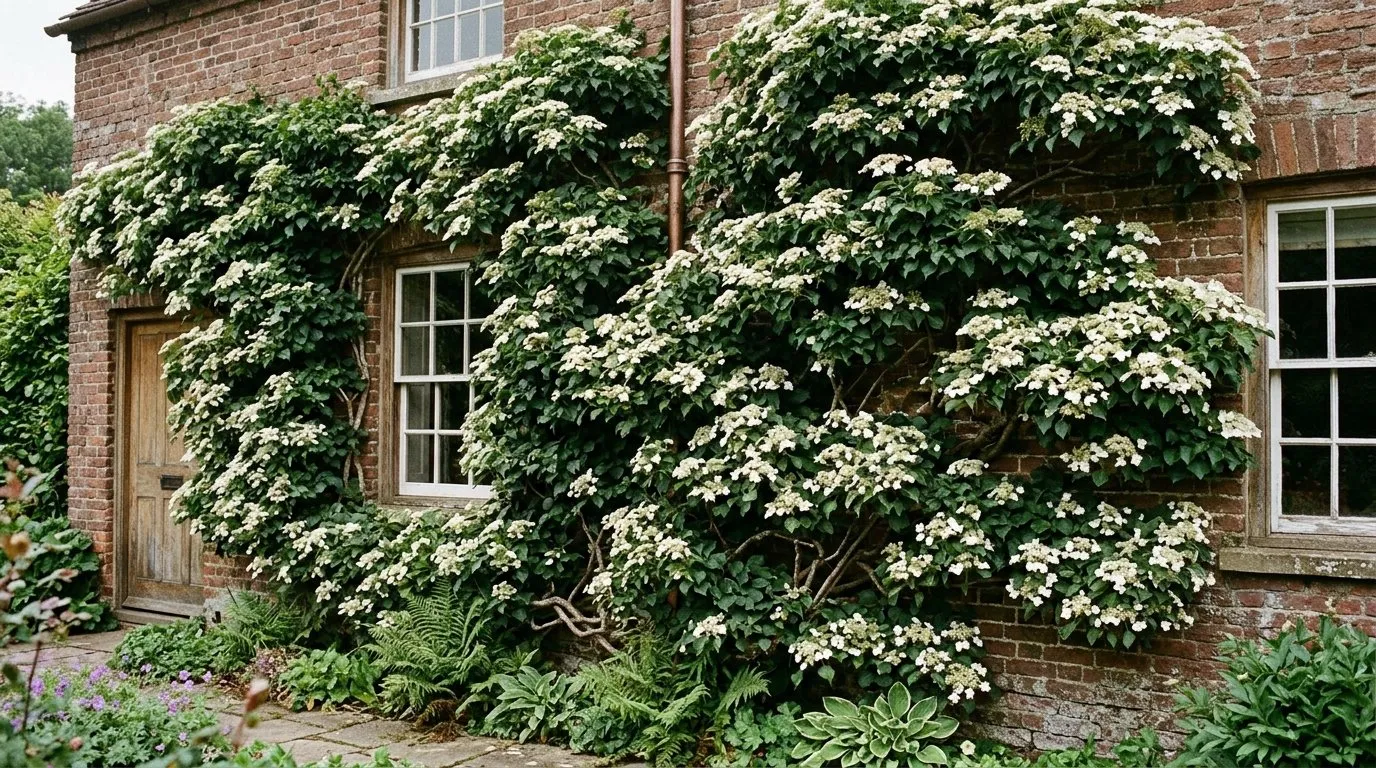
Climbing hydrangea (H. petiolaris) on a north-facing wall. Slow to establish but covers large areas once mature.
The catch is patience. In years one and two after planting, little happens above ground. The plant is building an extensive root system. From year three onwards, growth accelerates, and by year five a climbing hydrangea is adding 60cm or more per season. This is the one hydrangea where the first-year gardener almost always gives up just before it takes off.
Identification
Aerial rootlets visible on the stems, these grip masonry and bark without needing support. Flat, lacecap-type flower heads up to 25cm across. Broadly oval, serrated leaves, dark green and slightly shiny. Attractive peeling cinnamon-brown bark on mature specimens becomes a winter feature in its own right.
How to grow climbing hydrangea on a north wall
A north-facing wall gets no direct sun from October to April in the UK, and limited sun in summer. This rules out most climbers. Climbing hydrangea is adapted to the low-light conditions of forest tree trunks, making it ideal for this aspect.
Planting: Set the plant at least 30cm away from the wall base, angling the stems inward. The soil directly against a wall stays dry even in wet weather. Water thoroughly at planting and for the first two summers.
First two years: Do not prune. Do not expect rapid growth. Water in dry spells and apply a 5cm bark mulch each spring.
Year three onwards: Once established, remove any stems growing away from the wall surface. Thin crowded areas in April after flowering to let light into the centre.
Climbing hydrangea on a north-facing wall in June, established plant, approximately 8 years old, covering 4m of brickwork.
For more north-wall options, see our guide to the best climbing plants for UK gardens.
Oakleaf hydrangea (Hydrangea quercifolia)
Oakleaf hydrangea is the only type that earns its space in three separate seasons. In summer, white cone-shaped panicles up to 30cm long. In autumn, the distinctive lobed leaves, shaped like oak foliage, turn deep crimson, orange, and burgundy. In winter, the peeling, cinnamon-coloured bark adds structure to the border.
It is less commonly grown in the UK than mopheads or paniculatas, partly because it needs a sheltered spot. Cold winds shred the large leaves, and heavy clay causes root problems. In the right position, a sheltered, partially shaded border with reasonable drainage, it is outstanding.
Identification
Lobed, oak-like leaves 15-30cm long. This foliage immediately distinguishes it from all other hydrangea types. White flowers in elongated panicles, similar in form to paniculata but produced in summer rather than mid-summer. Bark peels in papery layers to reveal cinnamon-orange underneath.
Best UK oakleaf varieties
Snow Queen (H. quercifolia ‘Snow Queen’) is the most reliable variety for UK conditions. Upright panicles of white flowers from July. Excellent autumn colour in crimson and orange. Reaches 1.5-1.8m. Has received the RHS Award of Garden Merit.
Alice is more vigorous, reaching 2m, with larger panicles up to 30cm. Better suited to larger gardens where it can spread without competing with neighbouring plants. Requires a sheltered position in the UK’s colder regions.
Hydrangea arborescens: the bonus type
Hydrangea arborescens is sometimes listed separately as a sixth type. Botanically distinct from macrophylla, paniculata, and quercifolia, it deserves a mention because of one exceptional variety.
Annabelle (H. arborescens ‘Annabelle’) produces the largest flower heads of any hydrangea in cultivation, pure white globes reaching 25-30cm across. It flowers on new wood (pruning Group 2) and can be cut hard to 30-45cm each February. Hardy, tolerant of partial shade, and unaffected by soil pH.
The downside: the enormous flower heads become heavy with rain and cause the stems to flop. In exposed gardens, peony rings or a loose framework of canes keeps the display upright. If staking sounds like too much effort, choose Incrediball instead, a new release with stronger, stiffer stems that hold the same large heads without support.
Arborescens types are not affected by soil pH. The white flower colour is fixed regardless of whether the soil is acid or alkaline.
Choosing the right type for your garden
The comparison table above is the starting point. But these additional questions narrow it down quickly:
Do you have a north-facing wall? Climbing hydrangea is the answer. No other climber performs as well on a fully shaded wall in UK conditions.
Is your garden frost-prone or in a cold region? Choose paniculata. Flower buds form on new spring growth, so no amount of late frost can destroy them. Avoid mopheads and lacecaps in exposed, frost-pocket gardens unless you can protect them in April and May.
Do you want autumn interest beyond flowers? Oakleaf hydrangea adds leaf colour and winter bark that no other type matches.
Are you gardening on a shaded, damp site? Mopheads and lacecaps evolved as woodland edge plants. They are among the best plants for shaded UK borders and outperform almost every other flowering shrub in dappled shade.
Do you want blue flowers? You need a mophead or lacecap on naturally acid soil, or in a container with ericaceous compost. No other type will produce blue flowers regardless of what you do to the soil. For the full technique, read our guide on soil testing and pH adjustment.
Do you want minimum pruning effort? Paniculata wins. Cut hard to a low framework in February. That is all it needs.
Aspect and soil preferences at a glance
| Type | Best aspect | Soil | Hardiness | Pruning time |
|---|---|---|---|---|
| Mophead | E, W, or sheltered N | Moist, humus-rich, acid preferred | Hardy to −15°C | Late March–April |
| Lacecap | E, W, or sheltered N | Moist, humus-rich, acid preferred | Hardy to −15°C | Late March–April |
| Paniculata | S, E, or W | Most soils including clay | Hardy to −25°C | Late February |
| Climbing | N, E, or sheltered W | Moist, humus-rich | Hardy to −20°C | April (after flowering) |
| Oakleaf | W or sheltered N | Well-drained, humus-rich | Hardy to −15°C | Light tidy in late April |
| Arborescens | E, W, or partial shade | Most soils | Hardy to −20°C | Late February |
Pairing hydrangeas with other shade-tolerant flowering shrubs makes a border that performs from spring through to late autumn. The best flowering shrubs for UK gardens includes several that complement hydrangeas in aspect and soil preference.
Frequently asked questions
What is the difference between mophead and lacecap hydrangeas?
Both are Hydrangea macrophylla, but their flower forms differ completely. Mopheads have dense, globe-shaped heads made entirely of sterile florets. Lacecaps have flat, open heads with a ring of large sterile florets surrounding a centre of tiny fertile flowers. Both change colour with soil pH, need the same pruning, and prefer partial shade. Lacecaps are generally more pollinator-friendly, as bees can access the fertile central flowers.
Which hydrangea is easiest to grow in the UK?
Hydrangea paniculata is the easiest type for UK gardens. It flowers on new wood, so late frosts never destroy buds. Hard pruning in February is safe and beneficial. It tolerates clay better than mopheads, copes with exposed sites, and is hardy to minus 25°C. Limelight and Vanilla Fraise are the most reliable varieties for British conditions.
Can I grow hydrangeas on a north-facing wall?
Climbing hydrangea (H. petiolaris) thrives on north-facing walls. It attaches to surfaces with aerial roots, needs no trellis, and produces white lacecap flowers from June. Growth is slow in the first two years but accelerates from year three. Mophead and lacecap types also tolerate north-facing borders, though they flower less prolifically than in partial shade.
Do all hydrangeas change colour with soil pH?
No, only Hydrangea macrophylla types change colour. Mopheads and lacecaps shift from blue (acid soil, pH below 5.5) to pink (alkaline soil, pH above 6.5). Paniculata, climbing, and oakleaf hydrangeas have fixed flower colours unaffected by soil chemistry. White varieties of any type stay white regardless of pH.
When should I prune different types of hydrangeas?
Pruning timing depends entirely on the type. Mopheads, lacecaps, climbing, and oakleaf hydrangeas flower on old wood, prune lightly in late March or April. Paniculata and arborescens types flower on new wood, cut hard in late February. Getting this wrong costs you a year’s flowers on mopheads and lacecaps.
What is the best hydrangea for a small garden?
Little Lime (H. paniculata) stays under 1m and suits small borders and large containers. Cityline Paris (mophead) reaches just 60-80cm and suits a patio pot. Bobo (paniculata) is another compact choice at 70-90cm with masses of white flowers ageing to pink. All three flower reliably and are available at most UK garden centres.
How long does it take climbing hydrangea to establish?
Climbing hydrangea (H. petiolaris) is slow in its first two to three years. It puts energy into root establishment rather than top growth during this period. From year three onwards, growth accelerates significantly. A mature plant can add 60cm or more of new growth per year and eventually cover an entire house wall. Patience in the early years is essential, do not judge it by its first-season performance.
Related reading
- How to grow hydrangeas in the UK, planting, feeding, watering, and month-by-month care
- How to prune hydrangeas in the UK, Group 1 and Group 2 techniques in full detail
- How to change hydrangea colour, the science of pH and aluminium sulphate treatment
- Best plants for shade in UK gardens, what to grow alongside hydrangeas in dappled light
- Best climbing plants for UK gardens, alternatives and companions for climbing hydrangea on shaded walls
Our team produces practical UK gardening guidance from source research, contributor records and established horticultural practice. Editorial standards are overseen by Matt W.