Key takeaways
- Black garden ants nest under slabs because joints are dry, warm and aphid-rich
- Re-point all joints with kiln-dried sand before any treatment for a 70 percent reduction
- Boiling water on a visible nest is legal and clears the colony in 24 hours
- Diatomaceous earth only works when bone-dry, reapply after any rain
- Bleach, salt and home poison baits fail and can damage paving or kill pollinators
- Neonicotinoid ant sprays for amateur use are banned in the UK since 2018
Black garden ants on a UK patio are not a sign of poor cleaning. They are a sign that the slabs, joints and surrounding planting suit them. Stop patio ants by changing those conditions, not by chasing trails with spray cans. Lasius niger (the common black garden ant) accounts for around 90 percent of patio nests across England and Wales according to Natural History Museum surveys.
This guide ranks seven tested fixes by what actually clears a colony. Most cost under £25. All of them comply with current UK law, which now bans most neonicotinoid ant sprays for amateur use and restricts what you can use near pollinators. The sequence matters. Fix the joints first, then treat the nest, then keep the perimeter dry. Skip the first step and the ants come back within a fortnight.
Why your patio attracts ants in the first place
Patios suit black garden ants because three things line up. Slabs absorb solar gain and the ground beneath stays 5 to 8C warmer than open soil in summer. Dry sand-filled joints offer ready-made tunnels with no excavation cost. Aphid colonies on nearby roses, salvias, lupins or hostas drip honeydew that ants farm directly.
Queens fly in July (the so-called flying ant day across most of the UK falls between 7 July and 25 July). They land on warm paving, drop their wings, and dig down through any open joint. Within three weeks the first workers emerge. Within six weeks the colony is large enough to be visible. By August one slab can hide 4,000 to 8,000 ants and a single queen who lives for up to 28 years if undisturbed.
The fix is to remove all three conditions. Cool the ground (you cannot), block the joints (you can), and cut off the food (you can). Two out of three is enough for most UK patios.
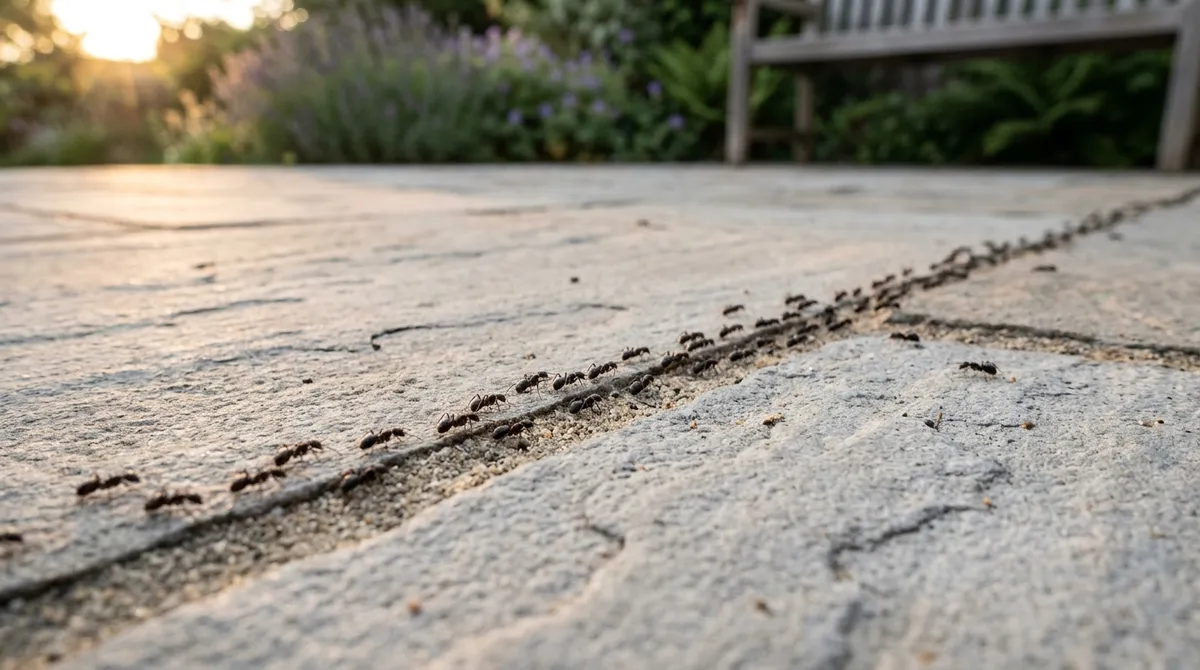
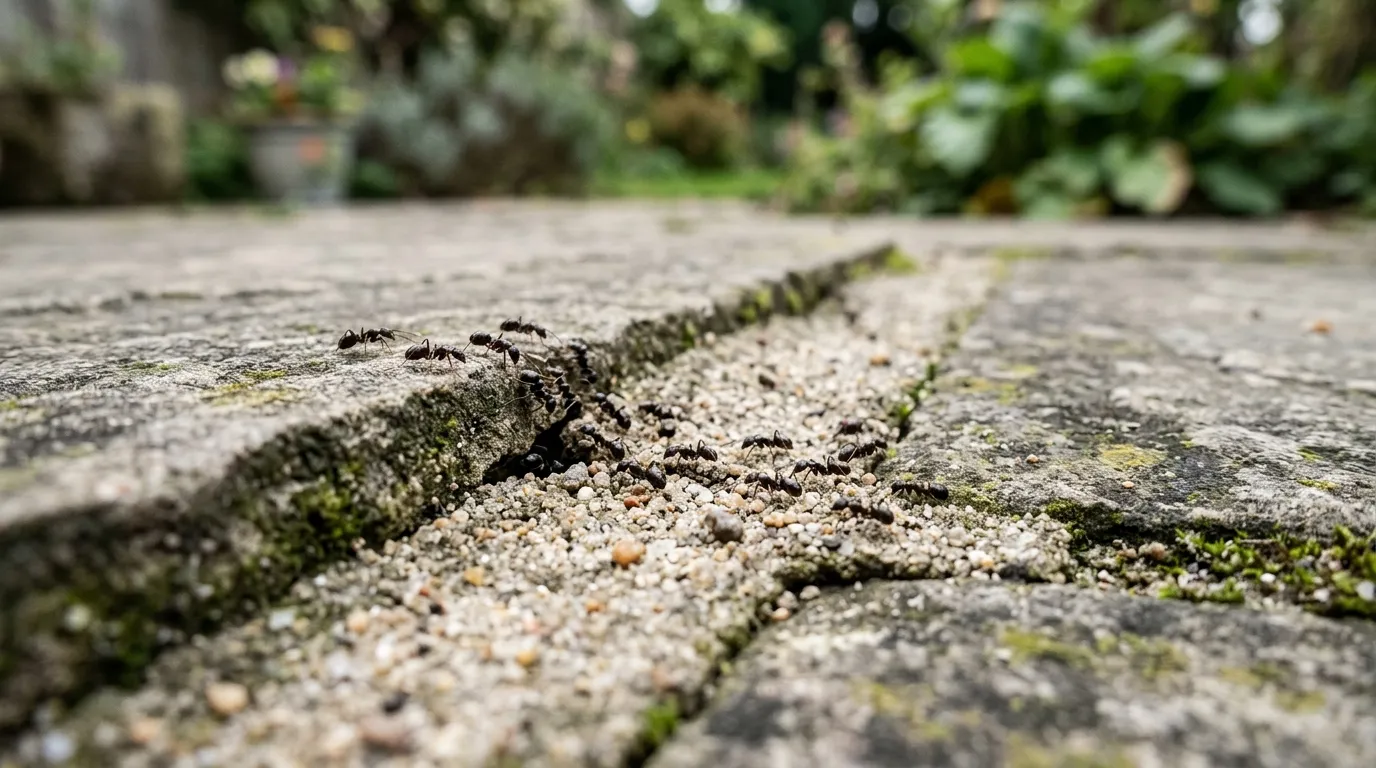 A typical Lasius niger entrance: a single dry crack in the sand joint behind which a colony of several thousand ants can build. Re-pointing this joint is the most effective single fix.
Step 1: Re-point every joint with kiln-dried sand
This is the single biggest fix and the one almost every homeowner skips. Kiln-dried sand is graded fine sand at under 1 percent moisture, sold in 25kg bags from builders’ merchants for around £6. It locks tight when brushed in dry and resists displacement.
Sweep the patio bone-dry. Empty the sand across the slabs and brush diagonally across each joint with a stiff yard broom until joints are level with the slab edge. Top up with a smaller dustpan brush, then sweep loose sand off the surface. Wait 48 hours before any rain or hosing.
For older patios with failed jointing compound, scrape the loose material out with a pointing iron before topping up. For tight ant problems on driveways, jointing polymer sand (£18 per 20kg) hardens after wetting and stops ants completely. It cannot move with frost so use it only on stable sub-bases. Our how to lay a patio UK guide covers full sub-base prep for new builds.
Step 2: Remove aphid host plants within 3m
Lasius niger is a farming species. Workers move aphids onto fresh shoots, defend them from ladybirds, and harvest honeydew. The richer the aphid colony, the larger the ant colony grows. Cut the aphid supply and the ant colony stalls.
Check pots, roses and salvias within 3 metres of the patio for green or black aphid colonies on new growth. Squash colonies with a thumb and forefinger, or wash off with a soft jet from a hosepipe. For larger infestations, see our guide to the black bean aphid identification and control.
Avoid blanket sprays. A neonicotinoid spray near pollinator plants is illegal for amateur use since 2018 in the UK. Soft soap solution (5g per litre of warm water) clears aphids in 48 hours and breaks down within a week. Repeat applications every 5 days through May and June stop new colonies establishing.
If you have lupins, lime trees overhanging the patio, or large stands of nettles within 3m, the honeydew supply will keep ants returning every year. Either move the planting back to 4m or accept that ants will need yearly suppression.
Step 3: Pour boiling water on visible nests
Boiling water is the fastest single treatment for an active Lasius niger nest. Pour 2 litres of freshly boiled water directly into the nest entrance. The temperature drops below the kill threshold (around 60C) within the top 100mm of soil but that depth is enough to scald the queen in most patio nests.
Pour slowly. Let the water run down into the tunnels rather than splashing across the slab. Keep a tight kettle stream rather than a wide pour. Repeat the next day if you still see workers using the entrance.
The legal position in 2026 is clear. The Wildlife and Countryside Act 1981 protects bumblebees and some solitary bee species but not Lasius niger. Boiling water on a known ant nest is lawful. Boiling water near a bee nest is not. If you are unsure whether the nest is bee or ant, watch for 10 minutes. Ants run in trails. Bumblebees fly singly from a single entrance and the workers are noticeably larger and fuzzier.
Never pour boiling water within 30cm of plant roots you want to keep. The heat cooks fine feeder roots and stalls growth for weeks. Lawns recover in 2 to 3 weeks. Hosta crowns die outright.
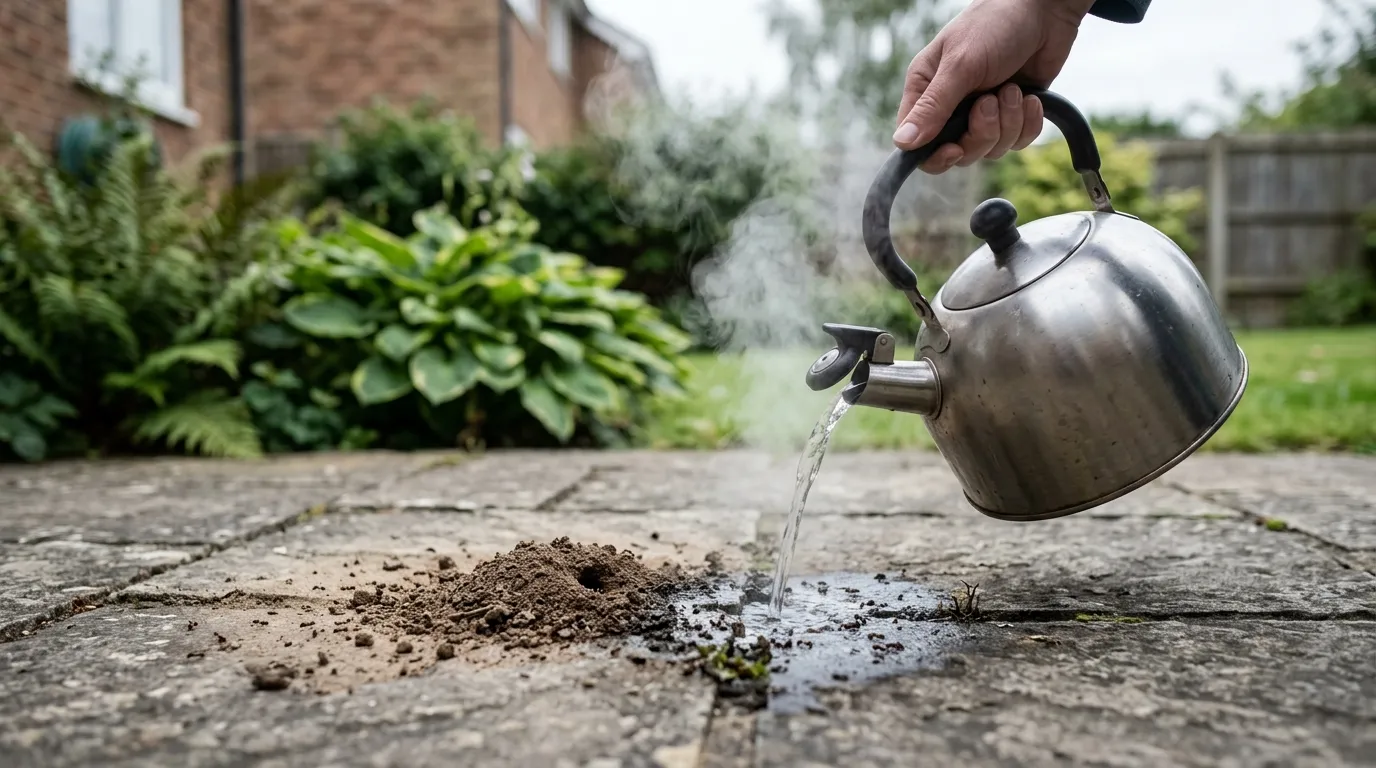 Pour slowly and let the water run down the tunnels. Two litres is enough to clear most surface nests in a single application.
Step 4: Dust diatomaceous earth in dry weather
Food-grade diatomaceous earth (DE) is fossilised algae crushed to a microscopic powder. It scratches the waxy cuticle on ants and they dehydrate within 48 hours. DE has no chemical action so resistance cannot build up. It is safe around pets and children at amateur dose rates.
Buy food-grade DE rather than swimming pool grade. Pool DE is calcined (heat-treated) and is dangerous to inhale. Food-grade powder costs around £15 for a 1kg pot from suppliers like Lakeland or the agricultural supplier Just Ingredients. A pot covers a 30 square metre patio twice.
DE is brilliant for maintenance dosing: a light dust along the patio perimeter every fortnight through summer keeps numbers down. It is poor as the sole control for a major nest. Combine with Step 3 (boiling water on the nest entrance) for fast knockdown plus ongoing suppression.
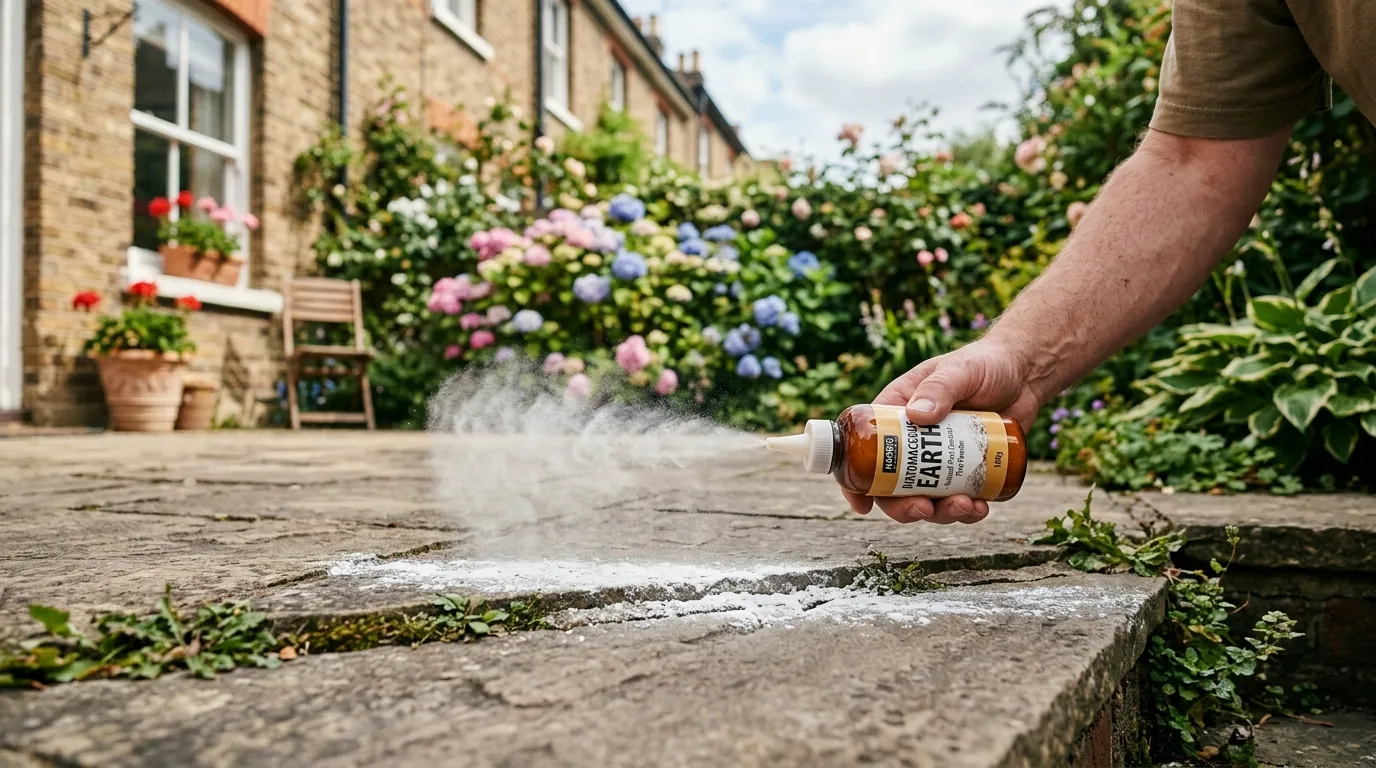 Food-grade diatomaceous earth applied as a thin perimeter dust. The powder must stay dry to keep working.
Step 5: Use boric acid bait stations as a last resort
If the colony survives Steps 1 to 4, switch to bait rather than another contact treatment. Boric acid stations work because foragers carry the bait back to the nest and feed it to the queen. The colony collapses from the inside over 14 to 21 days.
Choose a sealed plastic station (Nippon, Raid or BASF Maxforce). Open dishes of borax-sugar slurry are effective but dangerous around dogs (borax causes vomiting from 3g per kg of body weight) and toddlers. Sealed stations cost around £6 for two and exclude all non-target species.
Place one station per 2 metres of trail. Leave them undisturbed for at least 14 days. Foragers find the bait in 24 to 48 hours and trail traffic increases at first before falling away. Do not break the trail or move the station mid-treatment. The whole point is that workers carry the bait deep into the nest.
Avoid amateur sprays containing clothianidin, thiamethoxam or imidacloprid. These neonicotinoids are banned in the UK for outdoor amateur use since 2018 because of pollinator harm. Read product labels carefully. Several older boxed kits still appear on online marketplaces.
Step 6: Try Steinernema feltiae nematodes (limited effect)
Beneficial nematodes are the workhorse of organic pest control for vine weevil and sciarid fly. Their effect on Lasius niger is honest but modest. UK trials by Defenders Ltd and Dragonfli report colony reductions of 30 to 40 percent, not the 90 percent figures common for true target species.
The nematode species sold for ant control is Steinernema feltiae. Apply by watering can to damp soil at 15 to 25C between May and September. A 50 million pack treats around 20 square metres and costs around £22.
Use nematodes where boiling water is risky (near plant crowns, in mixed borders adjacent to the patio) and where chemical baits are not appropriate (organic kitchen gardens, near edible herbs). Combine with re-pointing and bait stations for the best outcome. Our biological pest control nematodes UK guide covers the full species list.
Step 7: Keep the perimeter swept, dry and aphid-free
The reason most patios are ant-free for a year then full again the next spring is maintenance drift. Joints lose sand, aphid colonies rebuild, organic matter accumulates between slabs and the cycle restarts.
A simple monthly routine through April to September keeps patios clear:
- First Saturday of each month: sweep patio, brush kiln-dried sand into any thin joints, check pots and adjacent borders for fresh aphid colonies.
- After heavy rain (over 15mm in 24 hours): check sand levels in joints and top up if more than 5mm below slab edge.
- Mid-July (flying ant day window): dust a thin perimeter line of food-grade diatomaceous earth to deter landing queens.
- End of August: lift any pots, sweep underneath, check for new nests building before autumn shutdown.
Five minutes a month prevents a £200 patio re-jointing job and avoids any need for chemical treatment in subsequent years.
What does not work and why
| Treatment | Result | Why it fails |
|---|---|---|
| Bleach on trails | Clears workers, colony survives | Queen and brood are 100mm underground; bleach also etches limestone and bleaches sandstone |
| Salt poured into joints | Brief deterrent | Salt damages adjacent plant roots, leaches into beds, no effect on queen |
| White vinegar spray | Repels for hours | Evaporates within a day, no nest effect, can damage limestone joints |
| Lemon juice or peel | Mild deterrent | Sugars in juice attract ants in the medium term |
| Coffee grounds | No effect | Folk remedy, fails every controlled UK trial since 2010 |
| Cinnamon powder | Mild deterrent | Washes away in one rain, ants reroute trail 100mm sideways |
| Amateur neonic sprays | Banned for amateur outdoor use since 2018 | Pollinator harm, also kills predators that suppress aphid colonies |
Patio ant treatment comparison
| Method | Time to clear | Cost for 30m² patio | Best use | Safety around pets and pollinators |
|---|---|---|---|---|
| Kiln-dried sand re-point | 14 days for 70% drop | £6 + 1 hour | First step on every patio | Excellent |
| Boiling water on nest | 24 hours | Free | Visible nest entrance | Good, keep 30cm from plants |
| Food-grade DE | 48 hours per dose | £15 per kg | Maintenance dusting in dry weather | Excellent, do not inhale |
| Sealed boric acid bait | 14 to 21 days | £6 for two stations | Stubborn colonies after Steps 1-3 | Good if sealed; never use loose borax dishes |
| Steinernema feltiae nematodes | 4 to 6 weeks | £22 per pack | Soft borders next to patio | Excellent |
| Polymer jointing sand | Permanent in joints | £18 per 20kg | New patios and driveways | Excellent, single application |
| Neonic amateur spray | n/a | n/a | Do not use, banned for amateur outdoor use 2018 | Banned for pollinator harm |
Month-by-month UK patio ant calendar
| Month | Task |
|---|---|
| March | Sweep patio bone-dry. Top up any joints losing sand from winter. |
| April | First aphid checks on roses, salvias and lupins within 3m. Soft soap if needed. |
| May | Apply Steinernema feltiae nematodes if soil at 15C plus. Re-point any open joints. |
| June | Dust diatomaceous earth along perimeter every fortnight in dry spells. |
| July | Flying ant day window. Pour boiling water on visible new nests within 24 hours. |
| August | Peak colony size. Set sealed boric acid bait stations if numbers still high. |
| September | Continue DE dusting. Aphid second flush, soft soap again. |
| October | Sweep patio, lift pots, top up sand. Final perimeter dust. |
| November | Clear leaf litter from joints (ants overwinter under leaf piles). |
| December | Patio rest. No action required. |
| January | Stock kiln-dried sand for spring. Check forecasts for early flying ant day signs. |
| February | Dry-weather window: re-point any joints that failed over winter. |
Common mistakes
- Treating the symptoms before fixing the joints. Boiling water on Monday and re-pointing in August means the colony just moves 30cm sideways. Always re-point first.
- Pouring bleach instead of boiling water. Bleach kills surface workers, etches limestone joints, bleaches sandstone, and leaves the queen alive 100mm below.
- Using open borax dishes around dogs and children. Borax (sodium tetraborate) causes vomiting in dogs from around 3g per kg of body weight. Use sealed stations only.
- Applying DE in damp conditions. Wet diatomaceous earth has no effect. The patio must be bone-dry and stay dry for at least 24 hours after application.
- Spraying any patio plant in flower. Killing pollinators on lavender or salvia removes the predators that suppress the aphid colonies feeding the ants. The ant problem worsens within a fortnight.
Gardener’s tip: Watch the patio at dawn between 1 July and 25 July for the flying ant emergence. Queens spend 10 to 20 minutes on the slabs before flying. A thin line of food-grade DE around the patio perimeter at this point stops most new colonies establishing.
Warning: Several boxed ant killers sold in 2024 on online marketplaces still contain clothianidin or thiamethoxam. These neonicotinoids are banned for amateur outdoor use in the UK since 2018. Check the active ingredient on the label before buying. Refuse any product where the label is missing or unreadable.
Three pitfalls to plan around
- Acting too late. A single nest in May becomes 8,000 ants by August. Watch for the first trails in late April and re-point straight away.
- Mixing chemical bait with boiling water. Boiling water kills the bait carriers before they reach the queen. Choose one method per nest, not both.
- Ignoring the next-door garden. A neighbour’s untreated patio reseeds yours every July. Where possible, share the work or at least give them a bag of kiln-dried sand.
Bringing it all together
Most UK patios clear within 14 days using Steps 1 to 3 alone: re-point joints, remove aphid hosts, boiling water on visible nests. If the colony survives, Step 5 (sealed boric acid bait) is the cleanest follow-up. Skip the bleach, skip the salt, skip the supermarket spray cans.
Now you have the seven steps for patio ants, read our guide on how to clean a patio UK for the seasonal maintenance routine that keeps slabs ant-free for years.
Frequently asked questions
What is the fastest way to stop ants on a patio?
Pour 2 litres of boiling water directly into the nest entrance. This clears most visible Lasius niger colonies within 24 hours. Follow up the next day with kiln-dried sand brushed into the surrounding joints to stop reinvasion. Reapply after any rain washes the sand out.
Is it legal to pour boiling water on garden ants?
Yes, boiling water on a Lasius niger nest is legal in UK gardens. The Wildlife and Countryside Act 1981 protects bumblebees and some solitary bee species but not common garden ants. Pour carefully, avoid roots of adjacent plants, and never use boiling water near bee nests or hibernating wildlife.
Will bleach kill ants on a patio?
No, bleach does not clear an ant colony. It kills surface workers but the queen and larvae underground survive. Bleach also bleaches Indian sandstone, etches limestone, and can damage adjacent plant roots. Use boiling water on the nest entrance instead.
What is the best ant powder for a UK patio?
Food-grade diatomaceous earth is the safest patio ant powder. It cuts the waxy cuticle on ants and they die of dehydration within 48 hours. It must stay bone-dry to work. Reapply after rain. Avoid scented amateur ant powders containing pyrethroids near pollinator-friendly plants.
Do nematodes work on patio ants?
Steinernema feltiae nematodes have limited effect on Lasius niger. They reduce colony numbers by around 30 to 40 percent in trials, not the 90 percent typical for vine weevil or sciarid fly. Use nematodes as a supplementary step alongside re-pointing and boiling water, not as the main fix.
Why do ants keep coming back to my patio every summer?
Patio slabs stay warm, joints stay dry and aphids on nearby plants supply honeydew. Until those three conditions change, new colonies arrive each spring. Re-point the joints, remove or treat aphid hosts within 3m of the patio, and keep paving swept and dry. Most patios stay ant-free for two to three years afterwards.
Are home-made ant poison baits safe?
Borax and sugar home-baits are effective on Lasius niger but unsafe around pets and children. Borax causes vomiting in dogs and kidney damage at higher doses. Use a sealed bait station rather than open dishes. Commercial boric acid stations cost around £6 and protect non-target species.
Our team produces practical UK gardening guidance from source research, contributor records and established horticultural practice. Editorial standards are overseen by Matt W.